
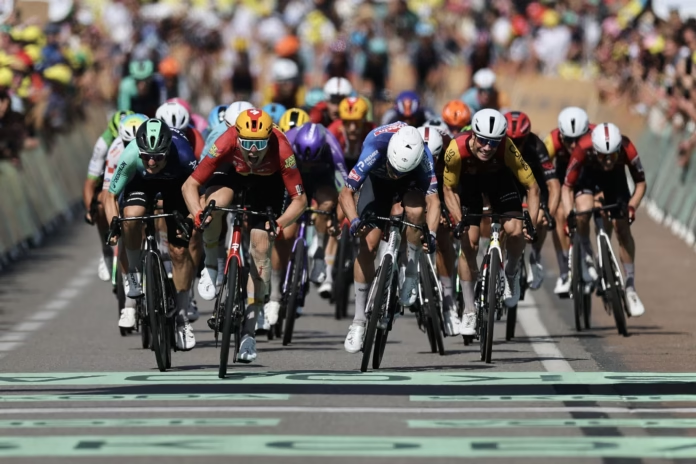
Jasper Philipsen crossed the line third on stage 11 of the 2026 Tour de France, briefly appeared to have been relegated to 119th place and was then restored to the podium after the race jury reversed its decision.
The changing result created understandable confusion.
Philipsen had not been disqualified from the Tour. He was initially given a sprint relegation after commissaires reviewed contact and movement during the frenetic finish in Nevers.
Alpecin-Premier Tech then approached the jury, further footage was examined and the original punishment was withdrawn. Philipsen therefore kept third place behind Søren Wærenskjold and Olav Kooij in the final official classification.
The complete finish and confirmed result are covered in our Tour de France 2026 stage 11 report.
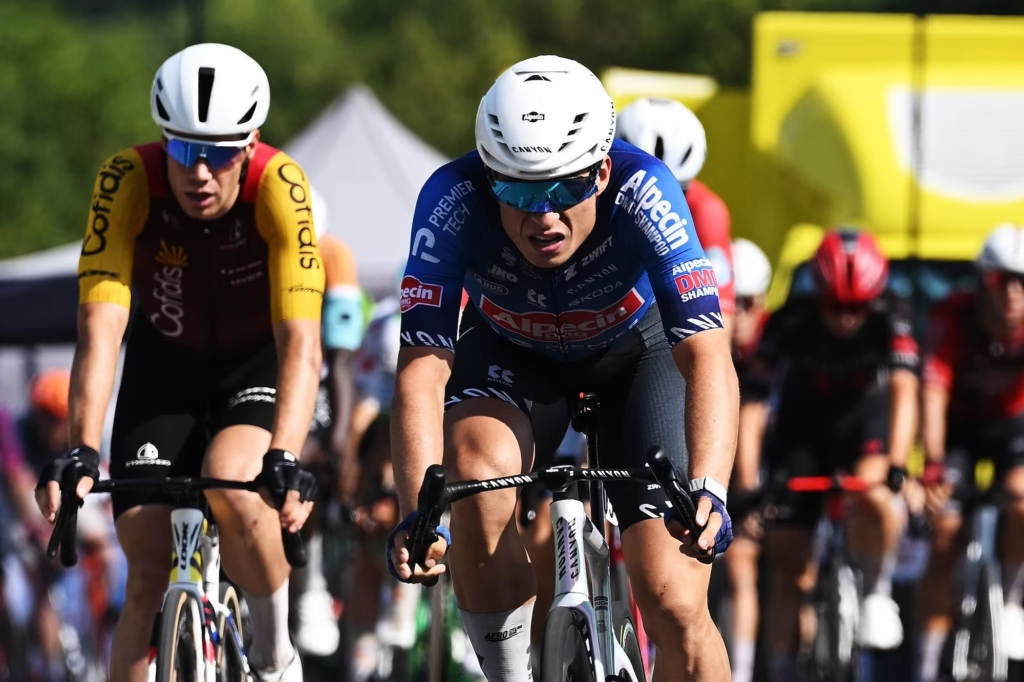
Quick answer: why was Jasper Philipsen relegated?
Philipsen was initially relegated because the commissaires believed his actions during the stage 11 sprint may have constituted an irregular or dangerous sprint.
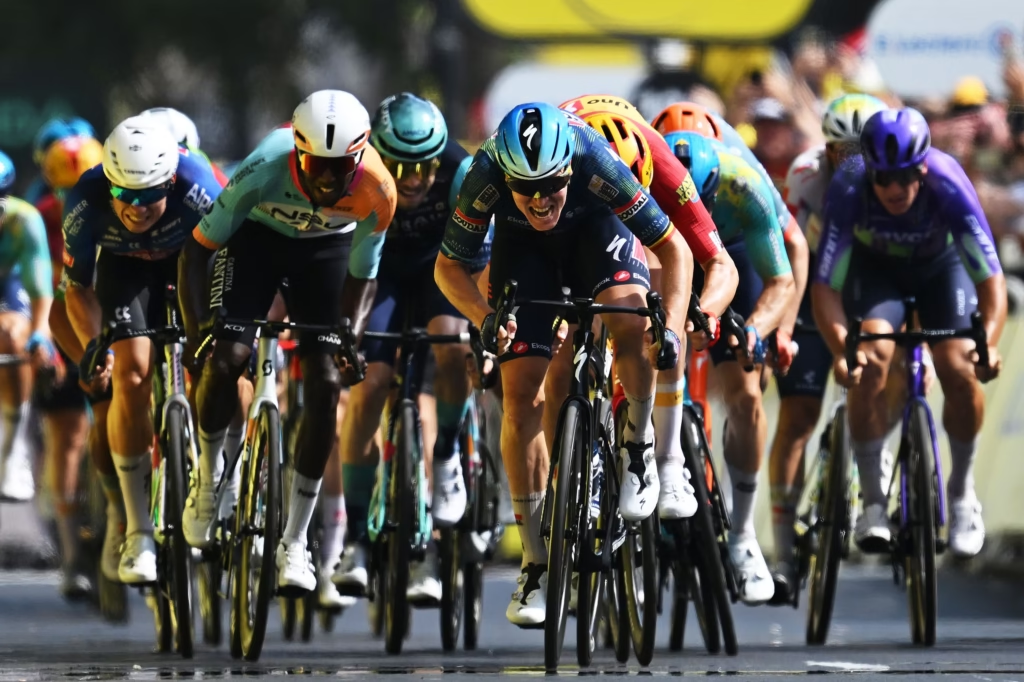
The finish included several riders converging at high speed, contact involving Philipsen and late changes of direction as the sprinters attempted to react to Wærenskjold’s early acceleration.
Officials initially decided that the incident justified moving Philipsen to the back of the group in which he finished.
That placed him 119th in the revised provisional classification rather than third.
The jury later reviewed the incident again and overturned the penalty. Philipsen was reinstated to third in the final result.
What happened in the stage 11 sprint?
The final kilometre in Nevers did not develop like a conventional organised bunch sprint.
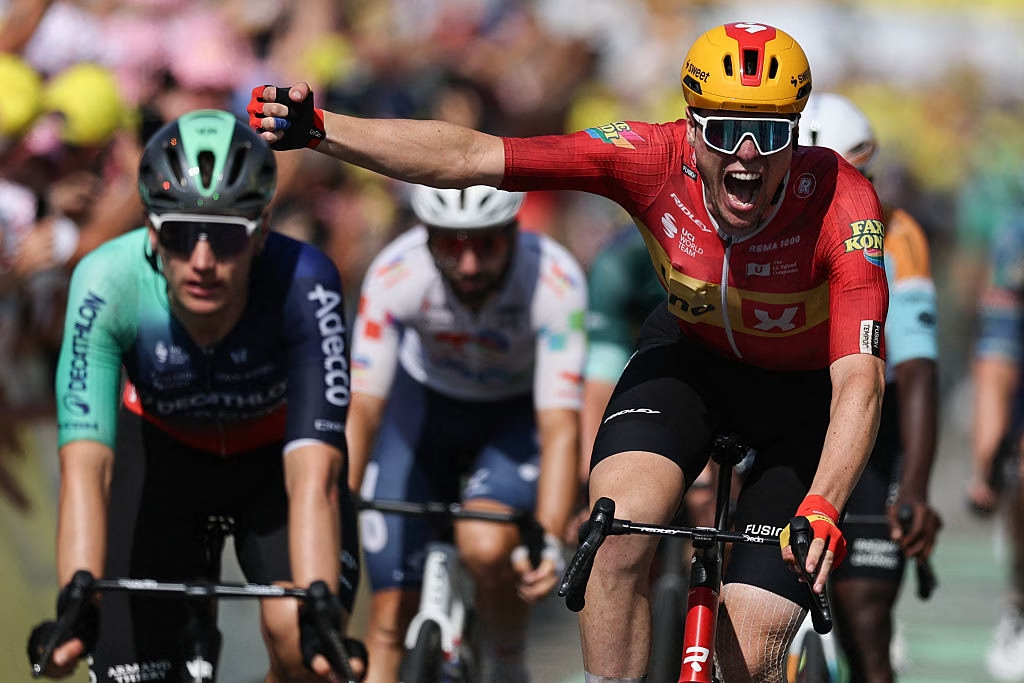
Cees Bol opened a small advantage when the pace briefly stalled at the front. Wærenskjold recognised the opportunity and began his sprint from around 350 metres out.
Behind him, Kooij, Philipsen, Biniam Girmay, Milan Fretin and several other fast riders attempted to accelerate through limited space.
Philipsen was involved in contact as the riders moved across the road and fought for position. He still crossed the line third, narrowly behind Kooij.
The immediate finishing order was:
- Søren Wærenskjold
- Olav Kooij
- Jasper Philipsen
- Milan Fretin
Commissaires then reviewed the finish and initially removed Philipsen from the podium. Fretin was briefly promoted to third before the decision changed again.
The final official result returned Philipsen to his original position.
The unusual shape of the sprint came at the end of a record-breaking afternoon, with our explainer on why Tour de France stage 11 was so fast showing how the tailwind, controlled breakaway and sprint-team chase kept the speed above 50km/h.
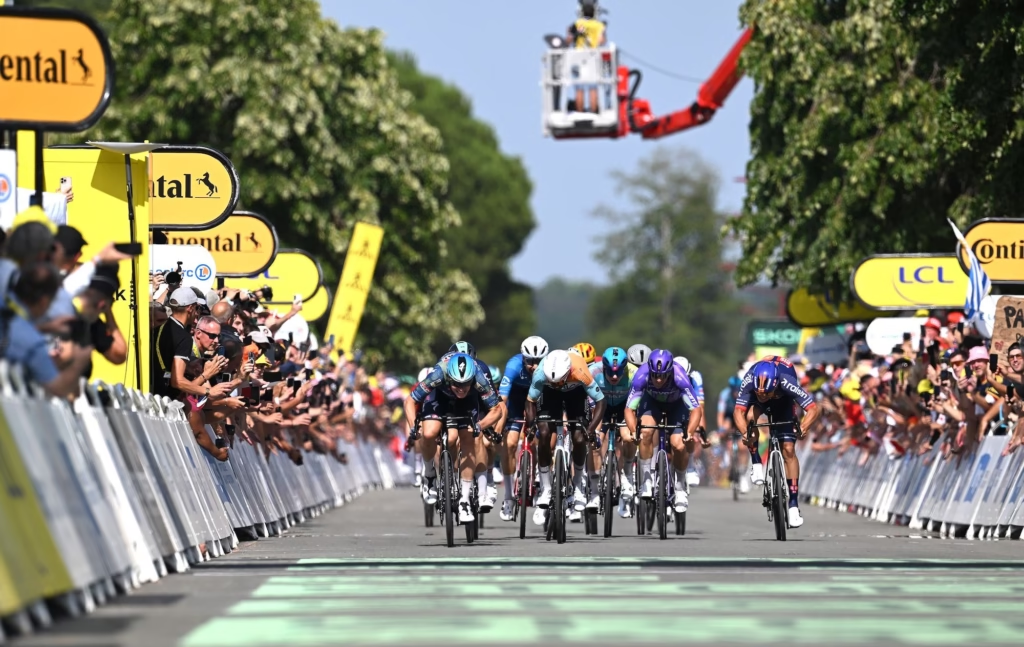 Photo Credit: Getty
Why was Philipsen reinstated?
Philipsen was reinstated after Alpecin-Premier Tech questioned the initial decision and the commissaires conducted another review.
Reports from the finish suggested that even Philipsen’s team was initially uncertain about which precise movement had prompted the punishment.
The jury then considered further footage and reversed the relegation.
That does not necessarily mean there was no contact or deviation during the sprint. Contact is common when riders are travelling at more than 60km/h and several sprint lines converge.
The important question is whether Philipsen caused an obstruction or danger through an illegal movement.
After the additional review, the commissaires no longer believed the available evidence justified the punishment.
The final decision therefore restored his third place and the points, prize money and classification benefits attached to it.
Was Jasper Philipsen disqualified?
No.
Philipsen was not disqualified from stage 11 and was never expelled from the Tour de France.
He was initially relegated within the stage result.
A relegation and a disqualification are not the same punishment.
The confusion often arises because both decisions can cause a rider to disappear from the position in which they crossed the line. The consequences are very different.
Our guide to Tour de France penalties and yellow cards explains the wider system of fines, relegations, warnings and race expulsions.
What is a sprint relegation?
A sprint relegation moves a rider to the back of the group in which they finished.
Philipsen crossed the line with the main peloton, so the initial decision placed him 119th rather than third.
He would still have completed the stage and remained in the Tour.
A relegated rider can normally start the next stage, although additional penalties such as a fine, yellow card or loss of classification points may also be imposed depending on the offence.
The main sporting consequences include losing:
- The original finishing position
- Stage prize money
- UCI ranking points
- Points towards the green jersey
- Possible time bonuses
Because Philipsen’s relegation was reversed, those consequences did not remain in the final result.
What is a disqualification?
A disqualification is a more serious decision.
Depending on the offence, a rider may be removed from the stage result or expelled from the race completely.
A rider disqualified from the Tour cannot simply start again the following morning.
Disqualifications are normally reserved for more serious breaches, repeated dangerous conduct or behaviour carrying a specific expulsion penalty under the regulations.
Philipsen’s incident never reached that level.
Early searches asking why he had been “disqualified” were therefore based on a misunderstanding of the original provisional decision.
Relegation compared with disqualification
| Decision | What happens to the stage result? | Can the rider continue in the Tour? |
|---|---|---|
| Relegation | Rider is moved to the back of the finishing group | Usually yes |
| Disqualification from stage | Rider is removed from the stage classification | Depends on the full penalty |
| Expulsion from race | Rider is removed from the event | No |
| Fine | Result may remain unchanged | Yes |
| Yellow card | Warning recorded under the UCI system | Yes, unless further sanctions apply |
Philipsen briefly received the first punishment before it was withdrawn.
What do commissaires look for in a sprint deviation?
UCI rules state that riders must not deviate from their chosen sprint line if doing so obstructs or endangers another rider.
This does not mean every sprinter must ride along a perfectly straight imaginary line.
Sprint finishes are fluid. Riders need to move around slowing competitors, react to gaps and avoid crashes.
Commissaires look at whether the movement crossed the line between normal sprint positioning and an irregular sprint.
They consider questions such as:
- Had the rider already launched their sprint?
- Did the rider change direction?
- Was another rider forced to brake or alter course?
- Did the movement close a gap against the barriers?
- Was there dangerous use of an elbow, shoulder, hand, head or knee?
- Was the contact avoidable?
- Did the rider gain an advantage?
- Did the action create a risk of a crash?
- Was the movement deliberate, reckless or a reaction to another rider?
- What do the overhead and head-on camera angles show?
The sprint is the final visible part of a much longer tactical process. Our beginner’s guide to the Tour de France explains how sprint teams control breakaways, organise lead-outs and position their fast riders before the final acceleration.
Does a rider have to cause a crash to be relegated?
No.
A rider can be punished even if everyone remains upright.
The purpose of the sprint rules is to prevent dangerous movements rather than wait for them to cause an accident.
If a sprinter closes another rider against the barriers or forces a rival to brake sharply, the jury can intervene without a crash taking place.
Intent is also not essential.
A movement can be judged dangerous even when the rider did not deliberately attempt to obstruct anyone.
The commissaires must assess the action and its consequences rather than trying to prove what the rider was thinking.
Why do different camera angles matter?
Sprint decisions can look completely different depending on the angle.
A head-on camera may make two riders appear to move sharply across the road when the road itself is bending.
An overhead view can show whether a rider moved away from their original line, but it may not clearly reveal the amount of physical contact.
A side-on camera can show an elbow or shoulder movement while providing little context about what happened immediately beforehand.
Commissaires can use several sources, including:
- Television footage
- Overhead helicopter images
- Photo-finish cameras
- Fixed cameras near the finish
- Reports from officials
- Information supplied by teams
- Available on-bike or roadside footage
Philipsen’s reinstatement demonstrates why an initial decision does not always remain final.
One angle may appear to show an offence. Another may reveal that the rider was reacting to someone else, avoiding a slowing competitor or had less space than first appeared.
Why was the result allowed to change twice?
Results displayed immediately after a stage are provisional.
The first finishing order is based on the riders crossing the line. The jury then needs time to examine crashes, possible deviations and photo finishes.
That means a stage result can follow several steps:
- The riders cross the line.
- A provisional result is published.
- Commissaires review an incident.
- A revised result applies a penalty.
- A team provides further information or asks for clarification.
- The jury reviews the evidence again.
- The official result is confirmed.
That is what happened in Nevers.
Philipsen was third in the initial result, 119th in the first revised classification and third again once the jury completed its second review.
It looked chaotic from the outside, but the ability to correct a decision is an important part of the process.
A quick but incorrect ruling would be worse than a confusing sequence that eventually produces the result the commissaires consider fair.
Did Philipsen lose green jersey points?
No, not in the final classification.
Had the relegation remained in place, Philipsen would have lost almost all the points earned for finishing third.
That would have damaged his attempt to close the gap to green jersey leader Mads Pedersen.
Once the commissaires restored Philipsen to third, he received the points attached to that position.
He therefore remained ahead of Tim Merlier in the points classification after stage 11, although still well behind Pedersen.
The updated standings are included in our GC and jerseys report after Tour de France stage 11.
Pedersen’s wider advantage comes from his ability to score on harder terrain as well as sprint stages, as explored in our analysis of whether Mads Pedersen can win the Tour de France green jersey.
Why did some reports say Philipsen finished 119th?
Those reports reflected the provisional revised result available at the time.
After the first jury decision, Philipsen was placed at the back of the main finishing group. That produced the 119th-place classification reported by several outlets.
The decision was later changed.
This does not mean the initial reports invented the relegation. They accurately described a result that had been published but had not yet become final.
The most accurate complete description is:
Philipsen crossed the line third, was initially relegated to 119th and was later reinstated to third after the commissaires reversed their decision.

Has Philipsen been relegated before?
Philipsen’s sprinting has attracted commissaires’ attention in previous Tours.
He was relegated from second place on stage 6 of the 2024 Tour de France after officials judged that he had impeded Wout van Aert during the sprint.
That earlier history may influence public discussion around him, but each incident must be judged on its own evidence.
A rider’s reputation does not prove that a new movement was illegal.
The stage 11 jury ultimately decided that Philipsen should retain third place.
His performances before Nevers had already raised questions about his lead-out and timing rather than his basic speed. Our analysis of what is going wrong for Jasper Philipsen at the Tour de France looks at why he has remained close to the front without converting those positions into a victory.



What did the reinstatement mean for Philipsen’s Tour?
Third place was Philipsen’s best sprint result of the 2026 Tour to that point.
He had entered the race as one of the principal sprint and green jersey favourites, but Olav Kooij, Tim Merlier and Wærenskjold had all won stages before him.
The podium in Nevers did not solve every problem.
It did show that Philipsen remained capable of reaching the decisive position in a fast and disorganised finish.
The confirmed result also kept him within the leading group of riders in the points classification before another likely bunch sprint on stage 12.
Philipsen’s strengths and expected opportunities were set out before the race in our guide to Jasper Philipsen’s Tour de France 2026 sprint chances and lead-out strength.
Why the Philipsen decision matters
The incident provides a useful example of how professional cycling results are confirmed.
Crossing the line does not guarantee that a rider will keep the position. Commissaires must consider whether the result was achieved within the rules.
At the same time, a jury decision is not beyond review.
New footage, a different angle or additional context can change the interpretation of a sprint.
Philipsen was initially punished because officials believed his actions may have obstructed or endangered another rider.
He was reinstated because the further review did not support leaving that punishment in place.
He was never disqualified from the Tour.
The final stage 11 podium remained:
- Søren Wærenskjold
- Olav Kooij
- Jasper Philipsen
The confusion came from the result changing twice.
The explanation is simpler: the first decision was provisional, the evidence was reviewed again and the jury reversed it.

