
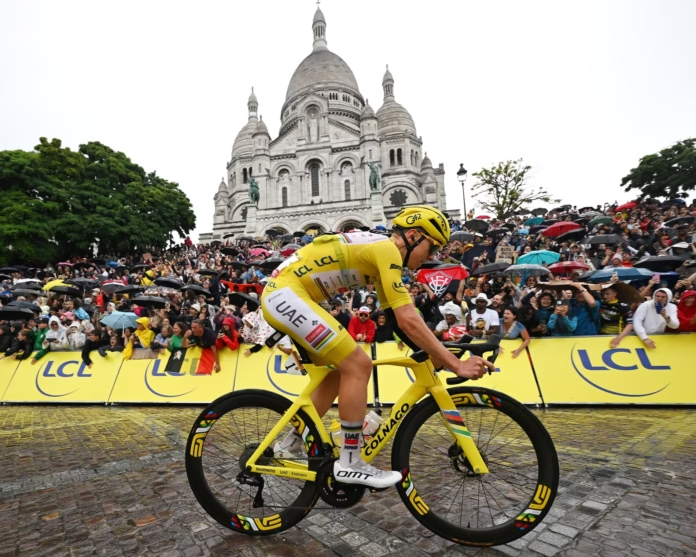
The final stage of the Tour de France is no longer just a ceremonial ride into Paris followed by a sprint on the Champs-Élysées.
Montmartre has changed that.
For the second successive year, the Tour will send the peloton up the Côte de la Butte Montmartre three times on Stage 21, taking the race through Rue Lepic before returning towards the Champs-Élysées.
The climb is short, roughly a kilometre at around 6%, but the numbers only tell part of the story. The road is narrow, the crowds are huge and the repeated accelerations create a type of racing completely different from the traditional Paris circuit.
In 2025, the experiment worked.
Wout van Aert ultimately won Stage 21 of the 2025 Tour de France after attacking on a wet Montmartre circuit, while Tadej Pogačar himself helped turn the final stage into a genuine race.
Now the Tour goes back.
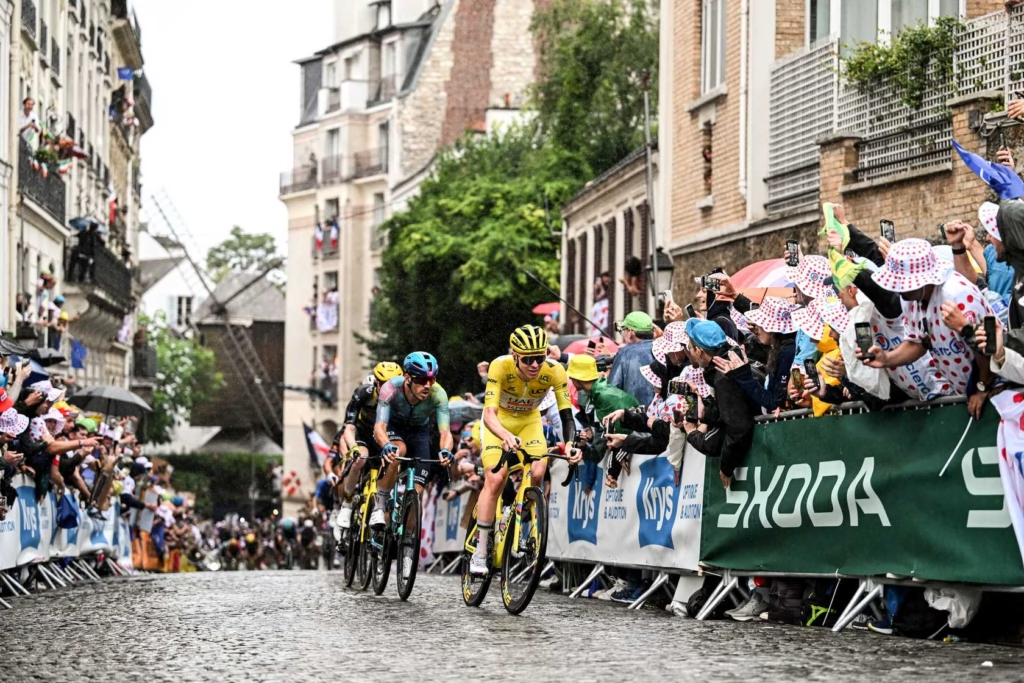 Photo Credit: A.S.O./Charly López
The Tour climbs Montmartre three times
Stage 21 runs for around 133km from Thoiry to the Champs-Élysées, bringing the Tour into Paris for the final time on Sunday 26 July.
The important part comes late.
Rather than remaining exclusively on the familiar Champs-Élysées circuit, the riders head north towards Montmartre and tackle the Côte de la Butte Montmartre three times.
That gives attackers three opportunities to disrupt the sprint teams before the race returns towards the traditional finish.
The concept is familiar from last year. The 2025 Stage 21 preview described Montmartre as the feature capable of turning the Paris finale away from its usual set-piece sprint.
The race proved exactly that.
Rue Lepic is much harder than it looks
A kilometre at around 6% is not a serious climb by Tour standards.
After two days on Alpe d’Huez and a Stage 20 containing the Croix de Fer, Télégraphe, Galibier and Sarenne, Rue Lepic barely registers as a mountain.
But this is not really about climbing ability.
It is about position and acceleration.
The road narrows considerably compared with the Champs-Élysées. Riders arrive at speed, the peloton stretches and anyone entering the climb too far back risks losing contact almost immediately when the attacks begin.
There are also steeper sections towards the upper part of Rue Lepic, where the gradient reaches around 7%.
A rider sitting 70 places back cannot simply produce the same power as the front group and expect to recover the position.
By the time the road opens again, the split may already have happened.
That makes Montmartre terrain for classics riders rather than pure climbers.
Montmartre changed the Tour finale in 2025
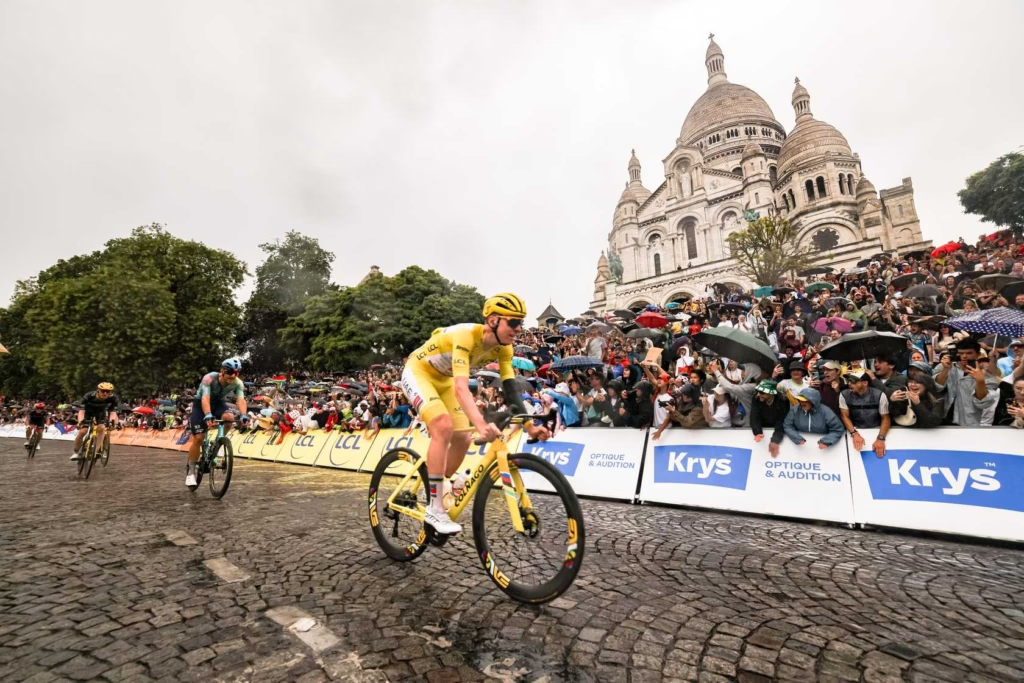
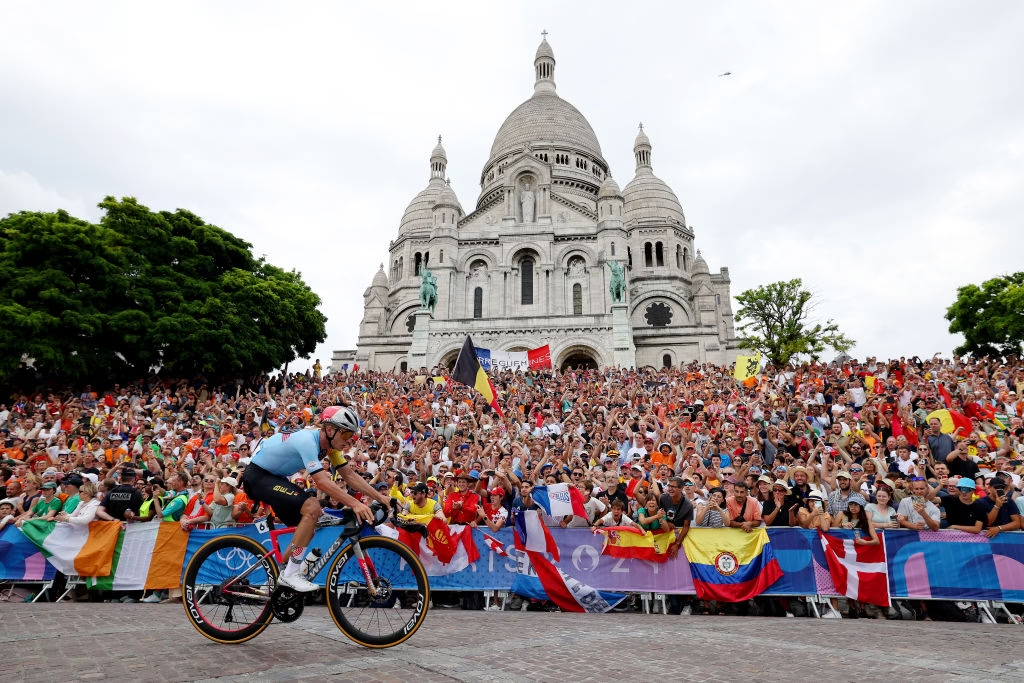
The Tour first introduced the Montmartre loop to its final stage in 2025, borrowing one of the defining features of the Paris 2024 Olympic road races.
The result was immediately different from the old Paris formula.
Traditionally, Stage 21 had three distinct parts.
The yellow jersey celebrations came first.
Then came the ceremonial ride into Paris.
Finally, racing began on the Champs-Élysées and the sprint teams controlled almost everything until the closing kilometres.
Montmartre broke that structure apart.
In 2025, Pogačar attacked, the race fragmented and Van Aert eventually rode away to win alone.
Instead of merely adding scenery to the final stage, the climb fundamentally changed what was tactically possible.
That is why its return in 2026 matters.
Why the final ascent can decide the stage
The last passage over Montmartre comes close enough to the finish for an attack to survive.
That is the key difference.
A rider does not need to create a minute.
A handful of seconds may be enough if the group behind fractures and the sprint teams cannot immediately organise a chase.
The descent and fast roads back towards central Paris can then favour a small group of strong riders working together.
That puts enormous pressure on the sprinters.
The 2026 sprint stages ranking already identified Paris as one of the more complicated sprint opportunities of the Tour precisely because Montmartre changes the final kilometres.
Winning on the Champs-Élysées remains one of cycling’s great prizes.
Getting there with the full peloton together is no longer guaranteed.
 Photo Credit: Getty
Pogačar could make Paris difficult again
Pogačar is one reason the new route becomes especially unpredictable.
Assuming the yellow jersey remains secure after Stage 20, he has almost nothing to protect tactically in Paris.
There is no mountain stage on Monday.
There is no reason to save energy.
If Pogačar reaches Montmartre and sees an opportunity, he can attack simply because he wants to win the stage.
That was part of what made the 2025 finale work.
The yellow jersey did not treat Paris as a procession.
He raced it.
For sprint teams, that creates an unpleasant problem.
Allow Pogačar five or ten seconds on a climb and bringing him back is not remotely straightforward, particularly after three weeks of racing when lead-out trains are depleted and domestiques are tired.
Montmartre opens the door for classics riders
The ideal Stage 21 rider now looks rather different from the archetypal Champs-Élysées sprinter.
Explosive climbing matters.
So does positioning.
The rider also needs enough power to maintain an advantage across fast roads after the climb.
Van Aert demonstrated the template perfectly in 2025.
A classics rider can survive or create the split on Rue Lepic and then turn that separation into a sustained attack before the sprinters reorganise.
That is why ProCyclingUK’s ranking of the best breakaway stages at the 2026 Tour includes Stage 21 despite its official flat classification.
It is unlikely to be won by the traditional early break.
The danger comes much later.
The sprinters still have a genuine chance
Montmartre does not automatically kill the sprint.
That is what makes the route so effective.
The climbs are short enough that a powerful sprinter can survive them, particularly if the attacks never become fully committed.
The road back to the Champs-Élysées also provides time for groups to reconnect.
A sprinter reaching the top only five or ten seconds behind can still return if several teams commit riders to the chase.
But the days when Paris could be treated as an almost guaranteed bunch finish have gone.
That was already obvious earlier in the final week, when Stage 17 represented the sprinters’ last conventional opportunity before Paris.
Sunday is still an opportunity.
It is simply no longer a predictable one.
Montmartre has already embraced the Tour
The sporting impact is only part of the appeal.
Montmartre has quickly become one of the most distinctive spectator locations on the Tour.
More than 180,000 people were reported to have lined the Montmartre section in 2025, building on the extraordinary crowds seen during the Paris Olympics a year earlier.
Rue Lepic became a tunnel of spectators.
Windows, balconies and pavements filled.
The images looked much closer to a Flemish Classic than the traditionally broad Paris boulevards associated with Stage 21.
Remarkably, after only one Tour appearance, the climb already felt like part of the event.
Now local residents and businesses are preparing to do it again.
Rue Lepic is preparing for another huge crowd
Barriers are already being prepared around Montmartre and the neighbourhood is expecting another enormous influx of spectators on Sunday.
Some businesses are preparing for one of their busiest days of the year.
Others will close entirely because of the crowds and restrictions.
For residents, reaction is understandably more mixed.
The spectacle brings tens of thousands of people into streets that are already under enormous tourism pressure. Access becomes difficult, roads are closed and large crowds inevitably create problems with rubbish and disruption.
But that tension is now part of the unusual identity the Tour has created around Rue Lepic.
For a few hours, Montmartre becomes both a race circuit and a street festival.
That atmosphere was one of the reasons the 2025 experiment felt so successful.
Paris road closures will begin well before the peloton arrives
Anyone planning to watch Stage 21 in person needs to arrive early.
Restrictions across Paris begin well before the riders reach the capital, with Montmartre itself becoming heavily restricted during Sunday.
Rue Lepic, Caulaincourt, Lamarck, Norvins and the surrounding roads form part of a large controlled area around the race.
The sheer number of spectators seen in 2025 also makes late arrival risky.
Finding a position on Rue Lepic once the crowds have built will be extremely difficult.
For viewers staying at home, the Tour de France 2026 TV schedule and daily start times has Stage 21 expected to finish at around 18:30 BST.
UK viewers can also find the full broadcast options in our guide to watching the 2026 Tour de France in the UK.

Montmartre remains part of the official route
The Montmartre circuit remains part of the planned Stage 21 route.
Preparations and traffic restrictions in Paris are being organised around the peloton making all three passages through the district.
As with any major sporting event, operational circumstances can force late alterations.
Until an official announcement says otherwise, however, the 2026 finale should be treated as the Montmartre route that has been published and prepared for.
For cycling fans, that means the final day has become much more interesting than the word “flat” on the stage profile suggests.
Montmartre has made Stage 21 worth racing again
The old Paris finale had enormous prestige.
What it increasingly lacked was uncertainty.
Montmartre has restored that.
The riders still finish on the Champs-Élysées. The yellow jersey still gets the photographs and celebrations on the road towards Paris. Winning the final sprint remains one of the great ambitions for any fast rider who survives three weeks of the Tour.
But once the peloton reaches Rue Lepic, the ceremonial part is finished.
Three climbs, narrow roads, huge crowds and repeated opportunities to attack give a much broader group of riders a chance.
It also fits the wider shape of the Tour de France 2026 route, which saves meaningful racing all the way through the final weekend rather than effectively ending the competition before Paris.
Last year proved that Montmartre can transform Stage 21.
Tomorrow, it gets to do it again.

