
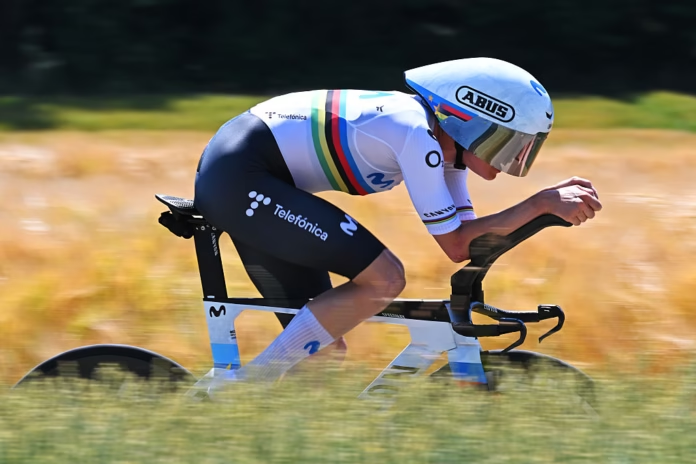
Marlen Reusser won stage 4 of the 2026 Tour de France Femmes, producing the fastest time over the 21-kilometre individual time trial from Gevrey-Chambertin to Dijon and moving into the yellow jersey.
The world time trial champion completed the course in 27:30, averaging 45.82km/h. Lieke Nooijen delivered the surprise ride of the afternoon to finish second, just 4 seconds behind, while Demi Vollering took third at 18 seconds after an exceptionally fast descent into Dijon.
Zoe Bäckstedt finished fourth at 20 seconds, having matched Nooijen at the intermediate checkpoint before losing time on the downhill section. Cédrine Kerbaol was among the strongest GC riders at 54 seconds, while Elisa Longo Borghini limited her loss to 1:03.
Reusser now leads Vollering by 14 seconds in the general classification. Kerbaol moves to third at 54 seconds, ahead of Longo Borghini at 1:03 and Kasia Niewiadoma-Phinney at 1:09. Overnight leader Sigrid Ytterhus Haugset lost yellow after paying for the effort of her record-breaking 88.5-kilometre solo victory in Poligny.
A time trial designed around two very different efforts
The only individual time trial of the 2026 Tour de France Femmes covered 21 kilometres through the Côte-d’Or vineyards, beginning in Gevrey-Chambertin and finishing on the Avenue du Général-de-Gaulle in Dijon.
The opening 7 kilometres were largely flat, rewarding sustained aerodynamic power before the riders reached the Lacets de Marsannay. The climb measured 1.8 kilometres at an average gradient of 6.9 per cent, followed by another kilometre of rising road towards Corcelles-les-Monts.
From there, the character of the stage changed completely. The final 9 kilometres descended quickly towards Dijon, with strong tailwinds and cross-tailwinds helping riders reach extreme speeds on their time trial bikes.
That created a difficult pacing problem. Riders needed enough power to limit losses on the opening section and climb, but they also had to judge the fast descent carefully. The stage was not decided by climbing or aerodynamics alone. Bike handling, confidence and the ability to carry speed through the corners became just as important.
Early benchmarks fall quickly
Romina Hinojosa was the first rider down the start ramp and established the opening time of 31:24. Noémie Abgrall soon improved that to 30:33 before French time trial champion Célia Le Mouël became the first rider to set a meaningful benchmark, finishing in 28:50.
Sandrine Tas then edged ahead by less than a second. The former speed skater reached Dijon in 28:49.39 after recovering from a 10-second deficit at the intermediate checkpoint, showing how much time could be gained on the descent.
Lotte Claes lowered the leading time to 28:25, with Millie Couzens finishing 13 seconds slower. The increasingly rapid improvements demonstrated how fast the later starters would need to ride merely to challenge the podium.
The first truly significant time came from Nooijen.
Nooijen produces the ride of her career
Nooijen reached the intermediate checkpoint in 15:30 and then attacked the descent with exceptional commitment. The Team Visma | Lease a Bike rider completed the course in 27:34, averaging 45.70km/h and improving Claes’ time by 51 seconds.
Her descending speed was remarkable. Nooijen averaged 56.2km/h over the final section and carried enough momentum to turn what was already a strong climbing performance into a genuine stage-winning time.
That result changed the expectations for the rest of the afternoon. Nooijen had not merely taken the provisional lead. She had set a target capable of surviving against several of the established favourites.
She remained in the hot seat through the rides of Kristen Faulkner, Mischa Bredewold and other recognised specialists. Even Bäckstedt, who had won seven of her previous eight individual time trials, could not dislodge her.
Bäckstedt matches Nooijen before losing time downhill
Bäckstedt had started as one of the main challengers to Reusser. The British champion recently won the Baloise Ladies Tour time trial and overall classification, while also defending her national title.
She was immediately on pace, catching both her one-minute and two-minute riders during the opening half of the course. At the intermediate checkpoint, Bäckstedt was only 0.29 seconds slower than Nooijen.
The stage remained finely balanced. Bäckstedt had produced the climbing performance required to fight for victory, but the descent proved decisive. She completed the course in 27:50, losing 16 seconds to Nooijen over the final section.
That left her fourth once the main favourites had finished, 20 seconds behind Reusser. It was still an excellent Tour debut time trial, but also evidence that the descent into Dijon rewarded riders prepared to take considerable speed through the technical sections.
Reusser takes command on the climb
Reusser began her ride as the overwhelming favourite. The Swiss rider arrived wearing the rainbow jersey after winning the world time trial title in Kigali and had never finished outside the top 10 in a completed professional individual time trial.
Her position on the bike immediately set her apart. Reusser remained compact and aerodynamic while still producing the power required on the Lacets de Marsannay. At the 9.7-kilometre time check, she stopped the clock in 15:10.
That was 20 seconds faster than Nooijen and 58 seconds ahead of Anna van der Breggen. By that point, the question was no longer whether Reusser would challenge the fastest time. It was whether she could preserve enough of the advantage on a descent where Nooijen had been outstanding.
Reusser covered the opening flat kilometres and the climb at an average speed of 38.4km/h. Her superiority in that section provided the foundation for both the stage victory and yellow jersey.
Nooijen brings Reusser’s lead down to four seconds
Reusser was not as dominant on the descent. She covered the second section at an average of 50.1km/h, significantly slower than Nooijen’s 56.2km/h.
The world champion surrendered 16 of the 20 seconds she had gained by the intermediate checkpoint, but had done just enough. Reusser crossed the line in 27:30, beating Nooijen by only 4 seconds.
The narrow margin gave a more accurate picture of the ride than the intermediate split alone. Reusser was comfortably the strongest through the opening section and climb, but Nooijen turned the final half into a serious contest through her descending speed.
For Reusser, the result was still exactly what she needed. She had won the stage, put significant time into almost every general classification rival and moved into the virtual yellow jersey before the final starters had finished.
Vollering descends back into contention
Vollering produced the best ride among Reusser’s established GC rivals. She reached the intermediate checkpoint in 15:33, 23 seconds behind the Swiss rider, but attacked the descent with enough speed to regain time.
The FDJ United-Suez leader did not remain on the aero extensions through every corner, choosing a slightly safer position where necessary before sprinting hard out of the turns. On the flatter roads towards Dijon, her speed regularly approached 60km/h.
Vollering finished in 27:48, only 18 seconds behind Reusser. She collapsed beyond the line after giving everything through the final kilometres.
The ride moved Vollering to second overall, only 14 seconds behind Reusser. That gap is small enough to keep the yellow jersey battle completely open, particularly with Ventoux and the decisive Alpine stages still ahead.
More importantly, Vollering avoided the kind of time loss that would have forced her to attack from distance later in the race. She is behind, but firmly within striking distance.
Kerbaol emerges as a serious GC presence
Kerbaol was one of the strongest performers outside the obvious time trial favourites. The EF Education-Oatly rider completed the stage in 28:24, losing 54 seconds to Reusser.
That result moved her into third overall at the same margin, giving France another rider near the top of the classification alongside Vollering and Pauline Ferrand-Prévot.
Kerbaol’s place is not a product of a breakaway advantage or bonus seconds. She earned it through one of the strongest sustained performances among the GC contenders. The question now is whether she can defend that position when the race reaches Ventoux and the longer Alpine climbs.
Her climbing record suggests the podium will be difficult to hold, but she has given herself a genuine platform. Riders such as Longo Borghini and Niewiadoma-Phinney now have time to recover if they want to move ahead of her.
Longo Borghini and Niewiadoma-Phinney limit the damage
Longo Borghini was only 21 seconds behind Reusser at the intermediate checkpoint and eventually finished 1:03 down. The second half was less favourable, but the Italian remained close enough to stay involved in the overall fight.
She moves to fourth overall at 1:03. That is not an ideal margin, especially against two riders as strong as Reusser and Vollering, but it keeps her within one decisive mountain attack of changing the race.
Niewiadoma-Phinney finished 1:09 behind Reusser and now occupies fifth overall at the same gap. The Canyon SRAM leader was 32 seconds down at the checkpoint and lost further time on the final section, but avoided the much larger losses suffered by several rivals.
Neither Longo Borghini nor Niewiadoma-Phinney won the day. Both, however, did enough to make the mountains meaningful. They now need to use the steeper terrain to reverse the advantage Reusser has created against the clock.
Blasi stays firmly in the white jersey battle
Paula Blasi delivered another composed ride for UAE Team L’IMAD. The Spanish rider reached the intermediate point 32 seconds behind Nooijen and finished in 28:34, 1:04 slower than Reusser.
That moved Blasi to sixth overall at 1:12 and strengthened her position among the young riders. She remains ahead of Antonia Niedermaier, Femke de Vries, Dominika Włodarczyk and Isabella Holmgren in the general classification.
Blasi’s race is increasingly becoming about more than the white jersey. She now sits only 9 seconds behind Longo Borghini and 3 seconds behind Niewiadoma-Phinney, with the terrain still to come likely to suit her better than the Dijon time trial.
UAE Team L’IMAD also have Longo Borghini fourth, Blasi sixth and Włodarczyk 10th. That gives the team several tactical options once the Tour returns to the mountains.
Van der Breggen loses ground but remains seventh
Van der Breggen finished in 28:39, losing 1:09 to Reusser. Her deficit had already reached 58 seconds at the intermediate checkpoint, showing that much of the damage came before the descent.
The SD Worx-Protime rider now sits seventh overall at 1:17. That is not enough to remove her from contention, but it changes her tactical position. Reusser, Vollering and several other rivals now have a clear advantage, meaning Van der Breggen may need to attack rather than wait for the final climbs.
Her result also highlighted the difference between the two reigning world championship medallists. Van der Breggen had finished second to Reusser in Kigali, but could not reproduce that level in Dijon.
Ferrand-Prévot suffers a major setback
Ferrand-Prévot endured the most damaging day among the leading GC favourites. The defending Tour champion lost 1:21 to Reusser by the intermediate checkpoint and eventually finished in 29:43, conceding 2:13.
Her time trial position appeared less aerodynamic than those of the strongest specialists, with visible movement through the upper body and a higher head position. Ferrand-Prévot had worked extensively on her equipment and position after previous iliac artery problems, but Dijon exposed the remaining gap to the best riders against the clock.
She drops to 13th overall at 2:13. That is a significant deficit, especially with Reusser now in yellow and Vollering only 14 seconds behind.
Ferrand-Prévot’s Tour defence is not over. The route still includes Mont Ventoux and major Alpine stages, terrain where she was decisive in 2025. However, her tactical freedom has disappeared. She can no longer ride primarily to follow Vollering or Reusser. She must now find more than 2 minutes through attacking.
-
 Photo Credit: A.S.O./Billy Ceusters

Le Court-Pienaar loses touch with the podium
Kim Le Court-Pienaar began the stage second overall and in a strong position to take yellow if Haugset struggled. Instead, she lost substantial time throughout the course.
The Mauritian champion was already 1:26 behind Reusser at the intermediate checkpoint and finished 2:23 down. It was one of the weakest time trials among the riders who had started the day near the front of the GC.
Le Court-Pienaar falls to 14th overall at 2:15. She remains capable of strong performances on hilly stages and reduced finishes, but the podium has become a much more distant objective.
Her loss was also greater than Ferrand-Prévot’s, underlining how sharply the race hierarchy shifted in one afternoon.
Haugset’s remarkable yellow jersey spell ends
Haugset began the stage with 2:10 over Reusser after her extraordinary solo win in Poligny. That gave her a chance of defending yellow, but the effort of the previous day and the specialist nature of the time trial made the task extremely difficult.
At the intermediate checkpoint, Haugset had already lost 2:05 to Reusser. Her advantage was almost gone with more than half the course remaining, including the high-speed descent where Reusser still held a clear technical and aerodynamic advantage.
Haugset ultimately surrendered the race lead, ending Norway’s first yellow jersey spell in the modern Tour de France Femmes. That does not diminish what she achieved on stage 3. Her 88.5-kilometre solo remains one of the defining performances of this edition.
The time trial simply returned the GC towards the riders expected to fight for the overall title.
Reusser takes yellow with a narrow but valuable lead
Reusser now leads the Tour by 14 seconds over Vollering. Kerbaol sits third at 54 seconds, followed by Longo Borghini at 1:03, Niewiadoma-Phinney at 1:09 and Blasi at 1:12.
Van der Breggen is seventh at 1:17, with Niedermaier eighth at 1:43 and De Vries ninth at 1:47. Włodarczyk completes the top 10 at 1:59.
The classification is beginning to take shape, but it is far from settled. Reusser has the advantage and has shown she can climb with the best riders this season. Vollering is close enough to attack the race without taking reckless risks. Longo Borghini, Niewiadoma-Phinney and Blasi are all within a range that can disappear on one mountain finish.
Ferrand-Prévot is the rider under the greatest pressure. At 2:13, she needs the race to become genuinely selective in the mountains.
Dijon changes how the Tour must be raced
The stage did more than place Reusser in yellow. It assigned a tactical role to almost every major contender.
Reusser can now defend, though a 14-second lead offers little protection against Vollering. Vollering can wait for the right climb rather than attack from distance. Kerbaol has a podium place worth protecting. Longo Borghini, Niewiadoma-Phinney and Blasi need to create opportunities rather than simply follow.
Ferrand-Prévot has no choice but to race aggressively. Le Court-Pienaar must reassess her GC ambitions. Van der Breggen needs to find time rather than rely on consistency.
The Dijon time trial was always going to be the first clear measure of the overall contenders. Reusser delivered exactly what was expected, but Nooijen’s remarkable second place and Vollering’s descent ensured it was not a one-sided result.
Reusser has yellow. Vollering remains close. The climbers now have their deficits, and the mountains will decide what they do with them.
Tour de France Femmes 2026 stage 4 result
| Position | Rider | Team | Time/gap |
|---|---|---|---|
| 1 | Marlen Reusser | Movistar Team | 27:30 |
| 2 | Lieke Nooijen | Team Visma | Lease a Bike | +0:04 |
| 3 | Demi Vollering | FDJ United-SUEZ | +0:18 |
| 4 | Zoe Bäckstedt | Canyon SRAM | +0:20 |
| 5 | Mischa Bredewold | Team SD Worx-Protime | +0:45 |
| 6 | Kristen Faulkner | EF Education-Oatly | +0:54 |
| 7 | Cédrine Kerbaol | EF Education-Oatly | +0:54 |
| 8 | Lotte Claes | Fenix-Premier Tech | +0:55 |
| 9 | Riejanne Markus | Lidl-Trek | +1:01 |
| 10 | Elisa Longo Borghini | UAE Team L’IMAD | +1:03 |
Main photo credit: Getty

