
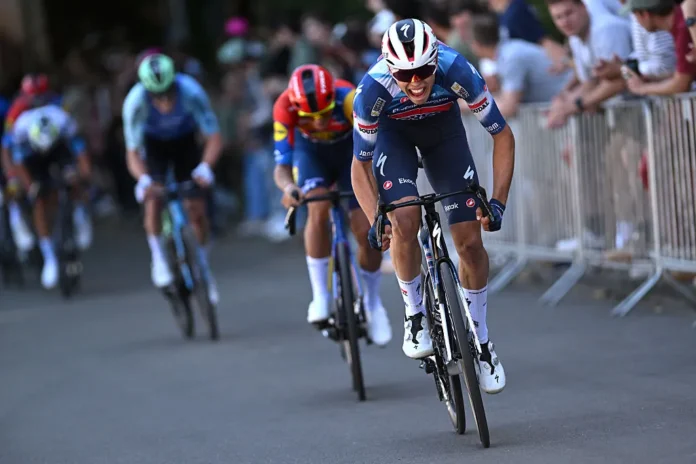
The 2026 Renewi Tour takes place from 19 to 23 August, with five stages entirely in Belgium and a route built around the characteristics which have made the race one of the most unpredictable events on the men’s WorldTour.
There is no individual time trial this year. Instead, the GC will be decided through a combination of sprint bonuses, short climbs, cobbled Classics terrain, crosswinds and two particularly important stages in Geraardsbergen and Leuven. The Celles to Geraardsbergen stage is the obvious queen stage, but the final day around Leuven has already shown how easily the race can remain undecided until the last few kilometres.
The 21st edition begins with a new Grand Départ in Diest, visits the traditional sprint finish in Ardooie, heads across the Muur van Geraardsbergen and Bosberg on Stage 3, returns to Limburg for Riemst to Bilzen-Hoeselt and finishes with another Classics-style circuit around Leuven.
For a wider introduction to the race, including its format, jerseys and likely contenders, see our beginner’s guide to the Renewi Tour 2026.
Renewi Tour 2026 route at a glance
| Stage | Date | Route | Expected character |
|---|---|---|---|
| 1 | 19 August | Diest to Diest | Hilly/sprint |
| 2 | 20 August | Blankenberge to Ardooie | Flat/sprint |
| 3 | 21 August | Celles to Geraardsbergen | Cobbled/hilly GC stage |
| 4 | 22 August | Riemst to Bilzen-Hoeselt | Rolling/sprint |
| 5 | 23 August | Leuven to Leuven | Hilly Classics finale |
All five stages take place in Belgium, making this edition slightly different from the cross-border Benelux identity associated with many previous editions.
That does not change the basic character of the race. The Renewi Tour remains a stage race built around the terrain of the Low Countries rather than conventional mountains, with seconds usually created through cobbles, wind, short climbs, positioning and bonus opportunities.
Our brief history of the Renewi Tour looks at how the race developed from the Eneco Tour through its BinckBank Tour and Benelux Tour identities before adopting its current name.
Stage 1: Diest to Diest
Wednesday 19 August 2026
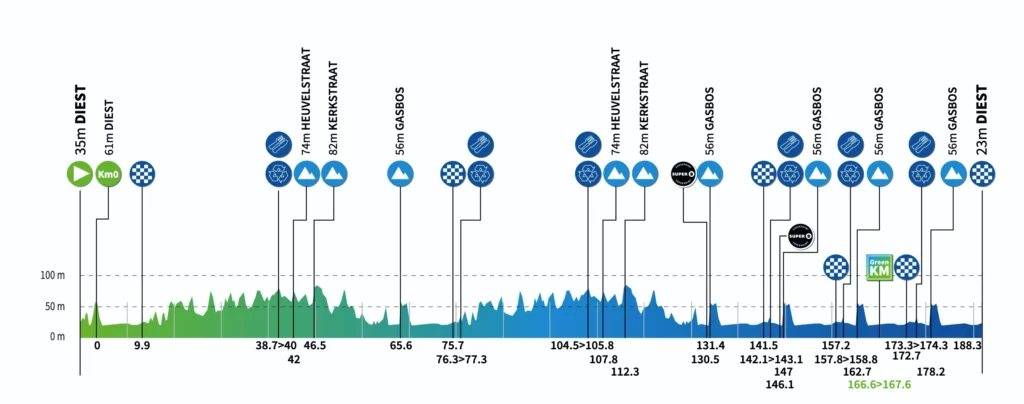
The 2026 Renewi Tour begins with a completely new start and finish city.
Diest hosts the Grand Départ, with the race heading through the Hageland, a region of short climbs and rolling roads which should make the opener considerably less straightforward than a conventional flat stage.
The riders return towards Diest for a circuit-based finale, with several passages through the finish area before the final arrival. That should increase the importance of positioning as teams learn the approach and begin fighting for the front on successive laps.
There is enough difficulty in Hageland to encourage attacking, particularly if the racing becomes aggressive or the wind helps create splits, but the stage also gives the faster Classics riders a realistic chance of reaching the finish together.
That could make Stage 1 surprisingly important for the GC. With no time trial later in the race, every finishing bonus becomes more valuable, and a rider capable of sprinting after repeated short climbs could immediately gain useful seconds.
Stage character: Hilly and sprinter-friendly
GC importance: Medium
Best suited to: Powerful sprinters and Classics riders
Stage 2: Blankenberge to Ardooie
Thursday 20 August 2026
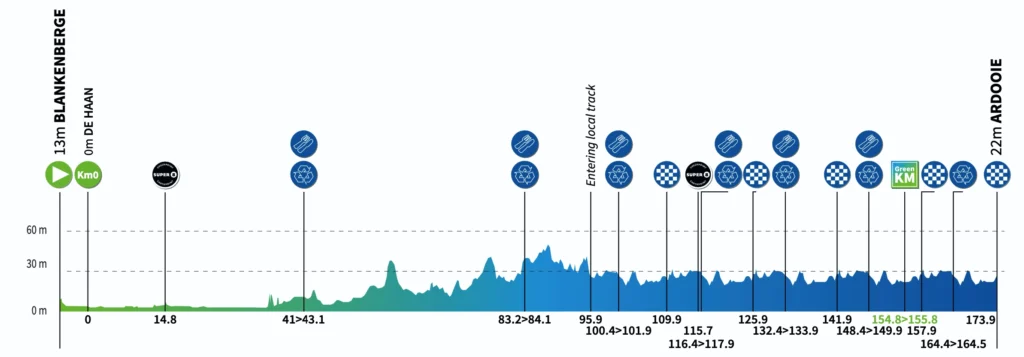
173.9km
This is the clearest opportunity for the pure sprinters.
The race begins on the Belgian coast in Blankenberge before heading inland through West Flanders towards Ardooie, one of the most familiar finishing locations in Renewi Tour history.
On profile alone, this should be the easiest stage to read. There is little climbing capable of producing a natural selection and the Ardooie finish has repeatedly suited the fastest riders.
The warning is the wind.
Flat racing in West Flanders can become far more selective than a hilly stage if the direction is right. Open roads near the coast are particularly vulnerable to echelons, and a GC contender caught too far back when a split forms can lose far more time here than on one of the recognised climbing stages.
That gives the overall contenders two priorities: stay near the front and avoid treating the day as a recovery stage.
If the race stays together, a bunch sprint remains by far the most likely outcome.
Stage character: Flat
GC importance: Low unless crosswinds intervene
Best suited to: Pure sprinters
Stage 3: Celles to Geraardsbergen
Friday 21 August 2026
This is the stage every serious GC contender will have marked.
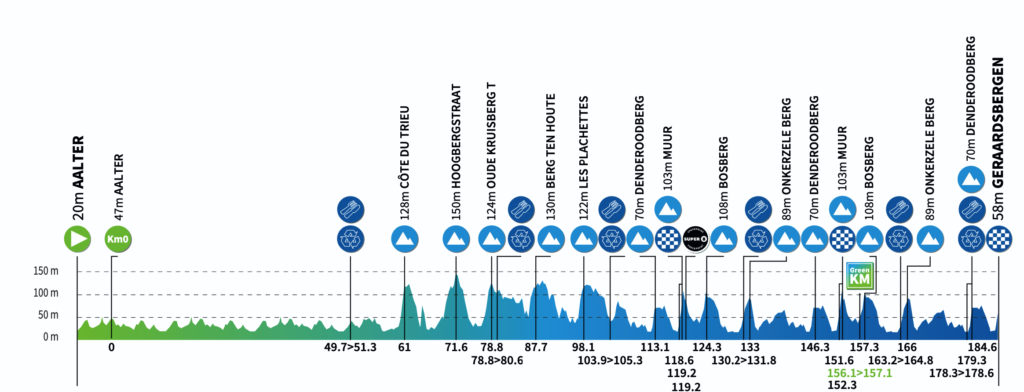
Celles makes its debut as a Renewi Tour host before the race heads towards Geraardsbergen and terrain closely associated with the Flemish Classics. The Muur van Geraardsbergen and Bosberg provide the headline difficulties, but the real challenge comes from the accumulation of short climbs, narrow roads, cobbles and repeated accelerations.
The Muur van Geraardsbergen remains one of the most recognisable climbs in Belgian cycling. It is short enough that its statistics can look relatively harmless, but the combination of steep gradients, cobbles and positioning before the lower slopes makes it considerably harder in a race situation.
The Bosberg provides another obvious launch point afterwards, while the finish in Geraardsbergen gives teams little time to repair mistakes.
This is not the sort of queen stage where a rider gains three minutes through sustained climbing. It is far more typical of the Renewi Tour: one rider reaches the decisive climb ten positions too far back, a split opens over the top and suddenly 15 seconds have disappeared.
Those small differences matter enormously here.
Stage character: Cobbled and hilly
GC importance: Very high
Key climbs: Muur van Geraardsbergen, Bosberg
Best suited to: Classics specialists, puncheurs and GC riders with excellent positioning
Why Geraardsbergen could decide the Renewi Tour
The key to Stage 3 is not simply surviving the Muur.
Renewi Tour GC racing is unusual because many of the riders capable of winning overall are also capable of winning major one-day Classics. There is no high mountain where a traditional stage racer can simply ride at threshold and create minutes.
Instead, the gaps come through repeated accelerations, splits, cobbles and bonuses.
A rider who reaches Geraardsbergen with a group of four or five can potentially gain time in several ways. There may be an actual road gap behind, finishing bonuses can increase the difference, and the race’s Green Kilometre can create another opportunity to collect seconds.
That makes tactical judgement particularly important. Waiting for the final sprint may be safe, but allowing one dangerous rival to escape over the Muur or Bosberg can effectively decide the whole Tour.
The terrain also links directly to the wider history of Flemish racing. Our guide to cycling in Geraardsbergen and Pajottenland looks in more detail at why the Muur remains such an important climb despite its relatively modest length.
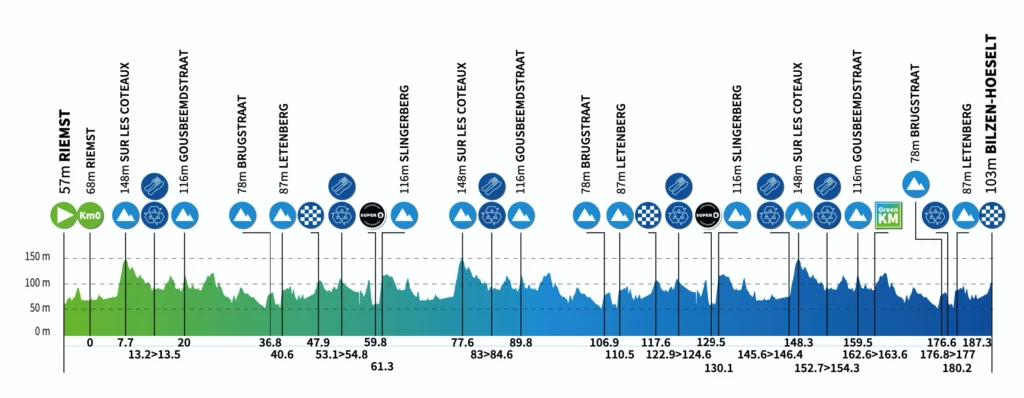
Stage 4: Riemst to Bilzen-Hoeselt
Saturday 22 August 2026
The fourth stage moves east into Limburg and brings a different type of terrain.
Riemst hosts the start before the race crosses the rolling roads towards Bilzen-Hoeselt. The profile is more undulating than Stage 2, but not obviously difficult enough to guarantee a GC selection.
The slightly rising finish is important. It should favour riders who can survive repeated rolling roads and still produce a sustained sprint rather than the most specialised flat-road sprinters.
For the GC contenders, the main objective will probably be avoiding trouble. This stage sits directly between Geraardsbergen and the final Leuven showdown, so the team holding the leader’s jersey will have little incentive to make it unnecessarily difficult.
That does not mean the day will automatically be controlled. Rolling Belgian roads, constant changes of direction and late attacks can still punish any team which assumes the race will simply organise itself for the sprinters.
Stage character: Rolling
GC importance: Low to medium
Finish: Slightly uphill
Best suited to: Durable sprinters and breakaway riders
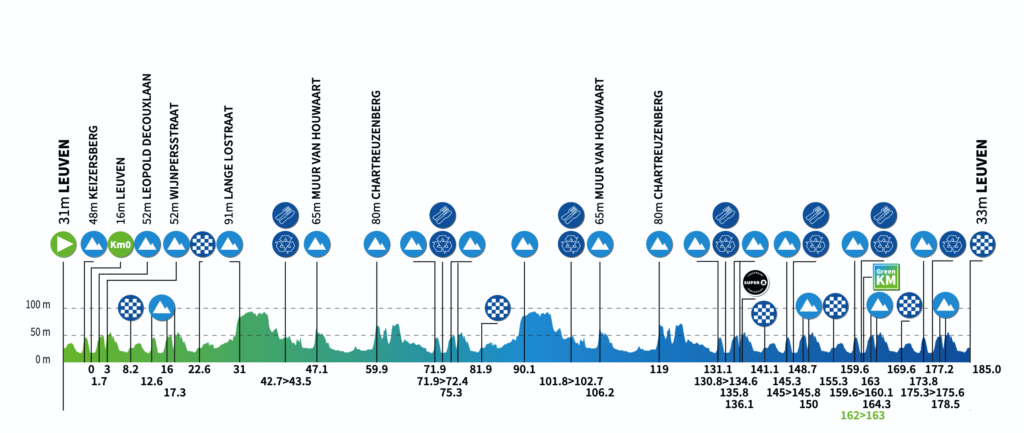
Stage 5: Leuven to Leuven
Sunday 23 August 2026
The Renewi Tour again ends with a genuine racing stage rather than a ceremonial procession.
Leuven provides both the start and finish, with the route drawing on roads familiar from the city’s one-day racing and the 2021 World Championships. The result is a succession of short climbs and repeated accelerations rather than one obvious decisive ascent.
That is almost ideal Renewi Tour terrain.
No climb is individually hard enough to create the sort of gap seen on a mountain stage, but the repeated efforts gradually reduce the group and make the race increasingly difficult to control. By the final laps, a short attack can become dangerous simply because every remaining domestique has already been forced to respond several times.
The final finish comes on Bondgenotenlaan, and with no stage afterwards there is no reason for a rider sitting a few seconds off the GC lead to wait.
The 2025 race demonstrated exactly why Leuven matters. Arnaud De Lie and Mathieu van der Poel reached the final stage separated by almost nothing, with Van der Poel briefly moving into the virtual overall lead through bonus seconds before De Lie won the final sprint and secured the GC by only three seconds.
That finale is covered in our history of the Renewi Tour and remains the clearest recent example of how the race can stay open until the final sprint.
Stage character: Hilly Classics stage
GC importance: Very high
Best suited to: Puncheurs, Classics specialists and fast GC riders
No time trial changes the whole GC battle
The most important structural feature of the 2026 route is what is missing.
There is no individual time trial.
That keeps a much wider type of rider in contention. A specialist against the clock cannot simply build a substantial advantage and spend the remaining stages protecting it. Instead, the overall classification will be constructed through finishing bonuses, small road gaps, crosswinds and positioning.
That is why sprinters can remain genuine GC contenders at the Renewi Tour.
A rider who wins in Ardooie and perhaps takes another high finish can build useful bonus seconds before Geraardsbergen. If that rider is also strong enough to survive the Muur with the main Classics group, those seconds remain relevant all the way to Leuven.
The beginner’s guide to the Renewi Tour 2026 explains why the race can be won by a much broader range of riders than a conventional stage race, including puncheurs, cobbled Classics specialists and powerful sprinters.
 Photo Credit: Getty
Bonus seconds could decide everything again
The absence of a time trial also increases the importance of every bonus opportunity.
The 2025 edition provided an extreme demonstration. De Lie and Van der Poel reached the final stage separated by almost nothing, and the GC continued changing virtually through bonus seconds before the final sprint.
That is entirely plausible again in 2026.
Stages 1, 3 and 5 all give powerful all-rounders opportunities to collect seconds. Stages 2 and 4 give the sprinters the chance to build their own advantage. The Green Kilometre adds another tactical element for teams willing to commit riders before the finish.
The overall winner may therefore never produce one clearly dominant performance.
The more likely route to victory is to finish near the front every day, avoid every damaging split and repeatedly collect two or three seconds wherever possible.
Geraardsbergen and Leuven are the two obvious GC stages
If the general classification has two major checkpoints, they are Stage 3 and Stage 5.
Geraardsbergen offers the clearest opportunity to create an actual road gap. The Muur and Bosberg favour riders accustomed to Tour of Flanders-style racing, and the accumulation of climbs should be enough to expose anyone who is slightly below their best.
Leuven is more complicated. It lacks one iconic climb with the reputation of the Muur, but the repeated hills create fatigue and there is no opportunity to repair a mistake afterwards.
That final-day dynamic can generate aggressive racing much earlier than the profile alone would suggest. A rider sitting six seconds behind cannot afford to reach the final kilometre without trying something.
The most likely overall winner is therefore not necessarily the rider who dominates either stage. It may be the rider who survives both of them, avoids every crosswind split and still has enough speed to collect bonuses.
 Photo Credit: Getty
Stage 2 is the clearest sprint opportunity
For the pure sprinters, Blankenberge to Ardooie is the obvious target.
The route from the coast into West Flanders has little climbing to produce a natural selection and Ardooie has repeatedly rewarded fast finishes.
The only major caveat is the wind. Echelons can quickly transform a straightforward sprint stage into one of the most stressful days of the race, particularly if teams deliberately increase the pace on exposed roads.
Any GC contender treating Stage 2 as irrelevant risks discovering that the flat stages of the Renewi Tour are often dangerous precisely because everyone expects them to be easy.
Stage 4 gives the sprinters another chance
Riemst to Bilzen-Hoeselt is less straightforward but still provides another obvious opportunity for the faster riders.
The rolling Limburg terrain should remove some of the pure sprinters if the pace is particularly high, while the slightly rising finish gives a small advantage to riders with more strength after a hard day.
That makes Stage 4 a good opportunity for the increasingly common modern sprinter who can survive short climbs rather than requiring a completely flat approach.
It could also reward a breakaway if the main GC teams decide they have more important work waiting in Leuven.
A route for Classics riders rather than conventional stage racers
Renewi Tour remains one of the strangest WorldTour stage races to classify.
There are no high mountains. There is no long time trial. There is no obvious summit finish where a conventional Grand Tour contender can establish superiority.
Instead, the race combines terrain more normally associated with the spring Classics calendar. Hageland introduces short climbs, West Flanders provides exposed roads and crosswinds, Geraardsbergen supplies the cobbles, Limburg adds rolling terrain and Leuven finishes the race with repeated short climbs.
That makes the likely GC contenders riders who can function across all of those environments.
A pure sprinter may lose too much time in Geraardsbergen. A pure climber may lack the positioning and finishing speed required to exploit the terrain. A time trial specialist has no dedicated stage on which to create an advantage.
The ideal Renewi Tour rider sits somewhere between a puncheur, a cobbled Classics specialist and a fast finisher.
That distinctive identity is also why the race occupies an unusual place on the men’s WorldTour calendar. It is a stage race, but the skills required to win it often look much closer to those needed in a one-day Classic.
-
 Photo Credit: Cor Vos
Renewi Tour 2026 key stages
Most likely sprint stage: Stage 2
Blankenberge to Ardooie is the most obvious conventional bunch finish, provided the wind does not break the race apart.
Hardest stage: Stage 3
Celles to Geraardsbergen contains the Muur and Bosberg and provides the clearest opportunity to create meaningful GC gaps.
Most unpredictable stage: Stage 1
The new Hageland opener could produce anything from a reduced sprint to an immediate GC split.
Best stage for a durable sprinter: Stage 4
The rolling Limburg roads and slightly uphill Bilzen-Hoeselt finish reward speed without being completely straightforward.
Most important stage for the final GC: Stage 5
Leuven comes last, contains repeated short climbs and gives riders no opportunity to recover from a tactical mistake.
Renewi Tour 2026 schedule
The race runs from Wednesday 19 August to Sunday 23 August, with the team presentation in Diest the evening before the opening stage.
| Date | Stage |
|---|---|
| 18 August | Team presentation, Diest |
| 19 August | Stage 1: Diest to Diest |
| 20 August | Stage 2: Blankenberge to Ardooie |
| 21 August | Stage 3: Celles to Geraardsbergen |
| 22 August | Stage 4: Riemst to Bilzen-Hoeselt |
| 23 August | Stage 5: Leuven to Leuven |
The race sits immediately after the ADAC Cyclassics and overlaps with the opening weekend of the Vuelta a España, making it an important late-summer target for riders whose strengths lie more in sprinting, cobbled racing and short climbs than Grand Tour mountains.
With no time trial and two difficult Classics-style stages waiting in Geraardsbergen and Leuven, there is every reason to expect the GC to be measured in seconds rather than minutes.
The Muur may produce the first decisive split.
Leuven may still decide who actually wins the 2026 Renewi Tour.

