The Grand Prix Cycliste de Montréal has always been the harder half of Canada’s WorldTour double, and the 2026 edition retains that identity while introducing the circuit that will play a central role in the UCI Road World Championships later in September.
Sunday 13 September’s race covers 214.4km across 16 laps of a new 13.4km circuit around Mount Royal, accumulating 4,304 metres of climbing. The lap has been extended from the traditional 12.3km configuration, taking the race onto additional Montréal streets while retaining the familiar sequence of Camillien-Houde, the Côte de la Polytechnique and Pagnuelo.
The total climbing is actually slightly lower than in 2025, when 17 laps of the previous circuit produced approximately 4,573 metres of elevation gain. That does little to make the 2026 race easier. More than 4,300 metres of climbing remains an enormous total for a one-day race, while the redesigned circuit gives teams an invaluable competitive reconnaissance of the roads that will decide the world title two weeks later.
For a wider introduction to the event, ProCyclingUK’s beginner’s guide to the Grand Prix Cycliste de Montréal 2026 explains how the race works and why Mount Royal has become one of the most distinctive WorldTour circuits.
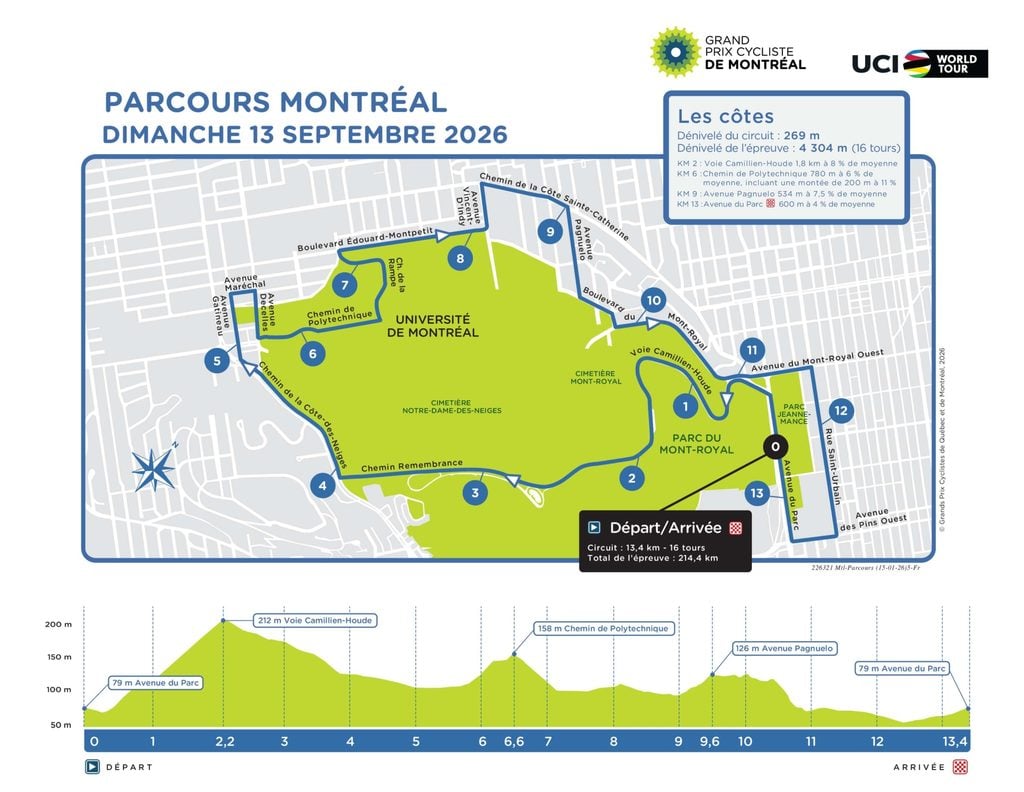
GP Montréal 2026 route at a glance
| Detail | GP Montréal 2026 |
|---|---|
| Date | Sunday 13 September 2026 |
| Start and finish | Avenue du Parc, Montréal |
| Distance | 214.4km |
| Circuit length | 13.4km |
| Number of laps | 16 |
| Elevation gain per lap | 269 metres |
| Total climbing | 4,304 metres |
| Camillien-Houde | 1.8km at 8% |
| Côte de la Polytechnique | 780m at 6%, including around 200m above 11% |
| Avenue Pagnuelo | 534m at 7.5% |
| Avenue du Parc | 600m at approximately 4% |
| Start time | 10:15 local time |
| Expected finish | Approximately 15:45 |
| Classification | UCI WorldTour, 1.UWT |
Those figures immediately explain the difference between Montréal and Friday’s race in Québec City. The Grand Prix Cycliste de Québec 2026 contains approximately 2,780 metres of climbing. Montréal adds more than 1,500 metres despite being only a little over eight kilometres longer.
Why has the GP Montréal route changed for 2026?
The 2026 redesign is closely connected to the UCI Road World Championships, which take place in Montréal from 20 to 27 September.
The Championships will use a 13.4km Mount Royal finishing circuit containing many of the same roads and climbs as GP Montréal. The elite men’s world road race starts in Brossard before crossing the wider Montérégie region and eventually arriving in Montréal, where the riders will complete 12 laps of the Mount Royal circuit.
GP Montréal skips that long approach and spends its entire 214.4km on the circuit.
That distinction is important. Sunday’s WorldTour race is not an exact recreation of the men’s Worlds road race, but it is about as useful a reconnaissance opportunity as a rider could hope for.
Training on the circuit can reveal gradients, corners and road surfaces. Racing it 16 times against a WorldTour peloton reveals far more.
Riders will discover where the fight for position begins before Camillien-Houde, how difficult it is to recover before Polytechnique, whether Pagnuelo provides enough separation for an attack and how much energy remains for the uphill drag on Avenue du Parc.
The new urban section also takes the race along roads including Avenue du Mont-Royal Ouest, Rue Saint-Urbain and Avenue des Pins Ouest, bringing the Grand Prix much closer to the Worlds configuration.
By the time the elite men’s World Championship takes place on Sunday 27 September, anyone who races GP Montréal will have had 16 competitive laps in which to learn those roads.

The 2026 circuit is longer, but not vertically harder than 2025
One important distinction needs to be made when comparing the new route with last year’s race.
The 2025 GP Montréal covered 209.1km across 17 laps of a 12.3km circuit, with 269 metres of climbing on each lap. That produced approximately 4,573 metres of total elevation.
For 2026, the circuit grows to 13.4km but the number of laps falls from 17 to 16.
The elevation gain per lap remains approximately 269 metres, leaving the total at 4,304 metres.
So the redesign has not made Montréal harder simply by adding more vertical metres. What it has done is change the roads linking the familiar climbs while preserving an extraordinarily demanding climbing density.
More than 4,300 metres in 214km still puts GP Montréal firmly into the territory of races where genuine climbing ability matters.
Recent results already reflected that direction.
Brandon McNulty won in 2025 after riding clear with Tadej Pogačar, while Quinn Simmons finished more than a minute behind in third. Adam Yates won in 2023, and Pogačar dominated the 2022 and 2024 editions.
The history of the Grand Prix Cycliste de Montréal shows how a race once capable of rewarding riders such as Peter Sagan, Greg Van Avermaet and Michael Matthews has increasingly tilted towards elite climbers.
The 2026 parcours gives little reason to expect that trend to reverse.
Camillien-Houde remains the backbone of GP Montréal
The defining climb is still Voie Camillien-Houde, reached early on every circuit as the race climbs Mount Royal.
The steepest recognised section measures approximately 1.8km at an average of 8%. The broader rise used in World Championships descriptions extends further, but the important tactical point remains the same: Camillien-Houde is a sustained climb rather than a short punchy ramp.
That separates Montréal from GP Québec.
Québec’s Côte de la Montagne measures only around 600 metres. A powerful rider can potentially survive it through a short anaerobic effort before recovering.
Camillien-Houde requires considerably more sustained climbing power.
Early in the race, the peloton should remain largely intact. Teams have little reason to make a full commitment when another dozen laps remain.
The effect becomes increasingly visible through repetition.
By lap ten, the riders have already climbed Camillien-Houde ten times. By lap 14, riders who were comfortable during the opening hour can suddenly begin losing contact when the strongest teams increase the pace.
The final ascent is effectively a several-minute climbing effort performed after more than 4,000 metres of accumulated elevation.
At that point, reputation matters very little.
Anyone unable to reproduce their earlier climbing power disappears from contention.
The descent rewards riders who conserve positions
Crossing the summit does not necessarily mean the difficult work is finished.
The race descends through Mount Royal towards the western side of the circuit, where position can become almost as important as climbing strength.
A rider who starts the descent among the first 20 can use much of it to recover.
Someone repeatedly entering it 60th may spend the supposedly easier section fighting back towards the front before the next climb arrives.
That difference can remain largely invisible on television during the opening laps.
Four hours later, it matters.
Circuit racing repeatedly rewards riders who minimise unnecessary efforts. Two contenders can climb at virtually identical speeds yet arrive at the finale with very different energy reserves because one has spent the afternoon moving smoothly near the front while the other has continually accelerated to repair poor positioning.
At Montréal, there are 16 opportunities to get that calculation right or wrong.

Côte de la Polytechnique provides the steepest gradients
The next major test comes around the Université de Montréal on Chemin de la Polytechnique.
The climb measures approximately 780 metres at 6%, but that average hides the feature that makes it particularly dangerous. Around 200 metres rises at more than 11%.
That produces a different type of effort from Camillien-Houde.
Camillien-Houde rewards sustained climbing power.
Polytechnique rewards explosiveness.
A rider who has survived the first ascent at a steady pace can suddenly find themselves above their limit when someone launches a violent acceleration on the steepest section.
This becomes particularly dangerous once the front group has already been reduced.
Imagine 30 riders surviving Camillien-Houde on the penultimate lap. A team with several contenders can then drive Polytechnique hard enough to halve that number without necessarily asking its leader to attack.
That creates tactical opportunities later in the circuit.
The climb is also short enough to encourage actual attacks rather than simply tempo riding.
Early in the race, any gaps are likely to close.
On the final lap, there is much less incentive to hesitate.
Pagnuelo could be the most dangerous late attacking point
The Avenue Pagnuelo climb deserves particular attention because of where it sits within the lap.
At approximately 534 metres averaging 7.5%, it is shorter than Camillien-Houde but arrives much closer to the finish.
That makes it particularly attractive during the final circuit.
A rider attacking on Camillien-Houde still has most of the lap left to defend the advantage. A move on Pagnuelo has considerably less road remaining.
It also comes after the race has already crossed Camillien-Houde and Polytechnique.
On the final lap, everyone reaching Pagnuelo has therefore completed more than 4,000 metres of climbing and almost five and a half hours of repeated accelerations.
At that point, a 500-metre climb at 7.5% can produce much larger differences than its profile suggests.
For teams with several strong climbers, Pagnuelo also provides an ideal secondary attack point.
One rider can attack earlier and force rivals to chase. A teammate can then counter over Pagnuelo when the chasing riders are already committed.
That tactical layering is one of the reasons Montréal becomes so difficult to control.
There is never just one climb to defend.

The new urban section changes the run towards Avenue du Parc
The extension to 13.4km introduces an altered urban section through roads including Avenue du Mont-Royal Ouest, Rue Saint-Urbain and Avenue des Pins Ouest before the course returns towards the finish.
These kilometres do not add another major recognised climb, but tactically they are significant.
They change the recovery period between Pagnuelo and the final rise and give riders another technical sequence to understand before the World Championships.
This is where familiarity gained during the Grand Prix could become particularly valuable later in September.
Knowing the gradients is straightforward.
Knowing exactly where the bunch compresses, which corners are best approached from the front and where an attacker briefly disappears from the chasing group’s sight line is much harder to learn from a route map.
After 16 laps, the riders should know those details intimately.
Avenue du Parc provides the final uphill test
The final recognised rise comes on Avenue du Parc, with approximately 600 metres averaging around 4%.
Four per cent is not difficult enough to create substantial differences between fresh professional riders.
Nobody reaches the final passage fresh.
The importance of Avenue du Parc comes from everything that has already happened.
If five riders reach the final kilometre together, the gradient favours someone who still possesses a strong uphill acceleration.
If an attacker carries five seconds out of Pagnuelo and the urban section, the rising finish makes closing that gap more difficult than it would be on a flat road.
It also creates a problem for anyone who attacks too aggressively earlier.
There is no downhill run to the line where a rider can rely on aerodynamics and momentum. The final minutes still require sustained power.
That means the strongest rider has several ways to win.
Attack earlier and attempt to arrive alone.
Force a small selection and sprint.
Use teammates to launch repeated moves and wait for everyone else to weaken.
GP Montréal rewards climbing ability, but the final kilometres still make tactics important.
Why team strength matters across 16 laps
More than 4,300 metres of climbing inevitably reduces the race to strong individuals, but the process of reaching that point makes team depth extremely important.
Every lap contains several moments where a dangerous move can form.
Does someone chase over Camillien-Houde?
Does an attack on Polytechnique need answering?
Can five strong riders be allowed ten seconds after Pagnuelo?
Who controls the new urban section?
Those questions are relatively easy to answer when a team has six riders around its leader.
They become considerably more difficult after four hours.
The 2025 race provided the clearest possible example of what numbers can achieve.
UAE Team Emirates-XRG repeatedly applied pressure before Pogačar attacked with around 35km remaining. Eventually only McNulty could stay with him. Instead of having one isolated favourite, UAE had the two strongest riders in the race riding together.
They finished more than a minute ahead of Simmons.
That kind of numerical superiority is devastating on a circuit where rivals are already close to their physical limits.
The final three laps could begin the real race from 40km out
Three laps from the finish means there are still 40.2km and more than 800 metres of climbing remaining.
In most one-day races, attacking at 40km to go still qualifies as an ambitious long-range move.
At Montréal, it can simply be the beginning of the finale.
Three Camillien-Houde ascents remain. Three passages through Polytechnique remain. Pagnuelo still has to be tackled three more times.
A strong group escaping at that point can continue using the climbs to prevent a larger peloton from organising.
The penultimate lap may be even more important.
With 26.8km remaining, teams with several contenders have an obvious incentive to attack before everyone reaches the final circuit.
Waiting gives the strongest rider one final opportunity to decide the race through pure physical superiority.
Attacking earlier creates uncertainty.
By the final lap, strategy becomes simpler.
Camillien-Houde is the obvious place for sustained pressure.
Polytechnique provides the steepest ramps.
Pagnuelo offers the final substantial climbing launchpad.
Avenue du Parc settles whatever remains.
There are several plausible places to win GP Montréal, which also means there are several places where a contender can lose it.
What type of rider does the GP Montréal 2026 route favour?
The clearest answer is an elite climber with one-day racing explosiveness.
The old Montréal winners list contains considerably more variety.
Peter Sagan won in 2013. Greg Van Avermaet won twice. Michael Matthews succeeded in 2018. Simon Gerrans combined his climbing ability and sprint to win in 2014.
Recent editions look different.
Pogačar won in 2022.
Yates won in 2023.
Pogačar won again in 2024.
McNulty won in 2025 with Pogačar alongside him.
That is four consecutive victories for UAE Team Emirates-XRG and three different riders whose climbing ability would be entirely at home in a Grand Tour mountain stage.
Pogačar’s dominant solo victory at GP Montréal in 2024 remains one of the clearest demonstrations of how the race can be controlled by an exceptional climber once accumulated fatigue begins to bite.
The 2026 route should continue to favour that profile.
A fast finish is useful.
Climbing well enough to still be there after 4,304 metres is essential.
-
 Photo Credit: Getty

Why GP Montréal is harder than GP Québec
The two Canadian WorldTour races were created together and remain closely linked, but their character is very different.
Québec covers 206km with around 2,780 metres of climbing.
Montréal covers 214.4km with 4,304 metres.
That additional 1,500 metres radically changes the potential winner.
Québec’s shorter Côte de la Montagne allows powerful Classics riders and resilient sprinters to remain involved. The race can still become highly selective, but outright climbing ability is not always decisive.
Montréal repeatedly asks riders to produce several-minute climbing efforts.
That moves the race much closer towards Ardennes territory and, in recent years, towards riders with genuine Grand Tour climbing ability.
It is why completing the Canadian double is so difficult.
A rider needs enough speed and explosiveness to maximise Friday’s opportunity in Québec while still possessing the climbing endurance required two days later around Mount Royal.
GP Montréal becomes a full-speed World Championships reconnaissance
The 2026 Grand Prix carries significance well beyond its own result.
The UCI Road World Championships begin in Montréal exactly one week later, on 20 September, with the elite men’s road race taking place on Sunday 27 September, fourteen days after GP Montréal.
The men’s World Championship covers 273.7km with 3,803 metres of climbing.
That total is actually lower than GP Montréal’s 4,304 metres because the World Championship begins with a long journey through Montérégie before the riders reach Mount Royal. Once in Montréal, however, the elite men complete 12 laps of the same 13.4km finishing circuit.
That makes the Grand Prix an unusually concentrated test.
Sixteen laps on 13 September.
Twelve decisive laps on 27 September.
The riders will already know what happens when Camillien-Houde is raced hard, which gradients on Polytechnique create the greatest differences and whether Pagnuelo provides enough road to make an attack stick.
The question will not be where the decisive points are.
Everybody should know them.
The question will be who still has the legs to exploit them.
That is what makes the GP Montréal 2026 route so interesting. The new 13.4km circuit may be designed partly with the World Championships in mind, but Sunday’s WorldTour race is no gentle reconnaissance ride.
Sixteen laps, 214.4km and 4,304 metres of climbing ensure the rainbow jersey contenders will learn about the Mount Royal circuit in the hardest possible way.