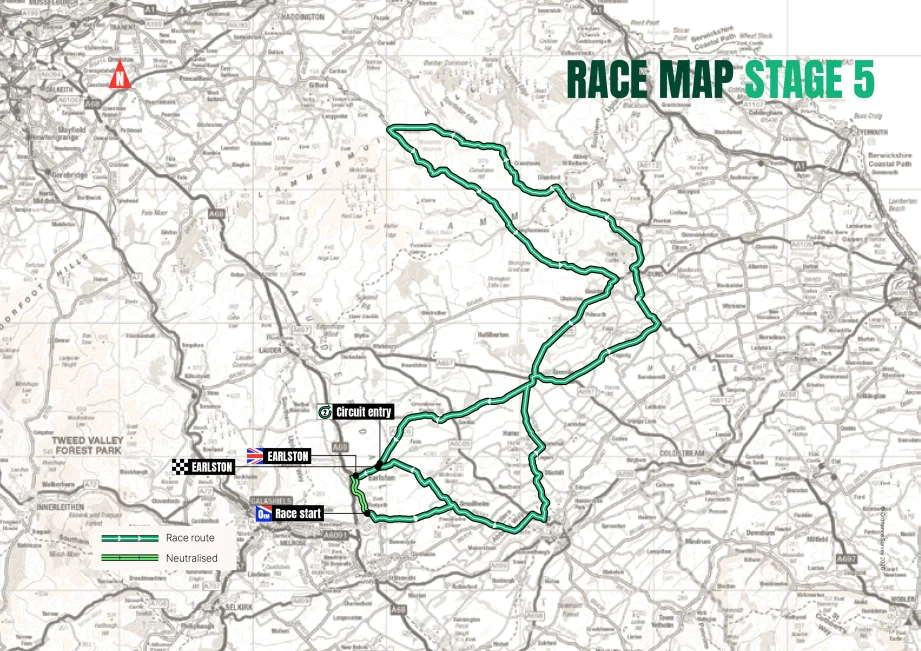
The 2026 Tour of Britain Men reaches its conclusion on Sunday with 156.1km starting and finishing in Earlston, where the Scottish Borders provide one final opportunity for both the sprinters and riders still hoping to improve their position in the general classification.
Stage 5 contains 2,236 metres of climbing, considerably more than a conventional sprint stage, but the placement of that climbing is important. The main difficulties come through the Lammermuir Hills well before the finish, with Redstone Rig and Duddy Bank forming the heart of the climbing before the race returns towards Earlston for two laps of a 19km finishing circuit.
That should bring Olav Kooij and Tim Merlier back to the front of the stage conversation after they split the two previous sprint opportunities between them. Merlier won Stage 2 in Skegness, before Kooij reversed the result in Beverley the following afternoon.
Sunday is harder than either of those stages, but the final 40km gives dropped riders time to recover and the finishing circuits are rolling rather than genuinely selective. The likely outcome is therefore a reduced sprint, although the final day of a five-stage race rarely gives the sprint teams complete control.
Tour of Britain Men Stage 5 at a glance
| Detail | Stage 5 |
|---|---|
| Date | Sunday 6 September 2026 |
| Start | Earlston |
| Finish | Earlston |
| Distance | 156.1km |
| Elevation gain | 2,236m |
| Stage type | Hilly / reduced sprint |
| Main climbing | Redstone Rig, Duddy Bank, Hardens Hill |
| Finishing circuit | 19km, completed twice |
| Official race start | 11:15 BST |
| Expected finish | Around 14:45-15:00 BST |
| Region | Scottish Borders |
| Race status | Final stage |
The Tour of Britain Men 2026 race preview identified Earlston as a stage that could look much easier on paper than it feels on the road. More than 2,200 metres of climbing is substantial over 156km, even if the biggest obstacles come early enough for the peloton to regroup before the finish.
The final stage is hilly without being a true GC mountain day
Saturday’s Stage 4 through the Yorkshire Dales provided the clearest climbing test of the Tour, with Greenhow Bank, Kidstones, Greets Moss and Grinton Moor concentrated into a difficult second half.
Earlston is a different proposition. The Scottish Borders still provide repeated climbing, but there is no equivalent of the late Yorkshire sequence where one sustained period of pressure can leave the GC favourites isolated all the way to the finish.
That does not make Stage 5 harmless. The final day gives teams nothing to save for, bonus seconds remain available and the rolling circuits offer opportunities for late attacks. Anyone trying to change the overall result needs to use those features rather than waiting for a decisive mountain that never arrives.
For the sprinters, the task is simpler. Survive the Lammermuirs close enough to the front, use the long return to Earlston to reorganise and make sure the finishing circuits do not turn into a sequence of attacks.
The race heads east before turning towards the Lammermuir Hills
Leaving Earlston, the route heads towards Smailholm and the outskirts of Kelso before turning through Hume, Greenlaw, Charterhall and Duns.
The early terrain is rolling enough to encourage a strong breakaway without immediately destroying the field. With this being the final day, teams that have not yet won have every reason to put riders forward rather than saving them for another stage.
That could make the opening fight more difficult than on the earlier sprint days. A four-rider move containing riders with no realistic chance of winning is easy to control. A larger group containing powerful Classics riders and rouleurs can become much more awkward, particularly when the peloton knows the climbs ahead will naturally help the break preserve its advantage.
Kooij’s Decathlon CMA CGM and Merlier’s Soudal Quick-Step should both want some control, but neither team will be keen to spend the whole afternoon doing work that primarily benefits the other.
Redstone Rig begins the main climbing block
The route changes once the race enters the Lammermuir Hills around Whiteadder Reservoir.
Redstone Rig is approximately 3.8km at 4.3%, although the precise figures depend on where the climb is measured. The important point is that it provides a sustained piece of uphill road after the peloton has already accumulated plenty of smaller efforts.
It is not steep enough for the strongest climbers to simply ride away from everybody else. Instead, it gives attacking teams the chance to make the race uncomfortable for the sprinters.
A steady tempo probably leaves Kooij and Merlier in contention. A succession of attacks is much more useful to riders such as Jasper Stuyven, Matteo Trentin and Florian Vermeersch, who can survive the climb comfortably but have little reason to carry two of the world’s quickest sprinters all the way back to Earlston.
That distinction should determine how selective Stage 5 becomes.
Duddy Bank keeps tired legs under pressure
Duddy Bank follows as the next major difficulty, at roughly 3.1km and a little over 3% on common route measurements.
Again, those figures are not dramatic. The cumulative effect is more important.
The riders have already completed four days of racing, including the hardest stage of the Tour only 24 hours earlier. A climb that would normally cause little trouble can become much more selective when the pace stays high and riders are repeatedly asked to close gaps.
This is where the sprint teams need discipline. Chasing every attack themselves risks using the teammates they will need later on the finishing circuit. Allowing a strong group to gain 30 or 40 seconds creates a different problem once the route turns back towards Earlston.
The best outcome for Kooij and Merlier is likely a controlled but reasonably hard tempo rather than either extreme.
Hardens Hill provides one final chance to make the climbing count
Hardens Hill is the last notable climbing opportunity before the terrain begins favouring the chase more clearly.
At around 2.2km at 4.5%, it is still not a climb capable of deciding the Tour through raw climbing ability alone. What it can do is provide a launchpad for riders who have already spent the Lammermuir section making the race selective.
This is where the identity of an attacking group matters.
A lone lightweight climber with 15 seconds is unlikely to survive the long road back to Earlston. A group containing Vermeersch, Stuyven, Trentin or Filippo Ganna has a very different chance because those riders can maintain serious speed once the gradients disappear.
The sprint teams therefore cannot judge every move simply by the size of the gap. Ten seconds to the wrong four riders can be more dangerous than a minute to a weak early break.
The long return towards Earlston favours Kooij and Merlier
After the main climbing, the route runs back through Greenlaw and Gordon towards Earlston.
This is where the balance begins shifting towards the sprinters.
There is enough road for a reduced peloton to repair much of the damage caused in the Lammermuirs, particularly if several teams retain fast finishers. Decathlon have Kooij, Soudal have Merlier, NSN Cycling Team can look towards Ethan Vernon and Pinarello Q36.5 have Sam Bennett.
Those teams do not need to cooperate perfectly. Even short spells of shared responsibility can rapidly reduce the advantage of a tiring break once the road becomes faster.
The complication comes if one or more sprinters have been removed completely. If Merlier is dropped beyond recovery, Soudal can immediately switch towards Stuyven and stop helping Decathlon. If both Kooij and Merlier are gone, the race changes completely and the stronger Classics riders suddenly have much more freedom.
That is why the distant climbs still matter.
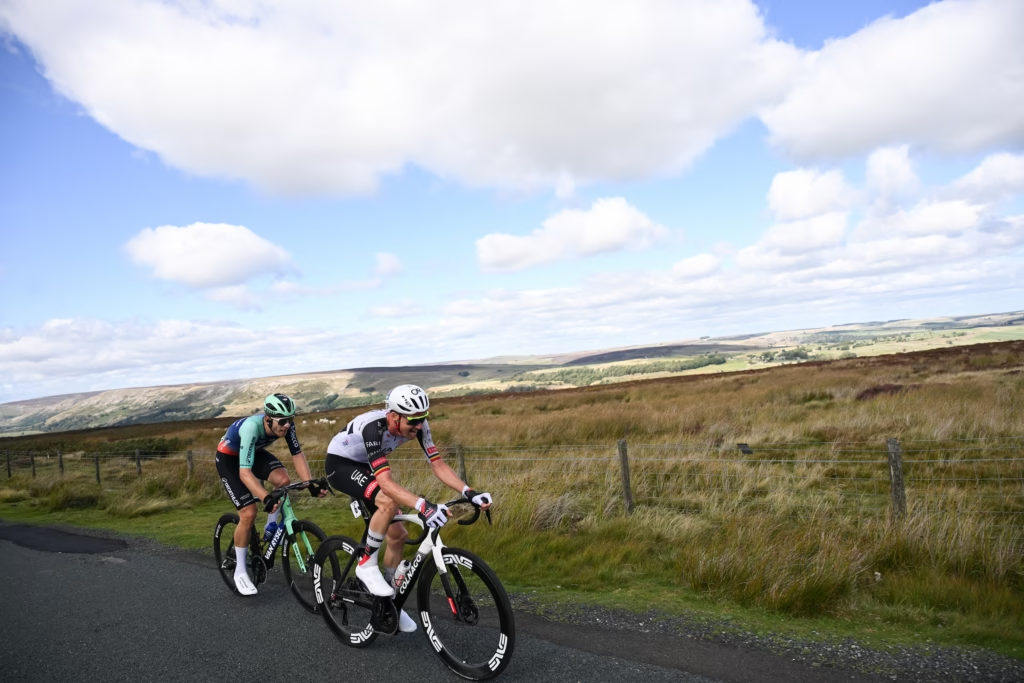 Photo Credit: SWPix.com
The first passage through Earlston comes with 38.9km remaining
The riders reach the finish line for the first time with 38.9km still to race before beginning the two 19km circuits.
That is a substantial amount of road after the hardest terrain. It is also one of the strongest arguments for predicting a sprint.
The circuits are gently rolling rather than mountainous, so riders distanced temporarily in the Lammermuirs have a realistic opportunity to regain contact before the finale. The peloton will also know exactly what is coming after completing the first lap, allowing teams to identify the best sections for positioning and attacks.
For the sprint squads, the first circuit is about restoring order. For everybody who does not want to race Kooij or Merlier at the finish, it is one of the last opportunities to prevent that order being restored.
Expect the pace to remain high even if a reasonably large group reaches Earlston together.
The finishing circuits give the attackers another chance
Repeated circuits often favour control because teams know the roads. The final stage of a short stage race can produce the opposite effect.
Every rider knows where the road narrows, where the wind is most exposed and where a small rise gives an attack a few seconds before the chase can respond. There is also no reason to conserve energy once the race enters the final lap.
That should create repeated moves rather than one obvious attack.
Stuyven and Trentin are particularly suited to that racing. Both are fast enough to win from a reduced group but know that a conventional sprint against Kooij and Merlier leaves them with much worse odds.
Vermeersch has spent much of this Tour attacking before the finish and has every reason to do it again. Ganna is another rider whose power becomes more dangerous once the race leaves the proper climbs behind.
The sprint teams may therefore have to chase several times rather than simply bringing back one break.
Olav Kooij has the clearest route to another win
Kooij enters the final stage having already settled one part of his contest with Merlier.
The Belgian was comfortably stronger in Skegness, but Kooij reversed the result on the uphill drag at Beverley Racecourse. His Stage 3 victory was particularly impressive because he initially appeared boxed in before finding enough room to accelerate and come past Merlier in the final metres.
Sunday’s stage is much harder, but Kooij has enough climbing ability to survive terrain that removes more conventional sprinters. He also has almost 40km after the first passage through Earlston, which gives Decathlon plenty of time to bring him back if he is briefly distanced earlier.
If Kooij begins the final lap in the main group with teammates around him, he becomes extremely difficult to oppose.
Tim Merlier remains the fastest direct rival
Merlier has already demonstrated why teams cannot assume a hard day automatically removes him.
Stage 2 was transformed by crosswinds rather than climbing, but it still became a much more demanding race than expected. Merlier survived the selection and then produced a decisive sprint to beat Kooij and Bennett.
Sunday asks a different question because the Lammermuir climbs require repeated uphill efforts rather than simply surviving exposed roads. Even so, none is steep or long enough to rule him out.
Soudal also have an important advantage in Stuyven. They do not have to spend every rider keeping Merlier in contention if the stage becomes genuinely selective. Stuyven can become the protected option while Merlier tries to regain contact.
That allows the team to wait longer before committing completely to one scenario.
Jasper Stuyven becomes more dangerous the harder Stage 5 gets
Stuyven is perhaps the rider with the widest range of winning scenarios.
If Merlier survives, he can help control the finale and contribute to the sprint operation. If Merlier is dropped, Stuyven immediately becomes one of the strongest contenders remaining.
He can attack on the finishing circuit, follow a move involving other Classics riders or wait for a reduced sprint where many of the pure fast men are missing.
That flexibility is particularly useful on a final stage because there is no need to protect resources for the following day. Soudal can attack and defend simultaneously rather than choosing one approach 70km from the finish.
A hard stage therefore does not necessarily weaken their chances. It simply changes which rider is most likely to deliver the result.
Matteo Trentin should not wait for Kooij and Merlier
Trentin faces a similar tactical calculation.
Taking Kooij and Merlier to the final 200 metres is unlikely to produce his best chance of winning. A smaller group created by the Lammermuirs or one of the Earlston circuits is much more attractive.
Tudor Pro Cycling Team also have Rick Pluimers, giving them another rider capable of following moves rather than forcing Trentin to respond personally every time.
Trentin’s strength is that he does not need the stage to become exceptionally hard. Repeated accelerations and a reduced field are enough.
That makes him one of the riders most likely to start racing aggressively once the peloton has completed the major climbs.
Florian Vermeersch has spent the week looking for exactly this sort of opening
Vermeersch has repeatedly refused to wait for conventional finishes during this Tour.
He attacked ahead of Michaelgate on Stage 1, tried again during the crosswind stage to Skegness and has consistently given UAE Team Emirates-XRG another tactical option alongside Tim Wellens.
The final stage offers ideal terrain for another move.
The climbs are manageable enough for Vermeersch to remain strong, while the roads back towards Earlston reward his power much more than they reward a pure climber. If he gets into a small group after Hardens Hill, the sprint teams cannot afford to give him much space.
UAE can also use him to force other teams to work rather than spending the whole day controlling themselves.
Filippo Ganna has one final stage built for a long attack
Ganna’s GC ambitions were badly damaged by his puncture and the crosswind split on Stage 2, when he lost almost two minutes despite a long chase from Netcompany INEOS.
That makes Stage 5 much simpler for him.
Waiting for the sprint offers very little. Attacking gives him a genuine route to victory.
The Scottish stage also suits a Ganna move far better than Saturday’s repeated Yorkshire climbs. He should be able to survive the Lammermuir section without being forced into a pure climbing contest, while the faster roads afterwards allow him to use his greatest strength.
A move containing Ganna is particularly dangerous because even a small gap can become difficult to close once he settles into a time-trial effort.
Netcompany INEOS also have the experienced Ben Swift available during his final Tour of Britain. Swift announced his retirement at the end of the 2026 season, making Sunday’s Scottish finale one of his final appearances in his home stage race.
Ethan Vernon gives NSN another sprint option
NSN Cycling Team have Ethan Vernon if the stage comes back together.
Vernon has already been around the front of the sprint stages and should be more comfortable than many pure fast men if the Lammermuir section is raced hard without becoming completely selective.
The team’s wider priorities can complicate the chase, however. Committing several riders to a sprint only makes sense if it does not compromise their position in the overall race.
That could leave Vernon relying on Decathlon and Soudal to do much of the work before the finishing circuits.
If he reaches the final kilometre fresh enough, he has the speed to challenge behind the obvious Kooij-Merlier pairing.
Sam Bennett gets one last chance in a sprint
Bennett finished third behind Merlier and Kooij in Skegness and remains another serious threat if the peloton comes back together.
The route is less naturally suited to him than to Kooij, but the long distance between the hardest climbing and the finish helps significantly.
Bennett does not need to ride Redstone Rig and Duddy Bank at the front. He needs to make sure any deficit remains small enough for Pinarello Q36.5 to repair on the return towards Earlston.
If he reaches the finishing circuit in the main group, the earlier climbing largely stops mattering.
His outright speed keeps him in the stage conversation.
The breakaway has a genuine final-day chance
The route may point towards a sprint, but the race situation gives the breakaway more hope than it had in Skegness or Beverley.
This is the last stage.
Teams that have achieved little so far have no reason to keep riders around their leaders for Monday. There is no Monday stage.
That usually produces a stronger opening escape and more aggressive racing once the break begins fragmenting.
The sprint teams also face a coordination problem. Decathlon would like Kooij to win, but Soudal do not want to do all the work for him. Soudal want Merlier in the sprint, but Decathlon have no reason to spend their entire squad helping him.
If a break containing powerful riders reaches the Lammermuirs with several minutes, the climbing can help it maintain the gap.
The finishing circuits then provide plenty of time for the chase, but only if enough teams still have a reason to contribute.
Wind could make the Scottish Borders more selective
The Scottish Borders rarely provide completely sheltered racing.
Exposed roads around Greenlaw, Duns and the Lammermuirs can amplify even moderate winds, particularly once the race begins changing direction frequently.
That gives Classics-heavy teams another way to make Stage 5 difficult without relying entirely on the climbs.
A crosswind split can be harder for a sprinter to repair than briefly losing contact on a 5% ascent. It can also create GC problems in terrain where nobody expected major time gaps.
The riders near the front of the overall classification therefore need to stay attentive well beyond the categorised climbs. Sunday’s route may lack the gradients of the Yorkshire Dales, but there are enough exposed roads and changes of direction for poor positioning to become expensive.
How Stage 5 is likely to unfold
The opening roads towards Smailholm and Kelso should produce an active breakaway fight, with teams still searching for a stage result prepared to put several riders forward.
The race should become much harder around Duns and the Lammermuir Hills. Redstone Rig and Duddy Bank provide opportunities to increase the pace, while the later climbing can be used to launch stronger attacks once the peloton has already been reduced.
The long return towards Earlston then favours the chase. Riders such as Kooij, Merlier and Bennett do not need to survive every climb in the first group if teammates can bring them back before the circuits begin.
Once the race crosses the line with 38.9km remaining, the tactical battle changes again. The first circuit should contain repeated attacks from riders who know a sprint is becoming more likely with every kilometre. The final lap becomes a contest between those attacks and whatever sprint trains still have enough riders left to control them.
A bunch sprint is the most likely outcome, but it should take plenty of work to create one.
Main favourites for Tour of Britain Stage 5
Olav Kooij starts as the clearest favourite if a sizeable group reaches Earlston. He has already beaten Merlier in Beverley and has the climbing ability to survive more difficult terrain than most sprinters.
Tim Merlier remains his biggest direct rival. He was comfortably faster in Skegness and only needs to stay close enough through the Lammermuirs to regain contact before the final circuits.
Jasper Stuyven becomes increasingly dangerous as the stage gets harder. If Merlier is removed, Soudal can switch completely towards him without losing much tactical strength.
Matteo Trentin has no reason to accept a conventional sprint and is one of the riders most capable of turning the finishing circuits into an attacking race.
Ethan Vernon gives NSN a fast option if the peloton reaches Earlston together, while Sam Bennett remains capable of challenging Kooij and Merlier if he survives the climbing.
Florian Vermeersch is one of the strongest attacking options, particularly once the final proper climb is behind the riders. Filippo Ganna is the other obvious long-range threat, with the faster final roads much better suited to him than another uphill finish.
Earlston leaves one final chance to change the Tour
Stage 5 is unlikely to be decided by one spectacular climb. Its difficulty comes from the accumulation of more than 2,200 metres of ascent, a testing passage through the Lammermuir Hills and almost 40km of circuit racing once the peloton first reaches Earlston.
That makes Kooij and Merlier logical favourites without making the stage straightforward. Stuyven, Trentin, Vermeersch and Ganna all have reasons to attack rather than wait for the sprint, while anyone still chasing seconds in the overall classification has one afternoon left to find them.
The opening stage in Lincoln established the first important gaps. Skegness and Beverley belonged to Merlier and Kooij, while the Yorkshire Dales provided the race’s biggest climbing test.
Earlston now has to settle everything that remains.
Main photo credit: SWPix.com