For much of the 2000s, Equipe Nürnberger Versicherung was the reference point for German women’s professional cycling.
The team combined a strong German identity with an international roster capable of winning the biggest races on the calendar. Judith Arndt became road world champion while riding for Nürnberger. Regina Schleicher repeated the achievement a year later. Oenone Wood won the season-long World Cup. Trixi Worrack developed into one of the most durable all-rounders of her generation, while riders including Petra Rossner, Edita Pučinskaitė, Amber Neben and a young Lisa Brennauer all passed through the structure.
That list also explains why Nürnberger should not simply be described as a development team. It developed riders, certainly, but it also recruited champions and expected them to win immediately.
The insurer backed the project through to the end of 2009, giving it unusual continuity during an era when women’s teams frequently disappeared after only a few seasons. The underlying organisation survived for one more year as Noris Cycling before closing after 2010.
Its place in ProCyclingUK’s wider women’s cycling team history comes from what happened during those years in between. Nürnberger built a team capable of producing champions without becoming dependent on a single one.

Nürnberger became Germany’s flagship women’s team
The Nürnberger-backed project emerged around the turn of the millennium, initially racing as Equipe Nürnberger before becoming Equipe Nürnberger Versicherung.
Its significance was partly structural.
Germany already had a strong tradition in women’s road and track cycling, but the professional team landscape was much less secure than it is now. Talented riders could progress through clubs and the national programme only to find comparatively few stable trade teams capable of offering a full international calendar.
Nürnberger helped fill that gap.
The team was based in Nuremberg, maintained a substantial German core and became closely connected with the country’s national-team strength. It could give younger riders regular exposure to World Cup races, major stage races and international championships while surrounding them with riders who already understood how to win at that level.
That combination became increasingly powerful as the decade developed.
Petra Rossner brought instant authority
Petra Rossner was one of the most important established names to join the team.
By the time she arrived for 2003, Rossner was already an Olympic champion on the track, a former individual pursuit world champion and one of the dominant road sprinters of her era. Her record in North America was extraordinary, particularly at the Liberty Classic in Philadelphia, while she had already won the Women’s Road World Cup overall in 2002.
ProCyclingUK’s full history of Petra Rossner shows how unusual her combination of track pedigree and road longevity became.
For Nürnberger, Rossner offered more than results.
She gave a young group of German riders direct exposure to someone who had already spent years winning internationally. Trixi Worrack later spoke about how much she learned after joining a team containing riders such as Rossner and Judith Arndt.
That knowledge transfer became one of Nürnberger’s less visible strengths.
The team did not have to wait for its younger riders to become leaders before teaching them how elite racing worked. They were already surrounded by riders doing it.
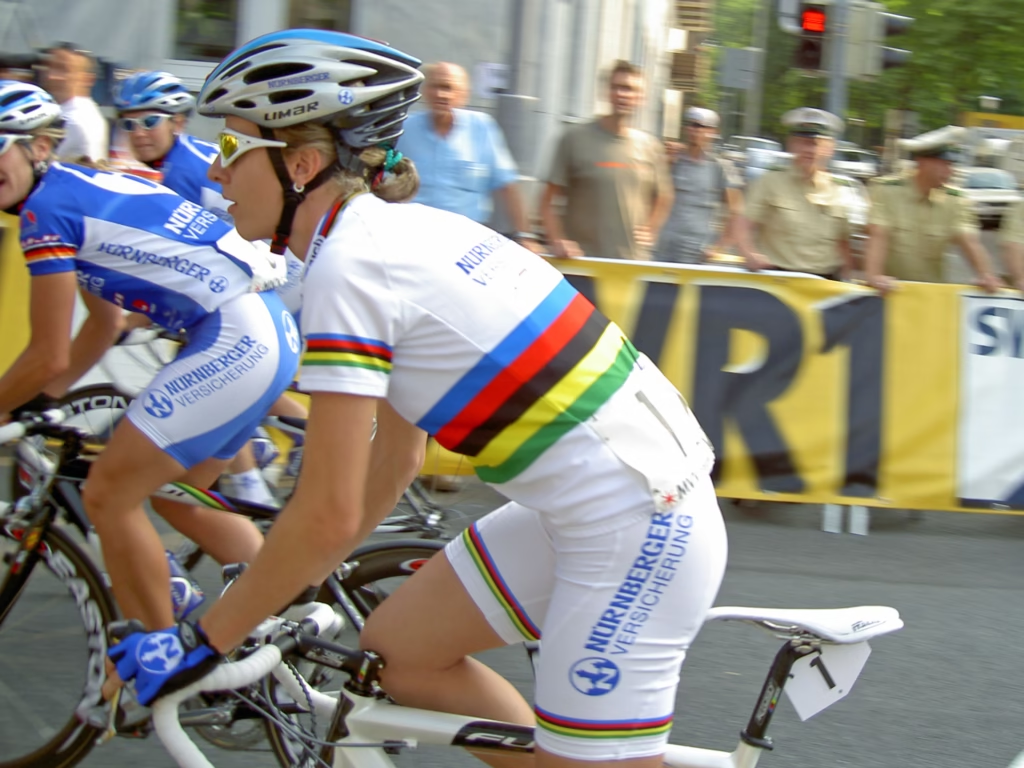
Judith Arndt’s 2004 season put Nürnberger at the top of the sport
Judith Arndt joined Nürnberger in 2003 and produced one of the most complete seasons of her career the following year.
She had already been a world champion on the track and an Olympic medallist before concentrating more heavily on road racing. At Nürnberger, that ability developed into sustained dominance across several formats.
In 2004, Arndt won the UCI Women’s Road World Cup overall, took silver in the Olympic road race in Athens and then became elite road world champion in Verona.
Her world title was particularly important for the team.
Nürnberger was no longer merely a strong German squad with ambitions on the international calendar. It now had the rainbow jersey inside its own roster.
Arndt’s range also fitted the team particularly well. She could time trial, climb, win stage races and contend in the hardest one-day events. Her career is covered more fully in ProCyclingUK’s history of Judith Arndt as one of the great Spring Classics riders.
The 2004 rainbow jersey was not the beginning of her success, but it represented a major step in Nürnberger’s status.
The team was about to do it again.
Regina Schleicher kept the rainbow jersey within Nürnberger
Regina Schleicher joined for 2005 after spending the previous seasons with Italian teams.
She immediately delivered.
Schleicher became German road champion and then won the elite women’s road race at the 2005 World Championships in Madrid, beating Nicole Cooke and Nürnberger team-mate Oenone Wood from a reduced group.
The victory meant riders from Equipe Nürnberger Versicherung had won the road world championship in consecutive seasons.
Arndt had taken the rainbow jersey in Verona.
Schleicher succeeded her in Madrid.
The complete list of road cycling world champions shows how rare it is for one trade team to have successive women’s road champions during an era when championship racing was contested in national colours.
There was an extra layer to the Madrid result because Nürnberger’s influence ran throughout the front of the race.
Arndt was part of the German team working for Schleicher, Worrack contributed to the lead-out and Wood took bronze for Australia.
For one afternoon, a World Championship contested between nations still looked remarkably like evidence of Nürnberger’s strength.
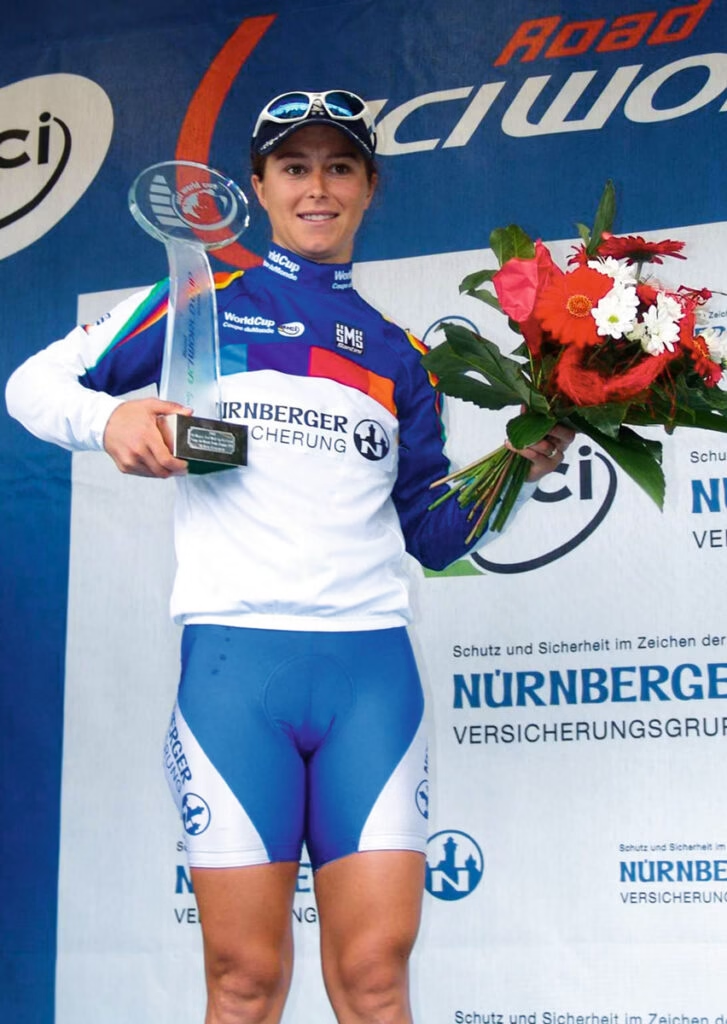
Oenone Wood gave the team another World Cup
Wood’s 2005 season made that impression even stronger.
The Australian had won the Women’s Road World Cup overall in 2004 before joining Nürnberger. Rather than treating that success as a finished achievement, she defended the title in her first season with the German squad.
Her battle with Susanne Ljungskog ran through the year before the final round in Nuremberg, where Wood’s third place was enough to secure a second consecutive World Cup overall victory.
Nürnberger had therefore taken the World Cup through Arndt in 2004 and Wood in 2005.
It was an exceptional two-year period.
The team could send one rider to a difficult one-day race, another to a sprint and still have several genuine alternatives. It was becoming increasingly difficult to describe Nürnberger through one racing identity because its strength came from having so many of them.
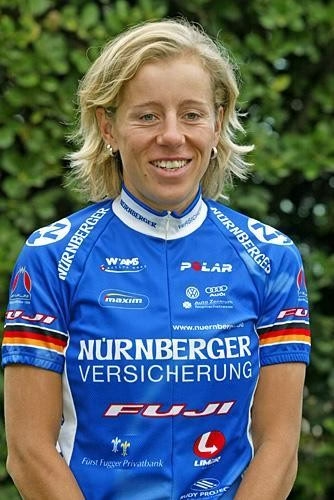
Trixi Worrack grew up inside the team
Few riders are more closely associated with the structure than Trixi Worrack.
Worrack joined Nürnberger as a young professional and remained with the organisation through its transition into Noris Cycling in 2010.
Her early career showed exactly what the team could offer.
She had already won the junior world time trial title and the under-23 European road championship before joining, but Nürnberger gave her a stable international programme and access to experienced team-mates.
In 2003 she became German road champion.
Two years later came one of the best victories of her early career at the Primavera Rosa, the women’s Milan-San Remo-style World Cup race.
The 2005 result also demonstrated Nürnberger’s depth particularly clearly.
Worrack won after slipping clear in the finale, with Wood finishing third and Schleicher fourth. Arndt had played a major role in keeping the race together around the decisive climbs.
Worrack would later become known as a rider capable of almost everything: Classics, stage races, time trials, team leadership and eventually the road-captain role she occupied deep into her career.
Nürnberger was where much of that versatility was built.
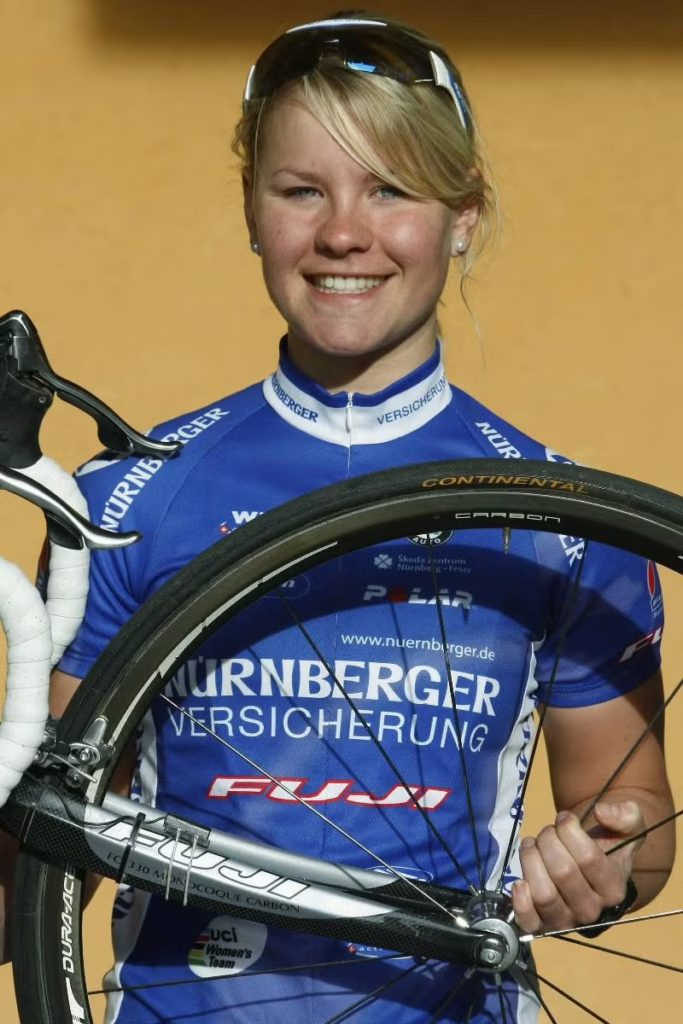
The roster increasingly became international
The team retained a clear German identity without limiting itself to German riders.
Wood was one example.
Edita Pučinskaitė was another.
The Lithuanian arrived as an established world champion and one of the best stage racers of her generation. She had already won the Giro d’Italia Women in 2006 before joining Nürnberger for 2007.
Then she won it again.
Pučinskaitė’s 2007 Giro victory gave Nürnberger one of the biggest stage-race successes in its history and reinforced the team’s ability to compete far beyond the World Cup one-day calendar.
Her place among the Giro’s great champions is covered in ProCyclingUK’s complete history of the Giro d’Italia Women.
The same roster contained Claudia Häusler, later Claudia Lichtenberg, who was still developing into a major stage racer.
Häusler would leave Nürnberger after 2008 and win the Giro the following season.
Again, the team had managed to combine a rider capable of winning immediately with another who was moving towards the highest level.
It was never only about future talent
Calling Nürnberger a talent pipeline is useful, but only if it does not understate the team’s immediate ambitions.
This was a results team.
Rossner joined after becoming one of the best sprinters in the world.
Arndt arrived as an established international rider.
Wood had already won a World Cup.
Pučinskaitė was already a world champion and Giro winner.
The team’s achievement was making those established riders fit alongside Worrack, Häusler and others who were still developing.
That balance separated Nürnberger from a pure feeder programme.
A young rider did not arrive expecting the team to spend several seasons waiting for her. She joined a squad trying to win major races immediately and learned within that environment.
The pressure was real, but so was the opportunity.
Amber Neben arrived wearing the time trial rainbow jersey
Amber Neben joined Nürnberger for the final season under the insurer’s sponsorship in 2009.
It is important to place that move correctly.
Neben had won the 2008 individual time trial world championship while racing for Flexpoint, so Nürnberger did not produce her first rainbow jersey. It recruited the reigning world champion.
That distinction actually says something useful about where the team stood.
A decade into the project, it remained attractive enough to bring in one of the best time triallists in the world.
Neben won a Giro d’Italia Women time trial during her year with the team and remained a major international presence. Her career would eventually include a second world time trial title in 2016, eight years after the first.
ProCyclingUK’s Amber Neben profile covers a career remarkable both for its longevity and for how long she remained competitive against the clock.
The 2009 roster also contained Worrack, Schleicher, Suzanne de Goede, Charlotte Becker and another German rider whose biggest achievements were still years away.
Lisa Brennauer.
Lisa Brennauer appeared in the final Nürnberger season
Brennauer was only 21 during the team’s final year with Nürnberger Versicherung.
At that stage she was a promising young rider rather than the multiple world champion and Olympic champion she would later become.
Her presence provides one last example of the pipeline the team had created.
Brennauer would go on to win the individual time trial world championship in 2014, multiple team time trial world titles, European and national championships, major road races and Olympic gold on the track.
Nürnberger did not remain around long enough to benefit from those peak years.
But its final roster already contained another rider who would become one of the defining German cyclists of the next decade.
The sponsor left after 2009, not 2008
Nürnberger Versicherung remained with the team through the 2009 season, completing roughly a decade of backing.
The timing of its departure is significant because the team was still highly competitive.
The 2009 squad recorded 14 victories and included the reigning world time trial champion Neben, former road world champion Schleicher and German champion Worrack.
Nürnberger had not stopped producing results.
The sponsor simply decided to end its involvement.
A replacement initially appeared to have been found in yacht company Skyter, which was announced as the new title sponsor for 2010. That deal then collapsed before the season began.
The underlying team survived as Noris Cycling in 2010, using a name derived from Nuremberg rather than a commercial title sponsor.
Worrack remained and enjoyed a particularly strong spell during the season, including overall victory at the Tour Féminin en Limousin-style Czech stage race where she dominated multiple stages.
But the financial base had changed completely.
Noris Cycling folded after the 2010 season.
The ending exposed the weakness beneath women’s cycling’s strongest teams
That final chapter is important because Nürnberger had possessed something women’s cycling badly needed: continuity.
A sponsor staying for roughly a decade was significant at a time when many teams existed from year to year without any guarantee that the next season would happen.
Nürnberger showed what sustained backing could produce.
Champions could be recruited.
Younger riders could develop without immediately moving elsewhere.
A recognisable team identity could form.
Riders could spend several seasons within the same environment.
Then the sponsorship ended and even that structure could not simply replace it.
The pattern runs through much of the history of women’s cycling. Sporting success and financial security were never the same thing.
Nürnberger had done almost everything a sponsor could reasonably ask from a women’s team.
That still did not make the project permanent.
The riders explain Nürnberger’s legacy
There is no single rider who defines Equipe Nürnberger Versicherung.
That is precisely why the team matters.
Judith Arndt became world champion and World Cup winner.
Regina Schleicher became world champion.
Oenone Wood won the World Cup while riding for the team.
Trixi Worrack developed there across the formative years of a career that lasted almost two decades.
Petra Rossner brought Olympic, world and World Cup-winning experience.
Edita Pučinskaitė won the Giro while wearing Nürnberger colours.
Claudia Häusler developed there before becoming a Giro champion.
Amber Neben arrived as the reigning time trial world champion.
Lisa Brennauer passed through at the beginning of a career that would later bring rainbow jerseys and Olympic gold.
That is an extraordinary concentration of talent for one team across one decade.
Nürnberger Versicherung did not simply keep producing champions. Sometimes it developed them, sometimes it gave them the environment in which they reached their peak and sometimes it recruited riders who already knew exactly how to win.
What remained consistent was the level.
For much of the 2000s, if a major women’s race contained Equipe Nürnberger Versicherung, there was a good chance one of its riders would matter before the day was over.