
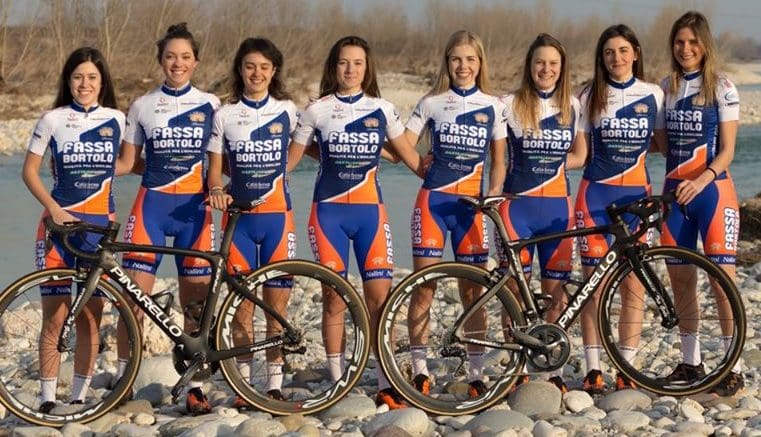
Top Girls Fassa Bortolo has never been the richest or most powerful team in women’s cycling, but longevity has given it a different kind of importance. The Italian project has existed in organised form since the 1990s and has been registered at UCI level since 2005, surviving repeated changes in the structure of the sport while continuing to give young riders a route into international racing.
Its story is closely tied to Spresiano in the Veneto region, to long-time sporting director Lucio Rigato and to Fassa Bortolo, the construction-products company based in the same town. Across two decades of UCI racing, the team has repeatedly functioned as a bridge between Italian junior or domestic racing and larger professional structures. The names that passed through early in their careers explain why that role matters more than the team’s modest victory count suggests.
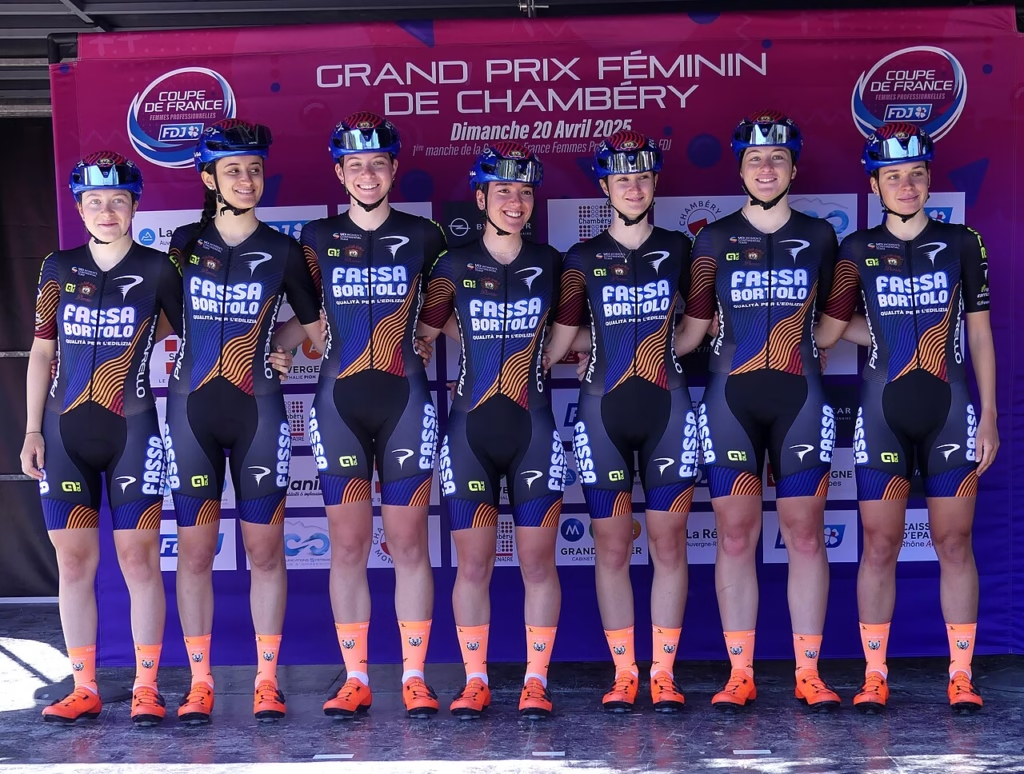
The roots pre-date the UCI team that appeared in 2005
The Top Girls project dates its origins to 1994, when Lucio Rigato established the team in Spresiano. The version that enters the international records most clearly began in 2005, when Top Girls Fassa Bortolo was registered as a UCI women’s team. That distinction is useful because it explains why different historical sources give different founding dates: the club and development structure came first, while the UCI team followed later.
Fassa Bortolo became the defining sponsor. The company had already been highly visible in men’s professional cycling through the Fassa Bortolo team of the early 2000s, but the women’s project was structurally separate and much more closely tied to local development. Top Girls Fassa Bortolo did not try to reproduce the men’s model with an expensive international roster built to win the biggest races immediately.
Instead, the team concentrated on giving younger Italian riders access to UCI racing. That approach became its most durable identity. Rosters changed, co-sponsors came and went and the category system around women’s cycling was rewritten several times, but they remained recognisable as the same organisation.
A remarkable number of major Italian riders passed through early
The list of riders associated with Top Girls Fassa Bortolo before they became established professionals is the strongest argument for the team’s historical significance. Giorgia Bronzini and Tatiana Guderzo both spent time within the project before becoming world road champions. Elisa Longo Borghini also rode for them early in her senior career before developing into one of the defining Italian riders of her generation.
Other riders who passed through include Annalisa Cucinotta, Marta Tagliaferro, Elena Berlato, Simona Frapporti, Barbara Guarischi, Soraya Paladin, Nadia Quagliotto and Francesca Cauz. The value of a development team is not measured only by how many of those riders win while still wearing its jersey. It is measured by how often the environment helps riders reach the next level.
That pipeline gave Top Girls Fassa Bortolo a place within Italian women’s cycling that was different from teams built around established leaders. Riders could learn international race positioning, longer stage races and the demands of the UCI calendar without immediately being expected to carry World Cup or WorldTour ambitions. The model was imperfect, but it filled a gap that formal development teams now occupy more deliberately.
 Photo Credit: Flaviano Ossola
The 2010 Ghezzi period briefly strengthened the sporting structure
One of the more important changes came in 2010, when Ghezzi joined Fassa Bortolo as a sponsor. The connection brought riders and staff across from Selle Italia-Ghezzi, including Walter Zini, Sigrid Corneo, Gloria Presti and Silvia Valsecchi. It was a moment when several strands of Italian women’s cycling overlapped inside one team.
ProCyclingUK’s Selle Italia-Ghezzi team history covers the other side of that transition. The Top Girls Fassa Bortolo version mattered because the reinforced roster lifted the team into a more competitive period. In 2010 it finished 12th in the world team ranking, one of the stronger positions in its UCI history, while Alessandra D’Ettorre was its leading individual rider.
The arrangement did not become a permanent merger. Zini and some of the riders later moved on and were involved in the creation of BePink, another important Italian project. The team returned to its familiar development-heavy structure, but the episode showed how fluid the Italian women’s team landscape remained before the WorldTour era.
Results mattered, but rider progression mattered more
Top Girls Fassa Bortolo rarely dominated the international calendar. Its strongest seasons were more often defined by good individual performances, youth classifications and riders developing into stronger professionals than by a long sequence of UCI victories. That can make the team look peripheral if history is reduced to a wins table.
The Giro d’Italia Women illustrated the model. They appeared repeatedly in the race during the 2000s and 2010s, and riders such as Elena Berlato and Francesca Cauz won youth classifications. The team did not win the overall Giro, but simply giving young riders repeated exposure to one of the hardest stage races in women’s cycling had development value that was difficult to replicate elsewhere.
The 2006 Giro provided one of the clearest examples of the collective strength the team could sometimes assemble, with Top Girls Fassa Bortolo taking the team classification. Later youth successes, including Berlato in 2011 and Cauz in 2013, fitted the same pattern from a different angle. The organisation was rarely built around buying a proven overall contender. Its better results came when several developing riders were strong enough to survive difficult stage races together, then carry that experience into the next phase of their careers.
In later years, the same pattern continued. Cristina Tonetti, Greta Marturano, Giorgia Bariani, Debora Silvestri and others used the team as part of their progression. Some moved to larger teams, some stayed longer, and some never made the next step, but the organisation kept supplying starts and contracts in a sport where those opportunities were limited.
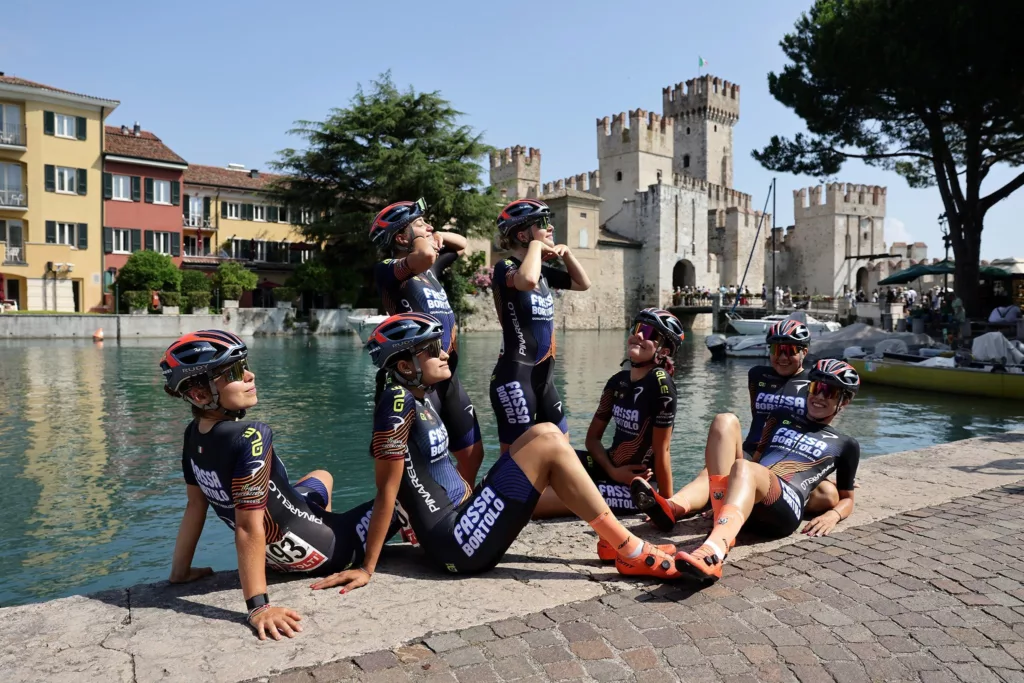
Tatiana Guderzo’s return in 2022 captured Top Girls Fassa Bortolo’s unusual continuity
Tatiana Guderzo’s return for the 2022 season was symbolically important. She had first ridden for them in the mid-2000s before becoming world champion in Mendrisio in 2009 and building a long career across several major teams. Returning at 37 placed one of the project’s earliest high-profile graduates alongside riders young enough to be beginning the same journey.
ProCyclingUK covered Guderzo’s return when the move was announced. Her role was not simply about results. An experienced world champion brought race knowledge to a roster dominated by riders in their late teens and early twenties, reinforcing the development function the team had always claimed.
The episode also demonstrated the durability of the organisation. Women’s teams frequently disappear before a rider has time to return to them a decade later. Top Girls Fassa Bortolo had lasted long enough for one of its former prospects to complete most of a career and then come back as the veteran in the room.
The Continental era has made survival harder, not easier
The introduction of the Women’s WorldTour and later Women’s ProTeam category changed the competitive landscape. Top Girls Fassa Bortolobecame a UCI Women’s Continental Team under the new structure from 2020, effectively sitting below increasingly professional and better-funded teams. The gap in staffing, salaries and race access has widened as the top of women’s cycling has improved.
That creates a difficult position for a development-focused Continental squad. The best young riders are now recruited earlier by WorldTeams, ProTeams and official development programmes, while access to WorldTour races is more restricted. ProCyclingUK’s analysis of the 2026 rules around Continental teams and WorldTour race invitations showed how narrow that space has become.
They nevertheless remained active in 2026 as an Italian Continental team. Its UCI roster still included riders such as Giorgia Bariani, Greta Marturano, Gaia Masetti, Debora Silvestri and Giorgia Vettorello, with Lucio Rigato continuing as sports director and Patrizia Zanette listed as team representative. Continuity that once seemed normal has become one of the organisation’s strongest assets.

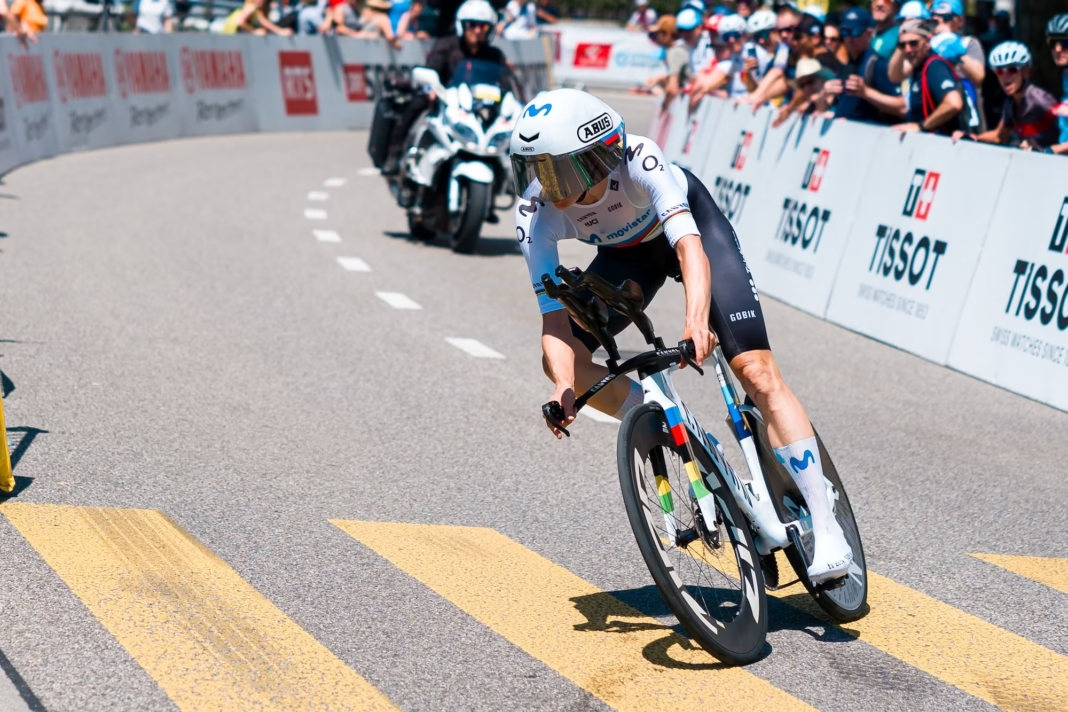
Why Top Girls Fassa Bortolo still matters in Italian women’s cycling
The simplest way to judge Top Girls Fassa Bortolo is to compare its resources with the teams above it and conclude that it has been left behind. That misses the function it has served. For years, Italian women’s cycling depended on small teams willing to employ riders before they were obvious international prospects. Top Girls Fassa Bortolo was one of the organisations that kept that pathway open.
Its longevity also preserves a link between very different eras. The project existed before women’s professional cycling had a WorldTour, before minimum standards improved and before development teams became a strategic priority for the richest organisations. It survived the shift into a more formal three-tier structure without losing the core identity built around young Italian riders.
The team’s story is therefore less about one defining victory than accumulation: years of starts, contracts, Giro appearances and riders who moved on to bigger things. Even individual announcements such as ProCyclingUK’s earlier contract updates form part of that continuity. In a sport where teams often vanish with a sponsor, Top Girls Fassa Bortolo has remained recognisably itself.

