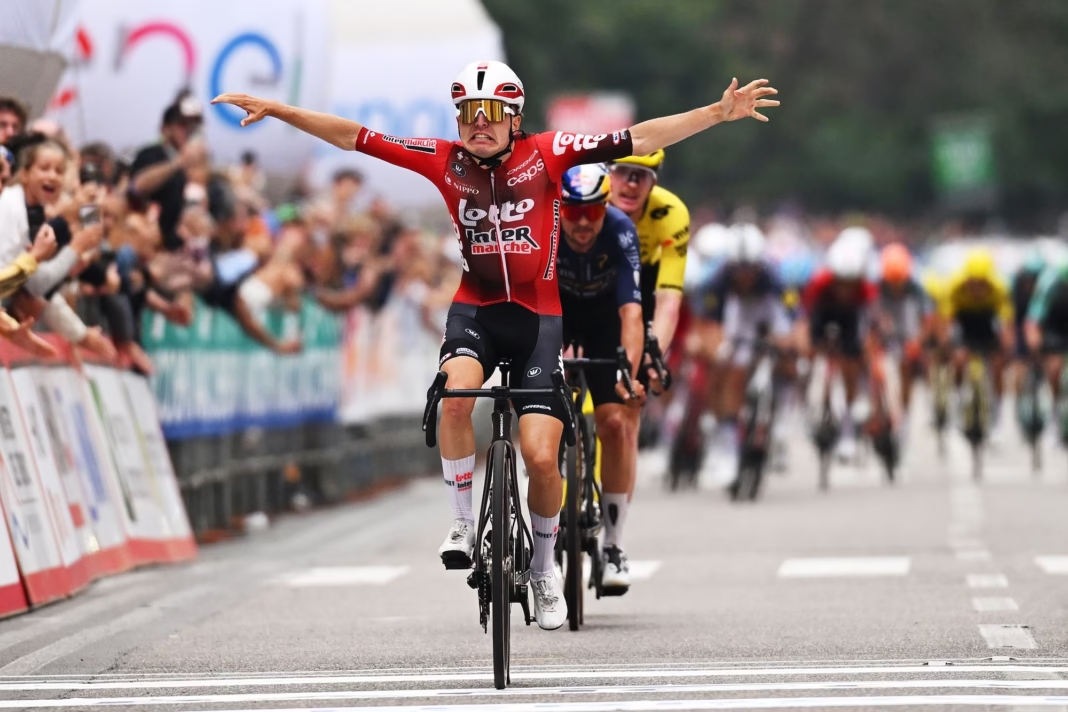
The Eneco Tour Women reaches its final day in Arnhem on Sunday 18 October, with a 70.1km circuit race bringing six days of competition to a close. The official start is at 12.30pm local time, or 11.30am BST, and the organisers expect the women to finish at approximately 1.15pm in the UK. It is a short stage, but there is enough climbing, cornering and repeated acceleration to make the final classification far from a formality.
Arnhem is familiar territory for the Dutch women’s peloton, and the roads have already produced dramatic racing in national championships and previous editions of the event. For anyone following the race from Britain, the key is to distinguish the women’s timetable from the men’s race, which uses the same host city but a longer route and a later expected finish.
Eneco Tour Women stage 5 start and finish times
The official Arnhem timetable puts the women’s team presentation at 11.15am CEST (10.15am BST), the race start at 12.30pm CEST (11.30am BST), the expected finish at 2.15pm CEST (1.15pm BST) and the podium ceremony at 2.30pm CEST (1.30pm BST). The stage starts and finishes on Zijpendaalseweg, on the northern side of Arnhem. All finish times are estimates, and the race can run ahead of or behind schedule depending on the speed of the peloton.
These times come from the organiser’s current stage programme. Some third-party listings give an earlier start or a different estimated finish, so the event timetable is the appropriate reference. The men’s stage is 149.2km, with a finish scheduled for 3.45pm CEST, which is 2.45pm BST. Do not use the men’s finishing time when planning to watch the women’s finale.
For a race this short, checking the broadcast or live tracker shortly before 11.30am BST is sensible. There is unlikely to be a long settling-in period, and an early break could immediately put pressure on the teams defending the general classification. The time of the finish also means that viewers joining around lunchtime may have missed much of the decisive racing.
How to watch and follow the women’s race in the UK
Coverage arrangements differ between countries and between the men’s and women’s events. Eurosport is listed for the women’s finale in some European markets, while race-day viewing information also points towards Max. Neither establishes that a particular UK subscription or channel carries the complete women’s stage, so viewers should check the UK listings for HBO Max and the Eurosport-branded cycling coverage before relying on either service. An overseas broadcast listing is not proof of UK availability.
The official Eneco Tour website provides the stage timetable, route and links to the event’s live coverage and results. It is also the best place to check for late changes to the schedule. If a live video feed is unavailable, the event’s live updates and classification pages are the next best option. Social updates from teams and riders can add useful detail about attacks or incidents, although they should not be treated as the definitive classification.
The practical viewing window is compact: have coverage ready by 11.30am BST, expect the race to develop rapidly through the first hour, and allow some flexibility around the projected 1.15pm finish. A close general classification may not be settled until bonuses and any time gaps have been checked. Official results are particularly important when several riders finish together or a late attack survives by a small margin.
Arnhem route: eight laps and repeated changes of pace
The route is officially classified as flat, but that description conceals a rolling urban circuit. After the neutralised departure on Zijpendaalseweg, the riders head towards Deelenseweg and return through the northern streets of Arnhem. The circuit uses roads including Cattepoelseweg, Beethovenlaan, Kluizeweg, Wagnerlaan, Apeldoornseweg and Sonsbeekweg, with eight full laps of approximately 8.1km following the opening section.
The course has repeated bends and short rises rather than a long categorised climb. That changes the demands on the bunch: riders must move up before corners, accelerate back to speed and avoid being caught too far behind when attacks go. A compact circuit also gives teams repeated opportunities to identify where the race is likely to split, but it leaves fewer kilometres to recover if they misjudge an acceleration.
Route analysis published ahead of the stage estimates roughly 700 metres of climbing across the race, despite its flat label. Exact elevation figures differ between route providers, so that should be treated as an indication of cumulative effort rather than a definitive measured total. The finishing approach is not a mountain-top test, but fatigue from repeated rises and corners could make the final sprint less straightforward than on a broad, straight road.
There is a useful precedent from the 2024 Dutch national road race championships, which used these roads as part of a longer event. Chantal van den Broek-Blaak escaped late and held on for the title, while Mischa Bredewold won the sprint for second behind her. That race was longer and cannot be transferred directly to this 70.1km finale, but it shows that the circuit can reward a decisive attack rather than automatically producing a bunch sprint.
What could decide the stage and the general classification?
The short distance should encourage aggressive racing from the opening kilometres. A strong breakaway containing riders without an immediate general classification threat might be allowed some room, but a dangerous move will force the leading teams to react quickly. Sprinters’ teams face a different calculation: they need enough riders to control attacks while preserving their lead-out for the closing kilometres.
The overall contenders have to think about bonus seconds as well as actual gaps on the road. A rider only a handful of seconds behind can gain time through intermediate opportunities or the stage finish, while a split created by a late attack may have a larger effect. The organiser’s race regulations and confirmed intermediate results determine precisely how those bonuses apply; there is no reason to assume that a close classification is settled before the finish.
Arnhem has already seen a last-day general classification reversal in this race’s earlier form. In 2024, Lotte Kopecky won the concluding stage and overturned Franziska Koch’s lead. That precedent is especially relevant on a circuit where the combination of a stage win and time bonuses can change the standings. The comparison does not predict the 2026 outcome, but it explains why teams near the top of the classification cannot simply follow wheels and wait for the podium.
Positioning may prove as important as raw sprint speed. Riders who can move through the bunch efficiently and carry speed through the bends will save energy on every lap. A rider repeatedly forced to chase out of corners may have little left for the final kilometre, even if the stage profile appears favourable. Conversely, a well-organised team can make the same technical sections work in its favour by keeping its leader near the front.
The route to Arnhem: how the six race days have unfolded
The event began with a 3.1km prologue in The Hague on Tuesday 13 October, followed by a 79.5km road stage around Ede. Thursday brought a 13.6km individual time trial in Tilburg, before the race moved to the more demanding roads of Sittard and Watersley on Friday. Saturday’s 114.1km stage from Hoogeveen to the VAM-berg added another climbing test before the final circuit race.
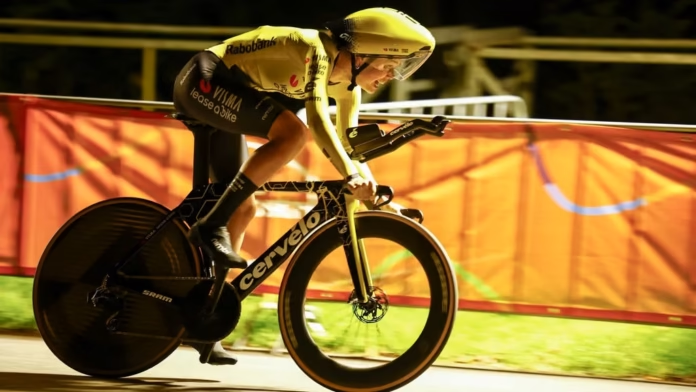
Lieke Nooijen won the opening prologue and the Tilburg time trial, demonstrating how much the two efforts against the clock mattered in this edition. Sandrine Tas took the Ede road stage. The VAM-berg then provided a different kind of test, with its steep ramps favouring riders able to produce repeated efforts rather than those relying on sustained flat-road speed.
That variety matters when assessing Arnhem. Riders who have lost time in the time trials may need to attack, while those carrying fatigue from the VAM-berg could find the repeated accelerations uncomfortable. Teams protecting an overall position will have to balance controlling the race with avoiding unnecessary expenditure before the last laps. The stage is short enough for a determined group to make that balance difficult.
More Eneco Tour Women coverage
For the complete six-day programme, including the time trials and VAM-berg stage, read ProCyclingUK’s Eneco Tour Women route guide. The race’s move from the Simac Ladies Tour name and its change of calendar position are explained in our background guide to the Eneco Tour Women.
The organiser’s Arnhem stage page carries the current programme and route maps. For viewers checking the race on Sunday morning, that is the most reliable place to confirm any timetable changes before the women’s start.