
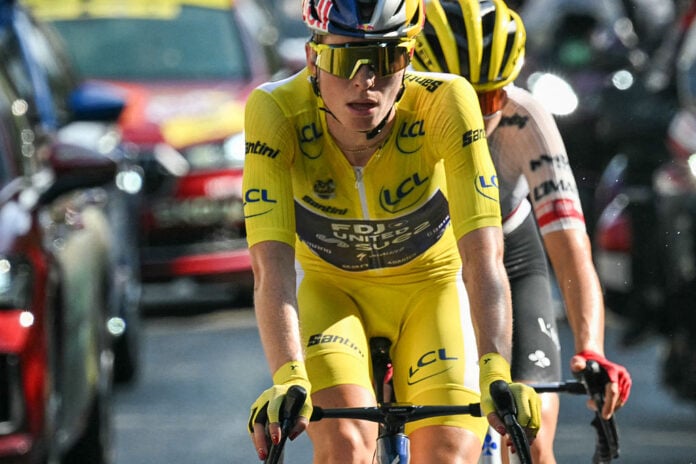
Demi Vollering’s second Tour de France Femmes victory changes the way her career has to be judged.
Winning the Tour once, in 2023, confirmed her as the leading stage racer of a new generation. Winning it again in 2026, after losing by four seconds to Kasia Niewiadoma-Phinney in 2024 and finishing second behind Pauline Ferrand-Prévot in 2025, gives the achievement more historical weight. This is no longer a career defined primarily by the Tourmalet, the Alpe d’Huez heartbreak or the succession from Annemiek van Vleuten. Vollering has built a stage-racing record substantial enough to stand on its own.
She is now the first two-time winner of the modern Tour de France Femmes, has won the current Giro, Tour and Vuelta, and has combined those stage-race victories with an increasingly deep Classics record. The obvious comparison is still Van Vleuten, the rider who set the modern benchmark for women’s Grand Tour racing, but Vollering has moved from being her successor to being a legitimate historical rival.
Van Vleuten’s complete career remains stronger. Vollering, though, is getting closer.
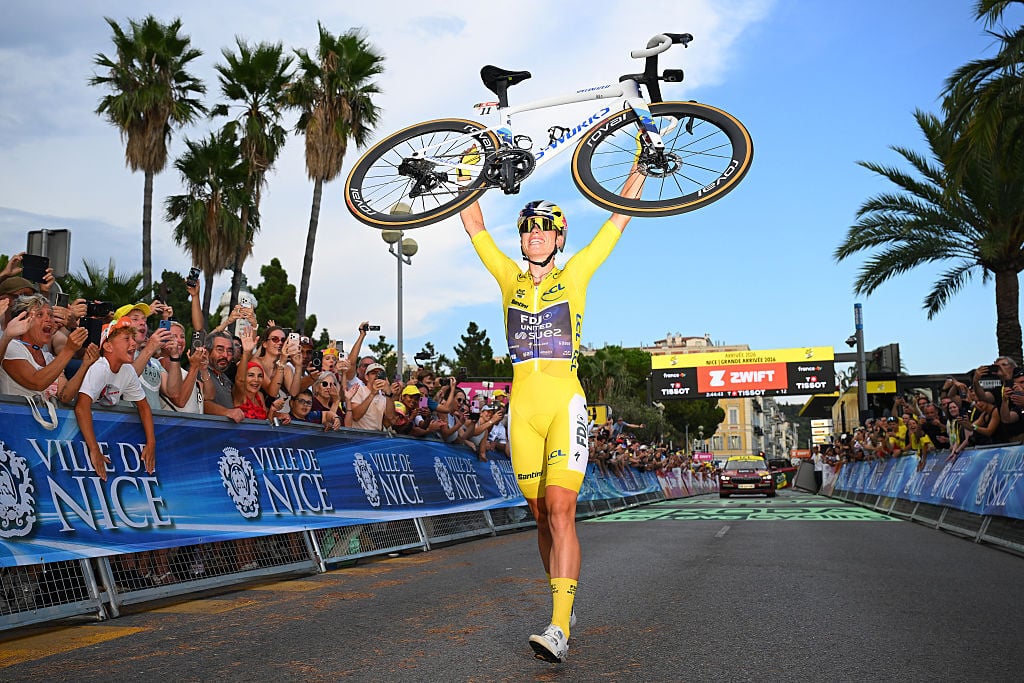
A second Tour changes the shape of Vollering’s career
The importance of the 2026 victory is not simply that it adds another yellow jersey.
Vollering had already won the Tour in 2023, dominating the upper slopes of the Col du Tourmalet before completing the victory in the Pau time trial. Since then, the Tour has repeatedly tested her in very different ways. She lost the 2024 edition by four seconds after an extraordinary final-stage attack on Alpe d’Huez, then finished second again in 2025 as Ferrand-Prévot dominated the final mountain weekend.
Returning to win in 2026 means those defeats now sit inside a much broader Tour record rather than standing as the obvious counterweight to her first victory.
The numbers are exceptional. Across the first five editions of the modern Tour de France Femmes, Vollering has finished first twice and second three times. No other rider has been remotely as consistent across the race’s short modern history.
The wider list of champions is covered in our Tour de France Femmes winners guide, but Vollering is now the first name to appear twice.
Demi Vollering’s major palmarès
Vollering’s Tour record makes more sense when placed alongside the rest of what she has already won.
Grand Tours and major stage races
- Tour de France Femmes: 2023, 2026
- Giro d’Italia Women: 2026
- La Vuelta Femenina: 2024, 2025
- Itzulia Women: 2022, 2024, 2025
- Vuelta a Burgos Feminas: 2023, 2024
- Tour de Romandie Féminin: 2023
- Tour de Suisse Women: 2024
- Volta Ciclista a Catalunya Femenina: 2025
- Setmana Ciclista Valenciana: 2026
Major one-day victories
- Liège-Bastogne-Liège Femmes: 2021, 2023, 2026
- La Flèche Wallonne Féminine: 2023, 2026
- Amstel Gold Race: 2023
- Strade Bianche Donne: 2023, 2025
- Dwars door Vlaanderen: 2023
- La Course by Le Tour de France: 2021
- European road race championship: 2025
- Dutch road race championship: 2023
That is not an exhaustive list of every professional victory, stage win or classification she has taken, but it shows why the discussion around Vollering has moved beyond simply asking whether she is the best stage racer currently competing.
She has already won across almost every type of terrain that matters in women’s road cycling.
Her 2026 season guide had already begun documenting another major year before the Giro and Tour transformed it into something much bigger.
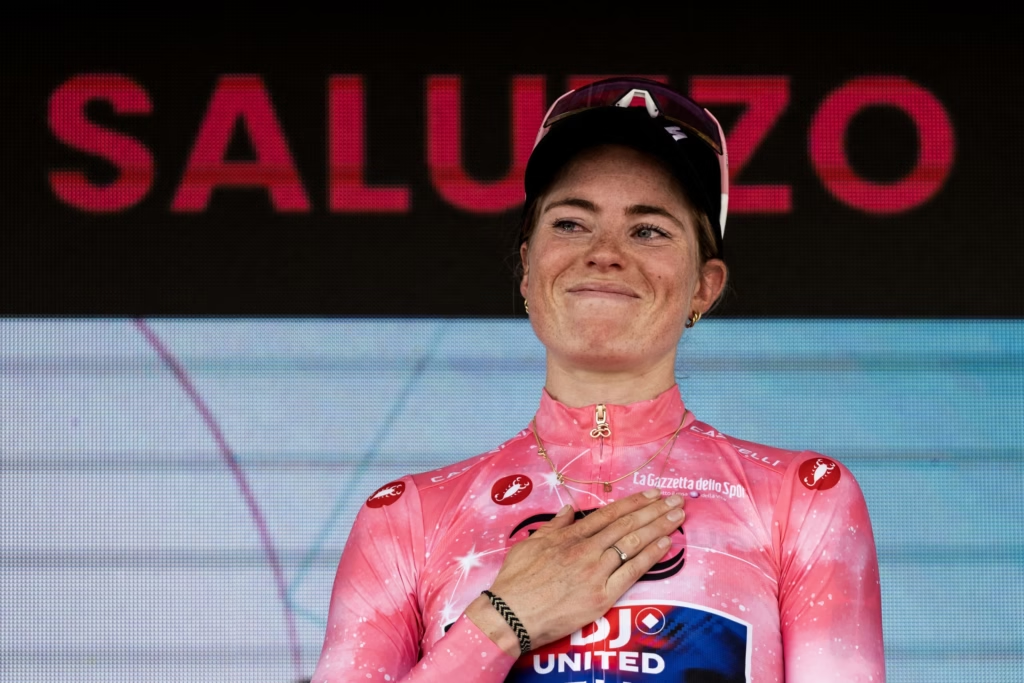
Completing the Giro-Tour-Vuelta set put her into rare company
The Giro victory earlier this season was important before Vollering ever arrived at the Tour.
She went into the final stage of the 2026 Giro d’Italia Women 49 seconds behind Anna van der Breggen and still found a way to overturn the race.
That victory completed the set of the three current major women’s stage races. Vollering had already won the Tour and La Vuelta Femenina, and the Giro gave her a victory in all three.
Only Van Vleuten had previously completed that particular collection.
The distinction is imperfect because women’s Grand Tour history has evolved significantly over time, with the Spanish race changing format and status and the modern Tour only beginning in 2022. Even so, winning all three current events is one of the clearest available measures of all-round stage-racing excellence.
Vollering has now done more than complete the set.
She has started accumulating repeat victories.
Five major stage-race titles put Van Vleuten within sight
Vollering now has five victories across the current Giro, Tour and Vuelta:
- Tour de France Femmes: 2
- La Vuelta Femenina: 2
- Giro d’Italia Women: 1
Van Vleuten remains ahead in the equivalent modern races, principally because of her extraordinary Giro record. She won the Italian stage race four times, as well as the 2022 Tour and 2023 Vuelta, while also winning earlier editions of the Spanish Challenge by La Vuelta before it developed into its present form.
That is why declaring Vollering the greater stage racer would still be premature.
But the gap is no longer abstract.
Vollering is not simply the strongest stage racer to appear after Van Vleuten retired. She is building a collection of victories which can increasingly be compared directly with Van Vleuten’s rather than judged as a separate, smaller body of work.
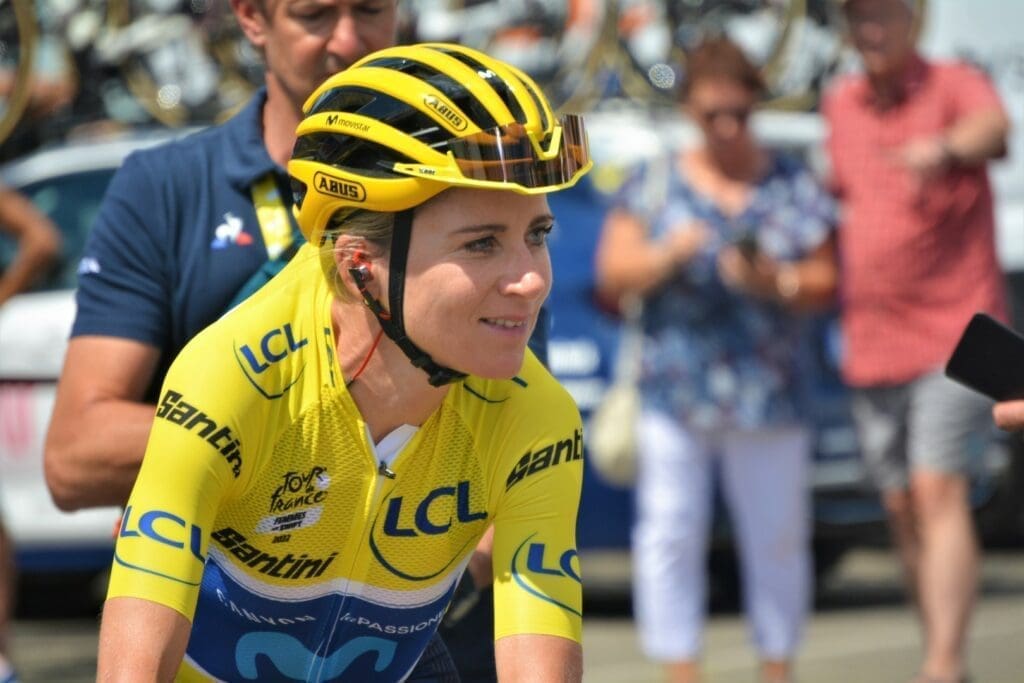
Van Vleuten remains the historical benchmark
Van Vleuten’s advantage in any wider career comparison is still substantial.
Her greatness was never confined to stage races. She won world road and time-trial titles, Olympic gold, major Classics and some of the most spectacular long-range victories of the modern era. Her 2022 season, when she won the Giro, Tour and Spanish stage race before adding the road world title, remains an extraordinary benchmark.
She also had a particular ability to make the hardest stage races feel inevitable.
At her peak, Van Vleuten could use sustained climbing and time-trial power to create gaps measured in minutes. Her 2022 Tour de France Femmes is the obvious example: after illness had threatened her race early, she blew the GC apart in the Vosges and was effectively untouchable thereafter.
Vollering’s dominance has usually looked different.
She can produce the long sustained climbing effort, but she also wins through acceleration, positioning, bonus seconds, tactical aggression and finishing speed. The 2026 Tour showed nearly all of those qualities within a single race.
That makes her a different type of dominant stage racer rather than a direct copy of Van Vleuten.
Vollering has become more versatile as her career has developed
The 2023 version of Vollering was already extraordinarily complete.
That spring she won Strade Bianche before taking all three Ardennes Classics, Amstel Gold Race, La Flèche Wallonne and Liège-Bastogne-Liège, and then added the Tour de France Femmes later in the season.
It was one of the clearest demonstrations that she could dominate both one-day races and stage races.
The seasons since have broadened the picture rather than narrowed it. She became a two-time Vuelta winner, won Strade Bianche again, took the European road title and, in 2026, added both the Giro and another Tour to her palmarès.
Her third Liège victory this spring was another significant historical marker. Vollering attacked on La Redoute and rode solo to Liège, becoming the first woman to win the race three times, a result we looked at in what Liège-Bastogne-Liège Femmes 2026 meant for the season.
That breadth is important because the comparison with Van Vleuten cannot be reduced to Grand Tour totals alone.
Great stage racers are usually great because they can solve several different forms of racing.
Vollering increasingly can.
 Photo Credit: Getty
The four seconds from 2024 still matter
The closest Vollering has come to being defined by defeat was the 2024 Tour de France Femmes.
She entered as defending champion, crashed while wearing yellow on Stage 5 and lost 1:47. On the final day she attacked across the Col du Glandon, won on Alpe d’Huez and recovered almost all of the deficit to Niewiadoma-Phinney.
Almost.
Four seconds remained.
There are sporting defeats where the margin is large enough to make the explanation straightforward. That was not one of them. Four seconds inevitably turned every small incident from the previous week into a potential answer. The crash mattered. Positioning mattered. Team support mattered. Bonus seconds mattered.
Vollering had been strong enough to win the Tour and still did not win it.
At the time, it looked like the sort of result capable of following a rider for the rest of her career.
The 2026 victory has not erased it, but it has changed what the four seconds mean.
The same rivalry produced a completely different ending in 2026
The symmetry between 2024 and 2026 was already striking before the final stage.
Two years earlier, Vollering began the last day 1:15 behind Niewiadoma-Phinney and reduced the entire Tour to four seconds.
This time Vollering started eight seconds ahead.
The roles had reversed, but the historical pressure was obvious. Niewiadoma-Phinney had already taken yellow away from her with a brilliant attack on Mont Ventoux, and then Vollering reclaimed it on Stage 8 around Nice.
The two riders therefore arrived at another final mountain stage with the race balanced between them, something explored in our comparison of the 2024 and 2026 Tours.
What made the ending significant was that Vollering did not merely survive.
She attacked the final Col d’Èze, won Stage 9 by 1:04 and finished the Tour 1:18 ahead of Niewiadoma-Phinney.
The rider who had once watched a Tour disappear by four seconds returned to the same rivalry and made sure the final calculation was no longer close.

The 2026 Tour may be more revealing than her first win
The 2023 Tour remains the breakthrough victory and may always carry the greater symbolic importance.
Vollering’s Tourmalet performance was the day she went from obvious contender to Tour de France champion. It confirmed the change in hierarchy after the retirement of Van Vleuten and established Vollering as the rider the rest of the peloton had to beat in major stage races.
But the 2026 victory arguably tells us more about her as a racer.
She did not dominate uninterrupted. Marlen Reusser beat her in the Dijon time trial. Niewiadoma-Phinney outmanoeuvred her on Mont Ventoux. Vollering then had to learn from that tactical error almost immediately, attacking on Stage 8 rather than waiting for Sunday’s expected showdown.
The final stage added the last layer. She could have defended eight seconds, followed Niewiadoma-Phinney and tried to calculate her way into Nice. Instead she attacked and won the stage by more than a minute.
The tactical progression across that final weekend is covered in our companion piece on how Demi Vollering won the 2026 Tour de France Femmes.
The historical importance is that this was not the same victory twice.
She found a different way to win.
Winning after changing teams strengthens the argument
Vollering’s first Tour victory came with SD Worx, the dominant women’s team of its era.
Her second has come with FDJ United-Suez.
That matters.
It would be simplistic to argue that her SD Worx success was created by the team around her. Vollering still had to produce the Tourmalet performance which decided the race. But changing teams inevitably asks a different question of any dominant rider: can the results continue when the support structure, teammates and tactical culture change?
Vollering’s answer has been emphatic.
She won La Vuelta Femenina in her first season with FDJ, finished second at the Tour, ended 2025 as the number one rider in the UCI World Ranking and then added the Giro-Tour double in 2026.
FDJ have unquestionably become stronger around her, but Vollering has also shown that the winning habit travelled with the rider.
The 2025 Vuelta Femenina victory was an early indication that the new project could produce major stage-race wins. The Giro and Tour have taken it much further.
 Photo Credit: Getty
Her Tour consistency may become the hardest record to match
The modern Tour de France Femmes is still too young for its records to have the permanence of the men’s race, but Vollering has already set a standard which could prove difficult to reproduce.
Five starts.
Two victories.
Three second places.
She has never finished outside the top two.
That is arguably as important as being the first rider to win the race twice. Stage racing rewards consistency across days, but Tour history ultimately rewards consistency across years as well.
Van Vleuten won the first modern edition and then retired after the following season. Niewiadoma-Phinney has won once. Ferrand-Prévot has won once. Vollering has been a central part of the yellow jersey contest every single year.
It already makes the early history of the race difficult to separate from her career.
Niewiadoma-Phinney has helped shape the legacy
Great riders benefit historically from having rivals capable of exposing their weaknesses.
Niewiadoma-Phinney has repeatedly done that to Vollering.
Their strengths are different enough to make the contest interesting. Vollering has the greater ability to create separation through pure climbing power and acceleration. Niewiadoma-Phinney is unusually good at recognising situations where the strongest rider is tactically uncomfortable and attacking before the obvious moment.
Mont Ventoux in 2026 was a perfect example. Niewiadoma-Phinney attacked while Vollering and Reusser watched one another, turning their hesitation into a stage victory and yellow jersey.
Vollering’s response is part of what strengthens this Tour historically. Rather than simply being stronger from the outset, she was forced to adjust to the way her rival raced.
Stage 8 was the tactical answer.
Stage 9 was the physical one.
Without Niewiadoma-Phinney, Vollering may still have accumulated many of the same victories. They would not tell quite as rich a story.
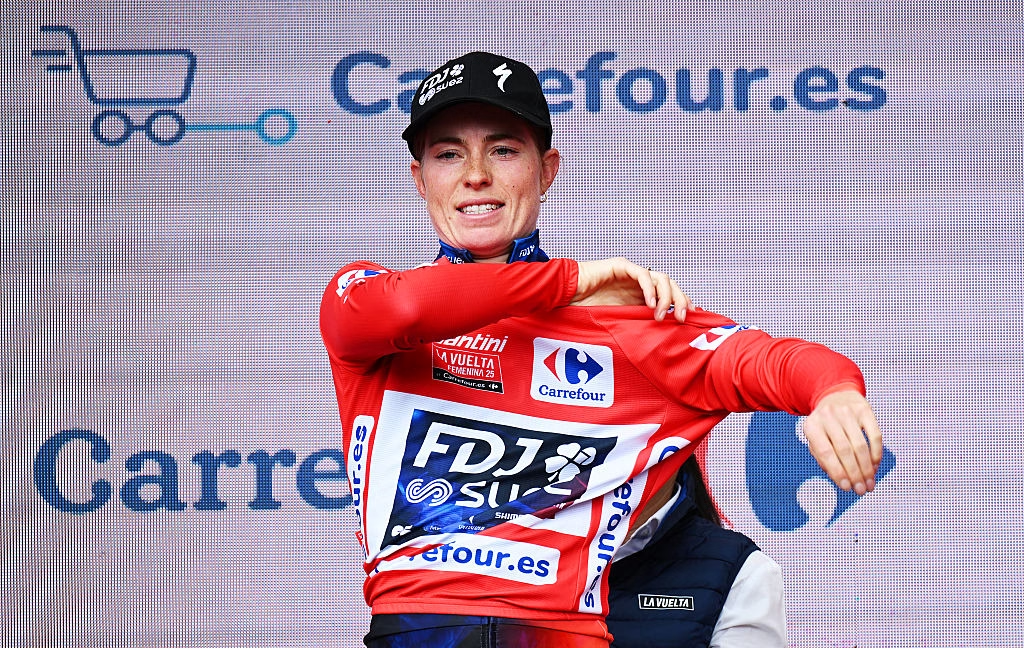
Where does Vollering now rank?
It is difficult to produce one definitive ranking across different eras of women’s cycling because the sport itself has changed too much.
The current Tour did not exist for most of Marianne Vos’s prime. The Vuelta has developed rapidly in status and format. The Giro has a much longer history, while calendar depth, team structures and race coverage have all changed substantially.
But within modern stage racing, there are now very few riders who can reasonably be placed above Vollering.
Van Vleuten remains one.
Anna van der Breggen’s career, with four Giro victories, Olympic and world titles and an extraordinary Classics record, also belongs in any broader discussion of the greatest stage racers and all-round riders of the era.
Vollering is now firmly part of that group rather than sitting immediately below it.
Her career is also unfinished, which makes the comparison increasingly interesting.
-
 Photo Credit: Getty
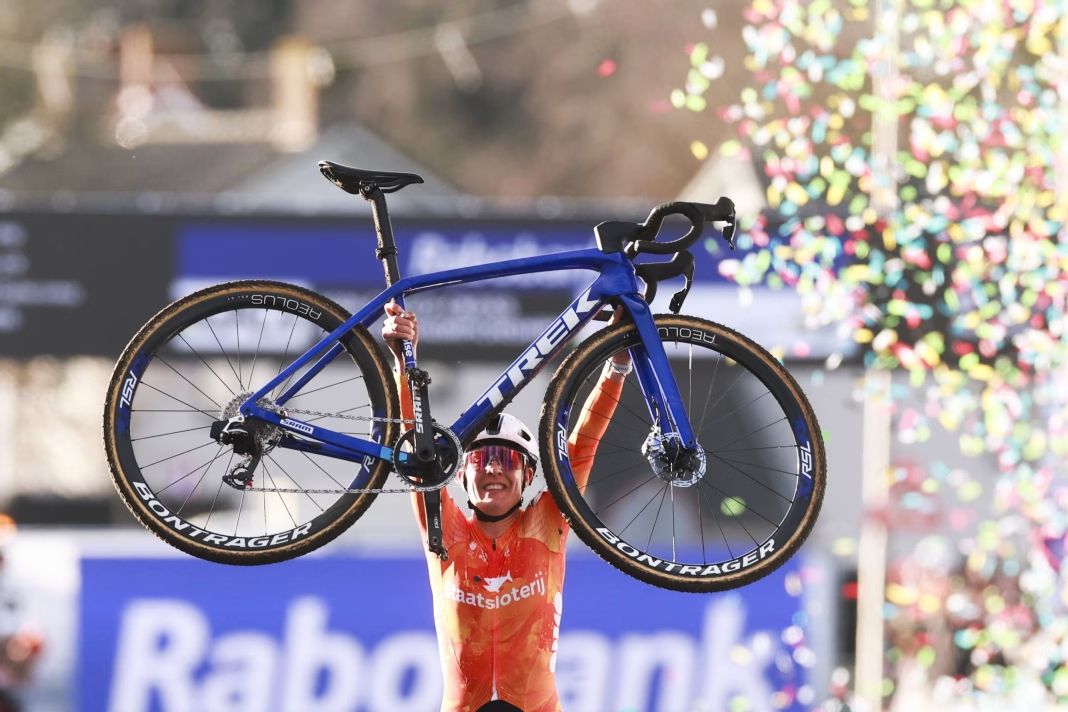

The biggest gap in the historical case is obvious
For all of Vollering’s stage-racing and Classics success, there are still achievements missing which prevent the Van Vleuten comparison becoming a straightforward argument over Grand Tour totals.
Vollering has not won the elite road world championship.
She has not won Olympic road gold.
Van Vleuten did both, and also became world time-trial champion twice.
Those are substantial differences.
Vollering has won the European road title and has collected medals at world level, but adding a rainbow jersey would change her historical standing almost as significantly as this second Tour has.
There is still room for the career to become considerably bigger.
What this Tour changes
Before the 2026 Tour, Vollering was already one of the defining riders of her generation.
After it, she has a stronger claim to something larger.
She is the first two-time champion of the modern Tour de France Femmes, has won all three current major women’s stage races and has accumulated enough Classics success that her career cannot be described as specialist domination of one discipline.
Most importantly, she has now won the Tour through two very different versions of herself.
The 2023 champion was the rider who overwhelmed the race on the Tourmalet.
The 2026 champion was forced to absorb setbacks, make tactical corrections and then attack from yellow on the final day when simply following would probably have been enough.
That is why the four seconds from 2024 remain relevant. They are evidence of how close Vollering came to a very different Tour history, but also of what happened afterwards.
She came back, won the Vuelta again, completed the Giro-Tour-Vuelta set, became the first rider to win the modern Tour twice and finally returned to another last-day battle with Niewiadoma-Phinney.
This time she did not leave four seconds to discuss.

