
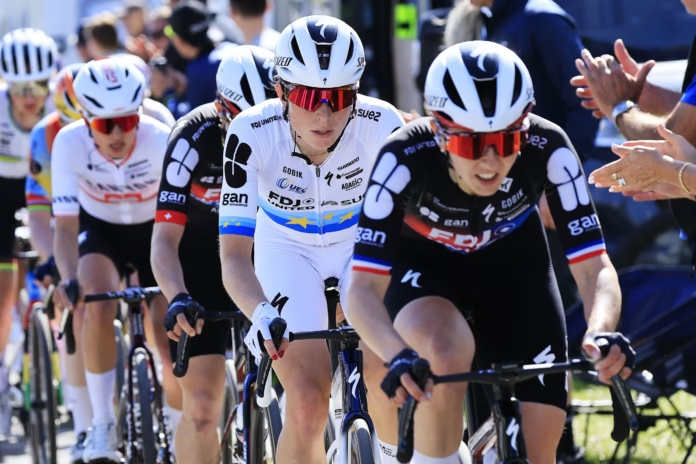
Tour de France Femmes riders routinely average close to 40km/h across an entire stage race, can push beyond 50km/h during short time trials, exceed 60km/h in sprint finishes and reach much higher speeds again on fast descents.
Those numbers become more impressive once the terrain is considered.
The 2025 Tour de France Femmes was the fastest edition of the modern race, with Pauline Ferrand-Prévot completing the nine stages at an overall average of just over 39km/h, despite a route that finished with major mountain stages.
Individual race days can be considerably faster. Stage 1 of the 2024 Tour de France Femmes was won at 45.057km/h, while Lorena Wiebes averaged 44.232km/h across 163.5km when she won Stage 3 in 2025. Those figures fit a wider trend explored in our feature on why women’s cycling sprint finishes are getting faster.
The important point is that there is no single answer to how fast Tour de France Femmes riders go. A rider climbing Mont Ventoux at 18km/h can be producing one of the strongest performances of the race, while someone sitting inside the peloton at 45km/h on a flat road may be using considerably less energy.
What is the average speed at the Tour de France Femmes?
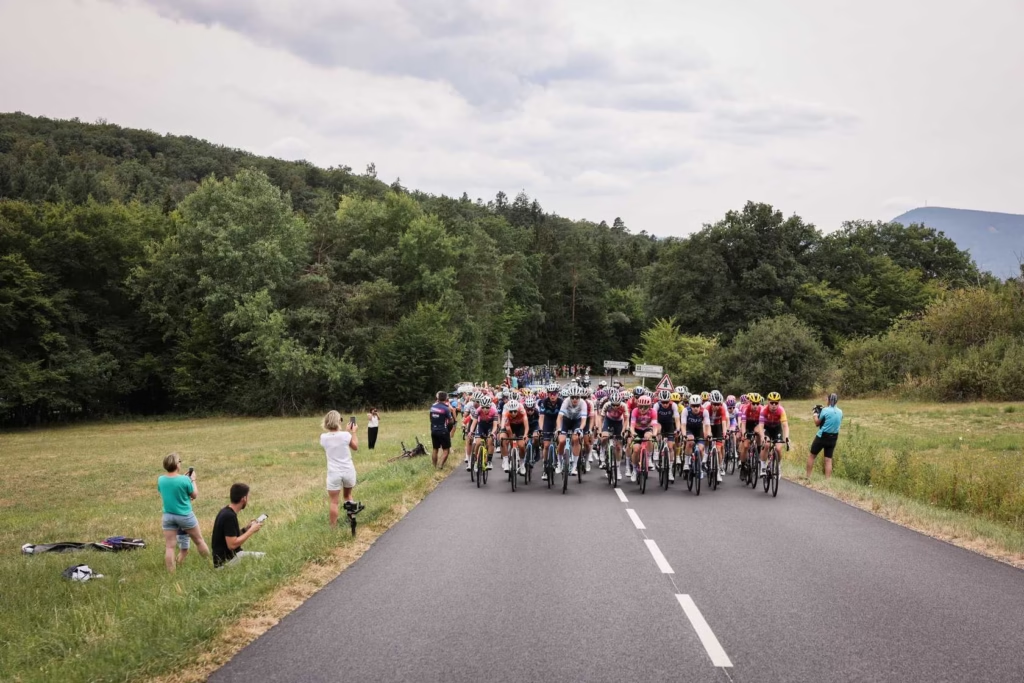
A useful modern benchmark is around 38 to 40km/h, or roughly 24mph, for the overall race average.
The exact figure depends heavily on the route.
A flatter edition naturally produces a higher average than one containing long summit finishes, while wind, weather and tactics can change the pace enormously from one year to another.
The riders are also not travelling steadily at 39 or 40km/h.
That overall average can include long periods above 45km/h on flat roads, climbs at less than 20km/h, descents above 70km/h and tactical sections where the peloton slows dramatically because nobody wants to chase.
The average is useful.
The variation is what makes the performance extraordinary.
How fast is 40km/h on a bike?
Forty kilometres per hour is about 25mph.
A strong recreational cyclist may be able to reach that speed comfortably on a flat road and maintain it for a period with favourable conditions.
Tour de France Femmes riders can average close to that speed for several hours, then do it again the next day.
And the next.
They are also repeatedly accelerating far above the average to follow attacks, move through the peloton, chase breakaways and position for climbs or sprints.
It is that combination of sustained speed and repeated high-intensity efforts that separates professional racing from simply riding quickly.
How fast do riders go on flat Tour stages?
On a conventional flat stage, the peloton will often spend substantial periods travelling at 40 to 45km/h.
The speed can initially be lower if a small breakaway escapes and the sprint teams are happy with the situation.
As the finish approaches, everything changes.
Once teams begin chasing properly, the bunch can maintain 45 to 50km/h for long sections.
Inside the final 10km of a sprint stage, the speed can climb towards 50 to 60km/h as several teams simultaneously try to move their sprinters and GC leaders forward.
That is why a supposedly straightforward flat stage can become one of the most stressful days of the race.
Sprint finishes are getting faster
The modern women’s peloton has become noticeably faster on sprint stages.
One useful comparison comes from the UAE Tour Women, where Wiebes won Stage 2 in 2025 at an average of 48.407km/h, the fastest recorded Women’s WorldTour stage.
At the Tour de France Femmes, Charlotte Kool’s Stage 1 victory in 2024 came at 45.057km/h, while Wiebes averaged 44.232km/h over the much longer Stage 3 in 2025.
Those are whole-stage averages, not sprint speeds.
The final acceleration is considerably faster.
As explained in our feature on why women’s sprint finishes are getting faster, the increase is not only about stronger sprinters. Better lead-outs, deeper teams, improved aerodynamics and more specialised training mean the entire approach to the sprint is now being ridden faster.
How fast is a Tour de France Femmes sprint?
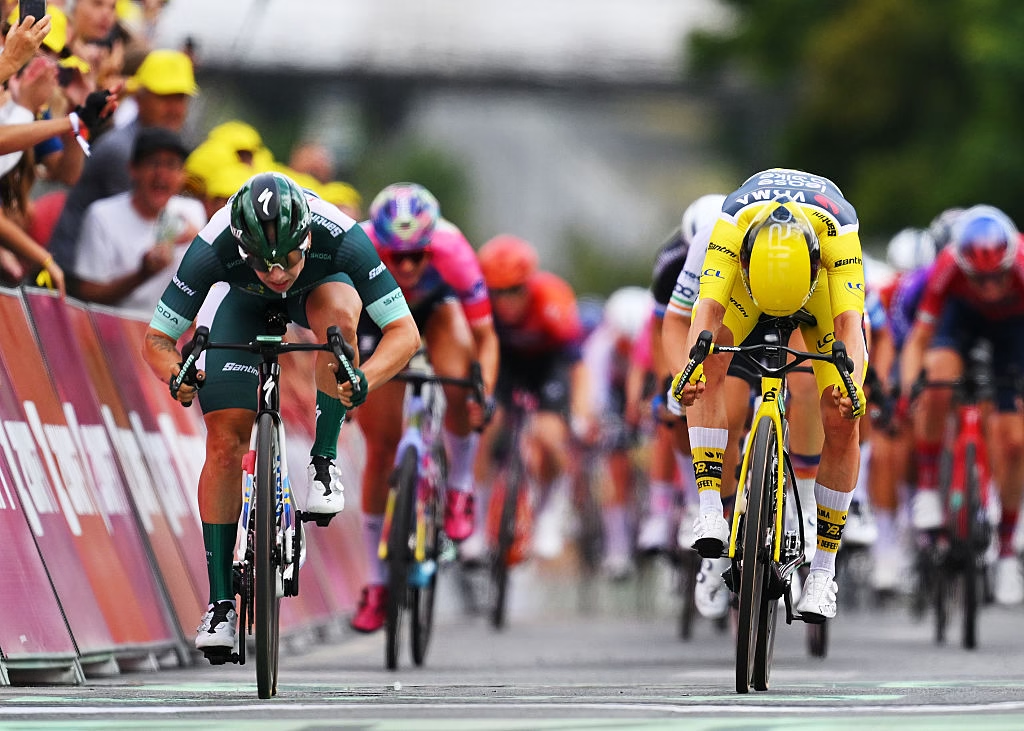
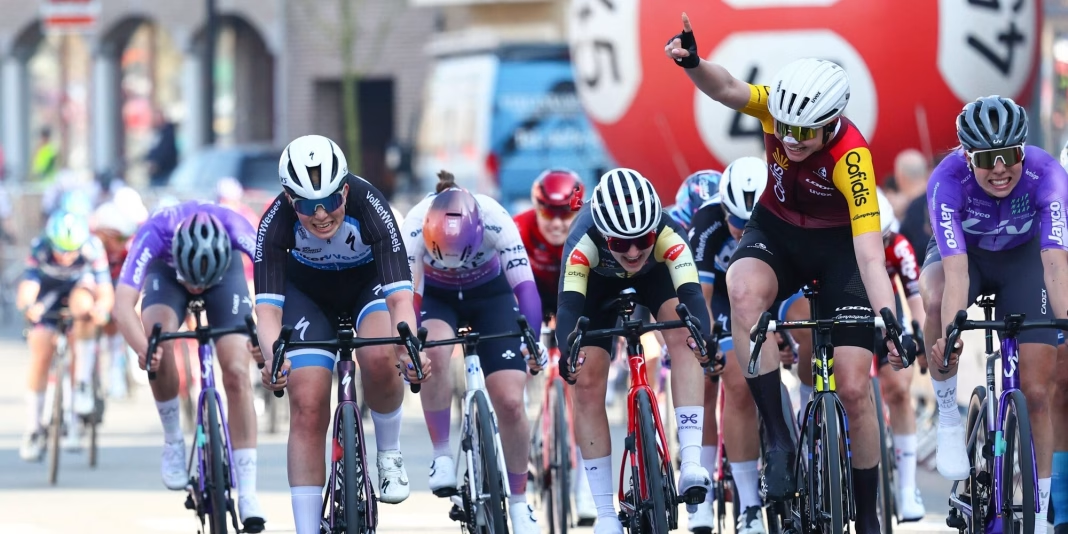
The fastest women in professional cycling can exceed 60km/h during a bunch sprint.
The exact maximum depends heavily on the finish.
A tailwind or slight downhill can produce much higher speeds than an uphill drag into a headwind. The rider’s speed when launching also matters.
A sprinter such as Wiebes may already be travelling at 55km/h behind her lead-out before she begins the final acceleration.
That means the sprint is not a standing start from 30km/h.
It is an additional burst of power on top of an already extremely fast lead-out.
How does a Tour sprint actually reach 60km/h?
The sprint starts long before the final 200 metres.
Teams first control the breakaway, then begin fighting for position several kilometres from the finish.
Lead-out riders take turns producing short, hard efforts while keeping the sprinter protected from the wind.
The final teammate then tries to launch the sprinter near the front at high speed.
Our guide to how a bunch sprint works in cycling explains how those roles fit together and why the fastest rider does not necessarily win.
By the time the sprinter launches, the race may already be travelling around 55km/h.
The final sprint simply pushes it faster.
Why does 60km/h not always look fast on television?
Television makes cycling speed difficult to judge.
The camera motorcycle or helicopter is travelling with the riders, removing much of the visual reference that tells us how quickly they are moving.
A sprint at 65km/h can therefore look surprisingly controlled.
A roadside camera gives a very different impression.
The peloton flashes past almost instantly.
The effect is even stronger during the lead-out, when dozens of riders can be travelling above 50km/h while separated by very small gaps.
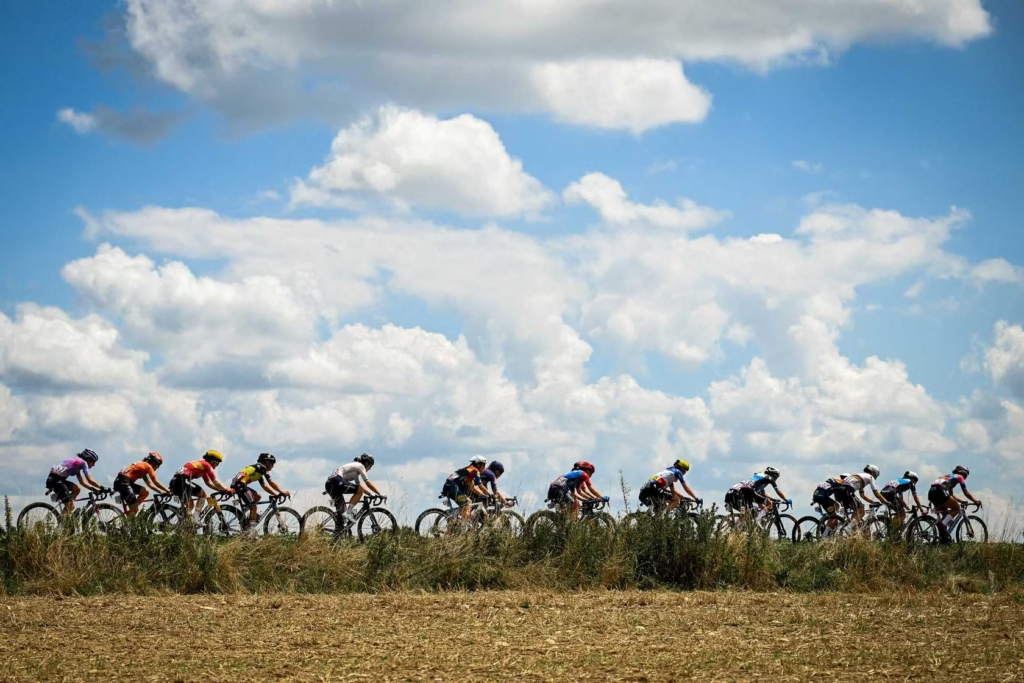 Photo Credit: A.S.O./Pauline Ballet
How fast do lead-out trains go?
Lead-outs become progressively faster as the finish approaches.
With several kilometres remaining, the peloton may be travelling around 45 to 50km/h.
Inside the final kilometre, the strongest lead-out riders can push beyond 55km/h, sometimes approaching 60km/h before the sprinter even opens her effort.
High speed is part of the tactic.
At 35km/h, rival riders can accelerate relatively easily around the outside.
At 55km/h, moving forward requires a much bigger effort.
A strong sprint train therefore does more than deliver its leader.
It makes it physically difficult for everyone else to take position.
How fast do Tour de France Femmes riders climb?
Climbing speed varies enormously because gradient, length and altitude matter.
A rough guide is:
| Type of climb | Typical professional speed |
|---|---|
| Gradual 3-5% climb | 25-30km/h |
| Sustained 6-8% climb | 19-24km/h |
| Long 8-10% mountain | 17-21km/h |
| Steep 10%+ section | 12-18km/h |
Those are broad ranges rather than targets.
A short four per cent climb during a hard Classics-style stage can be ridden much faster, while a steep ramp late in a mountain stage can reduce speeds dramatically.
The crucial difference from riding on the flat is that drafting becomes less useful as the gradient rises.
Why 18km/h uphill can be more impressive than 45km/h on the flat
Speed alone tells very little about how hard a rider is working.
At 45km/h on a flat road, aerodynamic drag dominates.
A rider sitting inside the peloton can save a substantial amount of energy by drafting.
On a nine per cent climb at 18km/h, gravity becomes the main resistance and the benefit of sitting behind another rider is much smaller.
Each rider has to lift herself and her bike uphill.
That is why a rider can appear to be moving relatively slowly on television while producing one of the hardest efforts of the entire Tour.
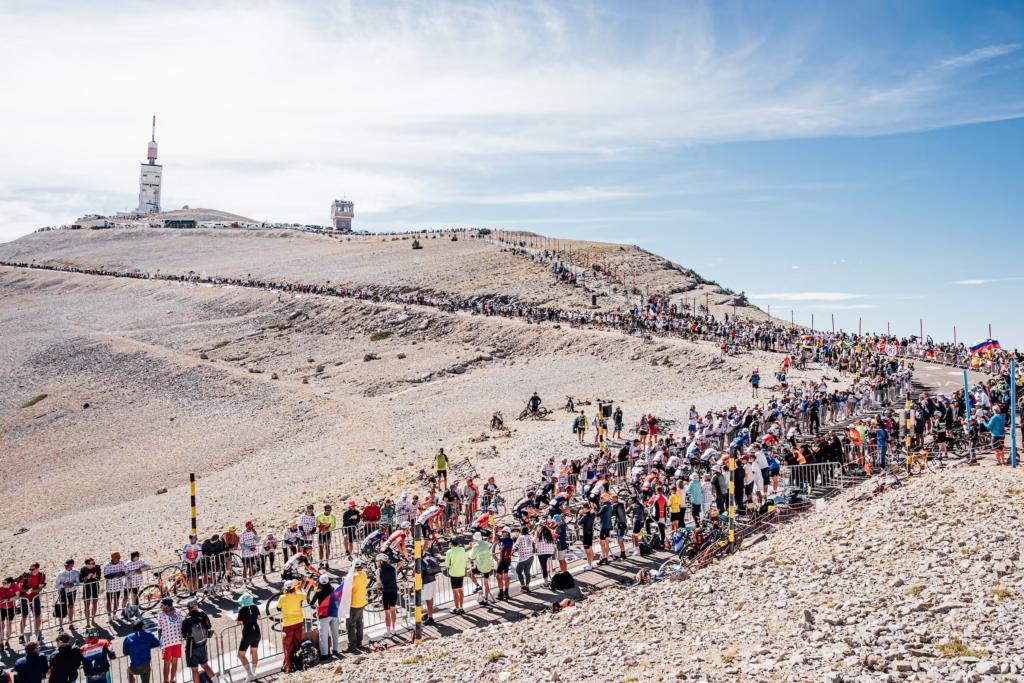
Mont Ventoux will provide the 2026 benchmark
Stage 7 of the 2026 Tour de France Femmes finishes on Mont Ventoux, with the official final climb measuring 15.7km at 8.8%.
The finish sits at 1,910 metres and comes at the end of a 146.8km stage containing approximately 3,565 metres of climbing.
Our Tour de France Femmes 2026 Mont Ventoux guide covers the ascent and why its long forest section should expose even small differences between the best climbers.
An average speed somewhere in the high teens for the strongest riders on the final ascent would represent an enormous sustained performance.
At 18km/h, covering 15.7km takes a little over 52 minutes.
Doing that at almost nine per cent after more than 120km of racing is very different from riding at the same speed on a flat road.
Steeper climbs create slower speeds but bigger gaps
A short 10 or 12% ramp can produce some of the lowest speeds seen during the race.
It can also produce some of the quickest separation.
Imagine one rider climbing at 15km/h and another accelerating to 19km/h.
Four kilometres per hour sounds insignificant compared with the difference between 50 and 60km/h during a sprint.
Uphill, it can open several bike lengths almost immediately.
That is why mountain attacks can look visually understated while changing the GC within seconds.
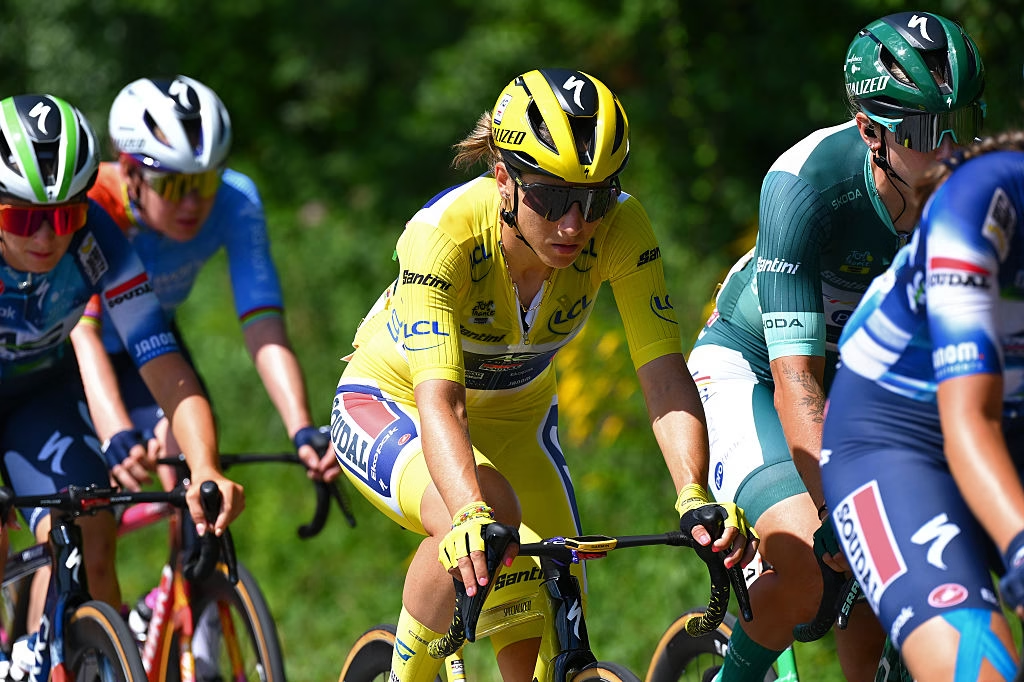 Photo Credit: Getty
How fast do Tour de France Femmes riders descend?
Mountain descents produce some of the highest speeds in the race.
On a long, straight descent with favourable conditions, riders can exceed 80km/h, with speeds around or above 90km/h possible on suitable roads.
The highest number is not necessarily what separates the best descenders.
Speed through corners is more important.
A good descender brakes later, carries more momentum through the bend and accelerates back to speed sooner.
A rider can therefore gain time without ever recording the highest top speed of the group.
Why descending at 80km/h requires more than bravery
Professional descending is a technical skill.
Riders repeatedly accelerate, brake, choose a line through a corner and then accelerate again.
They are also assessing the road surface, wind, other riders and changing grip levels.
At high speed, a small mistake becomes much more significant.
The fastest descenders tend to look smooth rather than spectacular because they avoid unnecessary braking and preserve momentum.
The 2026 route includes several days where descending ability may matter almost as much as climbing, particularly the repeated climbing and descending around Nice on the final stage.
The broader terrain is covered in our Tour de France Femmes 2026 route guide.
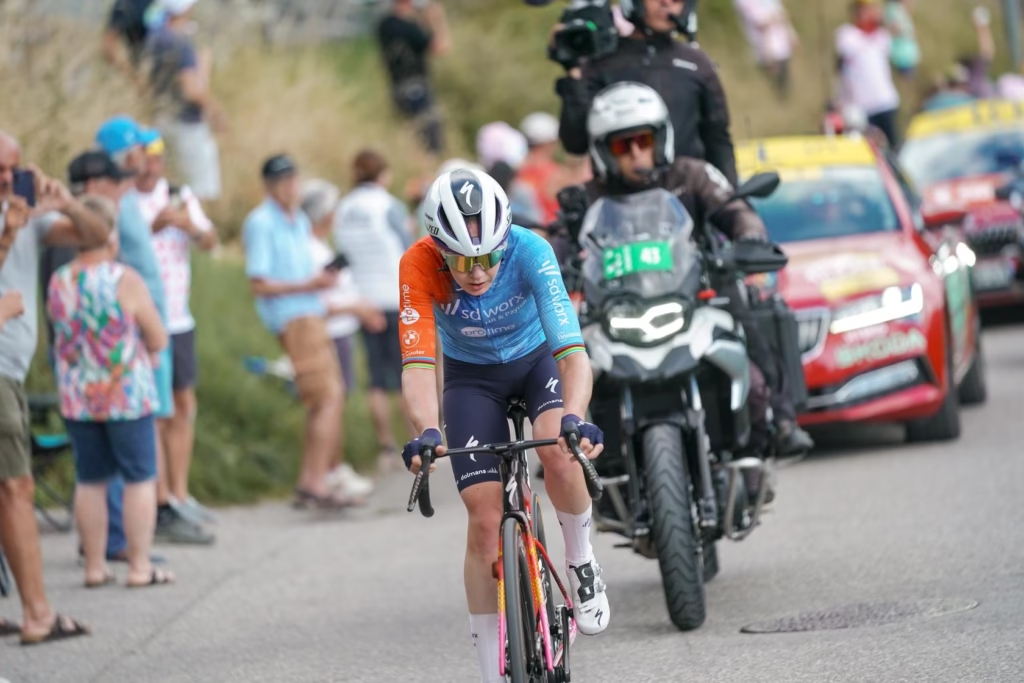 Photo Credit: A.S.O./Thomas Maheux
How fast do riders go in a time trial?
Time trials produce some of the highest sustained solo speeds in professional cycling.
On a flat course, the strongest riders can average 45 to 50km/h or more, depending on distance, wind and technical difficulty.
The important difference is that they are riding alone.
There is no peloton providing shelter from the wind.
The 2024 Tour de France Femmes time trial in Rotterdam demonstrated what is possible on a short, fast course, with the strongest riders pushing the average beyond 50km/h.
Longer time trials require more careful pacing, but sustained speeds in the mid to high 40s remain possible for elite specialists.
Why time trial bikes make such a difference
Aerodynamics becomes increasingly important as speed rises.
Time trial bikes therefore place riders in a narrow position designed to reduce frontal area and drag.
Deep wheels, disc wheels, aerodynamic helmets, skinsuits and carefully optimised riding positions all contribute.
The objective is not simply to produce more power.
It is to travel faster for the same power.
At nearly 50km/h, even a small aerodynamic gain matters.
How fast could the 2026 Dijon time trial be?
Stage 4 of the 2026 Tour de France Femmes is a 21km individual time trial from Gevrey-Chambertin to Dijon.
It is much longer than the short Rotterdam test used in 2024, so riders will need to sustain rather than simply survive a very high-intensity effort.
The strongest specialists should still average comfortably above 40km/h, with the winning speed determined by wind, road conditions and how much the climbing interrupts the faster sections.
Marlen Reusser is the obvious benchmark, while Demi Vollering, Anna van der Breggen, Antonia Niedermaier and Elisa Longo Borghini are among the other riders capable of producing significant GC performances.
Our Tour de France Femmes 2026 time trial contenders guide looks at the main favourites and how the course suits them.
How fast does the peloton chase a breakaway?
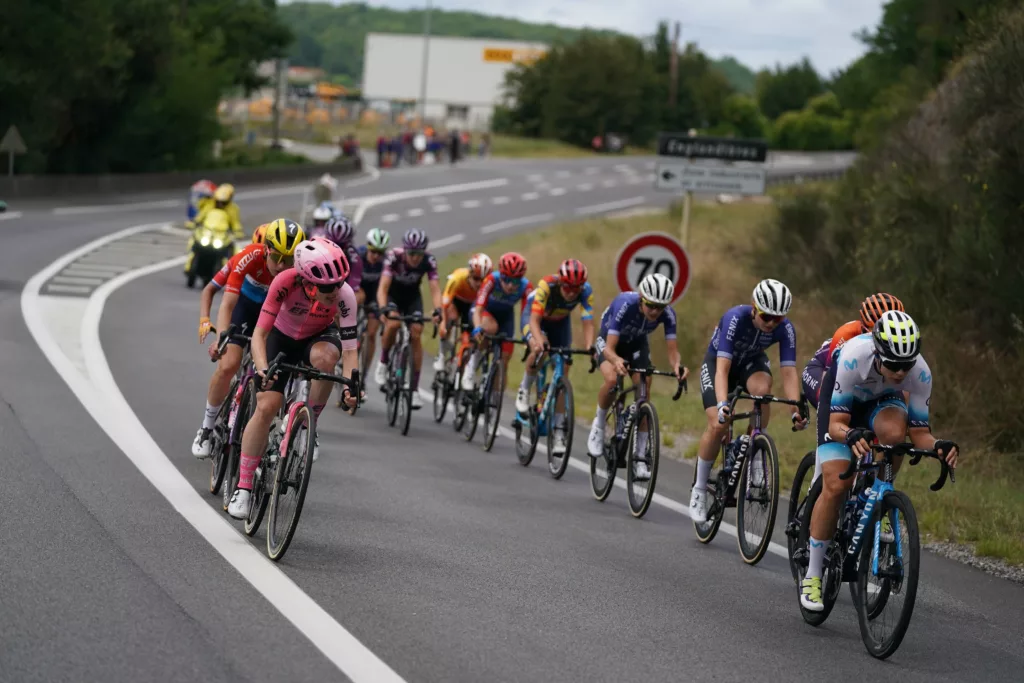
An organised peloton can sustain 45 to 50km/h across flat terrain while chasing.
This is why a breakaway gap can disappear so quickly.
Suppose four riders ahead are averaging 43km/h and the peloton raises its speed to 47km/h.
Four kilometres per hour does not sound like much.
Over several kilometres, it steadily eats into the advantage.
The peloton can also rotate fresh riders onto the front while most of the bunch remains sheltered behind.
A small breakaway has far fewer riders with whom to share the workload.
Why drafting makes professional cycling so fast
Drafting is one of the fundamental reasons a peloton can maintain such extraordinary speed.
At 40 to 50km/h, a large proportion of the rider’s effort goes into overcoming aerodynamic drag.
Sitting behind another rider reduces that resistance.
Inside a large peloton, the savings can be substantial.
That means one rider can be working extremely hard at the front while somebody 20 places further back travels at exactly the same speed with a much lower energy cost.
This is also why solo attacks are difficult.
A lone rider may be capable of averaging 45km/h.
A peloton can match that speed while distributing the workload among several teams.
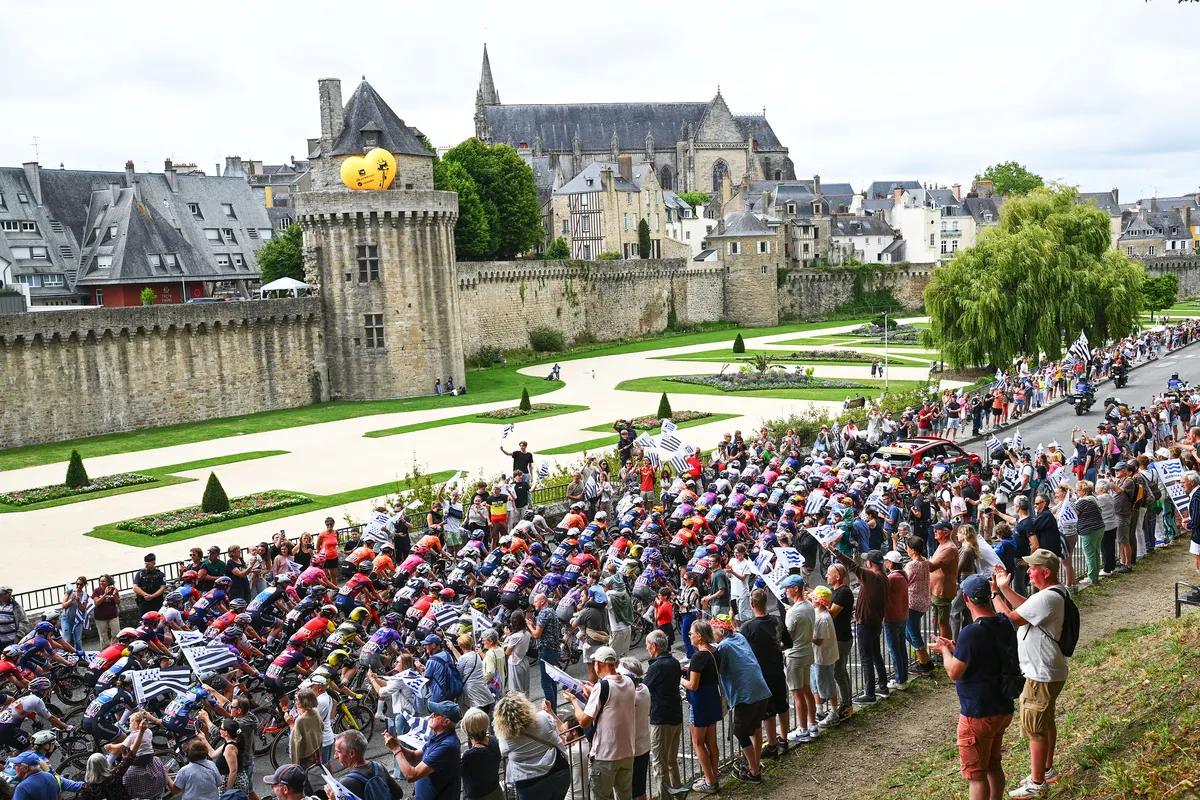
Why does the Tour peloton sometimes ride slowly?
The objective is not to record the fastest possible stage time.
It is to win.
If the right breakaway has escaped and no team has an incentive to chase aggressively, the peloton may slow considerably.
Riders eat.
They collect bottles.
They talk to teammates.
The speed might fall below 30km/h.
Then another team attacks or the chase begins and the race can return to more than 45km/h within minutes.
Professional cycling is therefore defined by acceleration and variation as much as raw speed.
Riding from 30km/h to 50km/h repeatedly can be more demanding than sitting at one steady pace.
How fast will the 2026 Tour de France Femmes be?
Another overall speed record is possible, but the route makes it difficult.
The 2026 Tour de France Femmes route covers approximately 1,175km with 18,795 metres of climbing, making it the most vertically demanding edition yet.
The race includes three flat stages, three hilly stages, two mountain stages and the Dijon individual time trial.
Mont Ventoux will pull the average down considerably, as will the repeated climbing around Nice.
Against that, the women’s peloton continues to become faster on the flat.
More organised sprint trains, deeper teams and improvements in training and equipment mean high-speed racing is increasingly sustained over longer distances.
The 2026 edition will therefore provide an interesting comparison between a harder route and a faster peloton.
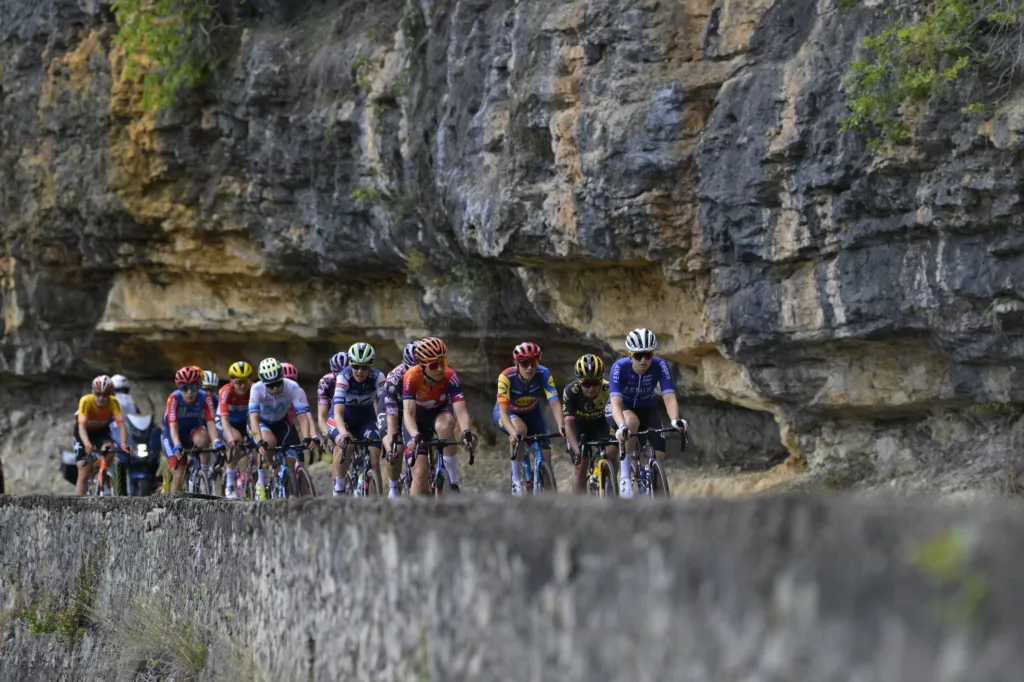
Tour de France Femmes speeds at a glance
| Situation | Typical speed |
|---|---|
| Overall Tour average | 38-40km/h |
| Fast flat stage | 40-45km/h average |
| Organised flat-road chase | 45-50km/h |
| Sprint lead-out | 50-60km/h |
| Final bunch sprint | 60km/h+ |
| Gentle climb | 25-30km/h |
| Long 7-9% mountain | 17-22km/h |
| Very steep climbing section | 12-18km/h |
| Flat time trial | 45-50km/h+ |
| Fast mountain descent | 70-90km/h+ |
These figures are useful guides rather than limits.
Gradient, wind, road surface, weather, tactics and stage distance can all shift them significantly.
How do Tour de France Femmes riders compare with recreational cyclists?
A fit recreational road cyclist might average somewhere around 25 to 30km/h over a decent-length ride.
A strong amateur group can push into the low or mid-30s.
Tour de France Femmes riders can average close to 40km/h over an entire stage race while also climbing major mountains, following attacks and producing sprint efforts above 60km/h.
That distinction matters.
They are not simply riding ten kilometres per hour faster than a good club cyclist.
They are maintaining the speed after several consecutive days of racing and still have enormous reserves available when the race becomes decisive.
-
 Photo Credit: Tomasso Pelagalli/SCA/Cor Vos


Are women professionals as fast as the men’s Tour peloton?
The men’s peloton is faster in absolute terms, particularly on sustained climbs and solo time trials, where differences in absolute power and power-to-weight become more apparent.
Comparing average speeds directly can be misleading, though.
The races use different routes, distances and tactical situations.
Drafting also compresses the difference on flat roads, meaning a Women’s WorldTour peloton can move at speeds that look very similar to a men’s race when a large group is riding quickly.
The biggest gaps become clearer once riders are climbing steep mountains or riding individually against the clock.
The most impressive speed is the one they can repeat
A sprint above 60km/h is spectacular.
An 80km/h descent makes the speed obvious.
A 50km/h time trial provides a simple number that anyone can understand.
The most impressive figure may still be the average.
Tour de France Femmes riders can race for several hours at close to 40km/h, climb mountains at speeds many recreational cyclists would be pleased to sustain on flat roads, sprint beyond 60km/h and then recover overnight to repeat the process.
The modern peloton is getting faster too. Better lead-outs and stronger teams mean even supposedly straightforward sprint stages are increasingly raced at high speed from well before the final kilometre.
The headline numbers help explain how fast Tour de France Femmes riders are.
The ability to keep producing them, day after day, is what makes the Tour different.

