
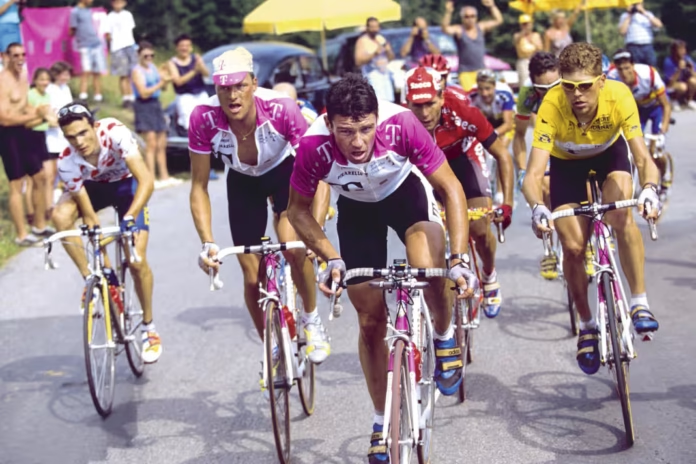
Team Telekom was more than a successful cycling team. For a period in the mid-to-late 1990s, it became the closest thing Germany had to a national cycling project, a commercial force, a Grand Tour machine and a cultural phenomenon all at once. Its pink and later magenta colours cut through the peloton, its riders became household names, and its Tour de France victories helped bring cycling into German living rooms on a scale the sport had rarely seen there before.
It was also a team whose legacy cannot be told cleanly. Bjarne Riis won the 1996 Tour de France in Telekom colours. Jan Ullrich followed in 1997, becoming the first and still only German rider to win the Tour. Erik Zabel turned the green jersey into a German institution, winning it six years in a row from 1996 to 2001. The team had Udo Bölts, Rolf Aldag, Andreas Klöden, Alexander Vinokourov, Giuseppe Guerini, Steffen Wesemann and others who made it a force across stage races, Classics, sprints and Grand Tour mountain stages.
But the same years that made Telekom iconic later became impossible to view without the doping record attached. Riis admitted EPO use during the period of his Tour win. Ullrich was later sanctioned in connection with Operación Puerto and admitted blood-doping links. Zabel, Aldag and others made their own admissions. The Freiburg University Clinic investigations placed the team within a wider system of medicalised doping, not simply a collection of isolated cases.
That is the layered legacy of Team Telekom. It helped make German cycling huge. It produced one of the most recognisable teams of the era. It shaped the transition from national super-team to global sprint-and-stage-win machine under the later High Road, Columbia and HTC identities. It also left German cycling with a credibility wound that took years to begin healing.
This is the story of Germany’s Grand Tour machine, and why its legacy still feels so complicated. For a broader external overview of the team’s rise and fall, Tour Magazine’s recent feature on Team Telekom’s history gives a useful reference point, while the Freiburg evidence later became central to the way the team’s biggest years were reassessed.
For related reading, see our Tour de France winners list, brief history of the Men’s Tour de France, everything you need to know about the Tour de France green jersey and HTC-Columbia men’s team history.
 Photo Credit: A.S.O./Ingrid Hoffman
From Stuttgart roots to Team Telekom identity
The team that became Telekom did not arrive fully formed. Its roots lay in Team Stuttgart, a German project from the late 1980s that gave the country a more serious foothold in the professional peloton. When Deutsche Telekom came in as title sponsor in 1991, the team gained the corporate identity and financial weight that would define its rise.
At first, Telekom was not yet the dominant force people remember. It had ambition and backing, but it needed structure, riders and time. Walter Godefroot’s arrival as team manager was important, as was the gradual building of a German core. Udo Bölts gave the team toughness. Erik Zabel brought sprinting class. Rolf Aldag became one of the engines. Steffen Wesemann added Classics potential. Then came Jan Ullrich, the rider who would change everything.
Telekom’s early years were about becoming credible. The team had to move from national project to international force. That meant gaining Tour de France relevance, building a roster that could compete beyond German roads, and turning its corporate backing into sporting authority.
The team did that with a very 1990s mix: strong internal hierarchy, German identity, international imports, powerful engines and a growing belief that it could compete with the established structures of Italy, France, Spain and Belgium.
By the middle of the decade, Telekom had stopped looking like a hopeful German experiment. It looked like a Grand Tour team. In the wider history of cycling teams, it sits alongside other highly recognisable national and sponsor-led projects, from the Basque identity of Euskaltel-Euskadi to the long-running institutional power of Peugeot.
Zabel gives Telekom its first repeatable identity
Before Ullrich became Germany’s Tour hero, Erik Zabel gave Telekom something just as valuable: repeatability.
Zabel was not simply a sprinter who won stages. He was consistent, durable and tactically sharp. He could place day after day, survive more than many of his faster rivals and collect points with a regularity that made the green jersey his natural territory. His six consecutive Tour de France points classification wins from 1996 to 2001 remain one of the defining green jersey runs in race history.
For Telekom, Zabel’s value was huge. He gave the team a daily Tour presence even before the GC story fully matured. On stages where the overall contenders were quiet, Telekom could still shape the race. Zabel gave German television something to follow every afternoon. He also gave the team a softer public face: reliable, professional, recognisable, less distant than the pure GC leaders.
That consistency helped make Telekom feel present across the entire Tour. In a three-week race, visibility matters. A team that only appears in the mountains can feel absent for long stretches. Zabel changed that. He kept the team in the points conversation, the sprint conversation and the daily results conversation.
It was a crucial part of Telekom’s rise. The team was not only built around yellow. It could win green, chase stages, animate sprint days and build a broader identity.
For more on Zabel’s place in Tour points-classification history, see our guide to the Tour de France green jersey and our look at father-son professional cyclists, which includes Erik and Rick Zabel.
Bjarne Riis and the first Tour win
The 1996 Tour de France made Telekom a Grand Tour-winning team.
Bjarne Riis arrived at the race as an experienced rider who had already been close to the podium. In 1996, he became the rider who finally broke Miguel Induráin’s long Tour domination. Riis won the overall, Telekom took its first Tour de France title, and the team suddenly had a result that transformed its place in the sport.
It was not only a sporting breakthrough. It was an image breakthrough. Telekom had become the sponsor on the front of a Tour-winning jersey. Germany, still building its modern cycling culture, now had a team at the centre of the biggest race in the world. The win gave Telekom authority and created the platform for the next year’s even bigger national moment.
Yet the 1996 victory is also where the layered legacy begins to harden. Riis later admitted he had used doping products, including EPO, during the period that included his Tour win. The official record still lists him as the winner, but the historical reading changed permanently. What had once looked like the start of Telekom’s golden age became part of the darker record of 1990s cycling.
That is the difficulty with Riis and Telekom. The win mattered. It changed the team. It helped make German cycling larger. But it also sits inside the EPO era, and later admissions mean it cannot be treated as a clean sporting origin story.
For more Tour context from that period, see our Tour de France winners list, brief history of the Men’s Tour de France, ten of the best Tour de France past winners and who is the best rider to never win the Tour de France?.
 Photo Credit: A.S.O./Bruno Bade
Jan Ullrich and the German cycling boom
If Riis gave Telekom its first Tour victory, Jan Ullrich gave it a national myth.
Ullrich’s 1997 Tour de France win was a seismic moment for German cycling. He was young, powerful, controlled and visually different from many of the riders around him. He did not win with theatrical aggression. He won with enormous strength. His time-trialling, climbing and sheer physical presence made him look like the future of the Tour.
Germany responded. Ullrich became a mainstream sports figure, not just a cycling figure. Telekom became the team that carried the hopes of a country that suddenly cared about July. In a German sporting culture already shaped by football, tennis and Formula 1, cycling found a new mainstream opening. Ullrich was the reason.
The team dynamic was also fascinating. Riis had won the Tour the previous year, but Ullrich was clearly the future. Telekom had moved from imported leadership to domestic superstar almost overnight. That mattered for the team’s commercial identity. Deutsche Telekom was not simply backing a foreign rider winning in its colours. It now had Germany’s Tour champion.
The 1997 Tour also showed Telekom at its sporting peak. Ullrich won yellow, Zabel won green, and the team looked almost impossibly strong. It was the full project coming together: German brand, German champion, German sprinter, Grand Tour control and a national audience.
But the later shadow is unavoidable. Ullrich’s career ended amid doping investigations, and he later admitted blood-doping links connected to Eufemiano Fuentes. His Tour victory remains on the record, but his place in cycling history is tangled between talent, pressure, silence, denial and later confession.
That is why Ullrich still feels central to Telekom’s legacy. He was not just the team’s greatest German rider. He was the symbol of everything Telekom gave German cycling, and everything it later forced German cycling to confront.
For wider context on Tour champions and eras, see our Tour de France winners list and brief history of the Men’s Tour de France.
The Grand Tour machine
Telekom was not only a Riis and Ullrich story. The team became a Grand Tour machine because it had depth.
Udo Bölts was one of the defining domestiques of the era, famous for his hardness and his ability to keep leaders moving through difficult mountain stages. Rolf Aldag brought engine-room reliability. Giuseppe Guerini gave the team mountain-stage options, including his famous 1999 Alpe d’Huez victory after being knocked down by a spectator. Andreas Klöden emerged as a later German GC force. Alexander Vinokourov added aggression and unpredictability before moving on.
The team was built in a way that made sense for the Tour de France but also worked across the calendar. It had Zabel for sprints, Ullrich and Riis for Grand Tours, strong domestiques for mountain control, time-trial power for GC, and enough quality to influence Classics and one-week races.
That variety made Telekom feel bigger than a single-leader team. It was not always elegant, and at times its internal hierarchy was complicated, but it had scale. It could arrive at a Grand Tour with multiple storylines. If Ullrich was injured or absent, Zabel could still chase green. If the GC plan failed, stage hunters could still win. If the race became tactical, Telekom had enough riders to shape it.
The team’s machine-like quality became part of its identity. It was structured, corporate, German, powerful and visible. Its jersey helped too. Whether in yellow-heavy Telekom colours or later pink and magenta T-Mobile colours, it was one of the easiest teams to pick out on television.
That visibility helped the myth. Every time the race hit a mountain, a sprint finish or a time-trial, Telekom seemed to be there. The same visual power is part of why old team identities continue to resonate, something explored in our top iconic vintage and retro cycling jerseys feature.
 Photo Credit: A.S.O./J.C. Moreau
Zabel, Ullrich and the double identity
Telekom’s strongest years were built around two parallel identities.
One was Ullrich: GC, yellow jersey, German national expectation, Tour de France pressure. The other was Zabel: green jersey, stage consistency, sprint craft, daily reliability. Together they made Telekom uniquely visible.
That double identity was powerful because it gave the team two Tour de France missions. Ullrich gave German fans a reason to watch the overall classification. Zabel gave them a reason to watch almost every stage. The result was a team that could dominate the narrative even when it did not dominate the race itself.
There was also a contrast in temperament. Ullrich often seemed burdened by expectation. Zabel seemed steadier, more open, more consistently productive. Ullrich’s career became a series of giant highs and painful absences. Zabel’s was defined by rhythm and repetition. One carried the national dream. The other delivered almost metronomic returns.
That contrast made Telekom more interesting. It was never only a team of grim control. It had sprinting, GC pressure, mountain domestiques, German character and international ambition. It was one of the few teams of the period that could be read as both a national project and a full-service Grand Tour organisation.
The tragedy is that both identities were later damaged by the doping record. Zabel’s green jersey dominance and Ullrich’s Tour greatness remain part of the sport’s memory, but neither exists untouched by later admissions and findings.
For more on the points side of that identity, see our Tour de France green jersey guide and our older Tour de France 2017 green jersey favourites piece, which also references Zabel’s record run.
The doping system behind the success
No serious history of Team Telekom can avoid doping.
The issue was not simply that some riders later admitted using banned substances. The Freiburg investigations and related evidence described a much deeper problem around medical support, EPO use and organised practices during the team’s golden period. Former staff and riders made admissions. The picture that emerged was of a team embedded in the broader doping culture of 1990s cycling, but with enough structure around it that the damage went beyond individual choices.
This is where Telekom’s legacy becomes hardest to untangle. Many of the biggest teams and riders of the era were caught up in doping. But Telekom’s case carried a particular force in Germany because the team had been marketed and understood almost as a national cycling symbol. Its success had brought people into the sport. Its downfall pushed many of them away.
When Riis admitted doping, it darkened the first Tour win. When Ullrich was linked to Fuentes and later admitted blood doping, it damaged the central German myth. When Zabel and others made admissions, even the apparently steadier sprint story was complicated. The Freiburg revelations added institutional weight to what might otherwise have been dismissed as isolated athlete behaviour.
The USADA-hosted Freiburg evidence overview remains one of the most useful external reference points for understanding how the investigations framed systematic doping around Team Telekom and T-Mobile. It is the reason any credible history of the team has to move beyond individual confession and look at the medical and institutional structure behind the success.
That is why the Telekom story still matters. It shows how a team can build a public sporting culture, then help destroy public trust in that same culture. In Germany, the consequences were severe. Cycling coverage suffered. Sponsors became wary. Fans who had invested emotionally in Ullrich, Zabel and Telekom were left with an uncomfortable question: what exactly had they been watching?
The answer is not simple. They had watched extraordinary riders. They had watched real effort. They had watched a team that changed German cycling. They had also watched a chemically distorted era whose results cannot be separated from its methods.
For wider Tour-era context, see our flashback to the 1999 Tour de France, which sits in the same difficult period of cycling history.
 Photo Credit: A.S.O./J.C. Moreau
The T-Mobile rebrand and the slow unravelling
In 2004, the Telekom identity shifted into T-Mobile. The colours changed, the brand modernised, and the team tried to move forward. But the deeper structure and history remained.
The mid-2000s were increasingly unstable. Ullrich returned to the team after his Bianchi season, but his Tour hopes never fully recovered the inevitability of 1997. Klöden became a major GC figure. Vinokourov had already moved on. Zabel left after 2005. The team still had strength, but the clean, coherent Telekom myth was fading.
Then came Operación Puerto in 2006, and Ullrich was removed from the Tour before the race began. That was a turning point. For years, German cycling had lived inside the tension between suspicion and devotion. Puerto pushed that tension into the open. The old emotional contract between team, rider, sponsor and public could no longer hold.
The 2007 season then brought more damage. The team tried to present itself as reformed, but new controversies and old revelations collided. Patrik Sinkewitz’s positive test during the Tour period hurt the sponsor. Former Telekom figures were speaking publicly about doping. The Freiburg story was gathering force.
By November 2007, Deutsche Telekom ended its sponsorship. The team as Germany had known it was gone.
For the deeper continuation of the structure after that moment, see our HTC-Columbia men’s team history.
High Road and the attempted clean break
The end of T-Mobile did not immediately kill the team structure. Bob Stapleton kept it alive through High Road Sports, and the team moved into a new phase as Team High Road, then Columbia, HTC-Columbia and HTC-Highroad.
This was more than a new sponsor name. It was an attempted cultural break. The team moved away from the old German identity, took on a more international shape and tried to build itself around a more transparent anti-doping position. It changed nationality, changed tone and changed sporting priorities.
The results were remarkable. The later High Road, Columbia and HTC years produced one of the most successful winning machines of the modern era. Mark Cavendish became the face of the sprint train. Tony Martin and Bert Grabsch brought time-trial power. André Greipel, Edvald Boasson Hagen, Michael Rogers, Kim Kirchen, Matt Goss, John Degenkolb and others helped turn the structure into a relentless stage-winning operation.
The women’s side of the wider structure was also influential, with riders such as Ina-Yoko Teutenberg, Ellen van Dijk, Emilia Fahlin and others connected to the T-Mobile, Columbia and HTC eras. That part of the story matters because the post-Telekom structure did not only produce men’s sprint trains. It also helped shape major women’s careers and the professionalisation of women’s road racing.
But the clean break was never complete in historical memory. The later High Road project may have been run differently, but it still carried roots that went back through T-Mobile and Telekom. That tension is part of the legacy. The same structure that had become synonymous with scandal also produced one of the most disciplined and successful attempts to rebuild around a new identity.
For more on that second life, see our HTC-Columbia men’s team history, Mark Cavendish: British sprinting star, Ina-Yoko Teutenberg: the full story, Ellen van Dijk rider history and women’s cycling rider history.
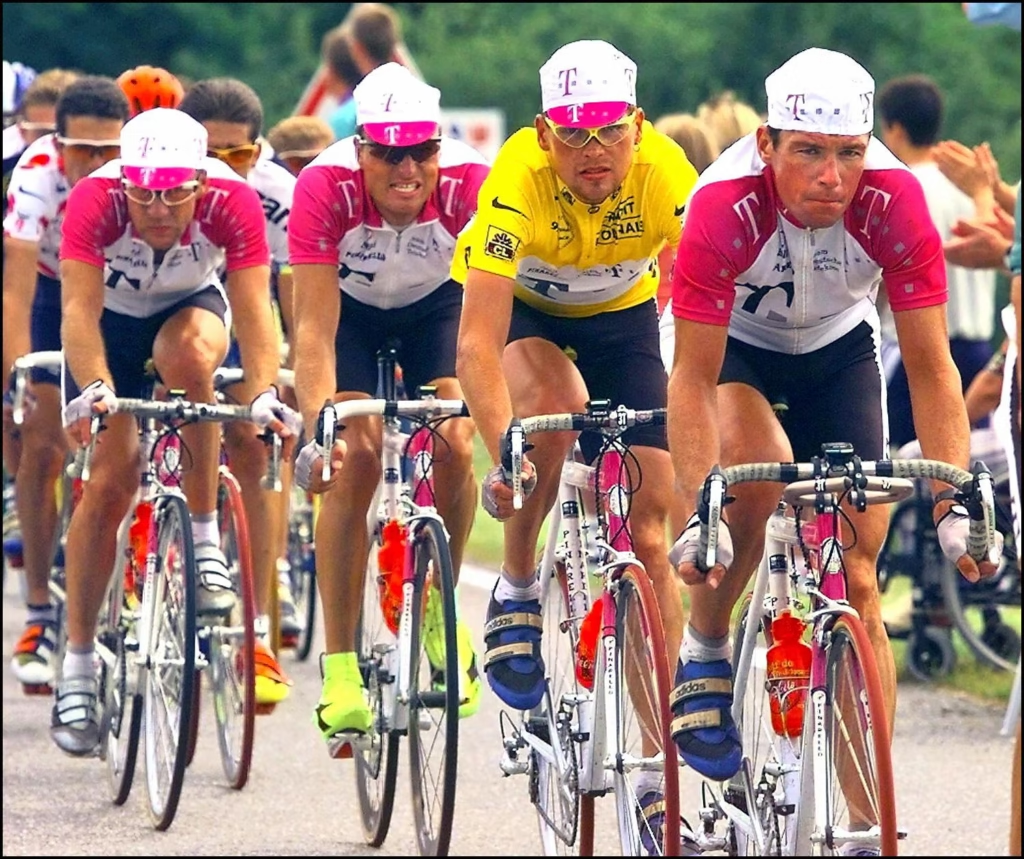 Photo Credit: Getty
Why Telekom mattered to German cycling
Telekom mattered because it gave German cycling a centre.
Before Telekom, Germany had great riders, but it did not have the same sustained professional road-racing identity as Belgium, Italy, France, Spain or the Netherlands. Telekom changed that. It created a team German fans could follow all year, but especially in July. It brought together domestic riders, international leadership, corporate money and television appeal.
Ullrich’s 1997 Tour win was the peak, but the wider effect was bigger. Zabel made the green jersey familiar. Bölts became the model of the hard-working German domestique. Aldag and Wesemann made the team feel rooted. Klöden and later riders extended the German GC thread. The team helped produce a generation of fans who understood cycling through pink, magenta, Telekom, T-Mobile, Ullrich and Zabel.
Its commercial impact was also significant. Deutsche Telekom’s backing showed that a German corporate giant could use cycling as a major brand platform. The team looked modern, professional and internationally visible. It linked cycling to a changing Germany in the 1990s, one increasingly comfortable with large-scale sporting marketing and global competition.
But the collapse damaged that same world. When German broadcasters reduced cycling coverage and sponsors became more cautious, Telekom’s fall was one of the reasons. Fans did not simply lose a team. They lost trust in the story they had been sold.
That is why Germany’s later relationship with professional cycling has often felt cautious, even with strong riders and teams returning to prominence. Telekom built the boom, then helped create the hangover.
For more on German cycling figures connected to this wider period, see our Ina-Yoko Teutenberg profile and Ellen van Dijk profile, both of which connect to the later professional environment shaped by the T-Mobile, Columbia and HTC structure.
The jersey, the bikes and the memory
Telekom’s visual identity still carries power.
The pink and magenta jerseys remain among the most recognisable kits of the era. For some fans, they trigger instant memories: Ullrich in yellow, Zabel in green, Bölts driving on the front, the black shorts, the bright blocks of colour on mountain roads. The bikes, especially the Pinarello years, also belong to that visual memory. The Telekom look was unmistakable.
That matters because cycling history is often remembered visually first. A jersey can outlast the result sheet. A colour scheme can keep a team alive long after the sponsor is gone. Telekom’s kit still appears in retro conversations because it represents a very specific era of the sport: late 1990s power, big corporate teams, the rise of German cycling, and the shadow of EPO-era dominance.
There is discomfort in that nostalgia. The jersey is beautiful and loaded at the same time. It is possible to remember the excitement without pretending the context was clean. In fact, the only honest way to remember Telekom is to keep both in view.
The kit was iconic. The racing was compelling. The legacy is damaged. All three statements can be true.
For more on old team colours and cycling nostalgia, see our top iconic vintage and retro cycling jerseys, Peugeot team history and Euskaltel-Euskadi team history.
Key riders in Telekom history
Jan Ullrich is the central figure. His 1997 Tour victory made him the symbol of German cycling’s biggest moment, and his later doping admissions made him the symbol of its deepest disillusionment. His talent was enormous. His legacy remains painfully complex.
Erik Zabel gave the team its daily Tour rhythm. Six consecutive green jerseys made him one of the great points-classification riders, and his sprinting consistency helped keep Telekom visible across entire Tours.
Bjarne Riis gave the team its first Tour victory. His 1996 win transformed Telekom’s status, but his later doping admission changed how that result must be understood.
Udo Bölts gave the team its working-class spine. He was not the biggest star, but his mountain work, loyalty and presence helped define the team’s internal character.
Rolf Aldag was another core figure, both as rider and later staff member in cycling. His career sits inside the Telekom story and the later attempts to reshape the sport’s professional culture.
Andreas Klöden carried the German GC thread into the T-Mobile years, especially after Ullrich’s decline and absence from major moments.
Alexander Vinokourov brought aggression and unpredictability before his move away from the team. His years at Telekom added another layer of attacking identity beyond Ullrich and Zabel.
Giuseppe Guerini gave the team one of its most memorable mountain-stage moments, especially with his 1999 Alpe d’Huez win.
Mark Cavendish belongs more to the High Road, Columbia and HTC continuation than to Telekom itself, but his rise shows how the team structure found a second life after the German sponsor era ended.
For the post-Telekom continuation, see our HTC-Columbia men’s team history and Mark Cavendish: British sprinting star.
The layered legacy
Telekom’s legacy cannot be reduced to glory or disgrace.
If you focus only on the results, the team was one of the most important squads of its period. It won the Tour de France in 1996 and 1997, made Germany a central Tour nation, produced one of the great green jersey runs through Zabel, and created a structure that later evolved into the High Road and HTC winning machine.
If you focus only on doping, the team becomes a case study in how medicalised cheating shaped the 1990s peloton, how institutions enabled success, and how national sporting enthusiasm could be built on a fragile foundation.
Neither version is enough on its own. Telekom was both a great cycling team and a damaged one. Its riders were both gifted athletes and participants in a compromised era. Its effect on German cycling was both transformative and destructive.
That is why the story still matters. It explains why German fans fell in love with the Tour. It explains why many later turned away. It explains how a team can become bigger than a sponsor, then leave a legacy too heavy for simple nostalgia.
Telekom was Germany’s Grand Tour machine. It was also one of the teams that forced Germany to confront what that machine had been running on.
For wider Tour and team-history context, see our brief history of the Men’s Tour de France, HTC-Columbia men’s team history and Tour de France winners list.
-
 Photo Credit: Canyon SRAM (supplied media release)
 -
 Photo Credit: Park Tool

What came after Telekom
The official Telekom and T-Mobile era ended in 2007, but the structure lived on for four more seasons through High Road, Columbia and HTC. That continuation matters because it shows both the strength of the sporting organisation and the difficulty of escaping the past.
Under High Road and HTC, the team moved away from Grand Tour GC identity and became a stage-winning machine. Cavendish’s sprint train became one of the defining systems of modern sprinting. Tony Martin became a time-trial powerhouse. The team won across men’s and women’s racing, and for a period it looked like one of the most efficient organisations in the sport.
Yet even that success could not save it. HTC-Highroad folded after the 2011 season when the team could not secure enough sponsorship. It was a strange ending: a team that had survived scandal, rebranded, won relentlessly and still disappeared because cycling’s funding model remained fragile.
That final chapter makes the Telekom story feel even more layered. The original team built German cycling’s biggest boom. The T-Mobile years exposed the cost. The High Road years tried to rebuild. The HTC collapse showed that even winning teams can vanish.
For a full look at that second life, see our HTC-Columbia men’s team history, Mark Cavendish: British sprinting star and top iconic vintage and retro cycling jerseys.
Final verdict
Team Telekom was one of the defining cycling teams of the 1990s and early 2000s. It gave Germany its first Tour de France winner, one of the greatest green jersey riders, and a national cycling boom that changed the country’s relationship with the sport. It also became one of the clearest examples of how doping hollowed out that same era from within.
Its greatness is real, but it cannot be separated from its context. Riis, Ullrich, Zabel, Bölts, Aldag, Klöden and the rest of the structure gave the team enormous sporting weight. The Freiburg findings, the admissions and the later collapse of trust made the legacy far more difficult than a simple list of wins.
That is why Telekom remains so compelling. It was not just a team that won. It was a team that showed how cycling could become mainstream in a country, how a sponsor could shape a national sporting identity, how a Tour champion could become a cultural figure, and how quickly all of that could fracture when the truth came out.
Germany’s Grand Tour machine gave cycling some of its most memorable images. It also left behind one of its most uncomfortable lessons. In the end, the Telekom legacy is not clean, but it is essential to understanding the sport that modern cycling had to become.

