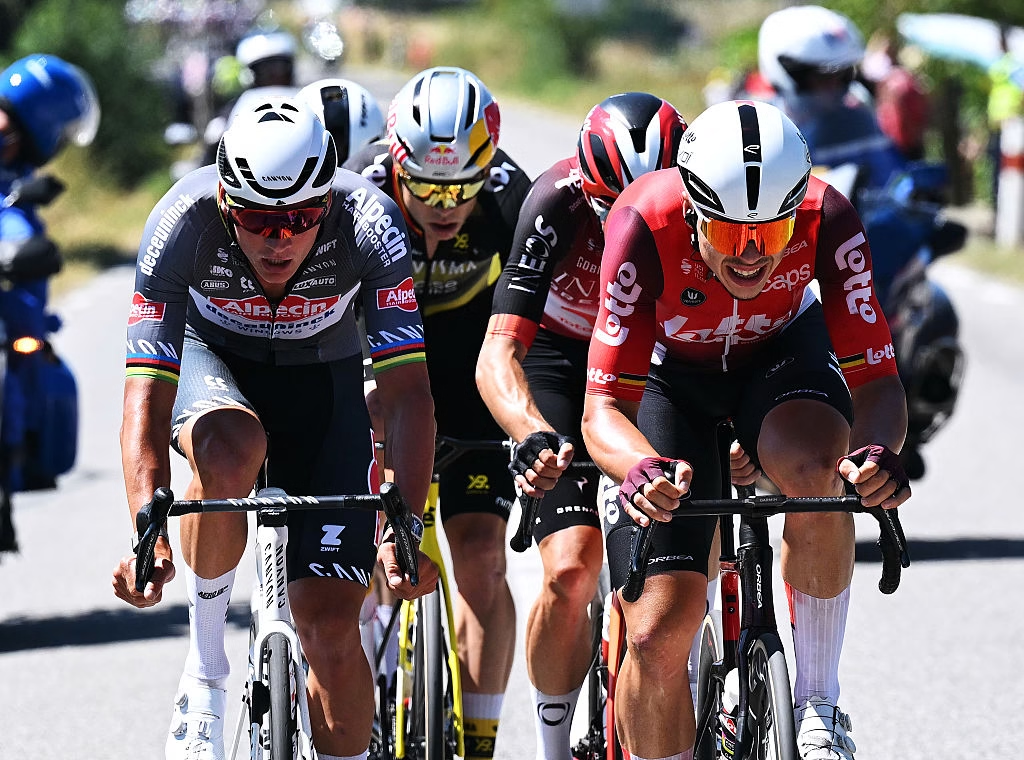
The Tour de France is not only a bike race. It is also a moving city.
Every day, riders, staff, mechanics, buses, cars, lorries, media teams, police, sponsors, hospitality units and the publicity caravan have to move from one stage to the next. Sometimes that journey is short. Sometimes it is a late-night transfer after a mountain finish, a long drive before a rest day or a carefully managed move between regions.
The 2026 Tour de France has a route that makes those transfers especially important. The race starts in Barcelona, moves into France after stage 3, crosses the Pyrenees, heads north through the west and centre of the country, then cuts across towards the Vosges, Jura and Alps before the final journey to Paris.
For the full sporting picture, see our Tour de France 2026 full route guide. For new fans, our beginner’s guide to the men’s Tour de France 2026 explains how the whole race fits together.
For fans, transfer days explain why rest days are not always restful, why some stages feel harder than they look on paper and why team logistics can matter almost as much as form.
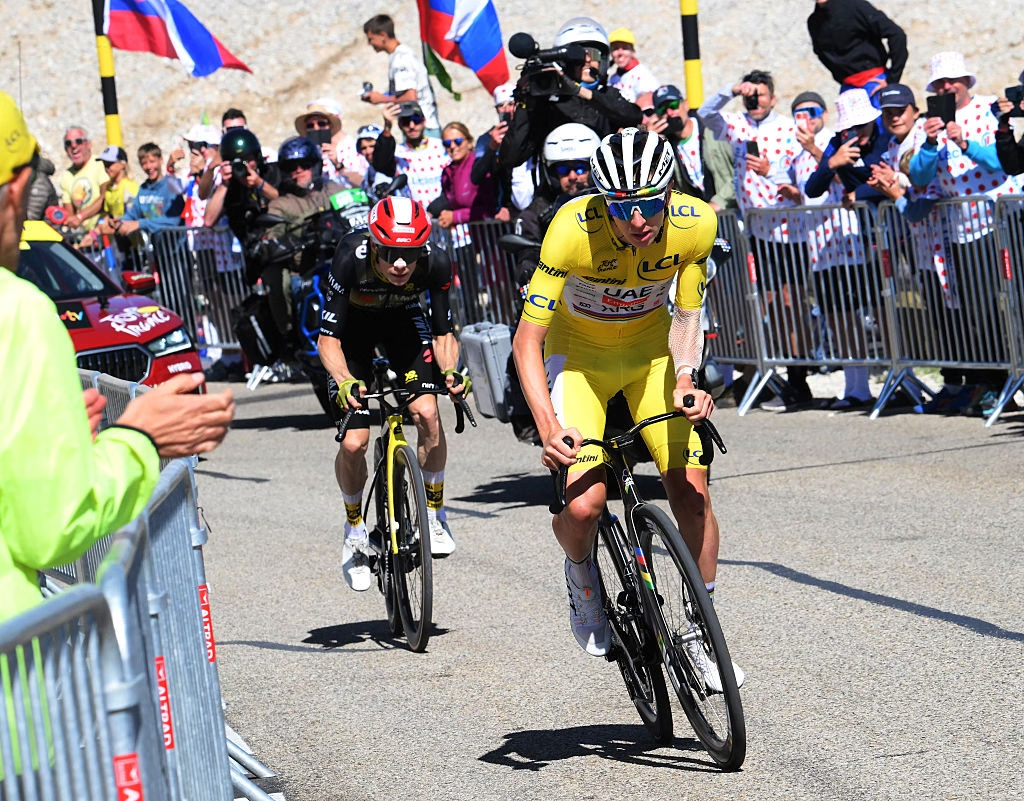 Photo Credit: Getty
Quick answer: what are transfer days at the Tour de France?
Transfer days are the travel periods between stages, when riders, teams and the race organisation move from one finish town to the next start town or rest-day base. They are not always official rest days. At the 2026 Tour de France, the biggest transfers come after the Barcelona opening block, after the Pyrenees, around the first rest day in Cantal, between the Jura and Haute-Savoie, and after the final Alpine stages before the Paris finish.
| Transfer point | Why it matters |
|---|---|
| After stage 3 | The race leaves Catalonia and moves into France |
| After stage 6 | Teams leave the high Pyrenees and head towards Hagetmau/Bordeaux |
| First rest day | The race resets in Cantal after stage 9 |
| Stages 10-13 | The Tour moves north-east through central France towards the Vosges |
| Second rest day | Teams recover in Haute-Savoie before the stage 16 time trial |
| After stage 20 | The race transfers from the Alps to the Paris region |
| Stage 21 | The final day starts in Thoiry and finishes on the Champs-Élysées |
Are transfer days the same as rest days?
No. A transfer day and a rest day are not the same thing.
A rest day is an official day without racing. Riders usually do a short recovery ride, speak to media, receive treatment, eat, sleep and prepare for the next block. At the 2026 Tour, the official rest days are Monday 13 July in Cantal and Monday 20 July in Haute-Savoie.
A transfer is simply the travel between places. It can happen after a stage, before a rest day, during a rest day or after the final mountain stage. Some transfers are short and almost invisible. Others can shape recovery because they add extra time on a team bus, delay dinner and reduce the amount of proper rest a rider gets.
That is why teams plan transfers carefully. The riders may only race for four or five hours, but the day is not over when they cross the line.
For the full breakdown of the two official pauses, see our guide to Tour de France 2026 rest days.
Why transfers matter at the 2026 Tour de France
The 2026 route is not a simple loop. It begins abroad, crosses back into France, moves through several mountain ranges and finishes in Paris after two hard Alpine stages.
That means the race has several logistical pinch points. The biggest are not necessarily the longest drives on a map. They are the transfers that come after hard stages, summit finishes or emotionally draining days.
A transfer after a flat stage is one thing. A transfer after a mountain-top finish is very different. Riders need to cool down, speak to media, change, eat, start recovery and get to the hotel before the evening disappears. On difficult days, the best teams are often the ones that turn chaos into routine.
In the 2026 Tour, that will matter because the hardest blocks are stacked tightly. The opening weekend is not gentle. The Pyrenees arrive early. The Massif Central comes before the first rest day. The final week has a time trial, several Alpine stages and back-to-back finishes at Alpe d’Huez.
Transfers will not win the Tour by themselves. But poor transfer management can make an already hard race feel worse.
The route’s hardest climbing blocks are covered in our Tour de France 2026 mountain stages ranking and our guide to the Tour de France 2026 climbs.
The Barcelona to France transfer
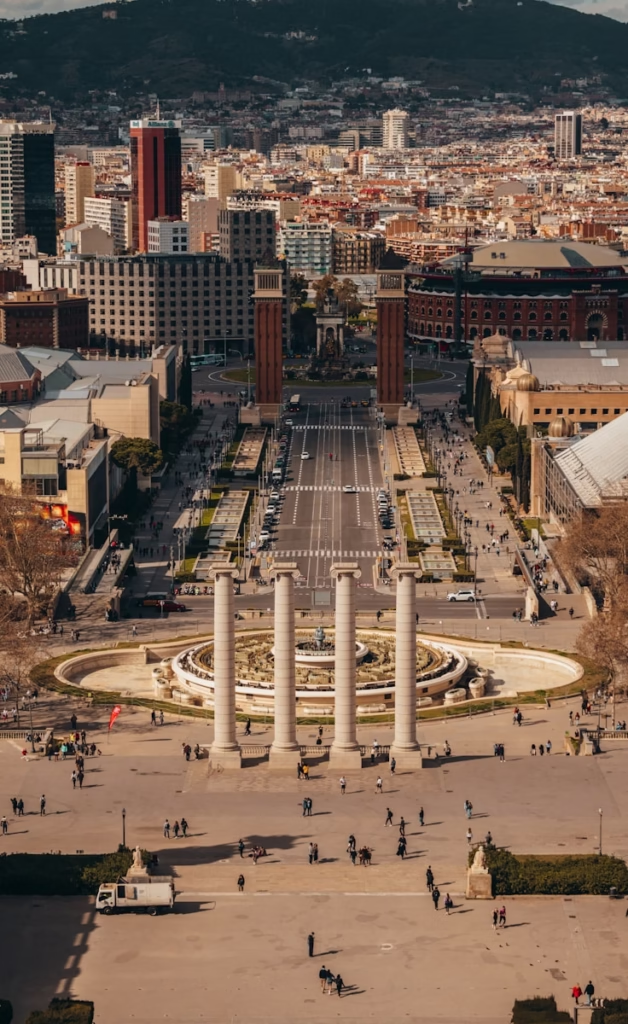
The first major move comes after stage 3.
The Tour opens with three days linked to Catalonia. Stage 1 is a 19.6km team time-trial in Barcelona. Stage 2 runs from Tarragona to Barcelona. Stage 3 goes from Granollers to Les Angles, taking the race into the mountains and towards the French side of the Pyrenees.
After that, the race has to settle fully into France for stage 4 from Carcassonne to Foix.
This transfer matters because it comes early. Teams will already have had the extra complexity of a foreign Grand Départ, with hotels, equipment, vehicles and staff based around Barcelona. Stage 3 then adds the first real mountain pressure before the race crosses into its French rhythm.
For riders, the danger is not just the drive itself. It is the combination of a nervous opening weekend, a team time-trial, a hilly Barcelona stage, the first mountain test and then a transfer before another hilly day. The Tour gives very little time to settle.
The practical side of the opening weekend is covered in our Tour de France 2026 Grand Départ guide, our guide to Tour de France 2026 in Catalonia and our feature on how to visit the Tour de France 2026 Grand Départ in Barcelona.
The Pyrenees to south-west France move
The next important transfer comes after stage 6.
Stage 5 takes the race from Lannemezan to Pau, then stage 6 goes from Pau to Gavarnie-Gèdre. That is the first major mountain summit finish of the 2026 Tour, with the Pyrenees already placing real pressure on the general classification.
The next day starts in Hagetmau and finishes in Bordeaux. That means teams have to leave the high Pyrenean setting of Gavarnie-Gèdre and move towards the Landes/south-west corridor before a flatter stage.
This is a classic Tour de France change of tone. One day, the climbers and GC riders are fighting on a summit finish. The next, the sprinters are thinking about Bordeaux. For teams, the challenge is to reset quickly.
The GC riders need recovery. The sprinters need their lead-out trains switched on again. The breakaway riders will be looking for chances. Mechanics may also have different bike setups to prepare, moving from climbing equipment and mountain gearing to faster road-stage setups.
The transfer is part of that transition. The race does not pause just because the terrain changes.
For the first major mountain block, see our Tour de France 2026 Pyrenees guide. For the flatter opportunities that follow, see our ranking of the Tour de France 2026 sprint stages.
The first rest day in Cantal
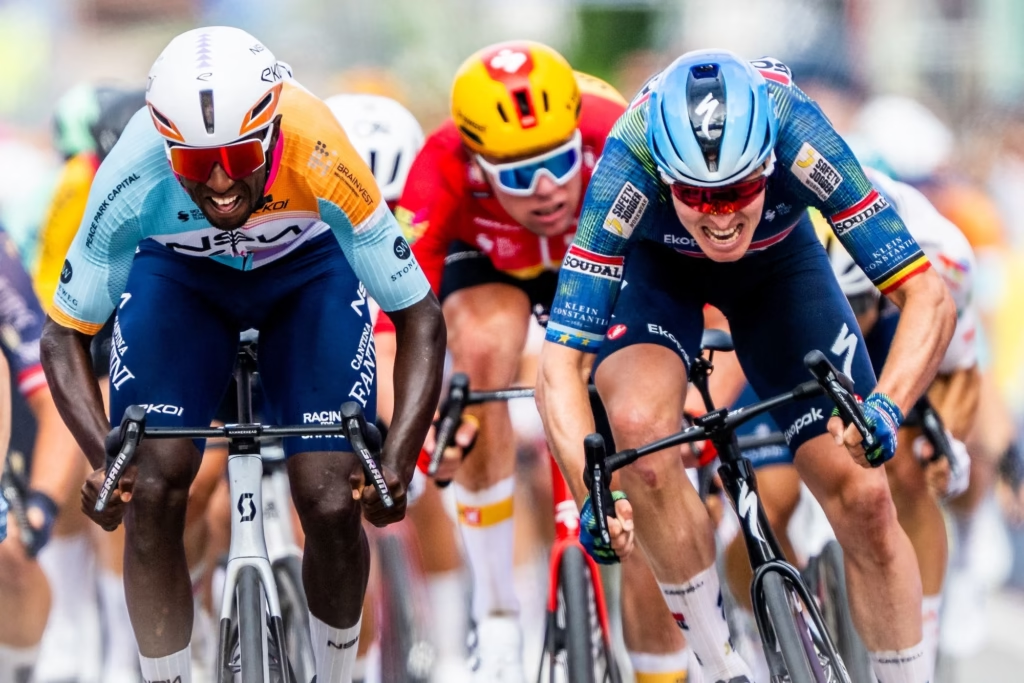
The first official rest day comes on Monday 13 July in Cantal, after stage 9 from Malemort to Ussel.
This is an important moment in the race. By then, the riders will have completed the Barcelona opening, crossed into France, raced through the Pyrenees, moved towards Bordeaux and Bergerac, and then climbed again towards the Massif Central.
The rest day is not only about sleeping. Riders will still ride, usually for an hour or two, because complete inactivity can leave the legs heavy. They will have massage, food plans, medical checks, media duties and team meetings. Equipment will be checked. Staff will reorganise for the next week.
The Cantal rest day also leads directly into stage 10 from Aurillac to Le Lioran on Bastille Day. That means the race does not restart gently. The riders come off a rest day into a mountain stage, with national pressure around a French holiday and a route that can immediately punish anyone who has recovered badly.
That is one reason rest days can be dangerous. They are meant to help, but some riders struggle to restart.
The racing before that first pause could also suit attackers, especially on the rolling roads towards Ussel. Our guide to the best breakaway days on the Tour de France 2026 route explains why stage 9 could be one of the key transition days of the race.
Moving north-east through central France
After the first rest day, the Tour begins one of its main travel arcs.
Stage 10 is Aurillac to Le Lioran. Stage 11 goes from Vichy to Nevers. Stage 12 starts at the Circuit Nevers Magny-Cours and finishes in Chalon-sur-Saône. Stage 13 then runs from Dole to Belfort.
This block moves the race from the Massif Central towards Burgundy, the Jura and the edge of the Vosges. It is not just a sporting transition. It is a logistical one.
The stage profiles also change quickly. A mountain stage is followed by flatter days, then a hilly stage, then the race moves towards another major climbing weekend. For teams, that means switching priorities almost daily. Sprinters will want the flatter stages. Breakaway riders will mark the rolling days. GC teams will try to recover before the next high-pressure mountain block.
Transfers during this part of the race may not look as dramatic as the move from Barcelona or the final Alpine transfer, but they accumulate. Every hotel change, bus ride and late arrival adds to the fatigue.
By the time the riders reach Belfort and then the Vosges, the Tour will already feel very different from the race that started in Spain.
For the GC picture across this middle section, see our guide to the best days for GC attacks at the Tour de France 2026.
The Jura and Haute-Savoie rest day
The second rest day comes on Monday 20 July in Haute-Savoie, after stage 15 from Champagnole to Plateau de Solaison.
That is one of the most important transfer points in the 2026 Tour. Stage 14 finishes at Le Markstein Fellering in the Vosges. Stage 15 then starts in Champagnole and finishes at Plateau de Solaison. After that, the race pauses in Haute-Savoie before stage 16, an individual time trial from Évian-les-Bains to Thonon-les-Bains.
This is a difficult sequence. Riders have a mountain stage to Le Markstein, then another mountain stage to Plateau de Solaison, then a rest day, then a time trial. That means recovery and logistics are closely linked.
The GC riders cannot treat the rest day as a full mental break. They need to recover from two mountain stages, inspect or think about the time-trial demands, manage media duties and stay switched on for a stage that could reshape the overall classification.
For time triallists and GC contenders, the second rest day is also an equipment day. Bikes, skinsuits, helmets, gearing, pacing plans and warm-up routines all matter. Teams will use the time to make sure nothing is left to chance.
This is not a quiet pause before the final week. It is a reset before one of the most important phases of the race.
The importance of those summit finishes is covered in our Tour de France 2026 summit finishes guide, while the time-trial angle is part of our wider Tour de France 2026 TV schedule and daily start times.
The final week transfers
The final week is where the Tour becomes especially compressed.
Stage 16 is the individual time trial from Évian-les-Bains to Thonon-les-Bains. Stage 17 runs from Chambéry to Voiron. Stage 18 goes from Voiron to Orcières-Merlette. Stage 19 runs from Gap to Alpe d’Huez. Stage 20 starts in Le Bourg d’Oisans and finishes again at Alpe d’Huez.
From a transfer point of view, this block is intense because the race moves through the Alps while the sporting stakes rise every day.
Stage 17 looks like a flatter transition day, but it also moves the race towards the final Alpine showdown. Stage 18 is a mountain day to Orcières-Merlette. Stage 19 is a shorter mountain stage to Alpe d’Huez. Stage 20 is the queen-stage-style Alpine test, starting in Le Bourg d’Oisans and finishing again at Alpe d’Huez.
The advantage is that stages 19 and 20 are geographically compact around the Oisans and Alpe d’Huez area. The challenge is that the racing itself is brutal. Teams may not have to cover enormous distances between those two stages, but riders will have to recover from one major Alpine day before another even harder one.
That is where good logistics become invisible. The best teams will have recovery drinks ready at the finish, warm clothing at the top of climbs, buses placed efficiently, staff moving bags and equipment, and hotel routines already planned. The rider should not have to think about any of it.
For the key final-week stages, see our Tour de France 2026 queen stage guide and our feature on Alpe d’Huez at the Tour de France.
The Alpe d’Huez to Paris transfer
The final major transfer comes after stage 20.
The race finishes stage 20 on Alpe d’Huez on Saturday 25 July. The next day, stage 21 starts in Thoiry and finishes on the Champs-Élysées in Paris. That means the entire race has to move from the Alps to the Paris region overnight.
This is the most symbolic transfer in the Tour. The real racing for yellow is usually done by then, but the logistics are still huge. Riders, teams, race staff and media all have to leave the Alps and arrive ready for the final stage.
For the yellow jersey team, that journey is part celebration and part obligation. There are media demands, sponsor commitments and the emotional release of having survived the final mountain stage. For sprinters, the transfer leads to one last target: the Paris finish.
Stage 21 is often described as processional for the general classification, but it is still a real sprint stage. The riders have to reach the start, switch from mountain survival to final-day ceremony, and still stay alert when the race reaches the Champs-Élysées.
For fans watching from home, the final-stage timings are included in our Tour de France 2026 TV schedule and daily start times.
Do riders travel by bus, train or plane?
At the Tour de France, transfers are usually managed by team bus, team cars and race vehicles, with longer moves sometimes involving trains or flights depending on the route and organisation. The exact arrangements vary by team, stage and distance.
For most normal stage-to-stage transfers, riders travel on the team bus. The bus is a recovery space as much as transport. Riders shower, eat, speak to staff, begin recovery and sometimes sit for long periods before reaching the hotel.
Behind the riders, the rest of the team operation is even more complicated. Mechanics move bikes and equipment. Soigneurs prepare food, drinks and recovery supplies. Lorries carry kit, washing machines, spare wheels, tools and race infrastructure. Hotel staff and team carers make sure rooms, bags and meals are ready.
The public sees the race on the road. The transfer is the part that makes the next day possible.
The wider race operation also includes the publicity caravan, which moves with the Tour and adds another layer to the travelling circus. Our Tour de France 2026 caravan guide explains how that side of the race works.
Why transfers affect recovery
Recovery after a Tour stage is time-sensitive. Riders need fluid, carbohydrates, protein, cooling, clean kit, massage, sleep and as little unnecessary stress as possible.
A long transfer can disrupt all of that. Dinner may be later. Massage may be shorter. Sleep may be pushed back. Riders may spend too long sitting still after a hard stage. Staff may arrive late and have less time to prepare bikes, food and race plans.
One bad transfer will not usually decide the Tour. But repeated small losses can matter. Over three weeks, fatigue is cumulative. A rider who gets to bed 45 minutes later than planned for several nights may feel that in the third week.
That is why teams invest so much in logistics. Marginal gains are not only about aerodynamics and nutrition. They are also about arriving at the hotel on time.
For a rider-level view of that process, see our guide to how Tour de France riders recover between stages.
What transfer days mean for fans
For fans following the Tour in person, transfers matter because they shape where it is realistic to watch multiple stages.
The 2026 race is not easy to follow from start to finish unless you are prepared for long drives and careful planning. The Barcelona opening weekend is self-contained, but the move into France comes quickly. The Pyrenees, Bordeaux, Massif Central, Jura and Alps are all different travel blocks.
The easiest fan strategy is to pick one region rather than chase the whole race. Barcelona offers stages 1 and 2, plus access to stage 3 if planned carefully. The Pyrenees offer stages 3 to 6. The Bordeaux and Dordogne block suits sprint-stage fans. The Vosges/Jura/Haute-Savoie block is better for mountain viewers. The final Alpine weekend around Alpe d’Huez is the obvious choice for fans who want the race-deciding moments.
Following every transfer is expensive, tiring and often slower than it looks. Roads close, mountain access can be restricted and parking can be a problem. Good Tour watching is usually about choosing the right base, not trying to see everything.
For Barcelona-specific planning, see our guide to the best places to watch the Tour de France 2026 in Barcelona. For those following from home, our Tour de France 2026 live stream guide by country covers the main viewing routes.
The hardest transfer blocks at the 2026 Tour
| Block | Why it is hard |
|---|---|
| Barcelona to Carcassonne/Foix | The race leaves its foreign Grand Départ and shifts into France after an early mountain stage |
| Gavarnie-Gèdre to Hagetmau/Bordeaux | A mountain finish is followed by a flatter sprint-style day |
| Ussel to Cantal rest day/Aurillac | Rest-day recovery leads straight into a Bastille Day mountain stage |
| Le Markstein to Plateau de Solaison/Haute-Savoie | Back-to-back mountain pressure before a time trial |
| Alpe d’Huez to Paris | The final overnight shift from the Alps to the Paris region |
The most difficult transfers are not always the longest. The hardest ones are those that come after stressful racing or before a stage where riders need to be sharp immediately.
-
 Photo Credit: Florian Frison


FAQs: Tour de France 2026 transfer days
What is a transfer day at the Tour de France?
A transfer day is the travel period between stages, when riders and teams move from one finish town to the next start town or rest-day location. It may happen after a stage, during a rest day or before the final stage.
How many rest days are there in the 2026 Tour de France?
There are two rest days in the 2026 Tour de France. The first is in Cantal on Monday 13 July, and the second is in Haute-Savoie on Monday 20 July.
Are rest days actually restful?
Only partly. Riders do not race, but they usually ride, recover, speak to media, attend team meetings and prepare for the next stage. Staff are often even busier on rest days because equipment, logistics and planning all have to be reset.
What is the biggest transfer at the 2026 Tour?
The most symbolic major transfer is after stage 20, when the race moves from Alpe d’Huez to the Paris region for the final stage from Thoiry to the Champs-Élysées. The early move from Catalonia into France and the post-Pyrenees move towards Bordeaux are also important.
Do transfers affect the racing?
Yes. Transfers affect recovery, sleep, meal timing and preparation. They rarely decide the race alone, but poor recovery can become important across three weeks.
Why does the Tour not always start the next stage near the previous finish?
The Tour is designed around sporting, logistical, commercial and regional priorities. Host towns pay and plan for starts and finishes, while the race also has to build a route that visits different regions and creates varied racing. That means transfers are unavoidable.
What should fans know about transfers?
Fans should avoid assuming that two stages are easy to combine just because they are close on the calendar. Road closures, mountain access, hotel availability and long drives can make transfers difficult. Picking one region is usually smarter than chasing the race every day.
Final word
The 2026 Tour de France route is not just a line from Barcelona to Paris. It is a three-week logistical operation that moves through Catalonia, the Pyrenees, the south-west, the Massif Central, the Vosges, the Jura, Haute-Savoie, the Alps and finally the capital.
The official rest days in Cantal and Haute-Savoie will help riders recover, but the transfers around them will still shape the rhythm of the race. The Barcelona departure, the early move into France, the reset after the Pyrenees, the Alpine build-up and the final journey from Alpe d’Huez to Paris all matter.
For riders, transfer days are part of the hidden Tour. For teams, they are a test of planning. For fans, they explain why the race is so difficult to follow on the ground.
The Tour is won on the road, but it is survived everywhere in between.