Pauline Ferrand-Prévot returns to the Tour de France Femmes in a very different position from the one she occupied 12 months ago.
In 2025, she was still proving that her return to full-time road racing could translate into success across an entire stage race. She answered that question emphatically, winning the final two stages and taking the yellow jersey by 3:42 over Demi Vollering.
Ferrand-Prévot now starts the 2026 edition as the defending champion, the central leader of Team Visma | Lease a Bike and one of the riders every rival will watch from the opening stage in Lausanne.
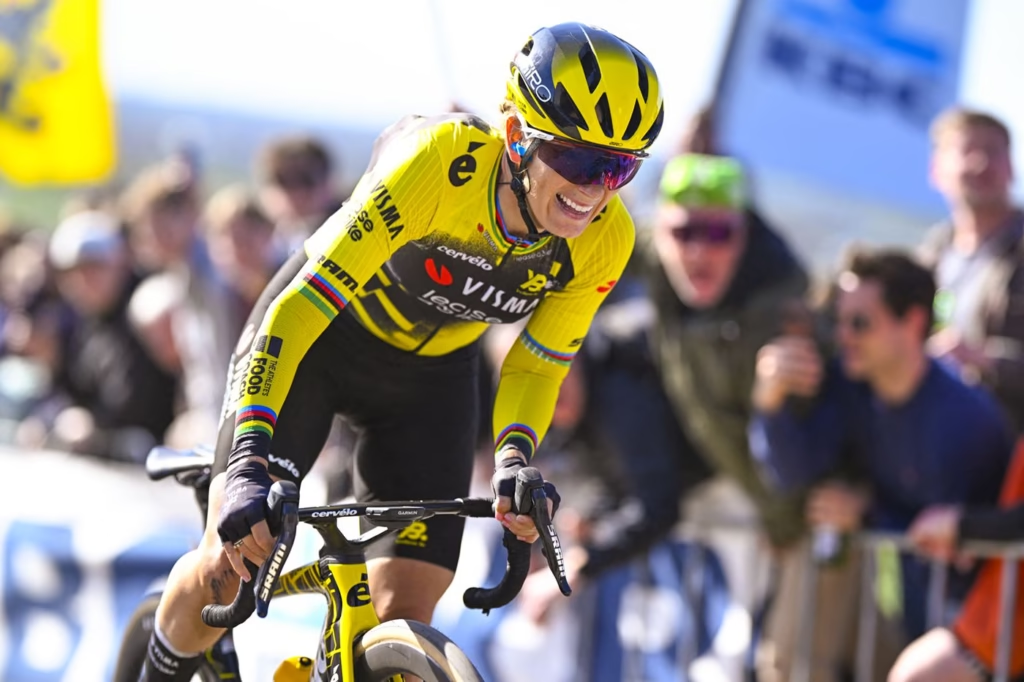
Her preparation has been less spectacular in terms of victories, but it has not been weak. Second at the Tour of Flanders and third at Paris-Roubaix Femmes showed that her physical level remained high during the spring, while her quieter results at La Vuelta Femenina were part of a programme built towards August rather than an attempt to peak throughout the year.
The wider context of her season, including the pressure of returning as Tour champion, is covered in the Pauline Ferrand-Prévot 2026 season guide.
The 2026 route should suit her climbing ability, technical skill and familiarity with the roads around Nice. The main uncertainty is the 21km time trial in Dijon, where Ferrand-Prévot must limit her losses to stronger specialists before the race reaches Mont Ventoux and its decisive final weekend.
Pauline Ferrand-Prévot’s 2026 season at a glance
| Race | Result |
|---|---|
| Strade Bianche | Mechanical problem removed her from the lead group |
| Tour of Flanders | 2nd |
| Paris-Roubaix Femmes | 3rd |
| La Flèche Wallonne | 7th |
| La Vuelta Femenina | 35th overall |
| Tour de France Femmes | Defending champion |
Ferrand-Prévot has not won a race in 2026 before beginning her Tour title defence. That statistic is notable, but it does not tell the whole story.
Her spring contained two Monument podiums, including second behind Vollering at the Tour of Flanders and third after helping create the decisive selection at Paris-Roubaix. She was also still inside the leading group at Strade Bianche before a mechanical problem ended her challenge with around 40km remaining.
The Vuelta result looks much less impressive. Ferrand-Prévot finished 35th overall and 42nd on the Angliru stage, while teammate Marion Bunel completed the podium. It was not the performance of an immediate Tour favourite, but neither was it designed to be the final judgement on her summer form. Her programme has consistently prioritised targeted peaks rather than collecting results every week.
No wins, but enough evidence of high-level form
Ferrand-Prévot’s failure to win during the first half of 2026 inevitably creates a different narrative from last season.
By the time she reached the 2025 Tour, she had already won Paris-Roubaix Femmes and established that her road return was progressing faster than expected. This year, she arrives without a victory and having been clearly beaten by Vollering at the Tour of Flanders.
That does not make her form poor.
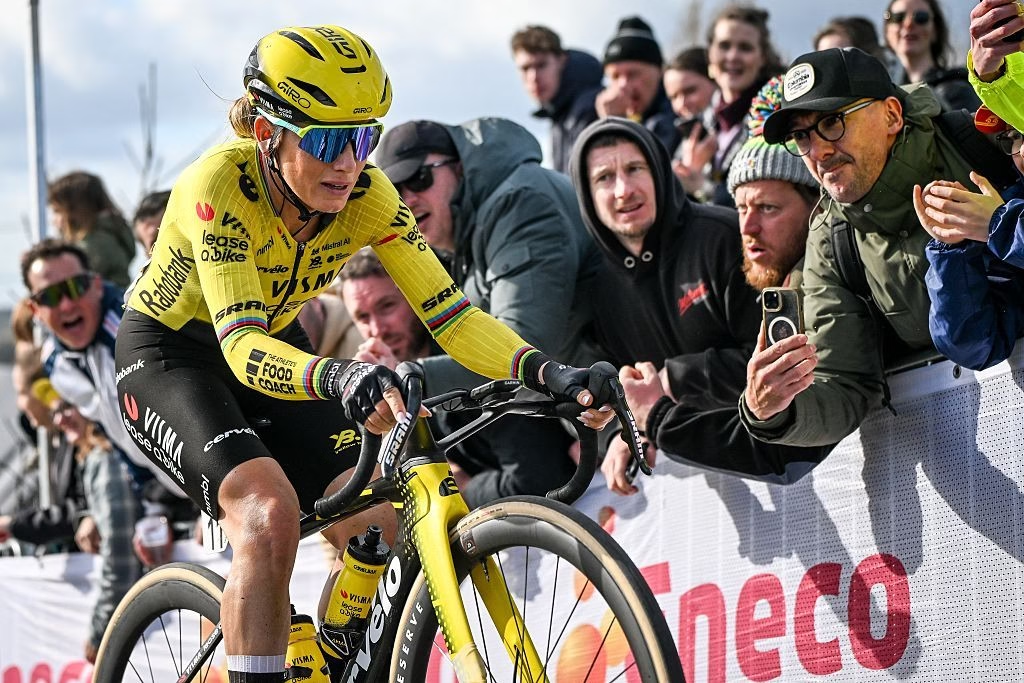
Ferrand-Prévot finished second in Flanders after surviving the race’s decisive cobbled climbs. Vollering was able to distance her on the Oude Kwaremont, but Ferrand-Prévot recovered well enough to take second place. She later acknowledged that she was still missing some race rhythm after an altitude camp focused heavily on longer climbing efforts.
That detail matters when assessing her Tour preparation. Flanders was not the final objective. It was a high-level test during a programme already shaped around longer climbs and stage-race endurance.
A week later, Ferrand-Prévot again helped decide Paris-Roubaix. She attacked after Mons-en-Pévèle, repeatedly forced the pace and reached the Roubaix velodrome in the leading group. The result demonstrated that she still possessed the endurance and aggression that produced her solo victory in 2025.
The evidence points towards a rider who remained close to the front of the biggest races without reaching her sharpest level. For a defending Tour champion aiming to peak in August, that may be more encouraging than a series of early-season victories followed by declining form.
 Photo Credit: Getty
The Vuelta result should not be ignored completely
Ferrand-Prévot’s 35th place at La Vuelta Femenina remains the main reason for caution.
She was not simply beaten by one or two rivals. She finished well outside the general classification battle, while Bunel emerged as Visma’s strongest climber and took third overall.
Ferrand-Prévot remained reasonably close during the opening stages, but her results deteriorated as the terrain became harder. She lost substantial time on the Angliru and ended more than 20 minutes behind the overall winner.
That can be interpreted in two ways.
The more concerning reading is that Ferrand-Prévot was not climbing at the level required to defend the Tour. Mont Ventoux and the repeated climbs around Nice will expose any weakness more severely than the opening stages in Switzerland.
The more favourable explanation is that the Vuelta served as a controlled training block during an extended preparation cycle. Ferrand-Prévot did not need to peak in May, and Visma had Bunel available as its clear general classification option once the race developed.
The truth may sit somewhere between the two. Ferrand-Prévot was clearly not at Tour-winning level in Spain, but she did not need to be. What matters is how much she has improved during the period between the Angliru and Lausanne.
Why the 2026 route suits Ferrand-Prévot
The Tour de France Femmes 2026 route offers Ferrand-Prévot several features that align closely with her strengths.
The race begins with two hilly stages in Switzerland before moving into France. The opening finish in Lausanne rewards positioning, explosiveness and the ability to cope with repeated changes of rhythm. Ferrand-Prévot may not be the fastest rider in a reduced sprint, but she should be comfortable enough to avoid early losses.
The Stage 1 finish in Lausanne contains enough climbing to prevent the opening day from being treated as a routine sprint. It creates an immediate need for Ferrand-Prévot to remain close to the front and avoid losing time through splits or poor positioning.
The general classification then faces its first clear test during the 21km time trial in Dijon. After that, the terrain grows progressively harder through the Beaujolais and Rhône Valley before the summit finish on Mont Ventoux.
Stages 8 and 9 take the race to the area around Nice, where Ferrand-Prévot lives and trains. She knows many of the roads, climbs and descents that will decide the final weekend.
The route does not offer one isolated summit finish followed by a straightforward conclusion. The decisive mountain stage comes on Stage 7, leaving two further opportunities for attacks and reversals.
That should suit a rider whose greatest strength is not simply one maximum climbing effort, but her ability to recover, handle technical terrain and remain tactically effective late in difficult races.
The Dijon time trial is her biggest vulnerability
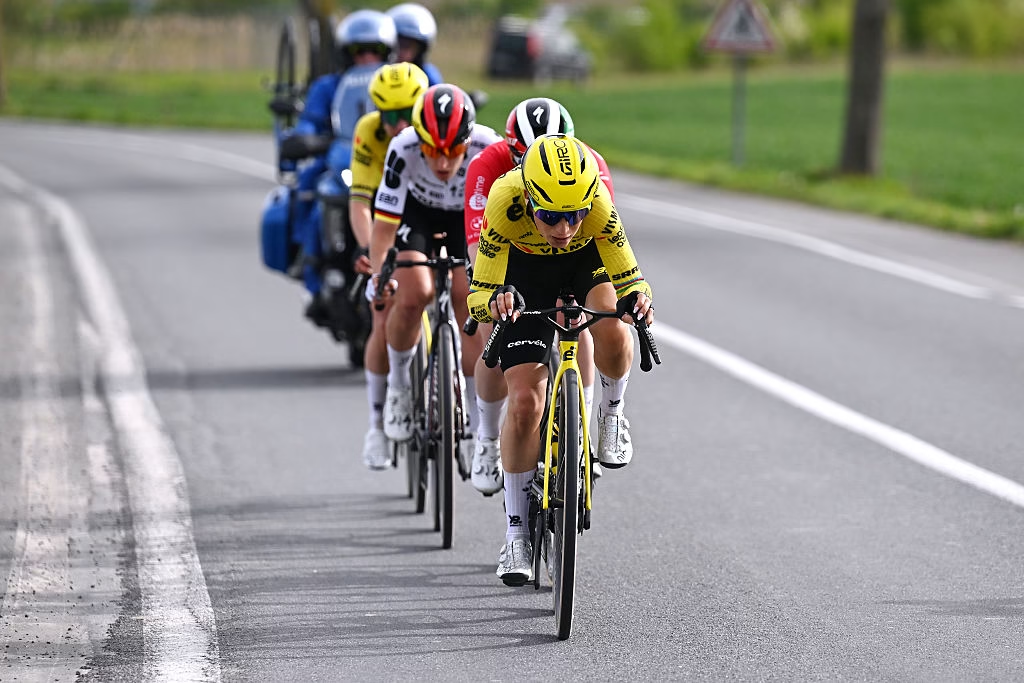
Stage 4 is the clearest point at which Ferrand-Prévot could lose control of her title defence.
The 21km individual time trial is the second-longest in the modern history of the race. It gives riders such as Vollering, Marlen Reusser and Anna van der Breggen an opportunity to establish meaningful advantages before the mountain stages.
The likely hierarchy and the riders best placed to gain time are examined in the Tour de France Femmes 2026 time trial contenders guide.
Ferrand-Prévot is not a poor time triallist. She won three consecutive French elite time trial titles between 2012 and 2014 and has the technical discipline required to hold an aerodynamic position.
She is, however, returning to a specialist discipline that has evolved considerably during the years she spent focused on mountain biking. Equipment, pacing models and aerodynamic preparation have all developed, while several of her rivals have continued racing time trials at WorldTour level.
Ferrand-Prévot and Visma have identified this as an important development area. The objective in Dijon does not necessarily need to be winning.
She must avoid conceding enough time to force a desperate long-range attack later in the race. Losing 20 or 30 seconds to Vollering would be manageable. Losing more than a minute would place much greater pressure on Mont Ventoux and reduce her tactical options.
Mont Ventoux provides the clearest route to yellow
Stage 7 from La Voulte-sur-Rhône to Mont Ventoux is the centrepiece of Ferrand-Prévot’s title defence.
The stage covers 146.8km and includes 3,565 metres of climbing before the final 15.7km ascent at an average gradient of 8.8%. The approach also contains three earlier categorised climbs, ensuring the peloton will already be reduced before reaching Bédoin.
The full stage, climb history and likely general classification impact are covered in the Tour de France Femmes 2026 Mont Ventoux guide.
This is the type of stage where Ferrand-Prévot can change the race through one sustained performance.
Her 2025 victory was built in a similar way. She remained close enough through the first week, then produced an overwhelming ride on the Col de la Madeleine before winning again on the final stage.
Her decisive move on the Madeleine is covered in the report on Ferrand-Prévot taking yellow on Stage 8 of the 2025 Tour de France Femmes.
Ventoux creates the same possibility. If Ferrand-Prévot reaches the final climb within a minute of yellow, she does not need a series of small attacks. She can ride at a sustained pace, allow the gradient and heat to reduce the group, then use the upper mountain to test who has managed the climb correctly.
Her familiarity with the mountain is relevant, but not decisive by itself. Knowing the gradient changes, wind exposure and transition out of the forest can help pacing, yet every leading contender will reconnoitre the climb and arrive with detailed performance plans.
Ferrand-Prévot’s advantage is more personal. Ventoux is accessible from her training base, allowing repeated efforts in different conditions rather than one organised reconnaissance several months before the race.
The final Nice stages make route knowledge valuable
The race does not finish on Mont Ventoux.
Stage 8 travels from Sisteron to Nice, making it the longest day of the race and a difficult recovery test after the summit finish. Stage 9 then contains four ascents of the Col d’Èze around a short and aggressive Nice circuit.
The final stage, travel considerations and best roadside locations are detailed in the Tour de France Femmes 2026 Nice finish guide.
Ferrand-Prévot should know many of these roads better than almost anyone in the field. That familiarity can help with positioning before climbs, judging descents and recognising the sections where attacks are most likely to succeed.
It may become particularly important if the time gaps remain small.
A defending champion wearing yellow after Ventoux can use local knowledge to manage the race, anticipate dangerous moves and avoid wasting energy. A Ferrand-Prévot still chasing the lead can identify less obvious places to attack before the final ascent.
The last stage is unlikely to produce the same type of long summit effort as Ventoux. Repeated climbs and descents create a more tactical contest where confidence and decision-making matter alongside pure power.
That versatility is one of Ferrand-Prévot’s strongest qualities. Her career across mountain biking, cyclo-cross, gravel and road racing has made her comfortable when races become technically difficult and hard to control.
Defending the title changes how rivals will race her
Ferrand-Prévot surprised parts of the peloton in 2025.
Her victory at Paris-Roubaix had established her quality, but few expected her to dominate the Tour’s mountain finale so completely. She entered the decisive stages as a threat rather than the rider every team had built its plan around.
That will not happen again.
Ferrand-Prévot starts among the central names in the Tour de France Femmes 2026 riders to watch, alongside Vollering, Reusser, Anna van der Breggen, Kasia Niewiadoma-Phinney and the other leading GC contenders.
FDJ United-SUEZ, UAE Team ADQ, Canyon-SRAM zondacrypto and the other general classification squads know that Ferrand-Prévot can win the Tour through one exceptional mountain stage. They are unlikely to give her freedom or wait until she has already created a decisive gap before responding.
Vollering has the most obvious reason to race aggressively. She was beaten by 3:42 in 2025 and has already demonstrated stronger one-day form than Ferrand-Prévot this spring.
Other riders may also attempt to exploit the time trial. Reusser can build a buffer in Dijon, while lighter climbers may try to isolate Ferrand-Prévot before the upper slopes of Ventoux.
Ferrand-Prévot will need to win from the position of favourite rather than outsider. That requires patience during the opening stages and confidence that her decisive move does not need to come before the terrain truly suits her.
Visma must balance several strong options
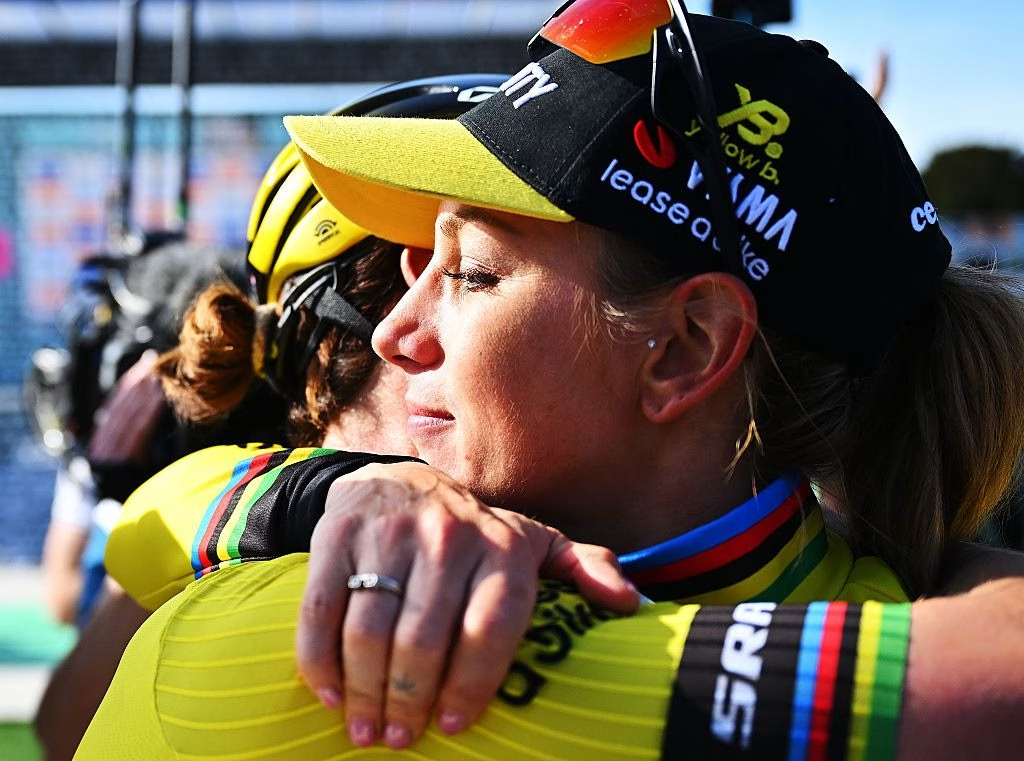
Team Visma | Lease a Bike brings more than one rider capable of influencing the general classification.
Bunel’s podium at La Vuelta Femenina confirmed that she can compete with the strongest climbers across a difficult stage race. That gives the team a valuable second card for Mont Ventoux and the final Nice stages.
Marianne Vos provides stage-winning potential, tactical intelligence and the ability to collect time bonuses during the opening days. Other riders can protect Ferrand-Prévot through positioning battles and the approach to major climbs.
The relationship between Ferrand-Prévot and Bunel could become especially important.
Visma will start with Ferrand-Prévot as the defending champion and primary leader, but Bunel’s presence prevents rival teams from focusing entirely on one rider. If she remains close on general classification, she can attack earlier and force Vollering or another favourite to chase.
There is also protection against an unexpected problem. Ferrand-Prévot’s title defence does not have to collapse completely if she loses time through a puncture, crash or difficult day.
The challenge is keeping two ambitions alive without creating uncertainty when a decisive commitment is required.
Demi Vollering remains the clearest rival
Vollering begins as the most obvious threat to Ferrand-Prévot’s title.
Her Tour of Flanders victory demonstrated that she could distance Ferrand-Prévot on a sustained cobbled climb, while the 2026 route provides opportunities to gain time both in Dijon and on Mont Ventoux.
The time trial may be particularly important. Vollering has more recent experience in the discipline and should expect to gain on Ferrand-Prévot if both perform at their usual level.
Ferrand-Prévot’s task is to keep that difference manageable, then change the balance in the high mountains.
The psychological comparison with 2025 also matters. Vollering knows that Ferrand-Prévot can produce an overwhelming late-race performance. She may therefore try to build a larger advantage before Ventoux rather than waiting for the final climb.
Ferrand-Prévot, by contrast, can draw confidence from having beaten Vollering decisively over nine stages. She does not need to prove that the strategy can work. She needs to repeat it against a rival who is now much better prepared for what is coming.
Time bonuses could matter before the mountains
Ferrand-Prévot’s title defence will not be decided only by the time trial and summit finishes.
The opening stages contain opportunities for general classification riders to collect bonus seconds, particularly if a reduced group reaches Lausanne or Geneva. Vollering’s acceleration makes her especially dangerous in those situations, while Vos may also influence how Visma approaches the finales.
The full system is explained in the Tour de France Femmes 2026 time bonuses guide.
Ferrand-Prévot does not need to chase every available second, but she cannot repeatedly allow Vollering or another rival to gain time without responding. A series of small bonuses could turn a manageable Dijon deficit into a larger problem before Mont Ventoux.
The key is avoiding unnecessary energy expenditure. Ferrand-Prévot’s best chance still comes later in the race, so the opening stages must be managed rather than treated as opportunities that need to be won at all costs.
Can Pauline Ferrand-Prévot defend her title?
Yes, but her path to victory is narrower than it appeared after the 2025 Tour.
Ferrand-Prévot has shown enough during 2026 to remain one of the leading favourites. Two spring Monument podiums confirmed that her physical level and racing instincts remain intact, while the route gives her major opportunities on Mont Ventoux and roads she knows around Nice.
The lack of a victory and her modest Vuelta performance prevent her from beginning as an overwhelming favourite. The Dijon time trial also creates a genuine weakness that was not present in the same form during last year’s race.
Her Tour may depend on three linked objectives:
- Avoid early time losses or crashes during the Swiss stages.
- Remain within a manageable distance of the strongest time triallists after Dijon.
- Produce her best climbing performance on Mont Ventoux without leaving herself exposed during the final two stages.
Ferrand-Prévot does not need to lead from the opening weekend. She may not even need to hold yellow after the time trial.
She needs to arrive at the foot of Mont Ventoux close enough to make one exceptional performance decisive.
Ferrand-Prévot is still capable of changing the race in one afternoon
The defending champion enters the 2026 Tour with more questions than she had at the end of last summer.
She has not won this season. Vollering has beaten her directly. The time trial favours several rivals, and every team understands the danger of allowing her to reach the final mountain stages within striking distance.
Ferrand-Prévot also possesses advantages few other riders can match.
She has already won the race, already handled the pressure of carrying French expectations and already demonstrated that she can recover from a decisive mountain effort to win again the following day. Her overall victory was completed with another solo success on the final stage, as covered in the report on Ferrand-Prévot sealing the 2025 Tour de France Femmes title.
The route passes through terrain she knows intimately, while Mont Ventoux gives her exactly the type of long, exposed test capable of turning a close race into a clear hierarchy.
Her title defence is not built around dominating every stage. It is built around staying close, limiting damage in Dijon and reaching the final weekend with the form to make the race hers again.
That was enough to win the Tour de France Femmes in 2025.
The central question of the 2026 edition is whether Ferrand-Prévot can produce the same transformation when everyone knows precisely what to expect.