
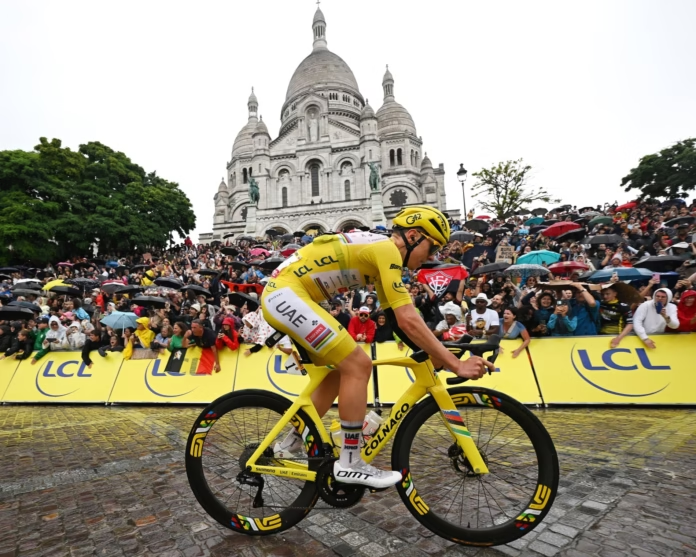
The 2026 Tour de France reaches Paris on Sunday, but the final stage will look very different from the one originally designed.
Stage 21 has been shortened from 133km to 89km, with the competitive part of the race now taking place entirely within Paris after security personnel were redeployed to support the response to wildfires across France.
Thoiry still hosts the team presentation and caravan departure, but the riders will then travel to Paris by bus. The official stage start will take place directly on the Champs-Élysées at 17:50 local time.
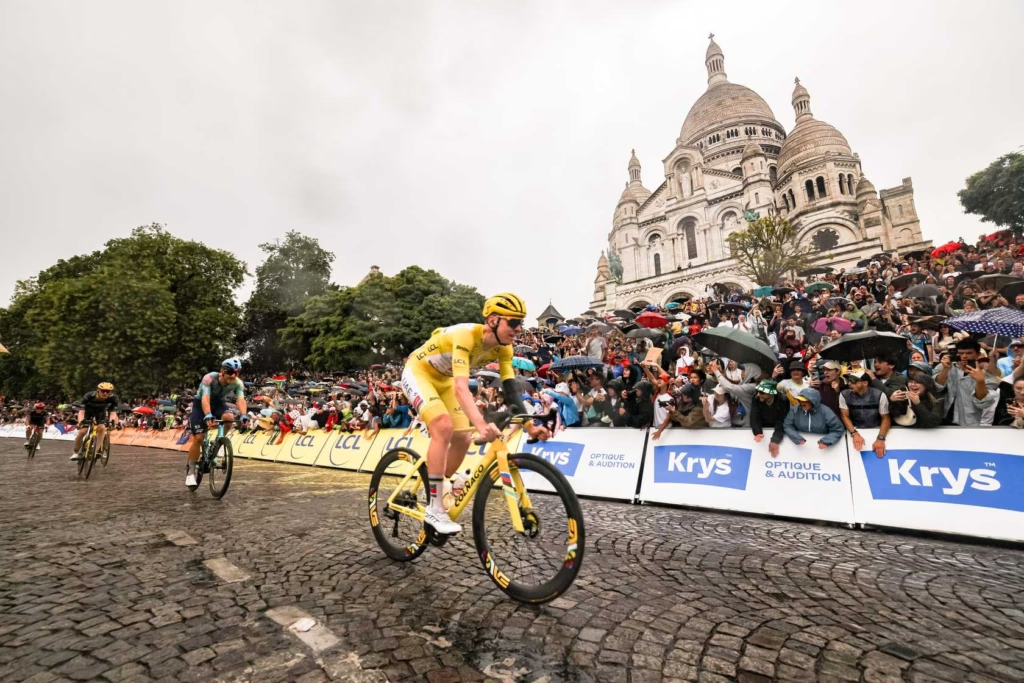
There will be two additional laps of the Champs-Élysées before the race heads towards Montmartre, where the Rue Lepic circuit has survived the emergency redesign.
That means Sunday still offers the basic sporting tension planned before the route change.
Can the sprinters control Montmartre and bring the race back together?
Or will Tadej Pogačar, Mads Pedersen and the classics riders turn the final 89 kilometres of the Tour into something much less ceremonial?
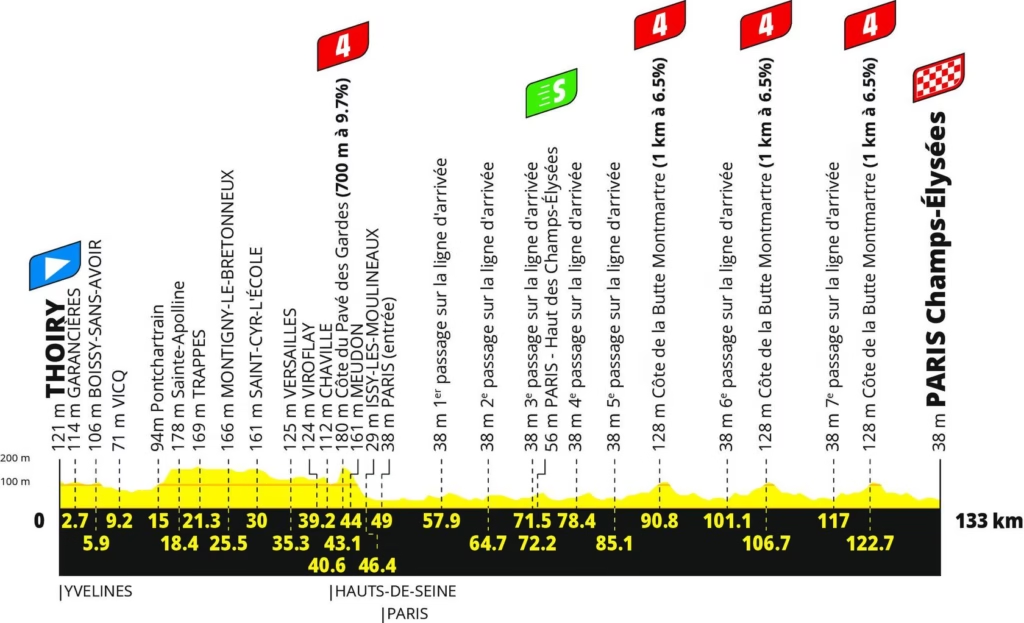
Tour de France 2026 Stage 21 route
Date: Sunday 26 July 2026
Route: Paris to Paris Champs-Élysées
Distance: 89km
Stage type: Flat, with repeated Montmartre climbs
Official start: 17:50 CEST / 16:50 BST
Expected finish: Around 19:45 CEST / 18:45 BST
The biggest change is straightforward.
There is no longer a racing start from Thoiry.
The planned sections through Yvelines and Hauts-de-Seine have been removed, cutting around 44 kilometres from the original stage and creating an unusually compact Paris finale.
After completing their presentation in Thoiry at 15:40, the riders will transfer to Paris.
The flag drops on the Champs-Élysées.
That alone makes this one of the strangest Stage 21 formats in recent Tour history.
The wider change is covered in our Tour de France 2026 Stage 21 route update.
Why was Stage 21 shortened?
The decision was made because of the wildfire emergency affecting France, particularly Gironde.
Police and other security personnel originally allocated to the Tour are being redeployed to support affected regions and protect local communities.
Running a Tour stage across Yvelines, Hauts-de-Seine and Paris requires an enormous security operation, particularly when every junction along the route needs to be controlled.
Removing the suburban section allows the race to concentrate its available resources inside Paris.
Thoiry therefore keeps the ceremonial departure, but the peloton will not race through the western suburbs.
For spectators who had planned to watch along that part of the route, the Tour will no longer pass.
Montmartre survives the redesign
This is the most important sporting detail.
There had been speculation on Saturday morning that the Montmartre circuit might also be affected.
It has not been removed.
The riders will still leave the Champs-Élysées circuit and head towards Montmartre, where Rue Lepic gives attackers somewhere to disrupt what would otherwise be a relatively conventional Paris sprint.
That keeps the essential character of the stage intact.
Our dedicated Montmartre Stage 21 tactical guide explains why the repeated climb of Rue Lepic matters far more than its modest gradient suggests.
The Tour discovered in 2025 that Montmartre changes Paris completely.
Rather than the usual ceremonial arrival followed by a controlled sprint, the narrow roads and repeated short climbs created something much closer to an urban classic.
There is every reason to expect riders to try again.
An 89km stage changes the race
The most interesting consequence of the route change is not necessarily what has been removed.
It is how fresh everyone will be when the decisive racing begins.
The original route gave riders more than 40 kilometres before reaching Paris.
Now the entire competitive stage is only 89km.
That should mean faster racing.
Sprint teams will have more domestiques available late in the stage.
Attackers will have more energy when they reach Rue Lepic.
The usual accumulated fatigue of a 130km final stage will be reduced.
After three weeks of racing, nobody is genuinely fresh, but this becomes something much closer to a short one-day race than a conventional Tour stage.
That could make the fight for position before Montmartre extremely aggressive.
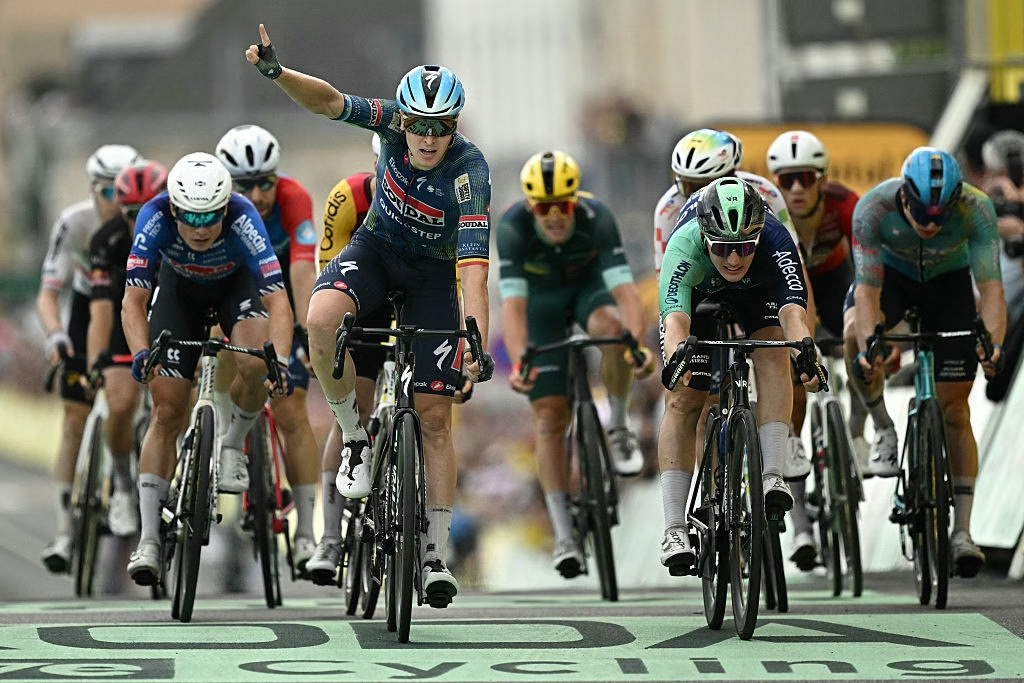 Photo Credit: Getty
Pedersen and Philipsen arrive with very different Paris objectives
Earlier in the final week, Mads Pedersen and Jasper Philipsen looked set to bring the green jersey battle all the way to Paris.
After Stage 17, Philipsen had closed to just seven points behind Pedersen after winning in Voiron.
At that point, the points classification looked wide open.
Pedersen’s ability to score on harder stages had always been his biggest advantage, something we explored in whether he could win green at the 2026 Tour.
The Alpine stages ultimately allowed him to regain control.
That means Sunday is now much more about the stage victory itself than a last mathematical battle for the jersey.
For Philipsen, that simplifies the objective.
He needs Paris.
For Pedersen, the route gives him multiple ways to win.
Pedersen may be the rider Montmartre suits best
A conventional Champs-Élysées sprint might favour Philipsen.
The revised Montmartre finale may favour Pedersen.
The Dane has spent the Tour proving that he can survive terrain that should theoretically be too difficult for a points-classification rider.
Rue Lepic is nowhere near as difficult as the mountains he has crossed during the final week.
The question is therefore not whether Pedersen can survive Montmartre.
It is whether he attacks there.
His combination of power, positioning and climbing ability makes him close to the ideal rider for this finale.
Lidl-Trek also have little reason to race passively.
Pedersen can wait for a reduced sprint.
He can follow attacks.
Or the team can use riders such as Quinn Simmons and Jasper Stuyven to force Alpecin-Premier Tech and the other sprint teams to work.
That flexibility is exactly why Pedersen was already rated the strongest all-round sprint option in our Stage 17 preview.
Jasper Philipsen needs the race to come back together
Philipsen’s route to victory is more conventional.
Alpecin-Premier Tech need to keep him close enough over Montmartre for the group to reform before the Champs-Élysées.
The climb is not long enough to automatically remove a rider with Philipsen’s ability.
The problem is positioning.
If an attack goes from the front while Philipsen enters Rue Lepic 30 or 40 places back, the gap can open without him actually being dropped through lack of climbing ability.
Alpecin therefore need to treat the approach to Montmartre almost like the finale of a Classic.
Philipsen needs to start the climb near the front.
Then he needs teammates left afterwards.
If the peloton is together again on the Champs-Élysées, Philipsen remains one of the obvious favourites.
His Tour de France 2026 sprint profile explains why Mathieu van der Poel remains such a valuable weapon when Alpecin need both tactical flexibility and a lead-out.
Can Pogačar attack on Montmartre again?
Absolutely.
The more relevant question is why he would not.
Pogačar heads into Paris with the Tour effectively won and no reason to conserve energy for anything afterwards.
All he needs to do to confirm the overall victory is finish.
Once the race becomes competitive, he can treat Montmartre as a one-day race.
That is exactly what made the 2025 finale so unusual.
Pogačar did not simply sit in the yellow jersey group and allow the sprinters to have Paris.
He attacked.
The shortened 2026 route may make another move even more tempting.
He will reach Rue Lepic after considerably less racing than originally planned, and an explosive kilometre around 6% is almost perfectly suited to his strengths.
Nobody should expect UAE Team Emirates-XRG to control the race for him.
But Pogačar does not need a lead-out.
He only needs an opening.
Could Pogačar actually win Stage 21?
Yes, although the route after Montmartre still makes it difficult.
Attacking on Rue Lepic is one thing.
Staying away from a group containing Pedersen, Philipsen and several relatively fresh sprint teams is another.
The strongest scenario for Pogačar would be a small group forming rather than a solo attack.
If three or four powerful riders leave Montmartre together, the chase becomes much more complicated.
Nobody in that move wants to tow Pogačar to the line.
But nobody wants to sit up either.
That tactical confusion is precisely what makes Montmartre work.
It creates a finale where the strongest rider does not necessarily need to be the fastest sprinter.
The sprinters have been waiting for Paris
Stage 17 was the final conventional opportunity for the fast riders before the Tour entered the Alps.
Our analysis of whether Stage 17 was the sprinters’ last real chance before Paris always came with one qualification.
Paris itself was no longer a normal sprint stage.
Montmartre changes the equation.
Philipsen, Pedersen and the remaining sprinters have endured the Alps to reach Sunday, but simply making it to the Champs-Élysées circuit does not guarantee them a sprint.
They still have to survive Rue Lepic.
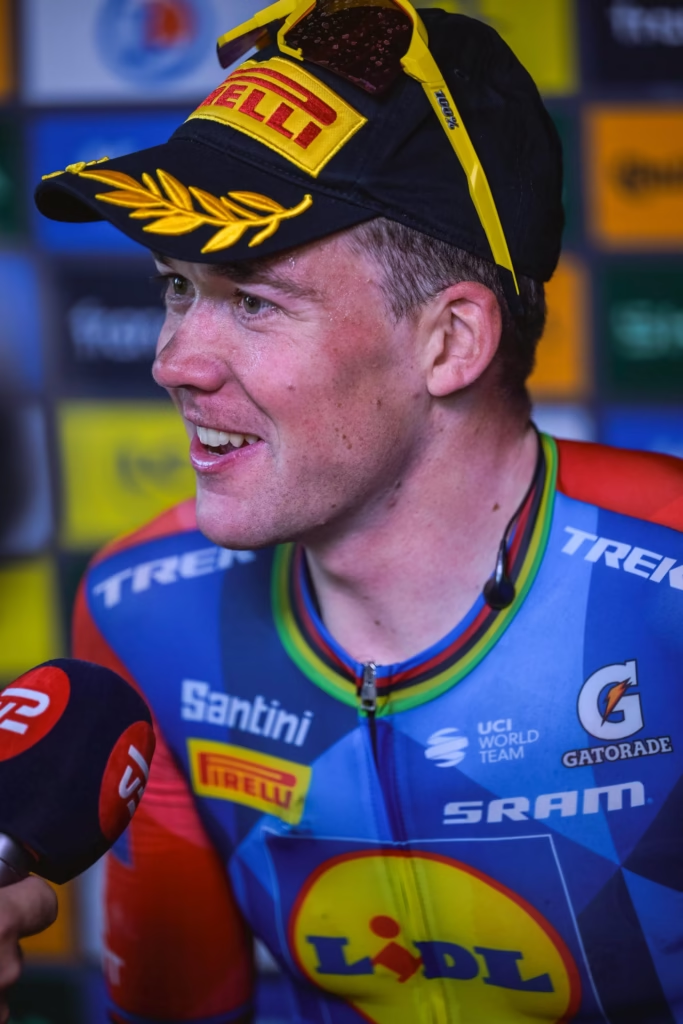 Photo Credit: A.S.O./Charly López
Who are the Stage 21 favourites?
Mads Pedersen
Probably the most complete fit for the revised route.
Pedersen can survive Montmartre comfortably, attack there and still win from a reduced sprint.
He does not need the race to unfold in one particular way.
Jasper Philipsen
Still one of the strongest choices if the race finishes in a bunch.
His challenge is surviving the repeated Montmartre accelerations in a position that allows him to stay connected.
If Alpecin-Premier Tech bring everything back together, Philipsen becomes much harder to beat.
Tadej Pogačar
The wildcard nobody really wants in the finale.
Pogačar has almost no tactical downside to attacking.
The shortened stage gives him fresher legs with which to do it.
Wout van Aert
If Van Aert has recovered sufficiently after a difficult Tour for Visma | Lease a Bike, the Montmartre finale is the type of stage where he can still be dangerous.
He can attack on Rue Lepic, survive a hard reduced race and sprint from a small group.
Mathieu van der Poel
Montmartre is obvious terrain for Van der Poel.
The combination of short climbing, positioning and repeated accelerations resembles a Classics finale far more than a traditional Tour sprint stage.
His difficulty is deciding whether Alpecin need him attacking or protecting Philipsen.

What happens to the usual Tour celebrations?
They will have to be compressed.
Stage 21 normally allows the yellow jersey team to enjoy a long ceremonial ride towards Paris.
There are photographs, champagne and congratulations throughout the peloton before serious racing begins on the finishing circuit.
That format does not translate neatly to Sunday.
The riders will go through the ceremonial presentation in Thoiry, board buses and then start the actual race from the Champs-Élysées.
There may still be opportunities for the traditional yellow jersey photographs before the official start.
But once the flag drops at 17:50, an 89km stage leaves very little reason to ride slowly.
It could become full racing almost immediately.
Stage 21 prediction
Winner: Mads Pedersen
Philipsen is the obvious alternative if the race returns to a full bunch, while Pogačar, Van Aert and Van der Poel provide the biggest attacking threats around Montmartre.
But the revised route arguably makes Pedersen the strongest all-round option.
He does not need the race to unfold in one particular way.
If attacks go on Rue Lepic, he can follow them.
If a reduced group reaches the Champs-Élysées, he can sprint.
If Lidl-Trek decide to make Montmartre aggressively hard, Pedersen can be part of that strategy rather than simply trying to survive it.
After spending three weeks fighting for green across terrain that rarely suited a traditional sprinter, an 89km Paris road race ending via Montmartre looks almost designed for him.
Prediction: Mads Pedersen
Second: Jasper Philipsen
Third: Wout van Aert
The Tour still ends on the Champs-Élysées.
Almost everything about how the peloton gets there has changed.

