The mountains will ultimately decide much of the Tour de France Femmes 2026, but the three officially classified hilly stages may be where the race becomes hardest to control.
Stages 3, 5 and 6 sit between the obvious sprint opportunities, the 21km Dijon time trial and the major climbing test on Mont Ventoux. None is designed to create the enormous gaps expected later in the race, yet each contains enough climbing to eliminate sprinters, encourage breakaways and punish a GC contender who is badly positioned at the wrong moment.
They are also some of the best opportunities in the Tour de France Femmes 2026 route for riders who sit between the traditional categories. Puncheurs who cannot match the strongest climbers on Ventoux, Classics riders who need something harder than a bunch sprint and aggressive stage hunters all have routes towards victory.
For the yellow jersey contenders, these are days where there may be relatively little to gain but plenty to lose.
Three hilly stages create a race within the Tour
The 2026 Tour contains three officially hilly stages: Stage 3 from Geneva to Poligny over 156.5km, Stage 5 from Mâcon to Belleville-en-Beaujolais over 140km and Stage 6 from Montbrison to Tournon-sur-Rhône over 153.4km.
They are not three versions of the same stage.
Stage 3 has its hardest climb early and could eventually come back towards faster riders. Stage 5 is the most obvious puncheur day, with almost constant climbing and Mont Brouilly close enough to the finish to launch a decisive attack. Stage 6 sits immediately before Mont Ventoux, making team tactics and willingness to chase just as important as the profile itself.
That variety means the same rider is unlikely to be the obvious favourite across all three.
The common theme is uncertainty.
Stage 3 may be harder to predict than to ride
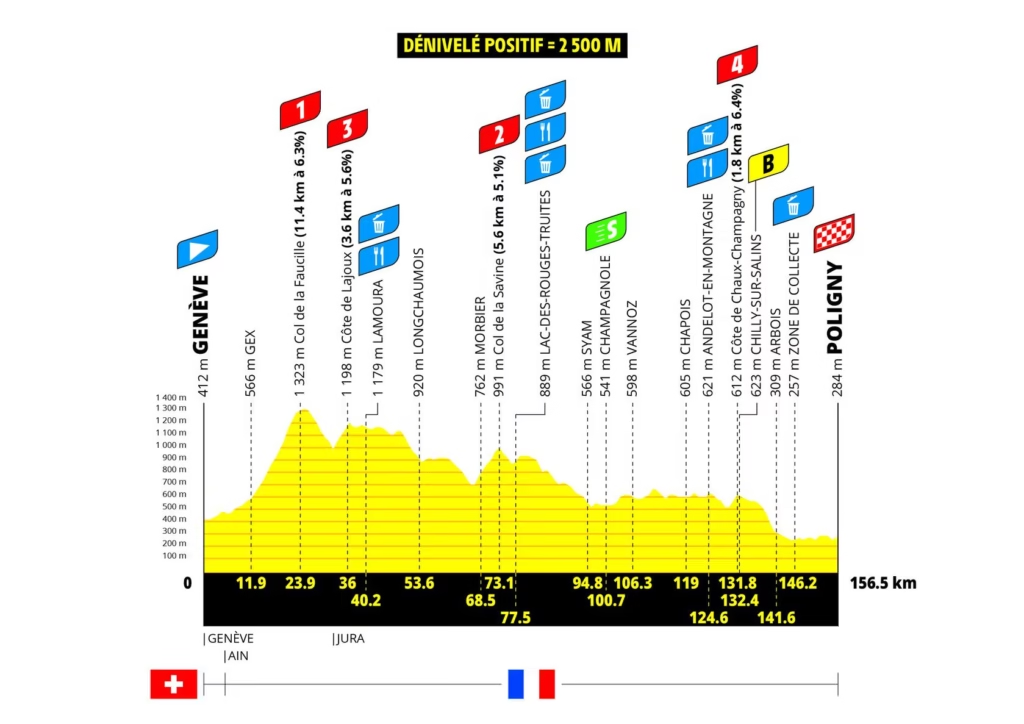
Geneva to Poligny looks intimidating when the climbing begins with the Col de la Faucille, 11.4km at 6.3%, after only 23.9km.
The Côte de Lajoux follows before the second-category Col de la Savine, but the key detail is how much racing remains afterwards. Once the main early climbs have been crossed, there is a long period for dropped riders to reorganise and teams to decide whether bringing the race back together is worth the effort.
That creates several possible races.
A strong breakaway can form on the Faucille while the peloton is already stretched. A puncheur can wait for the shorter late climbs. Stronger sprinters can survive the first half and hope enough teams remain interested in a reduced sprint.
That final scenario is why Lorena Wiebes cannot simply be crossed off because the stage is labelled hilly. Her combination of sprint speed and improving climbing range gives her more possible winning stages than a conventional fast finisher, something explored in our look at Wiebes’ sprint chances and green jersey route.
For the attackers, the challenge is preventing enough regrouping for that speed to matter.
The Faucille could create a high-quality breakaway
Stage 3 is also one of the first serious opportunities for the Tour de France Femmes 2026 breakaway specialists.
The Col de la Faucille is long enough to prevent a completely random early move from dominating the stage. Riders trying to establish the break need to climb properly while the race is still fresh and potentially aggressive.
That should favour all-rounders who know they are unlikely to win on Ventoux but are too strong to wait passively for flatter days.
The GC teams may be happy to let the right group go. With the Dijon individual time trial following on Stage 4, Demi Vollering, Marlen Reusser and the other overall favourites have little reason to make their teams chase harmless stage hunters for hours.
The break’s composition therefore matters enormously.
Put a rider close to yellow into it and the peloton has to respond.
Fill it with riders already outside the GC picture and the escape suddenly becomes much more dangerous.
Stage 3 is a sneaky GC danger day
The climbs may not produce major overall gaps, but the stage is dangerous precisely because it is not one of the obvious GC days.
The Faucille arrives before the race has fully settled. A favourite who begins the climb too far back could find herself on the wrong side of a split and forced into a chase that consumes far more energy than the time eventually lost suggests.
There are also bonus seconds available during the stage and at the finish.
For riders such as Kasia Niewiadoma-Phinney, whose aggressive style suits short climbs but who may expect Reusser to gain time in Dijon, those seconds can be worth taking when the opportunity presents itself.
Her form and attacking range were visible again at the Tour de Suisse, where Niewiadoma-Phinney climbed onto the final podium behind Reusser and Cédrine Kerbaol.
The danger is spending too much energy chasing small gains one day before the time trial.
Stage 3 rewards opportunism.
It does not justify turning the entire Tour into a GC war this early.
Stage 5 is the true puncheur stage
If Stage 3 can potentially come back together, Mâcon to Belleville-en-Beaujolais looks much harder to tame.
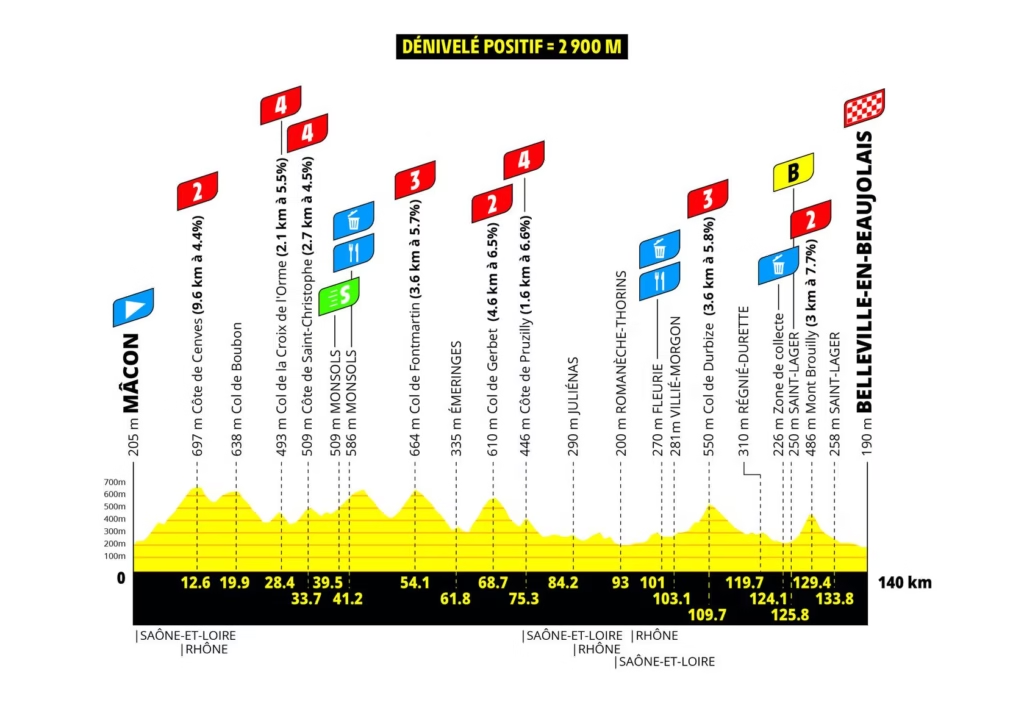
The 140km route contains close to 2,900 metres of climbing, with repeated ascents making it difficult for any team to settle into a long period of straightforward control.
The decisive point comes on Mont Brouilly, around 3km at 7.7%, with only a little over 10km remaining to the finish.
This is the stage where riders with an Ardennes-style profile should be thinking seriously about victory.
There is enough climbing to make conventional sprint teams suffer, but no climb is long enough to turn the stage exclusively into a test for the strongest mountain GC riders.
It is exactly the middle ground where puncheurs thrive.
Mont Brouilly is the obvious place to attack
Three kilometres at close to 8% will not produce the same gaps as Mont Ventoux, but after a day containing repeated climbs it is more than hard enough to split an already reduced group.
Its position is what makes it particularly valuable.
A rider crossing the summit with 10 or 15 seconds does not have to defend that advantage across another 40km of flat road. If the chase behind becomes hesitant, a small gap can survive.
Puck Pieterse is an obvious example of the type of rider suited to the stage. Her ability to accelerate on short climbs, descend quickly and sprint from a selective group gives her several ways to win. The broader Tour de France Femmes 2026 riders to watch also identifies Stages 3, 5 and 6 as realistic opportunities for her.
Niewiadoma-Phinney brings a different threat. She may need to attack because arriving with faster riders does not necessarily favour her, while repeated short climbs allow her to make the race difficult without waiting for a long mountain ascent.
Riders such as Magdeleine Vallières and Célia Géry bring another dimension. Both can handle selective terrain and still finish quickly from a small group, making them exactly the sort of riders who become difficult to chase if they reach the final climbs ahead.
Géry’s 2026 season has already demonstrated that quality, including her Brabantse Pijl victory after a perfectly timed uphill sprint.
Stage 5 may be the best pure breakaway day
A strong escape has two major advantages on the road to Belleville-en-Beaujolais.
First, chasing is expensive.
The road continually rises and falls, gradually reducing the number of domestiques available in the peloton. A team trying to hold an escape at two minutes cannot simply place several riders on the front and maintain the same pace all afternoon.
Second, almost every major team has competing priorities.
GC squads need to protect leaders.
Sprint teams may decide the terrain is too difficult.
Teams with strong puncheurs may prefer putting a rider in the break rather than committing to a chase.
Once enough squads are represented ahead, responsibility behind becomes difficult to assign.
That is exactly why the 2026 breakaway specialists guide highlights riders such as Géry, Vallières, Kristen Faulkner, Kimberley Le Court and Loes Adegeest.
For many of them, Stage 5 is not an alternative plan.
It is one of the best opportunities of the Tour.
The GC riders cannot switch off on Mont Brouilly
Stage 5 comes immediately after the Dijon time trial, so the GC hierarchy will finally be visible.
If Reusser has used her strongest discipline to move into yellow, every rival knows exactly what needs recovering. If Vollering limits her losses or even produces an exceptional ride of her own, the tactical pressure shifts elsewhere.
Mont Brouilly is short enough for an opportunistic GC attack without becoming a full mountain showdown.
Nobody is likely to win the Tour there, but a small split over the summit can become meaningful if the strongest riders cooperate on the descent and run-in.
Bonus seconds increase the potential reward.
The opposite scenario matters even more.
A mechanical problem or poor position at the foot of the climb could become a genuine time loss because there is so little road available to reorganise.
Stage 5 is therefore one of the classic danger days of this Tour: the expected gaps are modest, but the consequences of getting the finale wrong are not.
Stage 6 is shaped by what comes next
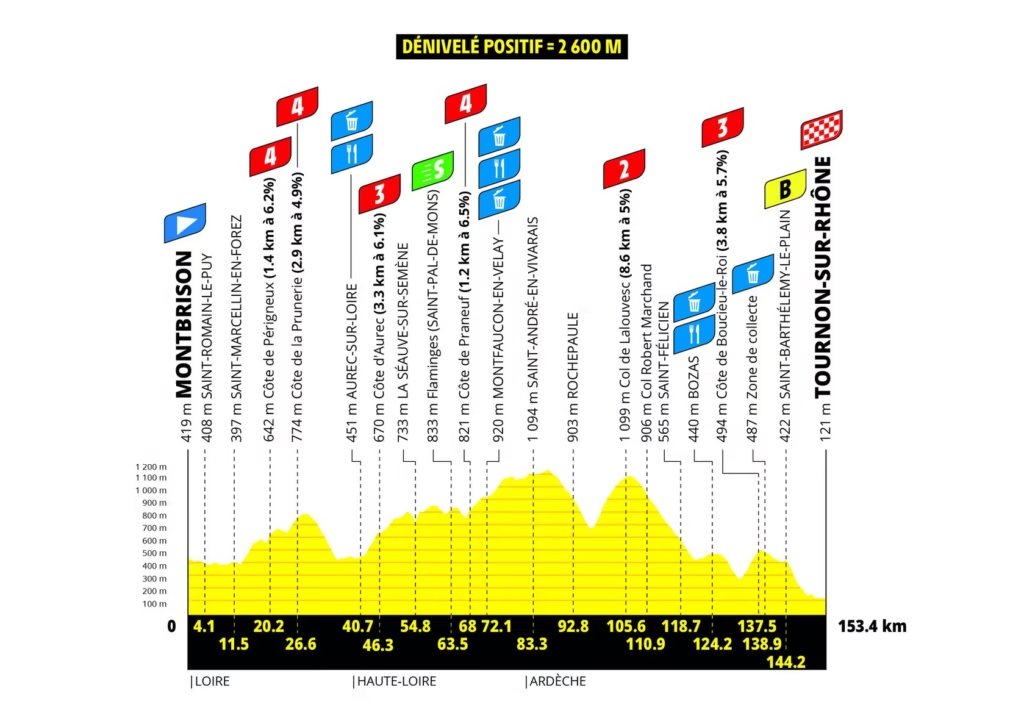
Montbrison to Tournon-sur-Rhône contains six categorised climbs and another long day of rolling terrain.
On its own, the profile already suits breakaways.
Its position makes them even more likely.
The following stage finishes on Mont Ventoux, the clearest sustained mountain test of the race.
Every team with serious GC ambitions will know what is coming. Domestiques who might normally spend 100km controlling a breakaway could be needed the following afternoon when the peloton reaches the Giant of Provence.
That creates a simple conflict.
Chasing a stage hunter on Stage 6 may cost more than the stage is worth.
Stage hunters are running out of chances
By Stage 6, opportunities for non-GC riders begin disappearing quickly.
Stage 7 is Ventoux.
Stage 8 offers another chance for faster riders, although the route into Nice is not straightforward.
Stage 9 is a short mountainous finale where the yellow jersey fight should dominate everything.
For riders without sprint speed or GC ambitions, Tournon-sur-Rhône is therefore one of the final obvious opportunities to build an entire day around the breakaway.
That should make the opening hour aggressive.
Teams cannot assume another chance will arrive later.
A rider suited to Stage 6 needs more than climbing ability. She needs enough power to survive a long day, confidence on the descents and preferably some finishing speed if the escape arrives as a group.
The perfect mountain domestique is not necessarily the perfect Stage 6 breakaway rider.
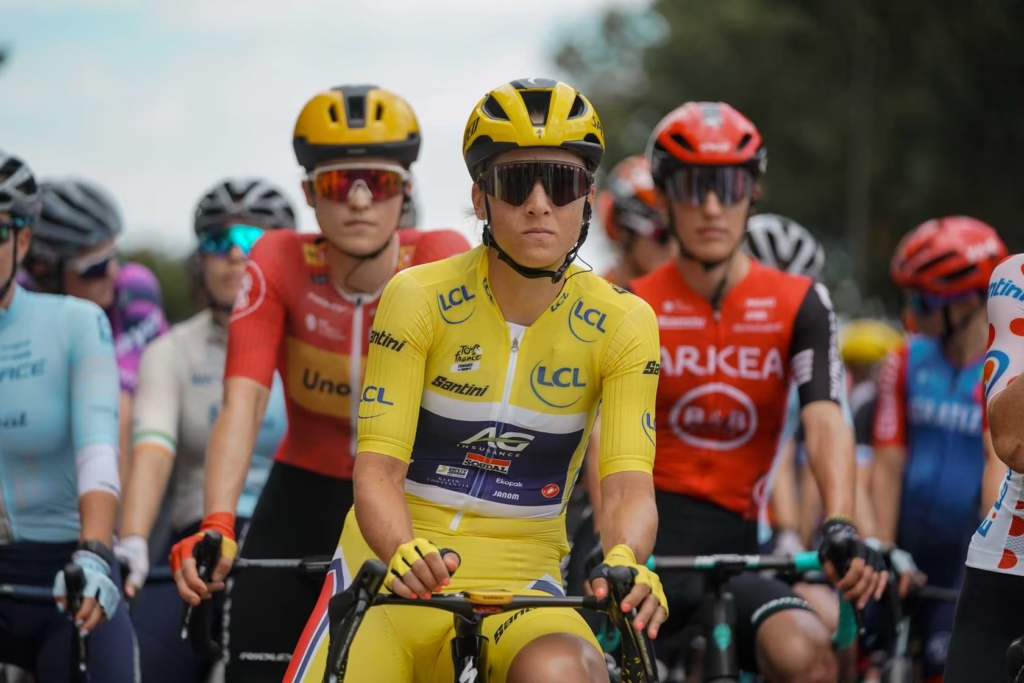 Photo Credit: A.S.O./Thomas Maheux
The yellow jersey team may actively want the break to survive
For the GC leader, Stage 6 could become easier if the right escape establishes itself.
Allow a group containing no overall threat several minutes and much of the tactical tension disappears. The break takes the stage win and bonus seconds while the GC teams ride a controlled tempo ahead of Ventoux.
That is the ideal scenario.
The problem is that rival teams do not have to cooperate.
If the yellow jersey leader looks vulnerable on rolling terrain, Stage 6 offers an opportunity to attack without waiting for the obvious mountain finish.
Seven-rider teams make this more dangerous. Lose a couple of domestiques on repeated climbs and a leader can become isolated surprisingly quickly.
The stage could therefore become either one of the quietest GC days of the race or one of the most chaotic.
That uncertainty is exactly why it matters.
Puncheurs can influence yellow without racing for it
One of the most interesting things about the hilly stages is the way riders outside the GC battle can shape it.
A stage hunter attacking Mont Brouilly forces someone to chase.
A strong breakaway can make the yellow jersey team work for several hours.
A puncheur contesting the finish can remove bonus seconds that a GC favourite wanted.
That is why the race cannot be reduced to Vollering, Reusser, Niewiadoma-Phinney and the other favourites waiting for Ventoux.
The Tour de France Femmes 2026 route deliberately gives different types of riders opportunities throughout the race.
Their objectives collide.
That is where tactical racing begins.
The hilly stages matter for green too
These stages also influence the points classification.
A rider such as Wiebes will want the hilly days to remain controlled enough that her improved climbing can keep her involved. More versatile rivals would rather make the race hard enough to remove her before the finish.
That makes Stage 3 particularly interesting because the difficult climbing comes early enough for regrouping, while Stage 5 provides a much sterner test.
If Wiebes survives those stages and continues scoring, her route towards green becomes much easier.
If she loses contact while a rival repeatedly finishes near the front, the classification can change without anyone beating her in a conventional bunch sprint.
The hills therefore become an important part of the sprint competition as well as the yellow jersey race.
Which hilly stage is the most dangerous?
Stage 3 is the positioning danger day. Its hardest climb arrives early, creating the possibility of unexpected splits before the race has settled.
Stage 5 is the puncheur and GC danger day. Repeated climbing and Mont Brouilly close to the finish make it the hilly stage most likely to produce genuine differences between the overall favourites.
Stage 6 is the tactical danger day. Everyone knows Ventoux comes next, which means few teams want to spend resources controlling the race. That reluctance creates exactly the conditions in which a strong breakaway or long-range move becomes difficult to retrieve.
None should produce the biggest time gaps of the Tour.
That does not make them secondary.
The mountains measure strength, the hills expose mistakes
Mont Ventoux offers a relatively straightforward question: who can climb fastest?
The hilly stages ask much messier ones.
Who gets into the break?
Who accepts responsibility for chasing?
Which sprinter survives?
Who is badly positioned when Mont Brouilly begins?
Does the yellow jersey team spend its domestiques on Stage 6 or save them for tomorrow?
Can an attacker turn 10 seconds into 30 because everybody in the chase waits for someone else?
Those are the days when a Tour can change without anybody producing the best climbing performance of the race.
The 2026 Tour de France Femmes has three officially hilly stages and each serves a different purpose. Poligny rewards riders who can survive the early climbing and retain enough speed. Belleville-en-Beaujolais is the clearest puncheur battleground. Tournon-sur-Rhône gives the breakaway specialists one final major invitation before Ventoux takes over.
For the stage hunters, they are opportunities.
For the GC favourites, they are days to respect.
The biggest mountains will reveal who is strongest.
The hilly stages may decide who reaches them without already having made a costly mistake.