

La Choralis Fourmies Féminine is a relatively young race, but in only a few years it has grown from a modest UCI 1.2 event into a regular Women’s ProSeries fixture.
First held in 2019 alongside the long-established men’s Grand Prix de Fourmies, the women’s race immediately adopted the same basic identity: a late-season one-day contest based around Fourmies and the rolling roads of the Avesnois in northern France. It has never needed huge climbs to make the racing difficult, instead relying on repeated short rises, narrow roads and a finale where the balance between attackers and sprinters can change quickly.
Its winners reflect that character. Thi That Nguyen won the inaugural edition, Pfeiffer Georgi relaunched the race after its Covid interruption with an attacking victory, Clara Copponi delivered a French home success, Marta Lach stole the race from the sprinters and Silvia Zanardi restored bunch control before Lorena Wiebes arrived in 2025 to underline how far Fourmies had developed by winning its first edition at ProSeries level.
For readers discovering the event for the first time, ProCyclingUK’s beginner’s guide to La Choralis Fourmies Féminine 2026 explains how the modern race works. Its short history shows why the outcome remains much less predictable than the relatively modest profile might suggest.
La Choralis Fourmies Féminine history at a glance
| Detail | La Choralis Fourmies Féminine |
|---|---|
| First edition | 2019 |
| Location | Fourmies, Hauts-de-France, France |
| Race type | Women’s one-day race |
| Original classification | UCI 1.2 |
| Upgraded to 1.1 | 2024 |
| Joined Women’s ProSeries | 2025 |
| Current classification | UCI 1.Pro |
| 2020 edition | Cancelled |
| First winner | Thi That Nguyen |
| Defending champion | Lorena Wiebes |
| Most wins | All winners have one victory |
| 2026 edition | Sunday 13 September |
Six editions were raced between the launch in 2019 and the end of 2025, with the 2020 event lost during the Covid-19 pandemic.
The women’s race grew from a much older Fourmies tradition
The women’s event may be recent, but professional cycling in Fourmies is anything but.
The men’s Grand Prix de Fourmies dates back to 1928 and became an established late-season French one-day race long before a women’s equivalent was created. That gave the organisers an existing event infrastructure, an established audience and a recognisable cycling weekend on which to build.
A women’s race was finally added in 2019, entering the UCI calendar at 1.2 level. The inaugural edition covered around 118km and, like every edition since, started and finished in Fourmies.
Adding the event was important in more than symbolic terms. Northern France already had a dense men’s racing culture, but opportunities for elite women remained much more limited. Fourmies immediately provided another established organiser and another traditional cycling town with a permanent place on the international women’s calendar.

Thi That Nguyen wins the inaugural edition in 2019
The first La Choralis Fourmies Féminine was won by Thi That Nguyen of Lotto Soudal Ladies.
The Vietnamese sprinter had already built a strong international palmarès, including an Asian road title and victories across Asian stage racing, but Fourmies became one of the most notable European results of her career.
Sara Poidevin and Nicola Juniper were among the riders who animated the race from the breakaway before the peloton eventually brought the move back and prepared for a sprint. Nguyen proved fastest in Fourmies, beating Kaat Hannes and former French champion Pascale Jeuland-Tranchant.
Clara Copponi, who would return to win three years later, was already inside the top 10.
The result established a pattern that remains relevant. The rolling roads gave attackers opportunities, but if the race returned together, a strong sprinter could still control the finish.
For a first edition, it established the race’s identity remarkably quickly.
Covid stops the race after only one edition
Momentum disappeared almost immediately.
The planned 2020 edition was cancelled during the Covid-19 pandemic, as restrictions and uncertainty wiped large sections of the European racing calendar.
That meant Fourmies effectively had to relaunch itself in 2021 rather than simply build smoothly from its inaugural year. The men’s Grand Prix de Fourmies suffered the same interruption, leaving 2020 as the only season since the women’s race was created in which neither professional event took place.
When the women returned the following September, the winner provided a very different tactical story from 2019.
Pfeiffer Georgi takes her first UCI professional victory in 2021
Pfeiffer Georgi won the returning race in 2021 at only 20 years old.
The British rider was already regarded as one of Team DSM’s leading young Classics prospects, but Fourmies became an important landmark in her professional career. Georgi made the early breakaway, remained central to an aggressive Team DSM race and then attacked again on the final lap before beating Rachel Neylan in the sprint from the small group that survived.
It was the first UCI professional victory of Georgi’s career, and ProCyclingUK’s 2021 La Choralis Fourmies Féminine race report captured a performance built around much more than simply waiting for the finish.
Neylan took second, with Silvia Zanardi two seconds behind in third.
That podium reads particularly well with hindsight. Georgi developed into one of Britain’s leading Classics riders, while Zanardi would return three years later to win Fourmies herself.
The result also demonstrated another side of the race’s identity. The profile is rarely difficult enough for a pure climber to make the difference, but a strong all-round rider capable of repeated accelerations can make the race selective enough to neutralise many of the outright sprinters.

Clara Copponi gives France a home winner in 2022
The 2022 edition returned to a more familiar Fourmies outcome.
Clara Copponi won for FDJ-Suez-Futuroscope, giving France its first home victory in the race. She beat Italian teenager Valentina Basilico and Portugal’s Maria Martins after the race came back together for the sprint.
Copponi fitted Fourmies extremely well. Her track background gave her exceptional speed and positioning, but she also had enough road endurance to survive the repeated changes in rhythm before the finish.
The victory became one of the important early road results of her career. Copponi would go several seasons without another road win before returning to winning form in 2025, while her wider development can be followed through ProCyclingUK’s Clara Copponi rider profile.
She had finished inside the top 10 at the inaugural race in 2019. Three years later she became its first French champion.

Marta Lach produced the race’s great escape in 2023
If one edition best explains why sprint teams cannot treat Fourmies as automatic, it is 2023.
Marta Lach attacked with three laps remaining and stayed away by the narrowest of margins.
The Pole had already developed into a dangerous one-day rider with a fast finish, but instead of waiting to challenge the sprinters directly she took the race away from them. The peloton came increasingly close as the finish approached, but Lach crossed the line with only one second remaining.
Sofie van Rooijen led the bunch home for second, with Marthe Truyen third.
ProCyclingUK’s report on Marta Lach’s 2023 Fourmies victory shows just how finely judged the attack had been.
It remains the best tactical template for riders trying to defeat a faster favourite at Fourmies. There is rarely one climb severe enough for an attacker simply to ride everyone off the wheel. Instead, a rider has to exploit a moment when the sprint teams are tired, short of domestiques or unwilling to take responsibility.
Lach found that moment perfectly.
Her subsequent development into one of the peloton’s most reliable Classics sprinters can also be followed through ProCyclingUK’s Marta Lach profile.
Fourmies steps up to UCI 1.1 level in 2024
The 2024 edition marked the first major structural step forward for the race.
After operating at UCI 1.2 level since its launch, La Choralis Fourmies Féminine was promoted to 1.1 status. The upgrade increased the level of UCI points available and helped attract a stronger field, while the route was extended to around 130km.
Women’s WorldTour teams including Team Visma | Lease a Bike and Movistar appeared on the start line, giving Fourmies a level of depth it had not previously enjoyed.
The result eventually came down to the sprint, but only after the peloton had been forced to work hard to produce it.

Silvia Zanardi converts her Fourmies consistency into victory
Silvia Zanardi already had history with Fourmies before winning in 2024.
She had finished third behind Georgi in 2021 and returned as one of the riders whose combination of climbing resistance and finishing speed made her particularly well suited to the race.
Her Human Powered Health team had to earn the sprint.
A dangerous late group containing Femke de Vries, Marta Lach and Emma Norsgaard remained clear until around three kilometres from the finish. Human Powered Health helped close the gap and Zanardi then completed the work by beating British teenager Cat Ferguson and Martina Alzini.
ProCyclingUK’s 2024 La Choralis Fourmies Féminine race report covers how close the late move came to denying the peloton.
For Zanardi, it was her first victory of the season and an important result during her first year with Human Powered Health. Her wider career and subsequent results can be followed through ProCyclingUK’s Silvia Zanardi profile.
For Fourmies, the race again reinforced the tactical balance that had existed since 2019. The route may favour fast riders, but the sprint is something teams have to actively create rather than simply wait for.
ProSeries status changes the race again in 2025
The most important step in the event’s development came only a year later.
For 2025, La Choralis Fourmies Féminine was promoted again, this time to UCI 1.Pro status and the Women’s ProSeries.
The rise had been remarkably quick:
- 2019-2023: UCI 1.2
- 2024: UCI 1.1
- 2025 onwards: UCI 1.Pro / Women’s ProSeries
In only six years, including one cancelled edition, Fourmies had moved from the third tier of women’s international one-day racing to the second.
The stronger classification brought more Women’s WorldTour teams and increased the value of the race as a late-season target. ProCyclingUK’s 2025 La Choralis Fourmies Féminine preview showed how much the level of the field had changed compared with the early editions.
Then one rider demonstrated that rise more clearly than anyone else could have.

Lorena Wiebes brings the biggest name yet in 2025
Lorena Wiebes arrived at Fourmies in 2025 during one of the most dominant sprinting seasons ever produced in women’s cycling.
The race was aggressive from the start, with repeated attacks attempting to prevent the expected bunch finish, but Team SD Worx-Protime remained committed to Wiebes and never allowed the race to escape their control for long.
Once the peloton reached Fourmies together, the result was emphatic.
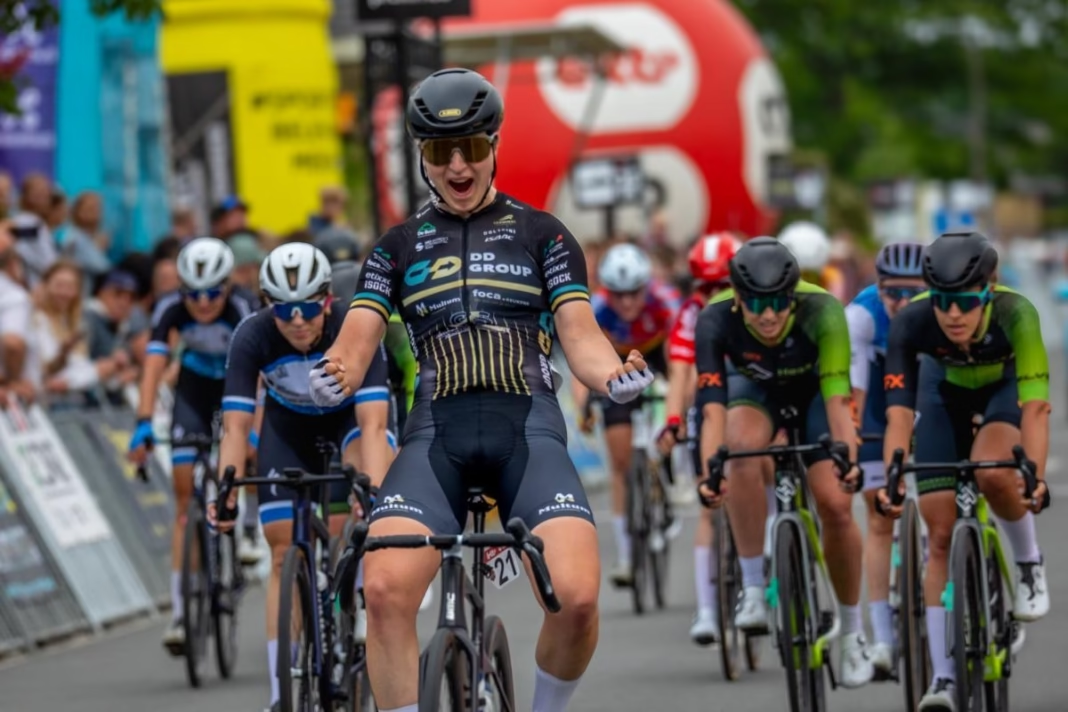
Wiebes won ahead of Lara Gillespie and Gladys Verhulst-Wild, taking the 24th victory of her 2025 season and her tenth win in a one-day race.
ProCyclingUK’s report on Lorena Wiebes’ 2025 Fourmies victory showed both how aggressive the race had been and how difficult Wiebes was to beat once SD Worx-Protime delivered her to the sprint.
For Fourmies, having the world’s dominant sprinter win the first ProSeries edition was significant.
The event had started only six years earlier with a largely Continental-level field. By 2025, one of the biggest stars in women’s cycling was deliberately targeting it and winning.
Wiebes’ continued dominance and development beyond conventional flat sprints can be followed through ProCyclingUK’s Lorena Wiebes profile.
Every La Choralis Fourmies Féminine winner
| Year | Winner | Country | Winning style |
|---|---|---|---|
| 2019 | Thi That Nguyen | Vietnam | Bunch sprint |
| 2020 | Cancelled | Covid-19 pandemic | |
| 2021 | Pfeiffer Georgi | Great Britain | Small-group sprint |
| 2022 | Clara Copponi | France | Bunch sprint |
| 2023 | Marta Lach | Poland | Late solo attack |
| 2024 | Silvia Zanardi | Italy | Bunch sprint |
| 2025 | Lorena Wiebes | Netherlands | Bunch sprint |
No rider has yet won La Choralis Fourmies Féminine twice.
That lack of a repeat winner is notable given how frequently the race has ended in a sprint. The terrain is consistent enough to reward similar characteristics each year but tactically open enough that no single rider has established a period of dominance.
Fourmies has become a race for durable sprinters
The winners list tells a fairly clear story about the rider profile Fourmies normally rewards.
Nguyen, Copponi, Zanardi and Wiebes all possess obvious finishing speed. Georgi and Lach sit closer to the Classics end of the spectrum but are still fast enough to win from reduced groups.
What the race has not produced is a victory for a pure climber.
That reflects the terrain. The roads around Fourmies and the Avesnois contain enough elevation to create fatigue, but not enough sustained climbing to make power-to-weight ratio the defining requirement. Riders instead have to survive repeated short efforts while preserving enough speed or tactical sharpness for the finish.
That balance is why Fourmies remains more interesting than simply looking at the number of bunch sprints might suggest.
The attackers have shaped almost every edition
Four bunch-sprint victories from six raced editions could make Fourmies sound straightforward.
The races themselves tell a different story.
The inaugural edition contained a meaningful breakaway before Nguyen won the sprint. Georgi’s 2021 success came from aggressive racing and a small group. Lach won outright from a late solo attack in 2023. The 2024 move containing de Vries, Lach and Norsgaard survived until only three kilometres remained.
Even Wiebes’ 2025 victory came after repeated attacking rather than a completely controlled procession.
That attack-versus-sprint battle has become the defining tactical feature of La Choralis Fourmies Féminine. There is enough difficulty to attack, but enough road remaining for organised teams to chase.
Neither side receives the race automatically.
Fourmies has also helped emerging riders announce themselves
One of the most interesting features of the race’s short history is how many winners or podium finishers were still developing when they achieved their result.
Georgi was only 20 when she took her first professional victory here in 2021.
Zanardi was third in the same edition before returning to win three years later.
Valentina Basilico was still a teenager when she finished second behind Copponi in 2022.
Cat Ferguson was also a teenager when she finished second in 2024.
The race’s position on the calendar contributes to that pattern. By September, leading riders can be following very different programmes, creating opportunities for younger riders and smaller teams to challenge more established opposition.
The arrival of Wiebes in 2025 showed that growing status does not have to remove that developmental role. Fourmies can attract the biggest teams while still providing emerging riders with a realistic opportunity to test themselves against them.
The Coupe de France adds to its domestic importance
La Choralis Fourmies Féminine has also developed an important place within French domestic racing through its position in the Coupe de France Femmes Professionnelles.
That matters tactically. French teams can arrive with objectives extending beyond the standalone victory, while riders may still be fighting for season-long individual or team positions.
A team protecting a Coupe de France lead may chase a breakaway even without one of the strongest sprinters in the race. Another squad may need to attack because a safe bunch finish offers little value.
The 2026 edition is scheduled as the seventh and final round of the Coupe de France Femmes Professionnelles FDJ United, giving the race another reason to remain aggressive even if one rider begins as a clear favourite.
That domestic importance has grown alongside Fourmies’ international status rather than being replaced by it.
Wiebes’ victory showed how far the race had travelled
The contrast between 2019 and 2025 is probably the clearest way to measure the development of La Choralis Fourmies Féminine.
The inaugural edition was a UCI 1.2 race with an international but relatively modest field.
Six years later, Fourmies was part of the Women’s ProSeries and being won by Lorena Wiebes during a season in which she dominated many of the biggest sprint races in the sport.
The progression was not simply cosmetic. The routes became longer, the fields became deeper and Women’s WorldTour teams became regular participants. Most significantly, the UCI classification moved upwards twice in successive seasons.
Fourmies had gone from providing another international racing opportunity to becoming an event riders could deliberately target as a meaningful late-season result.
-
 Photo Credit: A.S.O./Gaëtan Flamme

Why La Choralis Fourmies Féminine matters in September
September is a crowded but unusual period in women’s cycling.
The Tour de France Femmes has finished, most of the major European stage races are over and riders begin dividing their attention between late-season trade-team racing and the World Championships.
That gives Fourmies a useful niche.
Sprinters can target one of the final high-level European opportunities suited to them. Classics riders can use the rolling roads to test their late-season form, younger riders can take advantage of changing team priorities and French squads still have the Coupe de France to consider.
The 2026 race takes place on Sunday 13 September, less than two weeks before the elite women’s World Championship road race in Montréal. That gives the edition additional value as a late form check, even if the Canadian Championship course itself will be substantially harder.
For a race that did not exist before 2019, Fourmies has found a clear and useful position in the calendar remarkably quickly.
La Choralis Fourmies Féminine enters its next phase
The short history of La Choralis Fourmies Féminine is ultimately one of rapid growth.
Thi That Nguyen won a new 1.2 race in 2019. Pfeiffer Georgi helped relaunch it after the pandemic and collected the first professional victory of her career. Clara Copponi delivered the first French win. Marta Lach showed how the sprint teams could be beaten. Silvia Zanardi won as the race stepped up to 1.1 level, and Lorena Wiebes then became the first champion of its ProSeries era.
The winners have changed every year, but the central character has remained remarkably consistent. Fourmies gives fast riders a clear opportunity without ever guaranteeing them the sprint they want.
That balance has survived every step up the UCI hierarchy so far.
The 2026 La Choralis Fourmies Féminine therefore arrives not simply as another edition of a young race, but as the latest stage in one of the quicker rises through the women’s one-day calendar.

