Stage 12 of the 2026 Vuelta a España takes place today, Thursday 3 September, with the race returning to the high mountains for 166.6km from Vera to the summit finish at Calar Alto.
For UK viewers, this is one of the earliest Vuelta broadcasts of the second week. TNT Sports 3 coverage begins at 11:30 BST, with the stage also available to stream on HBO Max. The official race schedule begins at 12:07 BST, while the finish at the Calar Alto observatory is expected between 16:16 and 16:44 BST.
Anyone primarily interested in the general classification battle should aim to be watching by 14:50 BST. The Alto de Velefique begins between approximately 14:56 and 15:15, and from that point there is almost no respite before the riders tackle the 16.9km final climb to Calar Alto.
The full tactical picture, including why Velefique could be every bit as important as the summit finish itself, is covered in our Vuelta a España 2026 Stage 12 preview.
Vuelta a España Stage 12 start and finish times
The official Vuelta timetable is calculated using average speeds of 36, 38 and 40km/h. Spain is one hour ahead of the UK, giving the following approximate British viewing times.
| Stage 12 event | Spanish time | UK time |
|---|---|---|
| TNT Sports 3 coverage begins | 12:30 CEST | 11:30 BST |
| Racing begins from Vera | 13:07 CEST | 12:07 BST |
| Alto del Cabecico summit | 13:30-13:33 | 12:30-12:33 |
| Alto de Cóbdar summit | 14:26-14:35 | 13:26-13:35 |
| Collado García summit | 15:13-15:27 | 14:13-14:27 |
| Alto de Velefique begins | 15:56-16:15 | 14:56-15:15 |
| Intermediate sprint at Velefique | 15:59-16:18 | 14:59-15:18 |
| Alto de Velefique summit | 16:26-16:49 | 15:26-15:49 |
| Calar Alto begins | 16:41-17:04 | 15:41-16:04 |
| 3.2km remaining | 17:10-17:37 | 16:10-16:37 |
| Expected finish at Calar Alto | 17:16-17:44 | 16:16-16:44 |
The range becomes increasingly wide late in the stage because more than 30km of the final 45km are uphill. A hard GC battle on Velefique could push the race towards the slower end of the timetable even while the leaders are producing some of the highest efforts of the day.
What time is Vuelta Stage 12 on TV in the UK?
TNT Sports 3 begins live Stage 12 coverage at 11:30 BST, with the channel scheduled to remain with the race until 17:00.
HBO Max is the main streaming option and carries the Vuelta as part of TNT Sports’ cycling coverage.
There is also a TNT Sports 1 showing from 15:45 BST, after that channel’s earlier Tour of Britain coverage. By then the Vuelta should be on Velefique, descending towards Bacares or beginning Calar Alto depending on the race speed.
For anyone streaming, HBO Max is the simpler option because there is no need to switch channels during the afternoon.
The full subscription details and free highlights information are covered in our guide to watching the Vuelta a España 2026 in the UK.
When should you start watching Vuelta Stage 12?
There are four particularly useful points to join the stage.
11:30 BST gives you the complete live broadcast, including the fight to establish a breakaway on a route that begins climbing almost immediately.
14:10 BST should bring you in around the Collado García, with approximately 80km remaining and the race beginning to move towards the decisive mountains.
14:50 BST is the best overall time to start watching. The riders should reach the foot of Velefique between 14:56 and 15:15, after which the race remains difficult almost continuously to the finish.
15:35 BST is the latest comfortable entry point if you only want the GC battle. Velefique should either be approaching its summit or already producing the first serious selection, with Calar Alto following almost immediately.
Waiting until 16:00 carries a genuine risk of missing the first attacks on the final climb if the race is running towards the faster end of the schedule.
Why Velefique is where you need to be watching
The first three climbs contribute heavily to the day’s fatigue, but none should force Enric Mas, Primož Roglič, Felix Gall or Oscar Onley into direct action.
That changes with the Alto de Velefique.
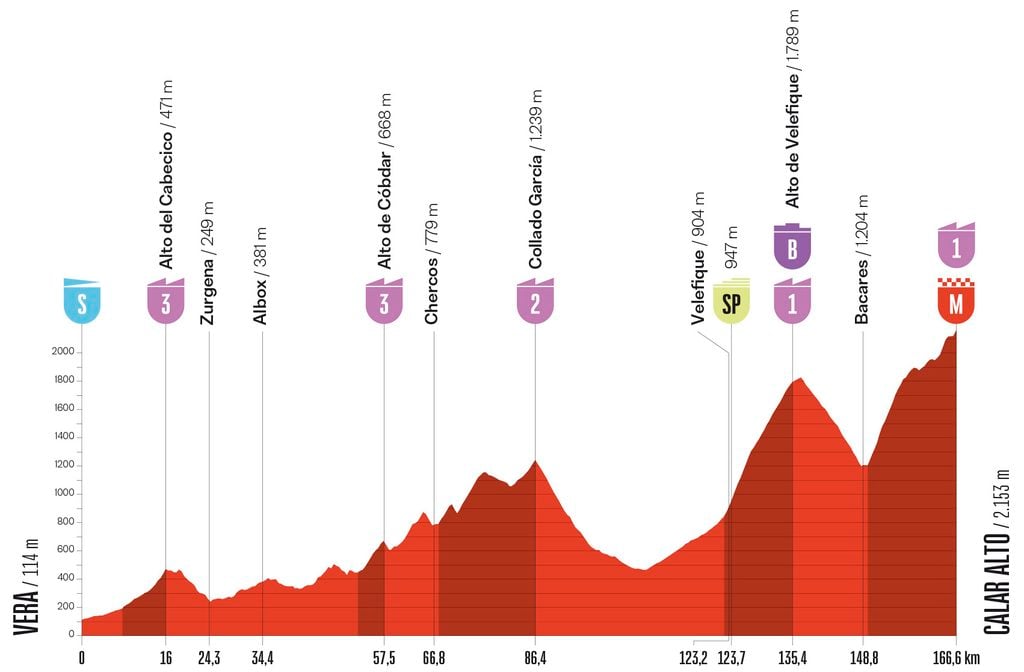
The climb begins with 44.3km remaining and measures 13.1km at 7.2%, gaining 951 metres before reaching 1,789 metres above sea level. Its summit comes with only 31.2km to go.
At the fastest schedule, the peloton reaches the foot at approximately 14:56 BST and the summit around 15:26 BST. At the slower estimate, those times move back to 15:15 and 15:49.
This is where Decathlon CMA CGM, Red Bull-Bora-Hansgrohe and EF Education-EasyPost can decide whether to simply wait for Calar Alto or make the race considerably harder for Mas beforehand.
Gall has particularly good reason to push the pace. He starts the day 1:39 behind Mas and has much more to gain from difficult mountain stages than from waiting for the Stage 18 individual time trial.
Roglič can afford more patience because the time trial remains an important weapon later in the race. Richard Carapaz, already 3:26 behind, has almost the opposite incentive. Another mountain stage spent following Mas changes very little for him.
If Velefique is raced conservatively, the red jersey should reach Calar Alto with more teammates and a larger GC group.
That is the version of Stage 12 Mas would probably prefer.
What time is the intermediate sprint?
The intermediate sprint comes at kilometre 123.7 in Velefique, only 1.4km after the first-category climb begins.
The race should reach it between approximately 14:59 and 15:18 BST.
Wout van Aert strengthened his points classification lead during Stage 11 into Lorca, but this is hardly an obvious stage for Visma | Lease a Bike to commit significant resources to collecting intermediate points. If a substantial breakaway is still clear, most or all of the points may disappear up the road anyway.
For viewers, the sprint is more useful as a marker.
Once the race reaches Velefique village and the intermediate sprint, the decisive 43km of Stage 12 are underway.
 Photo Credit: Getty
Alto de Velefique should finish between 15:26 and 15:49 BST
The summit timing is one of the most useful points on the roadbook.
Velefique should top out between 15:26 and 15:49 BST, leaving 31.2km to the finish.
There is then a descent towards Bacares rather than a lengthy valley where dropped riders can expect to reorganise. The race should pass through Bacares between approximately 15:40 and 16:03 BST, with Calar Alto beginning only 900 metres later.
That increases the value of anything achieved on Velefique.
A leader isolated at the summit has almost no time to regain teammates. A contender who loses 20 or 30 seconds could start the final climb already under serious pressure. Conversely, a teammate sent into the day’s breakaway can become extremely valuable if ordered to wait after the summit.
Stage 12 can therefore begin being decided well before Calar Alto appears on screen.
What time does the Calar Alto climb begin?
The final ascent should begin between approximately 15:41 and 16:04 BST.
Calar Alto measures 16.9km at 5.6%, gaining 952 metres before reaching the astronomical observatory at 2,153 metres.
That 5.6% average does not describe the climb particularly well.
The opening kilometres from Bacares contain much steeper ramps, including repeated double-digit gradients, before the road becomes more irregular higher up. Those lower slopes are therefore one of the best places to create genuine separation.
A rider dropped there may find opportunities to recover when the gradients ease later, but only if the damage has not already become too large.
Anyone turning the television on at 16:00 could consequently join after the first major move has been made.
When will the attacks on Calar Alto happen?
Much depends on what the GC teams do on Velefique.
If the first-category climb is ridden hard, Calar Alto could become a battle almost immediately. Leaders will arrive with fewer teammates, some contenders may already be carrying small gaps and the steep opening kilometres provide an obvious place to continue the pressure.
A more conservative Velefique encourages patience.
The upper half of Calar Alto contains enough easier road to punish a rider who attacks too early and then finds several rivals working together behind. Mas has little reason to expose himself unless he feels substantially stronger than everyone else.
The final 3.2km should be reached between 16:10 and 16:37 BST, with the finish six or seven minutes later at the fastest schedule.
If Mas, Roglič, Gall and Onley are all still together at that point, the chance of major GC gaps is considerably smaller.
Their best opportunity to put meaningful time into one another comes earlier.
Mas takes the same GC advantage into Calar Alto
Wednesday’s stage to Lorca did not alter the top of the general classification.
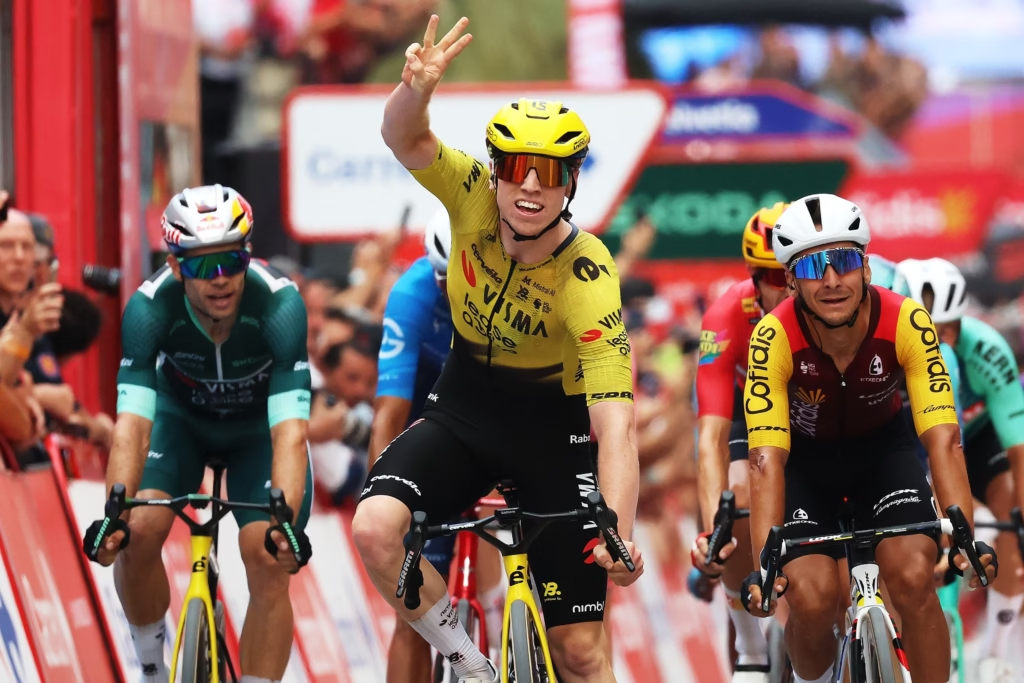
Matthew Brennan won Stage 11 in Lorca, beating Bryan Coquard and Jordi Meeus to collect his third victory of his debut Vuelta, while Mas and the other overall contenders finished safely together.
The leading gaps therefore remain:
| Position | Rider | Gap |
|---|---|---|
| 1 | Enric Mas | Leader |
| 2 | Primož Roglič | +1:18 |
| 3 | Felix Gall | +1:39 |
| 4 | Oscar Onley | +2:20 |
| 5 | Richard Carapaz | +3:26 |
| 6 | Mattias Skjelmose | +3:55 |
| 7 | Sepp Kuss | +4:09 |
The broader battle for red is covered in our GC contenders analysis after Stage 9.
Mas created his current advantage on Alto de Aitana, where he won Stage 9 and put another 12 seconds into Roglič and 18 into Gall. Onley was the only rider able to finish with him.
That performance came only a day after Tadej Pogačar’s crash ended his Vuelta, turning Mas from the rider inheriting red into the rider everyone else now has to beat.
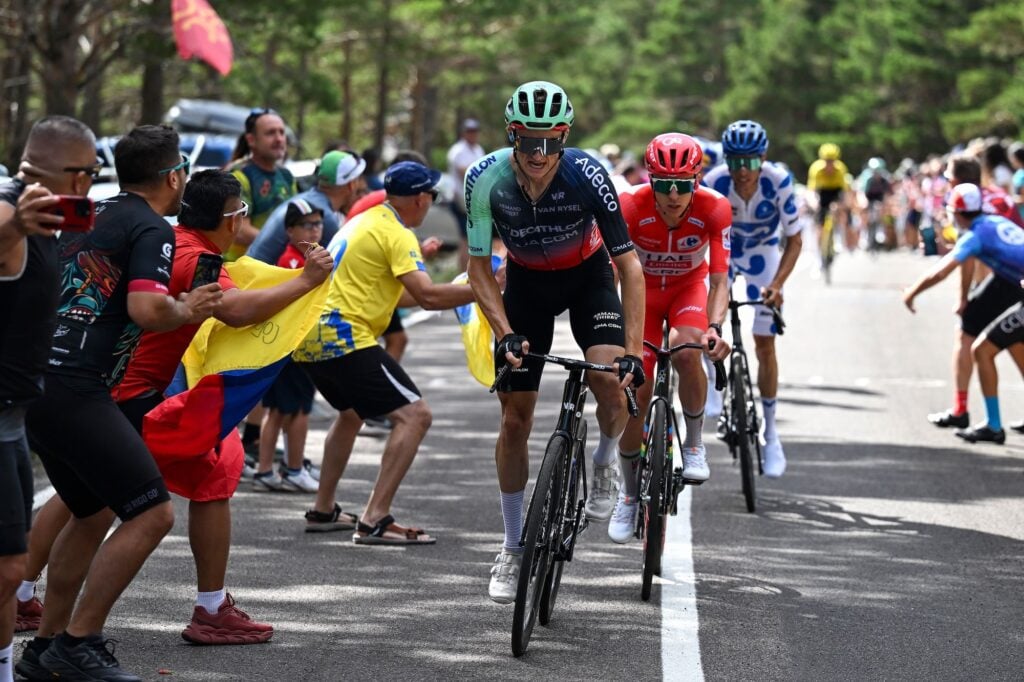
Why Stage 12 matters more for Gall than Roglič
The gaps alone do not fully explain the tactics.
Roglič is 1:18 behind but still has the Stage 18 individual time trial to Jerez ahead of him. Remaining within striking distance of Mas through the mountains keeps a very clear route towards a fifth Vuelta victory open.
Gall does not have the same advantage against the clock.
At 1:39, his best opportunities to change the race come on days such as Calar Alto, La Pandera and the major climbing stages of the final week.
That puts more pressure on Decathlon CMA CGM to make Velefique difficult rather than simply protecting Gall until the final few kilometres.
Carapaz has even more reason to look for something ambitious. At 3:26, matching Mas on another summit finish is useful for maintaining fifth place but does little to bring him back into the fight for red.
Onley can afford to be more reactive. His superb ride on Aitana moved him to fourth overall and within 41 seconds of Gall, turning what had already been a strong Vuelta into a genuine podium challenge.


Could the breakaway win on Calar Alto?
Yes.
A summit finish does not automatically mean Movistar will spend the entire afternoon chasing.
Mas does not urgently need the stage bonus seconds, and allowing a group of riders already well down on GC to contest the victory has an additional benefit: Roglič and Gall cannot collect them either.
The opening half of Stage 12 is well suited to a strong climbing break. The Alto del Cabecico begins after only 7.7km, followed by the Alto de Cóbdar and the long Collado García before the race reaches Velefique.
That means riders interested in the stage have opportunities to force a strong escape almost immediately.
If the break still has several minutes at the foot of Velefique, viewers could effectively be watching two races: one ahead for the stage victory and another behind for the red jersey.
Either way, the final 45km should be worth seeing in full.
Best time to watch Vuelta a España Stage 12
For UK viewers, the choices are straightforward:
11:30 BST: Full TNT Sports 3 and HBO Max coverage.
14:10 BST: Join around Collado García and see the complete build-up to the final mountains.
14:50 BST: Best overall viewing time. You should catch all of Velefique, the descent and the complete Calar Alto finale.
15:35 BST: Best choice if you only want the main GC showdown.
16:00 BST: Leave it this late and you risk missing the beginning of the final climb and possibly the first major attack.
The finish is expected between 16:16 and 16:44 BST.
Stage 11 gave Mas, Roglič, Gall and Onley a comparatively quiet afternoon while Brennan collected another sprint victory in Lorca. Thursday gives them no such luxury. From the foot of Velefique to the observatory at Calar Alto, the Vuelta returns to the terrain where the fight for red can change in a matter of minutes.