
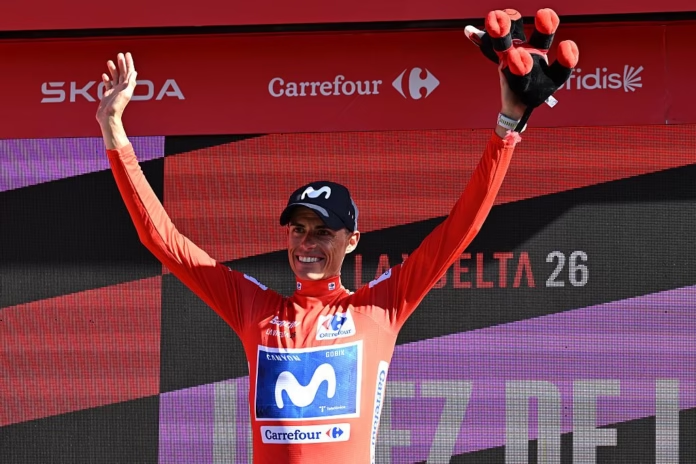
Enric Mas will start the final stage of the 2026 Vuelta a España with 2:15 over Primož Roglič and only 112km around Granada separating him from the first Grand Tour victory of his career.
Saturday finally removed the possibility that Roglič might overturn the race in the mountains. The Slovenian began the Stage 20 showdown on Collado del Alguacil needing to recover 1:37, attacked several times on the final climb and instead lost another 38 seconds to Mas. Felix Gall also closed towards second place and now sits only 29 seconds behind Roglič at 2:44 overall. Mikel Landa took the stage victory after attacking from the breakaway.
The red jersey should now be settled. Mas would have to suffer a crash, mechanical problem or some other extraordinary incident to lose more than two minutes on a stage designed primarily for celebration and the final stage victory.
The fight for Sunday’s win is much less predictable.
Granada replaces Madrid as the Vuelta’s final destination and the organisers have not designed a straightforward sprinters’ circuit. After 70km around the metropolitan area, the riders enter a finishing loop that repeatedly climbs towards the Alhambra before descending back to the finish on Paseo del Salón. The fourth and final climb comes with only eight kilometres remaining.
That gives Wout van Aert, Matthew Brennan, Magnus Cort and the remaining Classics-style riders one last opportunity to finish the Vuelta with a win.
There is also an unresolved safety question heading into Sunday. Reports on Saturday evening said a majority of teams wanted the general classification neutralised before the end of the technical Granada circuit. No final agreement had been announced at the time of writing, with partial neutralisation among the possibilities being discussed.
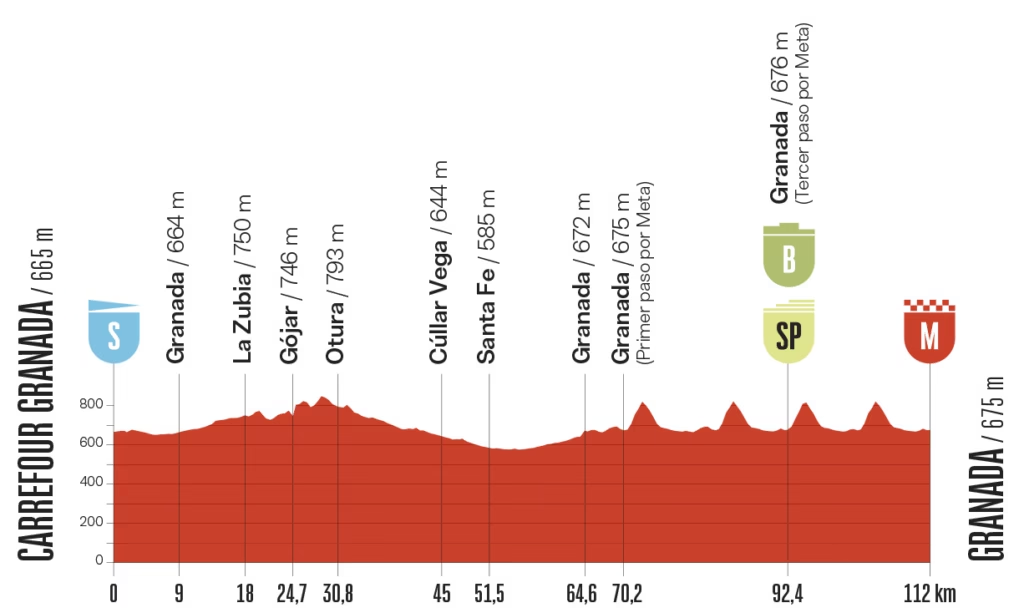
Vuelta a España Stage 21 at a glance
- Date: Sunday 13 September 2026
- Start: Carrefour Granada
- Finish: Granada
- Distance: 112km
- Stage type: Flat
- Neutralised start: 16:20 CEST / 15:20 BST
- Racing start: 16:23 CEST / 15:23 BST
- First passage over the finish: approximately 17:07 BST
- Intermediate sprint: Granada, 19.6km remaining
- Final Alhambra passage: 8km remaining
- Expected finish: approximately 18:06 BST
- Official finish window: approximately 18:06-18:24 BST
The current official itinerary lists the stage at 112km, longer than the 99.4km initially announced when the 2026 route was presented. The first passage through the finish comes after 70.2km before four climbs towards Paseo del Generalife and the Alhambra during the closing circuit.
Enric Mas finally gets to enjoy a Vuelta stage
For most of the last two weeks, Mas has spent each stage solving a different problem.
He had to establish himself when Tadej Pogačar crashed out of the race. He then needed to prove that inheriting the red jersey was different from merely wearing it.
Mas did that in the mountains.
He took time on Roglič and Gall at Alto de Aitana, Calar Alto and Sierra de La Pandera, building the advantage that eventually allowed him to survive the final week. The decisive moment may actually have come away from his preferred terrain, when he limited Roglič to only 33 seconds in the Stage 18 time trial to Jerez.
Roglič emerged from that stage still 1:37 behind.
Peñas Blancas changed nothing. Collado del Alguacil then made the margin larger.
Mas now carries 2:15 into a final stage where the GC contenders would traditionally spend the opening kilometres talking, posing for photographs and allowing the race leader’s team to enjoy the occasion.
If he reaches the finish safely, he will become the first Spanish winner of the Vuelta since Alberto Contador in 2014.
For a rider who has finished second in his home Grand Tour three times, Sunday will carry rather more significance than the usual final-stage procession.
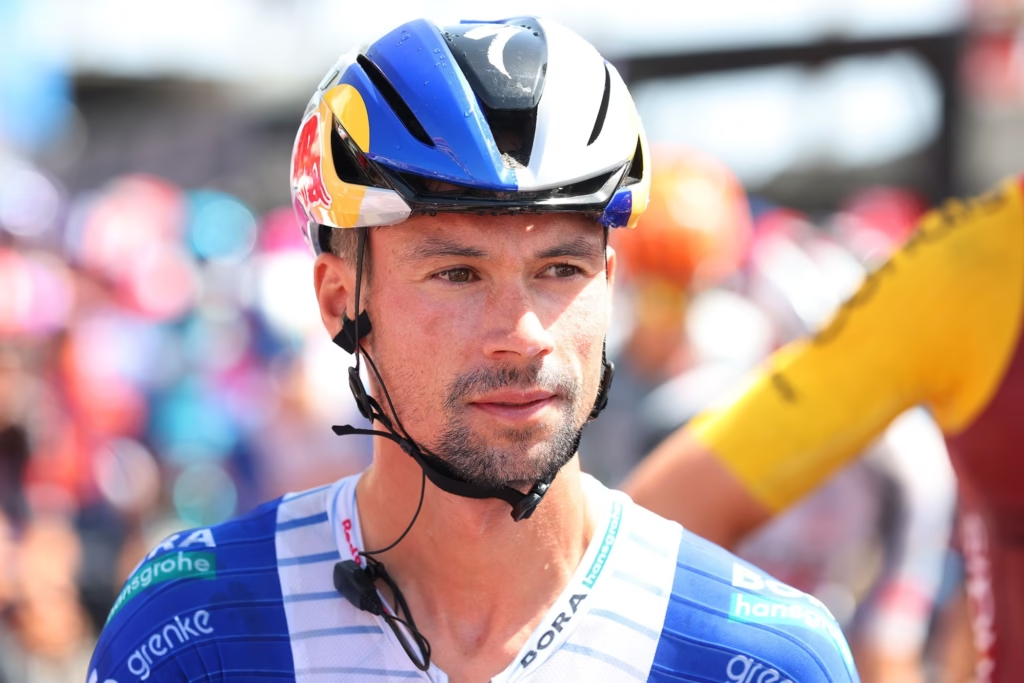 Photo Credit: Getty
Roglič and Gall still have 29 seconds separating second and third
The red jersey is effectively settled, but one part of the podium remains much closer.
Roglič is second at 2:15.
Gall is third at 2:44.
Only 29 seconds separate them after Gall again proved the stronger climber on Stage 20. Behind them, Richard Carapaz remains fourth at 6:54, while Sepp Kuss jumped six places to fifth after his aggressive long-range ride through the Sierra Nevada.
Ordinarily, neither Roglič nor Gall would be expected to contest a 29-second gap on the final day. Teams generally respect the GC once a Grand Tour reaches its ceremonial finale.
Granada is less straightforward because of the circuit itself.
Repeated climbing, narrow sections and a technical descent create far more potential for splits or incidents than the broad Madrid circuits traditionally used by the Vuelta.
That is one reason the discussion around neutralisation matters.
If GC times are frozen before the final circuit or on the final lap, Roglič and Gall can remove themselves from the fight for position and allow the stage hunters to race.
If times count all the way to the finish, both still have an incentive to remain near the front through sections where the sprinters’ teams and attackers will be fighting for the same road.
Nobody needs a contrived GC battle on Sunday. They do need clarity about where the timing stops.
The first 70km should still look like a traditional final stage
The peloton leaves from Carrefour Granada before moving through Armilla and the municipalities surrounding the city.
The first 60km contain no classified climbing and should allow the race to begin in the traditional Grand Tour manner. Movistar can celebrate with Mas, riders can pose for photographs and there is little reason for an early breakaway to turn the stage into a serious chase immediately.
The character changes once Granada appears.
The first finish-line crossing on Paseo del Salón comes after 70.2km, leaving 41.8km.
From there the race heads uphill towards Paseo del Generalife outside the Alhambra, descends through the city and returns to the finish.
Then it does it again.
And again.
And once more.
The final passage at the Alhambra comes with eight kilometres left, followed by the descent and run back towards Paseo del Salón.
That final 42km should be a proper bike race.
Four climbs towards the Alhambra make this difficult for the pure sprinters
The climb is not categorised, but classification tells only part of the story.
Third-party measurements put it at around 2km at six to seven per cent, with cobbled sections adding another complication. More important than the precise average is how often it appears and how close the final passage sits to the finish.
A single two-kilometre climb would be manageable for almost every sprinter left in the race.
Four repetitions are different.
The first should begin to thin the group. The second allows teams to identify who is struggling. By the third, anyone riding for a reduced sprint can increase the pace knowing there is little racing left afterwards.
The fourth is where the stage can be won.
An attacker reaching the top with ten or 15 seconds has only eight kilometres to defend, much of it on a descent where a large chasing group cannot necessarily use its numerical advantage immediately.
For the sprinters, the objective is not simply surviving the climb.
They need enough teammates to survive it as well.
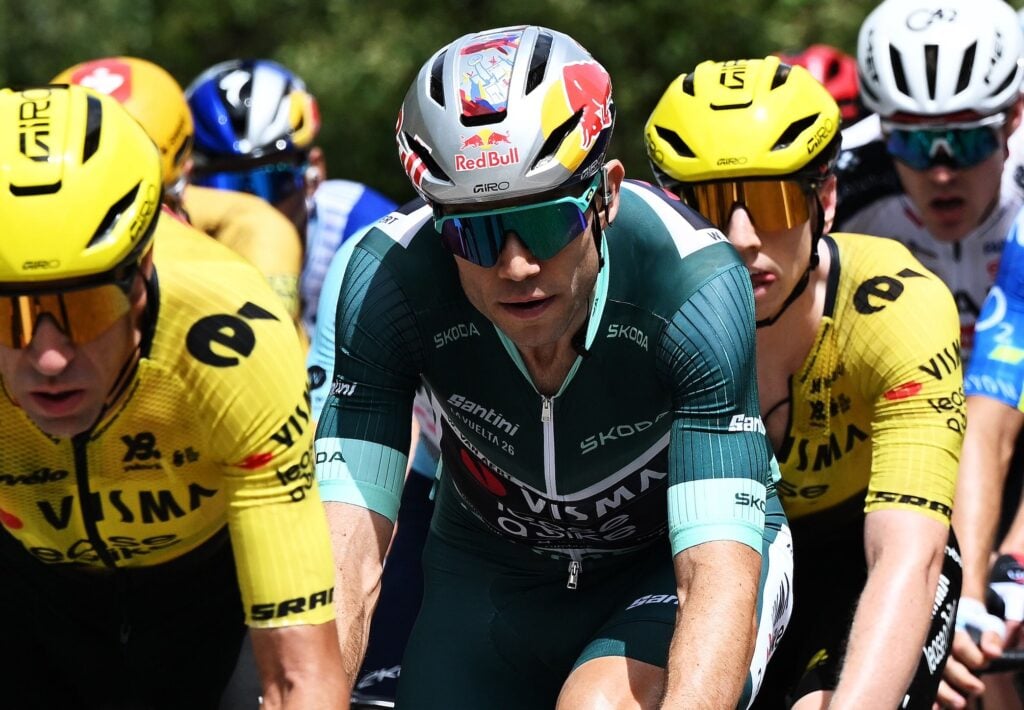
Wout van Aert has more options than anyone else
Van Aert begins the final stage with the green jersey mathematically secured.
His advantage over Brennan increased to 87 points on Saturday, putting the points classification beyond reach before Granada.
That frees him to race entirely for the stage.
Few riders have a better collection of options.
Van Aert can attack on the final climb. He can follow a move made by another Classics rider. He can win from a group of five or ten. If the race comes back together, he remains one of the fastest riders left in the Vuelta.
His Stage 15 victory in Córdoba showed exactly why that range is so difficult to manage. Visma | Lease a Bike spent much of the day controlling for Brennan before Van Aert changed roles, attacked into the decisive group and then won its sprint himself.
Granada provides the same freedom.
The difference is that Visma also have the most successful sprinter of this Vuelta waiting behind him.
Matthew Brennan has one final chance at a sixth stage victory
Brennan has already won five stages in his first Grand Tour.
Manosque was followed by victories in Roquetes, Lorca, La Rábida and finally Sevilla, where he took his fifth after another Van Aert lead-out. His Stage 17 victory in Sevilla made him the youngest rider to win five stages in a single Grand Tour.
Granada is not an obvious sixth.
Brennan climbs much better than a conventional heavyweight sprinter, which keeps him firmly in contention. The repeated Alhambra ascent should not automatically remove him.
The harder question is how many accelerations he can absorb before still producing his sprint.
Visma do not need to decide between Brennan and Van Aert early.
Van Aert can follow dangerous attacks on the climb without requiring Brennan to respond. If Van Aert’s group stays away, Visma have a rider capable of winning from it. If everything returns, Brennan becomes the preferred option.
It is an awkward situation for their rivals because chasing one Visma rider can deliver the race to another.
Magnus Cort does not need a bunch sprint
Magnus Cort has been consistently close to the fastest riders without yet taking a stage victory.
Granada gives him a different route.
Cort is strong enough on short climbs to remain involved when a conventional sprinter begins struggling, but quick enough that nobody wants to carry him to the line in a small group.
That makes the final Alhambra ascent useful territory.
Uno-X Mobility do not need to control the stage from the bottom of the climb. Cort can follow Van Aert, Stefan Küng or another strong attacker and rely on his sprint if the group stays clear.
His third place behind Brennan in Sevilla showed the speed is still there.
The question is whether he can get to the finish without having to race directly against both Visma options at once.
Alessandro Romele should welcome a selective final lap
Alessandro Romele enters Granada third in the points classification after one of the most consistent sprint campaigns of the race.
He also fits the circuit unusually well.
Romele has enough climbing ability to stay involved when the race becomes selective, while a smaller finishing group improves his chances against Brennan.
His second place behind Van Aert in Córdoba came after both riders were part of the attacking group rather than waiting for a conventional sprint.
Granada may reward the same adaptability.
XDS Astana do not have the strength to dominate the entire circuit. They do not need to. Romele’s best race is one where other teams make the climbs hard enough to reduce Brennan’s support without producing a solo move that disappears completely.
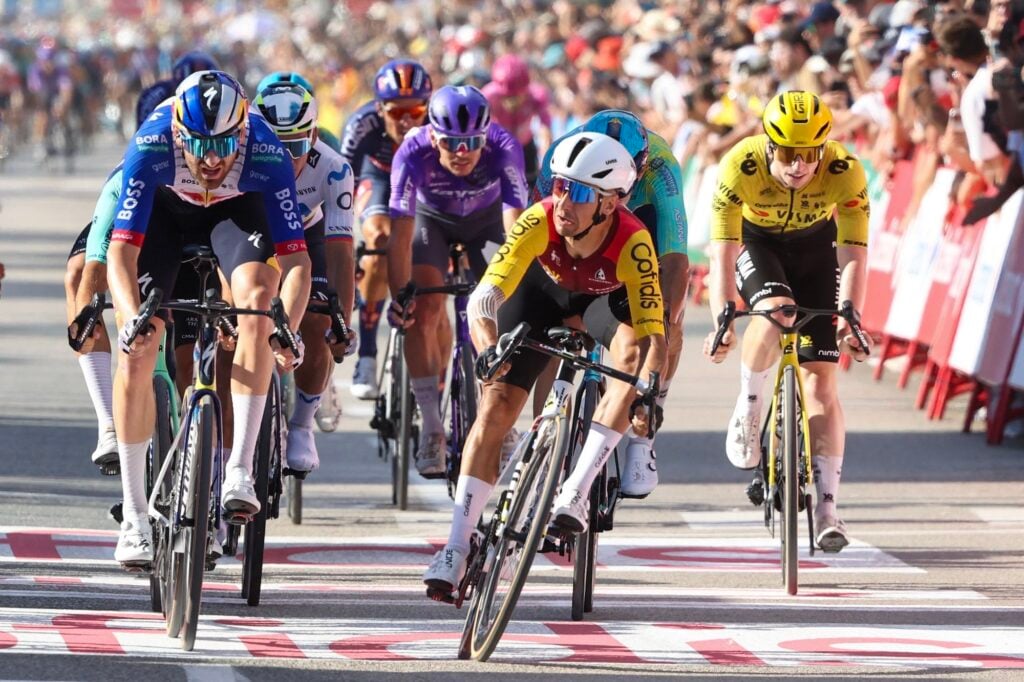 Photo Credit: Getty
Bryan Coquard needs attacks to come back
Bryan Coquard’s route to victory is narrower.
He should cope with the climbing better than many of the remaining sprinters, but he does not have the same incentive as Van Aert or Cort to turn the last lap into an attacking race.
Cofidis want the final climb ridden quickly enough to reduce the field, but not so aggressively that the best puncheurs ride away.
There is enough descending and flatter road after the summit to bring a move back.
The issue is having riders available to do it.
After four passages of the climb, Cofidis may be trying to organise a chase with a handful of riders against attackers who have deliberately selected themselves by climbing strength.
Coquard can win from the group that remains.
Getting that group to the line together is the harder part.
Stefan Küng can turn eight kilometres into a very long chase
Küng has already achieved one of his main objectives at this Vuelta by winning the Jerez time trial.
That does not make Sunday irrelevant.
A rider with his power is particularly dangerous immediately after a climb. The obvious attacks may come on the steepest part of the circuit, but Küng does not necessarily need to make his move there.
If a small group crests the final Alhambra passage before the sprinters, Küng can use the descent and flatter run to increase the gap rather than simply trying to survive until the finish.
The same applies if he bridges across immediately after the summit.
Eight kilometres is a long way for one rider to hold off an organised peloton.
It is much more manageable when the peloton has already been reduced and half of the strongest teams have somebody in the move.
Iván Romeo gives Movistar something to do after protecting Mas
Movistar’s first job is obvious.
Get Mas safely to the point where the general classification is secure.
After that, the team can race for the stage.
Iván Romeo is their clearest attacking option. His strength suits the repeated climbs and the final kilometres give him enough road to use his power without requiring him to beat Brennan or Van Aert in a sprint.
It would also be an appropriate way for Movistar to approach the final circuit.
They have spent three weeks riding around Mas. Once his red jersey no longer needs defending, Romeo can be released rather than asking the entire team to remain passive until the podium ceremony.
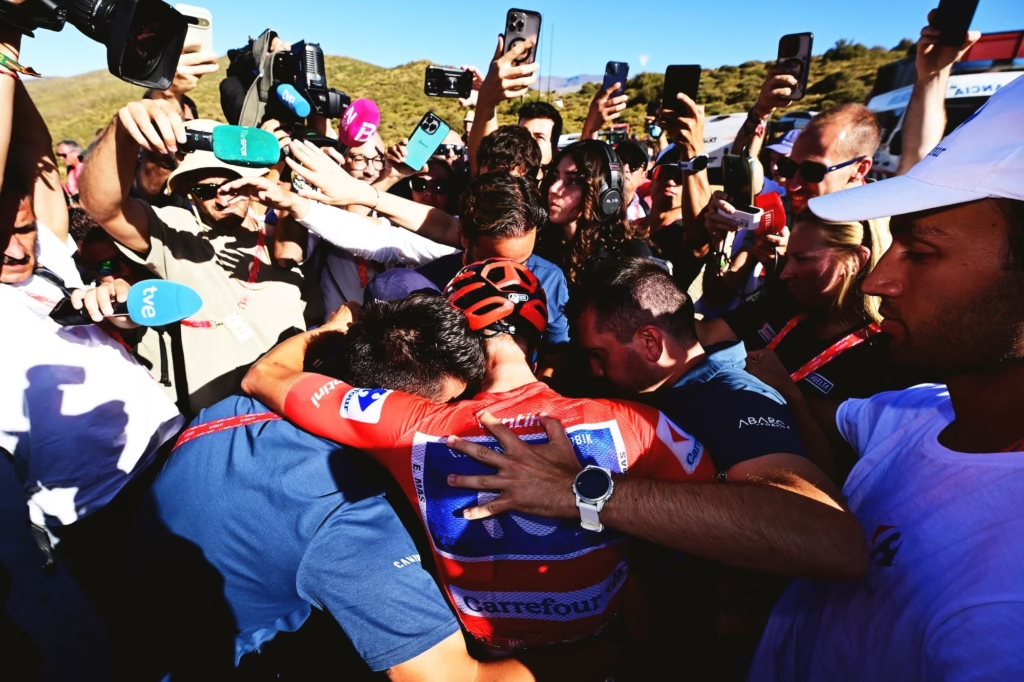 Photo Credit: Getty
The neutralisation debate needs resolving before the start
Sunday morning’s most important update may have nothing to do with the favourites.
Teams have raised concerns over the safety of the Granada finishing circuit and reports on Saturday said a majority were in favour of neutralising the general classification before the finish. The race organisation and UCI had not agreed to neutralising the entire circuit at that stage.
A compromise would make sense.
Freezing the overall times before the final lap would protect Mas, Roglič, Gall and the remaining GC riders from needing to fight for position while still leaving the stage hunters free to contest the victory normally.
That would not make the finale less competitive.
It could make it more so.
GC riders would be able to move away from the risk once their times were secured, leaving the front of the race to riders who actually need to contest the final corners and Alhambra climb.
Until an official decision is announced, the published 112km route remains the route to expect.
The green jersey is already Van Aert’s
There will be an intermediate sprint on the third passage through Paseo del Salón with 19.6km remaining.
It will not decide the points classification.
Van Aert secured green during Stage 20 and starts Sunday with an unassailable 87-point advantage over Brennan. The two Visma riders therefore have no internal classification battle complicating their tactics.
That is another advantage for the team.
They can use Van Aert aggressively without worrying about protecting his points lead and can still fall back on Brennan if the race comes together.
Few teams reach the final stage of a Grand Tour with two riders who both have such obvious routes to victory.

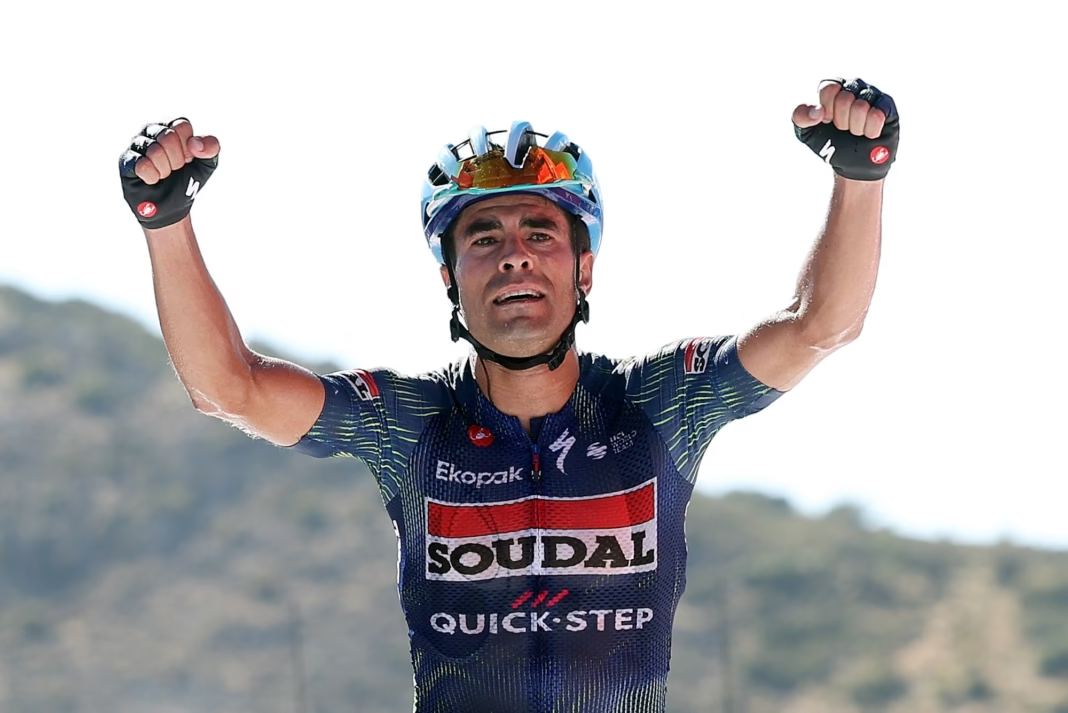

Stage 21 favourites
Wout van Aert is the strongest overall pick because the circuit does not force him into one specific race. He can attack, follow or sprint.
Matthew Brennan becomes the obvious favourite if a reasonably large group survives the final Alhambra climb. Five victories have already established how difficult he is to beat when Visma deliver him into position.
Magnus Cort is one of the riders most likely to benefit from a reduced group. He can follow hard moves and still sprint.
Alessandro Romele has repeatedly shown that harder racing does not remove his finish. The circuit probably improves his chances compared with a completely flat finale.
Bryan Coquard needs more control but should still be present if the last lap produces a reduced sprint rather than a successful attack.
Stefan Küng and Iván Romeo are among the most dangerous riders if the stage is decided away from the sprinters.
Vuelta a España Stage 21 prediction
Prediction: Wout van Aert
Brennan has been the outstanding pure finisher of the Vuelta, but Granada gives Van Aert more ways to reach the same result.
The final Alhambra climb comes too close to the finish to assume every attack will be caught. Van Aert can make the move himself or simply follow when somebody else forces the selection.
His presence also makes Visma almost impossible to race conventionally.
Let Van Aert go and he can win from the break.
Chase him and Brennan may still be waiting behind.
Bring everybody back and Van Aert himself can still sprint.
Mas will be happy to leave that problem to everybody else.
His route to red through the final week depended on surviving Roglič’s time trial advantage and Gall’s climbing strength. He did both, then finished the job himself on Collado del Alguacil.
The final 112km are now about getting through Granada safely.
At the front, the stage hunters still have a race to win.
A little further back, Mas only needs to reach Paseo del Salón and finally allow three weeks of defending red to become a celebration.

