
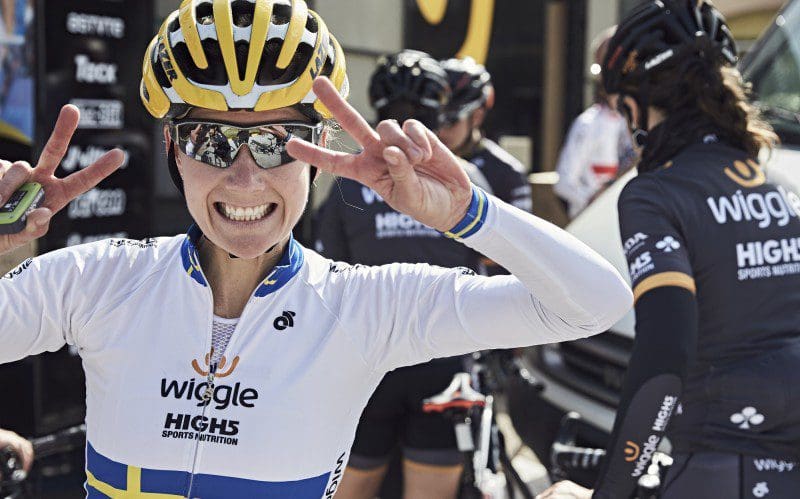
Emma Johansson was never the easiest kind of cycling star to explain.
She did not build her reputation through loud dominance or a single season that swallowed everything around it. She built it through repetition: being in the right move, surviving the hardest section, reading the race properly and turning up again and again in the places where results are made.
That is why the nickname “Silver Emma” was both fitting and slightly unfair.
Yes, the silver medals were central to her story. She won Olympic road race silver in Beijing in 2008 and again in Rio in 2016. She also took silver at the 2013 UCI Road World Championships and bronze medals at the Worlds in 2010 and 2014. But reduce her career to “almost” and you miss the point entirely.
Emma Johansson was one of the most consistent road racers of her generation. She won major races, led teams, shaped championships and gave Sweden a genuine global presence in the women’s peloton. Her career was not defined by falling short. It was defined by how rarely she disappeared.
She belongs naturally in the wider Women’s Cycling History Hub and the Women’s Cycling Rider History archive, because her career helps explain what elite women’s road racing looked like in the years before the sport’s current level of visibility.
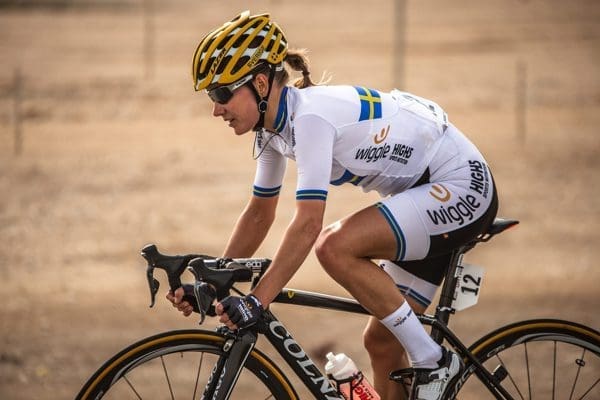
Emma Johansson made consistency look relentless
Emma Johansson came through at a time when women’s cycling was still fighting for visibility beyond the Olympics, world championships and a handful of major one-day races. Coverage was inconsistent, teams were still developing, and even elite results could pass with less attention than they deserved.
That makes her record stand out even more.
Year after year, Johansson was there. In the front group. In the decisive split. On the podium. In the final kilometres of races that had already removed most of the field. She was a rider who made the hardest part of cycling look almost ordinary: being present when the race finally showed its truth.
There was nothing wasteful about the way she rode. Johansson did not race like someone trying to overpower every situation. She raced with control. She read moves, measured effort, stayed calm under pressure and seemed to understand exactly when a race was starting to become serious.
On rolling roads, hilly Classics and selective championship courses, that skill mattered as much as raw power.
Why Emma Johansson matters in cycling history
Johansson matters because she was one of the most dependable elite road riders of the modern women’s peloton.
Cycling often remembers the rider who wins on the day. It is less good at remembering the rider who is repeatedly second, third, fourth or fifth in the biggest races in the world. Yet that level of consistency is not a lesser achievement. In many ways, it is the harder one.
To finish on the podium once in a major championship requires form, skill and timing. To do it repeatedly across different years, courses and tactical situations requires something deeper. It needs patience, tactical intelligence, positioning, resilience and the ability to race well when everyone knows you are dangerous.
Emma Johansson had all of that.
She also helped define a period when women’s racing was becoming sharper and more professional. The fields were getting deeper, the teams better organised and the biggest races harder to control. Johansson was not just a rider who survived that shift. She was one of the riders who helped set the standard within it.
That wider professional shift is part of the story behind the modern Women’s WorldTour, but Johansson’s career also belongs to the period that helped make that structure necessary.
The silver medals and what they really mean
The obvious headline is the Olympic record.
Emma Johansson won silver in the women’s road race at the 2008 Beijing Olympics, finishing behind Nicole Cooke in a brutal race that ended in heavy rain. Cooke’s own career, and the wider questions she forced around women’s cycling, are covered in our feature on Nicole Cooke.
Eight years later, Johansson won Olympic silver again in Rio, finishing behind Anna van der Breggen on one of the hardest Olympic road race courses the women’s peloton had faced. Van der Breggen’s range, from Olympic gold to world titles and Giro dominance, is explored in our profile of Anna van der Breggen.
Two Olympic silver medals, eight years apart, tell you something important.
They show more than near-misses. They show a rider who could prepare for the biggest day, handle the pressure of a national jersey, survive a championship race and still have the clarity to be present in the decisive finish. Olympic road races are not controlled, predictable events. They are sparse, tense and often chaotic. Johansson twice found her way through that chaos to the podium.
Her world championship record added another layer. Silver in 2013 and bronze in 2010 and 2014 made her one of the most reliable championship riders of her era. Those results came against different fields, different race patterns and different expectations, but the theme was the same.
When the race came down to the riders who had judged it best, Johansson was usually still there.
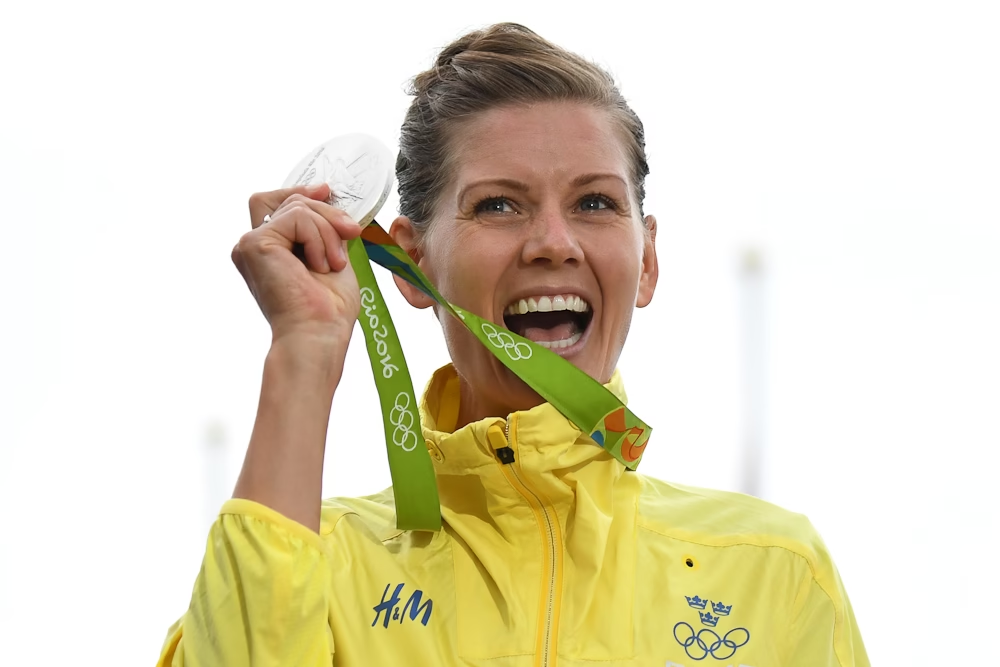 Photo Credit: Getty
Big wins and standout results
Johansson’s career was not just a pile of second places.
She won important races and built a palmarès that deserves to be seen beyond the Olympic medals.
| Result | Why it mattered |
|---|---|
| Olympic road race silver in 2008 and 2016 | Proof of championship quality across two different eras |
| World championship silver in 2013 | One of her clearest elite one-day results |
| World championship bronze in 2010 and 2014 | Further evidence of repeated championship consistency |
| Emakumeen Euskal Bira overall in 2013 and 2016 | Major stage-race wins on hard Basque terrain |
| Trofeo Alfredo Binda in 2014 | A major one-day victory on selective Italian roads |
| Omloop van het Hageland wins in 2010 and 2011 | Strength on difficult northern roads |
| Ronde van Drenthe in 2009 | A major early Classics-style success |
| Multiple Swedish national titles | Long-term dominance at home |
The Basque wins were especially fitting. Emakumeen Euskal Bira demanded exactly the qualities Johansson had: positioning, repeated climbing, technical control and the ability to stay calm on roads that never gave the race much room to breathe.
Those races suited her because they were not about one giant acceleration. They were about accumulation. Every rise, corner, descent and split mattered. Johansson was built for that kind of pressure.
That Basque racing identity still matters in the modern calendar. Our brief history of Itzulia Women explains how the region’s sharp roads and aggressive racing culture continue to shape women’s stage racing.
A rider for awkward roads
Johansson was not a pure sprinter and not a pure climber.
She was something more useful in the races she targeted: an all-round road racer with enough climbing strength to survive selective terrain, enough finishing speed to matter in reduced groups, and enough race craft to arrive at the right moment.
That made her particularly dangerous on awkward roads.
She was good when the profile never settled. She was good when small climbs arrived one after another. She was good when the wind stretched the peloton and every corner turned into a fight for position. She was good in races where the strongest rider did not always win, because the cleverest rider had to get through the day first.
That was Johansson’s strength. She rarely made racing look wild. She made it look processed, understood and controlled.
Her place in the Classics story is why she also sits naturally alongside riders such as Marianne Vos, Ellen van Dijk and Chantal van den Broek-Blaak, all of whom helped shape a deeper and more tactically demanding era of women’s one-day racing.
Teams and the road behind the results
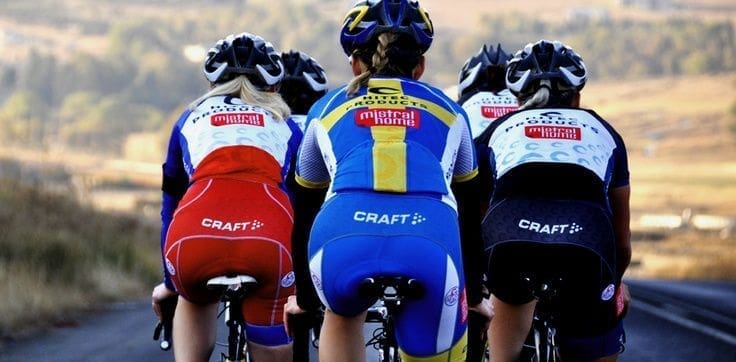
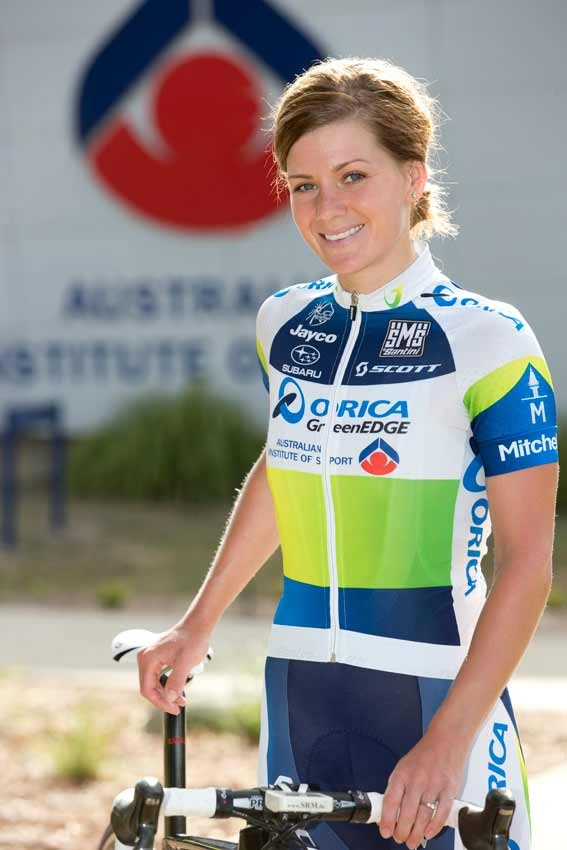
Johansson rode for several influential teams during her career, including Hitec Products, Orica-AIS and Wiggle High5.
At Hitec Products, she was part of one of the teams that helped bridge the more fragile structures of earlier women’s road racing with the stronger international squads that followed. The team’s wider role is covered in our look back at the history of Hitec Products.
Her later move to Wiggle High5 placed her inside one of the most recognisable projects of the 2010s. That team brought together sprinters, Classics riders, track stars and stage-race riders, and Johansson’s experience fitted neatly into that mix. Our Wiggle High5 team history explains why that squad helped change how a professional women’s team could look and operate.
Johansson did not always need the entire race built around her. She could lead, but she could also adapt. She could follow moves, cover danger, protect position and choose the right moment.
That kind of rider is invaluable.
Teams often talk about leaders as if leadership only means winning. Johansson showed another version of it. She gave teams stability. She gave them a rider they could trust in races that were difficult to script. If the race exploded, she was rarely the one missing the move.
Her career also showed the changing geography of women’s racing. She won and placed on Belgian roads, Italian hills, Basque climbs, championship circuits and stage-race terrain. She was not tied to one type of course. She was one of those riders whose value increased when the race became less predictable.
For broader context on the teams that shaped that era, see the Women’s Cycling Team History archive.
The psychology of always arriving
Johansson’s career is interesting because of how she handled pressure.
Some riders burn hot. They race in surges, emotions and visible drama. Johansson’s strength was different. She seemed to understand that elite road racing is often about removing mistakes.
Do not panic too early. Do not chase the wrong move. Do not waste effort when the race is still pretending to be calm. Stay near the front. Stay alive. Let others spend. Then commit when the race is finally worth committing to.
That is not a cautious style. It is a disciplined one.
It also helps explain the medal record. Johansson’s championship results did not happen because she stumbled into good days. They happened because she knew how to manage the biggest races, where the pressure is heavier and the margin for error is smaller.
Silver at the Olympics and Worlds is sometimes treated like a mark of what a rider did not win. In Johansson’s case, it should be read differently. Those medals show how often she was good enough to be in the final picture when almost everyone else was gone.
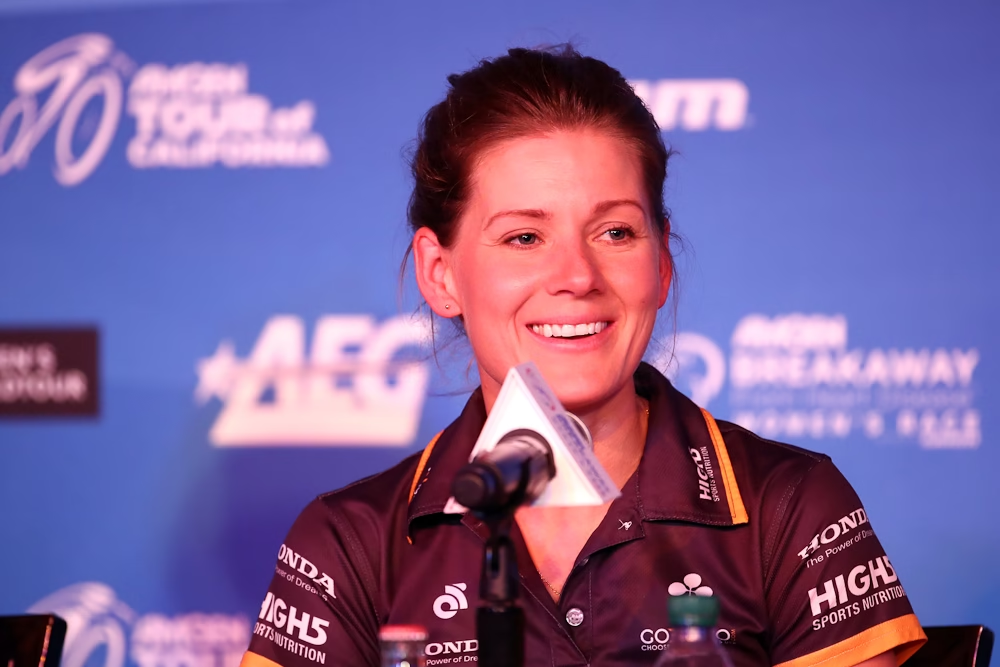 Photo Credit: Getty
More than “Silver Emma” Johansson
The nickname was understandable, but it came with a risk.
“Silver Emma” captured the medals and the near-misses, but it could also make her sound like a rider defined by absence. No Olympic gold. No rainbow jersey. No single result that casual fans could use as a shortcut.
That is too thin.
Johansson won big races. She won national titles. She won World Cup-level events. She took stage-race victories. She finished on major podiums often enough that her consistency became part of the fabric of the women’s peloton.
The better reading is that Johansson was one of the great high-floor riders of her generation. Her best days were excellent. Her normal days were still dangerous. Her bad days were rarer than most.
In a sport as volatile as road cycling, that is a serious form of greatness.
That was the argument in our earlier archive piece on Emma Johansson as one of the great Spring Classics riders, and it still holds. The headline results only make sense when placed inside the longer pattern of how often she reached the decisive point of a race.
-
 Photo Credit: Cor Vos
 -
 Photo Credit: Zac Williams/AusCycling
Life after racing
Johansson retired after the 2016 season, closing a career that had stretched across a major period of change in women’s cycling.
By the time she stopped, the sport was different from the one she had entered. Teams were stronger, calendars were more visible, the Women’s WorldTour structure had been introduced, and the best women’s races were beginning to receive the attention they had long deserved.
Johansson was part of the bridge between those eras.
Since retiring, she has remained connected to the sport and to public life in Sweden, while also building a life away from the constant rhythm of travel, training, selection and recovery. That transition is not always simple for elite athletes. A career like Johansson’s is built on discipline and repetition, and leaving that structure behind can be its own challenge.
But her influence does not depend on being permanently visible in a team car or commentary box. Some riders matter because the standard they set remains useful after they leave the peloton. Johansson is one of them.
Why Emma Johansson is still worth remembering
Johansson deserves more than a footnote as a rider who came close.
She was one of the clearest examples of sustained excellence in modern women’s road racing. She gave Sweden a rider with genuine global weight. She helped shape championship racing across almost a decade. She showed that consistency is not the opposite of greatness, but one of its hardest forms.
Her career was built on roads that rarely made things simple. Hilly circuits, crosswinds, rough Classics, Basque climbs, Italian rises and Olympic courses all asked different questions. Johansson kept finding answers.
That is why her record is richer than the headline suggests.
The silver medals will always shine brightest from a distance. They are easy to remember and easy to package. But the real story sits underneath them: the repeated podiums, the major wins, the national titles, the calm racing intelligence and the respect earned from always being there when the day became decisive.
Emma Johansson did not need to dominate every headline to become one of the defining riders of her generation.
She made consistency look relentless, and that is why her career still matters.

