
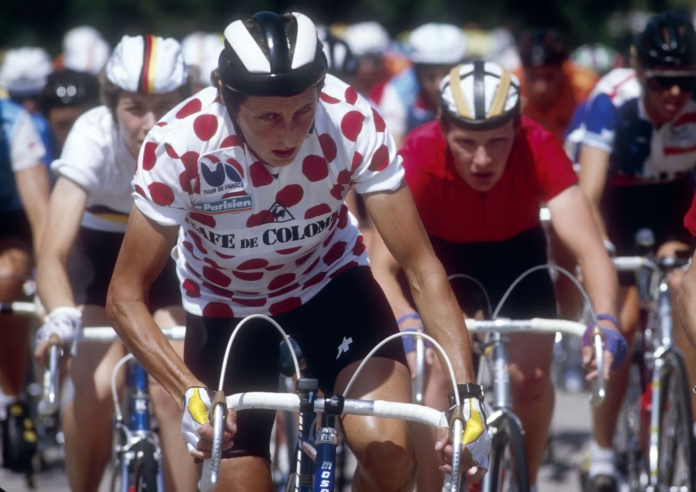
Maria Canins did not follow anything resembling the normal route towards becoming one of the best road cyclists in the world. She was already in her early thirties, a mother and an accomplished cross-country skier before serious road racing became part of her life. Within months she was Italian champion and a World Championship silver medallist. Three years later, she won the Tour de France Féminin.
That background matters when trying to understand the rider Canins became. She arrived with an endurance engine developed through years of cross-country skiing in the Dolomites, where effort is rarely separated neatly into climbing, descending and recovery. She was accustomed to long races, changing gradients and managing effort rather than simply producing one explosive moment. Cross-country skiing had already made her an elite endurance athlete before cycling discovered what she could do. Canins won 15 Italian skiing titles, became the first Italian woman to win Sweden’s Vasaloppet and won the Marcialonga 10 consecutive times between 1979 and 1988.
Road cycling gave those qualities another outlet. Canins won the Tour de France Féminin in 1985 and 1986, the inaugural Giro d’Italia Femminile in 1988, the Coors Classic in the United States and the Tour de l’Aude. She collected four World Championship road race medals without ever winning the individual rainbow jersey and was part of Italy’s victorious team time trial squad in 1988. She was also a six-time Italian road champion and one of the defining rivals of Jeannie Longo.
Canins belongs near the centre of the history of women’s cycling, not because she was simply an early champion, but because her career showed how demanding women’s stage racing had already become by the middle of the 1980s.
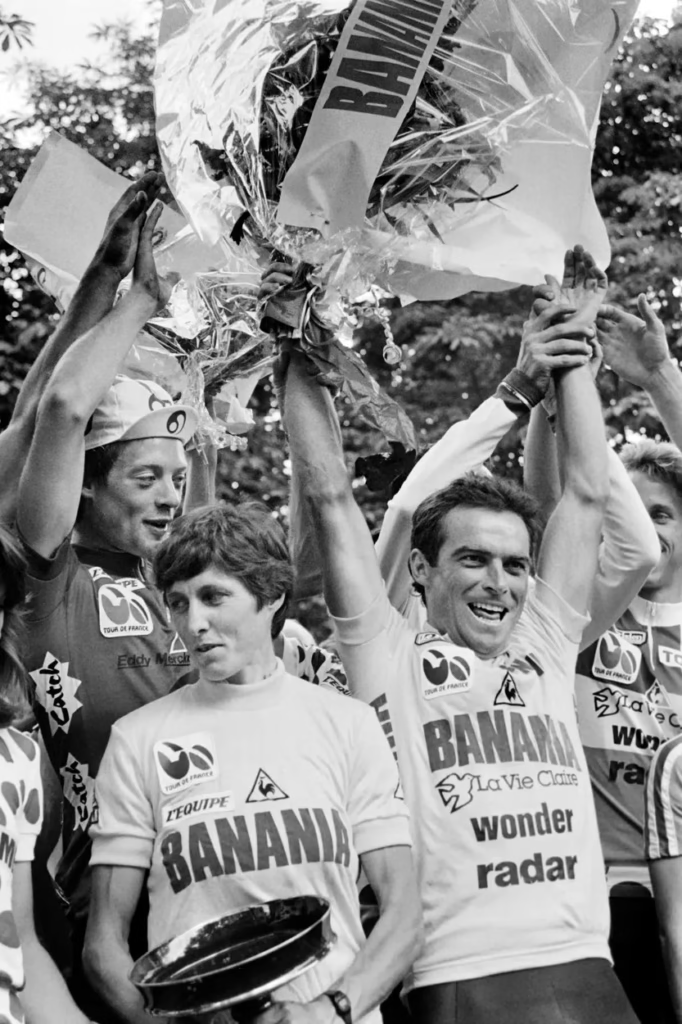
She was a skier long before she was a cyclist
Canins was born in La Villa in Alta Badia on 4 June 1949, surrounded by the Dolomites of South Tyrol. Sport began on skis rather than a bike.
She competed seriously in cross-country skiing from the late 1960s and built a domestic record that would have represented a substantial sporting career on its own. Fifteen Italian titles were joined by victories in the major long-distance events of the period. The Marcialonga became almost her personal race, with Canins winning the women’s competition every year from 1979 through 1988. The Vasaloppet victory was particularly significant because she became the first Italian woman to win the Swedish endurance event.
Cycling initially fitted around that life rather than replacing it.
Canins was 32 when she began racing seriously on the road. By conventional sporting timelines, especially now that WorldTour teams recruit riders directly from junior racing, she should have been arriving too late.
Instead, in 1982 she became Italian road champion and finished second to Mandy Jones at the World Championships at Goodwood.
That first major international season immediately revealed something about her athletic level. Canins did not need several years to learn how to become competitive. The endurance base was already there. What she had to acquire was the language of road racing: positioning, tactics, feeding, bunch movement and the calculation of when strength needed to become an attack.
She learned quickly.
The Coors Classic showed she could win a major stage race
By 1984, Canins had become much more than an endurance athlete experimenting with another sport.
She won the Coors Classic in Colorado, one of the most demanding and internationally significant women’s stage races of its era. The combination of altitude, climbing and American stage-racing conditions fitted her particularly well. Canins also won the prologue and then finished fifth in the Olympic road race in Los Angeles.
The Olympic result is easy to lose among the victories that followed, but fifth place mattered. Women’s road cycling had only just entered the Olympic programme, with Connie Carpenter winning the inaugural event in Los Angeles. Canins was already 35 and yet stood among the best riders in a rapidly internationalising peloton.
Her stage-racing profile was becoming clearer at the same time. She could climb, but she was not dependent on summit finishes. She could time trial, recover across consecutive hard days and take advantage of terrain that gradually reduced a field rather than producing one clean selection.
That made the newly established women’s Tour de France an obvious target.
The 1985 Tour turned Canins into the dominant stage racer of the moment
The official Tour de France Féminin had begun in 1984, with Marianne Martin winning the first edition while the women’s race was run alongside the men’s Tour organisation. The history that eventually led to today’s Tour de France Femmes is complicated, but the 1984-1989 event was a genuine Tour de France race rather than one of the independent successors that followed.
Canins entered its second edition in 1985 and dominated.
The route contained 17 stages and a prologue, with mountain finishes in the Alps and Pyrenees as well as individual time trials. Canins won both against the clock and repeatedly took time in the mountains, including victories at Morzine-Avoriaz and Luz Ardiden. By Paris, she had won five stages and the overall classification ahead of Longo.
It was exactly the sort of race that exposed the value of her sporting background.
A long stage race does not reward maximum effort every day. It rewards the rider who understands where the effort matters and who can keep producing it when accumulated fatigue begins changing everyone else’s level. Canins had spent years doing that on skis.
The Tour simply gave her mountains with tarmac on them.
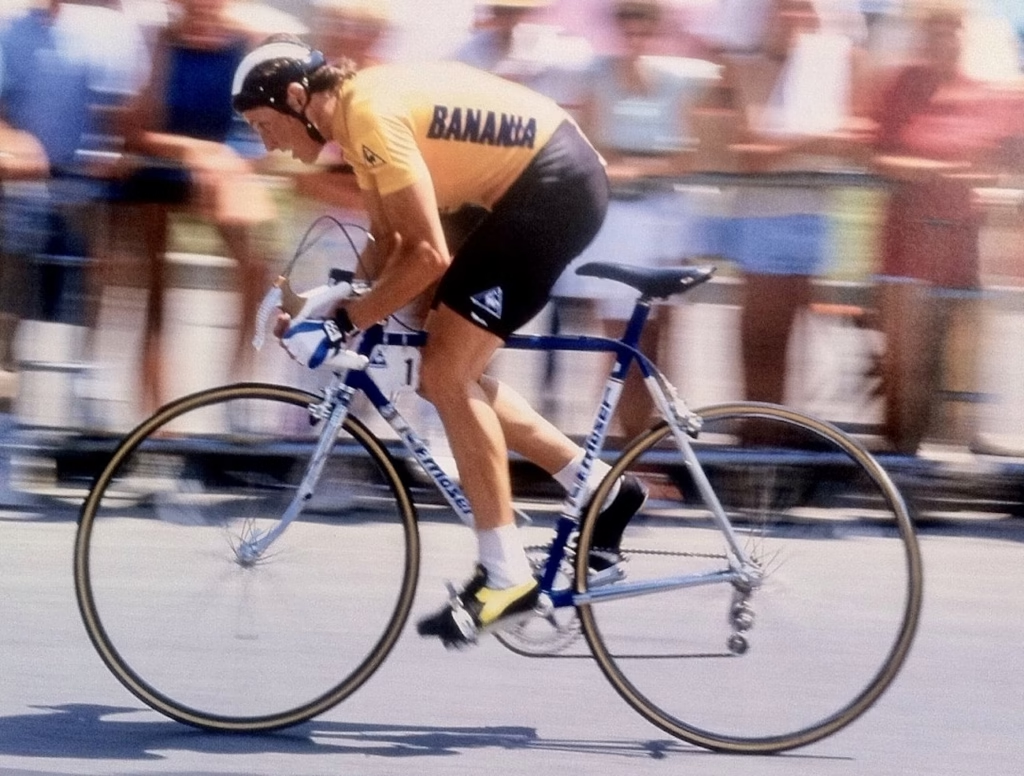
The 1986 Tour may have been her most complete performance
Winning once established Canins among the leading riders in the sport. Her defence in 1986 established something closer to dominance.
She won the prologue and five stages as the Tour crossed the Pyrenees, Massif Central and Alps. Canins was particularly damaging in the mountains, winning on the road to Luchon, at Serre Chevalier and on the Puy de Dôme before reaching Paris with a huge advantage.
Longo finished second overall, 15:31 behind. Inga Thompson was third at 22:09.
For Canins, the scale of the victory is important because it shows how much more she was than a climber.
A rider capable only of making the difference uphill would still have been vulnerable on the flatter stages and time trials. Canins rarely gave those opportunities away. She had enough power to reinforce what she achieved on the climbs, and enough consistency to make taking large amounts of time back from her extremely difficult.
The Tour also sharpened the rivalry that became central to women’s stage racing in the second half of the decade.
Longo was younger, increasingly successful and developing into perhaps the most relentless winner the sport had seen. Canins had arrived late but possessed the endurance base and stage-racing judgement to challenge her.
For five consecutive Tours, one of them finished first and the other second.
Longo eventually turned the Tour rivalry around
The Tour changed hands in 1987.
Longo won, with Canins second. The same happened in 1988 and again in 1989.
It would be easy to describe that simply as Longo replacing Canins, but the results show something more competitive. Canins did not disappear when her rival improved. She remained second in the Tour for three consecutive years while continuing to win stages.
Across the 1985 to 1988 editions, Canins accumulated 15 Tour de France Féminin stage victories.
That rivalry gives both careers more historical weight. Canins’ Tour victories were not collected in the absence of another exceptional stage racer, and Longo’s subsequent run was achieved with the rider who had dominated the previous two editions still racing at a high level.
Their strengths also created different tactical problems.
Longo increasingly possessed the ability to dominate across climbing and time trials, while Canins had the accumulated endurance and experience to remain difficult to dislodge. A bad day could cost either rider minutes because the women’s Tour of that period was sufficiently difficult to create large gaps, but neither could rely on the other making one.
It was one of the first sustained GC rivalries in the history of the women’s Tour.

Canins won the Tour de l’Aude before taking the first Giro
There was plenty happening away from France.
In 1987, Canins won the Tour de l’Aude, taking Stage 5 on the way to the overall title. She finished second in the race a year later. The Tour de l’Aude would later become one of the most important women’s stage races in Europe, surviving until 2010 and providing a major GC target during years when the women’s Tour de France had disappeared.
Then came Italy.
The Giro d’Italia Femminile was launched in 1988, creating the race that would eventually become the longest-lasting major stage race in women’s cycling. Canins was 39 when she won its inaugural edition.
It was not a procession.
Canins lost more than three minutes after being caught out during the early part of the race, then began repairing the damage in the uphill time trial. She moved to within nine seconds of the lead and later attacked with Elizabeth Hepple during Stage 7, taking the overall lead before defending it to the finish.
That victory made her the first name on a winners list that would later include Fabiana Luperini, Joane Somarriba, Nicole Brändli, Marianne Vos, Anna van der Breggen, Annemiek van Vleuten and Elisa Longo Borghini.
The history of the Giro d’Italia Women begins with Canins for good reason. The race’s reputation would increasingly be built around climbing and complete GC riders, and its inaugural winner already fitted that description perfectly.
One Giro, not seven, but a much broader stage-racing record
Canins’ career is sometimes summarised inaccurately as containing multiple Giro victories. She won the Giro d’Italia Femminile once, in 1988.
Her stage-racing record does not need embellishment.
Alongside the two Tours and the Giro came victory in the Coors Classic, the Tour de l’Aude, two Tours of Norway and repeated success in Italian stage races. She also won the Postgiro féminin in 1985 and 1986, an Italian stage race that can easily become confused with the later Giro d’Italia Femminile when historical results are condensed into modern databases.
That distinction matters when looking back at women’s racing in the 1980s.
The calendar did not yet have today’s clear hierarchy of Women’s WorldTour events. Major races appeared, disappeared, changed organisers and sometimes shared similar names. A rider’s stage-racing reputation therefore has to be judged across the whole calendar rather than by counting victories in one modern Grand Tour category.
On that measure, Canins was one of the outstanding GC riders of the decade.
Four World Championship medals without the individual rainbow jersey
For all her victories, one major individual title escaped Canins.
She never became road race world champion.
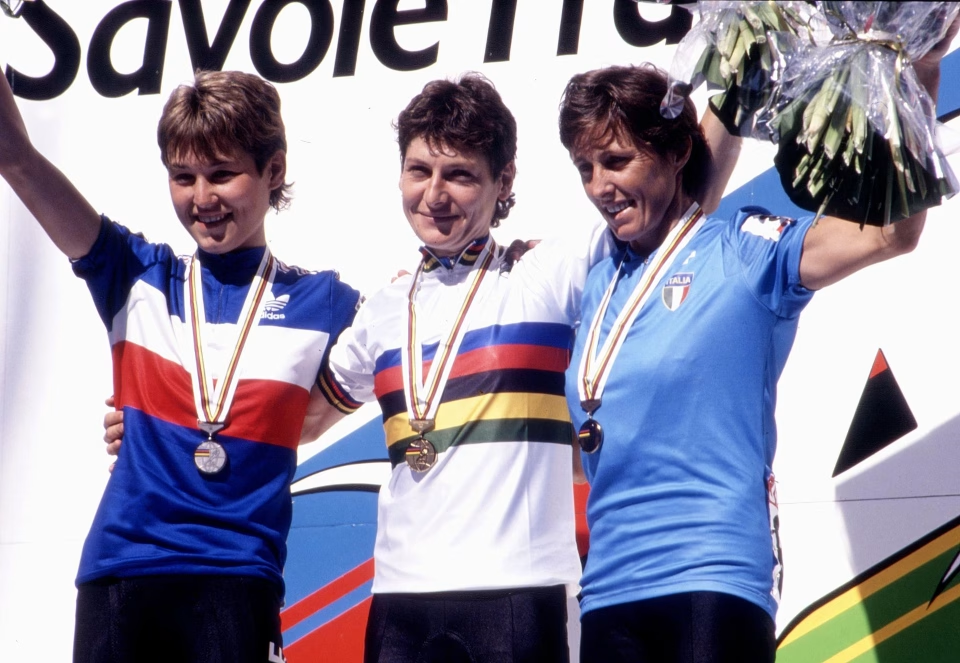
She came extremely close. Canins was second behind Mandy Jones at Goodwood in 1982 and second again behind Longo at Giavera del Montello in 1985. She added bronze medals in 1983 and 1989.
Four medals across eight seasons tell their own story.
Championship road races are very different from stage racing. There is no opportunity to recover a tactical mistake the following day and no general classification to reward controlled losses. Canins still repeatedly put herself in medal-winning positions.
She did become a world champion in 1988 as part of the Italian team that won the 50km team time trial.
That discipline suited her especially well. Long, sustained effort, pacing and collective control were all close to the qualities she had spent her sporting life developing.
Trofeo Alfredo Binda showed she could win without a week of racing
Stage races provide the main structure of Canins’ career, but reducing her to a GC specialist would miss another substantial part of her record.
She became a four-time winner of the Trofeo Alfredo Binda, placing her among the defining riders in the history of one of women’s cycling’s oldest surviving one-day races. Cyclingnews’ historical record lists victories in 1984, 1985, 1990 and 1992.
The last of those wins came when Canins was 42.
That longevity was not an isolated feature of her career. She was Italian road champion six times between 1982 and 1989 and won four national time trial titles from 1987 to 1990. At the 1984 Olympics she finished fifth; four years later, she returned to the Games in Seoul.
Her competitive life did not fit the conventional arc of an athlete who develops through her twenties, peaks around 30 and begins to decline.
Canins had barely begun.
-
 Photo Credit: Lezyne
 -
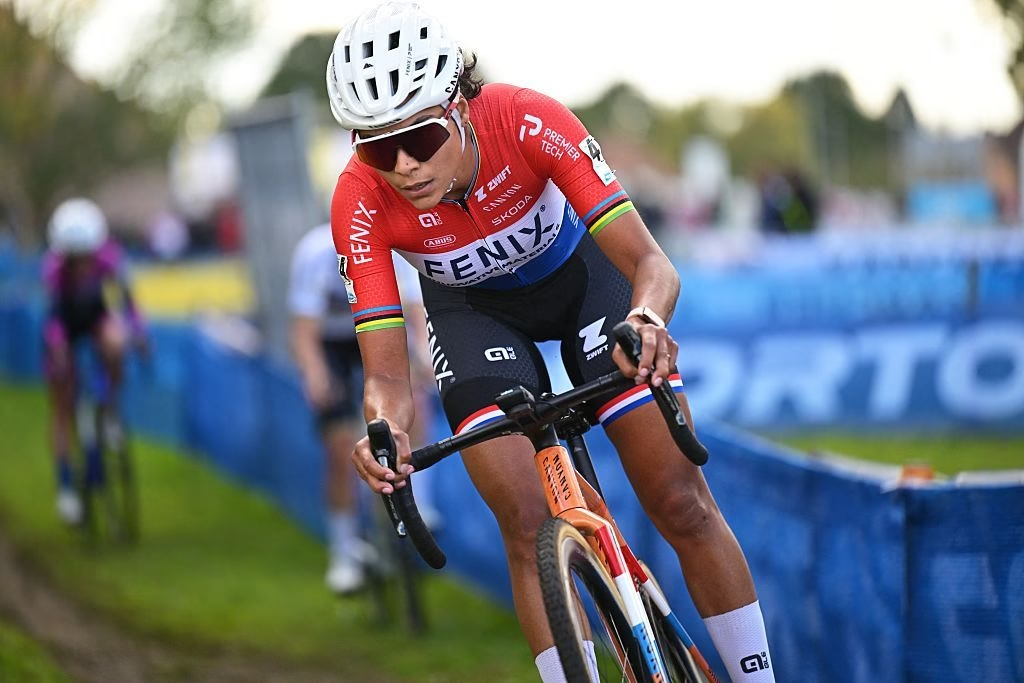
 Photo Credit: David Pintens / BELGA MAG/AFP via Getty Images
Mountain biking became another part of the story
Mountain biking belongs in Canins’ career, but not quite in the order sometimes suggested.
She was not primarily a mountain biker who transferred into road cycling. Cross-country skiing came first, road cycling made her internationally famous, and mountain biking became another outlet for the same appetite for endurance and technical terrain.
Canins went on to win mountain-bike titles and continued competing across endurance disciplines long after the peak of her road career. She also became a world champion in winter triathlon, where running, mountain biking and cross-country skiing brought together several strands of her sporting life. A 2025 interview with La Gazzetta dello Sport found her still riding off-road in Alta Badia at 76.
That makes the mountain-bike part of her story more interesting than a simple career change.
Canins kept returning to the mountains in different forms.
She is still riding in the Dolomites
The connection has continued well beyond elite competition.
Canins remained based in Alta Badia and became involved in guiding cyclists through the region. Current cycling packages in the area still advertise mountain-bike weeks featuring rides with Canins, more than four decades after she first became Italian road champion.
There is something appropriate about that.
Her international career took her to the Tour de France, the Giro, the Coors Classic, World Championships and Olympic Games, but the physical foundation came from the mountains around home. The roads and trails of the Dolomites were not simply scenery attached to her biography. They shaped the athlete.
Canins learned endurance there before cycling became the sport in which most people knew her.
She returned there afterwards.
Why Maria Canins belongs among the great stage racers
Canins won the Tour de France Féminin twice. She was then runner-up three consecutive times.
She won the first Giro d’Italia Femminile.
She won the Coors Classic and Tour de l’Aude. She collected 15 Tour stage victories, four World Championship road race medals and a world team time trial title. She won repeatedly in one-day racing and remained competitive into her forties.
Yet perhaps the most striking part of the record is when it began.
Canins was already 32 when she became serious about road cycling. Modern professional development systems would consider that extraordinarily late. In 1982, it took her almost no time at all to prove that the engine built through years of skiing could survive at the highest level on a bike.
Within four seasons she had won the Tour de France.
Within seven she had won the Giro.
The roads changed, the races changed and eventually Longo became the stronger Tour rider, but Canins remained difficult to remove from the front of a stage race because her strength was never built around one trick.
She could climb. She could time trial. She could survive long races, recover and do it again the next morning.
That is the basic definition of a great stage racer, whether the year is 1985 or 2026.

