
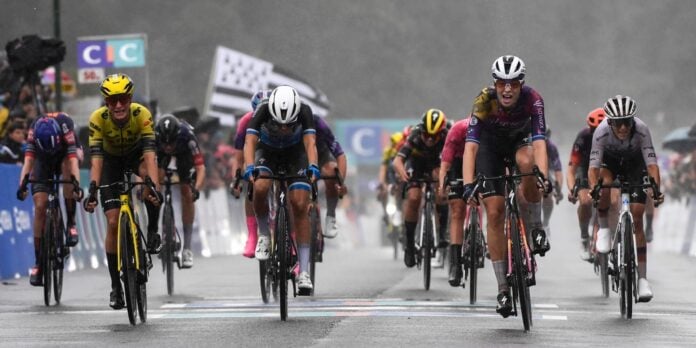
The 2026 Classic Lorient Agglomération takes place on Saturday 29 August, with the Women’s WorldTour peloton facing 172.6km and 2,809 metres of climbing on the relentlessly rolling roads around Plouay in Brittany.
The broad formula remains familiar. The race starts and finishes in Plouay, heads out across the Lorient Agglomération for a long opening section and then returns to the town for repeated passages of a redesigned finishing circuit. What has changed for 2026 is much more important than the basic shape of the course: the Côte de Ty Marrec is back.
One of the climbs most closely associated with racing in Plouay returns to the route for the first time since 2019. Rostervel disappears from the previous final loop, while Le Lézot and Kerscoulic remain before the riders reach Ty Marrec, whose summit comes only around five kilometres from the finish.
That gives attacking riders a much clearer launchpad than they have had in recent editions and could make it significantly more difficult for the fastest riders to keep the race together.
For the broader identity of the event, including why Plouay has become such an important part of the Women’s WorldTour, see ProCyclingUK’s Beginner’s guide to Classic Lorient Agglomération 2026.
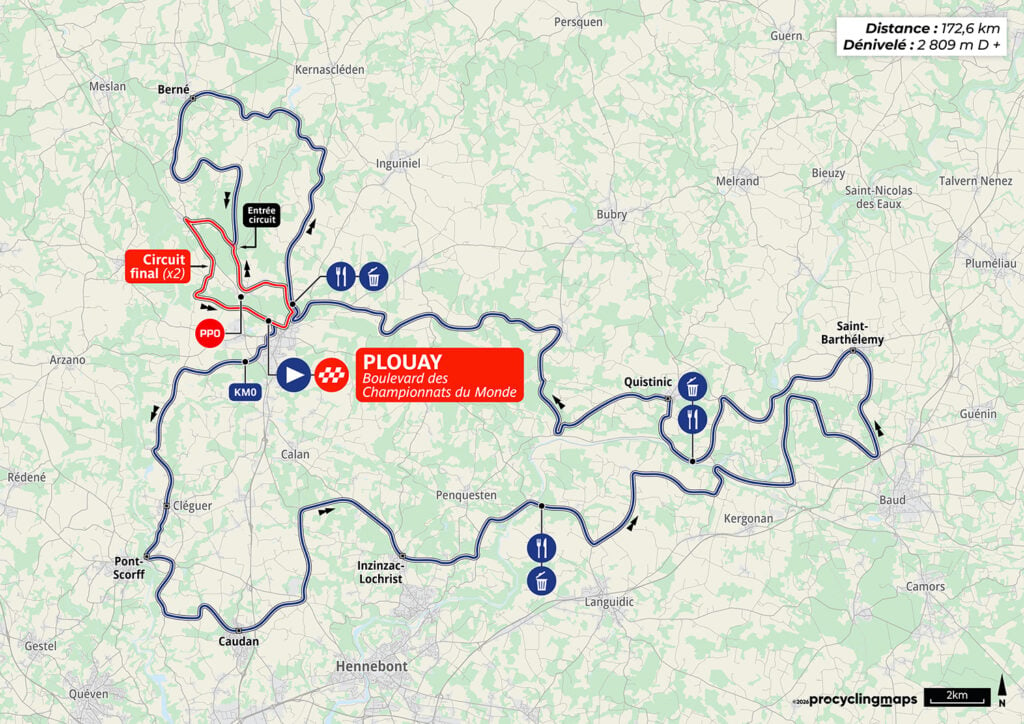
Classic Lorient Agglomération 2026 route at a glance
| Detail | Information |
|---|---|
| Date | Saturday 29 August 2026 |
| Start | Plouay |
| Finish | Plouay |
| Distance | 172.6km |
| Elevation gain | 2,809 metres |
| Race level | UCI Women’s WorldTour, 1.WWT |
| Opening section | Long loop through Lorient Agglomération |
| Finishing phase | Repeated laps of the new Plouay circuit |
| Key late climbs | Le Lézot, Kerscoulic, Côte de Ty Marrec |
| Ty Marrec | Around 1.5km at 5%, with a section around 10% |
| Ty Marrec summit | Around 5km from the finish |
| Final rise | Kerdalvé, around 1.5km from the finish |
| Finish | Boulevard des Championnats du Monde, Plouay |
| Defending champion | Mischa Bredewold |
The women’s race forms part of the traditional late-August cycling festival in Plouay, with the men’s Bretagne Classic following on Sunday. The two races share many of the same finishing roads and, in 2026, both reconnect with one of the most important climbs in Plouay’s history.
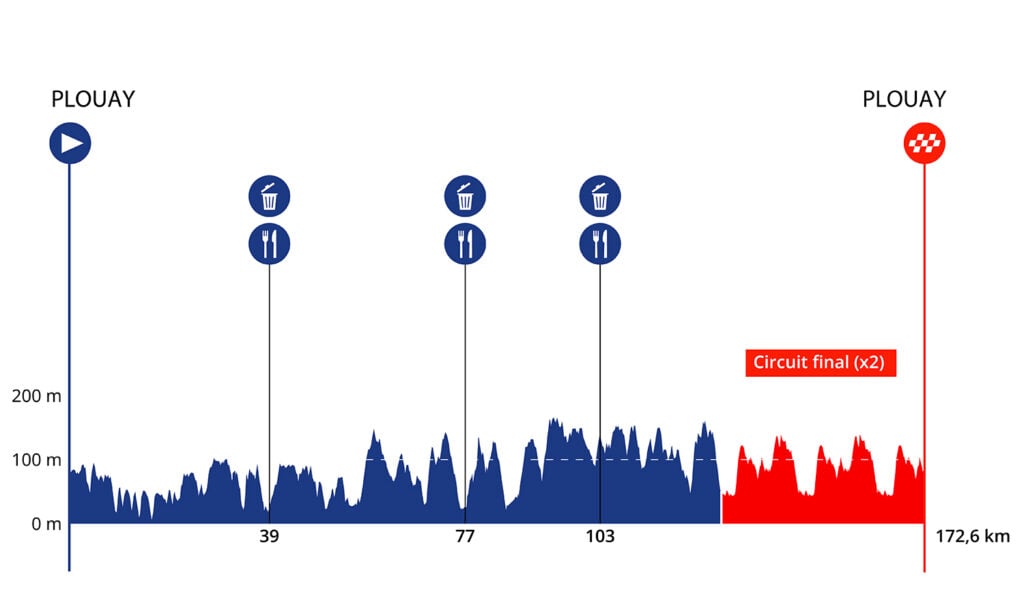
A longer route with almost 2,800 metres of climbing
The first number that stands out is 2,809 metres of elevation gain.
That is substantial for a 172.6km women’s one-day race, but it still does not turn the Classic Lorient Agglomération into a conventional climbing race.
There is no enormous mountain around which everything revolves. Instead, Plouay accumulates difficulty through dozens of changes in gradient. Riders are constantly climbing, descending, accelerating out of bends and fighting to retain position on roads where the bunch rarely settles into an easy rhythm.
The 2025 race covered 165.3km and still produced a heavily reduced finale before Mischa Bredewold outsprinted Marianne Vos. The full story of that race is covered in ProCyclingUK’s report on Bredewold completing a third consecutive Classic Lorient Agglomération victory.
The additional distance and concentrated final circuit in 2026 should increase the amount of fatigue already present before Ty Marrec becomes decisive.
That cumulative effect matters more than looking at any individual climb in isolation.
The race begins with a long loop through Lorient Agglomération
The opening section takes the peloton away from Plouay and across the wider Lorient Agglomération, using the rolling roads that give the event much of its character before the riders return for the finishing circuits.
This is not simply a long transfer towards the important part of the route.
The terrain continually rises and falls, and those efforts gradually soften the peloton. Narrow roads and frequent changes in direction can make chasing surprisingly expensive, particularly if a strong breakaway contains riders from several WorldTour teams.
That creates an early tactical question.
Teams with fast finishers want enough control to prevent a dangerous group building a major advantage, but using too many domestiques before the final circuits leaves their leaders exposed when the race becomes genuinely selective.
The opening kilometres should therefore establish the conditions for the decisive final hour even if they do not directly decide the winner.
 Photo Credit: Getty
The return towards Plouay begins the real fight for position
Once the race approaches Plouay again, the tactical character changes.
Every contender knows where the difficult sections are coming and understands that starting a climb 50 positions too far back can be as damaging as lacking the legs to follow the eventual attack.
That creates an intense fight for the front before the biggest accelerations have even begun.
Plouay is particularly punishing in this respect because there is no single mountain where teams can simply form a train and ride tempo. The road is constantly asking riders to brake, accelerate and reposition.
The best Classics teams will want their leaders surrounded by teammates as the race enters the finishing phase, but those numbers are likely to disappear quickly once the pace rises.
A redesigned 16km finishing circuit
The new local circuit around Plouay is approximately 16km long and has been reworked around the return of Ty Marrec.
The previous finishing configuration placed much of its emphasis on Le Lézot and Kerscoulic, with Rostervel forming another part of the sequence. Rostervel is removed from the new finale, while the road instead continues towards Ty Marrec.
That changes more than the list of climbs.
The old configuration could repeatedly wear riders down without necessarily giving an attacker one overwhelmingly obvious point from which to commit. The new route still contains those attritional ingredients, but now finishes them with a climb positioned close enough to the line to produce a potentially race-winning attack.
For the history behind those roads and the many different versions of the race used since 2002, ProCyclingUK’s brief history of Classic Lorient Agglomération traces the development of the women’s race around Plouay.

Le Lézot can start stripping away the domestiques
Le Lézot remains an important part of the circuit.
It is not a climb that should create enormous gaps among the strongest riders by itself. Its value comes from forcing another acceleration at precisely the point where fatigue is beginning to dominate the race.
Teams can use Le Lézot to make life difficult for the fastest finishers without necessarily asking their leader to attack.
A high pace over the climb can remove lead-out riders, stretch the group and force rivals towards their limit. Once a rider has been dropped here, returning to the front before the next difficulty can require another significant effort.
That makes Le Lézot an obvious place for teams with several strong riders to begin applying pressure.
In 2025, Femke de Vries attacked on Le Lézot during the decisive phase of the race, with the repeated accelerations helping to fragment the front before the eventual regrouping.
The difference this year is that anybody who survives Le Lézot knows Ty Marrec is still waiting.
Kerscoulic keeps the pressure on
The Bosse de Kerscoulic provides another short climbing effort before the race reaches its principal late obstacle.
Like so much of the Plouay route, its importance is greater than its raw profile suggests.
By this point riders have already covered well over 100km of constantly changing terrain. Another sharp acceleration can be enough to remove a domestique who would have comfortably survived the same climb earlier in the race.
Kerscoulic also presents an excellent tactical opportunity.
A strong rider can attack here without necessarily trying to ride alone to the finish. The objective may instead be to force the favourites’ teams to chase before Ty Marrec.
Every teammate used closing a move on Kerscoulic is one fewer rider available five or ten minutes later.
That is exactly the type of cumulative tactical pressure that makes Plouay difficult to control.

Ty Marrec returns for the first time since 2019
The headline change is the return of the Côte de Ty Marrec.
For the first time since 2019, the women’s and men’s WorldTour races in Plouay will use the climb that became one of the defining features of the old GP de Plouay circuit.
Ty Marrec is approximately 1.5km at 5%, with a steeper section reaching around 10%.
Those figures are modest compared with a mountain stage, but that is not how the climb is raced.
After more than four hours of repeated climbing, a rider can attack the steeper section close to maximum intensity. There is no need to calculate an effort for another 10 or 15 kilometres of climbing.
It is short enough for a puncheur to explode up it and difficult enough for that acceleration to produce separation.
Most importantly, it comes at exactly the right place in the race.
Why the final Ty Marrec ascent could decide the race
The summit comes with approximately five kilometres remaining.
That places Ty Marrec firmly inside the range where a strong attacker can realistically reach the finish alone.
Ten or 15 kilometres from the line, a chasing group has time to reorganise and use its numerical advantage. Five kilometres is different.
If somebody crests Ty Marrec with even five or ten seconds, every moment of hesitation behind becomes significant.
The fastest rider in the chasing group does not want to do the work.
A teammate of the attacker certainly will not chase.
Another contender may hesitate because she expects a rival team to take responsibility.
Suddenly a small advantage becomes much more difficult to close.
The course after Ty Marrec makes that problem worse.
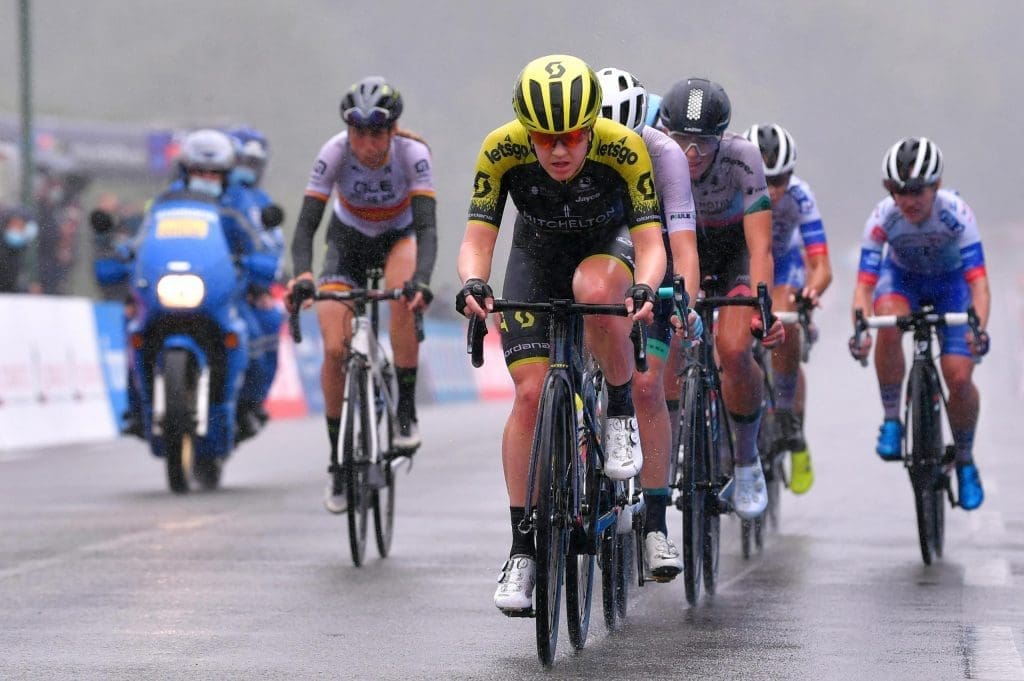
Technical roads make the chase harder after Ty Marrec
The descent and approach towards Plouay contain a succession of bends and narrower roads, rather than immediately placing the chasing group onto a wide, straight run towards the finish.
That favours the rider in front.
A lone attacker can choose her line and accelerate out of each corner. A chasing group has to negotiate the same bends while trying to organise riders from several teams with competing interests.
Those changes in direction interrupt the rhythm of a chase.
They also increase the importance of the position from which a rider crests Ty Marrec. A favourite who reaches the summit near the back of a 15-rider group may struggle to move forward through the technical section even if she still has excellent legs.
The final five kilometres therefore reward commitment.
Anybody attacking on Ty Marrec knows the road ahead offers at least some protection from an organised pursuit.
Kerdalvé provides one last opportunity
Even after Ty Marrec, the road is not completely finished with the riders.
A small rise around Kerdalvé comes approximately 1.5km from the finish.
It is not comparable with Ty Marrec in difficulty, but its position makes it tactically useful.
If one or two riders remain clear, the rise provides another opportunity to maintain momentum before the finishing straight.
If the favourites have regrouped, it creates one final chance for an opportunist to attack rather than accept a sprint.
And if a reduced peloton is already being organised into lead-outs, the acceleration over Kerdalvé can remove the final domestiques and leave the contenders fighting individually for position.
It is another reason why a group containing 20 riders with five kilometres remaining may contain considerably fewer by the time the sprint actually starts.
 Photo Credit: Getty
The famous Plouay finishing straight
The race ends on the Boulevard des Championnats du Monde, a reminder of Plouay’s hosting of the 2000 UCI Road World Championships.
The finishing road rises gently towards the line.
It is not a climb in the conventional sense, but after 172.6km it changes the sprint. Riders cannot simply rely on maximum speed for a few seconds. Going too early creates the risk of fading badly on the false flat.
Bredewold demonstrated the subtleties of the finish perfectly in 2025.
She launched early, Marianne Vos initially came past her, but Bredewold was able to find another acceleration and regain the advantage before the line. It was her third consecutive victory after winning in very different circumstances in 2023 and 2024.
Her second success came from a much smaller selection, with ProCyclingUK’s 2024 Classic Lorient Agglomération race report detailing how she beat Chloé Dygert and Liane Lippert from a three-rider finish.
Those contrasting victories underline why the final straight cannot be considered separately from everything that comes before it.
Why Ty Marrec changes the race for the sprinters
A reduced sprint remains one of the most plausible outcomes.
The Classic Lorient Agglomération has repeatedly shown that riders with enough climbing ability can survive the Breton terrain and retain the speed required to win.
The problem in 2026 is that the sprinters now have to deal with a much better late attacking opportunity.
Previously, a fast rider who survived Le Lézot and Kerscoulic could begin thinking seriously about the finish.
Now she still has to survive Ty Marrec.
Even remaining in the front group may not be sufficient. If an attacker gets clear and nobody immediately organises the chase, a strong sprint becomes irrelevant.
The new route therefore creates more incentive for teams without a top-level finisher to race aggressively and more responsibility for those trying to defend a sprint.
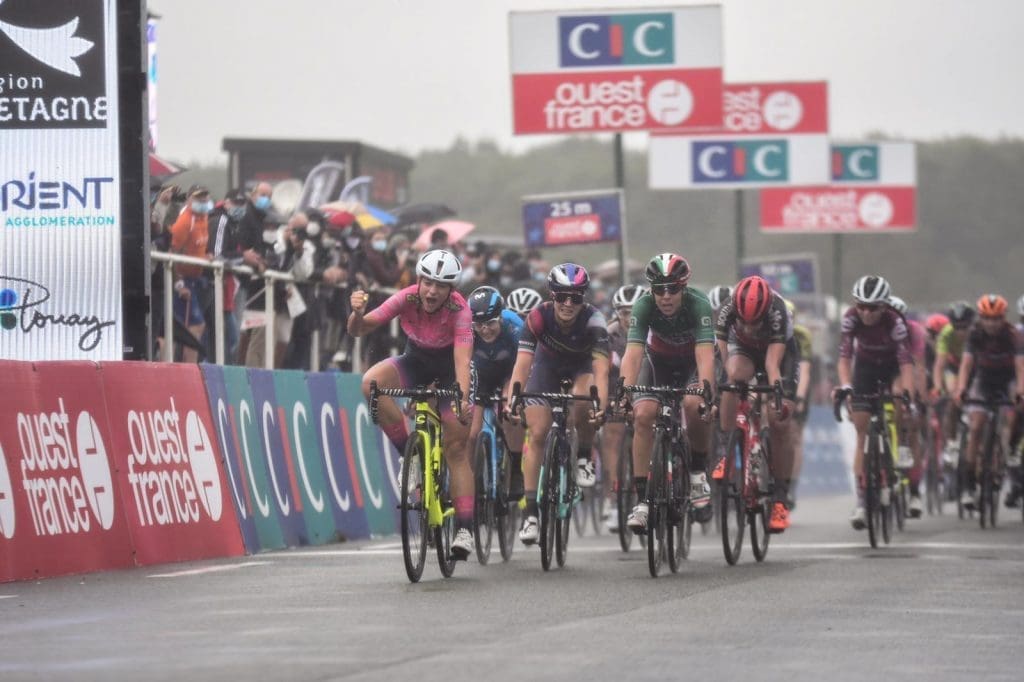
Where could the 2026 Classic Lorient Agglomération be won?
There are several realistic points where the race can change decisively.
The long opening loop
An early breakaway is unlikely to contain the eventual winner under normal circumstances, but a large and powerful move can force the favourites’ teams to work earlier than they want.
That becomes particularly important if multiple Women’s WorldTour teams place riders ahead.
Le Lézot
This is an ideal point to dramatically raise the pace without necessarily committing the team leader.
A hard ascent can remove sprinters’ helpers and put already tired riders under pressure before the biggest attacks begin.
Kerscoulic
A move here can force other teams onto the defensive.
The attacker may not expect to stay clear all the way to Plouay. Simply making rivals chase before Ty Marrec can change the balance of the race.
Côte de Ty Marrec
This is the clearest race-winning point on the route.
The climb is steep enough for an explosive rider to produce a gap and close enough to the finish for even a small advantage to become dangerous.
Anyone without confidence in her sprint should be thinking about attacking here.
Kerdalvé
If the main favourites neutralise one another on Ty Marrec, the final small rise provides another opportunity.
An attack with 1.5km remaining is difficult to chase if the group has already lost its final domestiques.
The Boulevard des Championnats du Monde
If everything comes back together, the race still favours riders who can sprint after an extremely demanding four hours.
The slightly rising finish rewards patience, positioning and the ability to sustain speed rather than simply the highest peak power.
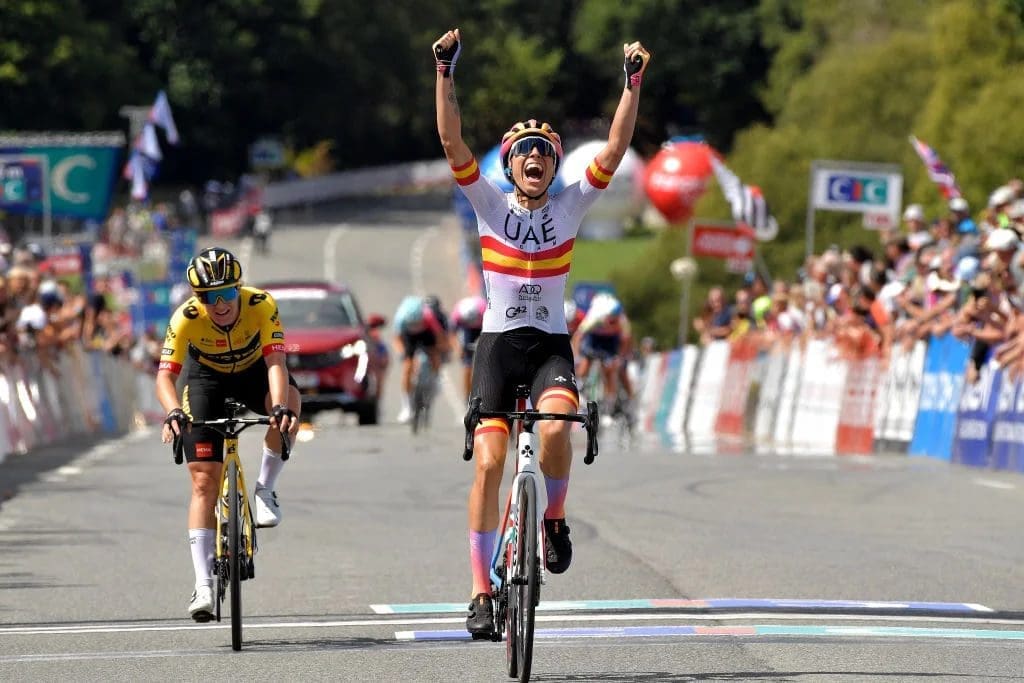
Who does the 2026 route favour?
The ideal rider for Plouay sits somewhere between a climber and a sprinter.
A pure sprinter is unlikely to appreciate 2,809 metres of climbing and the repeated high-intensity efforts of the finishing circuit.
A pure climber may find Ty Marrec too short to exploit her power-to-weight advantage sufficiently before faster riders return.
The ideal contender is a puncheur with a sprint.
That rider can survive the opening attrition, attack on Ty Marrec if the opportunity appears and still have a route to victory if a reduced group reaches the finish.
Powerful Classics specialists are also particularly well suited. The constant changes of pace, narrow roads and technical positioning mean outright climbing ability is only one part of the equation.
The varied list of previous winners reflects that. Marianne Vos, Lizzie Deignan, Emma Pooley, Anna van der Breggen, Elisa Longo Borghini, Mavi García and Bredewold all found different solutions to essentially the same problem.
The evolution of those winning styles is covered in more detail in ProCyclingUK’s history of Classic Lorient Agglomération.
What Ty Marrec means for Mischa Bredewold
No discussion of the 2026 route can avoid Mischa Bredewold’s extraordinary record in Plouay.
She has won in 2023, 2024 and 2025, with the three victories demonstrating how well her characteristics match the race.
Bredewold is fast enough to beat most riders who can survive the climbing, but strong enough over short ascents to ensure conventional sprinters often disappear before she does.
Her first Classic Lorient Agglomération victory in 2023 began a run that has since made her the obvious reference point for every rival.
Ty Marrec makes defending that record more complicated.
Rivals no longer have to find a way to beat Bredewold in the sprint. They have a climb only five kilometres from the finish where they can attempt to make sure she never reaches it.
That should create a simple tactical incentive for almost every rider without her speed: do not wait.
If Bredewold reaches the Boulevard des Championnats du Monde with the leading group once again, the advantage swings back heavily in her direction.
-
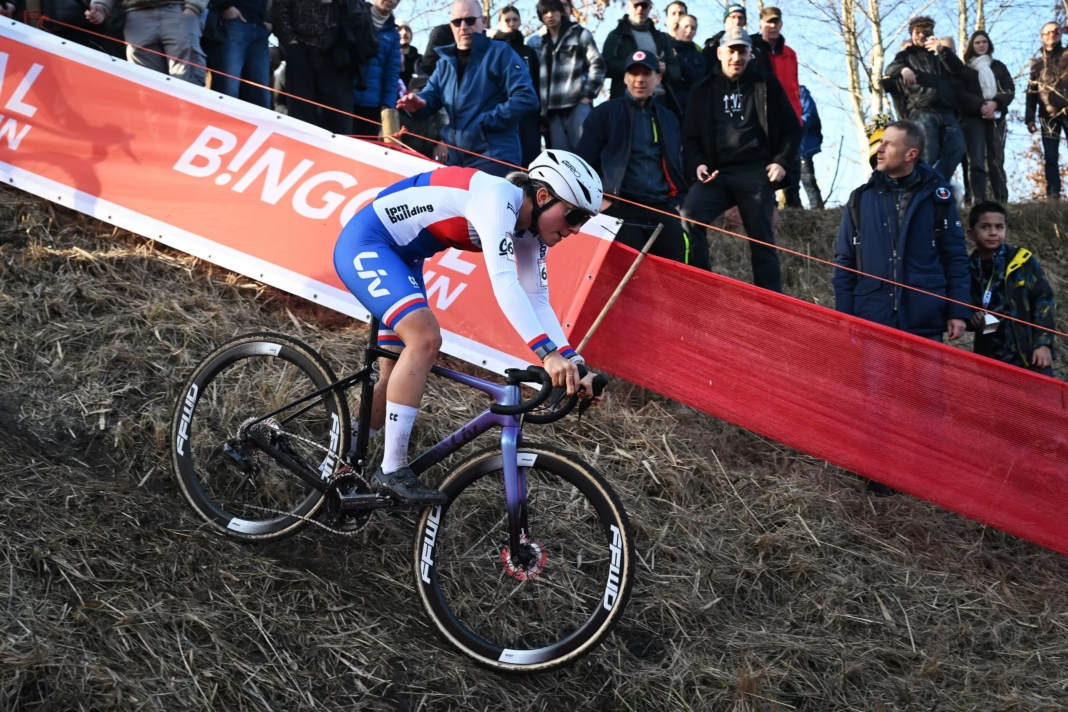
 Photo Credit: Cor Vos
Classic Lorient Agglomération 2026 route difficulty
| Route feature | Difficulty | Likely impact |
|---|---|---|
| 172.6km distance | ★★★★☆ | Long enough for fatigue to accumulate |
| 2,809m climbing | ★★★★☆ | Heavy climbing load without one major mountain |
| Opening Breton roads | ★★★☆☆ | Constant rolling terrain and positioning |
| Le Lézot | ★★★☆☆ | Useful for increasing pressure |
| Kerscoulic | ★★★☆☆ | Another short selective effort |
| Ty Marrec | ★★★★★ | Principal late attacking point |
| Technical final 5km | ★★★★☆ | Makes an organised chase more difficult |
| Kerdalvé rise | ★★★☆☆ | Final opportunity to avoid the sprint |
| Uphill finishing drag | ★★★☆☆ | Rewards durable fast finishers |
The overall numbers make the race hard. The placement of Ty Marrec makes the finale tactically dangerous.
Classic Lorient Agglomération 2026 route verdict
The return of Ty Marrec gives the 2026 Classic Lorient Agglomération a more obvious point of decision without removing the attritional character that makes Plouay distinctive.
Before reaching it, the peloton has to negotiate 172.6km of rolling Breton terrain and accumulate almost 2,800 metres of climbing. Le Lézot and Kerscoulic can remove domestiques and stretch the group before Ty Marrec finally gives the strongest attackers a place to commit.
From its summit there are only around five kilometres left, and the twisting roads towards Plouay make even a small advantage difficult to close. Kerdalvé then provides one final interruption before the traditional rising finish on the Boulevard des Championnats du Monde.
A reduced sprint remains entirely possible. Three consecutive victories for Bredewold show just how difficult the fastest riders who climb well are to remove on these roads.
But the 2026 route gives their rivals a much clearer answer.
If you do not want to sprint against them in Plouay, Ty Marrec is where you have to do something about it.
The women’s race takes place the day before the men’s WorldTour event on many of the same roads, with ProCyclingUK’s brief history of the Bretagne Classic providing further context on why Plouay and its surrounding circuit occupy such an important place in Breton cycling.

