
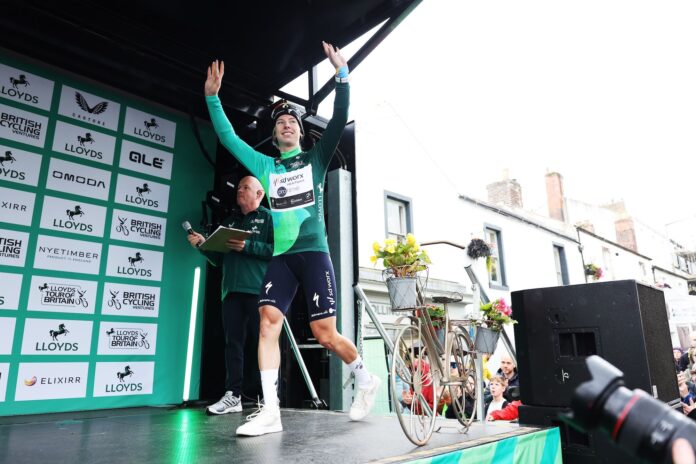
The Tour of Britain Women 2026 reaches North Wales on Friday 21 August for its shortest stage, but also the first day designed to create meaningful gaps between the main general classification contenders.
Stage 3 runs 104.7 kilometres from Mold to the summit of the Great Orme in Llandudno, packing 1,927 metres of climbing into barely more than 100 kilometres. The decisive final ascent comes via Saint Tudno’s Road, where the 2.5-kilometre climb averages 6.1% but includes ramps approaching 15%.
That combination should suit explosive climbers and powerful all-rounders more than pure mountain specialists. Lotte Kopecky and Kim Le Court-Pienaar consequently stand out among the strongest options, while defending champion Ally Wollaston, Karlijn Swinkels, Riejanne Markus and Lauren Dickson all have reasons to see the Great Orme as a crucial point in their overall race.
The Tour of Britain Women 2026 route guide identified Stage 3 as the clearest initial GC battleground long before the race began. After two days where sprint speed and bonus seconds have been important, Friday should finally tell us which riders can actually take time uphill.
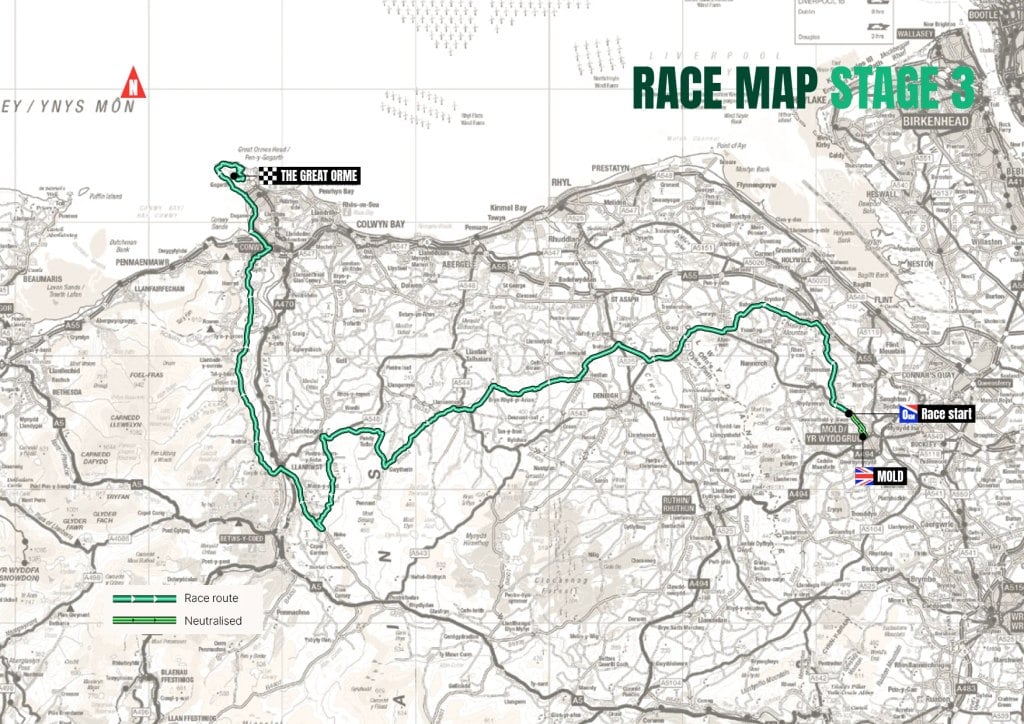
Tour of Britain Women Stage 3 route
Date: Friday 21 August 2026
Start: Mold
Finish: Great Orme, Llandudno
Distance: 104.7km
Elevation: 1,927m
Stage type: Hilly / summit finish
Final climb: Great Orme via Saint Tudno’s Road
Final climb length: 2.5km
Average gradient: 6.1%
Maximum ramps: Almost 15%
Mold hosts a Tour stage start for the first time before the race heads west through the Clwydian Range.
The route passes the Iron Age hillforts of Penycloddiau and Moel-y-gaer before continuing through Trefnant, Gwytherin and Llansannan. From there, the race turns north towards the coast, passing through Tal-y-bont and Caerhun before reaching Conwy.
The final section is particularly important.
Rather than simply approaching the Great Orme directly, the riders first circle the headland using Marine Drive before turning onto the much steeper Saint Tudno’s Road for the finishing climb.
That should make positioning increasingly important before the road even begins to rise sharply.
The full Tour of Britain Women 2026 start list shows just how many riders have realistic reasons to target this stage.
The Great Orme is short but steep enough to change the race
At 2.5 kilometres, the Great Orme is not long enough to turn Stage 3 into a conventional mountain stage.
That may actually make the finish more interesting.
The average gradient of 6.1% conceals sections approaching 15%, meaning the climb rewards acceleration and the ability to repeatedly change pace rather than simply maintaining one climbing tempo for 20 minutes.
The short stage beforehand also matters.
There are almost 2,000 metres of climbing packed into 104.7 kilometres, leaving relatively little easy road on which riders can recover. If the race is aggressive through the Clwydian Range, some contenders may arrive at Saint Tudno’s Road already close to their limit.
The steepest ramps then become much more damaging.
Even a gap of 10 or 15 seconds could prove significant in a five-day race where the remaining stages do not contain another summit finish.
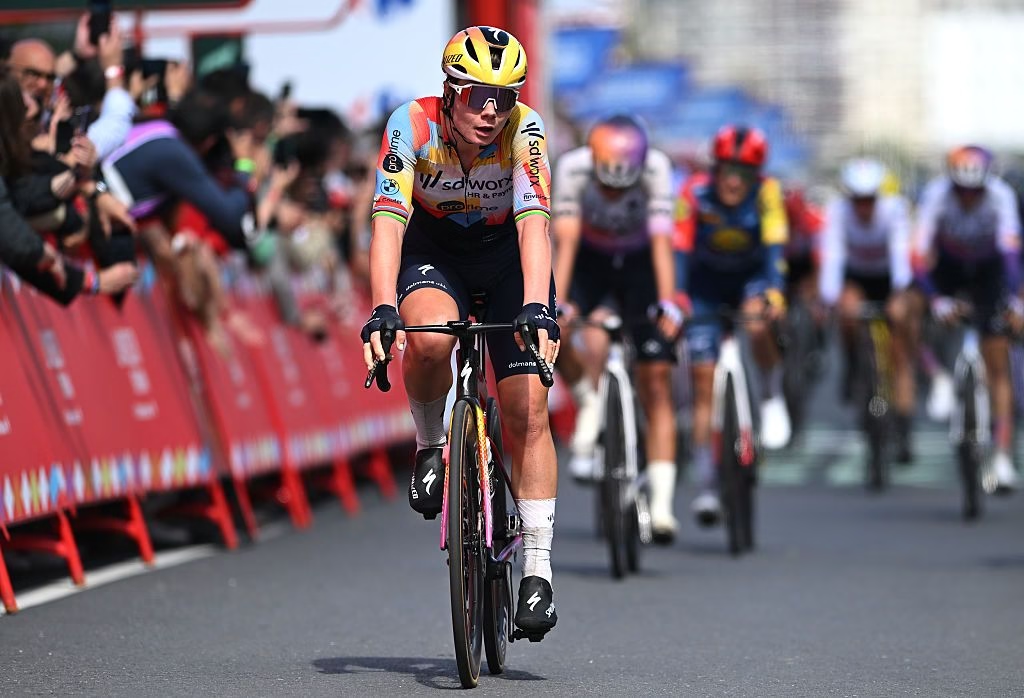
Lotte Kopecky has almost the perfect profile
Lotte Kopecky is the most obvious stage favourite.
The Great Orme asks for exactly the combination of attributes she possesses: sustained power, explosive climbing and enough finishing speed to win if several contenders reach the final few hundred metres together.
She also knows Llandudno well.
Kopecky won here during the 2024 Tour of Britain Women, although that stage finished on the promenade rather than at the top of the Great Orme. She went on to win the race overall, giving her another positive association with the Welsh resort.
More importantly, the final climb should suit her better than a long mountain would.
There is no need for Kopecky to match a 45-minute climbing specialist. She needs to remain powerful for a short, violent ascent where positioning and timing matter almost as much as watts per kilogram.
SD Worx-Protime’s situation also gives her tactical freedom. Lorena Wiebes has already demonstrated in this race that she can survive significantly harder terrain than a conventional sprinter, so rival teams cannot simply assume that dropping Wiebes leaves SD Worx without another option.
If the race becomes too difficult for Wiebes, Kopecky is waiting behind.
That makes her the rider everyone else needs to dislodge.
Kim Le Court-Pienaar should be one of the biggest threats
Kim Le Court-Pienaar is perhaps the strongest direct alternative to Kopecky.
Her 2026 season has repeatedly shown how effective she is when a race combines climbing with a fast finish rather than requiring specialist mountain ability.
That was evident again at the Tour de France Femmes, where Le Court-Pienaar won Stage 6 from an eight-rider group after surviving a demanding day.
The Great Orme creates a similar type of problem.
If Le Court-Pienaar can stay with Kopecky and the strongest climbers through the steepest sections, she has enough finishing speed to win the stage without needing to ride away alone.
She also has greater incentive than some rivals to make the climb selective.
Kopecky is difficult to beat from a controlled finish. Le Court-Pienaar’s better route may be to force the effort earlier and see whether repeated accelerations can isolate the Belgian before the final few hundred metres.
The wider Tour of Britain Women 2026 contenders preview explains why Le Court-Pienaar entered the race as one of the riders best suited to its overall combination of punch, climbing and finishing speed.
 Photo Credit: Getty
Lauren Dickson finally gets the terrain to test her comeback
Lauren Dickson is one of the most important unknowns of Stage 3.
Before fracturing her collarbone at the Tour de Suisse, the British rider had produced one of the breakthrough seasons of 2026.
Her results included third overall at Itzulia Women and 11th at the Giro d’Italia Women, establishing her as one of the strongest emerging British stage racers.
She was also sitting second overall at the Tour de Suisse when the crash interrupted that momentum.
The Tour of Britain is her return to racing.
That makes Friday the first proper opportunity to discover how much of that climbing form has survived the interruption.
Unlike Wollaston or some of the faster contenders, Dickson has little reason to want a larger group reaching the summit.
Her best race is one where the Great Orme becomes genuinely selective.
If she is anywhere close to her pre-injury level, the steeper sections give her an opportunity to put several riders under pressure and immediately move herself into the overall battle.
If the lack of racing sharpness shows, Stage 3 may instead become part of rebuilding towards the remainder of the season.
Either way, the Great Orme should provide the answer.
Ally Wollaston faces the biggest test of her title defence
Ally Wollaston won the 2025 Tour of Britain Women through consistency, sprint speed and bonus seconds.
The 2026 route asks more of her.
Friday is the key day.
Wollaston has enough climbing ability to survive difficult terrain, and the Great Orme’s relatively short duration is considerably more favourable than a long Alpine summit finish would be.
But she cannot afford to lose significant time.
If the pure climbers and stronger puncheurs create 20 or 30 seconds on the steepest part of Saint Tudno’s Road, sprinting for bonuses later in the race becomes a much less realistic route towards defending the title.
Her best scenario is therefore a selective but still relatively contained finish.
If a group of perhaps eight or ten riders reaches the final section together, Wollaston’s speed immediately becomes dangerous.
If Kopecky, Le Court-Pienaar or Dickson turn the climb into a sustained attack from further down, Wollaston faces a much more difficult afternoon.
The Tour of Britain Women 2026 contenders preview looks at why the harder 2026 route changes the challenge facing the defending champion.
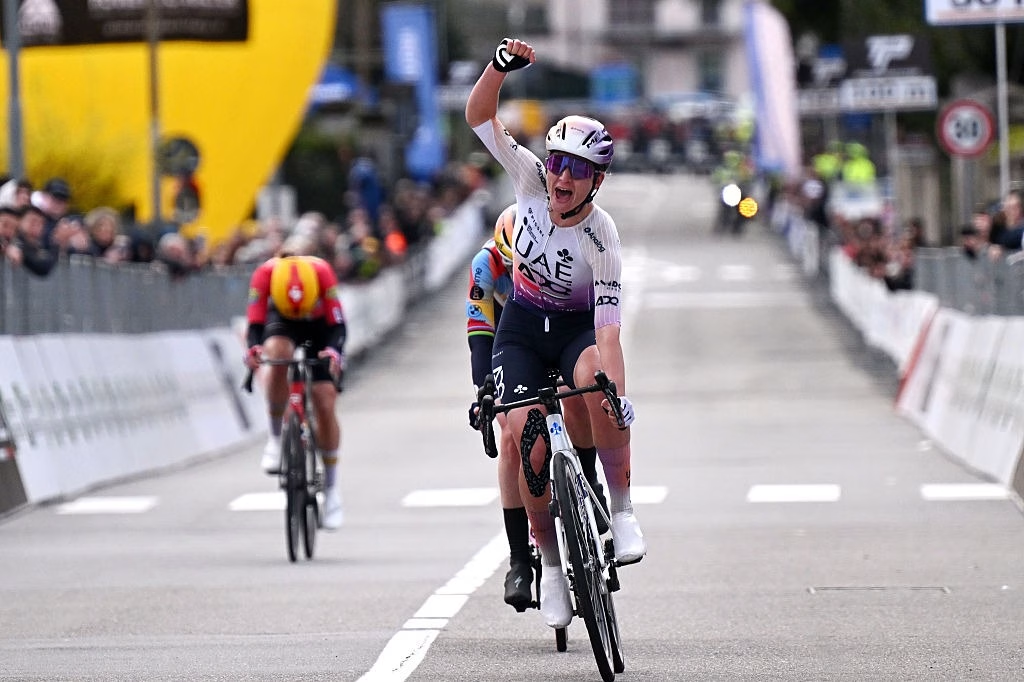 Photo Credit: Getty
Karlijn Swinkels can move towards another Tour of Britain podium
Karlijn Swinkels finished third overall in 2025 and has already demonstrated that consistency can be enough to produce a major result at this race.
The Great Orme should suit that approach.
Swinkels may not be the rider most likely to launch the decisive attack, but she handles rolling terrain exceptionally well, climbs strongly enough to remain involved and rarely gives away large amounts of time unnecessarily.
That becomes particularly valuable on Friday.
She does not need to win.
If Swinkels finishes alongside or immediately behind Kopecky and Le Court-Pienaar while several faster riders lose ground, she can emerge from the stage in a very strong GC position.
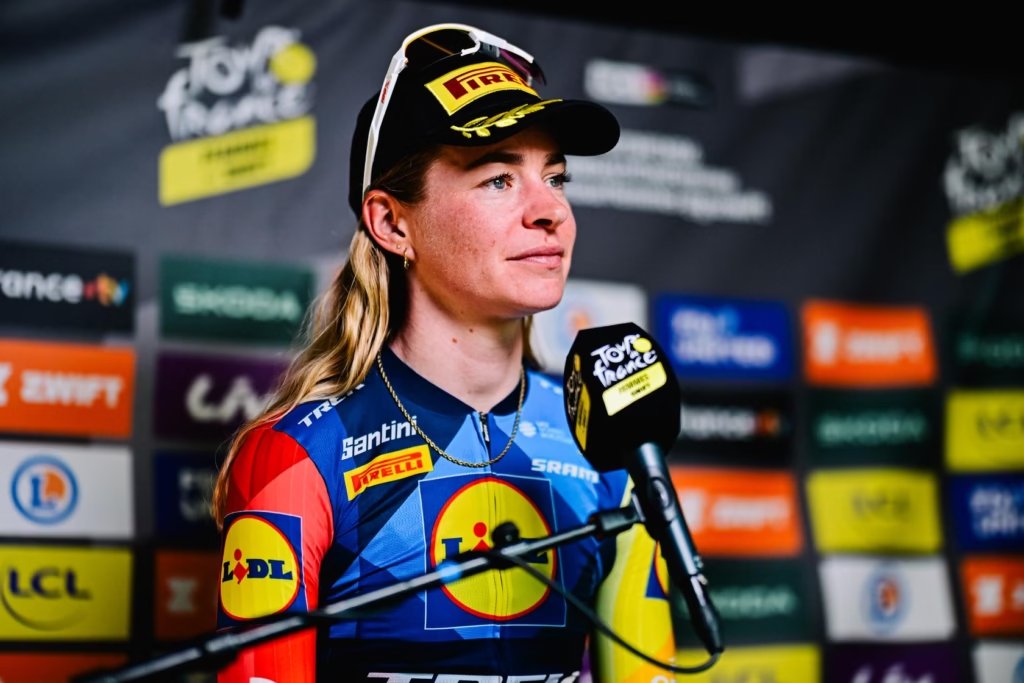
Riejanne Markus needs to make the climb hard
Riejanne Markus has a different problem.
She is unlikely to want Kopecky, Le Court-Pienaar or Wollaston reaching the final few hundred metres alongside her.
Her route to victory therefore involves making the stage harder.
Lidl-Trek can use the earlier North Wales climbs to increase the amount of fatigue before the final ascent and then try to maintain that pressure once the race reaches Saint Tudno’s Road.
Markus’ sustained climbing strength should become more valuable the longer the effort becomes.
She also has enough stage-racing experience to recognise that the Great Orme is not necessarily the place to wait.
An attack before the steepest ramps could force faster riders to chase rather than allowing them to sit behind until the sprint.
Pfeiffer Georgi can benefit if the race becomes tactical
Pfeiffer Georgi should also remain in the wider GC conversation.
The Great Orme is not an obvious perfect finish for her, but the stage as a whole can suit her if it is raced aggressively.
Almost 2,000 metres of climbing across little more than 100 kilometres creates a Classics-style rhythm where positioning, repeated accelerations and tactical judgement matter.
Georgi is particularly strong in that kind of race.
Her better route is probably not waiting until the final 500 metres against Kopecky.
Team Picnic PostNL can instead try to make the approach difficult, force rivals into repeated efforts and create a situation where the final climb begins with the race already fractured.
That should bring Georgi closer to the riders with greater pure climbing ability.
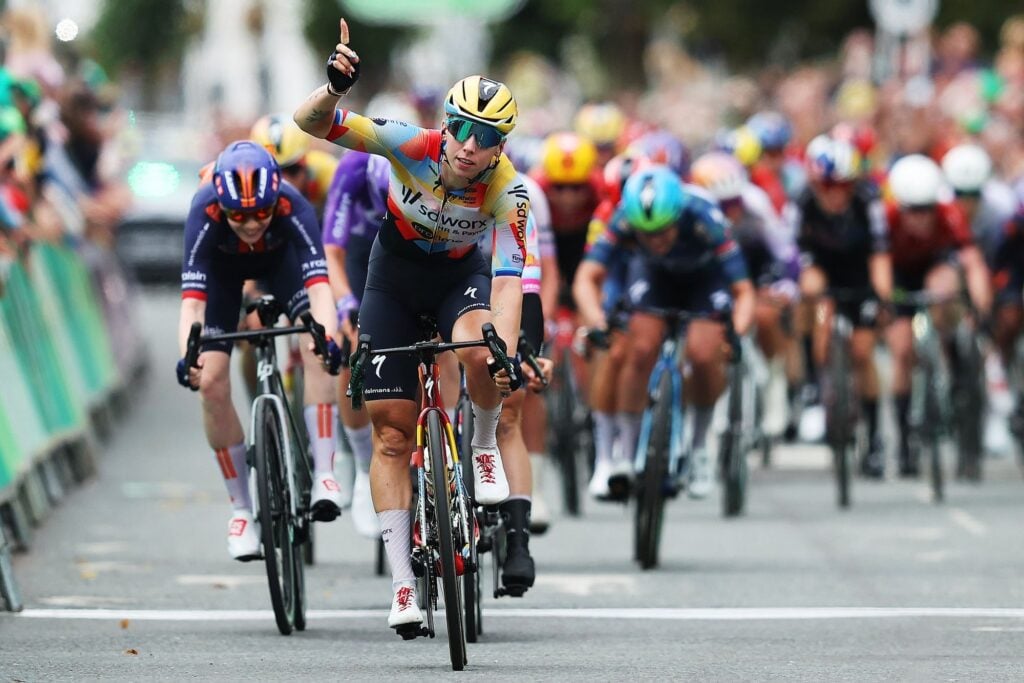 Photo Credit: Getty
What about Lorena Wiebes?
Lorena Wiebes is the biggest wildcard of the stage.
The opening day in Cockermouth showed how difficult she has become to remove.
Teams attacked repeatedly during the final part of Stage 1, several other sprinters were dropped, and yet Wiebes remained in the front group before winning comfortably.
The full Stage 1 race report showed why treating her as a rider who disappears whenever the road rises is increasingly unrealistic.
The Great Orme is still a completely different test.
There is no flat road afterwards on which SD Worx can bring her back.
Once a gap opens, it is a GC gap.
The 15% pitches are also much steeper than anything that mattered in the Cockermouth finale.
Wiebes does not necessarily need to stay with the very best climbers, however. If she can limit her loss to only a few seconds, her finishing speed and ability to collect bonuses elsewhere in the race remain major assets.
That makes her performance one of the most important things to watch on Friday.
If the main GC contenders cannot put meaningful time into Wiebes on the Great Orme, her overall chances become considerably more serious.
Zoe Bäckstedt has a better role than forcing a GC challenge
Zoe Bäckstedt should not be treated as Canyon SRAM’s default GC leader simply because of her reputation and home-road strength.
Her Tour of Britain opportunities are broader than that.
Bäckstedt lost ground on the opening stage while teammate Chiara Consonni survived with the front group, which already made protecting a conventional overall classification less attractive.
Friday gives her the opportunity to race more aggressively.
If she feels strong, Bäckstedt can attack before the Great Orme, try to anticipate the main GC fight or use her power on the rolling North Wales terrain.
That is a much more natural use of her strengths than simply sitting behind and trying to limit losses on a steep summit finish.
The full Tour of Britain Women start list shows Canyon SRAM’s wider options for the remaining three stages.
Why the short distance could make the race harder
At 104.7 kilometres, Stage 3 is the shortest road stage of the Tour of Britain Women.
That does not make it easy.
Short mountain and hilly stages frequently produce especially aggressive racing because teams have less incentive to conserve energy.
There is also relatively little time to repair mistakes.
If a rider is dropped with 40 kilometres remaining, there is not a long transitional section later in the stage where the race can settle and groups can reorganise.
The terrain keeps coming.
That creates an obvious incentive for teams with stronger climbers to begin increasing the pressure before Llandudno.
Waiting until the Great Orme risks reducing the entire GC stage to a two-and-a-half-kilometre uphill sprint.
Kopecky would probably welcome that.
Her rivals should not.
Marine Drive could be almost as important as the climb
The final approach around Marine Drive gives Stage 3 another tactical dimension.
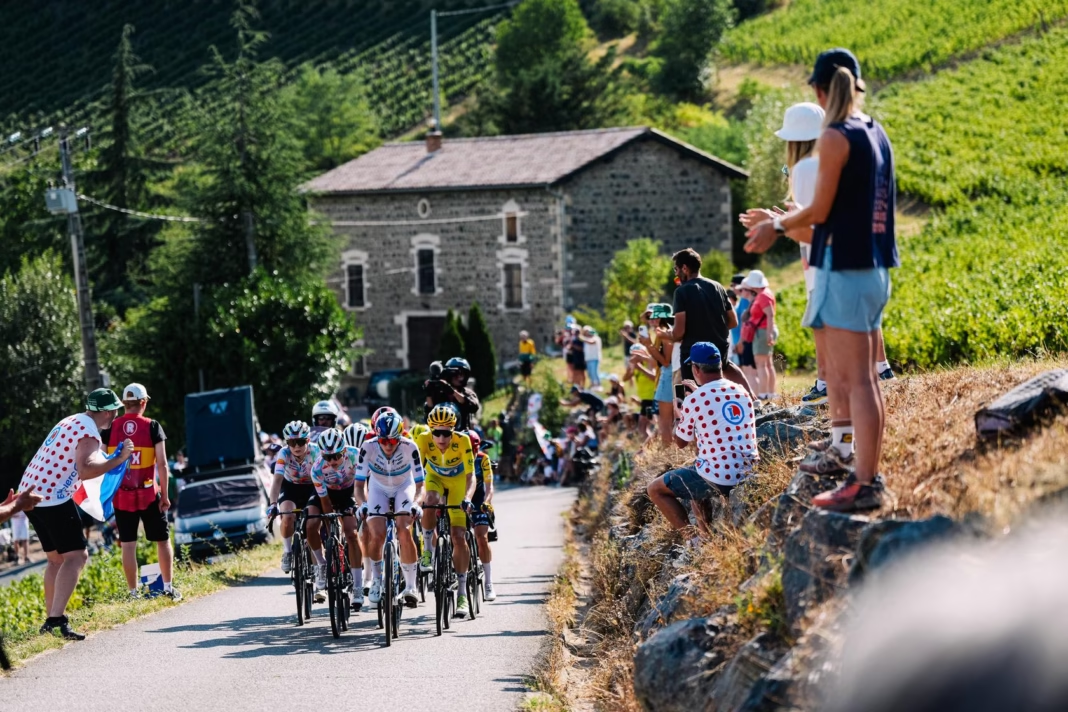
The riders circle the Great Orme before turning towards Saint Tudno’s Road, meaning positioning through that approach could decide who begins the climb with an advantage.
A rider entering the steep section 20 positions too far back may already be chasing before the attacks even begin.
That particularly matters because the climb is so short.
There is simply less distance available to recover from poor positioning.
Teams with GC ambitions therefore need to treat the approach as part of the climb rather than waiting for the gradient to increase.
Once the road pitches towards 15%, moving past riders becomes much more expensive.
-
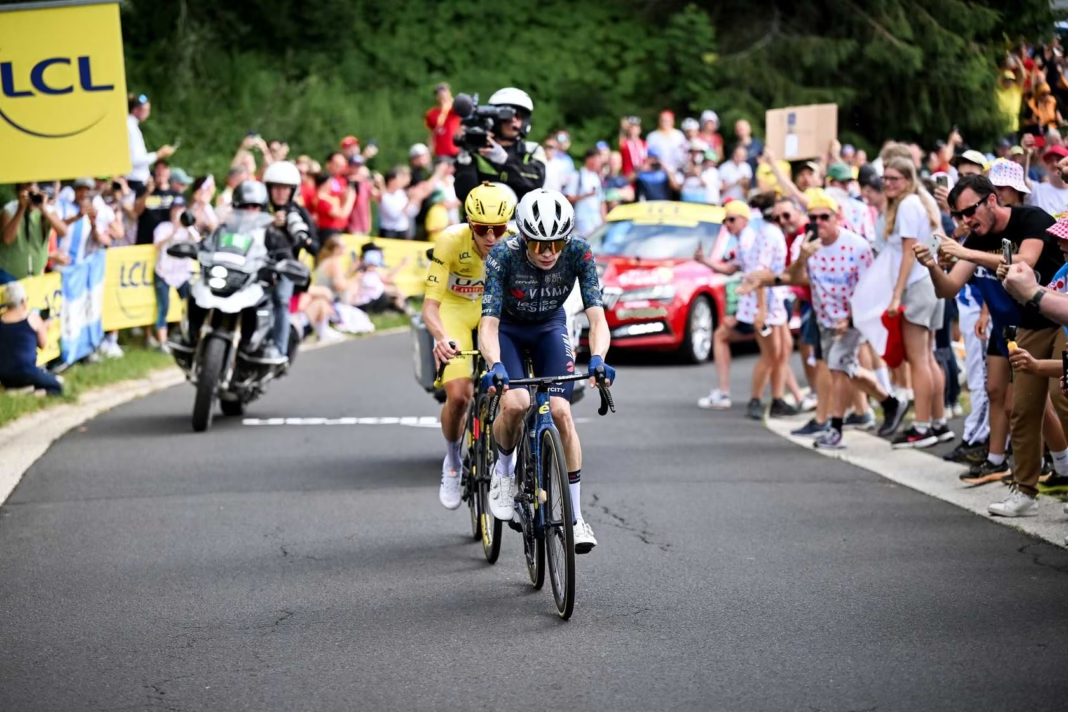
 Photo Credit: A.S.O./Billy Ceusters
Stage 4 means the Tour will not necessarily be decided here
The Great Orme is the first obvious GC stage, but it may not settle the race completely.
Saturday’s Stage 4 from Llanidloes to Hay-on-Wye contains even more climbing, with approximately 2,484 metres of ascent across 138 kilometres.
That day does not have the same summit finish, but it provides much more terrain for tactical attacks.
A rider taking green on the Great Orme still needs a strong team around them 24 hours later.
The Tour of Britain Women 2026 route guide explains why the combination of Stage 3 and Stage 4 rather than one single climb is likely to determine the overall winner.
Who wins Tour of Britain Women 2026 Stage 3?
Lotte Kopecky is the rider to beat.
The Great Orme is short enough for her explosiveness to matter, steep enough to create meaningful gaps and selective enough that the race should move away from the conventional sprinters.
Kim Le Court-Pienaar looks like the strongest direct alternative because she combines climbing ability with the finishing speed needed if a small group reaches the summit together.
Lauren Dickson is the major wildcard. Her pre-injury form would make her one of the strongest climbing options in the field, but Friday will reveal how close she is to that level after her collarbone fracture.
Ally Wollaston, Karlijn Swinkels, and Riejanne Markus form the next group of riders with realistic reasons to believe the Great Orme can move them towards the overall lead.
Then there is Wiebes.
The Tour of Britain Women Stage 2 preview identified Blackpool as the clearest opportunity for the sprint specialists. Friday is the opposite.
The question is no longer whether Wiebes can win the sprint.
It is whether anyone can put enough time into her when the road finally becomes steep enough to make sprint speed irrelevant.
Kopecky starts as the Stage 3 favourite, but the Great Orme should finally give the wider GC contenders the opportunity they have been waiting for.

