
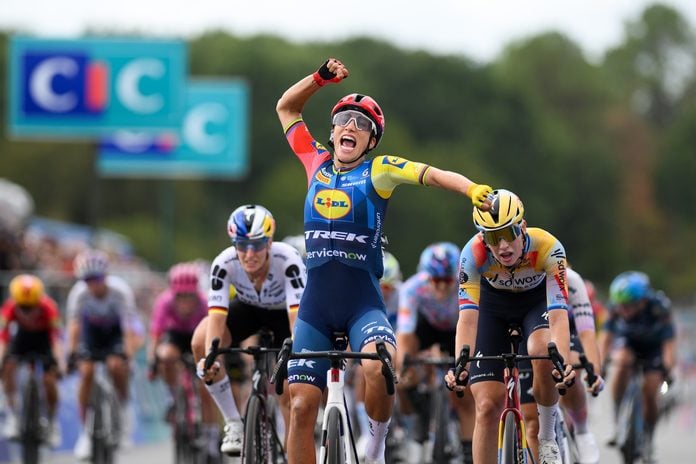
Elisa Balsamo winning the 2026 Classic Lorient Agglomération felt particularly appropriate for the 25th edition of the race’s modern history.
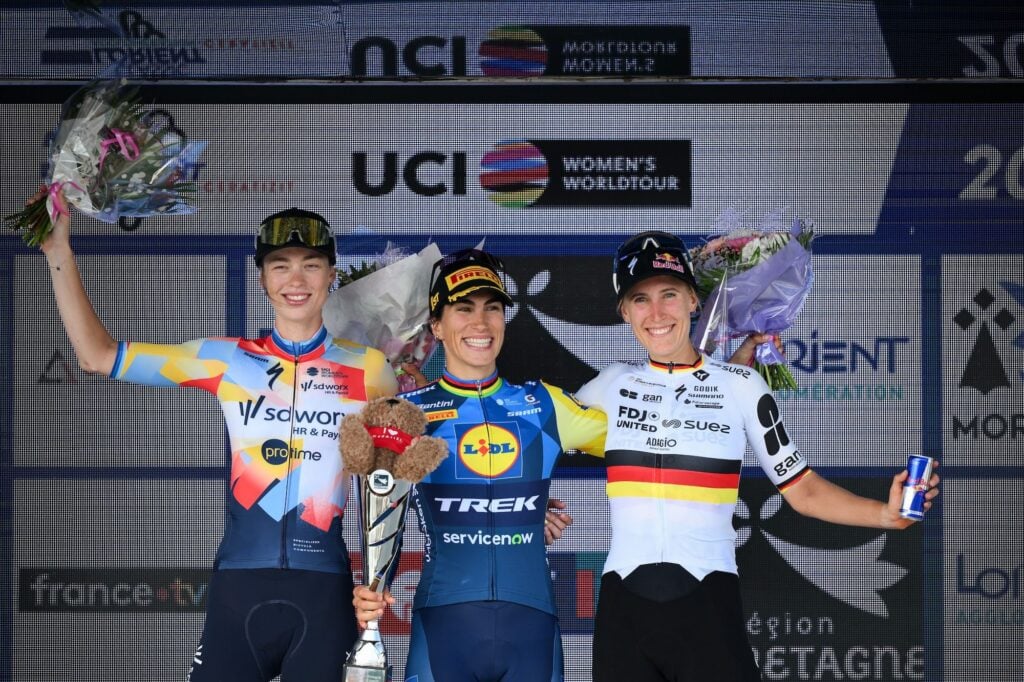
The Lidl-Trek rider beat three-time defending champion Mischa Bredewold in a reduced sprint after 172.6km of wet, attritional racing around Plouay, with Franziska Koch completing the podium. It gave Balsamo her first victory in the Breton WorldTour race while preventing Bredewold from becoming its first four-time winner.
Yet there was something familiar about the way the 2026 edition was decided. Almost 2,800 metres of climbing, repeated attacks and the return of the Côte de Ty Marrec had gradually removed riders and weakened teams without producing one decisive separation. The winner was ultimately the rider who could survive everything Plouay had demanded and still produce the strongest acceleration at the finish.
That combination links Balsamo directly with a history that stretches from Regina Schleicher and Nicole Cooke through Emma Pooley, Marianne Vos, Lizzie Deignan, Elisa Longo Borghini and Bredewold.
The names change. The fundamental problem posed by Plouay rarely does.
Twenty-five editions connect two very different eras of women’s cycling
The modern history of Classic Lorient Agglomération begins in 2002, when the women’s GP de Plouay became part of the UCI Women’s Road World Cup.
There is some earlier women’s racing associated with Plouay, including UCI historical references to victories before 2002, but the current race numbering starts with Regina Schleicher’s victory that year. That made Saturday’s race the 25th edition in the modern chronology.
Women’s professional cycling looked profoundly different in 2002.
The Women’s WorldTour did not exist, professional team structures were significantly smaller and the international calendar contained far fewer major women’s one-day races. Plouay nevertheless immediately had advantages that many emerging women’s events lacked: an established cycling venue, a difficult course and a place within the leading season-long competition.
Schleicher won that first edition ahead of Petra Rossner and Susanne Ljungskog. Nicole Cooke followed in 2003.
By 2026, the same event sits within a Women’s WorldTour characterised by deeper teams, larger support staffs, increasingly specialised preparation and considerably greater competition for places at the front of major races.
That longevity gives Plouay something increasingly valuable.
There are not many Women’s WorldTour races where a contemporary winner can place her name directly onto a roll of honour spanning several distinct generations of professional women’s cycling.
Balsamo now can.
Balsamo is another very Plouay-style winner
There has never been one simple template for winning in Plouay.
Emma Pooley won consecutive editions in 2009 and 2010 as one of the finest climbers and time-triallists of her generation. Elisa Longo Borghini attacked her way to a solo victory in 2021. Mavi García turned the 2022 edition into a two-rider contest with Amber Kraak.
At the opposite end of the tactical spectrum, Marianne Vos won in 2012 and 2013 because she could survive the climbing while retaining one of the strongest finishes in the sport. Bredewold has repeatedly exploited a similar balance between endurance, positioning and speed.
Balsamo belongs somewhere between those categories.
She is fundamentally a sprinter, and one of the quickest riders in the women’s peloton, but describing her simply as a bunch finisher understates why she was capable of winning in Plouay.
The 2026 Classic Lorient Agglomération route contained far too much climbing for a conventional pure sprinter to treat the afternoon as a matter of surviving until the final kilometre.
Ty Marrec’s return to the decisive circuit gave attackers a clear opportunity to make the race more selective. The constant succession of smaller ascents and changes of rhythm had already been taking energy from the bunch for several hours.
When Maëva Squiban attacked with around 12.5km remaining and Célia Gery and Eleonora Gasparrini subsequently tried to use Ty Marrec, Lidl-Trek had to respond rather than simply protect Balsamo behind a conventional lead-out.
The Italian first had to earn the right to sprint.
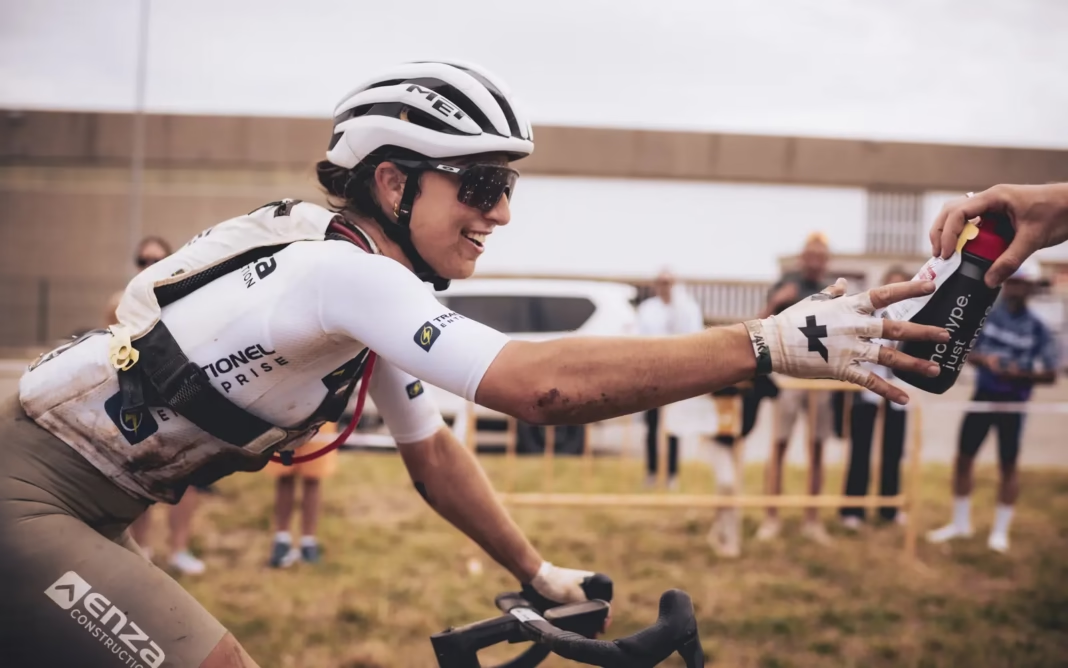
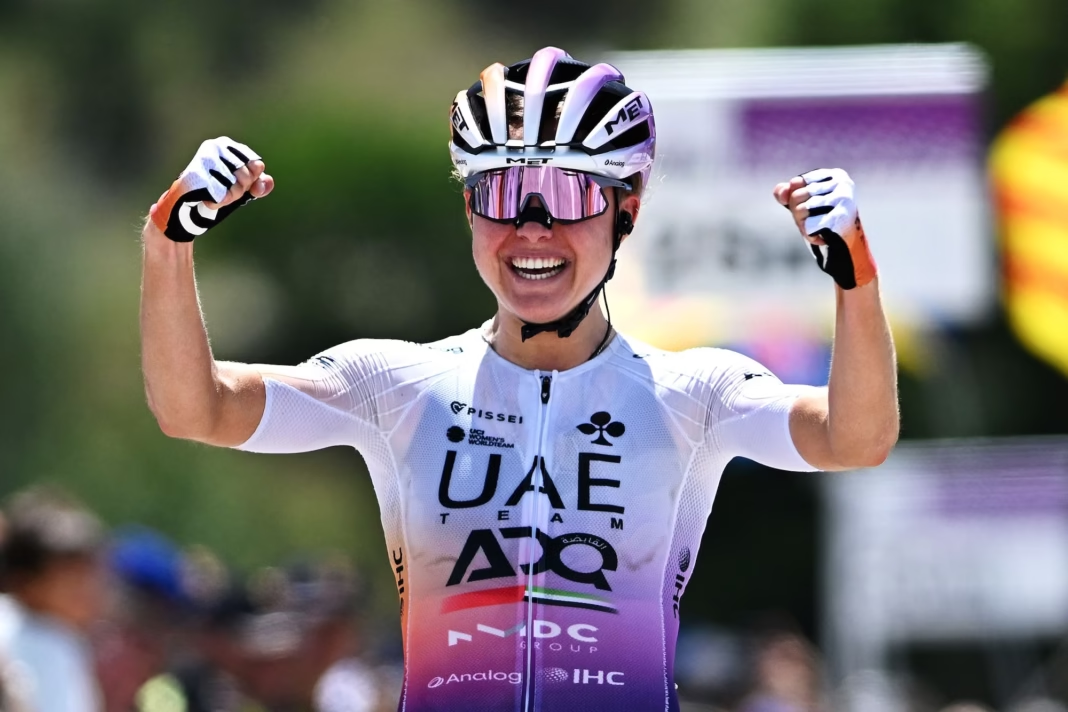
Only after those moves had been controlled could her biggest weapon become decisive. Bredewold launched early, but Balsamo used her slipstream before coming through in the closing metres to take the victory.
The full 2026 Classic Lorient Agglomération race report showed how many different phases Lidl-Trek had to negotiate before the sprint became possible.
That places Balsamo firmly within one of Plouay’s oldest traditions.
Cooke possessed the same broad combination. Vos did too. Lizzie Deignan could attack or sprint. Anna van der Breggen possessed the endurance to absorb the accumulation of climbing while still having enough explosiveness to settle a race late.
Plouay often rewards the rider who retains the greatest number of options after everyone has been made tired.
Balsamo’s victory fits that description almost perfectly.

Bredewold’s three-year winning streak now stands alone
The other major historical story of the 2026 edition belongs to the rider who finished second.
Bredewold entered the race having won in 2023, 2024 and 2025. Nobody else in the modern history of the event had won three consecutive editions.
Noemi Cantele won twice, in 2005 and 2007. Pooley successfully defended her title in 2010. Vos won back-to-back editions in 2012 and 2013. Deignan accumulated three victories, but they were spread across 2015, 2017 and 2020.
Bredewold compressed three wins into three seasons.
Her 2025 victory had moved her level with Deignan as the most successful rider in the modern race, giving the 2026 edition an unusually clear historical subplot. Another win would have taken Bredewold to four victories and made her the first rider to win four successive editions.
She came remarkably close.
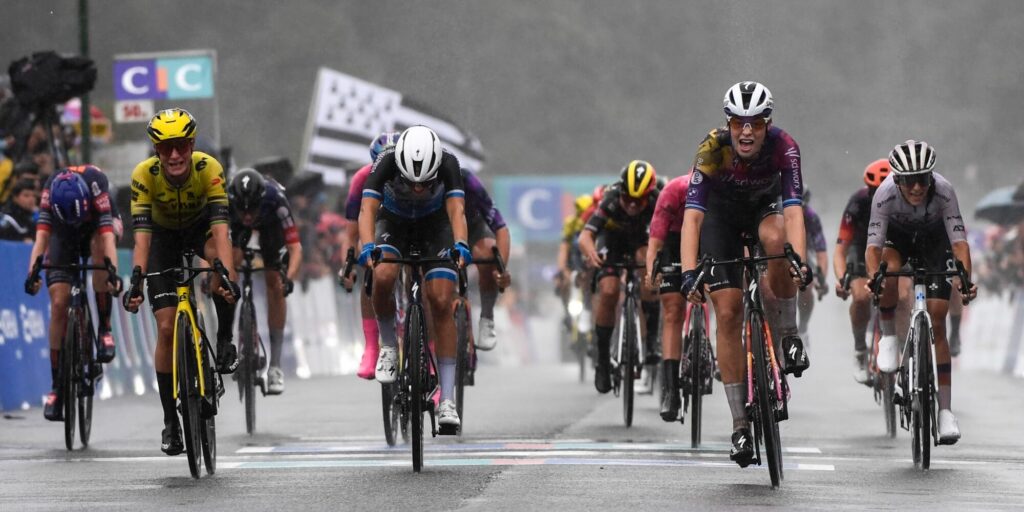
SD Worx-Protime lost several riders during a difficult afternoon, leaving Bredewold with considerably less support than the defending champion might have expected. She still responded to late moves, helped keep the race within reach and then committed early in the sprint.
For a moment, a fourth victory looked possible.
Balsamo finally came around her before the line.
That defeat does little to reduce what Bredewold achieved between 2023 and 2025. If anything, the 2026 race reinforced just how difficult winning repeatedly in Plouay can be.
Routes change. Weather changes. Team situations change. Some editions become highly tactical contests between small groups. Others repeatedly threaten to break apart before eventually regrouping.
Bredewold solved those different versions three years running.
Her sequence is over, but it has become one of the defining periods in the race’s history.
Balsamo continues Italy’s long relationship with Plouay
Italian riders have been prominent in the race almost from the beginning of its modern era.
Noemi Cantele became its first multiple winner with victories in 2005 and 2007. Fabiana Luperini won in 2008, while Longo Borghini added another Italian success with her solo attack in 2021.
Balsamo therefore becomes the fourth different Italian winner since 2002 and gives Italy a fifth victory in the modern race.
The contrast between those riders illustrates just how broad the Plouay winning profile can be.
Luperini was one of the outstanding climbers of her generation. Longo Borghini’s success was built around aggression and endurance. Cantele combined strong climbing with enough speed to make reduced finishes dangerous.
Balsamo arrives at the same answer from the opposite direction.
Her greatest weapon has always been her sprint, but the development of her ability to carry that speed across increasingly demanding courses has progressively widened the range of races she can win.
Plouay exposes exactly that quality.
A rider does not necessarily need to be the strongest climber in the race or the fastest sprinter in isolation. She needs to retain enough of both after four difficult hours for either weapon still to matter.
Balsamo did.
Ty Marrec gave the anniversary edition an older Plouay character
The route itself also strengthened the connection between 2026 and earlier editions.
Classic Lorient Agglomération has gradually expanded beyond the repetitive circuit racing that once defined much of the event. Longer loops through the surrounding Lorient Agglomération have created greater tactical variety and allowed breakaways to develop long before the race reaches the familiar finishing roads around Plouay.
The evolution has made the event less repetitive without removing the climbs that give it its identity.
The Côte de Ty Marrec is among the roads most closely associated with major cycling around Plouay, and its return for 2026 gave the final circuit a more obvious attacking point.
It did not ultimately produce the winning move.
That does not mean it failed to decide the race.
Gery and Gasparrini attacked around Ty Marrec, forcing Lidl-Trek and the remaining chasing teams to commit further resources. The climb also arrived after several hours of repeated efforts, making it another opportunity to remove riders who had already reached their limit.
That is historically how many Plouay climbs have worked.
The significance of the final ascent is not always that somebody attacks and stays away. Sometimes it comes from what the climb removes from the riders who still reach the Boulevard des Championnats du Monde.
Balsamo reaching the sprint after surviving that process makes her victory more significant than simply describing it as a bunch finish.
Only a heavily reduced field remained capable of contesting the result.
The race connects the Women’s World Cup with the modern WorldTour
The anniversary also underlines how much women’s professional cycling has changed around Plouay while the race itself has survived.
From 2002 through 2015, it formed part of the UCI Women’s Road World Cup, the leading season-long one-day competition of that era.
Deignan won the final World Cup edition in 2015.
When the Women’s WorldTour replaced it in 2016, Plouay moved directly into the new competition, with Eugenia Bujak winning the first WorldTour edition.
The race has remained at the highest international level since.
That makes its winners list unusually useful when looking at the development of women’s professional racing.
Cooke and Pooley competed during an era when the sport operated with substantially fewer resources and less television exposure. Vos became the defining rider through another period of rapid development. Deignan’s three victories stretched from the final World Cup years into the expanding WorldTour.
Bredewold’s winning sequence has taken place in an era of deeper rosters and increasingly sophisticated tactical and performance structures.
Balsamo’s victory belongs to the latest stage of that progression.
The race name has changed repeatedly during that period. GP de Plouay became GP de Plouay-Bretagne, passed through several Lorient Agglomération and sponsor combinations and eventually developed into the Classic Lorient Agglomération identity used today.
Historically, though, it remains one event.
That means Cooke winning the GP de Plouay in 2003 and Balsamo winning Classic Lorient Agglomération in 2026 belong on the same line of development.
-
 Photo Credit: quentinphotographiebe
 -
 Photo Credit: Getty
The 2026 race preserved Plouay’s greatest strength
Twenty-five modern editions have established a recognisable identity without producing a predictable formula.
That may be Plouay’s greatest strength.
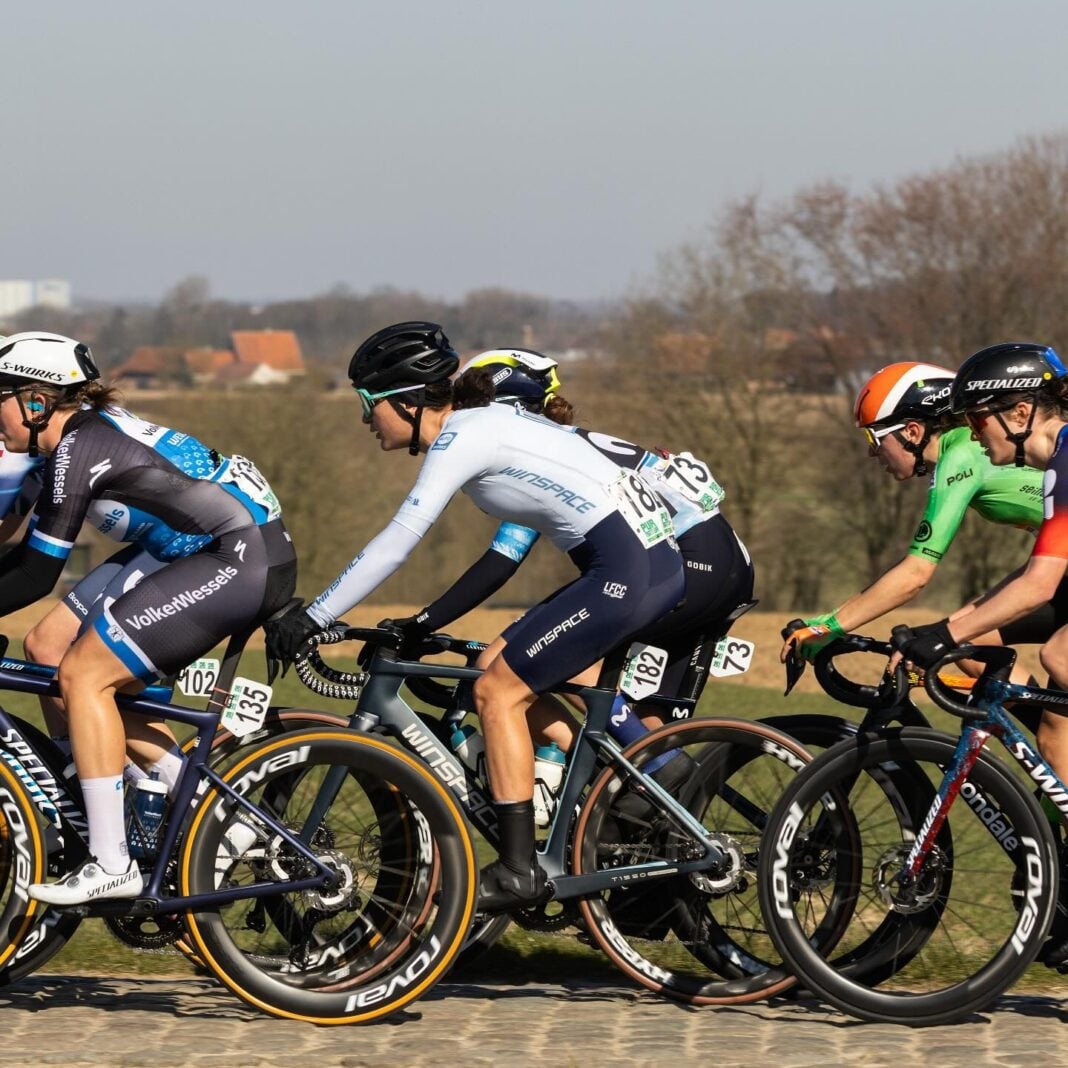
A climber can win. A Classics specialist can win. A long-range attacker can win. A resilient sprinter can win.
Sometimes two riders reach the finish. Sometimes a small group survives. Occasionally a substantially larger reduced peloton comes back together.
The terrain continually threatens selection without guaranteeing exactly where that selection will happen.
In 2026, the early breakaway altered the workload in the peloton. Cédrine Kerbaol helped accelerate the catch. Squiban attacked. Gery and Gasparrini tried again around Ty Marrec. Bredewold repeatedly covered the danger. Lidl-Trek eventually restored enough control for Balsamo to use her sprint.
The fastest rider left ultimately won, but only after the race had spent several hours determining who could still be considered a fast rider at all.
That distinction is central to Plouay.
It would be easy to see the late attacks failing and conclude that the race simply returned to a sprint. Its history suggests the opposite. The attacks, repeated climbs and accumulated fatigue create the conditions for the sprint that eventually occurs.
They decide which sprinters are still there, how many teammates remain to help them and how much acceleration they have left.
Balsamo survived all of those tests before producing the fastest finish.
Her victory also provided one of the final major European form checks of the season, with the wider significance of the 2026 Classic Lorient Agglomération result stretching towards the World Championships and the closing races of the year.
For the race itself, though, the 25th modern edition offered something more enduring.
Bredewold’s attempt at an unprecedented fourth victory supplied the historical storyline. Ty Marrec restored one of Plouay’s traditional landmarks to the decisive finale. Balsamo became the latest Italian to join a winners list populated by world champions and defining riders from several generations.
Twenty-five editions after Schleicher opened the modern chronology in 2002, the fundamental requirement had barely changed.
First survive Plouay. Then prove you still have something left.

