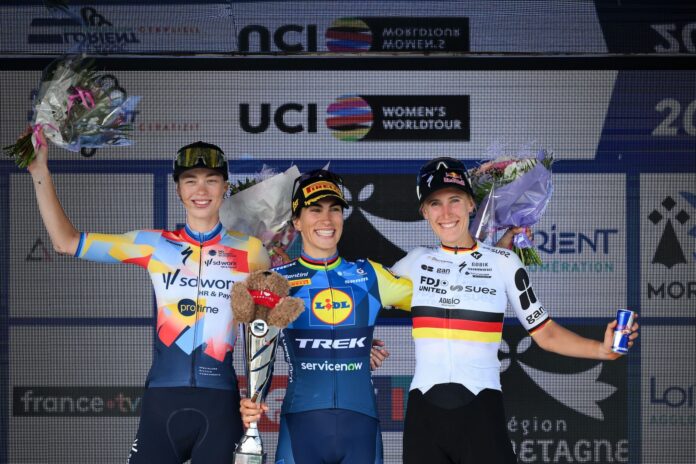
Elisa Balsamo won the 2026 Classic Lorient Agglomération, beating three-time defending champion Mischa Bredewold in a reduced sprint in Plouay.
The Lidl-Trek rider came through in the final metres on the Boulevard des Championnats du Monde, denying Bredewold a fourth consecutive victory in the Brittany Women’s WorldTour race. Franziska Koch finished third for FDJ United-Suez, with Eleonora Camilla Gasparrini fourth for UAE Team L’IMAD and Soraya Paladin fifth for Canyon SRAM.
Balsamo’s victory came after a controlled but demanding race, with an early seven-rider breakaway, rain in the closing phase, repeated attacks on the final circuit and Lidl-Trek taking responsibility when the race threatened to slip away. It was Balsamo’s first win at the race, formerly known as the GP de Plouay, and another major one-day victory for a rider whose 2026 season has already been built around a strong sprinting return.
A familiar Plouay test with a new winner
The Classic Lorient Agglomération again used the roads around Plouay, with a hilly 172.6-kilometre route that looked open enough for attacks but still within reach for the strongest sprinters.
The race was not mountainous, but it was never flat. The repeated Breton rises, the finishing circuit and the late Côte de Ty Marrec all gave the puncheurs and Classics riders a chance to disrupt the sprint scenario. That was always the tension of the day: could the attackers isolate Balsamo and Bredewold, or would the race come back together for a reduced finish?
Bredewold arrived as the rider with the clearest recent history at the race. She had won the previous three editions and knew exactly how to handle the Plouay finale. Balsamo, by contrast, had often looked like a natural fit for the race without previously converting it into victory.
This time, the final sprint finally turned the race her way.
Henderson gives Lidl-Trek early cover
The early breakaway gave Lidl-Trek the first important tactical advantage.
Anna Henderson made the move for the team, joining Sara Martín, Anouska Koster, Cristina Tonetti, Natalie Quinn, Sophie von Berswordt and Clémence Latimier in the day’s main escape. The group built a substantial gap, at one point reaching close to seven minutes, and that allowed Lidl-Trek to avoid chasing through the middle of the race.
That mattered. With Balsamo as one of the obvious sprint favourites, Lidl-Trek could easily have been forced into a long day of control. Instead, Henderson’s presence up front meant the pressure shifted elsewhere. Other teams had to decide how much they wanted a sprint, how much they feared the break, and how much energy they were willing to spend before the final circuit.
The escape was never guaranteed to survive, but it gave the race a proper structure. It also gave Balsamo’s team a route into the finale without burning too many riders too early.
Breakaway reaches the final circuit
The breakaway still had a meaningful advantage as the race moved towards the decisive final phase.
With around 55 kilometres remaining, the group had been reduced to six riders but still held roughly three and a half minutes. That made the move dangerous enough for the peloton to take seriously, especially on a course where the final circuit could create hesitation behind.
The weather then added another layer. Rain began to fall inside the final 30 kilometres, and the gap came down rapidly. What had looked like a controlled pursuit became a more nervous chase as the roads became slicker and the finishing laps began to bite.
By then, the race was beginning to change from a breakaway chase into a Classics-style elimination. The gap was closing, the peloton was shrinking and the teams with riders for the final were moving up.
Lidl-Trek still had options in both halves of the race. Henderson had served her purpose up the road, while Balsamo remained protected behind.
Kerbaol helps bring the race back
Cédrine Kerbaol was one of the riders who helped bring the breakaway’s day to an end.
With just over 20 kilometres remaining, the EF Education-Oatly rider accelerated from the bunch and helped close the final gap to the leaders. It was a move that suited the shape of the race. Kerbaol had reason to make the race harder, and the peloton needed riders willing to bridge rather than simply wait.
The effect was immediate. The remaining escapees were brought back, but the bunch was no longer complete. The main group had been reduced to around 60 riders, and the race entered the final 16-kilometre lap with enough strength at the front to keep attacking.
Koch was among the next riders to try, launching a counter-attack after the catch. She could not get away, but the move showed how much pressure was building before the last lap.
The race had not become a sprint yet. It was still being contested through attacks.
Squiban opens the late attacks
Maëva Squiban made the most dangerous first move of the closing kilometres.
The UAE Team L’IMAD rider attacked with around 12.5 kilometres remaining and opened a gap of around 15 seconds before the Côte de Ty Marrec. It was the kind of attack that can be difficult to manage in Plouay: late enough to create real pressure, strong enough to force the bunch to chase, but early enough that teams behind still had to decide whether to commit.
For UAE Team L’IMAD, it was also a logical move. They had Gasparrini as a fast finisher and Karlijn Swinkels in the group, so Squiban’s attack forced others to work while keeping the team’s sprint options alive.
Squiban was eventually caught on the climb, but she had changed the rhythm of the finale. The bunch could no longer ride steadily towards a sprint. The strongest teams had to respond quickly, and every acceleration made the reduced group more selective.
Gery and Gasparrini go on Ty Marrec
The next move came on the Côte de Ty Marrec, where Célia Gery and Gasparrini attacked.
That was the final major attempt to stop the sprint. Gery had the punch to make the climb count, while Gasparrini gave UAE Team L’IMAD another aggressive card after Squiban’s move. For a moment, the race looked as though it might tilt away from the sprinters.
Lidl-Trek did not allow that to happen. Niamh Fisher-Black and Fleur Moors were central to the chase, bringing the move back inside the final 5 kilometres and putting Balsamo back into a winning position.
That chase was one of the decisive pieces of teamwork in the race. It was not enough simply for Balsamo to survive the climb. She needed teammates able to close the late moves and still guide the final kilometres. Lidl-Trek had them.
Once Gery and Gasparrini were caught, the race finally pointed towards a reduced sprint.
Lidl-Trek take over before the sprint
Lidl-Trek controlled the final kilometres with purpose.
After Henderson had given them early cover and Fisher-Black and Moors had helped shut down the last attacks, Margot Vanpachtenbeke took responsibility in the sprint build-up. The team had kept Balsamo in the race through every phase, and now the job was to deliver her into position without letting Bredewold launch from too far ahead.
That was not simple. Bredewold is not a pure sprinter in the Balsamo mould, but her repeated success in Plouay has been built on exactly this sort of finish: a reduced group, fatigue in the legs, and a long acceleration that makes others hesitate.
The Dutch rider opened early and immediately looked dangerous. She created a gap, forcing Balsamo to chase rather than simply come off the wheel in the final 100 metres.
For a few seconds, it looked like Bredewold might be about to win this race again.
Balsamo comes past in the final metres
Balsamo did not panic.
Bredewold’s early sprint put her under pressure, but the Italian stayed committed and kept driving through the final metres. The finish in Plouay rises just enough to punish a rider who goes too early, and Balsamo later explained that she knew the final 50 metres would still be demanding.
That proved correct. Bredewold had opened the sprint well, but Balsamo closed the gap, came out of the slipstream and found one more acceleration before the line.
The margin was not large, but it was decisive. Balsamo passed Bredewold in the final metres and took the victory in 4:30:49.
It was a classic reduced sprint win, but it had been built on much more than finishing speed. Balsamo had survived the climbs, trusted her team, stayed calm after Bredewold’s early launch and timed her final surge better than the rider who had dominated this race for three years.
Bredewold denied fourth straight win
Bredewold’s second place was still a strong defence of her Plouay record.
The SD Worx-Protime rider again showed why this race suits her. She survived the attacks, stayed in the right group and had the confidence to open the sprint early. Against many riders, that would have been enough.
Balsamo was simply faster in the last metres.
That denied Bredewold what would have been a fourth consecutive victory at the Classic Lorient Agglomération, a remarkable run in any Women’s WorldTour one-day race. Instead, her sequence ends with another podium and another reminder that she remains one of the reference riders on this course.
There was no tactical failure from Bredewold. She did what she has done so often here. This time, Balsamo had the legs to come around.
Koch completes the podium
Koch took third for FDJ United-Suez, finishing off a strong race from a team that had repeatedly tried to influence the finale.
Gery had attacked on Ty Marrec and forced the sprint teams to respond, while Koch was still present in the reduced group and quick enough to finish on the podium. That gave FDJ United-Suez a visible return from an aggressive final circuit, even if the team could not turn its attacks into the winning move.
Gasparrini finished fourth after also going on the attack in the finale, a strong result given how much UAE Team L’IMAD had invested in trying to split the race. Paladin was fifth for Canyon SRAM, ahead of Paula Ostiz for Movistar.
Eleonora Ciabocco finished seventh for Team Picnic PostNL, with Gery eighth after her late move. Noemi Rüegg took ninth for EF Education-Oatly, while Letizia Borghesi completed the top 10 for AG Insurance-Soudal.
The result reflected the nature of the race. It was a sprint, but not a full bunch sprint. The riders at the front were those who could handle the hills, the wet roads, the attacks and the pressure of the final circuit.
First Plouay win for Balsamo
For Balsamo, this was a significant addition to her palmarès.
She had started the race five times before without winning it, but Plouay had already been an important place in her career. Six years and three days before this victory, she had won the under-23 European title on the same roads. This time, she returned as a former world champion and converted that connection into a Women’s WorldTour one-day win.
It was also her first professional victory in France and the seventh WorldTour Classic victory of her career.
That matters because Balsamo’s strongest days are often framed through sprint dominance, particularly stage-race sprints. Plouay is different. The repeated climbs, selective laps and late attacks mean the winner has to be durable before they can be fast.
Balsamo was both.
A team victory as much as a sprint win
Balsamo’s win was also a complete Lidl-Trek performance.
Henderson got into the breakaway and removed the need for the team to chase early. Fisher-Black and Moors helped control the most dangerous late attacks. Vanpachtenbeke played a key role in setting up the sprint. Balsamo then finished the work.
That sequence is what made the victory convincing. Lidl-Trek were present at every important stage of the race, not only in the final kilometre. They had a rider up the road when the breakaway mattered, strength on the climbs when the attacks began, and enough structure left to position Balsamo for the sprint.
Balsamo gave the win its headline, but the race had already been shaped by her team before she launched.
That is often what separates a difficult one-day sprint from a simple fast finish. Lidl-Trek never allowed the race to drift out of reach.
Plouay rewards the strongest finisher
The 2026 Classic Lorient Agglomération again showed why Plouay remains one of the most reliable late-season tests in the Women’s WorldTour.
The route encouraged a long breakaway, then punished it on the final circuit. The climbs gave Squiban, Gery, Gasparrini and others room to attack, but the finish still kept a reduced sprint alive. Bredewold almost used her knowledge of the race to win again, only for Balsamo to time the sprint better in the final metres.
It was not a race decided by one obvious moment. Henderson’s break mattered. Kerbaol’s acceleration mattered. Squiban’s attack mattered. Gery and Gasparrini’s move mattered. Lidl-Trek’s chase mattered. Bredewold’s early sprint mattered.
Balsamo won because she and her team handled every one of those moments, then had the fastest finish left at the end.
Classic Lorient Agglomération 2026 result
| Position | Rider | Team | Time/gap |
|---|---|---|---|
| 1 | Elisa Balsamo | Lidl-Trek | 4:30:49 |
| 2 | Mischa Bredewold | Team SD Worx-Protime | same time |
| 3 | Franziska Koch | FDJ United-SUEZ | same time |
| 4 | Eleonora Camilla Gasparrini | UAE Team L’IMAD | same time |
| 5 | Soraya Paladin | Canyon SRAM zondacrypto | same time |
| 6 | Paula Ostiz | Movistar Team | same time |
| 7 | Eleonora Ciabocco | Team Picnic PostNL | same time |
| 8 | Célia Gery | FDJ United-SUEZ | same time |
| 9 | Noemi Rüegg | EF Education-Oatly | same time |
| 10 | Letizia Borghesi | AG Insurance-Soudal Team | same time |
Main photo credit: Getty