
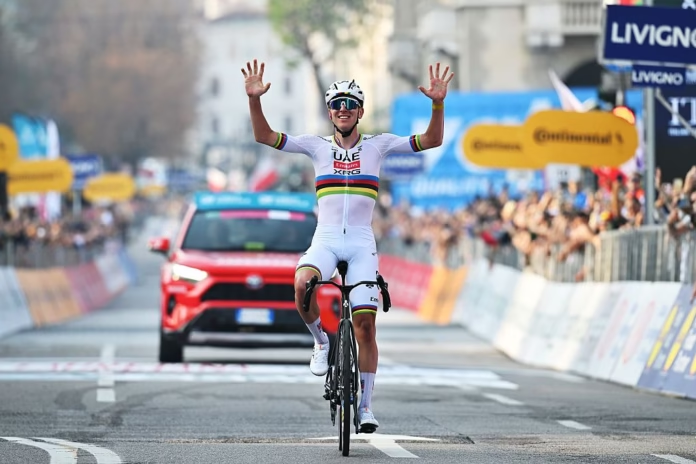
Il Lombardia is cycling’s great autumn Classic, a race shaped by the lakes, climbs and descending roads of northern Italy and by more than 120 years of history. First held in 1905, it has developed into the fifth and final Monument of the men’s road season, sitting alongside Milano-Sanremo, the Tour of Flanders, Paris-Roubaix and Liège-Bastogne-Liège.
Its place at the end of the European calendar has always been part of its identity. The race became known as the Race of the Falling Leaves, while for decades it carried another unofficial title, the Autumn World Championship. By the time riders reached Lombardia, much of the season had already been decided. Winning required enough form, motivation and endurance to produce one more major performance.
The route has changed continually. Milan, Como, Monza, Lecco and Bergamo have all played important roles, while the Madonna del Ghisallo and Muro di Sormano have become part of cycling folklore. What has remained consistent is the type of challenge. Il Lombardia asks climbers and attacking riders to survive a long, difficult race before making decisions on roads where both the climbs and descents can decide the result.
For the current event rather than its history, ProCyclingUK’s beginner’s guide to Il Lombardia 2026 covers how the race works, what makes it different from the other Monuments and what to look for when the latest route is announced.
How Il Lombardia began in 1905
The first Giro di Lombardia was held on 12 November 1905.
The race emerged from a dispute in another event. Pierino Albini had been beaten by Giovanni Cuniolo in the Coppa del Re at Milan’s Trotter Velodrome, and a new race was organised to provide an opportunity for a rematch.
Neither rider won.
Giovanni Gerbi took the inaugural edition instead, finishing around 40 minutes ahead of Giovanni Rossignoli. It was an enormous margin but also a sign of what road racing looked like in cycling’s early years, when poor surfaces, mechanical problems and much smaller fields could spread riders across huge distances.
The race quickly developed beyond the circumstances of its creation. La Gazzetta dello Sport became its organiser in 1907 and Lombardia established itself as one of the major fixtures closing the Italian racing season.
Its continuity was unusual. The race continued through the First World War and was only interrupted in 1943 and 1944 during the Second World War.
By then, it had already become far more than another Italian one-day race.
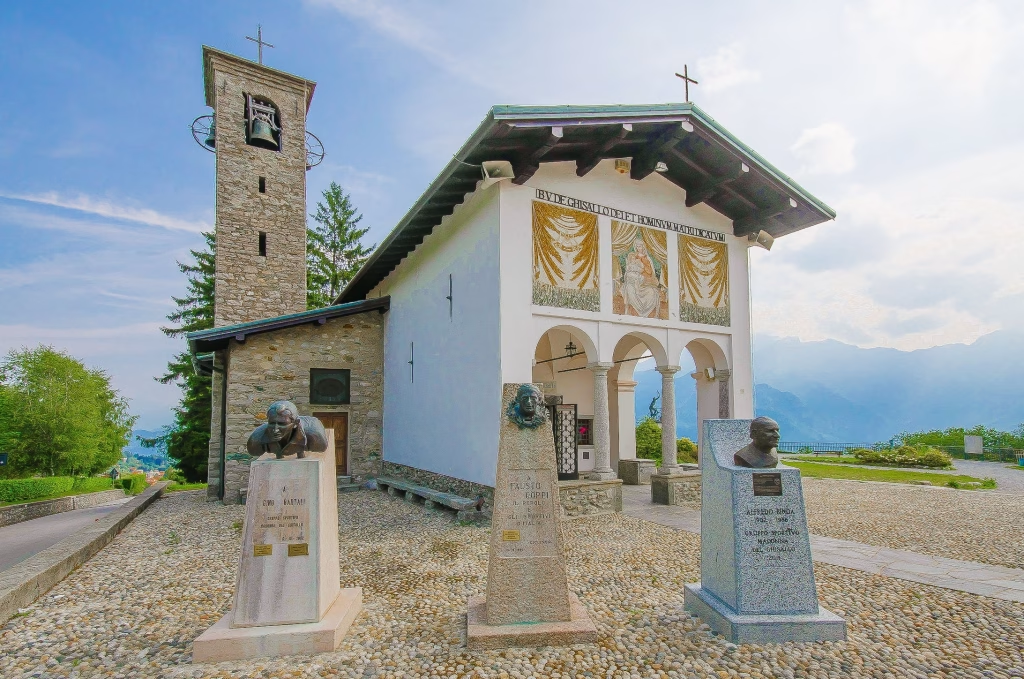
The Madonna del Ghisallo becomes part of the race
One of the most important changes came in 1919 with the introduction of the climb to the Madonna del Ghisallo.
The road rises from Bellagio above Lake Como towards the small sanctuary at the summit. The church later became closely associated with cycling and the Madonna del Ghisallo was declared the patroness of cyclists.
That relationship turned the climb into something larger than a difficult piece of road.
The Ghisallo has not appeared in exactly the same position or direction every year, and some editions have reduced its importance by placing harder climbs elsewhere. Yet it remains the landmark most closely associated with Il Lombardia.
For generations of riders, reaching the sanctuary has meant entering one of the most recognisable parts of the Italian Classics season.
It also helped shape Lombardia’s eventual identity as the Monument for climbers.
Binda, Bartali and the early Italian champions
Italian riders dominated much of the early history.
Costante Girardengo won three times between 1919 and 1922, before Alfredo Binda began an even more successful run. Binda won four editions in 1925, 1926, 1927 and 1931.
His 1926 victory became particularly famous.
The weather was miserable, the roads were difficult and Binda finished almost half an hour ahead of Antonio Negrini after more than 250 kilometres. The story most associated with the day is his extraordinary pre-race breakfast, when he reportedly ate 28 eggs.
Whether viewed through modern sports nutrition or simply common sense, it was a very different era.
Gino Bartali followed with victories in 1936, 1939 and 1940. He would eventually finish on the Lombardia podium nine times, a record which still shows how consistently one of Italy’s greatest riders performed in the race.
Those decades established a pattern which lasted for much of the 20th century. Lombardia was an international Classic, but its history was deeply connected to Italian cycling and its greatest champions.
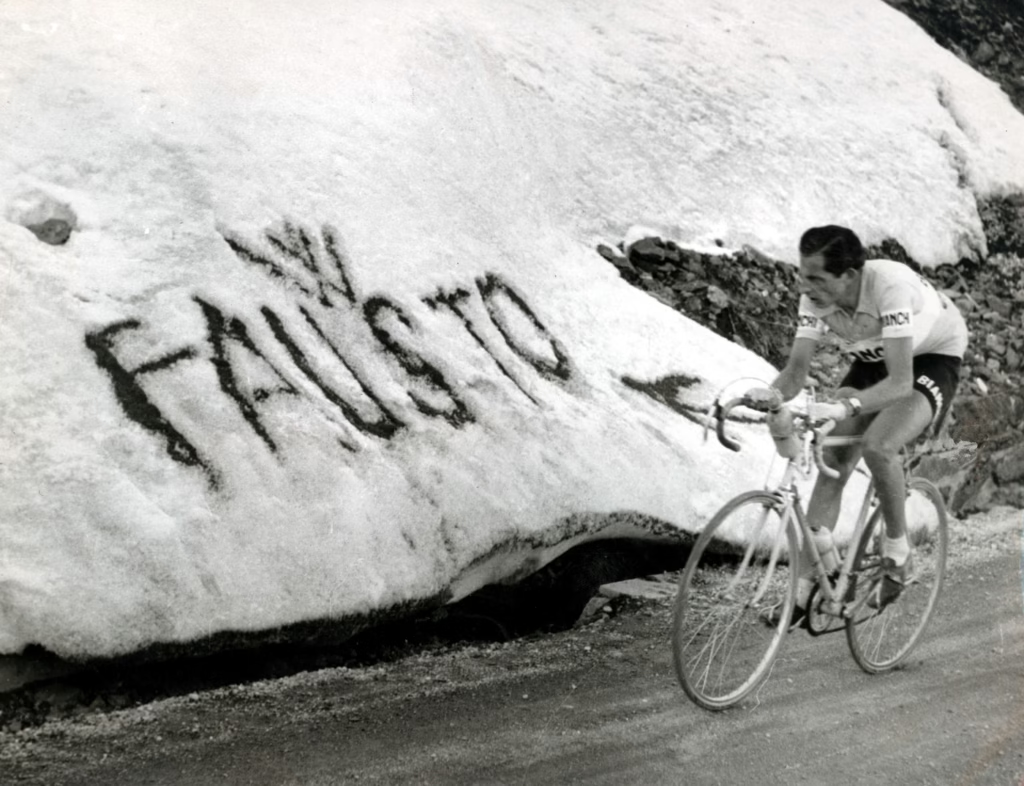
Fausto Coppi creates the first great Lombardia record
No rider shaped the race more profoundly than Fausto Coppi.
Coppi won four consecutive editions between 1946 and 1949 before returning to claim a fifth victory in 1954.
For more than 70 years, those five wins stood alone as the race record.
The manner of the victories helped build the reputation as much as the number.
Coppi won his first Lombardia in 1946 after attacking in Milan and riding alone to the Vigorelli Velodrome. A year later he dropped Fiorenzo Magni at Valbrona and completed almost 60 kilometres on his own.
In 1948, he attacked even further from the finish, going clear with more than 80 kilometres remaining after making the difference on the Ghisallo. Another long solo followed in 1949.
Those performances fitted perfectly with the mythology around Coppi. This was not simply a rider collecting victories through superior finishing speed. He repeatedly dismantled the race from distance.
The fifth win in 1954 came differently. Coppi was 35 and no longer the overwhelming force of the immediate post-war years, but he still found a way to beat Magni in the sprint.
The five victories became one of the longest-standing records attached to any Monument.
The Muro di Sormano changes the difficulty
If the Ghisallo gave Lombardia its most enduring symbol, the Muro di Sormano gave it one of its most extreme roads.
The climb first appeared around the beginning of the 1960s and immediately became infamous.
The Muro itself is only around 1.7 kilometres long, but its gradients reach roughly 27%. Riders in the early editions were sometimes forced from their bikes and had to walk on the steepest sections.
It was an extraordinary challenge to place near the end of a race already lasting well over 200 kilometres.
The Muro disappeared after the early 1960s but returned to Il Lombardia in 2012, restoring one of the race’s most distinctive historical climbs to the modern course.
Its role has changed with different route designs, but it represents the same basic idea as the Ghisallo: Lombardia is not simply about accumulated elevation. Particular roads have acquired personalities of their own.
Moving the finish to Como changed Il Lombardia
For the first half-century, Lombardia was essentially a Milan race.
From 1905 through 1960, the start and finish were normally in Milan, with the main exception coming in 1919 when the race finished in Monza.
That changed dramatically in 1961.
The race still started in Milan but finished for the first time at Como’s Stadio Giuseppe Sinigaglia beside the lake. Vito Taccone won the edition after a brutal route which included both the Ghisallo and the Muro di Sormano.
Moving the finish had a major sporting effect.
The difficult climbs could now sit much closer to the line, reducing the amount of flat road available for groups to reorganise. Lombardia became increasingly recognisable as a race in which the strongest climbers could attack late and still have a realistic chance of staying away.
Como would become one of the central locations in the race’s history.
The modern relationship between Lombardia and the Lake Como climbs was built during this period.
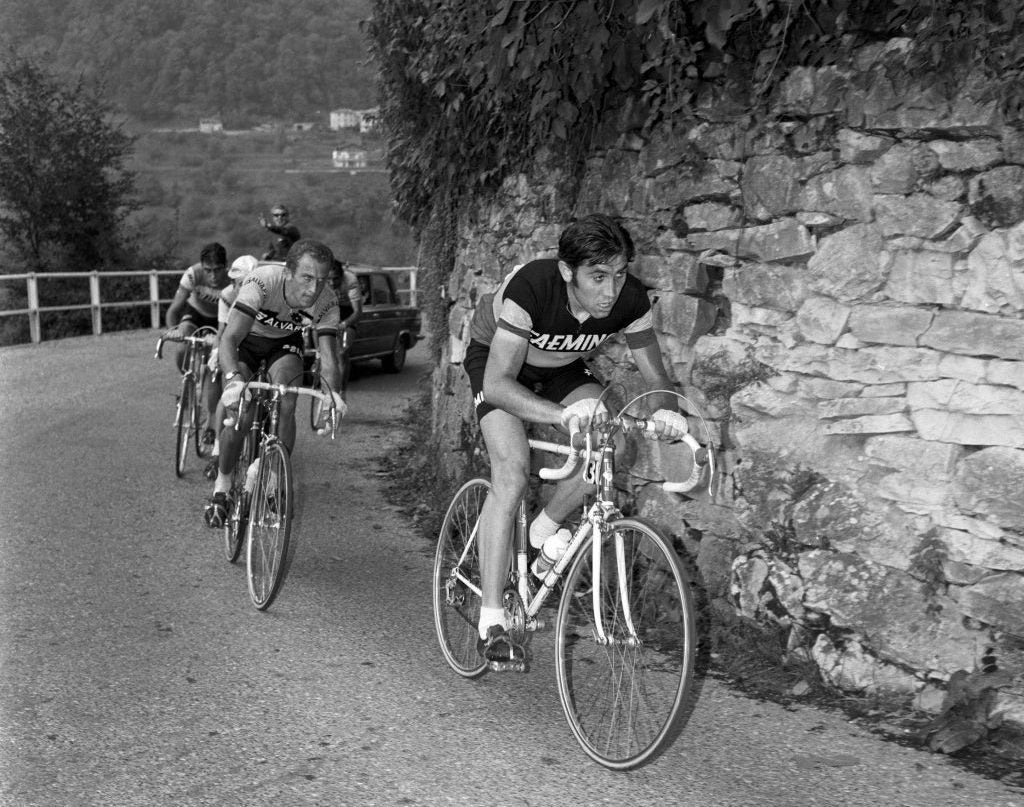
Why it became the Autumn World Championship
Between the 1960s and 1990s, Lombardia acquired the nickname the Autumn World Championship.
The international calendar looked very different from today. The World Championships were usually held earlier, the Vuelta a España occupied a spring date for much of the period, and Lombardia stood as the major international one-day prize at the very end of the season.
The winners justified the nickname.
Felice Gimondi won in 1966 and 1973. Eddy Merckx took consecutive victories in 1971 and 1972. Roger De Vlaeminck won twice, Francesco Moser twice and Bernard Hinault twice.
These were riders capable of winning Grand Tours, World Championships and multiple Monuments.
The full range of Monument history can also be seen in ProCyclingUK’s brief history of men’s Liège-Bastogne-Liège and brief history of the men’s Milano-Sanremo, two races which developed very different identities despite sharing the same elevated status.
Il Lombardia’s identity was increasingly clear by comparison. Milano-Sanremo rewarded patience and speed after nearly 300 kilometres. Flanders and Roubaix were tied to cobbles. Liège had the Ardennes.
Lombardia belonged to the climbers.
Sean Kelly becomes the great non-Italian winner
Sean Kelly occupies a particularly unusual place in Lombardia history.
The Irishman won three times, in 1983, 1985 and 1991, becoming the most successful rider from outside continental Europe in the race.
His victories also demonstrated the breadth of his abilities.
Kelly was capable of winning Paris-Roubaix, Milano-Sanremo and Liège-Bastogne-Liège, dominating stage-race points classifications and finishing highly in Grand Tour general classifications. Lombardia required yet another combination of qualities.
His success reinforced why he remains one of the most complete Classics riders cycling has produced.
The race itself was also moving geographically during this period. From 1985 to 1989, Como became the start and Milan the finish. Between 1990 and 1994, Monza hosted both ends of the race.
The route could change substantially while the underlying demands remained recognisable.
Bergamo joins Lombardia in the 1990s
Bergamo entered the story as a major finish city in 1995.
Gianni Faresin won the first edition to finish there, beginning a run which included victories for Andrea Tafi, Laurent Jalabert, Oscar Camenzind, Danilo Di Luca and Michele Bartoli.
Bartoli won consecutive editions in 2002 and 2003 before the race moved back towards Como.
Between 2004 and 2010, the lakefront finish returned, with the climb through San Fermo della Battaglia providing another late opportunity to attack.
The following three editions finished in Lecco before the race settled into the modern pattern of moving predominantly between Como and Bergamo.
Those changes have become part of Il Lombardia rather than a weakness.
Unlike races whose identity depends on following almost exactly the same route each year, Lombardia can rearrange its climbs and still remain unmistakably Lombardia.
The finish city immediately changes the tactical balance. A Como finale brings different roads and decisions from a Bergamo finish, even though both produce a race based around climbing and endurance.
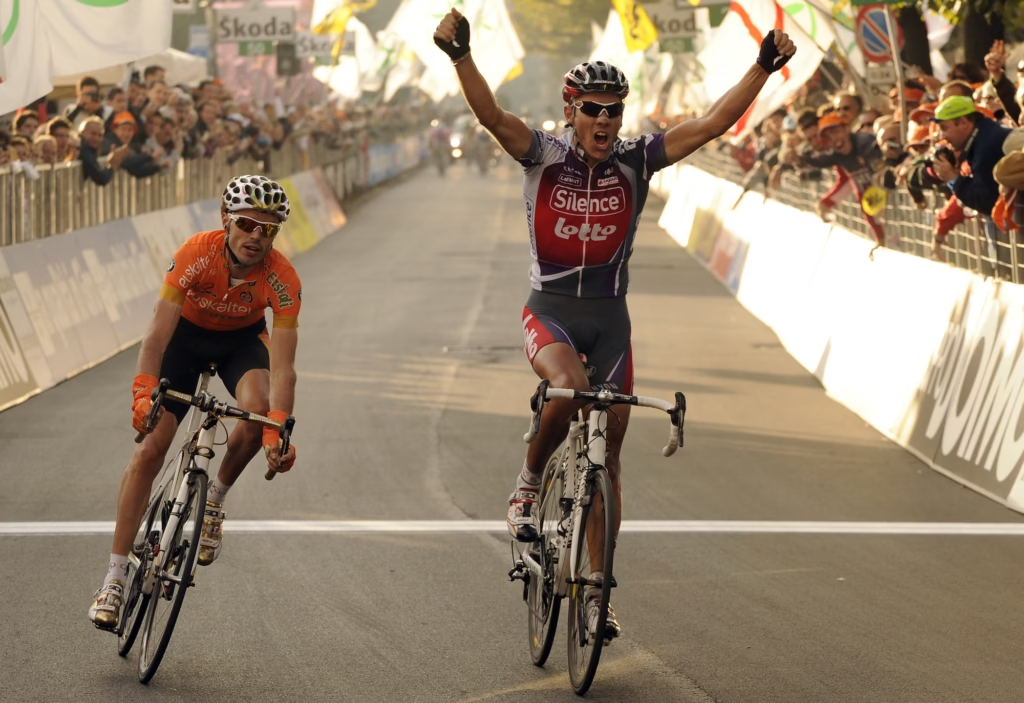 Photo Credit: Damien Meyer/AFP
Cunego, Gilbert and the specialists of the 2000s
Damiano Cunego became the leading Lombardia rider of the early 21st century.
He won three times, in 2004, 2007 and 2008, combining the climbing ability of a Grand Tour rider with enough finishing speed to make him particularly dangerous in a one-day race.
Other editions in the period produced a varied collection of champions.
Paolo Bettini won in 2005 and 2006. Philippe Gilbert won consecutive races in 2009 and 2010. Joaquim Rodríguez did the same in 2012 and 2013.
Each was an elite puncheur capable of climbing but also of turning a selective race into a decisive acceleration.
That distinction matters.
Lombardia is often called the climbers’ Monument, but being the strongest pure climber is not always enough. Descending, timing and finishing speed have frequently changed the winner.
Vincenzo Nibali and the importance of descending
Vincenzo Nibali gave the modern race two of its most memorable Italian victories.
He won in 2015 and again in 2017, using his descending ability as aggressively as his climbing.
Nibali’s success was especially fitting for Lombardia because the race has always made descending part of the contest rather than merely a way of connecting climbs.
A rider who reaches a summit with a small advantage still has to manage fast, technical roads while tired. In some editions, that can be as important as making the initial attack.
Nibali remains the most recent Italian winner.
His victories were followed by Thibaut Pinot in 2018, Bauke Mollema in 2019 and Jakob Fuglsang in 2020.
Pinot’s win was particularly emotional after years of chasing a major one-day victory. Fuglsang’s came in the strangest Lombardia of the modern era, with the 2020 race moved to August because of the disrupted pandemic calendar.
That edition was also marked by Remco Evenepoel’s serious crash on the descent from the Muro di Sormano.
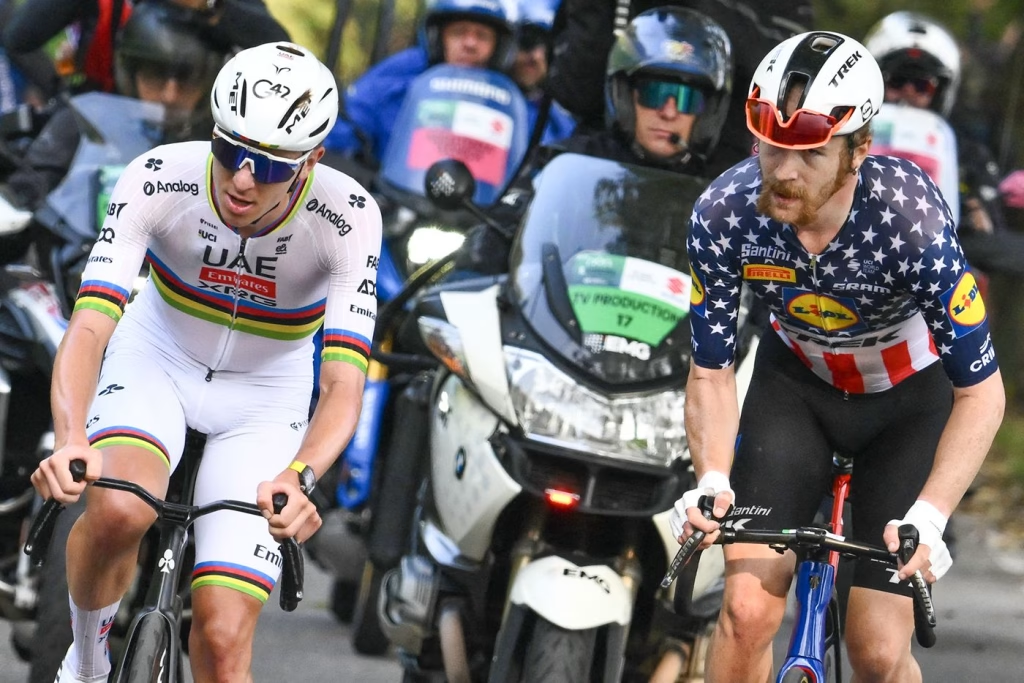
Tadej Pogačar rewrites the record book
From 2021 onwards, Il Lombardia entered another period of domination.
Tadej Pogačar won in 2021.
Then he won again in 2022.
And 2023.
And 2024.
And 2025.
Five consecutive victories took him level with Coppi for the most wins in the history of the race while moving him beyond Coppi’s record of four consecutive successes.
The comparison is remarkable because the two riders are separated by more than half a century yet reached the same total through similarly overwhelming periods.
Pogačar has also won on different Lombardia routes. His first victory came in Bergamo. Others finished in Como. In 2025, the direction changed again and he won in Bergamo after another long solo attack.
His fourth victory in 2024 is covered in ProCyclingUK’s report on Pogačar’s fourth consecutive Il Lombardia win.
The fifth placed him alongside Coppi rather than merely chasing him.
A sixth victory in 2026 would have broken the outright record, but Pogačar will not get that opportunity this year. The injuries suffered in his Vuelta a España crash have ended his season, ruling out a return for Lombardia. ProCyclingUK’s update on Pogačar’s season-ending injuries explains why his attempt to extend the streak will have to wait.
Who has won Il Lombardia the most times?
Pogačar and Coppi now share the outright record.
Five wins
- Fausto Coppi: 1946, 1947, 1948, 1949, 1954
- Tadej Pogačar: 2021, 2022, 2023, 2024, 2025
Four wins
- Alfredo Binda: 1925, 1926, 1927, 1931
Three wins
- Henri Pélissier
- Costante Girardengo
- Gaetano Belloni
- Gino Bartali
- Sean Kelly
- Damiano Cunego
Bartali holds another major record with nine podium finishes from his long relationship with the race.
The winners list is one of Lombardia’s greatest strengths. Coppi, Bartali, Merckx, Gimondi, Hinault, Kelly, Nibali and Pogačar represent very different eras, but all possessed the endurance and climbing ability required to remain dangerous late in a long Classic.

Why the name changed from Giro di Lombardia
For most of its history, the race was known as the Giro di Lombardia, or Tour of Lombardy in English.
The official name changed to Il Lombardia from 2011.
The shorter branding did not change the race itself, and both names remain widely understood. Historical writing still naturally refers to the Giro di Lombardia when discussing older editions, while the modern event is marketed as Il Lombardia.
The Race of the Falling Leaves nickname has survived both.
That is probably the more important name anyway, because it describes the feature which has remained consistent through almost every version of the event: Lombardia arrives when the European racing season is nearly finished and autumn has taken hold in northern Italy.
Could there finally be a women’s Il Lombardia?
Il Lombardia remains the only men’s Monument without an established women’s equivalent.
That may not remain the case for much longer.
RCS Sport has been working towards adding a women’s version, potentially from 2027. If those plans are completed, it would fill the final major gap after women’s versions of the Tour of Flanders, Liège-Bastogne-Liège, Paris-Roubaix and Milano-Sanremo became established on the international calendar.
ProCyclingUK has covered the developing plans in more detail in RCS reportedly planning women’s Il Lombardia for 2027.
A women’s race would begin with none of the century of history carried by the men’s event, but the roads around Como and Bergamo already provide a natural setting.
Why Il Lombardia still stands apart
Il Lombardia has changed repeatedly since Giovanni Gerbi won the first edition in 1905.
The start and finish have moved. Climbs have disappeared and returned. The calendar has changed around it. Its official name has changed. Even the time of year briefly changed in 2020.
Yet the character of the race has remained remarkably stable.
It is still a long race through Lombardy in which climbing ability matters, descending can change the result and tired riders must decide whether to attack or wait after an entire season of racing.
That late position gives Lombardia a different atmosphere from the spring Monuments. Nobody is beginning a campaign here. Riders arrive with months of racing already behind them, often carrying the consequences of Grand Tours, championships and earlier Classics.
Winning therefore feels like both a major target and a final statement on the season.


From Binda and Bartali to Coppi, Kelly, Nibali and Pogačar, the names that have dominated Il Lombardia explain why it has retained its place among cycling’s five Monuments. The route may continue changing, but the race has spent more than a century asking essentially the same question: who still has enough left to win one of the hardest Classics of the year?

