
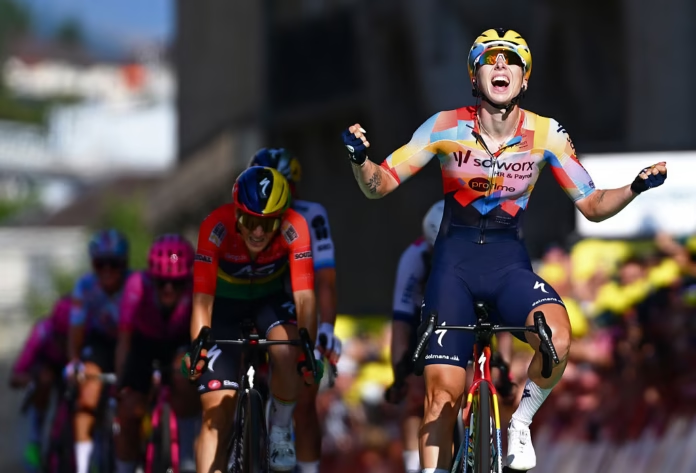
The Tour of Britain Women 2026 begins on Wednesday 19 August with a 158.9-kilometre opening stage starting and finishing in Cockermouth, and this is a much more complicated first day than a conventional sprint opener.
There are 1,913 metres of climbing, exposed roads along the Cumbrian coast, a 700-metre cobbled section at Silloth and a rolling second half before the race returns to Cockermouth. That gives Stage 1 enough variety to reward a sprinter, a Classics rider or an opportunist depending on how aggressively the terrain is used.
The Tour of Britain Women 2026 route guide shows why the opening day is one of the harder stages of the race to predict. Lorena Wiebes is still the clear rider to beat if a substantial group reaches the finish together, with Kim Le Court-Pienaar and Lotte Kopecky the strongest alternatives if the race becomes more selective.
The full Tour of Britain Women 2026 start list also contains several credible stage winners, including Lara Gillespie, Ally Wollaston, Mischa Bredewold, Zoe Bäckstedt, Nienke Veenhoven and Chiara Consonni. The overall contenders preview explains why even relatively small gaps on the opening day could matter later in the week.
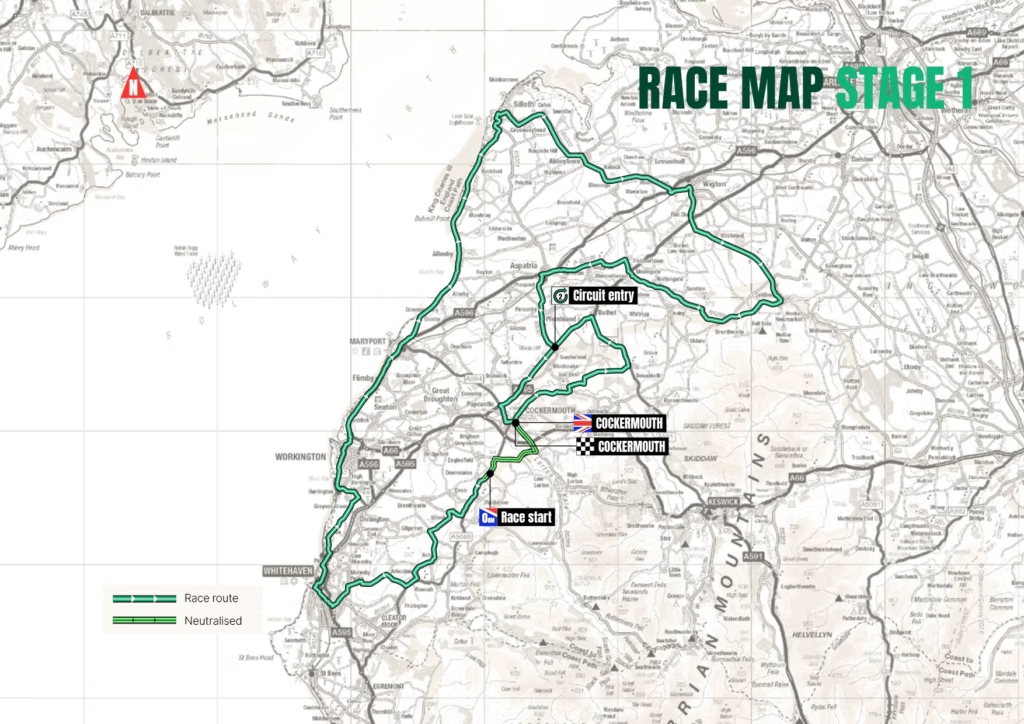
Tour of Britain Women 2026 stage 1 route
Date: Wednesday 19 August 2026
Start: Cockermouth
Finish: Cockermouth
Distance: 158.9km
Elevation: 1,913m
Start time: 11:30 BST
Expected finish: Around 15:25 BST
Stage type: Hilly, exposed and potentially selective
Cockermouth hosts both the start and finish, with the longest stage of the 2026 race immediately asking the peloton to deal with several very different types of terrain.
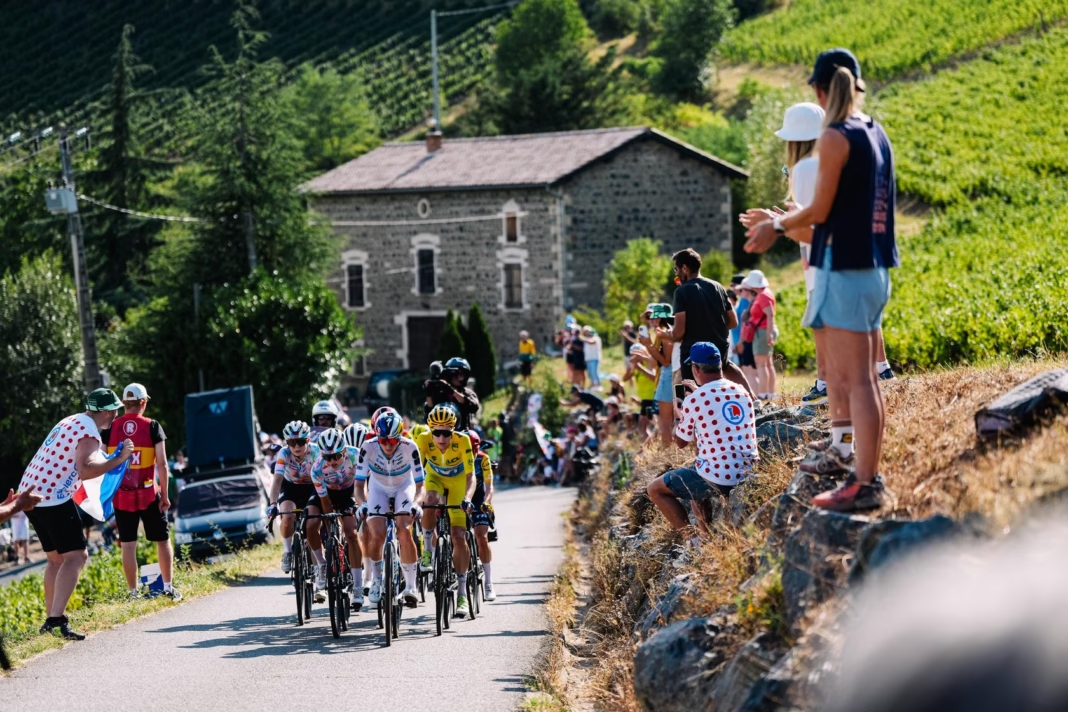
The route initially heads towards the west coast before moving through Whitehaven, Workington and Maryport. That long coastal section matters because the roads are exposed enough for wind to become a tactical factor before the race reaches the more obviously difficult terrain later in the day.
The peloton then continues towards Silloth, where approximately 700 metres of cobbles add another complication. It is not a Roubaix-length sector and should not decide the stage by itself, but it arrives after a long period in which teams may already have been fighting for position on exposed roads.
From there, the race turns inland and becomes hillier on the journey back towards Cockermouth. The combination of short climbs, fatigue and repeated positioning battles should gradually reduce the number of riders arriving fresh enough to contest the finish.
Why Stage 1 could affect the GC immediately
The major overall battle is expected to develop later in the week, particularly around the Great Orme finish on Stage 3, but Stage 1 is not something the GC contenders can simply ride through anonymously.
The 2026 field is particularly well suited to a race decided through small gaps and bonus seconds rather than one dominant mountain specialist. Kopecky, Le Court-Pienaar, Wollaston, Pfeiffer Georgi, Lauren Dickson and Karlijn Swinkels all feature prominently in ProCyclingUK’s Tour of Britain Women 2026 contenders preview, with several combining climbing ability and finishing speed.
That increases the value of every second available in Cockermouth. A rider who takes a podium finish can begin collecting bonuses immediately, while somebody caught behind a late split could lose time without ever being genuinely dropped on a climb.
The defending champion offers the clearest reminder of how tight this race can become. Wollaston won the 2025 Tour of Britain Women by only four seconds, so nobody with overall ambitions will want to give away even a small gap on the opening afternoon.
The exposed coast could shape the race before the hills
The route’s first major tactical question is whether the coastal roads produce meaningful crosswinds.
If the wind is strong and comes from the right direction, the stretch through Whitehaven, Workington, Maryport and towards Silloth gives the strongest teams an opportunity to split the peloton much earlier than many riders would like.
That would immediately favour squads containing powerful Classics riders. SD Worx-Protime have Kopecky and Bredewold, while Canyon SRAM have Bäckstedt, one of the strongest riders in the field on exposed and technical roads. Picnic PostNL can rely on Georgi, whose positioning and ability in difficult northern European racing makes this kind of terrain particularly attractive.
Even if the wind is not strong enough to create proper echelons, the threat itself matters. GC riders will still need to spend energy holding positions close to the front rather than hiding deeper in the bunch, making Stage 1 harder than its climbing statistics alone suggest.
Why the Silloth cobbles matter
The cobbled section at Silloth is relatively short, but its location makes it more important than the distance suggests.
By the time the race reaches it, riders will already have spent much of the opening half fighting for position along exposed roads. A 700-metre sector can stretch the peloton, create small gaps or force riders who enter badly positioned to spend extra energy closing them.
For the pure sprinters, that matters even if nobody is dropped permanently. Wiebes and Consonni do not need to lose contact for the cobbles to influence the result. If either is forced to chase or repeatedly accelerate afterwards, that effort can become relevant once the race reaches the later hills.
For riders such as Kopecky, Bredewold and Bäckstedt, the objective may not be to attack directly on the cobbles. Keeping the pressure high and making the fastest finishers work could be enough.
 Photo Credit: Getty
Lorena Wiebes is the clear rider to beat
If a reasonably large group reaches Cockermouth, Lorena Wiebes should be considered the clear favourite.
The route is difficult enough to complicate her day, but nothing on it looks sufficiently hard in isolation to make dropping Wiebes likely. She has repeatedly demonstrated that she can survive considerably more climbing than a conventional pure sprinter, which means rivals need to focus on accumulation rather than one decisive ascent.
That is where the exposed roads, cobbles and almost 2,000 metres of climbing become relevant. Wiebes is much easier to beat if she reaches Cockermouth after repeatedly chasing back into position or responding to accelerations than if SD Worx-Protime deliver her comfortably into the final kilometres.
Her own team makes the tactical problem even harder for everyone else. If Wiebes survives, SD Worx-Protime have the fastest finisher. If rival teams make the stage hard enough to put her under pressure, they risk creating exactly the sort of race that suits Kopecky.
Verdict: The most likely winner. Rival teams need to make this significantly harder than a normal sprint stage to change that.
Kim Le Court-Pienaar looks the strongest alternative
Kim Le Court-Pienaar is probably the rider best placed to profit if the race becomes selective without completely breaking apart.
She does not need a conventional bunch sprint, but neither does she require a climbing contest. A finish involving 15 to 30 riders would be close to ideal because it could remove several faster sprinters while leaving Le Court-Pienaar with enough finishing speed to beat many of the riders who survive.
There is also useful precedent. She won the opening stage of the Tour of Britain Women in 2025 and took the leader’s jersey before later leaving the race following a crash. Twelve months later, she returns with a considerably stronger body of results and as a genuine overall contender.
The route therefore fits her unusually well. If the stage is too easy, Wiebes has the advantage. If it becomes exceptionally hard, Kopecky and the stronger Classics riders come further into play. Le Court-Pienaar sits neatly between those two extremes.
Verdict: The strongest alternative to Wiebes, particularly from a reduced group.
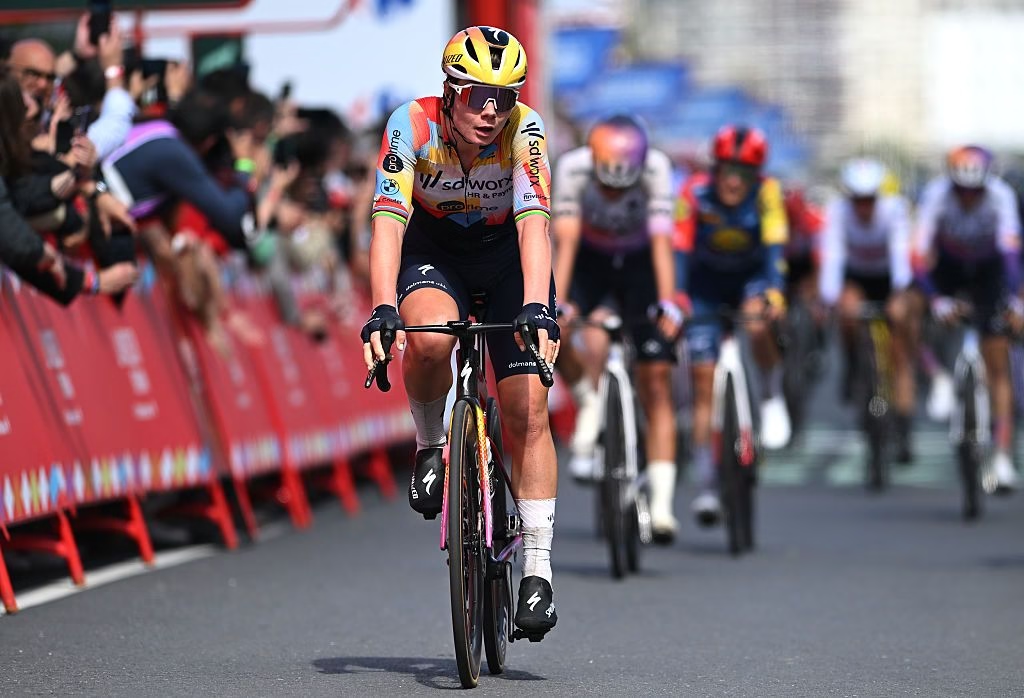
Lotte Kopecky has more ways to win than almost anyone
Lotte Kopecky may be the most versatile rider on the start line.
She can deal with the wind, cobbles and short climbs, attack before the finish and still sprint from a selective group. She is also one of the leading GC contenders, making any bonus seconds or gaps gained on Stage 1 valuable beyond the stage itself.
The complication is that Kopecky’s own team has Wiebes.
If their sprinter is comfortable, there is little incentive for Kopecky to launch an aggressive move that could disrupt a likely stage victory. Her freedom increases dramatically if Wiebes begins struggling or loses contact.
That means Kopecky is perhaps less likely to win than her suitability to the route alone would suggest, but if the stage becomes genuinely selective she immediately moves towards the front of the conversation.
Verdict: The strongest option if SD Worx-Protime need to switch away from Wiebes during the race.
Lara Gillespie deserves genuine contender status
Lara Gillespie should be treated as one of the principal sprint alternatives rather than a peripheral outsider.
Her best scenario is a race that becomes difficult enough to reduce the peloton but not so hard that the finish is taken over completely by the GC and Classics riders. If Wiebes reaches Cockermouth, Gillespie still faces the obvious problem of beating the fastest sprinter in the race, but the longer and more attritional the day becomes, the less straightforward that comparison is.
She is particularly interesting if the finale becomes disorganised. A reduced group with depleted lead-outs creates opportunities for a rider who can position herself independently and produce a strong final acceleration.
Gillespie therefore deserves to sit immediately behind Wiebes, Le Court-Pienaar and Kopecky in the stage hierarchy.
Verdict: A serious winning option if the stage produces a reduced sprint.
 Photo Credit: Alex Whitehead/SWpix.com
 Ally Wollaston begins her title defence with an opportunity
Defending champion Ally Wollaston begins Stage 1 knowing from experience how important bonus seconds can become at the Tour of Britain Women.
Her 2025 overall victory was decided by only four seconds, and her combination of sprint speed and resilience remains particularly well suited to a race where small margins can build across several stages.
Cockermouth is harder than her ideal sprint day, but it should remain within her range if the final third does not turn into repeated all-out attacks. A medium-sized group would give Wollaston a realistic opportunity to contest the victory while simultaneously collecting useful GC seconds.
If Kopecky and the stronger Classics riders make the finale relentless, her chances decrease. If the race is selective but controlled, they increase substantially.
Verdict: Strong reduced-sprint contender with an added incentive to collect early GC bonuses.
Mischa Bredewold gives SD Worx-Protime another option
Mischa Bredewold adds yet another layer to SD Worx-Protime’s tactical strength.
She is unlikely to be their first option if Wiebes remains comfortable, but the route itself suits her extremely well. Bredewold has the power for exposed roads, enough climbing ability to survive the rolling finale and the finishing speed to win from a selective group.
She is also dangerous in precisely the kind of tactical situation Stage 1 could produce. If a handful of riders escape late while teams with sprinters hesitate behind, Bredewold has the strength to turn a small advantage into a stage victory.
The difficulty for her is opportunity rather than ability. With Wiebes and Kopecky in the same team, she may need the race to become unusually complicated before she receives complete freedom.
Verdict: A dangerous third SD Worx-Protime card if the race becomes tactical.

Zoe Bäckstedt should be used aggressively
Zoe Bäckstedt has one of the more obvious route matches in the field.
The exposed coast and cobbles suit her raw power, while the rolling second half rewards riders capable of repeatedly producing short efforts rather than settling into a long climbing rhythm.
For Canyon SRAM, the tactical split is fairly straightforward. If Consonni survives comfortably, the team have a high-quality sprint option. If she begins struggling, Bäckstedt becomes the more interesting rider to use aggressively.
There is little reason to turn her into an improvised GC leader. This stage is about pursuing a win, and an attack during a chaotic final 30 kilometres could suit Bäckstedt much more than waiting to sprint against Wiebes.
Verdict: One of the strongest attacking options if the race becomes too difficult for the conventional sprinters.
Chiara Consonni needs a more controlled race
Chiara Consonni gives Canyon SRAM their clearest conventional route to victory.
She has enough outright speed to challenge almost anyone in the field, but Stage 1 sits close to the upper edge of what she will want before a sprint. Almost 2,000 metres of climbing combined with the exposed coast and Silloth cobbles provides several opportunities for rival teams to increase the cost of staying in the front group.
If the race remains relatively controlled, Consonni becomes one of Wiebes’ most credible sprint challengers. If the strongest Classics riders start attacking repeatedly during the final hour, her chances fall quickly.
That makes Canyon SRAM’s two-card approach particularly useful. They do not need to force Consonni through a race that has become too difficult when Bäckstedt provides a completely different way to attack it.
Verdict: A genuine contender from a larger group, but the terrain needs to remain under control.

Nienke Veenhoven could emerge from a reduced sprint
Nienke Veenhoven is another fast finisher who deserves attention if a sizeable group remains together.
She is unlikely to command the same attention as Wiebes, which can become useful during a chaotic finale. When the biggest sprint teams begin fighting for the same wheels, riders slightly outside the obvious hierarchy can sometimes find cleaner routes through the final kilometre.
The question is whether Veenhoven can preserve enough speed through nearly 160 kilometres of rolling terrain to take advantage.
She does not need the easiest possible race, but she probably wants the GC riders to avoid turning the final hills into an extended series of attacks.
Verdict: Credible outsider in a reduced or disorganised sprint.
Karlijn Swinkels needs the race to become selective
Karlijn Swinkels should be comfortable with almost every part of Stage 1, but her winning route looks different from that of the leading sprinters.
She has the strength to deal with exposed roads, enough climbing ability for the rolling second half and enough speed to remain dangerous from a small group. What she does not want is Wiebes, Gillespie, Wollaston and Consonni all arriving together for a conventional sprint.
Her chance increases as the race becomes more selective.
Swinkels also finished third overall in the 2025 Tour of Britain Women, a result covered as part of ProCyclingUK’s history of the Tour of Britain Women, so protecting her GC position remains important even if the stage victory proves unrealistic.
Verdict: More likely to succeed through a selective race or late move than a straightforward sprint.
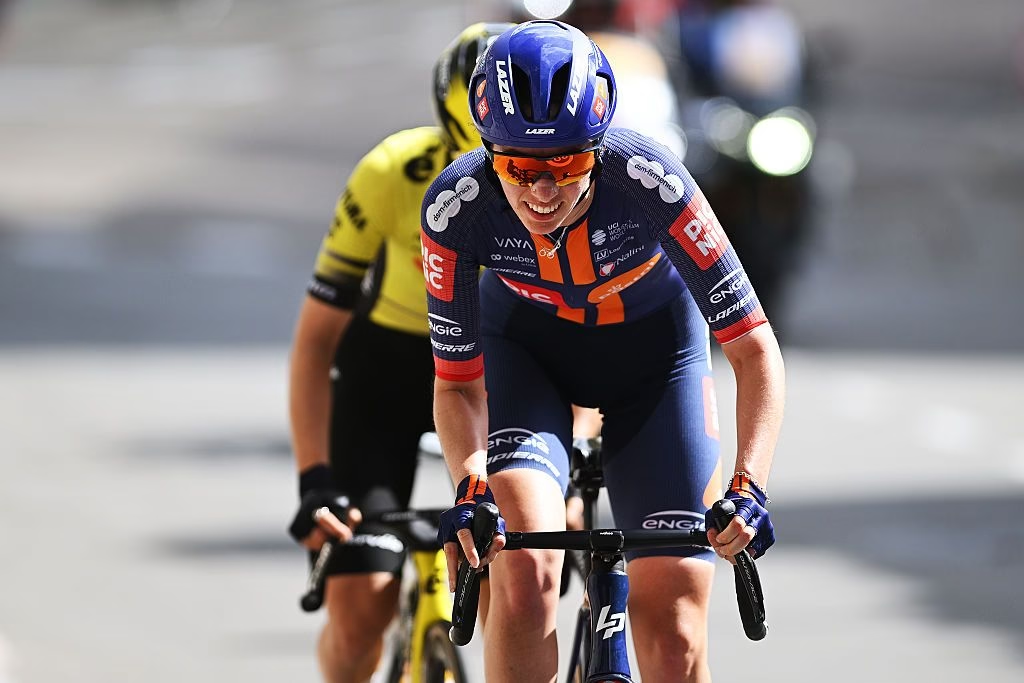
Pfeiffer Georgi could shape the result without winning it
Pfeiffer Georgi remains one of the riders most capable of making the stage difficult, but that does not necessarily make her one of the most likely winners.
The characteristics suit her extremely well: exposed roads, repeated short climbs and a finale where positioning and fatigue matter. Picnic PostNL should have every reason to use Georgi aggressively because waiting for a sprint against Wiebes offers little upside.
Her attacks could prove decisive even if somebody else ultimately wins. A Georgi acceleration late in the stage could be exactly what removes a sprinter, forces SD Worx-Protime to chase or creates the smaller group from which Le Court-Pienaar, Kopecky or Wollaston eventually takes the victory.
That distinction is important. Georgi is one of the most tactically influential riders on Stage 1 without necessarily being among its three or four most likely winners.
What will decide Stage 1?
The biggest factor is not one climb. It is how much energy the peloton spends before reaching the final 40 kilometres.
If the wind is quiet, the Silloth cobbles are ridden conservatively and the main teams retain enough domestiques, the stage should still come back towards a sprint. In that scenario, Wiebes is difficult to look beyond, with Gillespie, Wollaston and Consonni among the riders trying to challenge her.
If the coastal section becomes aggressive, the entire complexion changes. Riders could reach the later hills having already spent substantial energy on positioning and chasing, making each short climb far more effective than it would be against a fresh peloton.
That version brings Le Court-Pienaar and Kopecky much further into play, while Bredewold and Bäckstedt become dangerous attacking options.
The most likely outcome sits somewhere between the two: a reduced sprint in Cockermouth rather than either a completely intact peloton or a handful of pure climbers.
Tour of Britain Women stage 1 start and finish times
The stage begins in Cockermouth at 11:30 BST and covers 158.9 kilometres before returning to the town.
The expected finish is approximately 15:25 BST, although that can shift depending on the pace of the race and conditions on the exposed sections.
That puts the decisive final hour roughly between 14:20 and 15:25.
-
 Photo Credit: A.S.O./Billy Ceusters

How to watch Tour of Britain Women stage 1 in the UK
UK viewers can follow the race live and free, with full details in ProCyclingUK’s guide to watching the Tour of Britain Women 2026 in the UK.
The 2026 broadcast also includes an important innovation. Live rider performance data will be integrated into coverage of a Women’s WorldTour stage race for the first time, with ProCyclingUK looking at how the new Tour of Britain rider data will be used.
Stage 1 should be a particularly useful test for it. The difference between a rider sitting comfortably in the peloton and one repeatedly being pushed close to their limit may become clearer as the race moves from the exposed coast into the hillier finale.
Who wins Tour of Britain Women 2026 stage 1?
Lorena Wiebes is the clear favourite.
The route provides plenty of opportunities to make her work, but it probably does not contain enough outright difficulty to remove her unless rival teams commit to making the race hard well before Cockermouth.
Kim Le Court-Pienaar looks like the strongest alternative. A selective race ending with a medium-sized group would suit her extremely well because it removes some of the fastest pure sprinters without taking away her own finishing speed.
Lotte Kopecky is the other obvious threat, particularly if Wiebes comes under pressure and SD Worx-Protime switch their focus. Lara Gillespie deserves to be treated as the next strongest sprint option, with Wollaston, Bredewold, Bäckstedt, Consonni and Veenhoven forming the next group of plausible winners.
The most convincing hierarchy is therefore Wiebes first, Le Court-Pienaar and Kopecky as the principal alternatives, then Gillespie leading a deeper group of contenders.
The route gives the opposition several ways to disrupt that order, but they probably need to do it before the final few kilometres. If Wiebes reaches Cockermouth comfortably in the front group, everyone else is likely to be racing for the hardest prize in women’s cycling: trying to come around her in a sprint.

