
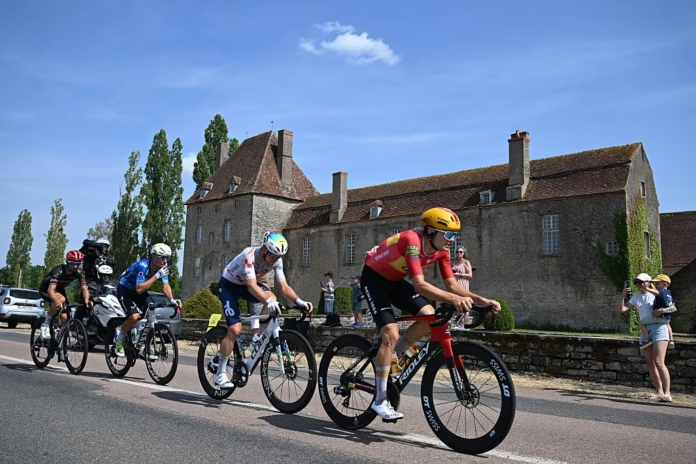
The Tour de France gives the sprinters another opportunity on stage 12, with a 179.1km route from the Circuit Nevers Magny-Cours to Chalon-sur-Saône.
Three category-four climbs and almost 1,800 metres of elevation mean the stage is not completely flat. None of the ascents is difficult enough to remove the leading fast men under normal circumstances, while the final climb ends almost 20km from the finish.
The expected result is therefore another bunch sprint.
Søren Wærenskjold arrives with renewed confidence after winning the stage 11 sprint in Nevers, where he beat Olav Kooij and Jasper Philipsen after the breakaway was caught with five kilometres remaining.
Tim Merlier remains the rider with the strongest sprint record after victories in Bordeaux and Bergerac, while Kooij has now finished first and second in two of the Tour’s bunch finishes.
Biniam Girmay, Max Kanter and Philipsen have continued placing consistently without taking a stage. Chalon-sur-Saône represents another valuable opportunity before the race moves into a much more difficult block through the Vosges, Jura and Alps.
Tour de France 2026 stage 12 details
| Detail | Information |
|---|---|
| Date | Thursday 16 July 2026 |
| Start | Circuit Nevers Magny-Cours |
| Finish | Chalon-sur-Saône |
| Distance | 179.1km |
| Stage type | Flat |
| Elevation gain | Around 1,800 metres |
| Categorised climbs | Three category-four climbs |
| Intermediate sprint | Decize after 45.8km |
| Neutralised start | 13:30 CEST, 12:30 BST |
| Expected finish | 17:29-17:50 CEST, 16:29-16:50 BST |
| Main favourites | Tim Merlier, Olav Kooij, Søren Wærenskjold and Jasper Philipsen |
The finish carries a major points allocation for the winner, while the intermediate sprint in Decize gives Mads Pedersen and his closest green jersey challengers another chance to alter the classification.
Stage 12 was always identified as one of the best opportunities for sprinters on the 2026 Tour route. Its position immediately after the Nevers finish makes recovery as important as outright speed.
Stage 12 in one sentence
Stage 12 is a rolling transition across Burgundy in which a late category-four climb may encourage attacks, but the sprint teams should have enough road to organise a finish in Chalon-sur-Saône.
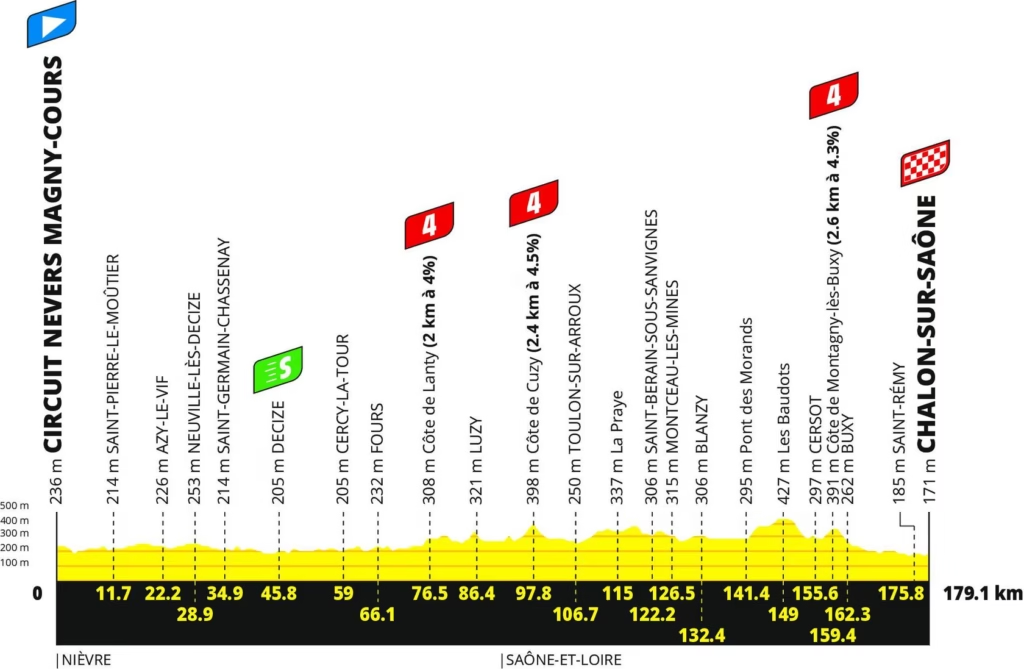
Tour de France stage 12 route
The stage begins at the Circuit Nevers Magny-Cours before travelling east through the Nièvre department.
The opening roads are relatively straightforward, passing Saint-Parize-le-Châtel and Saint-Pierre-le-Moûtier before reaching the Loire around Decize.
The intermediate sprint comes after 45.8km. Its early position should create an aggressive first hour because Pedersen and his closest green jersey challengers can all score before the route becomes more rolling.
From Decize, the race continues through Champvert, Cercy-la-Tour and Fours before reaching the first categorised climb.
The Côte de Lanty appears after 76.5km. It is followed by the Côte de Cuzy after 97.8km, taking the peloton towards Luzy and the southern edge of the Morvan.
The route then moves through Toulon-sur-Arroux and Montceau-les-Mines before turning towards the final climbing section around Buxy.
The Côte de Montagny-lès-Buxy is the last classified ascent. Its summit comes after 159.4km, leaving 19.7km to the finish.
That distance is the key to the stage.
The climb is close enough to invite attacks and force the sprint teams to remain attentive. It is still far enough from Chalon-sur-Saône for any dropped sprinters to return and for the peloton to catch a late move.
The final kilometres descend from the Chalonnais vineyards towards the Saône valley. The race enters Chalon-sur-Saône with only 700 metres remaining, creating a high-speed final approach in which positioning before the town should be more important than moving up during the finishing straight.
Tour de France 2026 stage 12 climbs
| Climb | Distance | Average gradient | Category | Summit |
|---|---|---|---|---|
| Côte de Lanty | 2.1km | 4% | Four | 76.5km |
| Côte de Cuzy | 2.5km | 4.5% | Four | 97.8km |
| Côte de Montagny-lès-Buxy | 2.7km | 4.3% | Four | 159.4km |
The three climbs award only one mountains point each. Tadej Pogačar should therefore retain the lead in the classification without becoming involved in the contest.
Their main significance is cumulative fatigue rather than selection.
Stage 11 was raced at an exceptional speed, with the peloton giving the breakaway very little room and maintaining pressure almost throughout. The riders may have avoided the mountains, but few will begin stage 12 feeling as though they enjoyed a recovery afternoon.
That fatigue can be particularly damaging to lead-out riders. Our explainer on why Tour de France sprinters struggle after mountain stages also shows why the riders guiding the sprinter into position can be more important than the headline finisher.
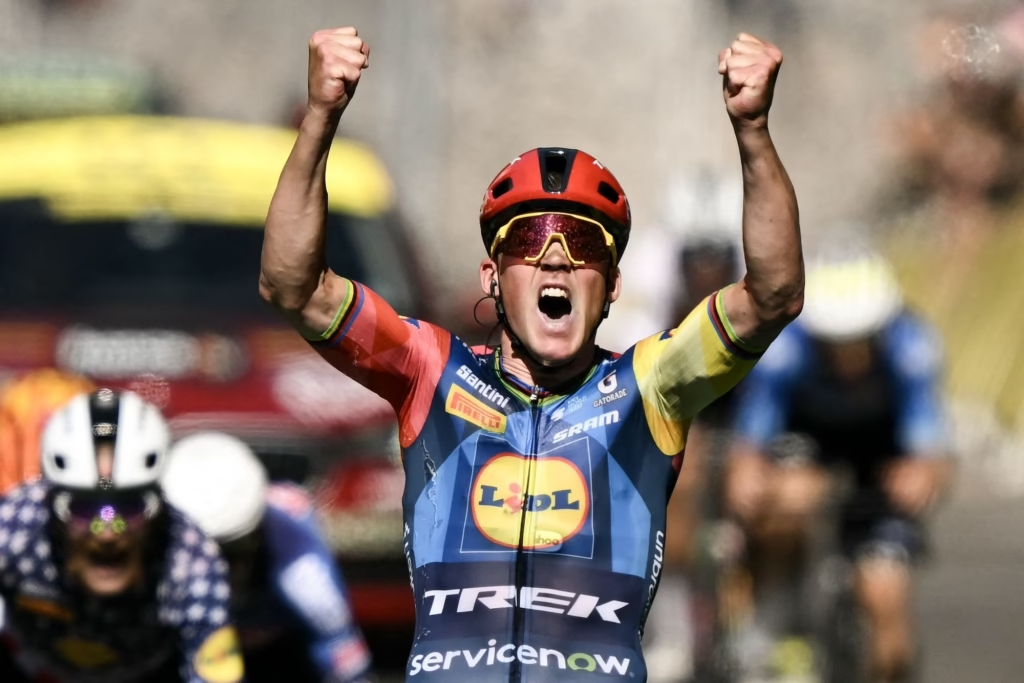 Photo Credit: Getty
The intermediate sprint could be more important than the climbs
The intermediate sprint in Decize comes after only 45.8km.
That timing means the green jersey teams must make their intentions clear almost immediately. A breakaway allowed to establish itself too early could take the largest points, while waiting too long risks missing the move entirely.
Pedersen remains in the strongest position.
His advantage comes from scoring on more types of terrain than the pure sprinters. He can contest conventional finishes, collect points from reduced groups and reach intermediate sprints on stages where Merlier, Philipsen and Kooij have already been dropped.
That versatility has made his attempt to win the 2026 Tour de France green jersey increasingly credible.
Stage 12 gives the other sprinters a better chance to fight back because they should remain in the peloton throughout.
Girmay has been the most consistent challenger, while Kanter and Philipsen have continued gathering useful totals through repeated high finishes. Merlier’s two victories have brought a large points return, but his position still depends on converting more of the remaining flat stages.
Pedersen does not necessarily need to win in Chalon-sur-Saône.
Taking a strong result at Decize and another top-ten finish at the line may be enough to leave stage 12 with his advantage intact.
Can the breakaway survive?
A breakaway win is possible only if the sprint teams become unwilling to work for one another.
Stage 11 demonstrated how difficult these transition stages are for attackers. The early move survived into the closing kilometres, but the peloton completed the catch with enough time to organise a sprint.
Stage 12 provides slightly more terrain for an escape.
The repeated rolling roads through the Morvan should allow a strong group to maintain momentum, while the Côte de Montagny-lès-Buxy offers a final place to increase the pace and remove tired chasers.
The problem is the number of teams with a reason to control.
Soudal Quick-Step has Merlier, Decathlon CMA CGM has Kooij and Alpecin-Premier Tech still needs a victory from Philipsen. NSN Cycling Team will support Girmay, Uno-X Mobility can now ride with confidence behind Wærenskjold and XDS Astana Team continues to place Kanter near the front.
Cofidis also received encouragement from Milan Fretin’s fourth place in Nevers, while Huub Artz’s fifth showed Picnic-PostNL has another credible option.
Even if each team contributes only one rider, the peloton should have enough strength to manage a conventional breakaway.
The escape needs poor cooperation behind, changing weather or an unusually strong group containing several powerful rouleurs.
The most likely pattern is a move of three to six riders being allowed several minutes before the chase gradually increases through the second half of the stage.
Côte de Montagny-lès-Buxy offers the attackers one chance
The final climb measures 2.7km at 4.3%.
Those figures are not enough to trouble an elite sprinter on their own. The location after almost 160km gives the ascent more tactical value.
Classics riders and stage hunters may attack before the summit, particularly if the peloton has spent the day controlling a strong break. A short acceleration could create a small group containing riders capable of sustaining high speed through the descent.
Pedersen may also ask Lidl-Trek to increase the pace.
A severe tempo could reduce the number of lead-out riders available to Merlier and Kooij without necessarily removing the sprinters themselves. That would create the disorganised finish Pedersen needs if he is to beat faster rivals.
Uno-X could make a similar calculation for Wærenskjold. The Norwegian is powerful enough to survive the climb comfortably and may benefit if the pure sprint trains reach Chalon with fewer domestiques.
The climb is still unlikely to decide the stage directly.
There are almost 20km between the summit and finish, including descending and flatter roads on which an organised peloton has a large aerodynamic advantage over two or three attackers.
A late move becomes dangerous only if the sprint teams hesitate while expecting someone else to chase.
The finish in Chalon-sur-Saône
The final descent carries the riders through Buxy and Granges before the route flattens towards Saint-Rémy.
There is no further categorised obstacle after Montagny-lès-Buxy. The speed should increase rapidly once the peloton completes the descent, making it difficult for riders caught behind a split to regain position.
The race enters Chalon-sur-Saône with 700 metres left.
That places considerable importance on the approach through Saint-Rémy. Sprint trains need to be organised before reaching the city rather than assuming they can recover positions on a long urban run-in.
The likely result is another compressed final kilometre.
GC teams will want Pogačar, Jonas Vingegaard, Remco Evenepoel and the other leaders protected until the closing kilometres. Sprint squads will be attempting to occupy the same road space.
The Tour de France team structure explainer shows how sprint trains and GC protection units can end up competing for the same positions even when their objectives are completely different.
Stage 11 produced a chaotic finish in which Wærenskjold used an opening after Cees Bol launched early. Kooij and Philipsen had enough speed to reach the podium but reacted too late to prevent the Norwegian taking the victory.
Chalon may again reward the rider who reads the finish best rather than the one delivered by the most visibly dominant train.
 Photo Credit: Getty
Tim Merlier remains the benchmark
Merlier’s failure to reach the first five in Nevers does not erase what he achieved in Bordeaux and Bergerac.
He remains the only rider with two conventional sprint victories at this Tour. Both wins came through a combination of patience, positioning and superior top-end speed.
The concern is recovery.
Merlier’s lead-out has already been weakened, forcing him to rely more heavily on rival trains. Stage 11 was exceptionally fast from the beginning and gave few riders an opportunity to conserve energy.
The rolling terrain on stage 12 may also make his support team work earlier than it would prefer.
If Merlier reaches the final 200 metres in position, he remains the fastest rider in the field. His challenge is arriving there without being isolated or trapped behind a slowing wheel.
Merlier remains one of the benchmark riders in our ranking of the best sprinters at the Tour de France 2026.
Olav Kooij is becoming the most reliable alternative
Kooij won in Pau and finished second behind Wærenskjold in Nevers.
Those results show he can compete in both a more structured bunch sprint and a chaotic finish in which the normal trains break down.
His victory in Pau changed the race’s sprint hierarchy because it proved he could still convert his speed after surviving an attritional stage. The wider implications are explored in why Olav Kooij’s Pau win changed the Tour sprint picture.
Decathlon CMA CGM also has a reason to commit fully.
Paul Seixas sits fifth overall and carries no responsibility for controlling the race on a flat stage. The team can protect him through the final kilometres while dedicating most of its available sprint support to Kooij.
Kooij appears to be recovering well from the mountain stages and has consistently reached the front at the right moment.
He may now be the safest podium prediction even if Merlier retains the greater maximum speed.
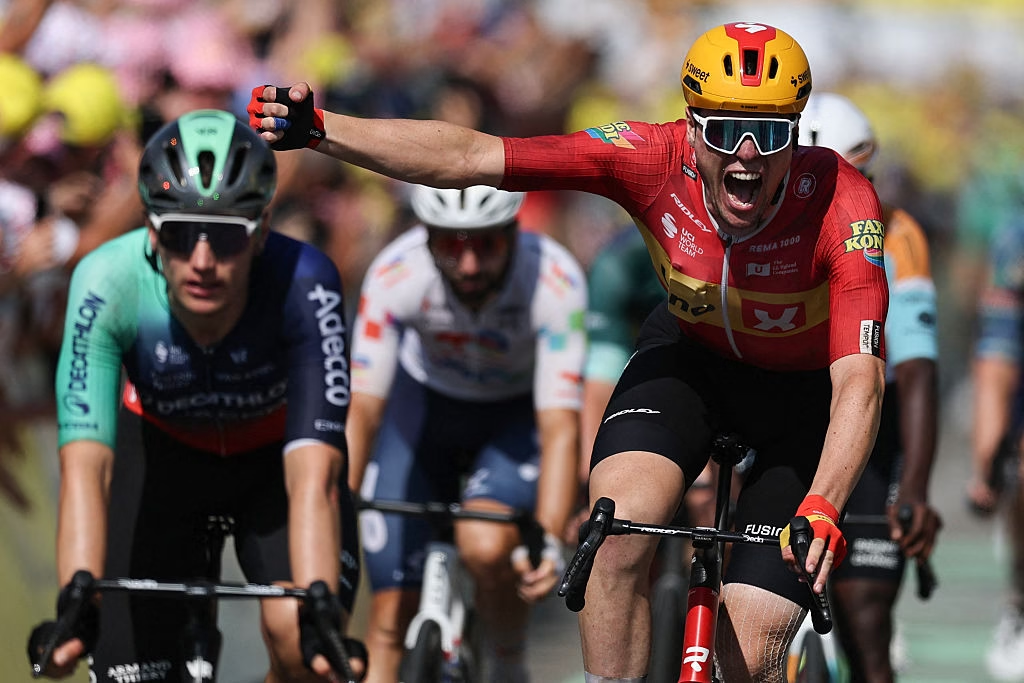
Søren Wærenskjold has changed his Tour
Wærenskjold entered stage 11 as an outsider with a strong second place in Bordeaux.
He leaves Nevers as a Tour de France stage winner.
The victory suited his strengths. Wærenskjold did not wait for a conventional final 150-metre sprint. He followed the acceleration in front, recognised the available space and committed before the other favourites could respond.
Stage 12 may suit him even better physically.
The rolling profile and late climb favour a rider with sustained power, while the faster descent towards Chalon creates another opportunity to begin the sprint from distance.
Uno-X no longer needs to chase from desperation. The team can ride with confidence and force rival squads to carry more of the workload.
The danger is that Wærenskjold will now be watched more closely.
Kooij and Philipsen allowed him enough room in Nevers because their attention was divided between several wheels. They will be less willing to let him launch freely in Chalon-sur-Saône.
Wærenskjold’s unusual mixture of sprinting and support strength also earned him a place in our guide to the best lead-out riders at the Tour de France 2026.
Jasper Philipsen is running out of ideal opportunities
Philipsen finished third on stage 11 but remains without a Tour victory.
The result was an improvement in placement, although it repeated the wider pattern of his race. Philipsen has regularly shown enough speed to reach the podium or top five without producing the final execution required to win.
Alpecin-Premier Tech needs to simplify the finish.
Philipsen has sometimes been released too early, boxed behind another rider or forced to begin his sprint from a poor wheel. Mathieu van der Poel’s stage 9 victory reduced the pressure on the team, but it did not solve the sprint problem.
Stage 12 gives Philipsen another suitable finish.
The climbing should not trouble him, and the fast approach into Chalon normally suits his ability to move through traffic.
He needs to begin the final kilometre closer to the front and react immediately if Wærenskjold or Pedersen launches early.
 Photo Credit: Getty
Biniam Girmay needs to turn consistency into a win
Girmay has remained central to the green jersey contest without taking a stage.
His strength has been repeatability. He has scored on different types of stages and regularly reached the final sprint, even when the route contained more climbing than the pure specialists wanted.
Stage 12 should suit him.
The late climb is not difficult enough to create a reduced sprint, but it may weaken some lead-outs and produce a less controlled finish. Girmay’s positioning and durability become more valuable when the race loses its normal structure.
NSN Cycling Team has two decisions to make.
It needs to contest the intermediate sprint in Decize without using too much support, then ensure Girmay is not isolated through the final descent.
A victory probably requires Merlier and Kooij to lose position. Girmay has been fast enough to place repeatedly, but not yet quick enough to pass every leading rival from behind.
The wider strengths and weaknesses of the main fast men are covered in our Tour de France 2026 sprinters guide.
Max Kanter remains close without breaking through
Kanter has been one of the Tour’s most consistent sprinters.
He finished second in Pau and remains prominent in the points classification, giving XDS Astana Team a clear reason to work.
The German’s strongest asset is his lead-out.
Astana has repeatedly moved him towards the final kilometre in a strong position. The missing element has been the acceleration required to complete the result.
Kanter is unlikely to beat Merlier, Kooij and Philipsen by launching from behind them.
His winning scenario involves reaching the front early and forcing those riders to find a route around him.
A podium remains realistic. A victory would require the cleanest execution of his Tour.
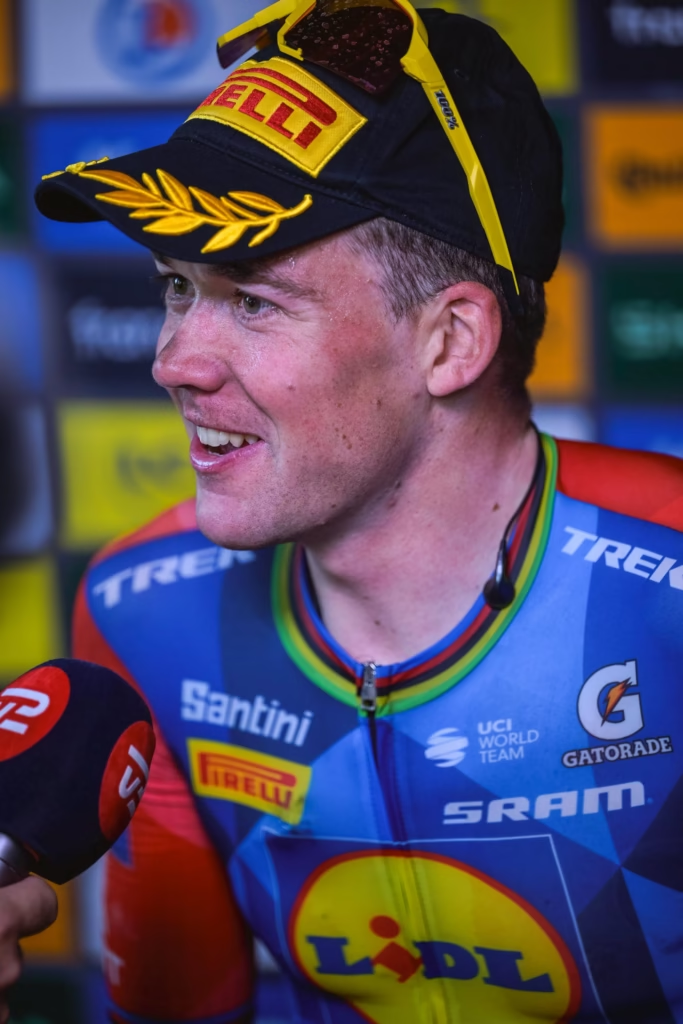 Photo Credit: A.S.O./Charly López
Mads Pedersen may prefer a harder finish
Pedersen is not the fastest rider in a completely flat bunch sprint.
The Côte de Montagny-lès-Buxy gives Lidl-Trek an opportunity to make the finale more demanding, but the average gradient is not severe enough to remove the main favourites.
Pedersen’s focus should therefore remain the green jersey.
Winning the intermediate sprint and finishing inside the first five could make stage 12 another successful day even without victory.
A long sprint may be his best chance at the finish.
Pedersen can begin his effort before Merlier and Kooij reach maximum speed, forcing them to chase rather than allowing them to wait for the ideal moment.
His ability to score across different terrain is also why the race’s green jersey battle cannot be judged only through conventional bunch sprints.
Stage 12 outsiders
Milan Fretin
Fretin finished fourth in Nevers, his best result of the Tour.
Cofidis should give him full support after that performance. He is reaching the final sprint consistently and may benefit from another disorganised approach.
Winning requires a further step in speed, but another top-five finish is realistic.
Huub Artz
Artz’s fifth place on stage 11 was one of the surprises of the finish.
He is more durable than a conventional pure sprinter and should handle the rolling profile comfortably. Picnic-PostNL may give him another opportunity while his confidence is high.
Pascal Ackermann
Ackermann has the experience required to navigate a crowded finish but has not yet shown the speed of the leading contenders.
Jayco AlUla needs to place him closer to the front before the sprint begins. A late acceleration from outside the first ten is unlikely to be enough.
Pavel Bittner
Bittner is well suited to a stage containing moderate climbing and a fast finish.
He has not featured as prominently as expected, but the profile offers another chance to use his durability and positioning.
Anthony Turgis
Turgis becomes more interesting if the final climb is raced aggressively.
He is unlikely to beat the pure sprinters in a complete peloton but could attack over the summit or contest a reduced finish if fatigue creates more damage than expected.

What stage 12 means for the general classification
The GC contenders should finish together.
Pogačar leads Vingegaard by 3:36, with Evenepoel third at 4:06. Juan Ayuso, Paul Seixas and Florian Lipowitz remain close behind in a tightly packed contest for the podium places.
The full standings and classification picture after the first Massif Central stage are covered in GC and jerseys after Tour de France stage 10.
None of the leading riders has a reason to attack on stage 12.
The objective is survival.
GC teams must keep their leaders ahead of crashes and splits without becoming entangled in the sprint. That becomes increasingly difficult when a fast stage brings most of the peloton into the final ten kilometres.
The Côte de Montagny-lès-Buxy offers no realistic opportunity to trouble Pogačar.
A crash on the descent or badly timed mechanical would be far more dangerous than any planned attack.
UAE Team Emirates-XRG should keep Pogačar near the front until the protected closing kilometres and then allow the sprint teams to take over.
Previous Tour de France finishes in Chalon-sur-Saône
Dylan Groenewegen won the most recent Tour finish in Chalon-sur-Saône in 2019, beating Caleb Ewan and Peter Sagan in a bunch sprint.
The city has not always produced a conventional finish. Brian Robinson won there in 1959 after a long breakaway, while later Tour winners in Chalon included Jean Stablinski, Rik Van Linden and Thierry Marie.
The recent history is more relevant to stage 12.
Groenewegen’s victory confirmed that the roads into Chalon can deliver a full sprint even at the end of a long stage.
With several teams still searching for their first victory of the Tour, another controlled finish is the strongest expectation.
How to watch Tour de France stage 12
The neutralised start is scheduled for 13:30 CEST, equivalent to 12:30 BST.
The race should reach the intermediate sprint in Decize between approximately 14:38 and 14:44 CEST.
The Côte de Montagny-lès-Buxy is expected between 17:03 and 17:22 CEST, with the finish in Chalon-sur-Saône scheduled between 17:29 and 17:50 CEST, or 16:29-16:50 BST.
UK coverage is available through TNT Sports and HBO Max, with free-to-air highlights on ITV.

Tour de France 2026 stage 12 prediction
Stage 12 should end in a bunch sprint.
The final climb may reduce the number of available lead-out riders, but it is too shallow and too far from the finish to remove the main fast men.
Merlier remains the quickest rider when he reaches the final 200 metres in position. Kooij has been more consistent across the Tour’s sprint stages, while Wærenskjold now has the confidence and tactical freedom that follow a first victory.
Philipsen has the speed to win but must produce a cleaner final kilometre. Girmay and Kanter remain strong podium candidates, while Pedersen should continue collecting points even if the finish is not ideal for him.
The narrow choice is between Merlier’s finishing speed and Kooij’s consistency.
Top five prediction
- Olav Kooij
- Tim Merlier
- Søren Wærenskjold
- Jasper Philipsen
- Biniam Girmay
Kooij has already won once and looked strong again in Nevers.
Merlier remains the fastest pure sprinter but needs to recover his position after missing the front of stage 11.
Wærenskjold’s victory changes how rivals will race against him, but the rolling profile keeps him firmly among the main favourites.
Frequently asked questions
What is the route for Tour de France 2026 stage 12?
Stage 12 covers 179.1km from the Circuit Nevers Magny-Cours to Chalon-sur-Saône. It crosses the Loire at Decize before travelling through the southern Morvan and over three category-four climbs.
Is Tour de France stage 12 a sprint stage?
Yes. The stage is officially classified as flat and the final climb ends almost 20km from the finish. A bunch sprint is the most likely result.
How much climbing is on stage 12?
The stage contains around 1,800 metres of elevation gain.
What are the climbs on stage 12?
The Côte de Lanty is 2.1km at 4%, the Côte de Cuzy is 2.5km at 4.5% and the Côte de Montagny-lès-Buxy is 2.7km at 4.3%.
Where is the intermediate sprint?
The intermediate sprint takes place in Decize after 45.8km.
What time does stage 12 start?
The neutralised start is scheduled for 13:30 CEST, or 12:30 BST.
What time will stage 12 finish?
The finish is expected between 17:29 and 17:50 CEST, equivalent to 16:29-16:50 BST.
Who is the favourite for stage 12?
Olav Kooij and Tim Merlier are the leading favourites, with stage 11 winner Søren Wærenskjold, Jasper Philipsen and Biniam Girmay also strong contenders.
Who leads the Tour de France before stage 12?
Tadej Pogačar leads Jonas Vingegaard by 3:36. Remco Evenepoel is third at 4:06.
When did the Tour last finish in Chalon-sur-Saône?
The most recent Tour finish in Chalon-sur-Saône came in 2019, when Dylan Groenewegen won the bunch sprint.

