
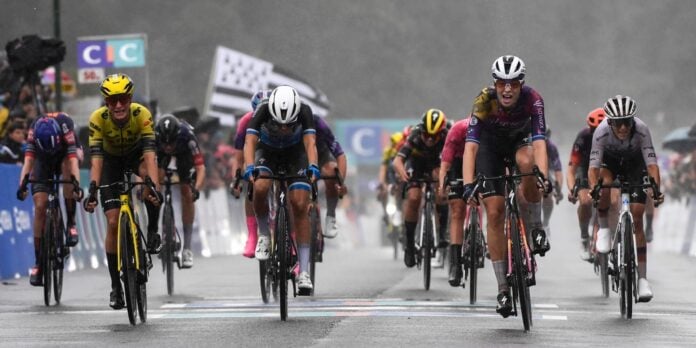
The Classic Lorient Agglomération is one of the longest-established one-day races on the women’s calendar, even if its changing name means plenty of newer fans may know the roads around Plouay better than the race itself.
Previously known in various forms as the GP de Plouay, GP Ouest France-Plouay and GP de Plouay-Bretagne, the race has been held since 2002 and remains part of the UCI Women’s WorldTour. The 2026 edition takes place on Saturday 29 August, six days after the conclusion of the Tour of Britain Women.
The terrain in Brittany makes the race difficult to categorise neatly. It is too hard for most conventional sprinters, but rarely selective enough to guarantee victory for a pure climber. That puts powerful Classics riders, puncheurs and fast finishers at the centre of the race.
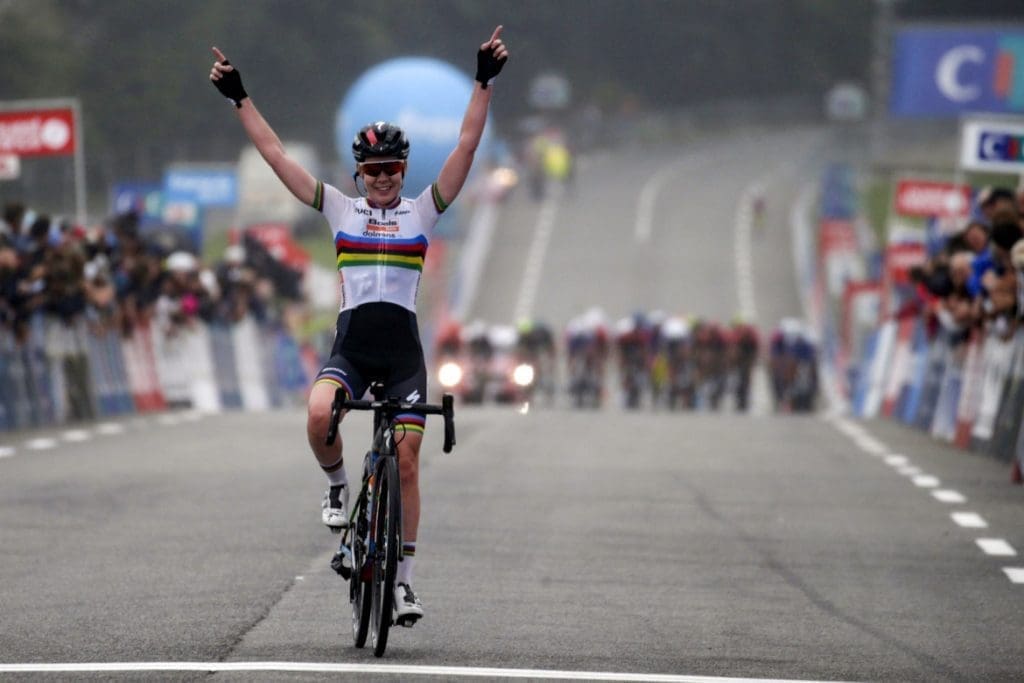
Nobody has solved that equation better recently than Mischa Bredewold. The Dutch rider has won each of the last three editions and returns in 2026 as the three-time defending champion.
What is the Classic Lorient Agglomération?
The Classic Lorient Agglomération is a one-day women’s road race held around Plouay in Brittany, north-west France.
It sits at UCI Women’s WorldTour level, the highest classification available for a women’s professional road race. That places it alongside races such as the Tour of Flanders, Paris-Roubaix Femmes, Amstel Gold Race and Strade Bianche, even if Plouay has a rather different character from the better-known spring Classics.
The first edition was held in 2002. For much of its history it was closely associated with the GP de Plouay name and the same Breton cycling festival that includes the men’s Bretagne Classic.
It formed part of the old UCI Women’s Road World Cup before becoming one of the races included when the Women’s WorldTour was introduced in 2016.
That makes Plouay a useful bridge between different eras of women’s cycling. Nicole Cooke, Emma Pooley, Marianne Vos and Lizzie Deignan won here before the modern WorldTour had fully developed, while the current generation continues to race over many of the same roads.
Our 2025 Classic Lorient Agglomération preview gives a good example of how those characteristics translate into modern racing.
When is Classic Lorient Agglomération 2026?
The 2026 Classic Lorient Agglomération takes place on:
Saturday 29 August 2026
It falls immediately after a busy August stage-racing period and just six days after the conclusion of the five-stage Tour of Britain Women 2026.
That position in the calendar matters.
Some riders arrive carrying excellent form from the Tour de France Femmes and Tour of Britain Women. Others have deliberately eased off after the major summer stage races and are beginning to build towards September objectives.
Plouay therefore tends to bring together riders with very different racing programmes but a similar requirement: enough endurance to handle a long, attritional one-day race.
Where is Plouay?
Plouay is a small town in Brittany, in the Morbihan department of north-west France.
For cycling, however, its importance is much greater than its size suggests.
The town has hosted major racing for decades and staged the 2000 UCI Road World Championships, where Edita Pučinskaitė won the elite women’s road race.
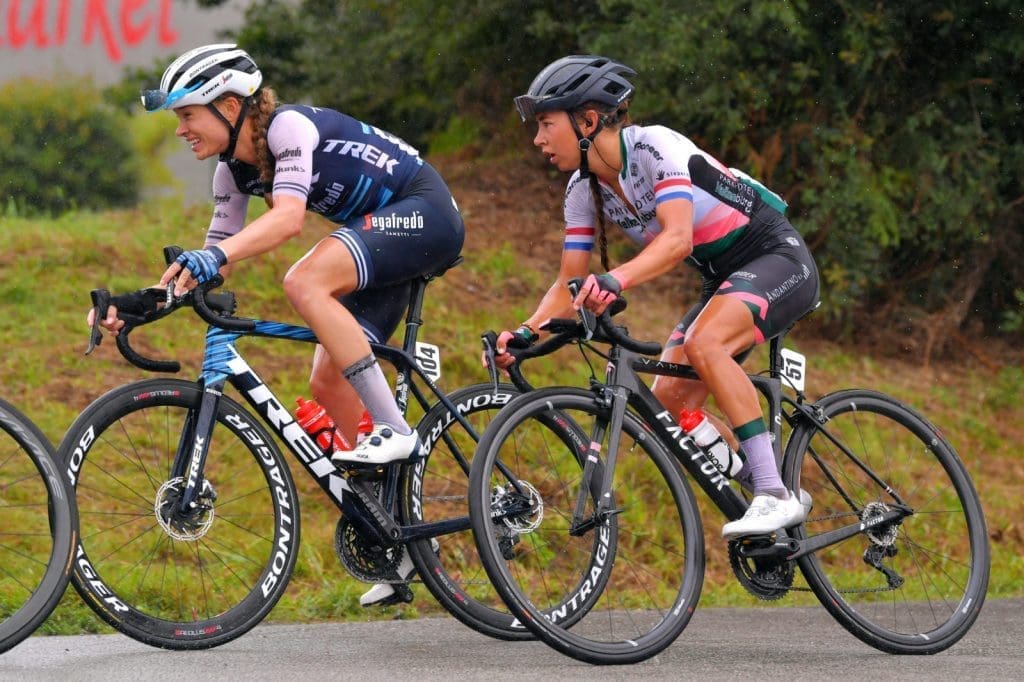
The surrounding roads are almost perfectly designed for selective one-day racing.
They rise and fall constantly without relying on one enormous climb. There are narrow roads, repeated changes in direction and relatively little opportunity for the peloton to settle into a comfortable rhythm.
That produces a race where the bunch can still look relatively large with 40 kilometres remaining before rapidly shrinking after two hard climbs, a series of attacks and another difficult circuit around Plouay.
What is the 2026 Classic Lorient Agglomération route?
The detailed 2026 route has not yet been officially published.
That matters because the exact configuration around Plouay changes between editions. The race keeps the same underlying identity, but organisers can vary the length of the opening loop and the number or structure of the finishing circuits.
The 2025 edition covered 165.3km and became an attritional race across the rolling Breton roads before finishing with the familiar circuits around Plouay.
That day eventually came down to a reduced sprint, with Bredewold beating Marianne Vos and Eline Jansen. Our 2025 Classic Lorient Agglomération race report shows how much selection had already taken place before that sprint became possible.
The previous year was similarly demanding. The 2024 Classic Lorient Agglomération covered around 160km and featured repeated short climbs before Bredewold beat Chloé Dygert and Liane Lippert from a three-rider selection.
That gives a strong indication of what to expect again in 2026: around four hours of rolling, increasingly selective racing with repeated opportunities to attack around Plouay.

Is Classic Lorient Agglomération a climbing race?
Not really.
There are plenty of climbs, but they are generally too short to make this a race for conventional Grand Tour climbers.
The difficulty comes through accumulation.
A rider may comfortably survive one two-kilometre rise. Repeating similar efforts after 140 kilometres while attacks are launching produces a completely different challenge.
There is rarely a single point where everybody knows the race will be decided.
Instead, riders are gradually removed.
That is why the front group can contain very different types of racer.
A strong climber can attack and go clear.
A puncheur can exploit one of the repeated short ascents.
A powerful rouleur can use the rolling terrain to escape.
A fast finisher who survives everything can wait for a reduced sprint.
The unpredictable relationship between those rider types is what makes Plouay interesting.

Why has Mischa Bredewold won three years in a row?
Bredewold is almost perfectly designed for this race.
She is fast enough to beat most riders from a reduced group but strong enough over repeated climbs to survive after the conventional sprinters have disappeared.
Her run began in 2023, when she took her first victory in Plouay from a sprint ahead of Marta Lach and Sofia Bertizzolo. The full race is covered in our report on Bredewold’s first Classic Lorient Agglomération victory.
She repeated the result in 2024, but in a completely different finale, beating Dygert and Lippert from a three-rider group.
Then came the third consecutive victory in 2025.
Bredewold had been caught up in a crash before the finishing circuits but returned to the front of the race and eventually beat Vos from a reduced bunch.
The important point is that she has not required the same race scenario each year.
She has won from a larger reduced sprint and a very small selection. That combination of endurance, climbing strength and finishing speed makes it difficult for rivals to identify one simple way of beating her.
Her 2026 season has reinforced those qualities. Bredewold won the opening stage and then the overall classification at Itzulia Women 2026, another race where surviving repeated climbs while retaining a fast finish was central to success.
Who has won Classic Lorient Agglomération before?
The roll of honour is unusually strong.
Recent winners
- 2025: Mischa Bredewold
- 2024: Mischa Bredewold
- 2023: Mischa Bredewold
- 2022: Mavi García
- 2021: Elisa Longo Borghini
- 2020: Lizzie Deignan
- 2019: Anna van der Breggen
- 2018: Amy Pieters
- 2017: Lizzie Deignan
- 2016: Eugenia Bujak
Further back, Marianne Vos won consecutive editions in 2012 and 2013, while Emma Pooley did the same in 2009 and 2010.
Nicole Cooke won in 2003.
Bredewold’s third successive victory in 2025 moved her level with Deignan on three wins, making them the joint record holders.
The variety of those names explains the race better than any gradient profile.
Pooley was one of the finest pure climbers of her generation. García and Longo Borghini favour hard, attritional races. Deignan and Bredewold combine Classics strength with a fast finish. Vos has spent her career winning across almost every type of terrain.
Plouay does not have one obvious winner profile.

What sort of rider should win in 2026?
Until the route and final start list are confirmed, it makes more sense to think in rider types than to produce a definitive favourites list.
Powerful puncheurs
This is probably the ideal profile.
They can survive the climbs, follow attacks and still sprint from a reduced group.
Bredewold is the clearest recent example.
Classics riders
Strong one-day specialists regularly succeed because positioning, endurance and tactical judgement matter almost as much as pure climbing ability.
A rider who performs well in the Ardennes Classics will usually find something familiar about Plouay, even if the climbs are generally less severe.
Fast climbers
A pure climber can have difficulty removing every faster rider, but someone who combines good climbing with a usable sprint becomes extremely dangerous.
García showed in 2022 that waiting for a conventional sprint is not compulsory. She escaped with Amber Kraak and then won the two-rider contest while the chasing group finished only seconds behind.
Reduced-group sprinters
A rider does not have to be the fastest pure sprinter in the peloton.
The more important requirement is retaining speed after four hours of attrition.
Vos finishing second in 2025 was a perfect example. Most of the field had already been eliminated, but she remained one of the quickest riders left. Bredewold was simply quicker.
How is Classic Lorient Agglomération usually won?
There are three main scenarios.
A reduced sprint
This has been particularly prominent during Bredewold’s winning streak.
The repeated hills eliminate the pure sprinters without producing enough separation between the strongest Classics riders. Somewhere between a handful and a couple of dozen riders arrive together.
The question then becomes who still has a sprint after the work required to reach that point.
A late attack
The finishing circuits provide repeated opportunities to attack tired riders.
A powerful puncheur can create a small gap on one of the final climbs and use the rolling roads afterwards to resist the chase.
This becomes particularly dangerous when several strong teams have different sprint options and nobody wants to take responsibility.
An attritional long-range race
This is the least predictable version.
A strong breakaway establishes itself, major teams begin attacking one another before the final circuit and the race never completely comes back together.
Plouay lends itself to that scenario because there are so few prolonged flat sections where one organised peloton can comfortably control everything.
The live coverage of the 2024 edition showed how quickly the tactical picture can change once the race reaches the finishing circuits.

Is this a sprinters’ Classic?
Calling Classic Lorient Agglomération a sprinters’ race would be misleading.
Bredewold has won three consecutive editions partly because of her sprint, but she only gets to use that sprint because she survives everything before it.
A conventional flat-road sprinter can be dropped long before Plouay.
A better comparison is with the more selective one-day races where repeated climbs steadily alter the composition of the peloton.
The individual ascents may not look especially frightening on paper. The difficulty is racing them repeatedly after three or four hours at WorldTour intensity.
That is why a rider such as Vos historically fits Plouay so well. She has enough climbing ability to survive the selection and enough speed to become dangerous once faster specialists have disappeared.
Why is Classic Lorient Agglomération important?
The race occupies an interesting point in the Women’s WorldTour calendar.
It comes after the Tour de France Femmes and, in 2026, immediately after the expanded five-stage Tour of Britain Women.
Many riders therefore arrive with substantial stage-race kilometres already in their legs.
That creates two competing possibilities.
Some riders carry exceptional form directly into Plouay. Others reach the race fatigued after several weeks of important racing.
It is part of what makes late-August form difficult to predict.
Plouay is also a valuable WorldTour victory in its own right. The strength of the historical winner list means this is much more than preparation for something else.
Winning here puts a rider alongside Cooke, Pooley, Vos, Deignan, Van der Breggen, Longo Borghini and the other major names who have shaped the race.
-
 Photo Credit: Getty



Why does the race have so many different names?
This is probably the most confusing part for newer fans.
The same women’s race has appeared under several names during its history, including:
- GP de Plouay
- GP Ouest France-Plouay
- GP de Plouay-Bretagne
- GP de Plouay – Lorient Agglomération
- Classic Lorient Agglomération – Trophée Ceratizit
- Classic Lorient Agglomération
So if an older article says Nicole Cooke or Marianne Vos won the GP de Plouay and a modern result says Bredewold won the Classic Lorient Agglomération, they are talking about different editions of the same race.
The changing title can make the event appear younger than it really is.
The women’s race has been part of elite international cycling since 2002.
What to watch for in Classic Lorient Agglomération 2026
The first thing to watch is not necessarily who attacks.
It is which fast riders disappear.
Every difficult section changes the tactical balance. Once the fastest sprinters begin losing contact, teams with a quick rider remaining become increasingly reluctant to attack.
That can completely reshape the finale.
Watch the strongest teams on the last circuits around Plouay. If several squads still have numbers, attacks can come one after another. If one team clearly has the fastest rider remaining, expect that team to start closing moves instead.
Then there is Bredewold.
Three consecutive victories mean everybody knows what happens if she arrives at the finish in the front group.
The problem for her rivals is that they have known that for several years already.
So far, knowing has not been enough to stop her.

