
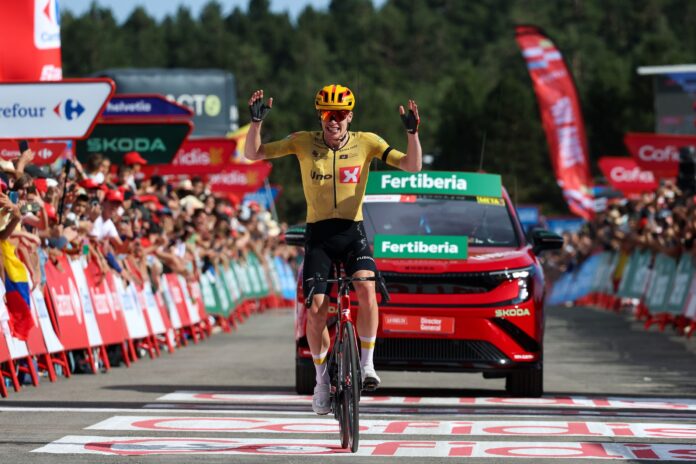
The first rest day of the 2026 Vuelta a España arrives with the strange feeling that the race has already lived through several different versions of itself.
It began in Monaco with Tadej Pogačar winning by less than a tenth of a second. Two days later, riders were sheltering from a violent hailstorm on the Col de Mont-Louis as Stage 3 was first neutralised and then cancelled. Pogačar responded by attacking from 50km out in Andorra and turning the general classification into what looked increasingly like a one-sided contest, while 21-year-old Matthew Brennan quietly accumulated two stage victories on his Grand Tour debut.
Then everything changed again. Pogačar crashed out while wearing the red jersey on a Stage 8 that had been expected to belong to the sprinters. Enric Mas inherited the race lead in circumstances he clearly did not want, only to go to Alto de Aitana 24 hours later and win in red. Oscar Onley followed him to the summit and suddenly became a genuine podium contender, while Primož Roglič and Felix Gall found themselves fighting for a Vuelta they had spent most of the week watching disappear beyond reach.
Even the green jersey has been caught up in the upheaval. Pogačar’s relentless scoring initially made the points competition another extension of his dominance before Wout van Aert moved ahead at Valdelinares. Van Aert reaches the first rest day with a commanding advantage, but Brennan sits second after one of the most extraordinary opening weeks by a Grand Tour debutant in recent years.
Nine stages into the race, the 2026 Vuelta has already delivered a cancelled stage, the longest solo Grand Tour victory of Pogačar’s career, two British sprint wins, a first Grand Tour victory for Bryan Coquard, an emotional Uno-X Mobility one-two, the loss of the overwhelming favourite and a new Spanish leader who immediately proved he intends to defend red rather than merely inherit it.
That is an unusually wild opening week even by Vuelta standards.
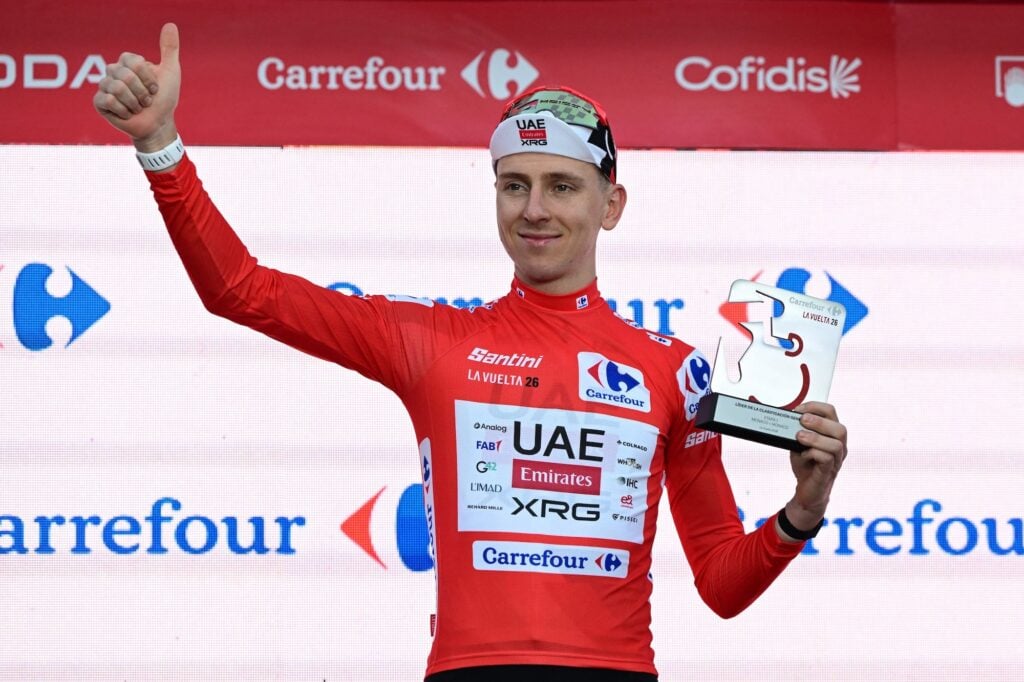 Photo Credit: Getty
Vuelta a España 2026 opening week at a glance
| Stage | Route/result | Winner |
|---|---|---|
| Stage 1 | Monaco to Monaco individual time trial | Tadej Pogačar |
| Stage 2 | Monaco to Manosque | Matthew Brennan |
| Stage 3 | Gruissan-Aude to Font-Romeu | Cancelled after hailstorm |
| Stage 4 | Andorra la Vella to Andorra la Vella | Tadej Pogačar |
| Stage 5 | Falset-Costa Daurada to Roquetes | Matthew Brennan |
| Stage 6 | Alcossebre to Castelló | Tadej Pogačar |
| Stage 7 | Vall d’Alba to Aramón Valdelinares | Andreas Leknessund |
| Stage 8 | Puçol to Xeraco | Bryan Coquard |
| Stage 9 | La Vila Joiosa to Alto de Aitana | Enric Mas |
The sequence alone explains why the first nine days have felt so unpredictable. Pogačar won three of the first six stages and appeared to have established total control. Three stages later, he is no longer in the race and Mas heads into the rest day with a stage victory and a 1:18 advantage over Roglič.
The full Vuelta a España 2026 route guide showed before the start how heavily the first week was loaded with difficulty. What nobody could predict was how much of the drama would come from circumstances completely outside the route itself.
Monaco gave the first warning that this would not be a quiet week
The drama began before the race had settled into Grand Tour rhythm.
Stage 1 was only a 9.4km individual time trial around Monaco, but it produced one of the closest Grand Tour opening victories imaginable. Ethan Hayter appeared to have done enough to take the stage and first red jersey before Pogačar found the required fraction in the closing kilometres and beat him by just 0.09 seconds.
Josh Tarling had earlier occupied the hot seat and eventually finished third at four seconds, while Callum Thornley produced an outstanding fourth place. Roglič was already 22 seconds behind Pogačar, giving the Slovenian an immediate advantage before the race had reached a single classified mountain.
The winning margin was tiny, but the symbolism was familiar. Pogačar had arrived trying to win the only Grand Tour missing from his palmarès and immediately found a way to take the opening stage.
At that point the story looked straightforward. Pogačar had red and the rest were already chasing.
It did not stay straightforward for long.
Matthew Brennan stopped week one becoming only the Pogačar show
Stage 2 introduced the other individual star of the opening week.
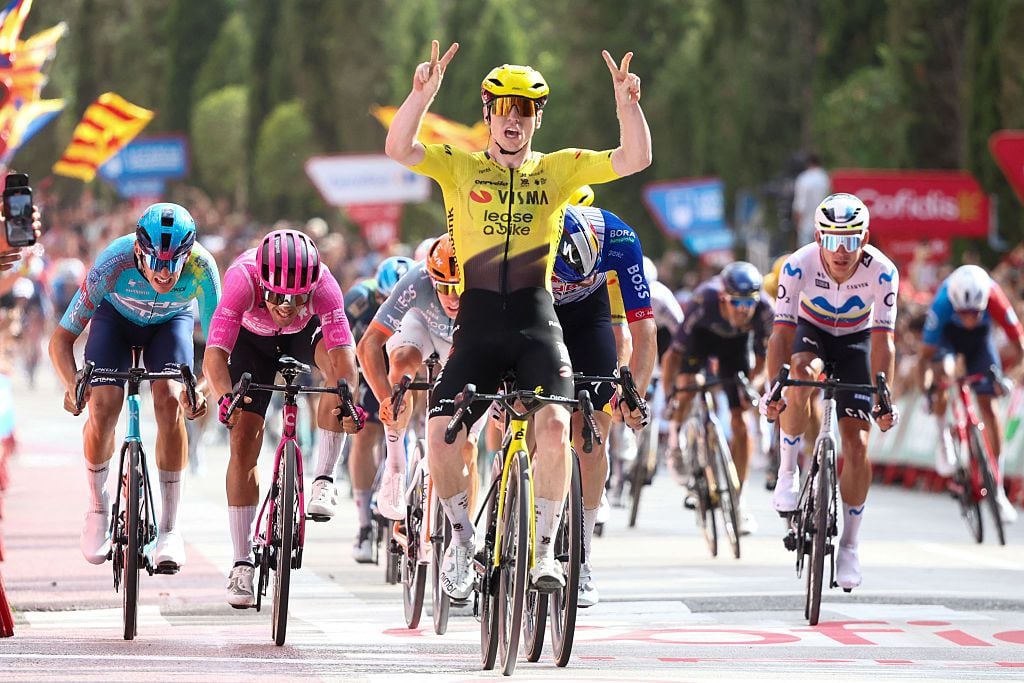
Matthew Brennan arrived at the Vuelta at 21 years old, racing his first Grand Tour and with far less pressure than riders such as Van Aert, Mads Pedersen or the established GC contenders. By the end of his first conventional road stage, he already had a Grand Tour victory.
The finish in Manosque was not a completely flat sprint. It rose towards the line and came after an aggressive finale in which Team Visma | Lease a Bike used its strength around Brennan before the Brit beat Pau Miquel and Pogačar to win Stage 2.
It was easy at that point to describe the result as an exceptional breakthrough by one of the youngest riders in the race.
Stage 5 would make that interpretation look too conservative.
The Stage 3 hailstorm turned a mountain race into a safety operation
The first significant mountain verdict was supposed to come on Stage 3.
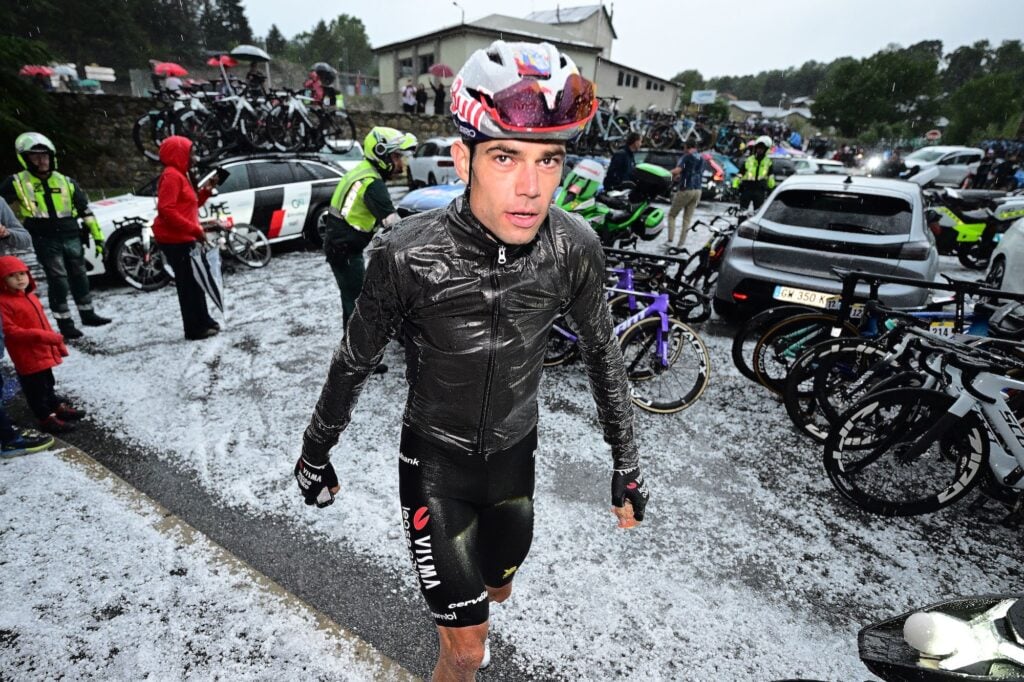
Instead, the Vuelta produced some of the most extraordinary images of the season.
The route from Gruissan-Aude towards Font-Romeu had begun to climb towards the Col de Mont-Louis when conditions deteriorated rapidly. Heavy rain became severe hail, temperatures dropped and riders who had expected to be fighting over the first summit finish were suddenly looking for shelter from the weather.
The race was initially neutralised in the hope that conditions might improve, but there was no realistic way to restart once riders had stopped, become soaked and were spread across the mountain. Organisers eventually cancelled the stage completely.
There was no stage winner and no GC finish at Font-Romeu. ProCyclingUK’s full account of the Stage 3 hailstorm and cancellation covers how quickly a tactical mountain stage became primarily a question of rider safety.
The cancellation also created an unusual situation for the rest of the Vuelta. Results already recorded at intermediate points remained relevant, but there could be no finishing times or winner. The Font-Romeu stage will not be rescheduled, meaning the 2026 Vuelta can now reach Granada with only 20 completed stages if everything else runs as planned.
That sent the race into Andorra still waiting for its first proper mountain hierarchy.
Pogačar provided one in the most emphatic way possible.
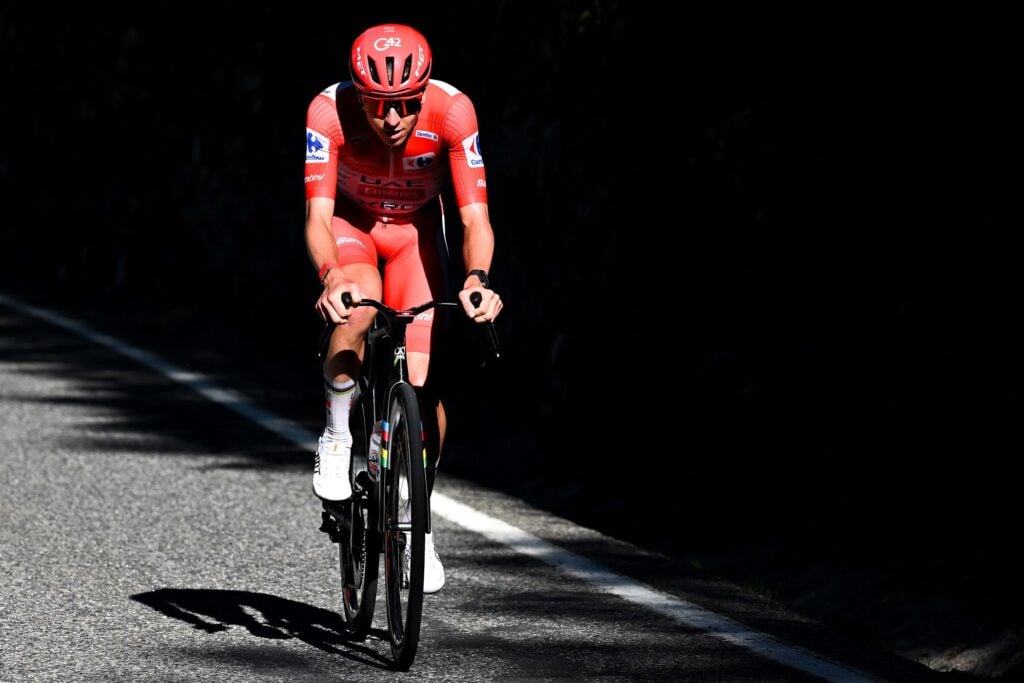 Photo Credit: Getty
Pogačar’s Andorra raid looked like the moment the Vuelta was won
Stage 4 was only 104.8km long, but Pogačar treated it almost like a one-day Classic.
He attacked with exactly 50km remaining on the Collada de Beixalis and rode away. There was no waiting for a summit finish, no concern about preserving energy in the opening week and no attempt to grind out a small advantage through bonus seconds.
Pogačar simply disappeared.
By the time he reached Andorra la Vella, he had gained 2:39 on Jarno Widar and the nearest chasers, completing the longest solo Grand Tour victory of his career.
The effect on the general classification was immediate. Roglič was already 3:21 behind and Mas 3:32 down. Every established GC rival was suddenly dealing with a deficit that would normally take several mountain stages to repair.
There was also a neat historical symmetry. Andorra was where Pogačar had taken the first Grand Tour stage victory of his career at the 2019 Vuelta. Seven years later he returned as the dominant rider in world cycling and produced an attack vastly more destructive than anything the 20-year-old version had managed.
The problem for everyone else was not simply the three-minute gap. It was the manner in which Pogačar had created it. Recovering that amount of time from a rider who appeared capable of riding away whenever he chose already looked close to impossible.
Brennan’s second victory changed his entire Vuelta
While Pogačar dominated the overall conversation, Brennan was building another remarkable story around the faster stages.
Stage 5 to Roquetes provided a different challenge from Manosque. The late Puerto de Paüls put some of the sprinters under pressure, while the technical approach meant positioning and team support mattered almost as much as outright speed.
Visma handled it superbly.
Christophe Laporte and Van Aert helped bring Brennan through the finale before the Brit won again in Roquetes.
Two victories in five stages changed the meaning of his debut. Brennan was no longer simply a talented young rider who had taken advantage of an unusual uphill sprint in Manosque. He had effectively converted both of the opening-week finishes that properly suited him.
That prompted a much larger discussion around how many opportunities might still be available. ProCyclingUK looked at that immediately after Stage 5 in Matthew Brennan’s remarkable Vuelta debut is becoming much bigger than two stage wins.
The points competition also became realistic. Brennan’s problem was that the rider repeatedly collecting large stage points on the mountain days was the same man dominating the general classification.
Stage 6 gave the first clue that Mas might be capable of something bigger
Pogačar won again on Stage 6, but Castelló produced one of the most important performances of the opening week from somebody else.
The red jersey attacked on the steep gravel section of Puerto El Bartolo and initially distanced the other contenders. Onley tried to respond and paid for the effort, while the rest appeared to be falling into the familiar pattern of limiting their losses.
Mas did something different.
The Movistar leader rode back to Pogačar before the summit and even came past him briefly, becoming the first rider during the opening week to answer one of Pogačar’s serious climbing attacks. The pair then worked together towards Castelló before Pogačar beat Mas in the sprint to win Stage 6.
Pogačar still had an enormous advantage because of the damage done in Andorra, but Mas had demonstrated something no other contender had managed. He could at least make the red jersey work.
At the time, it looked like evidence that Mas was becoming the strongest candidate for second overall.
By the end of Stage 9, it looked much more like the first indication that he might eventually be capable of leading the race himself.
Valdelinares gave Uno-X its moment and Van Aert the green jersey
Stage 7 finally allowed the breakaway to take centre stage.
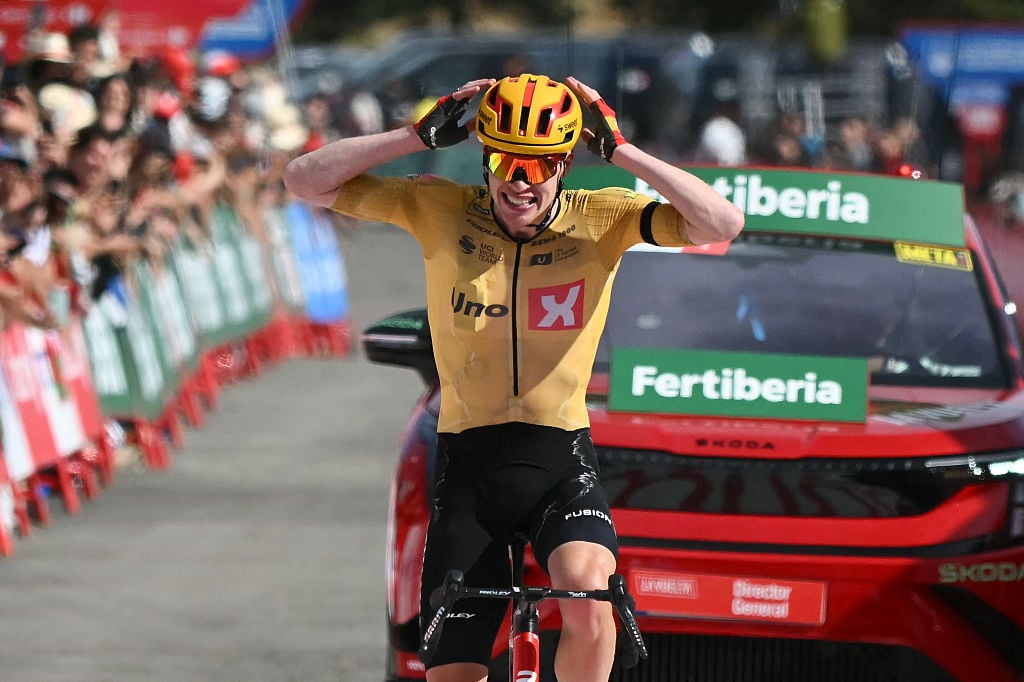
Andreas Leknessund attacked on the final climb to Aramón Valdelinares and secured his first Grand Tour stage victory, with Tobias Halland Johannessen completing an emotional Uno-X Mobility one-two.
It was a near-perfect piece of team racing. Leknessund attacked with 7.5km remaining, leaving Van Aert and the other chasers to decide how much work they were prepared to do while Johannessen could sit behind them. When Van Aert eventually began to fade, Johannessen attacked as well to secure second.
Pogačar still found a way to leave his mark on the stage. He attacked from the GC group late on Valdelinares and gained another 29 seconds on Roglič, Kuss and Onley, pushing his overall advantage over Mas to 3:50.
By Friday evening, the Vuelta looked even more secure than it had after Andorra.
There was, however, one classification Pogačar finally lost. Van Aert’s all-day breakaway effort and intermediate sprint points moved him ahead in the green jersey competition, ending the unusual period in which Pogačar’s combination of time-trialling, climbing and finishing speed had allowed him to dominate several classifications at once.
ProCyclingUK’s Vuelta jersey guide explains how the points system rewards exactly the versatility Van Aert has demonstrated throughout the opening week.
Twenty-four hours later, Pogačar would disappear from every classification entirely.
Stage 8 was supposed to be Pogačar’s quiet day
Few stages demonstrate the unpredictability of a Grand Tour better than the road from Puçol to Xeraco.
Stage 8 had been marked as one of the clearest opportunities for the sprinters. Puerto de Barx provided a late complication, but the GC riders had no tactical reason to attack. UAE Team Emirates-XRG simply needed to keep Pogačar safe between Valdelinares and the huge Alto de Aitana mountain stage.
He never reached Barx.
With around 32km remaining, Pogačar crashed heavily in the peloton. Television pictures showed him getting back to his feet and attempting to return to his bike before sitting down again, with obvious discomfort around his left shoulder and arm.
He eventually walked towards the ambulance and abandoned the Vuelta while holding a 3:50 lead.
Further medical examinations confirmed a displaced fracture of his left clavicle, a concussion and a stable C7 cervical vertebra fracture. What had looked increasingly like a race Pogačar could only lose through misfortune had ended through exactly that.
One of the most dominant opening weeks seen at a recent Grand Tour was over on a stage where he had no reason to be involved in the fight for victory.
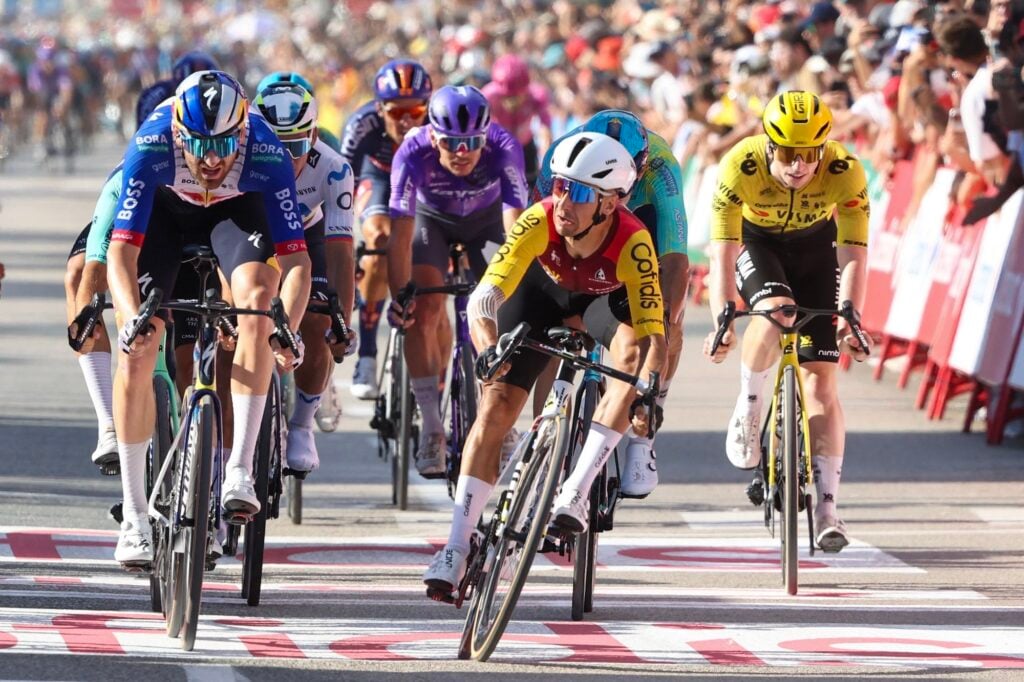 Photo Credit: Getty
Coquard finally won a Grand Tour stage on the day the sprint became secondary
There was still a race to finish after Pogačar left in the ambulance.
Bryan Coquard produced one of the biggest victories of his career, timing his sprint in Xeraco to beat Mads Pedersen and finally secure his first Grand Tour stage victory.
On almost any other day, that would have been the defining story.
Instead, the Stage 8 race report became primarily the account of how a sprint stage had destroyed the general classification.
Mas moved into the red jersey for the first time in his career. The circumstances were uncomfortable enough that he held the jersey rather than putting it on during the podium ceremony, making clear that this was not how he wanted to take control of his home Grand Tour.
Remove Pogačar from the standings and the entire race compressed instantly. Roglič went from almost five minutes behind the leader to only one minute from red. Gall was at 1:11. Kuss, Onley and Carapaz were all within 2:22 of Mas.
The Vuelta everyone had spent seven stages trying to solve had disappeared in one crash.
Alto de Aitana immediately forced Mas to prove himself
There was no gentle transition into the post-Pogačar Vuelta.
Stage 9 contained almost 5,000 metres of climbing, six categorised ascents and the 22km Alto de Aitana summit finish. It was comfortably the hardest sustained mountain test of the opening week and immediately forced Mas to prove whether he could defend a jersey acquired through somebody else’s misfortune.
He did considerably more than defend it.
Movistar accepted responsibility for controlling the stage before Decathlon CMA CGM Team increased the pressure for Gall on Aitana. Kuss was dropped, Carapaz attacked and was caught, and Gall tried to create separation before Mas eventually launched the move that settled the GC contest with around three kilometres remaining.
Only Onley followed.
Mas then beat Onley at the summit to win Stage 9, putting 12 seconds into Roglič and 18 into Gall.
The victory changed the tone around the red jersey completely. Mas had inherited it on Saturday. By Sunday evening, he had won one of the hardest mountain stages of the Vuelta while wearing it.
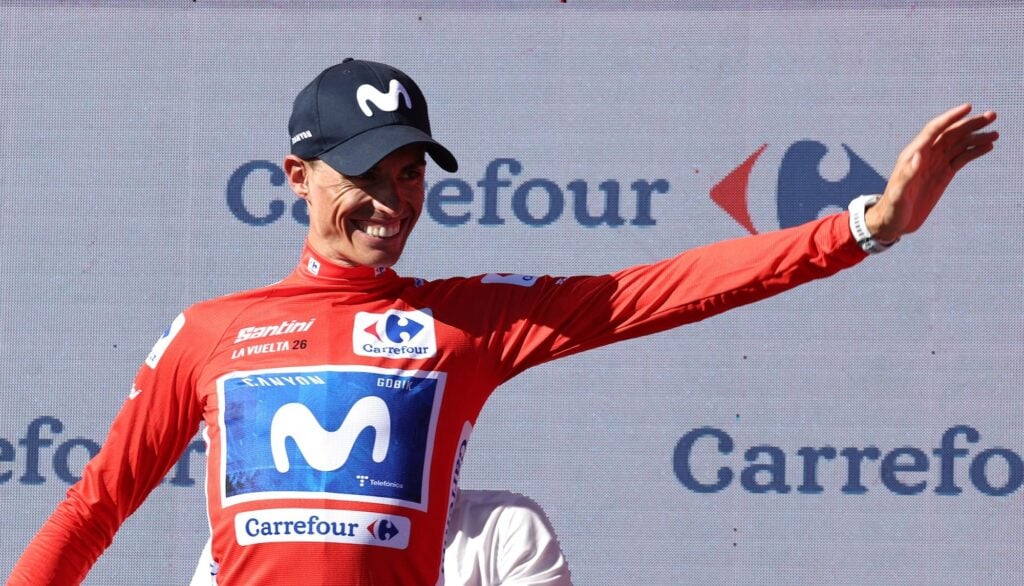 Photo Credit: Getty
Mas reaches the rest day as much more than Pogačar’s replacement
The general classification after Aitana gives week two a completely different structure.
| Position | Rider | Team | Gap |
|---|---|---|---|
| 1 | Enric Mas | Movistar Team | Leader |
| 2 | Primož Roglič | Red Bull-BORA-hansgrohe | +1:18 |
| 3 | Felix Gall | Decathlon CMA CGM Team | +1:39 |
| 4 | Oscar Onley | Netcompany INEOS | +2:20 |
| 5 | Richard Carapaz | EF Education-EasyPost | +3:25 |
| 6 | Mattias Skjelmose | Lidl-Trek | +3:55 |
| 7 | Sepp Kuss | Team Visma | Lease a Bike | +4:09 |
Mas has the advantage and the strongest recent climbing result. Roglič has four Vuelta victories and the Stage 18 individual time trial. Gall has a team capable of turning mountain stages into extended tests of pure climbing. Carapaz now has enough time to recover that conservative racing is unlikely to help him, while Kuss needs a response after losing 1:44 to Mas on Aitana.
The bigger question of who can actually convert that position into overall victory is covered separately in ProCyclingUK’s updated Vuelta GC contenders analysis after Stage 9.
What matters for the retrospective is how radically the picture has shifted. Nobody reaches the rest day with anything approaching Pogačar’s former control.
The Vuelta is open again.
Oscar Onley has moved from British hope to genuine podium contender
The British opening week would already have been remarkable without Onley.
Hayter missed the first red jersey by 0.09 seconds. Tarling finished third in Monaco. Brennan has won twice. Yet Onley’s performance on Aitana may eventually carry the greatest significance because it placed a British rider firmly inside a Grand Tour podium fight.
Onley did not simply limit his losses on Stage 9. When Mas made the decisive attack, he was the only rider capable of following. Roglič could not go with them, Gall could not go with them and Carapaz had already spent his effort trying to attack earlier.
Onley reached the finish on the same time as Mas and enters the rest day fourth overall, only 41 seconds behind Gall’s podium position.
That performance deserves more than a supporting role within the GC story. ProCyclingUK’s separate look at Oscar Onley’s Aitana ride and his genuine Vuelta podium chance examines how significantly his target has changed in nine stages.
Before Monaco, a top-five finish would have represented an excellent Vuelta.
After Aitana, the podium is the obvious target.
Van Aert has taken control of green
The changing general classification has understandably dominated attention, but the points race has developed almost as dramatically.
Pogačar’s ability to win time trials, mountain stages and uphill finishes initially made him a serious green jersey contender despite the presence of several specialist fast riders. Brennan’s two victories immediately put him near the top as well, while Van Aert accumulated points through intermediate sprints, breakaways and high finishes.
Valdelinares moved Van Aert into green and Pogačar’s Stage 8 withdrawal removed the most unusual threat to the sprint-oriented riders completely.
The standings heading into the first rest day are:
| Position | Rider | Points |
|---|---|---|
| 1 | Wout van Aert | 124 |
| 2 | Matthew Brennan | 67 |
| 3 | Alessandro Romele | 59 |
| 4 | Mads Pedersen | 58 |
| 5 | Ethan Hayter | 57 |
| 6 | Christophe Laporte | 52 |
Van Aert’s advantage is already substantial, but the identity of the rider immediately behind him tells another part of the opening-week story. Brennan has two stage wins and has gone from Grand Tour debutant to the closest challenger for green in nine stages.
The classification is another example of how completely the race has changed. Pogačar threatened to make green a by-product of his overall dominance. By the rest day, Van Aert is firmly in control and Brennan has a reason to think about the competition across the remaining two weeks.
Buitrago used Aitana to take over the mountains classification
The blue polka-dot jersey has been fluid as well.
Pogačar accumulated substantial mountain points through his stage victories, while Leknessund and Van Aert both used the breakaway at Valdelinares to move strongly into the competition.
Stage 9 changed it again.
Santiago Buitrago spent much of the day deliberately collecting points from the breakaway, taking maximum points over several of the categorised climbs and emerging as the new mountains leader.
The standings entering the rest day have Buitrago on 29 points, ahead of Mas on 24 and Leknessund on 19.
That competition should become increasingly suited to breakaway specialists during week two as more riders fall far enough behind on GC to receive freedom. The loss of Pogačar also removes a rider who could accumulate huge totals simply by trying to win the overall race.
For the first time this Vuelta, red, green and the mountains jersey all have very different races developing around them.

Week one showed how quickly every sensible prediction could become obsolete
Perhaps the defining feature of the first nine stages is how many perfectly logical expectations became irrelevant almost immediately.
Stage 3 was supposed to provide the first mountain selection. The weather cancelled it.
Stage 4 was short enough that controlled GC racing looked plausible. Pogačar attacked from 50km out.
Brennan arrived to discover how a Grand Tour worked. He won two of his first five stages.
Stage 8 was supposed to be one of the safest days for Pogačar between mountain finishes. It ended his race.
Mas moved into red because Pogačar crashed. Less than 24 hours later he won on Aitana and made the jersey completely his own.
Onley started the Vuelta as an interesting British top-five candidate. He reaches the first rest day 41 seconds from the podium.
That unpredictability is why the opening week cannot really be understood simply by looking at the standings. The hierarchy has been shaped by exceptional performance, extreme weather, emerging young riders and one crash that removed the rider around whom almost every pre-race calculation had been built.
The race starting week two bears little resemblance to the one that left Monaco
The peloton gets Monday off before Stage 10 from Alcaraz to Elche de la Sierra begins the second week.
The race restarting on Tuesday bears almost no resemblance to the one that began nine stages earlier.
Pogačar left Monaco in red after winning by 0.09 seconds and looked increasingly untouchable after his 50km raid in Andorra. He reaches the first rest day recovering from serious injuries and preparing for surgery rather than preparing to defend an advantage approaching four minutes.
Mas began the race as one of several riders hoping to remain somewhere near Pogačar. He enters the rest day as the Vuelta leader and winner on Alto de Aitana.
Roglič spent most of the week losing ground to the overwhelming favourite. He is now 1:18 from a fifth Vuelta title. Gall has a realistic route towards red. Onley has a realistic route onto the podium. Brennan already has two Grand Tour stage victories. Van Aert controls the green jersey, while Buitrago has emerged from the Aitana breakaway with the mountains lead.
The hailstorm that stopped Stage 3 had already ensured this would be remembered as an unusual opening week.
Everything that followed made it extraordinary.
The first rest day is normally an opportunity to assess how a Grand Tour has begun. At the 2026 Vuelta, it feels more like the pause between two completely different races.

