
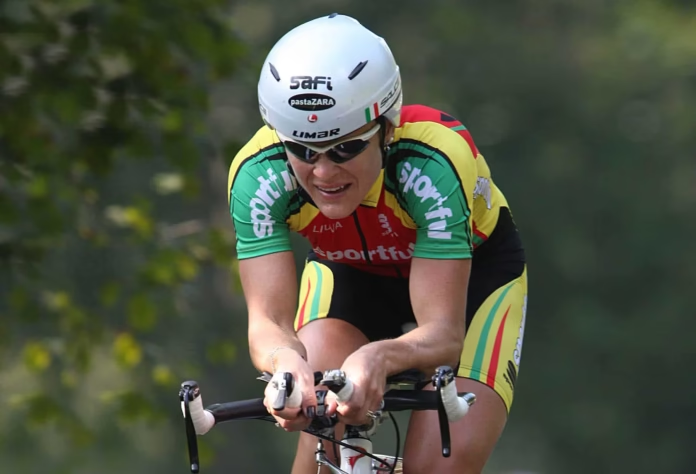
Diana Žiliūtė belongs to a generation of women’s cyclists whose palmarès deserves considerably more attention than the coverage available during their careers ever allowed.
The Lithuanian became road world champion at 22, won the biggest women’s stage race in France, twice topped the season-long UCI Women’s Road World Cup and collected an Olympic bronze medal. She won Classics, national titles and Giro d’Italia Femminile stages, while remaining competitive at the highest level for well over a decade.
There was also unusual range to the way she accumulated those results. Žiliūtė could sprint from a reduced group, survive difficult climbing, win from attacking situations and hold together a general classification across a long stage race. She was not built around one speciality.
That versatility made her one of the defining riders of women’s racing around the turn of the millennium and one of the most successful Lithuanian cyclists of any era.
Her career also sits at an important point in the wider history of women’s cycling. Žiliūtė raced before the Women’s WorldTour, before the current Tour de France Femmes and before many of the professional structures now taken for granted. Yet the level at the front of the biggest races was already exceptionally high.
Žiliūtė was one of the riders setting it.
From Lithuania to the top of European cycling
Born in Rietavas in 1976, Žiliūtė emerged internationally while still a teenager.
She became junior road world champion in 1994, an early indication that Lithuania had produced another major talent during a particularly strong period for the country’s women’s cycling programme.
By the middle of the decade she was already competing successfully against elite riders. A Giro d’Italia Femminile stage victory arrived in 1996, along with third at Trofeo Alfredo Binda. In 1997 she won four Giro stages and finished ninth overall.
Those early results established the profile that would define much of her career.
Žiliūtė was quick, but she was not simply a sprinter. She climbed too well for that description. She could also withstand the repeated efforts of a difficult one-day race and retain enough speed to finish the job afterwards.
An earlier ProCyclingUK look at Žiliūtė as a Spring Classics rider described her as the kind of all-round fast finisher who would become increasingly familiar in later generations of women’s racing.
By 1998, potential had become dominance.
1998 turned Žiliūtė into a world champion
The 1998 season remains one of the defining years of Žiliūtė’s career.
The newly established UCI Women’s Road World Cup brought together the leading one-day races into a season-long competition. Žiliūtė won the overall classification emphatically, taking two of the six rounds and finishing with more than twice the points total of second-placed Alessandra Cappellotto.
It was evidence of something more substantial than the ability to peak for one race.
World Cup success required a rider to perform repeatedly across changing terrain and conditions. Žiliūtė could do that because there were relatively few one-day courses on which she was completely out of place.
Then came Valkenburg.
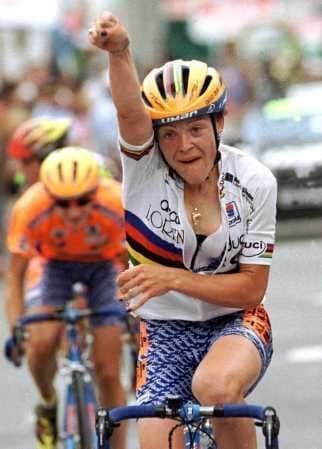
Žiliūtė won the 1998 UCI Road World Championships, denying Leontien van Moorsel a home victory in the Netherlands and taking one of cycling’s most recognisable jerseys back to Lithuania.
It remains the result most immediately associated with her career.
The significance was considerable. The women’s road race had already produced champions such as Jeannie Longo, Beryl Burton, Maria Canins and van Moorsel. Žiliūtė added herself to that line at only 22 years old.
Her victory also forms part of a remarkable Lithuanian period. Edita Pučinskaitė succeeded her as world champion in Verona the following season, while Rasa Polikevičiūtė would take the title in 2001.
For more on how the rainbow jersey developed into one of cycling’s defining prizes, see ProCyclingUK’s history of the road cycling World Championships.
Žiliūtė was not finished at Worlds either. She returned in 1999 and finished third, then remained capable of major championship performances deep into the following decade.
The Grande Boucle made her a Grand Tour winner
Her biggest stage-race victory followed in 1999.
Žiliūtė won the Grande Boucle Féminine Internationale, the major French women’s stage race that had inherited the space left by the earlier women’s Tour de France.
It is important to get the historical distinction right.
The race Žiliūtė won was not the modern Tour de France Femmes and, by 1999, could no longer use the Tour de France name. From 1998 it operated as the Grande Boucle Féminine Internationale.
Sportingly, however, it remained one of the biggest stage-race tests available to the women’s peloton.
Žiliūtė beat compatriot Edita Pučinskaitė, the defending champion, and Russia’s Valentina Polkhanova to take the overall victory.
The achievement places her among a formidable run of Grande Boucle winners that also included Fabiana Luperini, Joane Somarriba, Nicole Cooke and Emma Pooley.
ProCyclingUK’s complete history of the Tour de France Femmes and the races that preceded it puts Žiliūtė’s 1999 victory into that broader and occasionally complicated lineage.
For Žiliūtė herself, the result proved that she could do far more than win one-day races.
A world champion capable of surviving and controlling a major stage race became a much harder rider to categorise.
Two World Cups confirmed her consistency
Žiliūtė had won the inaugural World Cup in 1998.
She did it again in 2000.
The second title was closer, but perhaps more revealing. By then everybody knew how dangerous she was, yet she continued accumulating results across a calendar designed to identify the best one-day rider over an entire season.
Her 2000 campaign included victory in the Primavera Rosa, the women’s version of Milan-San Remo held between 1999 and 2005.
Žiliūtė survived the Cipressa and Poggio before winning the reduced sprint, beating Ina-Yoko Teutenberg after teammate Marion Clignet had helped close a late move.
The race itself disappeared after 2005, becoming one of the notable missing events from the women’s calendar before the eventual return of a women’s Milan-San Remo format decades later. ProCyclingUK previously looked at the history of the Primavera Rosa and the long push for a women’s Milan-San Remo.
Žiliūtė also finished fourth at La Flèche Wallonne that season and continued collecting results across North America and Europe.
Winning the World Cup twice is an important part of her reputation because it demonstrates just how repeatable her performances were.
A world title can come from one perfect afternoon.
Žiliūtė had those afternoons, but she also had whole seasons.
Sydney added an Olympic medal
The same year brought another of her major career results.
At the Sydney Olympics, Žiliūtė finished third in the women’s road race, taking bronze behind Leontien van Moorsel and Hanka Kupfernagel.
The race came down to a tightly packed finish, with Žiliūtė securing Lithuania another major international cycling medal.
She also finished ninth in the individual time trial.
The Olympic bronze gives Žiliūtė’s palmarès unusual completeness. Across a relatively short period she had won a world championship, a major stage race, two World Cups and an Olympic medal.
Those are achievements across very different formats.
She was much more than a late-1990s phenomenon
It would be easy to treat the years from 1998 to 2000 as Žiliūtė’s entire peak.
Her career lasted much longer.
She finished second overall at the Giro d’Italia Femminile in 2001, adding a stage victory, and followed that with third overall in 2002.
That is another useful measure of her versatility. The Giro has traditionally rewarded much stronger climbing than most of the one-day races Žiliūtė won, yet she remained capable of challenging for the overall classification.
Her Classics results continued too.
Žiliūtė won Trofeo Alfredo Binda in 2003, one of the oldest and most prestigious races in women’s cycling. She also won Rund um die Nürnberger Altstadt, then a World Cup event, during the same season.
Her relationship with Trofeo Alfredo Binda stretched across much of her career. She had already finished third there as a 19-year-old in 1996, returned to the podium in 2001, won in 2003, finished second in 2006 and was third again in 2008.
That longevity at one of the calendar’s most selective one-day races says plenty about the sort of rider she was.
A rider without one obvious speciality
Žiliūtė’s results make more sense when viewed together.
A conventional sprinter does not finish second in the Giro.
A pure climber does not win Primavera Rosa from a sprint.
A specialist stage racer does not twice win the World Cup.
Žiliūtė occupied the space between those categories.
Her sprint was good enough to make small groups dangerous for her rivals. Her climbing was strong enough that simply making the race hard did not necessarily remove her. She was also comfortable racing aggressively when the circumstances demanded it.
That meant opponents often had no easy way of getting rid of her.
Take Žiliūtė to the finish and she might beat you.
Attack on rolling terrain and she could follow.
Make a stage race consistently difficult and she remained capable of challenging overall.
It is the type of versatility increasingly associated with modern women’s cycling, where riders such as Marianne Vos have repeatedly blurred the distinction between sprinter, Classics specialist and stage racer.
Žiliūtė was doing much the same thing a generation earlier.
Italian teams became central to her career
Like many leading riders of her era, Žiliūtė’s professional career was closely connected to Italy.
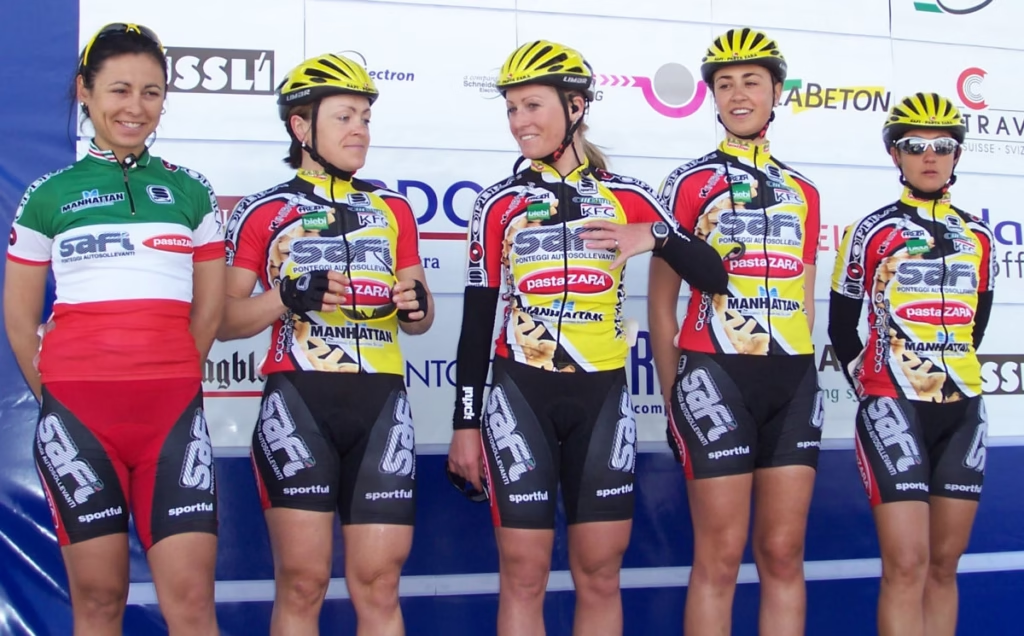
Italian trade teams provided much of the structure around elite women’s road racing during the 1990s and 2000s, with squads such as Acca Due O, Safi-Pasta Zara and their various successors becoming important fixtures in the international peloton.
For a Lithuanian rider, racing within those structures meant access to a much denser programme and to teams accustomed to competing in the major European events.
Žiliūtė became one of the most recognisable riders within that world.
It was an era when women’s teams could change sponsors and identities quickly, budgets were uncertain and the distinction between a major international programme and a struggling team could be considerable.
Her longevity through that period should not be treated as incidental.
The final years still contained major results
Žiliūtė remained competitive well beyond the point where many riders from her generation had disappeared from the front of the sport.
In 2006 she won multiple races and returned to the Trofeo Alfredo Binda podium.
Two years later, she went back to the Grande Boucle Féminine Internationale and won three stages on her way to sixth overall.
Then came an unusually successful final season in 2009.
Žiliūtė won the Trophée d’Or Féminin overall and the Giro della Toscana Femminile overall, adding several stages across those races.
Her final World Championships provided an appropriate ending.
Eleven years after winning the rainbow jersey at Valkenburg, Žiliūtė finished fifth in the 2009 road race in Mendrisio.
She retired still capable of competing near the front of a World Championship.
The results that define Diana Žiliūtė’s career
Žiliūtė’s career contains far more victories than can sensibly fit into one short list, but several achievements explain her historical standing:
- 1998 UCI road world champion
- 1998 and 2000 UCI Women’s Road World Cup winner
- 1999 Grande Boucle Féminine Internationale winner
- Bronze medal in the 2000 Olympic road race
- 2000 Primavera Rosa winner
- Second overall at the 2001 Giro d’Italia Femminile
- Third overall at the 2002 Giro d’Italia Femminile
- 2003 Trofeo Alfredo Binda winner
- Multiple Giro d’Italia Femminile stage victories
- Multiple Lithuanian road and time trial titles
- 2009 Trophée d’Or Féminin winner
- 2009 Giro della Toscana Femminile winner
What stands out is not simply the quantity.
It is the lack of repetition in the type of victory.
-
 Photo Credit: Lezyne
 -
 Photo Credit: David Pintens / BELGA MAG/AFP via Getty Images
Why Žiliūtė matters to Lithuanian cycling
Lithuania produced an extraordinary group of women’s riders around Žiliūtė’s generation.
Pučinskaitė became world champion and Giro winner. Polikevičiūtė won the rainbow jersey. Žiliūtė herself became world champion, World Cup winner, Olympic medallist and Grande Boucle champion.
That level of international success was remarkable for a country with a population far smaller than Europe’s traditional cycling powers.
Žiliūtė became one of its most recognisable representatives.
Her sporting importance in Lithuania also went beyond cycling results. She was named Lithuania’s leading sportswoman in 1998 after becoming world champion and received major national honours during the peak of her career.
That context matters when judging her place in the sport.
Žiliūtė was not simply a successful professional cyclist who happened to be Lithuanian. She was one of the athletes who made Lithuanian cycling internationally important during one of its strongest periods.
A career that deserves to be remembered in full
The rainbow jersey is the obvious starting point with Diana Žiliūtė, but it is not enough on its own.
She won the 1998 World Championships at 22 and could easily have built a historical reputation around that afternoon alone.
Instead, she won the biggest French women’s stage race the following year, claimed a second World Cup in 2000, took an Olympic medal, challenged for the Giro overall and remained a major Classics rider into the second half of the decade.
Eleven years separated her world title from fifth place at her final World Championships.
That longevity is as important as the peak.
The ProCyclingUK women’s rider history collection contains riders from very different eras, but Žiliūtė occupies a particularly interesting position within it. Her career came before the modern professional structures while containing the sort of range now associated with the most complete riders in the peloton.
World champion. Grand Tour winner. Twice the best World Cup rider across an entire season. Olympic medallist.
Diana Žiliūtė did not simply produce one of Lithuanian cycling’s great careers.
She produced one of the strongest all-round palmarès in women’s road racing at the turn of the century.

