
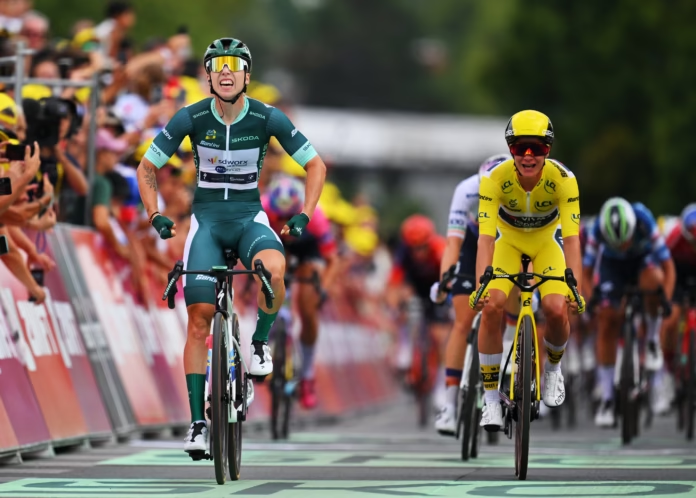
The green jersey at the Tour de France Femmes rewards consistency across the race rather than simply the rider who wins the most bunch sprints.
Points are available at every stage finish and at intermediate sprints, with the amount awarded at the finish changing according to the type of stage. That weighting gives the fastest sprinters a clear advantage on flat days, but it also leaves room for versatile riders who can survive hilly stages, collect intermediate points and continue scoring when the pure sprinters begin to struggle.
For the 2026 Tour, that distinction matters. Lorena Wiebes and Charlotte Kool remain the obvious pure sprint references, but Marianne Vos, Elisa Balsamo, Lotte Kopecky, Noemi Rüegg and several other riders can score across a wider range of terrain.
The green jersey therefore becomes a race within the race, shaped not only by who is quickest in Geneva or Nice, but by who can keep scoring from Lausanne all the way through the mountains. The wider picture of all four classifications is covered in our Tour de France Femmes 2026 jerseys explained guide.
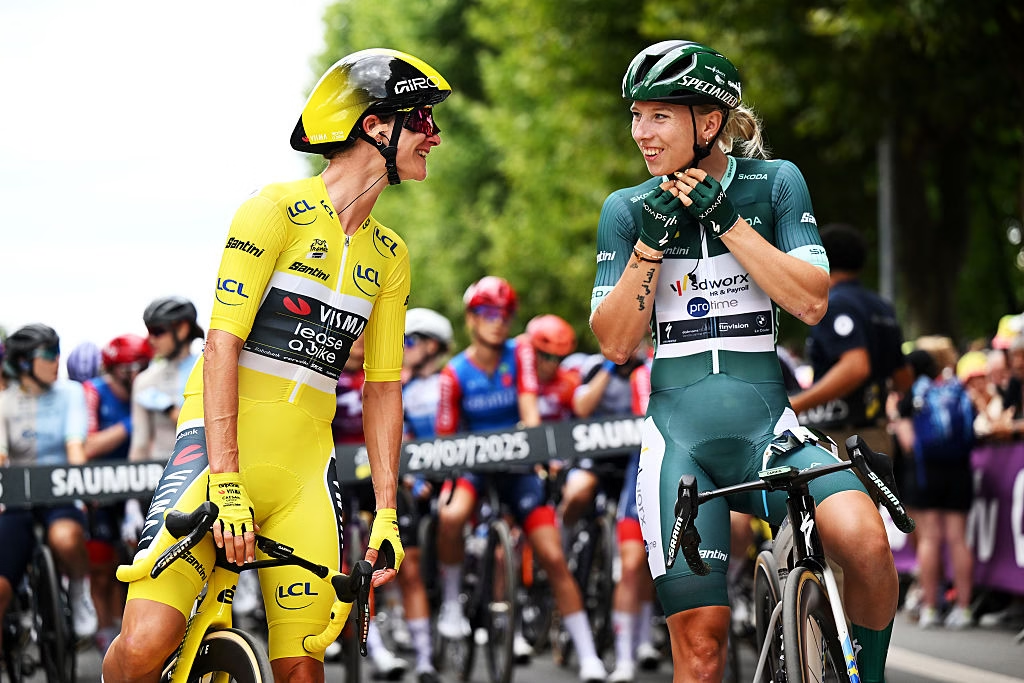 Photo Credit: Getty
What is the green jersey at the Tour de France Femmes?
The green jersey is worn by the leader of the points classification.
Unlike the yellow jersey, which is decided by cumulative time, the green jersey is based on points earned according to finishing positions at stage finishes and intermediate sprints.
A rider can therefore lose significant time in the mountains and still win green, provided she remains inside the time limit and continues collecting enough points elsewhere.
That is why the competition traditionally favours sprinters and fast all-rounders rather than GC contenders. The flat stages offer the biggest individual scores, while mountain finishes award fewer points.
There is still an important endurance element. Winning green requires reaching Nice after nine days, including Mont Ventoux and the final mountain stage around Nice.
How are green jersey points awarded in 2026?
The number of points available at the finish depends on how the stage has been classified by the organisers.
The 2026 Tour contains three flat stages, three hilly stages, two mountain stages and one individual time trial. The full sequence and terrain are set out in our Tour de France Femmes 2026 route guide.
Flat stages
The flat stages offer the largest reward.
The first 15 riders at the finish receive:
| Position | Points |
|---|---|
| 1st | 50 |
| 2nd | 30 |
| 3rd | 20 |
| 4th | 18 |
| 5th | 16 |
| 6th | 14 |
| 7th | 12 |
| 8th | 10 |
| 9th | 8 |
| 10th | 7 |
| 11th | 6 |
| 12th | 5 |
| 13th | 4 |
| 14th | 3 |
| 15th | 2 |
That 50-point prize is why the pure sprint stages matter so much.
The gap between first and second is also huge. A stage victory is worth 20 more points than finishing runner-up, meaning a rider who wins repeatedly can establish a substantial lead even if she occasionally misses the top positions elsewhere.
Stages 1, 2 and 8 are officially classified as flat in 2026, although the Lausanne opener is considerably more demanding than a conventional sprint stage.
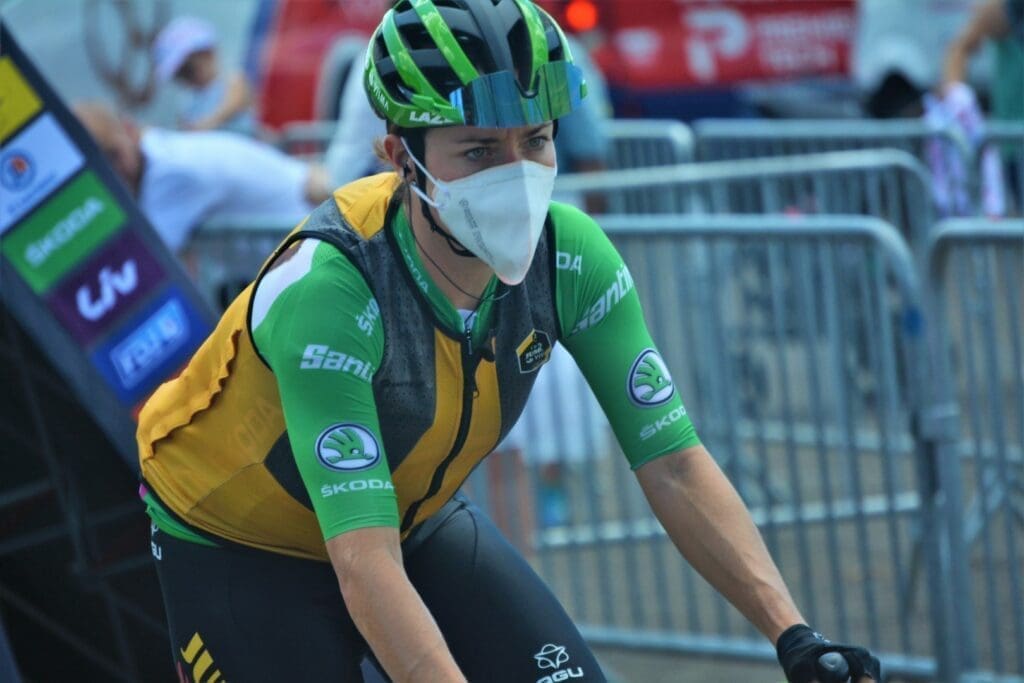
Hilly stages
Hilly stages reduce the reward for the winner and distribute the points more evenly.
The first 15 riders score:
| Position | Points |
|---|---|
| 1st | 30 |
| 2nd | 25 |
| 3rd | 22 |
| 4th | 19 |
| 5th | 17 |
| 6th | 15 |
| 7th | 13 |
| 8th | 11 |
| 9th | 9 |
| 10th | 7 |
| 11th | 6 |
| 12th | 5 |
| 13th | 4 |
| 14th | 3 |
| 15th | 2 |
Stages 3, 5 and 6 fall into this category.
This scoring structure helps explain why the green jersey is not automatically decided by the fastest pure sprinter. A rider such as Vos, Kopecky or Rüegg may score fewer points than Wiebes on a straightforward sprint day, but can recover much of that deficit by consistently finishing near the front on hilly stages where some of the pure sprinters have already been dropped.
Mountain stages
The mountain stages offer fewer green jersey points at the finish.
The first 15 riders receive:
| Position | Points |
|---|---|
| 1st | 20 |
| 2nd | 17 |
| 3rd | 15 |
| 4th | 13 |
| 5th | 11 |
| 6th | 10 |
| 7th | 9 |
| 8th | 8 |
| 9th | 7 |
| 10th | 6 |
| 11th | 5 |
| 12th | 4 |
| 13th | 3 |
| 14th | 2 |
| 15th | 1 |
The reduced points keep the competition weighted towards riders who can score heavily on flatter days rather than allowing a dominant climber to take green simply by winning the Tour overall.
That does not make the mountain stages irrelevant. A versatile contender capable of reaching the top 15 can pick up a handful of points while a pure sprinter scores nothing, and every green jersey hopeful still has to survive the climbs and finish inside the time limit.

What happens in the Stage 4 time trial?
The individual time trial also awards points, although it is unlikely to be a decisive green jersey day for most pure sprinters.
Stage 4 from Gevrey-Chambertin to Dijon offers:
| Position | Points |
|---|---|
| 1st | 20 |
| 2nd | 17 |
| 3rd | 15 |
| 4th | 13 |
| 5th | 11 |
| 6th | 10 |
| 7th | 9 |
| 8th | 8 |
| 9th | 7 |
| 10th | 6 |
| 11th | 5 |
| 12th | 4 |
| 13th | 3 |
| 14th | 2 |
| 15th | 1 |
That makes the stage more relevant to riders such as Kopecky or Zoe Bäckstedt than it is to Wiebes or Kool.
A powerful all-rounder capable of scoring in sprints and then placing high in Dijon can use the time trial to stay closer to the pure sprinters across the classification.
Intermediate sprints are worth 25 points
Every road stage also contains an intermediate sprint where green jersey points are available.
The first 15 riders receive:
| Position | Points |
|---|---|
| 1st | 25 |
| 2nd | 20 |
| 3rd | 17 |
| 4th | 15 |
| 5th | 13 |
| 6th | 11 |
| 7th | 10 |
| 8th | 9 |
| 9th | 8 |
| 10th | 7 |
| 11th | 6 |
| 12th | 5 |
| 13th | 4 |
| 14th | 3 |
| 15th | 2 |
Those points are substantial.
Winning an intermediate sprint is worth half as much as winning a flat stage and more than winning a mountain stage. A rider seriously targeting green therefore cannot simply wait for the finish every day.
Why intermediate sprints can decide the green jersey
Intermediate sprints create a tactical contest very different from a stage finish.
Some are positioned early enough that a breakaway can collect the biggest points before the main sprint teams have any reason to chase. Others come later and can trigger a genuine sprint within the peloton.
For a rider already near the top of the points classification, taking 10 or 15 points at an intermediate sprint can be almost as valuable as moving several places higher at the finish.
Teams may therefore start racing specifically for them. A domestique can close down a move before the sprint, a green jersey contender may commit energy herself, or a rival team may send someone into the break partly to remove points from another rider.
That tactical element becomes increasingly important if the classification stays close.
Why Lorena Wiebes starts as the green jersey favourite
Lorena Wiebes is the obvious favourite because the scoring system heavily rewards victories on the flat stages.
There is no rider on the confirmed start list with a more reliable route to 50-point stage wins. Stage 2 into Geneva is the clearest opportunity, while Stage 8 from Sisteron to Nice is officially classified as flat and provides another enormous points haul if the race comes back together.
Stage 1 is more complicated because the finish in Lausanne comes after repeated climbing and ends with the Côte Saint-François. Wiebes cannot simply assume that one will become a conventional bunch sprint.
Even so, the mathematics favour her.
If Wiebes wins two flat stages, that is 100 points before intermediate sprints are considered. A rival relying on hilly-stage placings needs exceptional consistency to overcome that.
Our wider Tour de France Femmes 2026 riders to watch guide also puts Wiebes at the head of the sprint hierarchy.
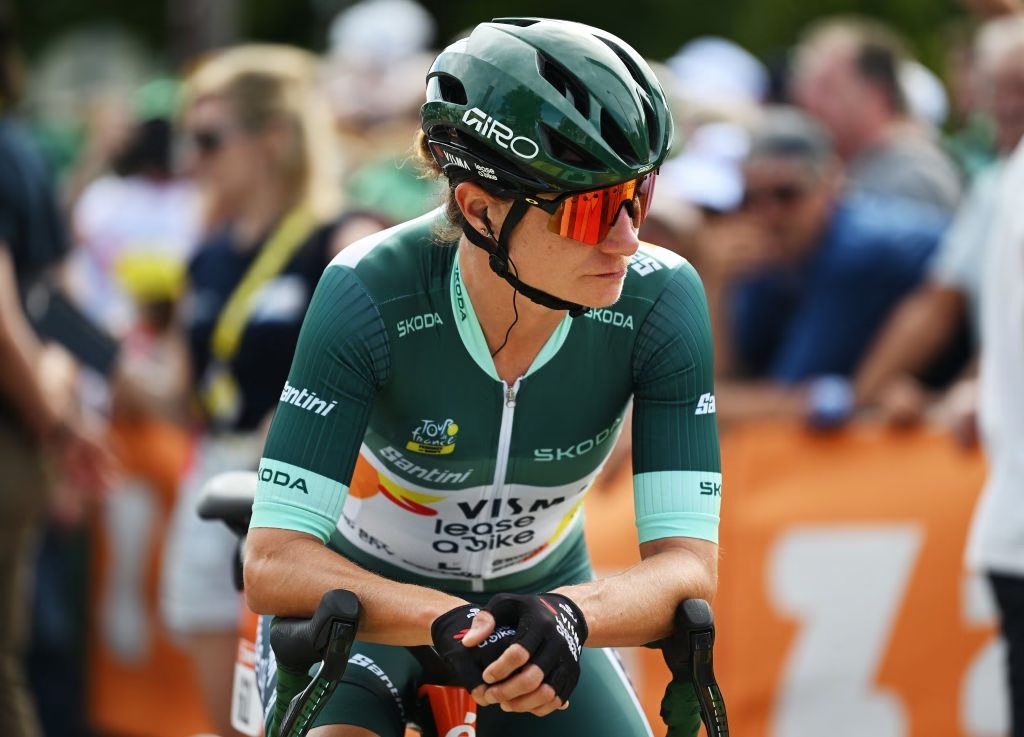
Marianne Vos may be the most dangerous all-round challenger
Marianne Vos presents a completely different threat.
She may not beat Wiebes often enough in a pure high-speed sprint to win green through flat-stage victories alone, but she can score across far more terrain.
Stage 1 suits her much better than a standard sprinter. Stage 3 could produce a reduced finish, while Stages 5 and 6 contain enough climbing to eliminate faster riders without automatically removing Vos.
That creates a broader points base.
If Wiebes collects 50 points on one day but scores nothing significant on a difficult hilly stage, Vos can keep accumulating 20, 25 or 30. She also has the tactical experience to recognise when an intermediate sprint is worth spending energy on.
For green jersey purposes, that makes Vos one of the most dangerous riders in the race.
Charlotte Kool needs the flat stages to deliver
Charlotte Kool has the speed to challenge Wiebes directly on the stages that finish with a conventional bunch sprint.
Her route to green is therefore straightforward: she needs to win stages.
Second place is substantially less valuable under the flat-stage scoring system. Wiebes beating Kool 50 points to 30 creates a 20-point swing from a single sprint, even before intermediate points are considered.
Kool’s challenge is the terrain.
Fenix-Premier Tech can support her on the flatter days, but the climbing-heavy middle of the Tour gives Vos, Kopecky and Pieterse more opportunities to keep scoring.
If Kool comes through the hilly stages without losing too many points, the 171.9km Stage 8 from Sisteron to Nice could put her firmly back into contention.
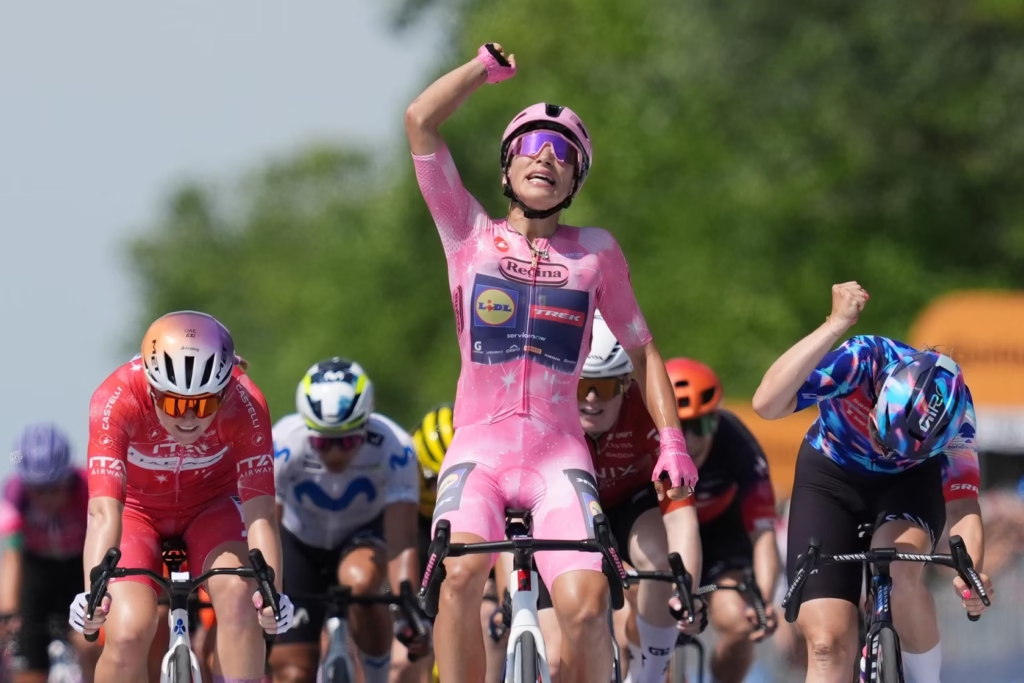 Photo Credit: RCS
Elisa Balsamo has the right combination of speed and resilience
Elisa Balsamo belongs among the strongest green jersey contenders because she sits somewhere between the pure sprinters and the all-rounders.
She has enough outright speed to win a major bunch sprint while also handling enough climbing to remain involved on days that remove riders who depend more heavily on a perfectly flat finish.
That gives Lidl-Trek several options.
Balsamo can challenge Wiebes and Kool directly in Geneva, but she may also remain involved on Stage 3 or another selective finish where the pure sprint field has been reduced.
The issue is opportunity. Lidl-Trek also have Loes Adegeest, Niamh Fisher-Black, Lucinda Brand and Riejanne Markus, so the team have several objectives across the Tour.
If Balsamo emerges from the opening stages as a genuine green jersey contender, those priorities may become much clearer.
Lotte Kopecky has the ideal profile but may have different priorities
On pure rider characteristics, Lotte Kopecky is almost designed for this competition.
She can sprint, survive climbs, score in hilly finishes and produce a strong time trial. She can even take points on terrain where most other green jersey contenders have disappeared from the front group.
The question is not whether Kopecky has the attributes to win green.
It is whether SD Worx-Protime want her riding for it.
With Wiebes also in the team, the obvious sprint priority belongs to the Dutchwoman. Kopecky may instead be used on harder stages or around the team’s wider objectives.
If circumstances place Kopecky near the top of the classification after the opening days, the competition becomes considerably more complicated.
Noemi Rüegg could score across almost every road stage
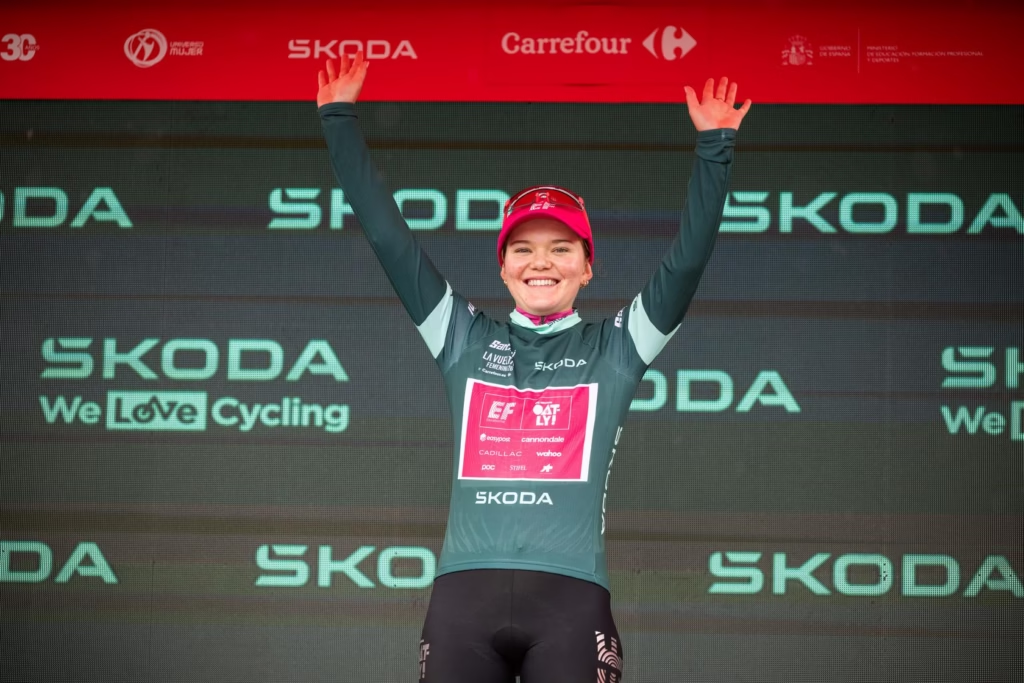
Noemi Rüegg is one of the more intriguing outside contenders.
She does not have Wiebes’ pure sprint speed, but her strengths fit the 2026 route exceptionally well. Rüegg can contest reduced sprints, survive repeated climbing and remain competitive on days that are too difficult for many of the fastest riders.
That makes Stages 1, 3, 5 and 6 potential scoring opportunities.
EF Education-Oatly also do not have a pure sprinter who automatically requires the team to build every finish around her. If Rüegg starts the Tour well, she can consistently collect points without needing to win three stages.
She probably needs the flatter stages to become harder than expected, but she has one of the clearest routes to a surprise green jersey challenge.
Puck Pieterse can score where the pure sprinters cannot
Puck Pieterse benefits from similar versatility.
A conventional high-speed sprint against Wiebes is not where she is most likely to collect maximum points. A hard stage where the bunch has been reduced to 30 riders is different.
Pieterse can score on punchy finishes, hilly stages and potentially the time trial, giving her access to points that pure sprinters may never contest. She also has the aggressive racing style to take intermediate sprint points from breakaways.
Her stage-winning opportunities across the route are covered in more detail in our Puck Pieterse Tour de France Femmes 2026 guide.
The difficulty is consistency. Green rewards repeated scoring, and Pieterse may be used more selectively as a stage hunter rather than trying to maximise every available point.
Kim Le Court can score heavily without being a pure sprinter
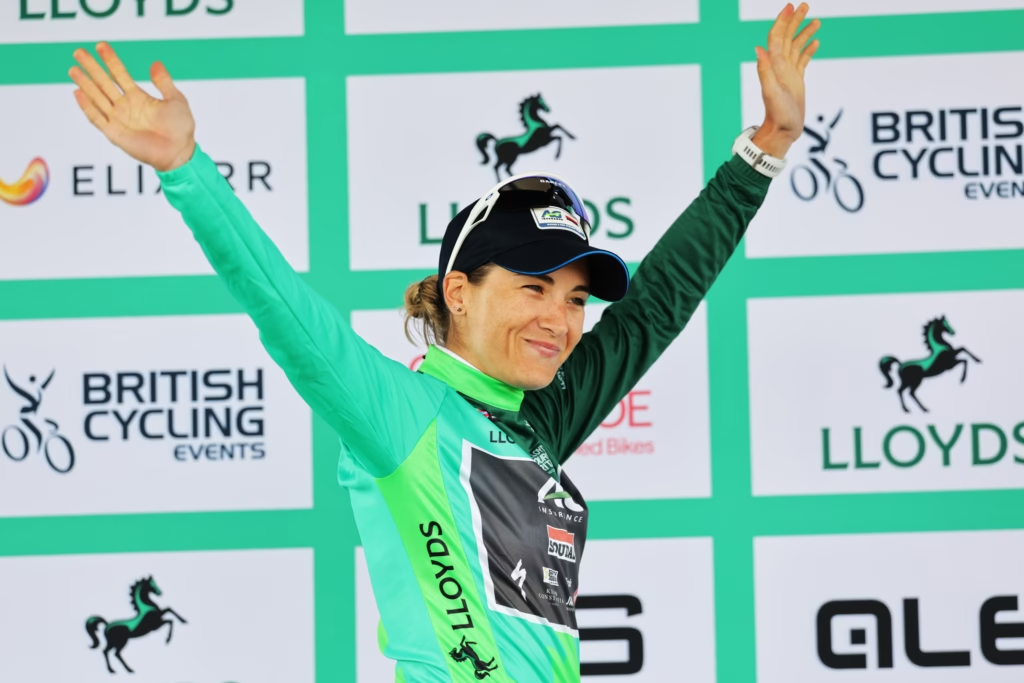
Kim Le Court is another rider whose route to green comes through difficult stages rather than outright top speed.
She has already shown that she can finish quickly from a selective group and is well suited to days where climbing has removed the specialist sprinters.
Stage 1 is an obvious opportunity, while Stages 3, 5 and 6 could also put her near the front.
The reason she is less likely to make green the central target is her GC ambition. AG Insurance-Soudal have identified a top-five overall finish as one of their major objectives, and spending energy contesting every intermediate sprint would be difficult to justify if the general classification remains realistic.
If that GC campaign fades, however, the points classification could become more attractive.
Chiara Consonni is Canyon SRAM’s pure sprint option
Chiara Consonni gives Canyon SRAM a genuine contender for the flatter finishes.
She has the speed to score heavily in a bunch sprint and can therefore take advantage of the 50-point stages in a way many of the team’s more versatile riders cannot.
The issue is whether she can match Wiebes, Kool and Balsamo often enough.
Green rarely rewards someone who repeatedly finishes fifth on flat stages if another rider is winning them. Consonni therefore needs at least one major result and probably some intermediate sprint points to become a serious classification threat.
Canyon SRAM’s GC objectives through Niewiadoma-Phinney and Niedermaier also mean the team will not necessarily commit every available rider to a sprint train.
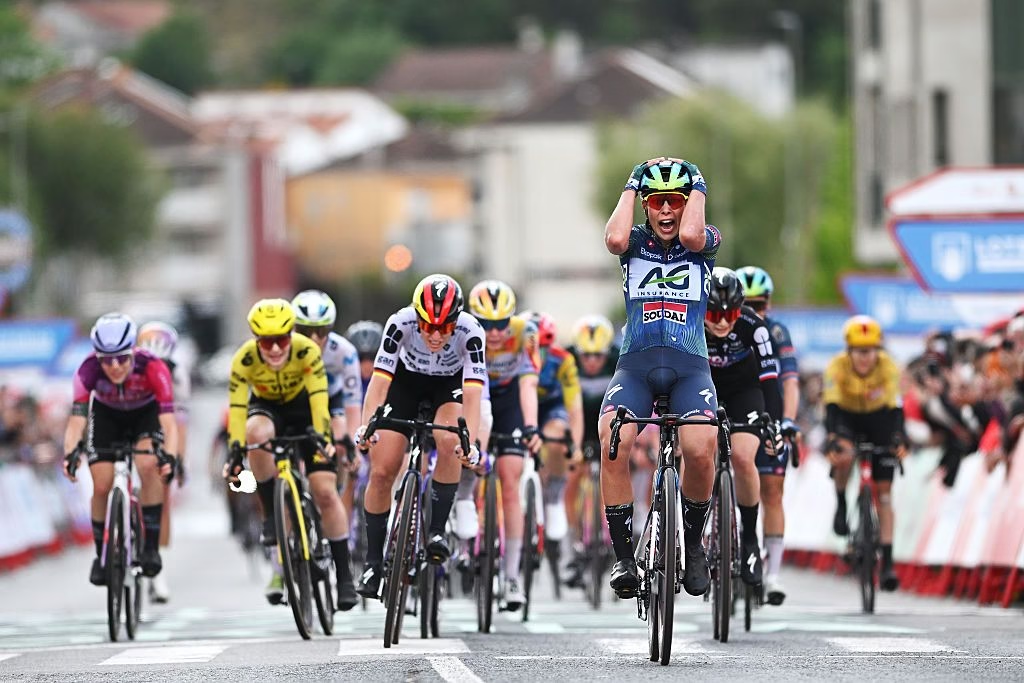 Photo Credit: Getty
Shari Bossuyt can benefit from harder sprint stages
Shari Bossuyt is another rider who could appear regularly near the front without necessarily beginning as a green jersey favourite.
The Belgian champion combines speed with enough resilience to survive selective racing, giving her opportunities after harder approaches to the finish.
AG Insurance-Soudal’s primary objective remains Le Court’s GC challenge, but Bossuyt has already made clear that she will take her own opportunities when they appear.
A green jersey campaign would probably require a major opening few stages. If she scores strongly in Lausanne and Geneva, the calculation changes.
Arlenis Sierra becomes dangerous when the pure sprinters disappear
Arlenis Sierra has a similar route into the competition.
Movistar are unlikely to build a conventional sprint train around her against Wiebes, but Sierra becomes much more dangerous after a demanding day.
A reduced bunch after several climbs can turn a stage where she starts as an outsider into one where she has one of the fastest finishes remaining.
The problem for green is that those opportunities may not occur often enough. Movistar’s main focus will also be Reusser’s GC challenge.
Sierra can collect points and potentially win a stage without necessarily committing to the full classification.

Amalie Dideriksen is another rider suited to selective finishes
Amalie Dideriksen gives Cofidis a realistic route towards sprint points.
Her strength is not simply top speed. She is often more competitive when a stage has already demanded significant endurance and positioning before the sprint begins.
That makes the less straightforward finishes particularly interesting.
Cofidis do not have a major GC leader requiring the whole team to ride defensively, so Dideriksen can receive substantial support when a stage suits her.
A green jersey challenge would still require consistently beating riders with greater outright speed, but the route offers enough opportunities for her to remain involved.
Stage 1 could immediately complicate the green jersey battle
Stage 1 in Lausanne is officially classified as flat, meaning the winner receives 50 points.
The profile is not remotely equivalent to a conventional flat sprint stage.
Four categorised climbs appear during the day, while the finish comes at the end of the Côte Saint-François, a 2.5km rise averaging 4.6%.
That combination makes the opening stage disproportionately important.
A rider such as Vos, Kopecky, Rüegg, Pieterse or Le Court could take the full 50 points on terrain where Wiebes and Kool may find it much harder to contest the victory.
If that happens, the pure sprinters begin Stage 2 already chasing a deficit created by a stage that technically carries maximum sprint-level points.
That could shape the entire classification.
Stage 2 is the pure sprinters’ biggest early opportunity
Stage 2 from Aigle to Geneva should give the fast riders a much more conventional chance.
There is climbing during the stage, but the final part of the route gives the peloton more opportunity to regroup.
If Wiebes, Kool, Balsamo and Consonni reach Geneva together, the 50-point prize becomes enormously important.
For anyone who lost points in Lausanne, this is the obvious opportunity to recover them. With another 25 points available at the intermediate sprint, a rider could theoretically collect 75 points from the stage.
That is enough to transform the classification in a single afternoon.
Stage 3 should favour the more versatile contenders
The journey from Geneva to Poligny begins with the Col de la Faucille and contains further climbing before the finish.
Because Stage 3 is classified as hilly, victory is worth 30 points rather than 50.
That reduces the advantage of pure sprint speed.
More importantly, the terrain increases the possibility that Wiebes or Kool are either distanced or reach the finish without enough support to control the sprint.
Vos, Kopecky, Rüegg, Pieterse, Le Court, Sierra and Balsamo could all benefit from that scenario.
This is the first stage where the green jersey competition can begin moving away from a straightforward sprint contest.
Stages 5 and 6 reward survival as much as speed
The two hilly stages after the Dijon time trial could be decisive.
Stage 5 contains close to 2,900 metres of climbing and finishes shortly after Mont Brouilly, while Stage 6 contains another succession of categorised climbs before Tournon-sur-Rhône.
Both offer 30 points for the winner.
Those totals are smaller than on the flat stages, but the opportunity can still be enormous if one rider scores while another scores nothing.
Vos collecting 25 points while Wiebes finishes outside the top 15 creates almost the same classification swing as beating her in a sprint for victory.
This is where versatility starts paying.
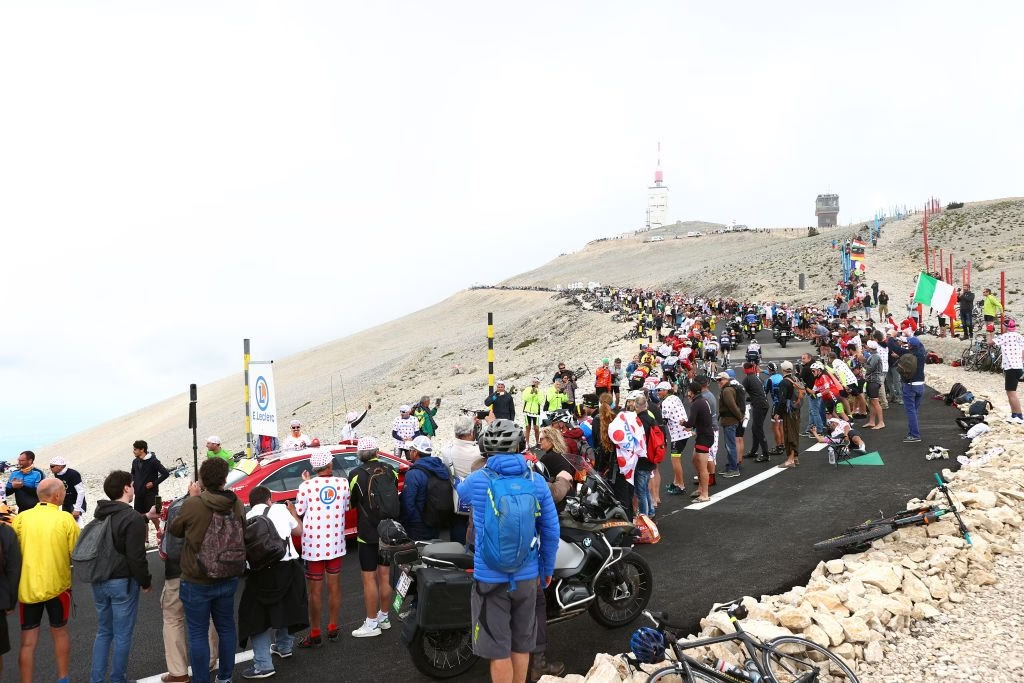
Mont Ventoux is mostly about reaching the finish
Stage 7 changes the objective for the pure sprinters.
The summit finish on Mont Ventoux offers fewer green jersey points and is overwhelmingly likely to be decided by climbers or GC contenders.
For Wiebes, Kool, Balsamo and the other fast riders, the priority is survival.
They need to make the time cut.
Losing minutes to Vollering or Ferrand-Prévot does not matter for green. Abandoning or finishing outside the permitted time ends the campaign entirely.
For a versatile contender such as Kopecky, Pieterse or Le Court, there may be some possibility of picking up points, but even that is unlikely to justify compromising another major objective.
Stage 8 could decide the green jersey
The 171.9km Stage 8 from Sisteron to Nice is officially classified as flat, making its 50-point prize potentially decisive.
It comes immediately after Mont Ventoux, creating a fascinating combination of maximum points and accumulated fatigue.
Any sprinter who survives Ventoux reaches Nice with a huge opportunity. If the classification remains close, teams may have to commit heavily to controlling the race because allowing a breakaway to take the stage also removes the 50 points their leader may need.
The length of the stage makes endurance important as well.
This is not simply another fresh-legged sprint early in the Tour. Whoever still has speed after seven previous stages may gain a major advantage.
The final mountain stage limits opportunities to recover
Stage 9 around Nice is only 99.2km but classified as mountain terrain.
That means the green jersey battle may effectively be decided before the final stage.
There will still be points available, but the route strongly favours GC riders and climbers.
A pure sprinter entering Stage 9 with the lead has one straightforward objective: finish the Tour.
A versatile challenger who is only a handful of points behind may still see an opportunity.
That difference could make the final day more interesting than expected.
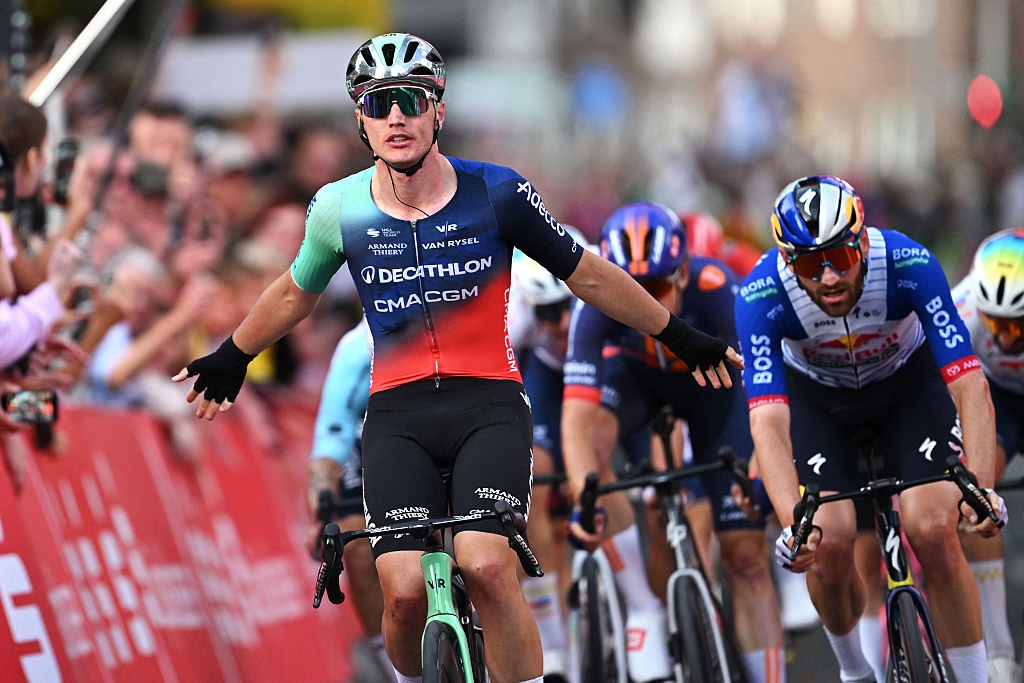
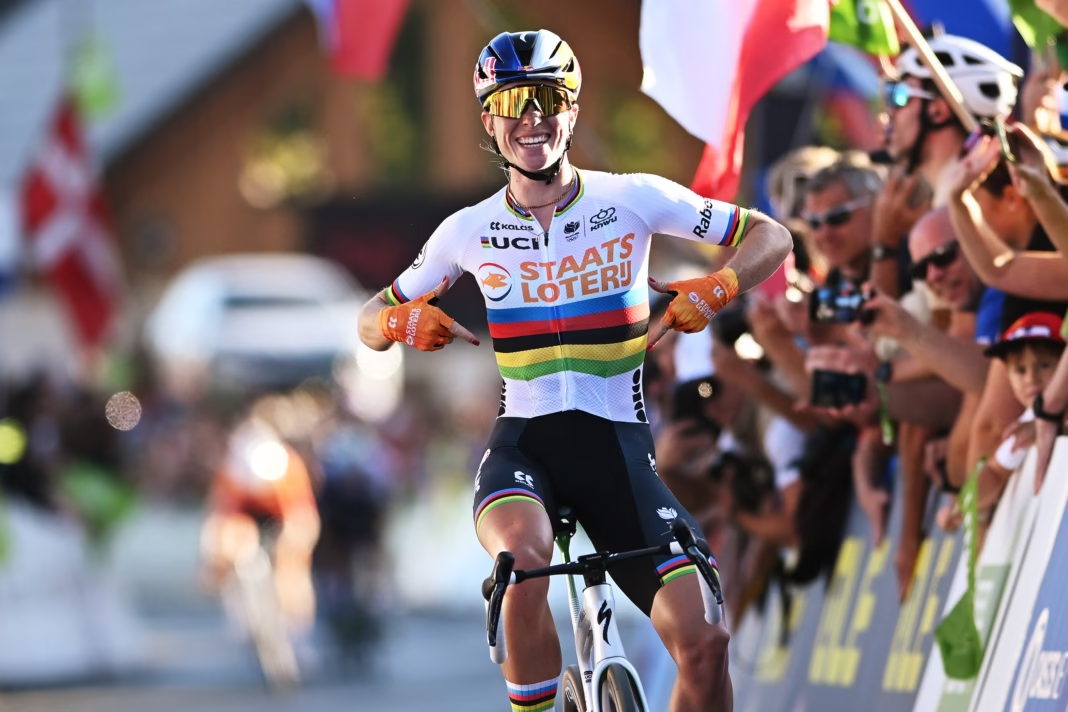
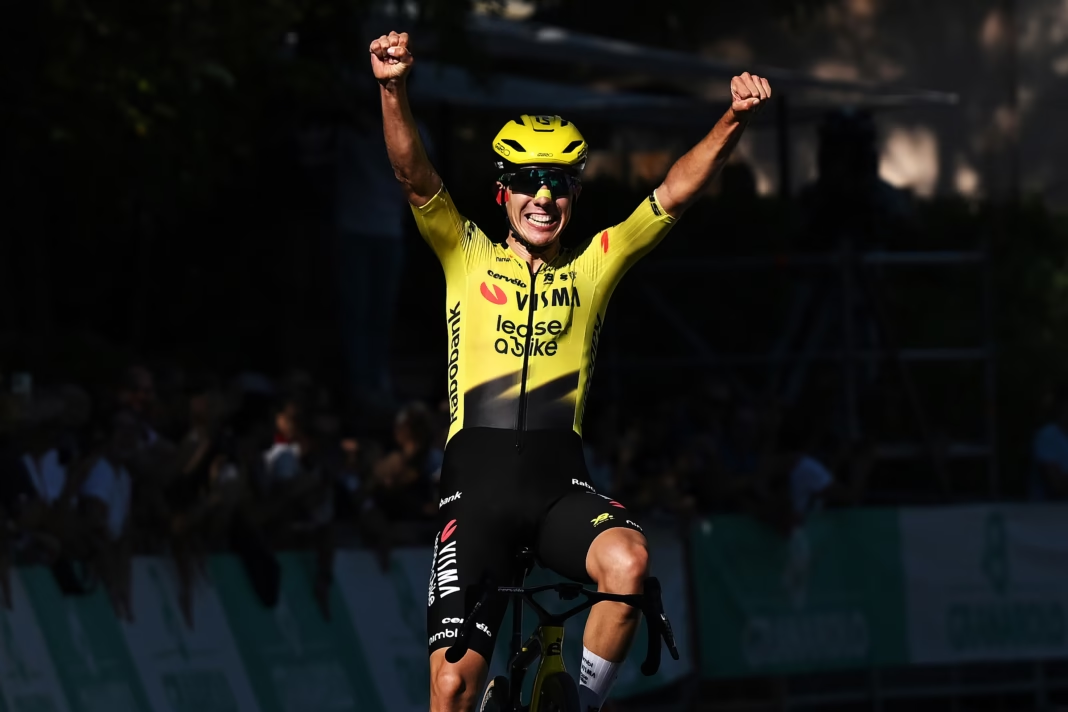
Who are the main green jersey contenders for 2026?
On the confirmed Tour de France Femmes 2026 start list, the hierarchy begins with a clear favourite but quickly becomes more complicated.
Lorena Wiebes has the strongest pure route to green because she can win the 50-point stages.
Marianne Vos is the most dangerous all-round challenger because she can score across almost every type of road stage.
Charlotte Kool needs the flatter stages to become conventional sprints but has the speed to beat anyone when they do.
Elisa Balsamo combines enough sprint speed with greater resilience on harder terrain.
Lotte Kopecky has perhaps the best overall physical profile for the competition but may have different responsibilities within SD Worx-Protime.
Behind them, Noemi Rüegg, Puck Pieterse, Chiara Consonni, Kim Le Court, Shari Bossuyt, Arlenis Sierra and Amalie Dideriksen all have credible routes towards significant points.
Green jersey prediction
Lorena Wiebes should start as favourite.
Three officially flat stages create too many high-value opportunities to overlook, particularly when winning one is worth 50 points.
But the 2026 route is not ideal for a sprinter who can only score on easy days.
Stage 1 is far harder than its flat designation suggests. Stage 3 is hilly. Stages 5 and 6 are demanding. Mont Ventoux sits between the final two major sprint opportunities.
That makes Marianne Vos the rider most likely to exploit any weakness in Wiebes’ campaign.
If Wiebes wins repeatedly in the pure sprints, the classification is hers to lose.
If the flatter stages become selective, the race for green becomes much wider, and in this Tour the intermediate sprints, hilly finishes and simple ability to survive the mountains may matter almost as much as outright top speed.

