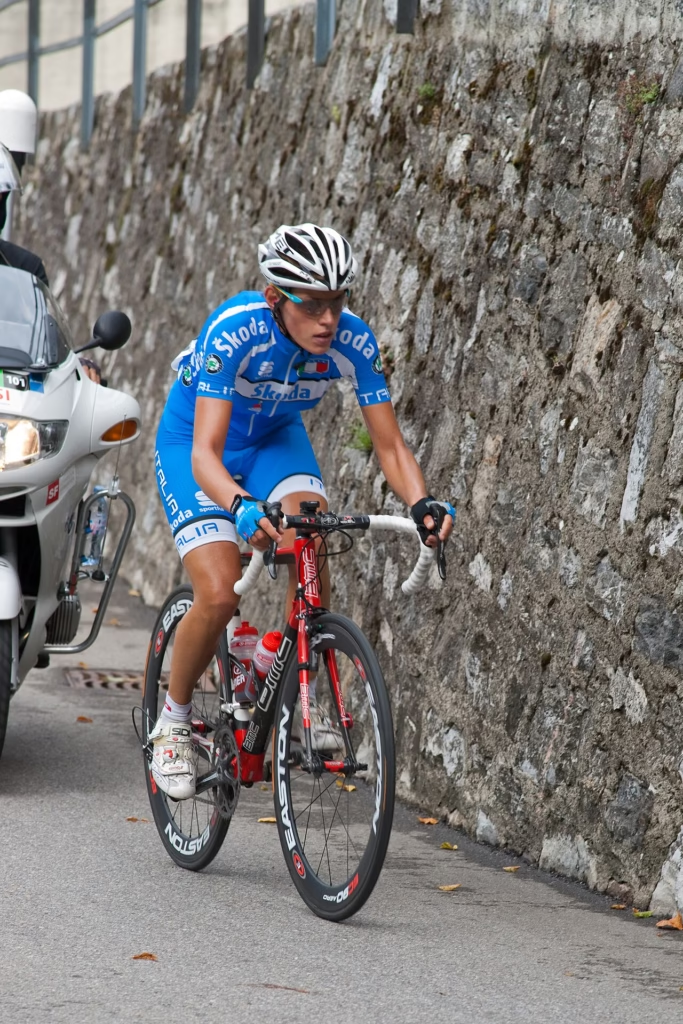
Noemi Cantele belonged to an Italian generation so deep that being one of the best riders in the world did not always make you the biggest name in your own national team.
That should not disguise how good she was.
Cantele won two editions of the Grand Prix de Plouay, became Italian road and time trial champion, won major stage races and reached the podium in both elite events at the 2009 World Championships. She raced successfully from the beginning of the 2000s into the middle of the following decade, adapting as women’s cycling became more international and its leading teams increasingly professional.
Her results also resist an easy label. She was strong enough against the clock to win national titles and take a World Championship silver medal, climbed well enough to contest demanding stage races and had the speed and tactical judgement to win selective Classics.
That makes her an important figure in the wider history of women’s cycling. Cantele was not defined by one dominant speciality. Her strength was how few races automatically ruled her out.
Growing up on roads that reward versatility
Cantele was born in Varese in July 1981, in one of Italy’s most recognisable cycling regions.
The surrounding Lombardy roads provide an appropriate setting for the rider she became. They rarely remain flat for long, but neither are they simply about high mountains. Short climbs, technical descents and constantly changing gradients reward riders capable of carrying speed and recovering between repeated efforts.
Cantele developed into exactly that kind of racer.
She could survive when a one-day race became selective without needing to drop everyone on a climb. She could attack, follow stronger climbers and still retain enough speed to finish from a small group.
There was also more time-trial ability than the description of Cantele as a puncheur or Classics rider sometimes suggests.
That part of her game would eventually produce one of the defining performances of her career.
The first major victories showed what kind of rider she was
Cantele began collecting international victories early in her elite career.
She won the Tour de Berne in 2000 and a stage of the Giro del Trentino in 2002 before her career moved onto a different level during the middle of the decade.
Her first victory at the Grand Prix de Plouay came in 2005.
On the final circuits, Edita Pučinskaitė attacked on the Côte de Ty Marrec and Cantele was the only rider able to follow. Rather than simply surviving alongside one of the strongest riders of the era, Cantele beat her in the finish.
Two years later she won there again.
The 2007 edition developed differently, with Cantele part of a dangerous selection alongside Marta Bastianelli, Oenone Wood and Nicole Cooke. On the final ascent of Ty Marrec, Cantele repeatedly attacked until she finally got rid of the others and went on to win alone.
Those two victories still place her among the most successful riders in the history of the race now known as Classic Lorient Agglomération. Only a small group have won it more often, as covered in ProCyclingUK’s history of Classic Lorient Agglomération.
The contrast between her two wins also tells us plenty about Cantele.
She could win a sprint.
She could also make the selection herself.
2007 was one of Cantele’s most complete seasons
The second Plouay victory formed part of an excellent 2007 campaign.
Cantele won the overall classification at the Trophée d’Or Féminin, taking the opening stage before defending the lead through the rest of the race.
She also won the Giro della Toscana Femminile, again combining stage victories with the consistency required to take the overall classification.
Those results reinforced her reputation as more than a one-day specialist.
Cantele did not have the climbing profile of riders such as Fabiana Luperini, but she could handle stage races where repeated hills, time gaps and tactical racing gradually separated the strongest riders.
That ability made her particularly useful within a team. On some days she could support a stronger pure climber. On others she was capable of becoming the leader herself.
Bigla gave Cantele a home during her prime
Much of Cantele’s strongest period came with Bigla.
She joined the Swiss-backed team for 2005 and remained there through 2009, racing alongside riders such as Nicole Brändli and Zulfiya Zabirova during the early years of a project that became one of the most recognisable women’s teams of its era.
The history of the Bigla team shows how ambitious that original structure already was. Long before its later Cervélo-supported phase, Bigla was recruiting some of the best riders available and building a genuinely international programme.
Cantele fitted that approach particularly well because she offered so many options.
Her strongest days were not restricted to one race type, which meant Bigla could take her to a broad programme and reasonably expect her to be competitive.
Those years produced both Plouay victories, her 2007 stage-race successes and eventually the greatest championship week of her career.
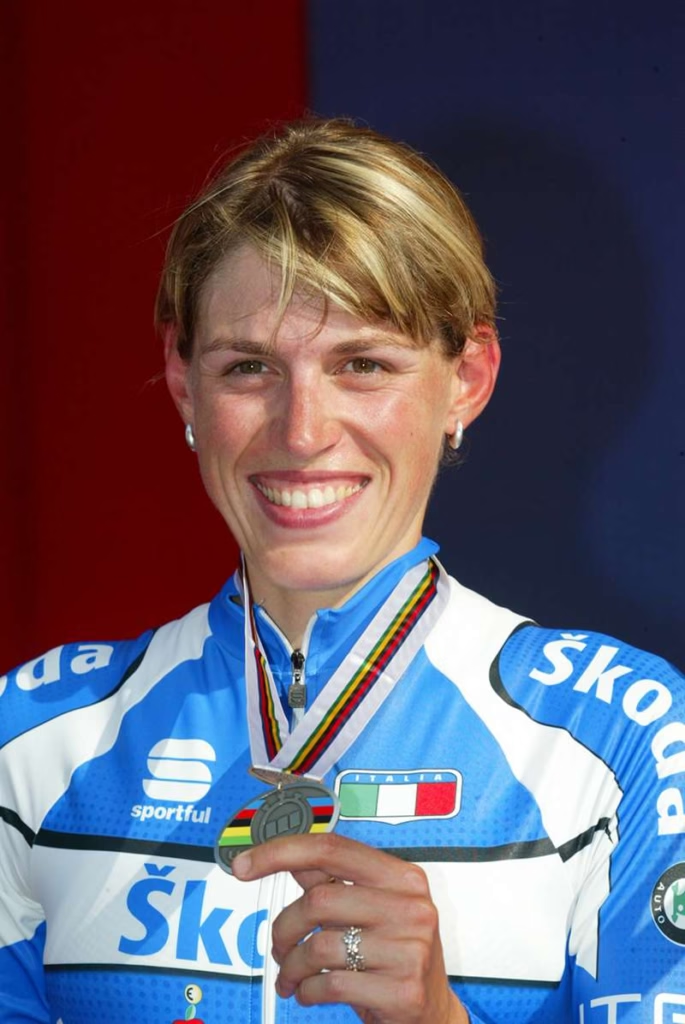
Mendrisio 2009 produced two World Championship medals
The original version of Cantele’s story is sometimes misremembered around the 2008 World Championships in Varese.
Her great championship performance actually came one year later in Mendrisio in 2009.
And she did it twice.
Cantele first rode the elite individual time trial and finished second behind Kristin Armstrong, losing 55 seconds to the American Olympic champion but beating Linda Villumsen by three seconds for silver.
That result alone significantly changes how Cantele should be remembered as a rider.
She was not merely someone capable of getting through a time trial without losing too much. At her best, she was one of the strongest time triallists in the world.
Days later she returned for the road race.
Tatiana Guderzo attacked alone to become world champion, with Marianne Vos taking silver 19 seconds later.
Cantele finished third, crossing with Vos to give Italy two riders on the podium.
Two medals from two elite World Championship events in the same week represents the high point of Cantele’s international career.
It also captured her range almost perfectly. Few riders capable of taking a World Championship time trial silver could then contend for the medals in a selective road race several days later.
The wider importance of those championships sits within a much longer lineage explored in ProCyclingUK’s history of the road cycling World Championships.
For Cantele, Mendrisio was the week everything she could do as a rider became visible at once.
The Italian jerseys completed the picture
Cantele’s domestic championship record is another area where the details matter.
She became Italian time trial champion in 2009, the same season in which she took World Championship silver in the discipline.
Two years later she produced a national championship double.
Riding for Garmin-Cervélo in 2011, Cantele won both the Italian road race and individual time trial titles.
The road victory gave her the tricolore jersey she had not previously won, while successfully taking the time trial title again confirmed that Mendrisio had not been an isolated performance.
An Italian national championship has always carried unusual depth in the women’s peloton.
Cantele’s era contained riders including Guderzo, Giorgia Bronzini, Bastianelli and Luperini, all of whom won world titles during their careers.
Winning both national disciplines in that environment was significant.
She could still win late in her career
Cantele did not disappear after her 2009 World Championship peak.
She moved to HTC-Columbia for 2010, joining a powerful team containing Judith Arndt, Ina-Yoko Teutenberg and Ellen van Dijk, before spending 2011 with Garmin-Cervélo.
From 2012 she became an important part of the new BePink project.
There were still victories.
She won the GP El Salvador in 2012 and a stage of the Giro del Trentino. In 2013 she went further, winning the overall classification of the Vuelta El Salvador and three stages across her two appearances at the race.
Those results came more than a decade after some of her earliest international successes.
That longevity is important when assessing her career. Cantele’s best years were not concentrated into one spectacular season. She repeatedly found ways to remain useful and competitive as teams, race formats and the level of the peloton changed around her.
Her Giro record showed another side to her career
Cantele never won the Giro d’Italia Femminile overall, but it remained an important part of her programme.
She won a stage in 2009 and spent years competing in a race that, for much of her career, was the central stage-racing target in women’s cycling.
The history of the Giro d’Italia Women helps explain why those appearances mattered. In an era before the current Tour de France Femmes, the Giro was often the clearest test of whether an all-round rider could withstand repeated climbing and accumulated fatigue against the best stage racers in the world.
Cantele’s career was built more around one-day races and shorter stage events than chasing the Giro overall.
Even so, she was versatile enough to win there and remain useful when the roads became difficult.
Cantele raced in one of Italy’s deepest generations
It is difficult to understand Cantele properly without looking at the riders around her.
Italian women’s cycling during her career was extraordinarily strong.
Fabiana Luperini had dominated the major stage races.
Alessandra Cappellotto had become road world champion.
Tatiana Guderzo won the world title in the race where Cantele took bronze.
Giorgia Bronzini would win consecutive world road titles in 2010 and 2011.
Marta Bastianelli had already worn the rainbow jersey.
That depth meant Cantele was rarely presented as the single defining Italian rider of the era.
Yet she repeatedly won alongside and against them.
Her value came partly from being able to fill gaps between specialists. Italy could use her in championship races because she offered several possible routes to a result. Professional teams could do the same throughout the season.
She could ride for others without becoming irrelevant as a winning option herself.
 Photo Credit: Graham Watson
What made Noemi Cantele so effective?
The easiest answer is versatility, but that can become too vague.
Cantele had several specific strengths.
She could time trial at world-class level.
She had enough climbing ability to survive selective one-day races and difficult stage-race terrain.
She could finish quickly from small groups.
And she was capable of attacking when waiting for a sprint was not the best option.
That combination explains the range of her biggest victories.
Plouay could be won by beating a rival from a small group or by riding away.
A stage race could be won by collecting seconds consistently rather than dominating one mountain.
A World Championship could produce a medal against the clock and another in the road race.
She was difficult to remove from contention because simply making the race harder did not necessarily expose a weakness.
Retirement led back into BePink
Cantele’s racing career ended after the 2014 season, following her final year with Astana-BePink.
She did not completely leave the sport.
Cantele remained close to the BePink structure after retiring and initially worked with the team as a consultant. In 2016 she became president of BePink, taking on a leadership role within the organisation she had represented during the closing years of her racing career.
It was a fitting continuation.
BePink had been built partly around developing riders within Italian women’s cycling, and Cantele brought experience from some of the strongest teams and most important races of the previous decade.
That kind of transition matters in women’s cycling history. The sport’s development has depended not only on former riders becoming coaches or directors, but on experienced figures remaining inside teams and passing knowledge into the next generation.
Noemi Cantele career highlights
Among Cantele’s most important results were:
- Second in the 2009 UCI World Championship individual time trial
- Third in the 2009 UCI World Championship road race
- Italian road race champion in 2011
- Italian time trial champion in 2009 and 2011
- Grand Prix de Plouay winner in 2005 and 2007
- Giro della Toscana Femminile overall winner in 2007
- Trophée d’Or Féminin overall winner in 2007
- Vuelta El Salvador overall winner in 2013
- Giro d’Italia Femminile stage winner
- Giro del Trentino stage winner
- Tour de Berne winner in 2000
It is a list that makes the word all-rounder unusually literal.
Why Noemi Cantele deserves to be remembered
Cantele’s place in cycling history does not depend on pretending she was the dominant rider of her generation.
She was not.
That is part of what makes her career interesting.
She raced through an exceptionally strong period in Italian women’s cycling and still accumulated two World Championship medals in the same week, two Plouay victories, national titles in both road disciplines and important stage-race wins.
Some champions are easy to describe because one quality explains almost everything they achieved.
Cantele requires more space.
Her time trial mattered. So did her climbing. So did her finish. So did the ability to recognise when a race required patience and when it required an attack.
That made her valuable for more than a decade, across several of the strongest teams in the sport.
The broader women’s rider history collection contains riders with bigger collections of rainbow jerseys, Grand Tours or Classics. Cantele’s importance comes from how well she connected those different parts of road racing.
She was one of the riders who gave Italy’s great generation its depth.
And on her best days, she was far more than supporting cast.