
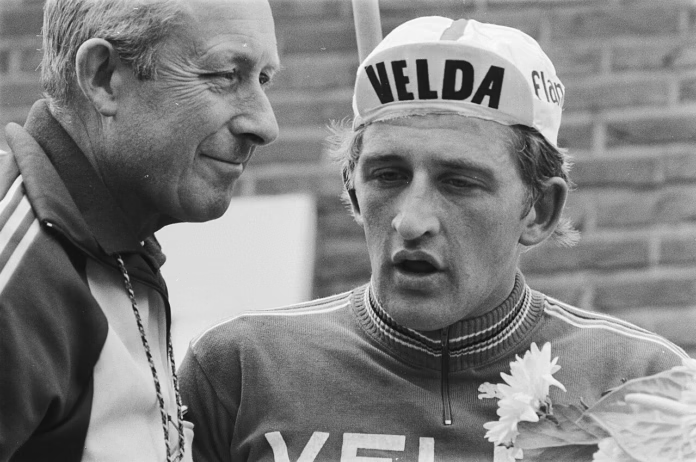
Freddy Maertens did not gradually become one of the best riders in the world. He arrived, started winning at an extraordinary rate and, for a brief period in the mid-1970s, seemed capable of overwhelming almost any race that did not involve the very highest mountains. He could sprint, time trial and survive difficult Classics, while his ability to recover and keep winning across stage races made him far more complete than the label of sprinter suggests.
The numbers remain startling. Maertens won eight stages of the 1976 Tour de France, 13 stages and the overall classification at the 1977 Vuelta a España, seven stages of that year’s Giro d’Italia and the road world championship in both 1976 and 1981. Yet his career never developed into the steady decade of dominance those results appeared to promise. Injury, the collapse of Flandria, financial problems and repeated team changes instead produced one of the sharpest rises and falls in professional cycling.
What makes the story even stranger is that Maertens came back. After several seasons in which the victories almost disappeared, he won five stages and the green jersey at the 1981 Tour before becoming world champion again in Prague. His greatness arrived in enormous bursts rather than through gradual accumulation, which is why his career still feels unusual even among the champions of his era.

Maertens was challenging cycling’s biggest names almost immediately
Maertens joined the Flandria organisation towards the end of 1972 and spent his first full professional season there in 1973. The talent was immediately obvious because he could finish races like a sprinter without needing to be protected like one. He had enough sustained power to win time trials, could cope with repeated climbs and was still quick enough to beat specialists once a difficult race had reached the final kilometres.
His first major international near-miss came at the 1973 World Championships in Barcelona. The race became entangled in the complicated relationship between Maertens and Eddy Merckx within the Belgian team, with arguments over tactics continuing long after the finish. Maertens eventually contested the sprint but was beaten by Felice Gimondi, with Luis Ocaña third and Merckx fourth.
Maertens was only 21. Silver at a World Championship would have been the defining result of many careers, but in his case it felt more like the first indication that the biggest victories were close.
Flandria built a team capable of exploiting everything he could do
Maertens’ rise became closely associated with Flandria, one of Belgium’s defining teams of the period. Michel Pollentier and Marc Demeyer were especially important around him, forming a group sometimes described as the Three Musketeers. Pollentier and Demeyer could make races difficult long before the sprint, while Maertens was strong enough to contribute to that work rather than simply wait behind them.
That made Flandria difficult to contain. Maertens did not need a completely controlled finish because he could survive and even help create the selection himself. If rivals tried to make the race hard enough to remove him, they often removed most of the other fast finishers instead.
By 1975 he was already winning major races including Gent-Wevelgem and Paris-Tours, while his overall consistency brought the Super Prestige Pernod competition. A year later his career moved onto another level. His two victories at Gent-Wevelgem, in 1975 and 1976, place him firmly within the history of the race now known as Men’s In Flanders Fields, but even those wins only explain part of the rider he had become.
Eight Tour stages in 1976 changed the scale of his career
Maertens made his Tour de France debut in 1976 and immediately produced one of the great stage-winning performances in the history of the race. He won eight stages, matching a single-edition record also achieved by Charles Pélissier and Eddy Merckx, and took the points classification.
The way he collected those victories mattered. Maertens was not simply waiting for flat bunch finishes. He won the opening prologue and could beat specialists against the clock before returning to dominate mass sprints and harder road stages. His green jersey was therefore built through a wider range of results than the normal image of a points-classification sprinter suggests.
That record makes him an obvious inclusion among ProCyclingUK’s greatest Tour de France sprinters, although the description still feels incomplete. Maertens had sprinter numbers, but his engine allowed him to contest races that would have eliminated most pure fast men long before the finish.
The Tour established him as one of the most dangerous riders in cycling. Two months later, he added the rainbow jersey.

Ostuni made Maertens world champion
The 1976 World Championships in Ostuni were raced over 288km in southern Italy. Maertens reached the decisive finish with Francesco Moser and beat the Italian to become world champion at 24.
It was his second World Championship medal after Barcelona three years earlier, but there was no controversy over Belgian tactics this time and nobody ahead of him on the podium. The World Championship roll of honour places Maertens between Hennie Kuiper in 1975 and Moser in 1977, in the middle of an era containing Merckx, Gimondi, Kuiper, Moser and Bernard Hinault.
Maertens belonged comfortably in that company. What followed in the rainbow jersey made the point even more clearly, because instead of becoming cautious under the pressure of being world champion, he embarked on one of the most prolific seasons professional cycling has seen.
The 1977 season became almost impossible to comprehend
Maertens won more than 50 races in 1977, depending on how individual stages and classifications are counted. The exact total matters less than the spread of victories. He won Paris-Nice, the Volta a Catalunya, the Setmana Catalana, Omloop Het Volk, the Giro di Sardegna and Trofeo Laigueglia, while continuing to collect stages almost everywhere he started.
Then came the Grand Tours. Maertens entered the Vuelta a España and treated it less like a three-week race built around one general-classification objective than a sequence of opportunities to keep winning. The scale of what followed remains difficult to compare with anything in modern cycling.
Thirteen Vuelta stages and the overall classification
Maertens won the opening prologue of the 1977 Vuelta a España and never surrendered the race lead. He then won Stage 1, Stage 2 and continued adding victories throughout the race until he had taken 13 stages in total.
This was not simply a sprinter collecting flat days while somebody else fought for the red jersey. Maertens won the race itself, finishing 2:51 ahead of Miguel María Lasa and 8:21 ahead of Klaus-Peter Thaler, while also taking the points classification.
The history of the men’s Vuelta a España contains dominant climbers, devastating time triallists and riders who controlled the race through team strength. Maertens’ 1977 edition is different because he seemed capable of winning almost every type of stage the route offered.
That race also makes it impossible to describe him accurately as a conventional sprinter. Pure fast men do not win Grand Tours. Maertens could because his finishing speed sat on top of enough endurance, climbing ability and time-trial strength to defend a lead for three weeks.
The 1977 Tour of Flanders showed the other side of his career
Even during his greatest season, disorder was never far away. The 1977 Tour of Flanders became one of the strangest episodes of Maertens’ career and one of the more unusual editions in the history of the race.
Maertens had a problem on the Koppenberg and continued on a bicycle obtained from a spectator, an illegal change that led race officials to disqualify him. He continued racing anyway. Roger De Vlaeminck eventually joined him and spent much of the run towards Meerbeke sitting behind, while Maertens continued to drive despite knowing his own result would not stand.
De Vlaeminck beat him in the sprint. The story then became still messier when Maertens also returned a positive doping control, while Walter Planckaert, initially third, was disqualified as well.
It is a chapter that fits the broader Maertens story almost too neatly. There was extraordinary physical performance, controversy and an outcome far more complicated than the strength in his legs alone suggested.
Seven Giro wins followed almost immediately
Only days after completing the Vuelta, Maertens started the Giro d’Italia and simply continued winning. He took the prologue and six further stages, bringing his 1977 Grand Tour stage total to 20 victories between the Vuelta and Giro.
Across his previous Tour and those two Grand Tours, Maertens had therefore won 28 stages in three consecutive appearances. The figures belong to a different rhythm of professional cycling, one in which the strongest riders raced more often and could dominate several types of stage rather than specialising as narrowly as many do today.
Then everything changed at Mugello.

The Mugello crash became the dividing line
On 28 May 1977, the Giro held a split stage at Mugello. Maertens contested the sprint against Rik Van Linden during the morning sector, won, then crashed after the pair collided.
The damage centred on his right wrist, including the scaphoid area, and he could not continue the Giro. It would be too simple to claim that one crash single-handedly destroyed the career that followed, because the problems became much broader than that, but Mugello still forms an obvious dividing line.
Before it, Maertens had spent months winning almost everything available to him. Afterwards, the same physical certainty never seemed entirely secure. Sprinting places enormous strain through the hands and wrists, particularly during the violent accelerations and bike handling required in the final metres, and the injury continued to trouble him.
The extraordinary run had stopped, even if the victories did not disappear immediately.
He was still one of the best riders in the world in 1978
Maertens remained a major force in 1978. He won Omloop Het Volk again, took E3 and the Four Days of Dunkirk, then returned to the Tour de France and won two stages along with a second green jersey.
His Classics results also showed that he had not suddenly become a lesser rider. He finished fourth at Paris-Roubaix during the period when Roger De Vlaeminck’s dominance was giving way to Francesco Moser’s run of three consecutive victories. The history of men’s Paris-Roubaix gives a sense of the quality of specialist Maertens was competing against.
The difference was no longer whether Maertens could still win. It was how often. The rider who had once seemed capable of taking a victory every few days was becoming much less predictable, just as the team structure around him began to deteriorate.
Flandria’s decline arrived at exactly the wrong moment
Flandria’s sponsorship difficulties became increasingly serious towards the end of the 1970s. The organisation that had surrounded Maertens during his best seasons was losing stability at the same time he was dealing with physical problems.
That combination was damaging. Maertens moved through a succession of teams without finding anything comparable to the environment in which he had become world champion and Vuelta winner, while his sporting problems were increasingly accompanied by serious financial ones.
Tax liabilities followed him for years. Money that should have provided security after the enormous success of 1976 and 1977 instead became another source of pressure. His weight fluctuated, his form deteriorated and the victories became increasingly scarce.
By 1979 and 1980, Maertens was still only in his late twenties but statistically looked almost nothing like the rider who had dominated the peloton a few seasons earlier.
The collapse was startling because it happened so early
This is where the fragility in Maertens’ story really belongs. It does not mean he lacked toughness. A rider does not win a Vuelta, survive the northern Classics and collect 20 Grand Tour stages in a single season without enormous physical resilience.
The fragility was in how quickly several parts of the career failed at once. An injured wrist reduced his certainty on the bike. Flandria was no longer providing the same support. Financial problems became a distraction rather than something handled away from racing, while repeated changes of team made it harder to rebuild.
The result was one of cycling’s sharpest collapses. In 1977 Maertens had won more than 50 races. Within a couple of seasons, individual victories had become noteworthy simply because they were so rare.
Most champions begin to decline when age removes something from their physiology. Maertens was still young enough that he should have been entering his prime.

Boule d’Or gave him one final route back
Few expected the old Maertens to reappear in 1981, but his move to Boule d’Or produced one of cycling’s great revivals.
The comeback became obvious at the Tour de France. Maertens won Stage 1a in Nice, then Stage 3 at Narbonne, before adding victories at Bordeaux, Saint-Priest and finally Paris. He finished the race with five stage wins and his third green jersey.
The modern ranking of the greatest Tour de France sprinters places Maertens among the most successful fast men in Tour history, but his 15 career stage victories came in only three editions: eight in 1976, two in 1978 and five in 1981.
There was almost no gentle accumulation in between. That is Maertens’ career in miniature. The success arrived in clusters, often so concentrated that the quiet years afterwards feel even more dramatic.
Prague completed one of cycling’s great comebacks
The 1981 Tour would already have been enough to restore much of Maertens’ reputation. Then came the World Championships in Prague.
The men’s road race covered more than 280km and produced a decisive group containing Giuseppe Saronni, Bernard Hinault, Francesco Moser and Maertens. Five years after winning in Ostuni, Maertens still had enough finishing speed to beat Saronni, with Hinault taking bronze.
The history of the road cycling World Championships contains many multiple champions, but Maertens’ second title stands out because of what happened between his two victories.
He had not spent those five seasons remaining near the top and waiting for another chance. He had gone from dominance to near-obscurity and somehow returned.
At 29, Freddy Maertens was world champion again.
The comeback was brilliant but brief
Prague did not begin a second long career at the top. The 1981 revival was exceptional, but it did not become sustained dominance.
Team changes continued, his results fell away again and the final years of his professional career looked much more like the difficult period before the comeback than the extraordinary summer itself. He continued racing into the middle of the decade before eventually stopping.
That means his two world titles effectively frame two very different versions of the same rider. The 1976 champion looked as though cycling might belong to him for years. The 1981 champion looked like somebody who had managed to rediscover the finest version of himself for one last summer.

The strange omission from his palmarès was a Monument
One notable gap remains in an otherwise enormous record. Freddy Maertens never won one of cycling’s five Monuments.
He certainly had the ability to contend. He finished second at both the Tour of Flanders and Liège-Bastogne-Liège, placed fourth at Paris-Roubaix and recorded several strong results at Milan-San Remo.
Yet the Monument victory never arrived.
That partly explains why he can sit slightly outside conversations about Belgium’s greatest Classics riders, especially when those discussions are dominated by the cobbled Monuments. Roger De Vlaeminck had four Paris-Roubaix victories, while Merckx won almost everything available.
Maertens built greatness differently. His reputation rests on World Championships, Grand Tour stages, points classifications and a volume of wins that very few riders could match at their absolute peak.
Freddy Maertens’ biggest career achievements
Among the results that best define Maertens are:
- World road champion in 1976 and 1981
- 1977 Vuelta a España overall winner
- 13 stages of the 1977 Vuelta
- 15 Tour de France stage victories
- Tour de France points classification in 1976, 1978 and 1981
- Seven Giro d’Italia stage victories
- 1977 Paris-Nice winner
- 1977 Volta a Catalunya winner
- Gent-Wevelgem winner in 1975 and 1976
- Paris-Tours winner in 1975
- Omloop Het Volk winner in 1977 and 1978
- E3 winner in 1978
- Four-time Four Days of Dunkirk winner
- Belgian road champion in 1976
Depending on the counting method used for stages and smaller victories, Maertens finished with around 150 professional wins. The exact figure matters less than the concentration. Very few riders have ever accumulated so much in such short periods.

The sprinter label never really explains him
It is understandable that discussions of Maertens begin with sprinting. Eight Tour stages in one edition make that inevitable.
Yet sprinting alone cannot explain the rider who won a Grand Tour, Paris-Nice and major time trials, or the rider who twice survived World Championship road races of nearly 300km and still had enough speed to beat the strongest survivors.
His rivals could not simply make a race difficult and assume Maertens would disappear. Often, making it difficult only removed other riders who might have been capable of beating him at the finish.
That breadth is what made his peak so oppressive. There were too many ways for him to win.
A career that never followed a normal shape
Maertens was never going to become the next Eddy Merckx, because almost nobody could. The comparison nevertheless followed him because Belgian cycling had barely finished living through Merckx’s dominance before another home rider started winning at an extraordinary rate.
Maertens’ career eventually developed in almost the opposite direction. Merckx built greatness partly through sustained dominance, whereas Maertens’ came through explosions: the eight Tour stages of 1976, the first world title, the extraordinary 1977 season, 13 Vuelta wins, seven Giro stages, the sudden collapse and then the 1981 revival.
The setbacks should not be romanticised. The financial problems were serious, the team instability was damaging and the 1977 Tour of Flanders remains part of an honest account of both his career and the doping culture of his era. Those complications do not make the peak less remarkable, but they do make the whole story harder to reduce to a clean rise-and-fall narrative.
Freddy Maertens was one of the fastest riders of his generation, but speed was only the starting point. For a few seasons he could win almost any race that gave him a plausible route to the finish, and when that ability disappeared it did so with astonishing speed.
Then, for one extraordinary summer in 1981, it came back.

