
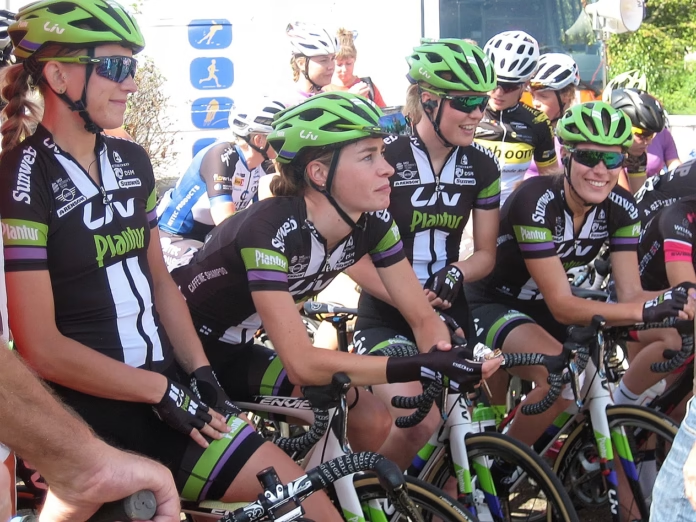
Liv-Plantur was not a short-lived standalone team. It was one name in the continuous history of the women’s programme now racing as Team Picnic PostNL.
The Dutch team began in 2011 as Skil-Koga and subsequently raced as Skil-Argos, Argos-Shimano and Giant-Shimano before becoming Liv-Plantur for the 2015 and 2016 seasons. It then moved into the longer Team Sunweb era, followed by Team DSM, Team dsm-firmenich PostNL and finally Picnic PostNL.
That wider lineage matters because Liv-Plantur is best understood as a transitional chapter within a project that has now operated for more than 15 years.
The team entered the Liv-Plantur period after losing Kirsten Wild, the prolific sprinter around whom many of its earlier successes had been built. It emerged from those two seasons with a younger and more varied racing identity, Leah Kirchmann established as an international leader and Floortje Mackaij developing into one of the team’s longest-serving riders.
Liv-Plantur did not produce the greatest results in the organisation’s history. The Sunweb years that followed brought World Championship success, major Classics victories and a much deeper roster.
The 2015 and 2016 seasons were still essential. They helped move the project from its early dependence on sprint victories towards the development-led, multi-discipline structure that remains visible in Picnic PostNL today.
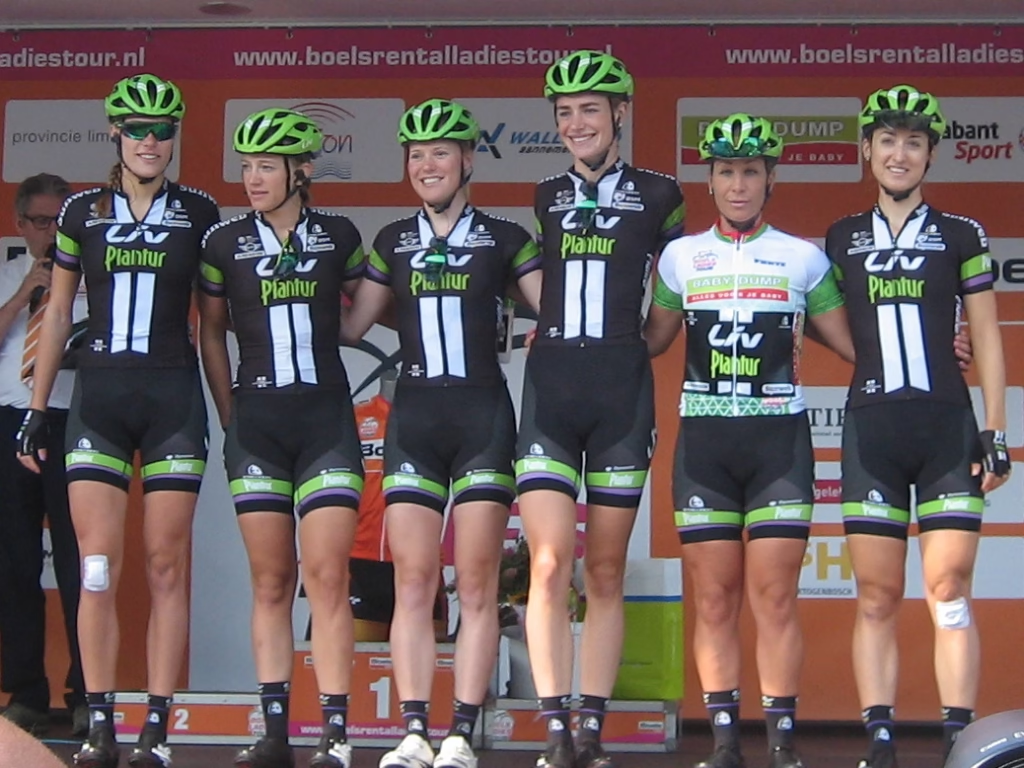
Liv-Plantur at a glance
| Detail | Information |
|---|---|
| Liv-Plantur seasons | 2015 and 2016 |
| Team founded | 2011 |
| Original identity | Skil-Koga |
| Registered country | Netherlands |
| General manager | Iwan Spekenbrink |
| Previous name | Giant-Shimano |
| Next name | Team Sunweb |
| Current identity | Team Picnic PostNL |
| Major 2015 rider | Floortje Mackaij |
| Major 2016 rider | Leah Kirchmann |
| Other important riders | Amy Pieters, Sabrina Stultiens, Riejanne Markus |
| Bicycle sponsor | Liv |
The team has operated continuously since 2011 despite repeated title sponsor and equipment changes.
Its history belongs within the wider story of long-running professional programmes collected in our Women’s Cycling Team History Hub.
The continuous team lineage from Skil-Koga to Picnic PostNL
The sequence of names can look complicated because the women’s team sometimes used a different identity from the associated men’s programme.
The basic lineage is:
| Period | Team identity |
|---|---|
| 2011 | Skil-Koga |
| 2012 | Skil-Argos |
| 2013 | Argos-Shimano |
| 2014 | Giant-Shimano |
| 2015–2016 | Liv-Plantur |
| 2017–2020 | Team Sunweb |
| 2021–2023 | Team DSM and Team dsm-firmenich |
| 2024 | Team dsm-firmenich PostNL |
| 2025 onwards | Team Picnic PostNL |
These were not separate teams being created and closed in succession.
The management structure, sporting organisation and rider development programme continued through each sponsorship change. Riders and staff regularly remained in place as the name, kit and equipment changed around them.
That continuity separates the project from many women’s teams of the same period, when sponsor withdrawals frequently caused entire squads to disappear.
The contrast with teams that did eventually close, such as the long-running Hitec Products project, helps explain why Picnic PostNL’s survival through repeated sponsor changes is significant.
Skil-Koga created the women’s programme in 2011
The women’s team was launched in 2011 within the same wider organisation as the established Skil-Shimano men’s squad.
Its first identity was Skil-Koga, reflecting the sponsors and bicycle supplier attached to the women’s programme.
The initial roster already contained riders who would shape its early history.
Kirsten Wild brought elite sprinting speed. Amy Pieters was still developing but already possessed the power and track background that would make her a major road rider. Other Dutch riders gave the team a strong domestic core at a time when international women’s racing remained far less professionalised than it is today.
The project was not created as a temporary one-season exercise.
It became part of a wider organisational strategy involving men’s, women’s and eventually development programmes.
The modern Picnic PostNL team still uses that integrated structure.
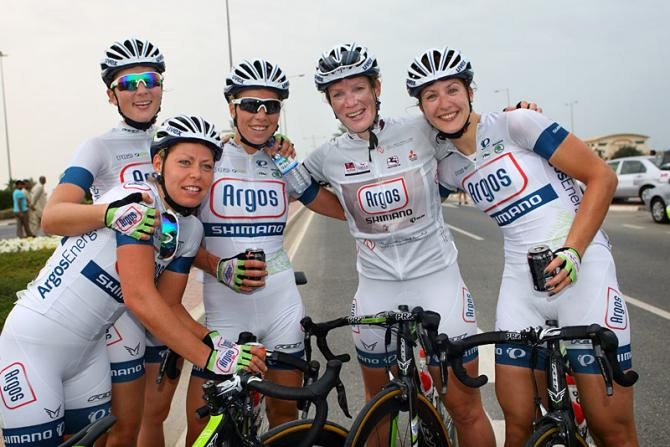
Argos-Shimano established the team internationally
After the opening Skil identities, the team became Argos-Shimano for 2013.
This was when the women’s programme began to accumulate results at a much higher rate.
Wild won the Ladies Tour of Qatar overall, took three stages and secured the points classification. She also won Gent-Wevelgem and multiple stages of the Energiewacht Tour.
Lucy Garner added a stage victory at the Tour of Chongming Island, while Pieters continued her progression towards the top level.
The team’s racing identity was clear.
Wild was one of the fastest riders in the world, and the squad could organise itself around bunch sprints, crosswinds and flat stage races. Pieters offered a more versatile option for the Classics and selective finishes.
Those strengths carried into the following season.
Giant-Shimano produced the first major peak
The women’s team raced as Giant-Shimano in 2014.
It was the strongest season of the project’s early phase.
Wild successfully defended her Tour of Qatar title, winning three stages. Pieters won another stage and the young rider classification before taking a major one-day victory at Omloop Het Nieuwsblad.
Wild also won the Tour of Chongming Island, while Claudia Lichtenberg secured the overall classification at La Route de France.
The roster was no longer dependent on one rider for every type of race, but Wild remained its most prolific winner.
Her departure at the end of 2014 therefore changed the team significantly.
It also coincided with a new sponsorship structure that created the Liv-Plantur identity.
Why Giant-Shimano became Liv-Plantur
The Giant-Shimano organisation added German haircare company Alpecin as a major sponsor for 2015.
The men’s team became Giant-Alpecin.
The women’s programme adopted the female-focused brands associated with the same partnerships. Liv was Giant’s women’s bicycle brand, while Plantur was part of the same Dr Wolff haircare group as Alpecin.
The result was Team Liv-Plantur.
It remained the same women’s team that had raced as Giant-Shimano, Argos-Shimano and Skil-Koga. The new identity reflected the commercial positioning of the sponsors rather than the formation of a new sporting project.
That distinction is important because the two Liv-Plantur seasons sit directly between the team’s first successful cycle and the much larger Sunweb era.
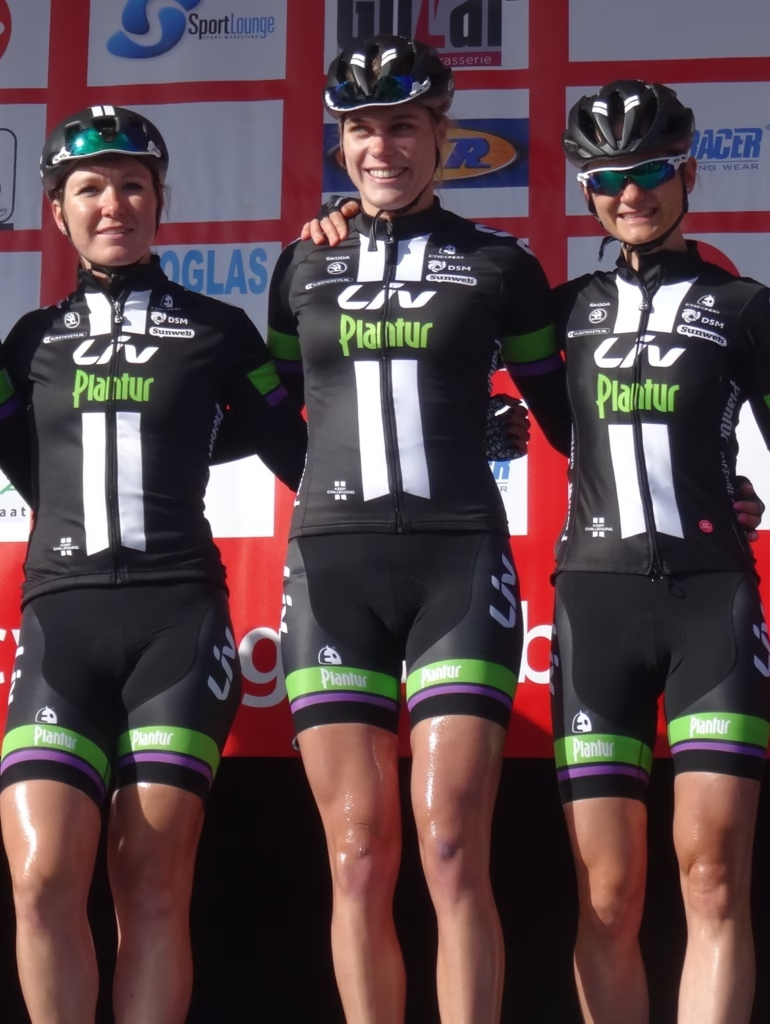
Liv-Plantur was separate from Rabo-Liv
The name can cause confusion because Rabo-Liv was also one of the most prominent teams in women’s cycling during the same period.
The two squads were unrelated.
Rabo-Liv was the Rabobank-backed team featuring riders such as Marianne Vos, Anna van der Breggen and Pauline Ferrand-Prévot.
Liv-Plantur was the continuation of the Skil-Koga and Argos-Shimano project managed within Iwan Spekenbrink’s organisation.
Both teams used Liv bicycles and displayed the Liv name, but they had different ownership, management, riders and sporting programmes.
Liv’s presence in both projects showed the brand’s wider commitment to women’s cycling, but the teams should not be treated as part of the same lineage.
The separate Rabobank structure is covered in our Rabo-Liv team history.
Losing Kirsten Wild forced a sporting reset
Wild left for Hitec Products before the first Liv-Plantur season.
Her departure removed the team’s most reliable source of victories.
Under Argos-Shimano and Giant-Shimano, the squad could enter flatter races with one of the clear favourites. Its domestiques understood that their central task was to control attacks, manage the peloton and deliver Wild into a sprint.
Liv-Plantur no longer had that certainty.
Pieters became the most established leader, but she was not a direct replacement. She was a powerful and versatile Classics rider who could sprint from smaller groups, attack on cobbles and compete in short time trials.
The team therefore had to become less dependent on conventional bunch sprints.
That shift reduced its immediate winning power but opened opportunities for younger riders and encouraged a less predictable racing style.
Amy Pieters offered continuity in 2015
Pieters entered 2015 as the clearest connection between the successful Giant-Shimano team and the new Liv-Plantur period.
She had already won Omloop Het Nieuwsblad and established herself among the leading Dutch Classics riders.
Pieters won Dwars door Vlaanderen during the spring and remained the team’s most consistent established performer.
Her importance extended beyond individual results.
Liv-Plantur’s roster was undergoing a transition, and Pieters gave the younger riders an experienced leader around whom the team could organise itself.
She could contest cobbled races, short stage races and reduced sprints, allowing Liv-Plantur to remain competitive while it searched for its next long-term direction.
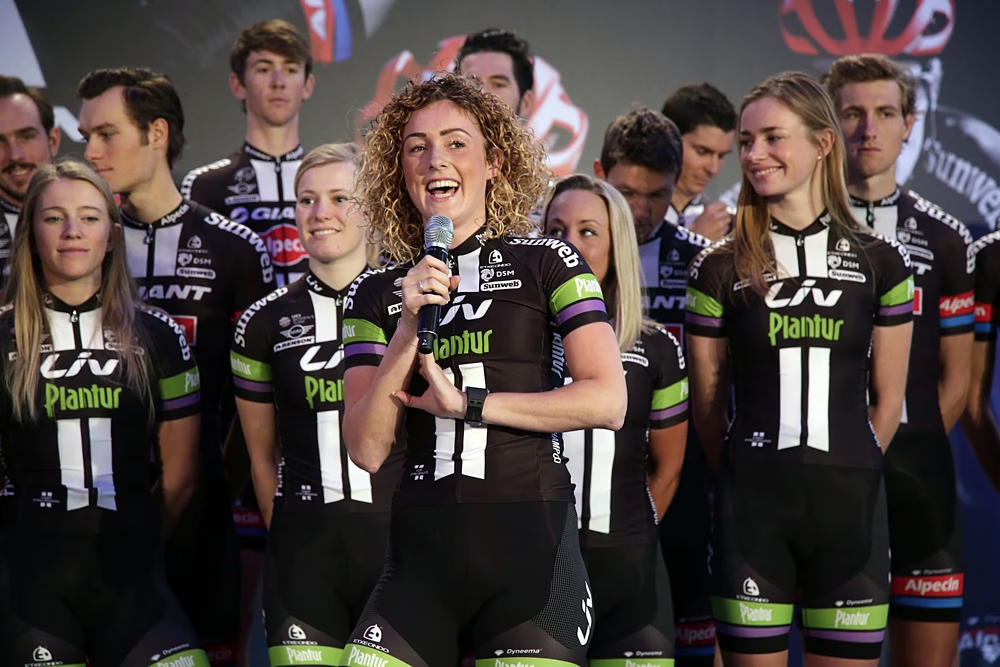
Floortje Mackaij delivered the defining 2015 breakthrough
The most important result of the first Liv-Plantur season came from Floortje Mackaij.
She was only 19 when she won Gent-Wevelgem in brutal wind and rain.
The race became a test of strength, positioning and resilience. Mackaij attacked late and stayed clear to claim the biggest victory of her young career.
It was not merely an unexpected win.
Mackaij’s success provided evidence that the team’s development model could produce elite results. She had joined the organisation as a teenager and had been allowed to learn within the professional peloton rather than waiting until she was already an established winner.
She followed Gent-Wevelgem with a stage victory and classification successes at the Festival Elsy Jacobs, then won another stage at the Lotto Belgium Tour.
Those performances made her the clearest symbol of Liv-Plantur’s future.
Mackaij connected Liv-Plantur to the later Sunweb and DSM teams
Mackaij’s significance extends well beyond her two seasons in Liv-Plantur colours.
She remained with the organisation when it became Team Sunweb in 2017 and continued through the DSM era.
By the time she left after 2022, she had spent almost a decade inside the same team structure.
That longevity makes her one of the most direct links between the project’s early identities and its later WorldTour incarnation.
Under the various names, Mackaij developed from a teenage prospect into an experienced Classics leader and road captain.
Her long association with the organisation and later career at Movistar are reflected in our coverage of Mackaij’s contract extension through 2026.
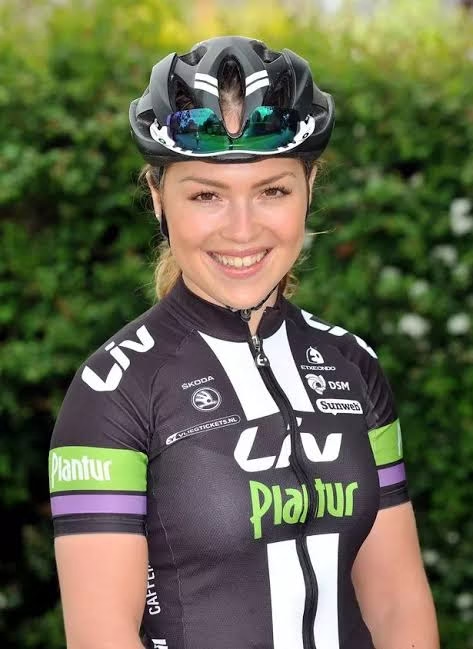
Lucy Garner carried major expectations
British sprinter Lucy Garner was another prominent member of the 2015 roster.
Garner had won the junior road world title twice and joined the professional ranks with considerable expectations.
She had already won for the team before it became Liv-Plantur, including a stage at the Tour of Chongming Island.
Her transition from dominant junior to consistent professional winner was less straightforward.
Injury, illness and the increased physical demands of senior racing interrupted her development. The departure of Wild also meant Liv-Plantur no longer possessed the same established sprint train and tactical certainty.
Garner remained capable of strong finishes, but the team could not simply replace Wild by asking a younger sprinter to perform the same role.
Her experience reflected the wider challenge facing Liv-Plantur. Development rarely follows a predictable path, particularly within a small roster competing against deeper and more established teams.
Sabrina Stultiens broadened the team’s ambitions
Sabrina Stultiens joined the programme for 2015 and gave Liv-Plantur a stronger option on climbing terrain.
The team’s previous success had been built largely around sprints, crosswinds and Classics. Stultiens offered potential in the Ardennes and stage races.
She finished 14th at La Flèche Wallonne during her first season, showing that she could compete on one of the hardest uphill finishes in the sport.
Her progress was repeatedly interrupted by injuries and health problems, preventing the team from building a reliable GC programme around her.
The recruitment still illustrated a change in ambition.
Liv-Plantur was no longer looking only for riders who could support sprinters or succeed on flat northern roads. It was attempting to assemble a roster capable of competing across more varied terrain.
The 2015 season was a controlled transition
Liv-Plantur finished eighth in the final UCI team ranking in 2015.
That represented a respectable return for a squad that had lost its leading winner and was changing its sporting identity.
Pieters provided established results.
Mackaij supplied the season’s most important breakthrough.
Stultiens brought climbing potential, while Garner, Sara Mustonen, Claudia Lichtenberg and the rest of the roster offered options across different race types.
The team was competitive without being dominant.
It lacked the depth of Boels-Dolmans, Rabo-Liv, Wiggle Honda and other leading squads. It could not place several potential winners into the finale of every major race.
Liv-Plantur instead relied on tactical opportunities, individual form and the continued development of its younger riders.
Pieters and Garner left after one Liv-Plantur season
The roster changed substantially again before 2016.
Pieters moved to Wiggle High5.
Garner joined the same team.
Their departures removed two of Liv-Plantur’s most recognisable riders and left Mackaij with a larger role despite still being early in her career.
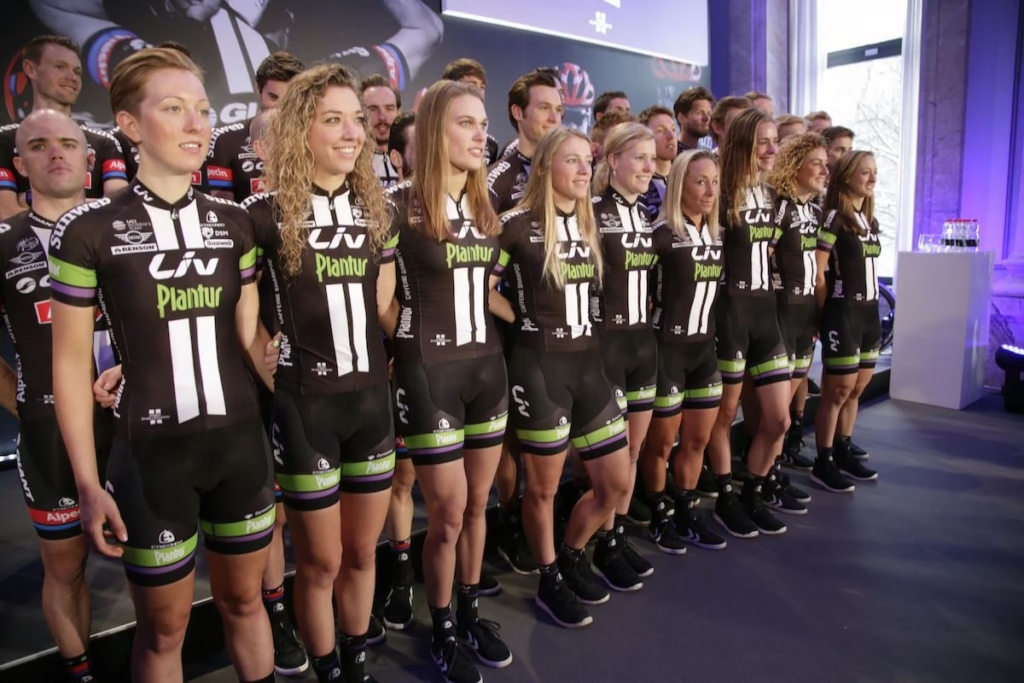
The 2016 Liv-Plantur squad contained only ten riders.
It was young, relatively small and clearly not designed to overpower the strongest teams through numbers.
Floortje Mackaij, Sabrina Stultiens, Julia Soek, Rozanne Slik, Molly Weaver and Kyara Stijns remained central to the project.
Riejanne Markus joined as another young Dutch prospect.
The most important new signing was Leah Kirchmann.
Leah Kirchmann gave Liv-Plantur a new leader
Kirchmann arrived from the North American Optum programme as a proven international rider.
She combined sprinting speed, time-trial ability and strength over rolling terrain.
That versatility made her particularly valuable to a small team.
Liv-Plantur did not have enough established riders to appoint separate leaders for every race type. Kirchmann could contend in flat finishes, difficult one-day races, time trials and stage races.
She immediately raised the team’s level.
Kirchmann won the Drentse Acht van Westerveld early in the season, beating the surviving members of a breakaway.
More importantly, she delivered consistently across the newly introduced UCI Women’s WorldTour.
The first Women’s WorldTour changed the context
The UCI Women’s WorldTour began in 2016, replacing the old World Cup and bringing one-day races and stage races into a single season-long competition.
Its creation increased the importance of consistency across the calendar.
Liv-Plantur entered that new era without one of the largest rosters or budgets.
Kirchmann still finished second in the overall individual WorldTour standings, behind Megan Guarnier.
That was one of the most important achievements of the Liv-Plantur period.
It demonstrated that the team could recruit an international leader, provide her with responsibility and compete across the season despite lacking the depth of its biggest rivals.
Kirchmann’s performances also marked a shift away from the team’s earlier dependence on Dutch sprinting talent.
The roster was becoming more international and more tactically varied.
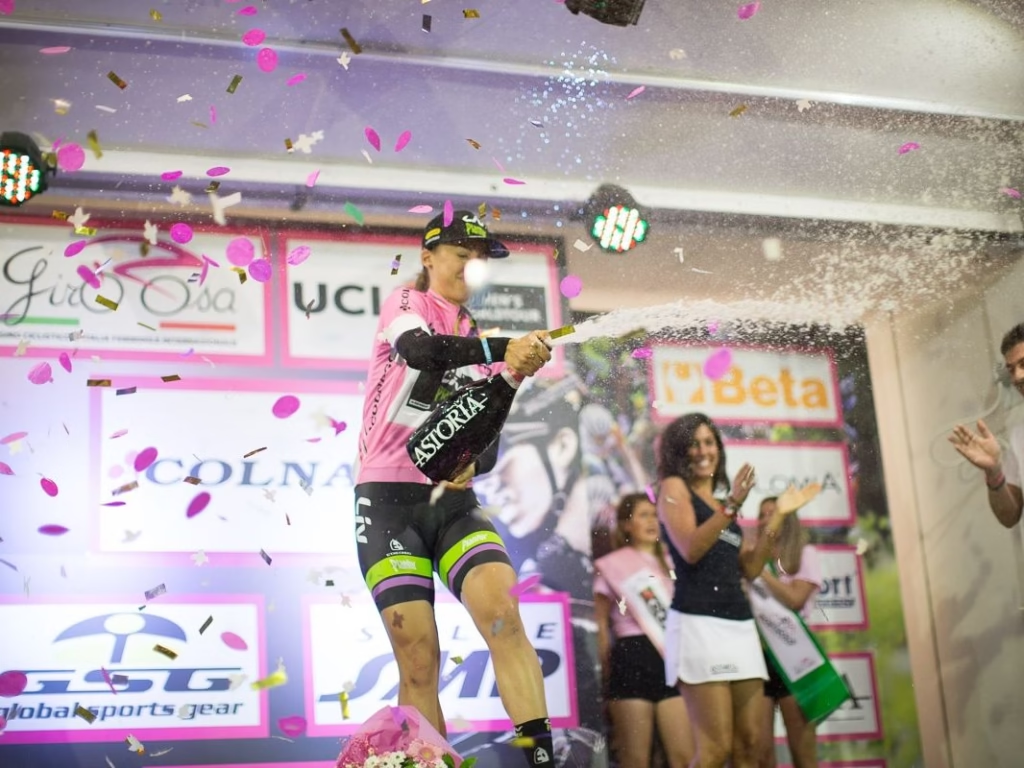
The Giro Rosa prologue produced a landmark result
Kirchmann won the opening prologue of the 2016 Giro Rosa.
The Giro was the leading women’s stage race of the period, attracting the strongest riders and teams in the sport.
Winning the opening test gave Kirchmann the first pink jersey and provided Liv-Plantur with one of its most visible moments.
The result also suited the direction in which the organisation was moving.
Later Sunweb and DSM teams became closely associated with structured preparation, aerodynamic development and detailed performance planning.
Those characteristics were still developing during the Liv-Plantur period, but Kirchmann’s prologue victory offered an early example of how the team could use a versatile rider and specialist preparation to outperform wealthier rivals.
Riejanne Markus joined before becoming an elite stage racer
Riejanne Markus signed for Liv-Plantur in 2016 while still establishing herself at professional level.
She later became a Dutch national champion, leading time triallist and major stage-race contender after leaving the team.
Her single season within Liv-Plantur nevertheless fits the organisation’s wider pattern.
The squad repeatedly recruited riders before they became obvious international leaders.
Markus could experience top-level racing without immediately carrying the responsibility attached to a proven star.
The team did not retain her long enough to benefit from her eventual peak years, but her presence reinforces Liv-Plantur’s position within the Dutch development pathway.
Her later progression into one of the peloton’s leading time triallists included back-to-back Dutch titles and eventually a move to Lidl-Trek on a three-year deal.
Molly Weaver represented the team’s widening recruitment
British rider Molly Weaver joined the organisation during 2015 after racing for Matrix Fitness.
She remained with Liv-Plantur for 2016.
Weaver brought time-trial ability and promise on rolling roads, adding another international rider to what had initially been a predominantly Dutch project.
Her arrival reflected the team’s gradual expansion beyond its original recruitment base.
Liv-Plantur was still centred on the Netherlands, but it was becoming more willing to identify talent from different national systems.
This internationalisation accelerated under Team Sunweb.
 Photo Credit: Cor Vos
Julia Soek became another symbol of continuity
Julia Soek was not the team’s most prolific winner, but she became an important figure within the wider organisation.
She raced through the Liv-Plantur and Sunweb years before later moving into staff and management roles.
Soek’s path reflects the value the team placed on riders who understood its system and could contribute beyond individual results.
The same continuity can be seen throughout the modern Picnic PostNL structure.
Former riders have often moved into coaching, performance or management roles, allowing knowledge to remain within the organisation even as sponsors and rosters change.
Liv-Plantur’s small roster exposed its limitations
The 2016 team could achieve major results through Kirchmann and create opportunities for younger riders, but its limited depth remained obvious.
Boels-Dolmans, Rabo-Liv, Wiggle High5 and Canyon-SRAM could start major races with several established winners.
Liv-Plantur had fewer alternatives.
If Kirchmann was unavailable, Stultiens was injured or Mackaij missed the decisive move, the team had limited ability to change its plan.
A ten-rider roster also had to cover an expanding international calendar.
The new Women’s WorldTour demanded more travel, recovery and logistical support while increasing the sporting importance of races throughout the year.
Liv-Plantur showed that the underlying project was stable. It also showed that the next version needed a larger and more accomplished squad.
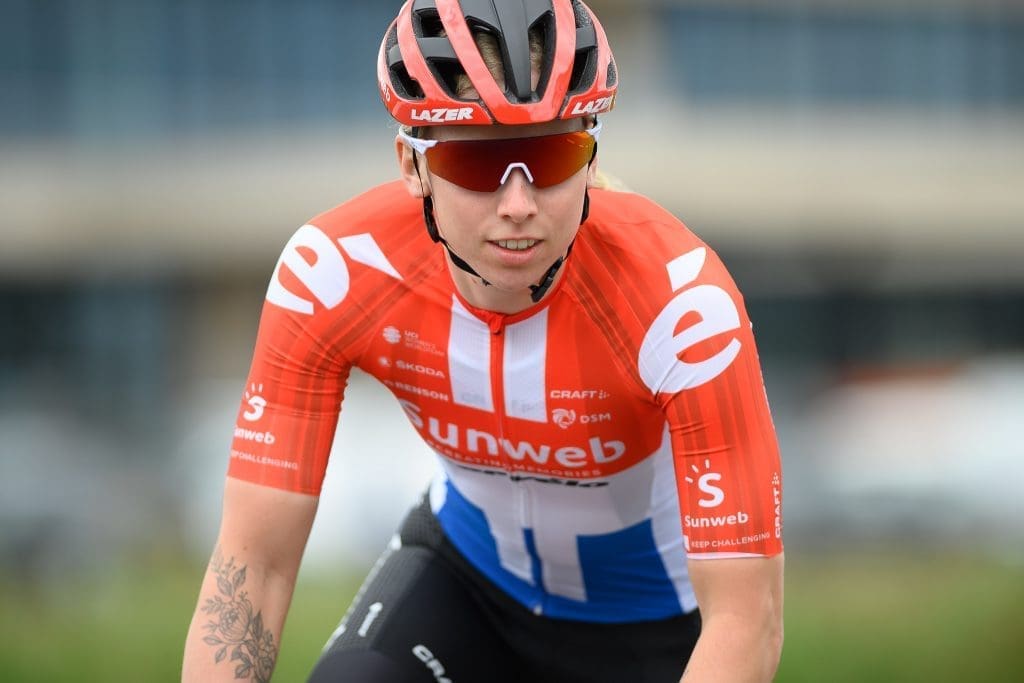
Sunweb was the next phase, not a new team
Sunweb was already involved in the wider organisation before becoming title sponsor.
For 2017, the men’s, women’s and development programmes were brought together under the Team Sunweb name.
The Liv-Plantur identity disappeared, but the women’s team continued directly into the new era.
Mackaij, Kirchmann, Stultiens, Weaver, Soek and Rozanne Slik all carried across from Liv-Plantur.
The management structure and development philosophy also remained in place.
What changed was the scale of ambition.
Team Sunweb added a group of riders capable of turning the existing framework into a leading international programme.
The 2017 recruitment transformed the continuous project
Ellen van Dijk joined as one of the world’s strongest time triallists and Classics riders.
Lucinda Brand brought aggression, technical skill and stage-race versatility.
Coryn Rivera added elite sprinting and one-day potential.
Liane Lippert and Juliette Labous arrived as long-term development signings.
The balance of the roster was far stronger than it had been during the Liv-Plantur years.
Experienced winners could lead immediately, while younger riders were given time to progress.
The results followed quickly.
Rivera won the Tour of Flanders. The team achieved success across time trials, Classics and stage races before winning the women’s team time trial at the 2017 World Championships.
Those achievements belong to Team Sunweb, but the squad had not appeared from nothing.
It was the strengthened continuation of the project that Liv-Plantur had stabilised during 2015 and 2016.
Liv remained involved after the title changed
Liv’s role did not end when the team became Sunweb.
The women’s squad continued riding Liv bicycles during the early Sunweb seasons.
The brand remained a technical partner and worked with the team on equipment designed for its female riders.
This included the development and promotion of the Liv Langma climbing bike.
The continued relationship shows that the move from Liv-Plantur to Sunweb was a sponsorship realignment rather than a rejection of the previous project.
The title changed. The team and technical collaboration continued.
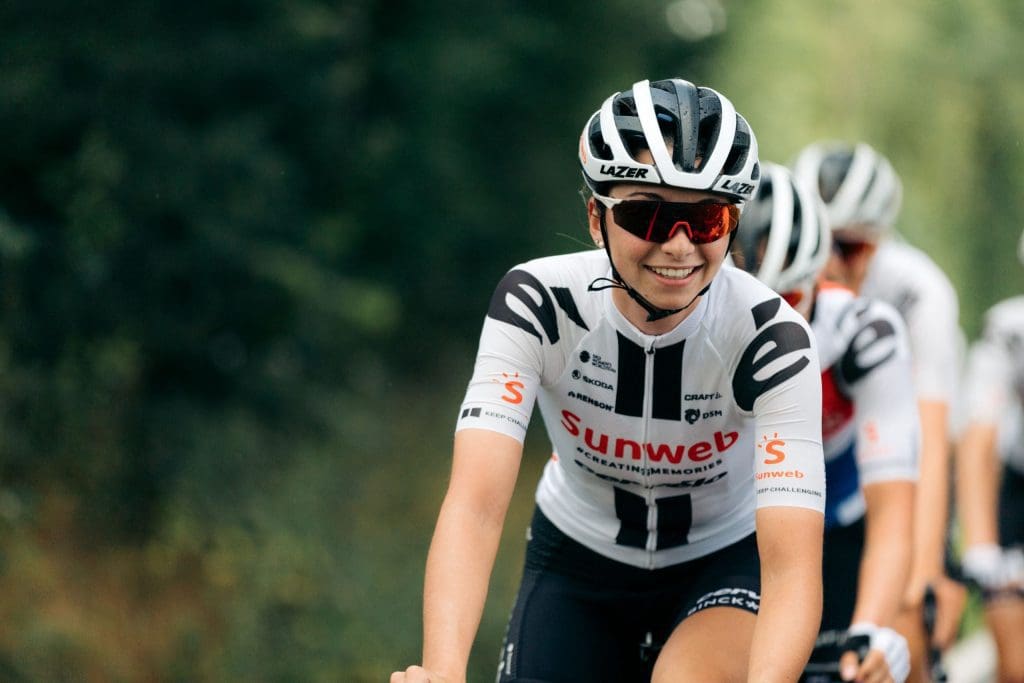
The Sunweb era delivered the team’s first major transformation
Between 2017 and 2020, Team Sunweb developed into one of the most recognisable women’s squads in the world.
Its roster combined established leaders with a formal development pathway.
Coryn Rivera, Ellen van Dijk, Lucinda Brand, Kirchmann and Mackaij supplied high-level results, while Lippert and Labous progressed towards leadership.
The team became known for detailed preparation, collective tactics and a willingness to trust younger riders.
Those characteristics had been visible during Liv-Plantur, but Sunweb possessed the roster and resources to apply them more successfully.
The women’s programme also gained greater identity within the combined organisation.
It was no longer simply a stable team surviving between sponsorship cycles. It had become one of the sport’s major long-term projects.
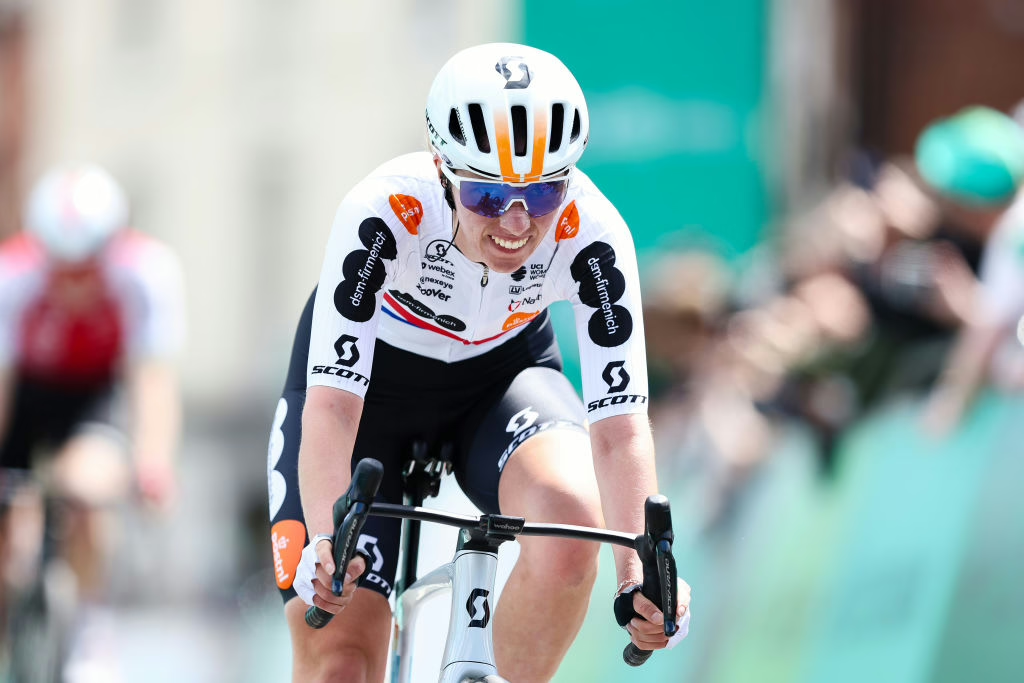
From Sunweb to DSM
The team became Team DSM in 2021 after another change of title sponsor.
Again, the sporting organisation continued.
The DSM period brought a new generation of leaders and winners, including Lorena Wiebes, Liane Lippert, Juliette Labous, Floortje Mackaij and Pfeiffer Georgi.
Wiebes delivered prolific sprint victories.
Labous developed into a Grand Tour contender.
Lippert became one of the strongest riders on hilly terrain.
Georgi progressed from a young signing into a Classics leader and British national champion.
These developments followed the same broad philosophy visible during the Liv-Plantur years: recruit young riders, give them top-level opportunities and develop them within a shared system.
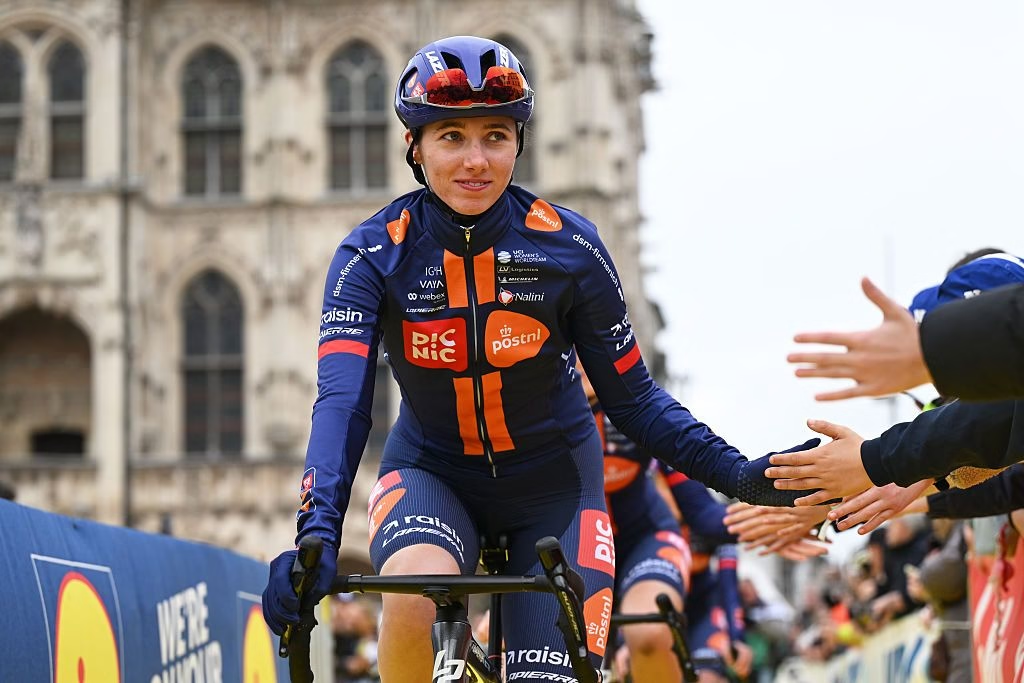 Photo Credit: Getty
PostNL and Picnic continued the same team
PostNL joined the title sponsorship in stages.
The women’s squad raced as Team dsm-firmenich PostNL in 2024 before becoming Team Picnic PostNL for 2025.
The current Picnic PostNL women’s team is therefore the direct successor to Liv-Plantur.
It is also the direct successor to Giant-Shimano, Argos-Shimano and the original Skil-Koga team.
The name, bicycle supplier, roster and lead sponsors have changed repeatedly.
The team’s organisational lineage has not.
This continuity is especially significant in women’s cycling, where many historically important teams were tied so closely to one sponsor that the entire programme disappeared when funding ended.
What remained consistent across the name changes?
The project has evolved substantially since 2011, but several characteristics have remained recognisable.
An integrated structure
The women’s programme operates alongside men’s and development teams within the same organisation.
A focus on rider progression
The team regularly signs riders before they have reached their peak and gives them opportunities at the highest level.
Long-term organisational management
The project has remained under the wider management of Iwan Spekenbrink throughout its different identities.
A collective racing philosophy
The team often emphasises positioning, teamwork and tactical flexibility rather than relying solely on one established superstar.
Continuity beyond riders
Former riders and long-serving staff have carried knowledge through different sponsorship eras.
Liv-Plantur did not create all of those characteristics, but its two seasons helped preserve and refine them at a vulnerable point in the team’s development.
Why Liv-Plantur can be overlooked
The Liv-Plantur name lasted only two seasons.
It also falls between two more obviously successful periods.
Giant-Shimano had Wild and Pieters winning major races.
Team Sunweb quickly became a major force with a much deeper roster and World Championship success.
Liv-Plantur’s results can therefore appear modest by comparison.
Yet team history cannot be measured only through its biggest wins.
The project had to manage the departure of Wild, then Pieters and Garner. It needed to identify new leaders, expand beyond its sprinting identity and continue operating through a rapidly changing period for women’s cycling.
It achieved all three.
The key successes of the Liv-Plantur years
The period’s importance can be summarised through several developments.
Floortje Mackaij proved the development model
Her 2015 Gent-Wevelgem victory showed that a young rider could progress within the team and win at the highest level.
Leah Kirchmann supplied international leadership
Her 2016 season gave the project a versatile leader capable of competing across the new Women’s WorldTour.
The roster became more varied
Stultiens added climbing ability, while riders such as Markus and Weaver widened the team’s profile.
The organisation survived major departures
The loss of Wild, Pieters and Garner did not cause the project to collapse.
The team identified what it needed next
The limited 2016 roster made the case for the ambitious recruitment that followed under Sunweb.
-
 Photo Credit: RCS
Liv-Plantur’s place in the Picnic PostNL story
Liv-Plantur should not be remembered as a separate team that existed briefly before being replaced.
It was the 2015 and 2016 identity of the continuous women’s programme founded as Skil-Koga in 2011 and now known as Picnic PostNL.
Its two seasons formed a bridge.
Behind it stood the Wild-led Argos-Shimano and Giant-Shimano teams, built around elite sprinting and a growing Dutch core.
Ahead stood Team Sunweb, where the organisation’s development philosophy was combined with enough depth and established talent to win the biggest races.
Liv-Plantur connected those phases.
Pieters carried the team’s earlier credibility into 2015. Mackaij emerged as the most important young rider of the first season. Kirchmann then gave the project international consistency during the inaugural Women’s WorldTour.
The results were not overwhelming, but the sporting direction became clearer.
The team was no longer simply a sprint-focused offshoot of a men’s programme. It was becoming a broader, long-term women’s development project capable of surviving sponsor changes and rebuilding around successive generations.
A transitional name in a lasting team
The blue Liv-Plantur kit disappeared after 2016.
The team did not.
It continued as Sunweb, DSM, dsm-firmenich PostNL and Picnic PostNL, carrying riders, staff, systems and development principles from one identity into the next.
That is the central meaning of the Liv-Plantur period.
It was not the team’s origin and it was not the final destination. It was the stage at which a successful but relatively narrow early project began turning into the long-running WorldTour organisation that exists today.
The team founded as Skil-Koga in 2011 has survived more than a decade of sponsor changes.
Liv-Plantur was one of the most important steps in that continuous history.

