The Tour of Britain Women has already been through several distinct eras despite being little more than a decade old.
It began in 2014 as The Women’s Tour, rapidly established itself as one of the strongest stage races on the women’s calendar and became part of the UCI Women’s WorldTour when the series launched in 2016. Financial problems then forced the cancellation of the 2023 edition before British Cycling stepped in and relaunched the event as the Tour of Britain Women in 2024.
The name has changed, but the sporting lineage remains the same. Marianne Vos won the inaugural edition, Lizzie Deignan became its first two-time champion, and subsequent winners have included Demi Vollering, Elisa Longo Borghini, Lotte Kopecky and Ally Wollaston.
Now the race is entering another phase. The Tour of Britain Women 2026 expands to five stages and moves into August, giving Britain’s leading women’s stage race its longest format since the British Cycling takeover.
The Women’s Tour began in 2014
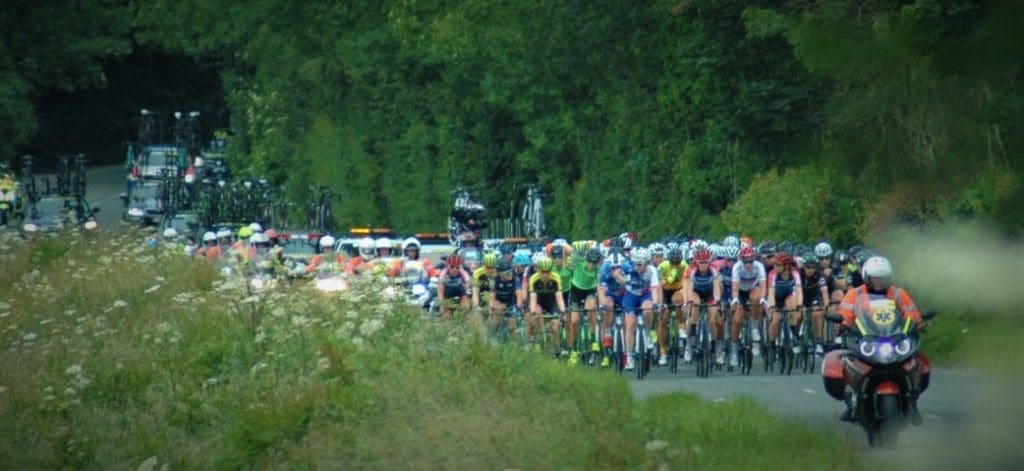
The first Women’s Tour took place in May 2014 at a point when elite women’s cycling had relatively few stage races with the visibility, roadside crowds and organisational ambition normally associated with major men’s events.
SweetSpot, already responsible for the men’s Tour of Britain, created the race as a standalone women’s event rather than simply attaching a token competition to the men’s Tour.
The inaugural winner could hardly have given it more credibility.
Marianne Vos took the overall classification after winning three of the five stages, adding Britain’s new event to a palmarès that already included world titles and Olympic gold.
Lisa Brennauer followed in 2015, showing early on the type of rider the British race would often reward. Without Alpine-length climbs, the GC depended more on rolling terrain, short ascents, positioning, sprinting ability and small time gaps.
That identity would stay with the race even as the routes changed.
WorldTour status gave the race greater importance
Women’s professional cycling was restructured in 2016 with the launch of the UCI Women’s WorldTour, and The Women’s Tour was included in the new top-level series from its first season.
Lizzie Deignan, then racing as Lizzie Armitstead, won that year’s edition.
For a British stage race trying to establish itself alongside the sport’s biggest events, a home victory by the reigning world champion was particularly significant.
Deignan’s success also began a period in which the winner’s list became increasingly impressive. Kasia Niewiadoma won in 2017 before Coryn Rivera took the 2018 title.
None of those victories required a traditional high-mountain GC performance. The British roads created their difficulty differently, with repeated climbs, narrow roads, unpredictable weather and aggressive racing regularly producing small but decisive gaps.

Lizzie Deignan became the first two-time champion
Deignan returned to win the race again in 2019, becoming its first two-time overall winner.
Her second victory strengthened the relationship between the race and British cycling. The Women’s Tour had become one of the few opportunities each season for the country’s biggest female riders to compete in a WorldTour stage race on home roads, often in front of crowds who otherwise had little chance to see the women’s peloton.
Deignan remained strongly associated with the event for the rest of her career. Her final appearance came at the 2025 Tour of Britain Women, with ProCyclingUK looking at Deignan’s final British Tour and the home riders around her.
The 2019 edition was also the last before the first major interruption in the race’s history.
The pandemic cancelled the 2020 race
There was no Women’s Tour in 2020 because of the COVID-19 pandemic.
The event returned in October 2021 rather than its usual early-summer position, with Demi Vollering taking the overall victory.
By then Vollering was becoming one of the leading stage racers in the women’s peloton, and her win added another future Grand Tour champion to an increasingly strong honours list.
Elisa Longo Borghini followed in 2022, beating Grace Brown by just one second overall.
That margin fitted the character of The Women’s Tour perfectly. The race rarely needed enormous mountains to produce an interesting GC. Bonus seconds, short climbs and small splits could be enough to decide the entire event.
But by then the biggest threat to the race was no longer sporting.
Why was The Women’s Tour cancelled in 2023?
The 2023 Women’s Tour was cancelled because organiser SweetSpot could not secure enough commercial funding to deliver the event.
Increasing running costs and the loss of sponsorship created a substantial financial shortfall. Attempts to attract further commercial backing, including crowdfunding, were not enough to save the planned edition.
This was more serious than the 2020 cancellation.
The pandemic had temporarily stopped a financially functioning race. In 2023, the question was whether The Women’s Tour itself remained sustainable.
The cancellation was particularly striking because this was not a minor event struggling for sporting relevance. It had WorldTour status, strong crowds and a winners list containing some of the most recognisable riders in women’s cycling.
The problem was making the economics work.
British Cycling rebuilt the race for 2024
The financial difficulties surrounding SweetSpot also affected the men’s Tour of Britain, and British Cycling eventually took over delivery of the country’s two leading professional stage races.
For 2024, the women’s event returned as the Tour of Britain Women.
The change was more than a rebrand. It marked a new organisational structure and brought the men’s and women’s races together under the same Tour of Britain identity.
The comeback edition contained four stages, down from the six used in 2022, but retained its place at the top level of women’s cycling.
British Cycling also included a Great Britain national team, with Lizzie Deignan and Elinor Barker among the riders selected for the 2024 race.
Most importantly, the race itself was back.
 Photo Credit: Alex Whitehead/SWpix.com
Lotte Kopecky dominated the 2024 comeback
Lotte Kopecky became the first winner under the Tour of Britain Women name.
The world champion won the opening stage into Llandudno and followed it with another victory in Wrexham, establishing the advantage that ultimately carried her to the overall title.
Anna Henderson finished second overall, with Kopecky’s strength on Britain’s short climbs and rolling roads once again demonstrating the type of rider the race has traditionally suited.
She was powerful enough to make differences on difficult terrain but fast enough to collect stage wins and bonuses.
The 2025 Tour of Britain Women race preview looked back at Kopecky’s victory as the result that successfully restarted the race after the disruption of 2023.
The 2025 race pushed further north
The second edition under British Cycling took the race somewhere it had never been before.
The 2025 Tour of Britain Women route began around the North York Moors and Tees Valley before heading through the Scottish Borders and finishing in Glasgow.
It was the first time the women’s race had visited Scotland, significantly broadening its geographical reach after years in which the route had concentrated mainly on England and Wales.
The field was strong too. Lorena Wiebes, Kristen Faulkner, Kim Le Court, Cat Ferguson, Anna Henderson and Deignan were among the headline names, with a record 19 teams taking part.
ProCyclingUK’s 2025 start-list announcement reflected how quickly the relaunched event had regained its position on the calendar.
 Photo Credit: Alex Whitehead/SWpix.com
 Ally Wollaston won the 2025 race by four seconds
The 2025 Tour of Britain Women produced one of the closest GC battles in its history.
Kim Le Court won the opening stage in Redcar after going clear with Kristen Faulkner, a result covered in our Stage 1 report.
Mara Roldan won the following day before British teenager Cat Ferguson took Stage 3 in Kelso and moved into the overall lead ahead of the Glasgow finale.
Ferguson started Stage 4 only three seconds ahead of Ally Wollaston.
Rather than waiting for the finish, Wollaston attacked the classification through the intermediate sprints, collecting enough bonus seconds to bring herself level before the final sprint.
Lorena Wiebes won the stage, but Wollaston’s third place brought another four bonus seconds and gave her the overall title.
She finished four seconds ahead of Ferguson, with Karlijn Swinkels third.
It was Wollaston’s first WorldTour stage-race GC victory and another result that captured the identity of the event. No summit finish was required. The race was decided through positioning, sprinting and seconds collected across a short final stage.
The Women’s Tour and Tour of Britain Women share the same history
The 2024 name change can make the history appear more complicated than it really is.
The Tour of Britain Women was not created as an entirely separate race with no connection to The Women’s Tour. British Cycling rebuilt Britain’s established women’s stage race under a new organisational structure and a new title.
The sporting history therefore runs from the first Women’s Tour in 2014 through to the modern Tour of Britain Women.
There have been two missing editions, 2020 because of the pandemic and 2023 because of the financial crisis.
Otherwise the winners belong to the same lineage.


Tour of Britain Women past winners
| Year | Winner |
|---|---|
| 2014 | Marianne Vos |
| 2015 | Lisa Brennauer |
| 2016 | Lizzie Deignan |
| 2017 | Kasia Niewiadoma |
| 2018 | Coryn Rivera |
| 2019 | Lizzie Deignan |
| 2020 | No race |
| 2021 | Demi Vollering |
| 2022 | Elisa Longo Borghini |
| 2023 | No race |
| 2024 | Lotte Kopecky |
| 2025 | Ally Wollaston |
Deignan remains the only rider to have won twice.
What stands out just as much is the range of riders beneath her. Vos, Niewiadoma, Vollering, Longo Borghini and Kopecky have all become world champions or major stage-race winners, while riders such as Brennauer, Rivera and Wollaston reflect the advantage the British terrain can give to powerful all-rounders.
Five stages mark another step forward in 2026
The next major change comes in 2026.
The race moves from June into a new 19-23 August slot and expands from four stages to five. British Cycling had already confirmed the extension after the 2025 edition, a development covered by ProCyclingUK when the Tour of Britain Women was approved to grow to five stages.
The full 2026 Tour of Britain Women route takes the race from Cockermouth through Lancashire and Wales before a final stage from Haverfordwest to Cardiff.
Stage 3 finishes on the Great Orme above Llandudno, providing the sort of short, difficult uphill finale that has traditionally suited the race, before the route continues through mid-Wales to Hay-on-Wye and then into South Wales for the final day.
The move to five stages matters beyond simply adding another day. It gives teams more scope to recover from an early setback, creates more opportunities for different rider types and brings the women’s race closer to the scale expected of Britain’s principal national stage race.
The development also reflects how far the event has come since the uncertainty of 2023.
The Tour of Britain Women has survived a pandemic, a financial collapse, a change of organiser and a complete rebrand in little more than a decade. Through all of that, its sporting identity has been surprisingly stable.
Britain does not need Alpine passes to create a difficult stage race. Short climbs, exposed roads, narrow lanes, unpredictable weather and bonus seconds have repeatedly been enough to separate some of the best riders in the world.
That was true when Vos won the first Women’s Tour in 2014, and it remains the basis of the Tour of Britain Women in 2026.