
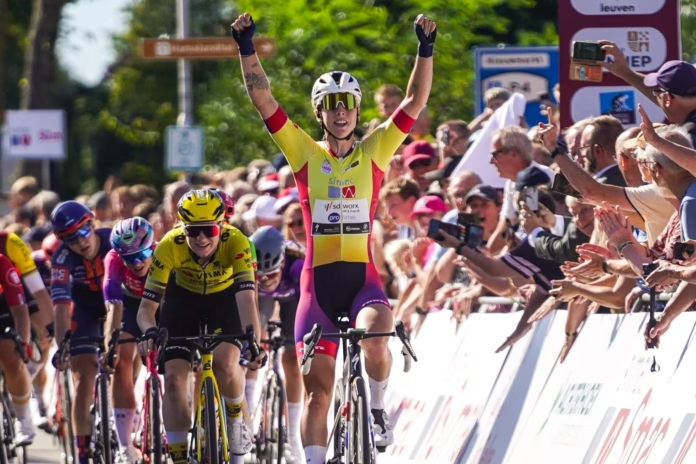
For almost three decades, the Simac Ladies Tour developed into the Netherlands’ leading women’s stage race, growing from a relatively modest national event into one of the most distinctive races in professional women’s cycling.
Its name changed repeatedly along the way. It began as the Holland Ladies Tour, became the Profile Ladies Tour, BrainWash Ladies Tour and Boels Rental Ladies Tour before Simac took over the title sponsorship in 2021. From 2026, another chapter begins as the women’s event is incorporated into the relaunched Eneco Tour alongside the men’s race.
Despite those changes, its sporting character remained recognisably Dutch. Flat roads rarely meant straightforward racing, with crosswinds, echelons, technical circuits, time trials and occasional visits to the hills creating a stage race where positioning and raw power could matter every bit as much as climbing ability. That combination explains a roll of honour headed by Marianne Vos, but also containing riders as different as Annemiek van Vleuten, Lotte Kopecky and Lorena Wiebes.
The Simac Ladies Tour name may have disappeared after the 2025 edition, but the race behind it carries a history stretching back to 1998.
The Holland Ladies Tour begins in 1998
The original Holland Ladies Tour was founded in 1998, at a time when the enormous strength of Dutch women’s cycling was not matched by a substantial home stage race. Wim van Duivenbode and women’s cycling coordinator Leo van der Wal were among the figures behind its creation, with the inaugural edition taking place shortly before the Netherlands hosted that year’s UCI Road World Championships in Valkenburg.
The first stage was a 4.6km prologue around Ter Aar on 15 September 1998, immediately giving the new event a prestigious opening winner when Leontien Zijlaard-Van Moorsel recorded the fastest time. She did not win the overall race, however. That honour went to Elsbeth Vink, who became the first Holland Ladies Tour champion.
Van Moorsel returned a year later to win the 1999 overall classification, establishing the new stage race remarkably quickly among the important fixtures of the Dutch women’s calendar. The origins and development of the event were also covered in ProCyclingUK’s 2025 Simac Ladies Tour preview.
Major winners quickly give the race credibility
The opening decade produced an impressive collection of champions. Mirjam Melchers won in 2000 and 2004, German sprint great Petra Rossner took the 2001 edition and Debby Mansveld followed in 2002. Swedish star Susanne Ljungskog claimed the first of her two victories in 2003 before returning to win again three years later, while Kristin Armstrong became champion in 2007, one year before taking Olympic individual time trial gold in Beijing.
Those names already revealed something important about the race. Rossner possessed enormous sprinting speed, Armstrong was one of the world’s leading time triallists and Ljungskog was a powerful all-rounder who had twice become road world champion. The Holland Ladies Tour was therefore never developing into a conventional stage race for one narrowly defined type of rider.
Instead, the winner usually needed several qualities. Sprinting counted. Time trialling counted. Positioning in crosswinds counted. As the race evolved, that versatility became its defining characteristic.
Time trials become part of the race’s identity
Racing against the clock was present from the very first afternoon in Ter Aar and remained an important part of the event throughout most of its history.
The geography of the Netherlands made that particularly useful. The organisers could not build a race around the sustained mountain passes capable of producing major GC differences at the Giro d’Italia Women or Tour de France Femmes, so other mechanisms had to separate the leading riders. Time trials provided one, crosswinds another, while selective days in Limburg or later visits to climbs such as the Col du VAM could add a further layer.
The result was a general classification where powerful Classics specialists could realistically beat more conventional climbers. The 2022 Simac Ladies Tour preview demonstrated that traditional formula particularly well, mixing sprint opportunities with a time trial and the constant possibility that exposed Dutch roads would split the race apart.
Marianne Vos takes control of the race
No rider has shaped the race’s overall record more than Marianne Vos.
Vos won for the first time in 2009, then successfully defended the title in 2010, 2011 and 2012. Four consecutive overall victories remain the record and represented one of the most dominant periods any rider has enjoyed in the history of the event.
The race was almost perfectly suited to her. Vos could sprint with the quickest riders in the world, handle short climbs, produce strong time trials and position herself superbly when wind or narrow roads began breaking the peloton apart. A stage race containing sustained high mountains might have allowed specialist climbers to expose her, but the Holland Ladies Tour rarely offered them that opportunity.
Instead, it repeatedly rewarded the versatility that made Vos one of the greatest cyclists of her generation. Her four-year sequence remains perhaps the clearest expression of what was required to dominate this particular Dutch stage race.
Ina-Yoko Teutenberg becomes the stage-win benchmark
Vos dominates the GC statistics, but Ina-Yoko Teutenberg established the benchmark for individual stage victories, accumulating 14 wins during her appearances in the race.
That total also says plenty about the event itself. Sprinters regularly received opportunities, but surviving to contest those finishes was rarely as simple as sitting in the peloton until the final kilometre. Exposed roads, crosswinds and aggressive racing could remove fast riders long before a bunch sprint became possible.
Teutenberg was exceptionally good at both sides of that equation. She had the speed to finish the job, but also the power, positioning and tactical experience to remain at the front when the race became difficult.
Those same qualities would eventually allow another generation of elite sprinters to become genuine general classification contenders.
Holland Ladies Tour becomes Profile, BrainWash and Boels
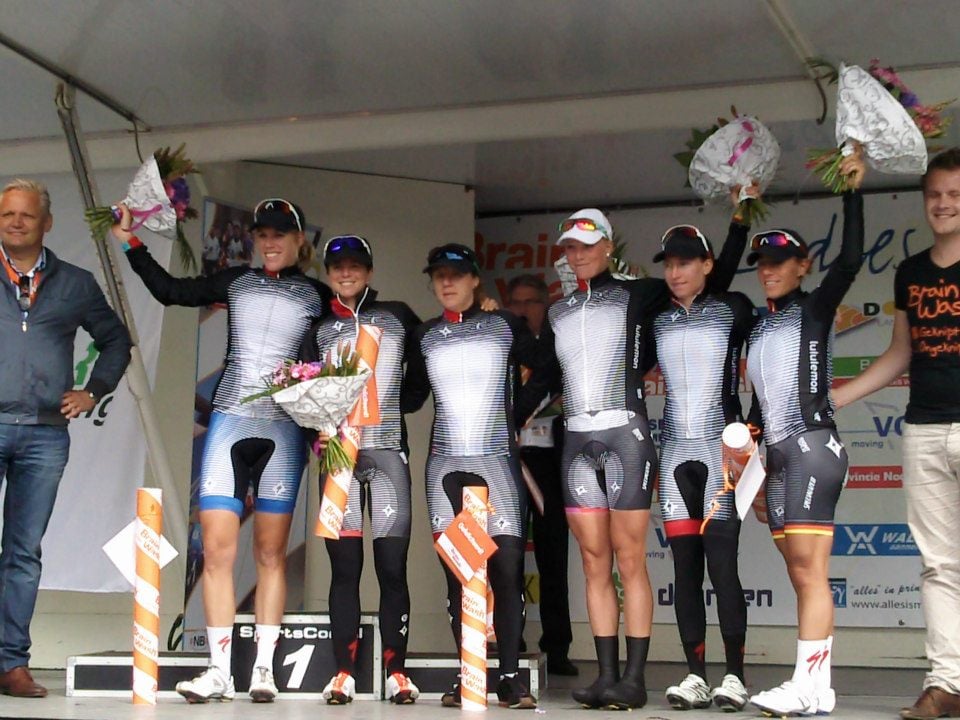
The original Holland Ladies Tour identity lasted through the event’s first decade before sponsorship changes began altering its public name. In 2011 it became the Profile Ladies Tour, followed by the BrainWash Ladies Tour in 2012 and the beginning of the long Boels Rental Ladies Tour era in 2013.
Those changes can make the historical results appear more fragmented than they really are. Vos’s victory in the 2010 Holland Ladies Tour and her 2011 Profile Ladies Tour title belong to exactly the same sporting lineage, as does Ellen van Dijk’s victory in the first Boels Rental edition two years later.
The sponsors changed. The race continued.
Ellen van Dijk opens the Boels Rental era
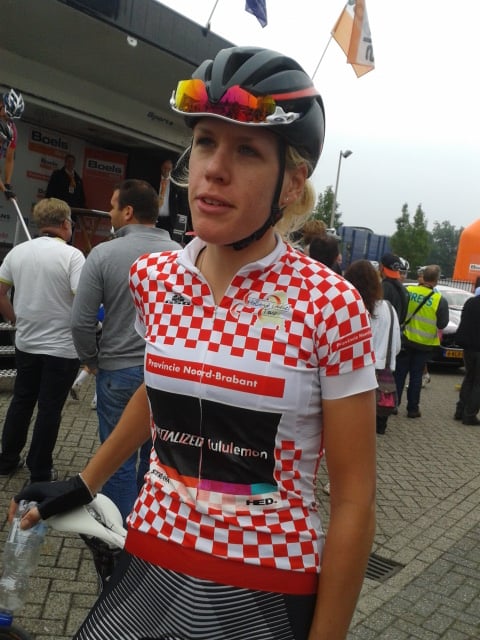
The first Boels Rental Ladies Tour in 2013 was won by Ellen van Dijk, another rider who fitted the demands of the race almost perfectly.
Van Dijk combined exceptional time-trial power with Classics strength and huge experience of racing in crosswinds. American Evelyn Stevens won the following edition before Lisa Brennauer claimed the 2015 title, extending the run of champions whose strengths went far beyond conventional climbing.
That pattern became one of the clearest distinctions between this race and more mountainous tours. The winner needed to be difficult to expose on flat roads, strong enough against the clock and alert enough not to lose the entire race when the wind changed direction.
Chantal Blaak wins before the WorldTour promotion
Chantal Blaak won in 2016, during the final season before the event joined the Women’s WorldTour.
The promotion arrived in 2017, almost two decades after Elsbeth Vink had won the inaugural Holland Ladies Tour. What had originally been created to provide Dutch women’s cycling with a substantial home stage race had now become part of the highest tier of the international calendar.
It was an important step in the event’s history, but it did not require a major change in identity. The race remained based around the ingredients that had already made it successful: exposed Dutch roads, selective time trials, tactical racing and just enough climbing to keep the classification open.
Annemiek van Vleuten dominates the first WorldTour editions
The promotion coincided with one of Annemiek van Vleuten’s strongest periods. She won the first WorldTour edition in 2017 and successfully defended the title in 2018, using the combination of time-trial power, climbing strength and tactical awareness that made her so difficult to beat across almost every type of stage race.
Van Vleuten was particularly dangerous because she could create meaningful gaps against the clock even when the road stages did not contain enough climbing to separate the strongest riders. At the same time, she was more than capable of handling the selective days and had enough experience to avoid being caught on the wrong side of a major split.
Her consecutive victories reinforced the race’s increasingly obvious identity. It was possible to win without being the best pure climber in the peloton, but almost impossible without being a very complete bike racer.

Christine Majerus wins before the pandemic interruption
Luxembourg’s Christine Majerus won in 2019, the final edition before the COVID-19 pandemic disrupted the international calendar.
The 2020 Boels Ladies Tour was eventually cancelled, producing the first season since the event’s creation in 1998 in which no edition took place. When the race returned the following year, it did so with another title sponsor and another new name.
Simac arrives in 2021
Technology company Simac became title sponsor in 2021, creating the name by which many current women’s cycling fans know the event.
Chantal van den Broek-Blaak won the first Simac Ladies Tour, taking her second overall victory five years after her first. By this stage, however, the wider environment around women’s stage racing was changing rapidly. Teams were becoming more professional, the Women’s WorldTour calendar was expanding and the Tour de France Femmes was about to transform the profile of the sport’s major stage races.
The Simac Ladies Tour retained its place by refusing to imitate those more mountainous events. It remained recognisably Dutch, building its GC around time trials, crosswinds, positioning and shorter selective stages rather than trying to manufacture a high-mountain race in a country without high mountains.
Lorena Wiebes proves a sprinter can win the GC
The 2022 Simac Ladies Tour provided one of the clearest demonstrations of the race’s unusual characteristics when Lorena Wiebes won the overall classification.
Calling one of the world’s fastest sprinters a stage-race GC winner sounds unusual almost anywhere else. Here, it made perfect sense. Wiebes could win stages and accumulate bonus seconds, she was powerful enough to survive crosswinds and there was little sustained climbing capable of automatically eliminating her from contention. Her time-trial ability was also good enough to prevent specialists from simply taking decisive minutes out of her.
Her campaign began with victory on Stage 1 in Lelystad, when crosswinds helped a 21-rider front group stay clear rather than the race ending with the conventional full-peloton sprint many had expected.
By the end of the week, Wiebes had secured the 2022 Simac Ladies Tour overall title, while Mischa Bredewold won the final stage. It was a perfect demonstration of how the race could produce a GC winner who would rarely have the same opportunity in a mountain-heavy stage race.

Lotte Kopecky takes over in 2023
If Wiebes appeared made for the Simac Ladies Tour, Lotte Kopecky brought an even broader collection of strengths.
The Belgian arrived with track power, elite sprinting speed, Classics strength and increasingly strong climbing and time-trial performances. A bunch sprint suited her, crosswinds suited her and the short selective climbs used by the race were unlikely to remove her.
Kopecky won the 2023 time trial in Leuven and moved into the race lead, then strengthened her position by winning on the Cauberg during the decisive Limburg stage. She ultimately won the overall classification, beginning what would become back-to-back victories.
The 2023 race also carried additional significance because it marked the end of one of the greatest careers in women’s cycling.
Annemiek van Vleuten ends her career at the Simac Ladies Tour
The final stage of the 2023 Simac Ladies Tour was Annemiek van Vleuten’s final professional race.
By then she had won the race twice, become world and Olympic champion and claimed overall victories at the Tour de France Femmes, Giro and Vuelta. Choosing a Dutch stage race she had won twice as the final event of her career gave the Simac Ladies Tour a particularly important place in the story of one of the Netherlands’ greatest riders.
ProCyclingUK covered Van Vleuten’s final professional race, with Kopecky taking the overall classification and Wiebes winning the final stage in Arnhem.
For a rider whose career had increasingly been defined by the world’s biggest mountain races, her last finish line came at the home stage race whose identity had always been built around something very different.
Kopecky wins again by seconds in 2024
Kopecky returned in 2024 and successfully defended her title, although her second victory proved considerably less straightforward.
The race reached its final stage in Arnhem with Franziska Koch holding the overall lead. Silke Smulders then launched a long attack that briefly placed her in virtual yellow, forcing Kopecky’s SD Worx team into a hard chase through the closing circuits.
The break survived until almost the finish. Kopecky finally came past in the final metres, taking both the stage victory and the ten-second winner’s bonus. That was enough to overturn Koch and secure the overall classification by only two seconds.
The 2024 Simac Ladies Tour finale was a particularly good example of how bonus seconds could become as important as conventional climbing gaps in this race. Kopecky had now won consecutive editions, becoming the first rider since Van Vleuten to successfully defend the title.
Lorena Wiebes dominates the final Simac Ladies Tour
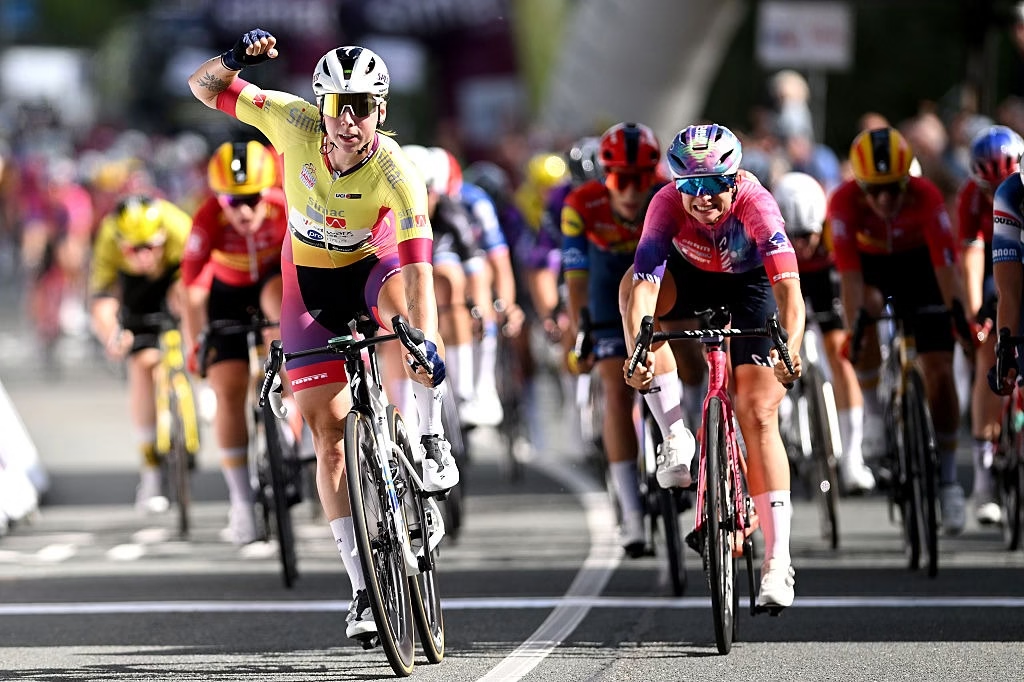
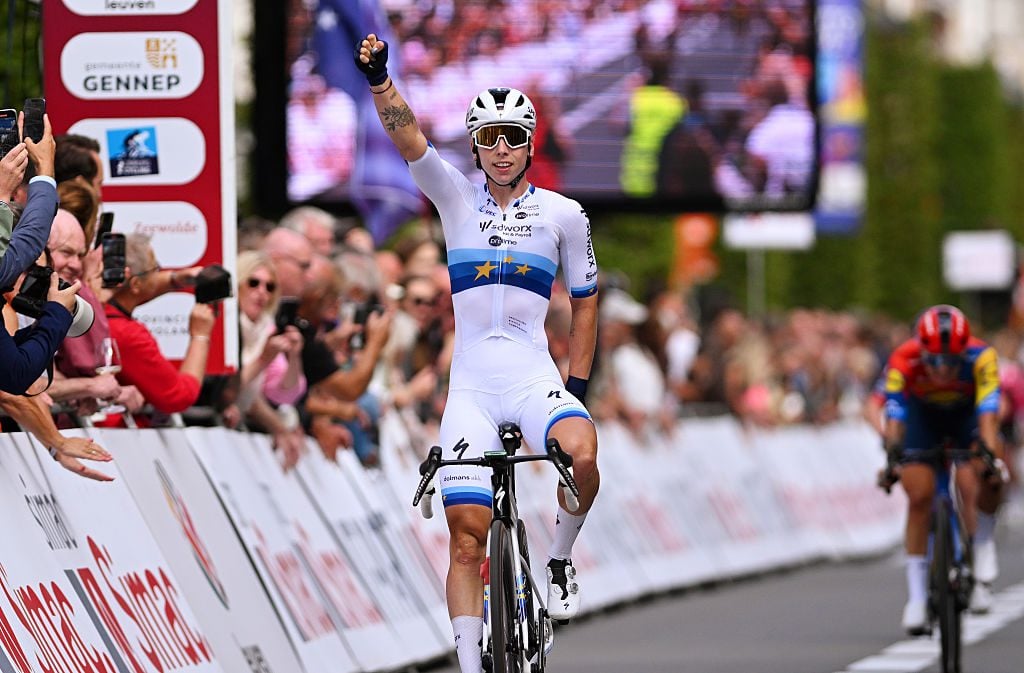
The 2025 edition brought the standalone Simac Ladies Tour era to a spectacular close, with Wiebes winning five of the six stages and the overall classification.
Even describing it as sprint domination understates what happened. Stage 2 was blown apart by crosswinds, leaving an 11-rider front group. The following stage brought more echelon racing, yet Wiebes kept winning. By Stage 4 in Alkmaar she had four consecutive stage victories.
Zoe Bäckstedt finally interrupted the sequence in the Stage 5 time trial, where she won against the clock while Wiebes protected her overall lead. Even that did not alter the overall pattern of the race.
The final stage added gravel and the Muur van Zeddam, but Wiebes won again. Her fifth stage victory also secured the 2025 Simac Ladies Tour overall title, ahead of Elisa Balsamo and Megan Jastrab.
It was an emphatic way for the Simac era to end, and perhaps the clearest possible demonstration of why this race could reward a rider normally defined as a sprinter.
Simac Ladies Tour overall winners
| Year | Winner |
|---|---|
| 1998 | Elsbeth Vink |
| 1999 | Leontien Zijlaard-Van Moorsel |
| 2000 | Mirjam Melchers |
| 2001 | Petra Rossner |
| 2002 | Debby Mansveld |
| 2003 | Susanne Ljungskog |
| 2004 | Mirjam Melchers |
| 2005 | Tanja Hennes |
| 2006 | Susanne Ljungskog |
| 2007 | Kristin Armstrong |
| 2008 | Charlotte Becker |
| 2009 | Marianne Vos |
| 2010 | Marianne Vos |
| 2011 | Marianne Vos |
| 2012 | Marianne Vos |
| 2013 | Ellen van Dijk |
| 2014 | Evelyn Stevens |
| 2015 | Lisa Brennauer |
| 2016 | Chantal Blaak |
| 2017 | Annemiek van Vleuten |
| 2018 | Annemiek van Vleuten |
| 2019 | Christine Majerus |
| 2020 | Not held |
| 2021 | Chantal van den Broek-Blaak |
| 2022 | Lorena Wiebes |
| 2023 | Lotte Kopecky |
| 2024 | Lotte Kopecky |
| 2025 | Lorena Wiebes |
Marianne Vos remains the record holder with four overall victories, all achieved consecutively between 2009 and 2012. Wiebes, Kopecky, Van Vleuten, Van den Broek-Blaak, Ljungskog and Melchers are among the riders to have won twice.
The spread of winners is important. Some were dominant time triallists, some were Classics specialists and some were among the fastest sprinters in the world. What united them was versatility.
Crosswinds became the race’s substitute for mountains
The Netherlands’ landscape was simultaneously the event’s biggest limitation and one of its greatest strengths. There were few substantial climbs capable of creating conventional mountain-stage gaps, so the wind became part of the terrain.
When strong crosswinds hit exposed Dutch roads, teams could form echelons, creating diagonal lines across the width of the road. Only a limited number of riders could remain properly sheltered, and once the front line filled, riders further back were forced into the wind. Gaps could form almost instantly.
That meant a completely flat stage could produce larger GC differences than a day containing several recognised climbs. The 2025 edition provided particularly vivid examples, but the phenomenon had been central to the identity of the race for decades.
It was also why sprinters could never assume a flat profile guaranteed them a simple journey to the final kilometre. Winning the Simac Ladies Tour required staying near the front long before the sprint became relevant.
The race had a useful relationship with the World Championships
For many years, the event’s late-season calendar position placed it relatively close to the UCI Road World Championships, giving the race another important role.
Time trials offered world championship contenders a valuable opportunity to test form, equipment and pacing shortly before competing for the rainbow jersey. Technical circuits and aggressive Dutch road stages also provided useful road-race preparation.
That calendar position helped attract leading riders even when they were not necessarily targeting the general classification. The Simac Ladies Tour could function simultaneously as an important stage race in its own right and as part of the final preparation block for the Worlds.
The Women’s WorldTour era ends after 2025
The race spent 2017 to 2025 as part of the Women’s WorldTour, excluding the cancelled 2020 edition, before a major structural change was agreed for 2026.
The original 2026 calendar still contained a Simac Ladies Tour, but the plans evolved as organisers moved towards combining the women’s event with the men’s Tour of Holland. Rather than another September Women’s WorldTour race, the women’s tour was incorporated into a new joint event later in the season.
It also stepped down from WorldTour level, with the current 2026 event classified as UCI 2.1.
That ended one era, but not the race itself.
-
 Photo Credit: Zac Williams/AusCycling
From Simac Ladies Tour to Eneco Tour Women
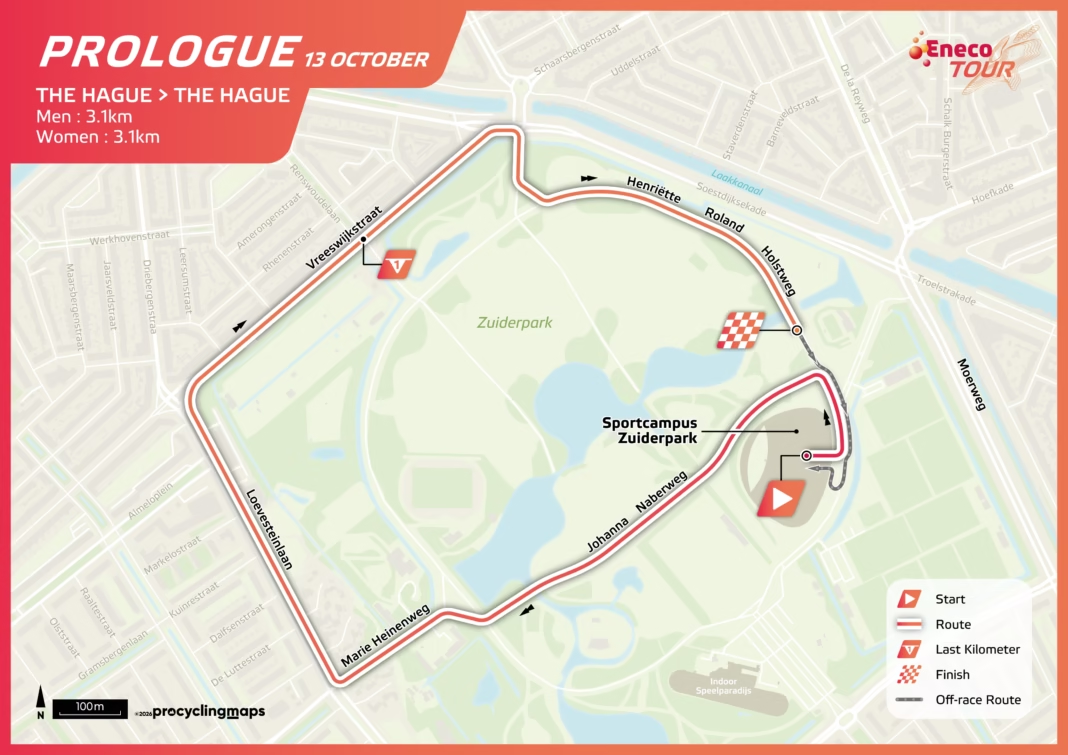
From 13 to 18 October 2026, the women’s race forms part of the relaunched Eneco Tour, staged alongside the men’s event.
The 2025 edition won so emphatically by Wiebes was therefore the final race held under the standalone Simac Ladies Tour identity. Simac remains involved with the event, but the public-facing name and its place in the UCI hierarchy have changed.
ProCyclingUK’s Beginner’s guide to Simac Ladies Tour 2026 explains the new format, including the six-day route, opening prologue in The Hague, Tilburg time trial, Limburg stage and Col du VAM.
Historically, however, the lineage remains continuous. The Eneco Tour Women inherits the race that began as the Holland Ladies Tour with a 4.6km prologue in Ter Aar in September 1998.
From Elsbeth Vink to Wiebes, versatility always mattered
The history of the Simac Ladies Tour is ultimately the story of a race adapting intelligently to the terrain available to it.
The Netherlands could never offer a stage race built around giant mountain passes, so the organisers developed another formula. Time trials created gaps, crosswinds created chaos, short climbs provided selective moments and sprint stages rewarded speed without necessarily allowing the fastest riders an easy journey to the finish.
That formula produced a remarkably varied list of champions. Vos won because she could do almost everything. Van Vleuten exploited her time-trial power and climbing strength. Kopecky combined Classics ability, sprinting and tactical versatility. Wiebes demonstrated that even the fastest sprinter in the peloton could become a multiple stage-race winner when the race rewarded power, positioning and consistency rather than sustained mountain climbing.
The Simac Ladies Tour name ultimately covered only five editions between 2021 and 2025. The race behind it was much older.
As it moves into its Eneco Tour era, it carries almost three decades of Dutch women’s cycling history with it.

