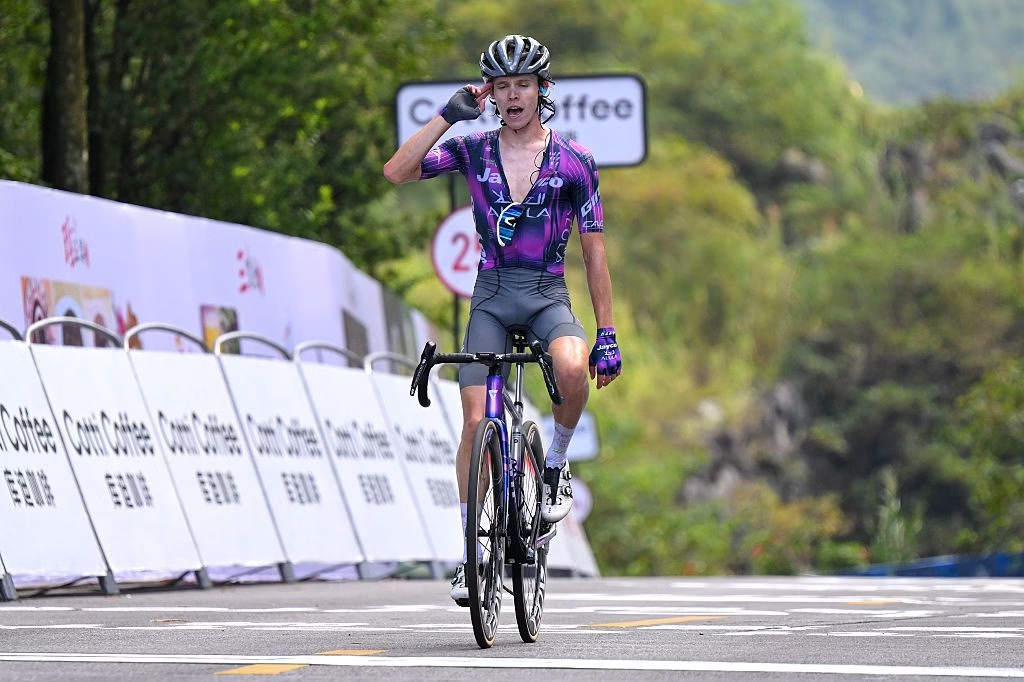
NSN Cycling Team have secured the futures of three New Zealand riders, with Corbin Strong, Dion Smith and George Bennett all signing contract extensions ahead of the 2027 season.
Strong has agreed the longest deal of the trio and will remain with the team through to the end of 2029. Smith has signed for a further two seasons, taking him through 2028, while Bennett will continue for one more year in 2027.
Strong commits through 2029
The three-year extension for Strong is the most significant of the announcements. The 26-year-old has spent his entire professional career within the same structure and has developed into one of NSN’s main options for harder one-day races and reduced sprints.
Strong added another important victory to his record in 2026 by winning the Circuit Franco-Belge and also finished fifth at Milan-San Remo. Those results underline the range that makes him valuable to NSN: he has enough speed to finish races from a small group, but can also survive far more climbing than a pure sprinter.
General manager Kjell Carlström described Strong as one of the team’s leaders and said the squad expects him to keep progressing over the next three seasons. Strong, meanwhile, pointed to the environment around the team as a major reason for staying after five years in the organisation.
“I feel like we’re continuing to get better every year,” Strong said. His new contract gives both rider and team a long runway as NSN continue reshaping the squad around several different leadership profiles.
Photo Credit: Getty
Smith retained after first season with NSN
Smith’s extension is built around a different role. The 33-year-old only joined the team for 2026 but quickly settled into a support position, working for leaders across a range of race types rather than chasing his own results as frequently as earlier in his career.
Carlström said Smith had proved his value as a teammate during his first season and that renewing the contract was an easy decision. The two-year deal keeps another experienced New Zealander in the group while the wider roster continues to change around him.
Bennett stays for 16th professional season
Bennett will continue into a 16th professional season after agreeing a one-year extension. The 36-year-old has increasingly become a road captain and climbing domestique, but he has still produced results of his own in 2026, most notably winning the New Zealand road race title for a second time.
His place in the squad also fits with the direction NSN are taking for 2027. The team have already signed Santiago Buitrago and Lennert Van Eetvelt, strengthening their climbing and general classification options. Bennett’s experience should make him particularly useful around riders expected to target stage races and Grand Tours.
“George’s experience is invaluable for the team,” Carlström said, adding that his road captaincy should become even more important as NSN put greater emphasis on general classification racing in 2027.
The three renewals give NSN continuity alongside a recruitment programme that has already brought several new names into the 2027 roster. Strong remains a long-term leader, Smith provides reliable support across different race programmes and Bennett offers both climbing depth and experience around the team’s new GC signings.
The moves have also been added to ProCyclingUK’s Men’s Cycling Transfers Hub, which is tracking confirmed transfers and contract extensions ahead of the 2027 season.
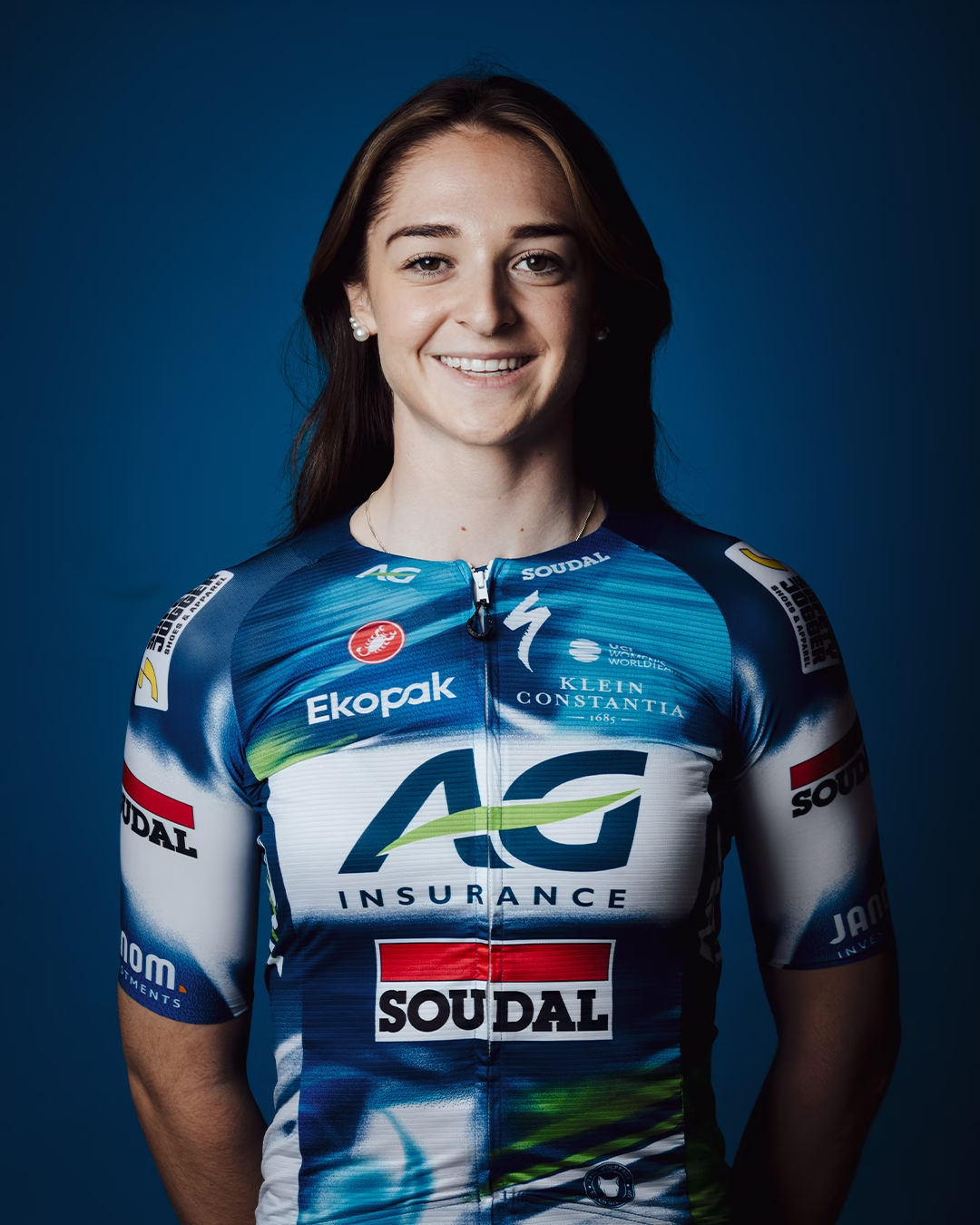
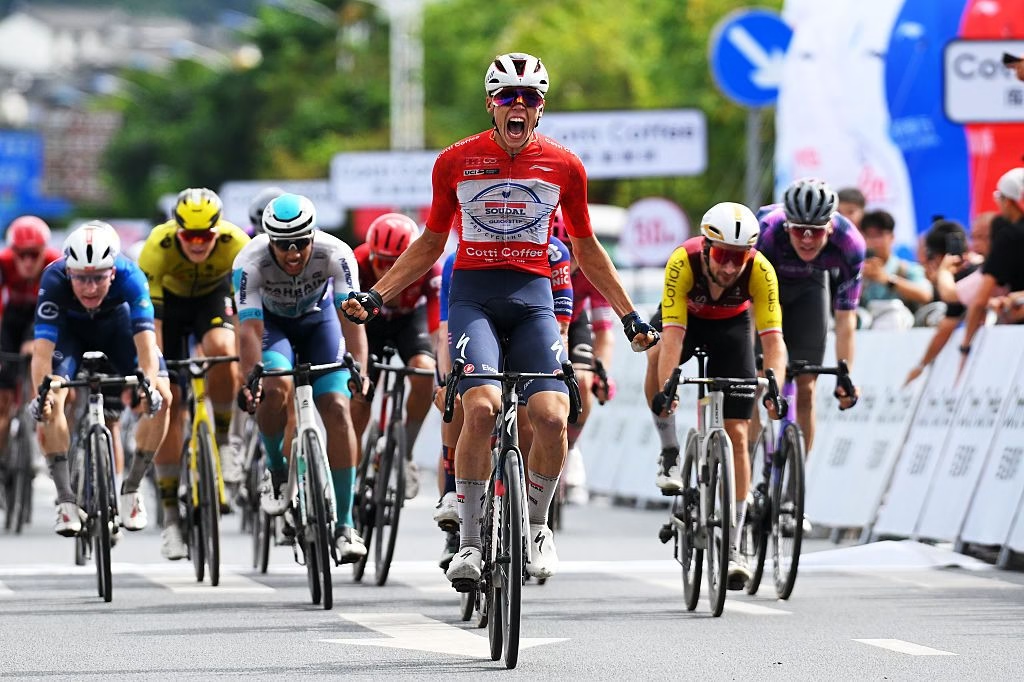
Marith Vanhove will join Ma Petite Entreprise for the 2027 season, giving the French ProTeam a Belgian sprinter who has taken a clear step forward during 2026.
The 23-year-old moves across after two seasons in the AG Insurance-Soudal development structure, with Ma Petite Entreprise presenting her as a rider built for the disorder of fast finishes. Vanhove has made no secret of where she believes her strengths lie either, describing the final kilometres of a bunch sprint as something she treats almost like a game.
Vanhove turns strong 2026 sprinting form into a move to France
Vanhove’s 2026 results help explain why Ma Petite Entreprise have moved for her. She won the Grote Prijs CHW Beveren in July, her first UCI road victory, and had already finished second in the 1.1 Trofee Maarten Wynants behind Gladys Verhulst-Wild in May. That AG Insurance-Soudal one-two in Helchteren was one of several indications that she was becoming a more reliable finisher rather than simply a rider with raw speed.
She followed that with sixth at the Simac Omloop der Kempen Ladies, eighth at GP Mazda Schelkens and eighth at the Argenta Classic, before taking third at Dwars Door Wingene. Those results have come in the type of flatter Belgian and Dutch races where positioning, timing and confidence in crowded finales are often as important as outright acceleration.
“I love the chaos of the final kilometres. It’s a game for me and I want to bring Ma Petite Entreprise high-level performances in bunch sprints,” Vanhove said in the team’s announcement. “I really can’t wait for 2027 to win races.”
Paris-Roubaix and WorldTour racing on Vanhove’s 2027 list
Her targets for the move are straightforward. Vanhove wants victories and regular top-10 finishes, but also more opportunities at WorldTour level. Paris-Roubaix Femmes is one of the races she specifically wants to add to her programme, while a Belgian elite road title remains a longer-term ambition.
The transfer also gives Ma Petite Entreprise a rider whose background is not exclusively road-based. Vanhove continues to race on the track and is due to represent Belgium in the team pursuit at the Track World Championships in October. That combination of track speed and repeated exposure to high-pressure road sprints fits neatly with the role the French team appears to have identified for her.
Vanhove has been racing since she was eight after first getting a bike as a six-year-old in Izegem. She also competed in dance when she was younger before committing fully to cycling at 14. Away from racing, she has completed a degree in occupational therapy while building her professional career.
For Ma Petite Entreprise, the signing adds a different type of option to a project that is continuing to build its 2027 roster after its first season at ProTeam level. Vanhove is still early in her elite career, but her progression during 2026 suggests the team are not simply signing sprint potential. They are bringing in a rider who has started turning that potential into results and now wants to test it more regularly against WorldTour fields.
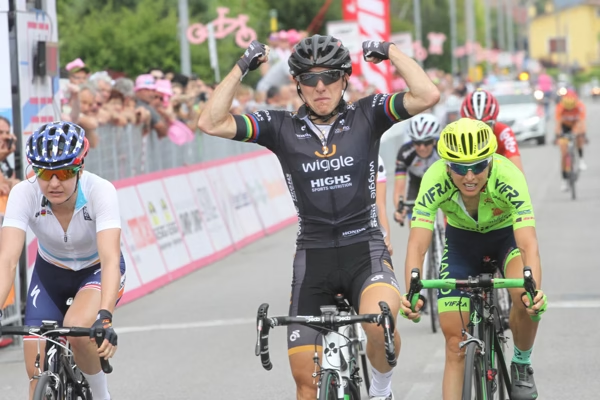
Giorgia Bronzini will join Team Visma | Lease a Bike Women as a sports director from the 2027 season, bringing one of the most experienced former riders and directors in the women’s peloton into the Dutch team’s staff.
The 43-year-old Italian arrives with a career that spans both sides of the team car. As a rider, Bronzini won the elite road race world title in 2010 and 2011, as well as the points race world title on the track in 2009. Since retiring from racing at the end of 2018, she has built a second career as a sports director, first with Trek-Segafredo and later with Liv Racing and Human Powered Health.
Bronzini brings experience from across women’s cycling
That mix of racing and directing experience is central to the appointment. Bronzini competed through a period in which the women’s sport changed substantially, then moved almost immediately into a management role. Her background gives Team Visma | Lease a Bike Women another director who has experienced the tactical and practical demands of major races from inside the peloton.
Bronzini’s own riding career was built around sprinting, positioning and race reading rather than raw speed alone. Her back-to-back world road titles came during one of the strongest eras of women’s racing, while her wider palmarès included more than 80 victories across road and track. Our profile of Giorgia Bronzini looks in more detail at the racing intelligence that defined that part of her career.
Her transition into the team car has been similarly extensive. Bronzini joined Trek-Segafredo as a director after retirement before moving to Liv Racing for 2022. She later joined Human Powered Health as a sports director, continuing to work across the Women’s WorldTour and with riders at very different stages of their careers.
New challenge with Team Visma | Lease a Bike Women
Team Visma | Lease a Bike Women said Bronzini’s experience as both a former professional and a director made her a valuable addition to the structure. The team has continued to build its women’s programme around a mixture of established leaders, developing riders and an increasingly broad coaching staff.
“It’s inspiring to become part of a team that never stops trying to improve, and I see a great opportunity here to keep growing,” Bronzini said in the announcement.
The move gives Bronzini another change of environment after several seasons working within the women’s peloton from the team car. It also adds another former world champion to the wider Visma setup at a time when the women’s squad includes some of the biggest names in the sport, including Pauline Ferrand-Prévot and Marianne Vos.
For Bronzini, the attraction appears to be the chance to develop further within a team that puts a strong emphasis on performance systems and continual improvement. For Team Visma | Lease a Bike Women, it is an appointment built around experience: a director who has raced at the highest level, managed riders across different teams and generations, and spent much of her career inside the women’s peloton as it has professionalised.
Kristýna Zemanová will race for Crelan-Corendon during the 2026-27 cyclocross season, giving the Belgian team one of the most consistent young riders from last winter’s women’s field.
The 22-year-old Czech rider will make the switch in time for the start of the new cyclocross campaign, with Crelan-Corendon also adding French junior Soren Bruyère Joumard. The two signings are part of the latest recruitment by the Roodhooft brothers, but Zemanová is the more established addition at elite level after a breakthrough 2025-26 winter.
Zemanová adds another front-line option for Crelan-Corendon
Zemanová spent much of last season racing close to the front of the biggest cyclocross events, turning a sequence of top-10 finishes into a genuine challenge for the podium by January. Her best result came at the final World Cup round in Hoogerheide, where she finished second behind Puck Pieterse after staying in contention deep into the final lap.
That performance was one of the clearest signs that Zemanová had moved beyond being an occasional outsider. She had finished fifth at both Benidorm and Maasmechelen in the preceding week, while her second place at Hoogerheide put her just six seconds behind Pieterse and ahead of Amandine Fouquenet.
Zemanová also retained the Czech elite national title in January and went on to finish 11th in the elite women’s race at the World Championships in Hulst. Earlier in her career she had already shown her ability at championship level with medals in the under-23 category, but last winter marked a clear step forward against the full elite field.
That makes the move to Crelan-Corendon a logical next step. The team already has significant experience in women’s cyclocross and provides Zemanová with a structure built specifically around the discipline, rather than requiring her cross programme to sit alongside a road team’s priorities.
Cyclocross move separate from 2027 road programme
The deal is specifically for cyclocross. According to the team announcement, Zemanová will race on the road for Fenix-Premier Tech in 2027, separating her winter and summer programmes between two teams. That arrangement is increasingly familiar among riders who combine road and cyclocross, allowing each discipline to be handled by a squad with specialist resources.
Bruyère Joumard will follow a similar path. The 18-year-old Frenchman joins Crelan-Corendon for cyclocross after winning junior World Cup rounds at Tábor and Hoogerheide last season, while he is set to race on the road within the Alpecin-Premier Tech structure next year.
For Crelan-Corendon, though, Zemanová is the signing with the most immediate significance in the elite women’s races. Her 2025-26 results already placed her regularly among the riders capable of challenging the established Dutch and Belgian names, and the move gives her a dedicated cyclocross home as she tries to turn that consistency into regular World Cup podiums.
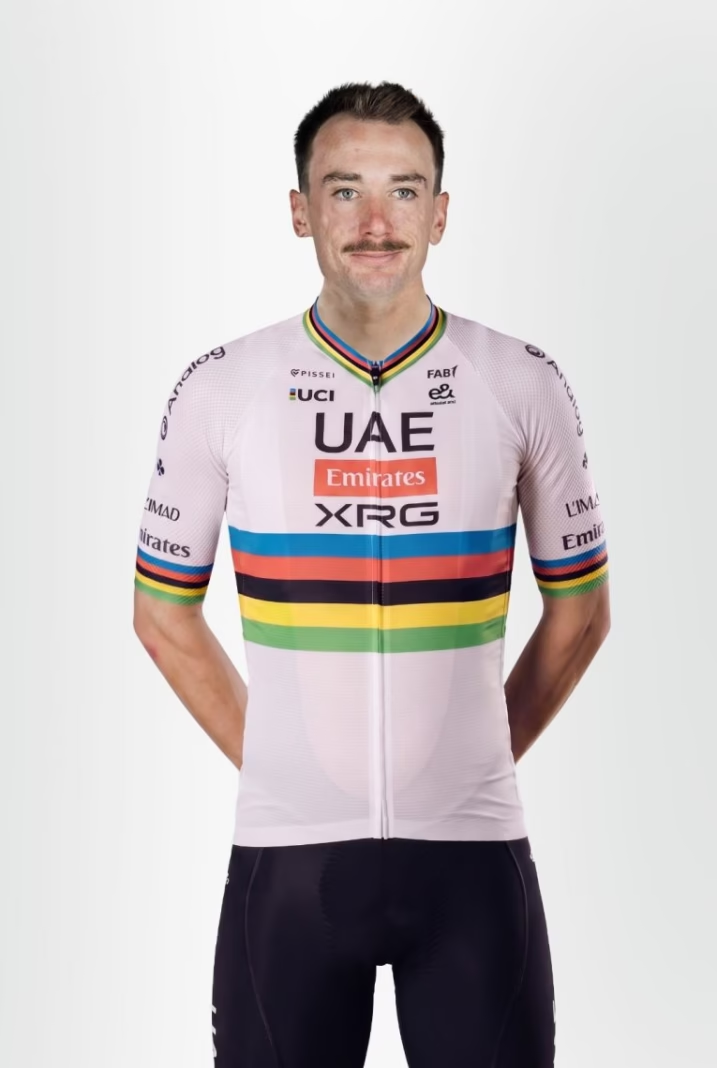
Brandon McNulty will race in the rainbow jersey for the first time on Saturday when he lines up at the Giro dell’Emilia, less than a week after becoming elite men’s road race world champion in Montréal.
The 28-year-old will return to UAE Team Emirates-XRG colours for the first time since his World Championships victory, with the team unveiling the trade-team version of his rainbow jersey ahead of the Italian one-day race. It will be McNulty’s first competitive appearance as world champion and his first start at the Giro dell’Emilia.
McNulty won the 2026 elite men’s road race world title in Montréal on Sunday after attacking with around 33km remaining and holding off a chasing group through the closing laps. Michael Matthews took silver and Mathieu van der Poel bronze as McNulty became the first American man to win the elite road race world title since 1993.
McNulty starts life as world champion at San Luca
The Giro dell’Emilia gives McNulty an immediate test in one of Italy’s most distinctive late-season races. The 1.Pro event takes place on Saturday 3 October and finishes in Bologna after repeated ascents of the San Luca climb, where the steep ramps normally reduce the race to a small group of the strongest climbers and puncheurs.
McNulty will have plenty of strength around him. UAE Team Emirates-XRG have named Igor Arrieta, Filippo Baroncini, Felix Großschartner, Jhonatan Narváez, Tim Wellens and Adam Yates alongside the new world champion. The team have won the previous two editions through Tadej Pogačar in 2024 and Isaac del Toro in 2025.
For McNulty, though, much of the attention will inevitably be on the jersey. “I’m really excited to make my debut in the rainbow jersey this Saturday,” he said ahead of the race. He added that the scale of the Montréal victory was still sinking in, but that he had no intention of changing the way he races now that he carries the world champion’s bands.
That is particularly relevant within UAE, where McNulty has spent much of his career balancing personal opportunities with work for the team’s other leaders. His World Championships victory came with the United States rather than his trade team, but the result immediately changes the visibility around every race he enters. The rainbow jersey will now make him one of the easiest riders to identify in the peloton, even on days when his role is primarily to support a teammate.
Italian races come quickly after Montréal
Saturday also begins a busy Italian block for McNulty. He is due to race the Coppa Agostoni on Sunday before returning on Tuesday for Tre Valli Varesine, giving the new world champion three starts in four days. UAE Team Emirates-XRG will also contest Monday’s Coppa Bernocchi, although McNulty is not part of the announced seven-rider squad for that race.
His Montréal victory came after a race in which the United States repeatedly placed riders into the decisive moves before McNulty made the attack that ultimately won the title. Our analysis of how McNulty won the World Championships looked at how that collective approach left the favourites reacting rather than controlling the race.
The Giro dell’Emilia now provides the first chance to see what comes next. McNulty has said the jersey will not alter his approach, but for the first time in his career he will roll to the start as the reigning world champion, with every move made in the rainbow bands.
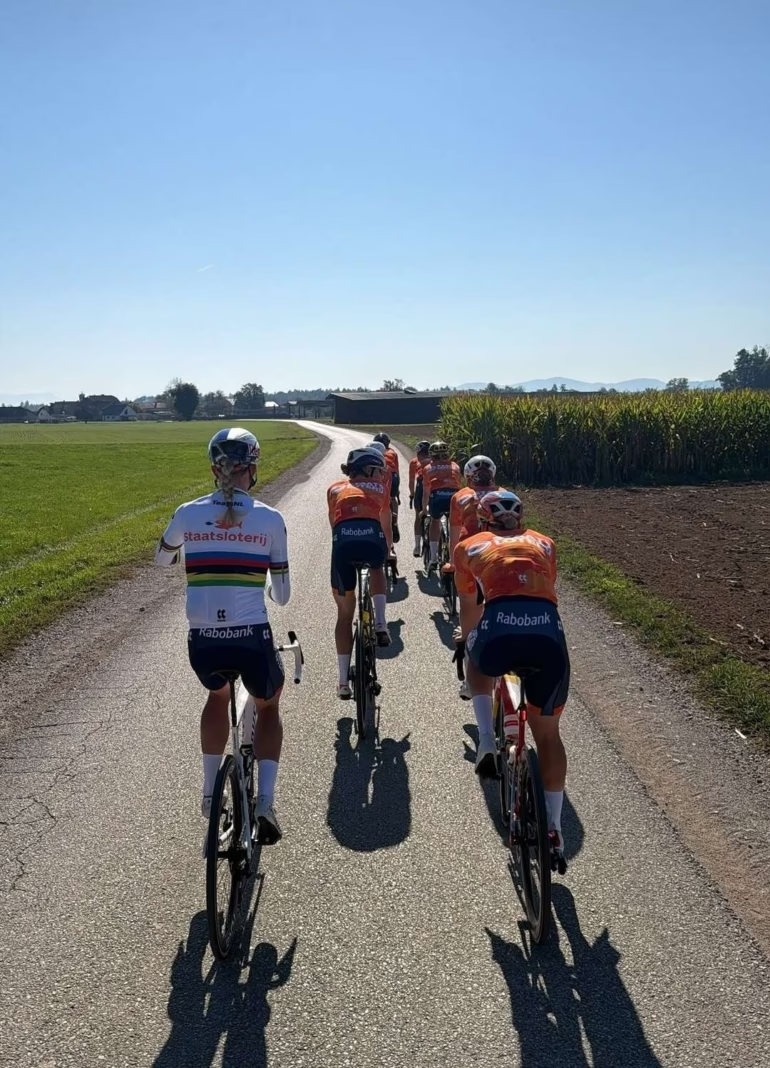
Demi Vollering has been pictured on the road in the rainbow jersey for the first time since becoming elite women’s world champion in Montréal, with the Dutch squad already together in Slovenia ahead of this weekend’s European Road Championships.
The first version of Vollering’s new jersey is not yet the FDJ United-Suez design that will become familiar in trade-team racing. Instead, she is wearing a TeamNL version carrying the Dutch national team’s branding, including Staatsloterij, while training with her Netherlands teammates. The rainbow bands are unmistakable, but the setting is very much another championship camp rather than a return to normal WorldTour racing.
A quick turnaround from Montréal
There has been little time for Vollering to settle into life as world champion. She won the elite women’s road race world title in Montréal on Saturday, taking her first rainbow jersey after a race in which the Netherlands committed fully to creating opportunities for her.
Vollering attacked from around 38 kilometres out after Puck Pieterse had helped force the decisive selection. The move was eventually brought back, but she still had enough left to survive the final attacks and beat Katarzyna Niewiadoma-Phinney in the sprint, with Elisa Longo Borghini taking bronze. It completed a major 2026 season that had already included overall victories at the Giro d’Italia Women and Tour de France Femmes.
That result also makes the timing of this week’s photograph unusual. New world champions normally get at least a short pause before their first public appearance in the rainbow bands. Vollering has effectively moved straight from one national-team championship environment into another, with only a few days separating Montréal from the European Championships.
Rainbow bands in Dutch colours
The TeamNL version will be a relatively brief variation on the jersey. When Vollering returns to racing for FDJ United-Suez, the trade-team sponsors will be incorporated into the world champion design. For this week, however, the national-team logos take precedence as the Dutch squad prepares for another title race.
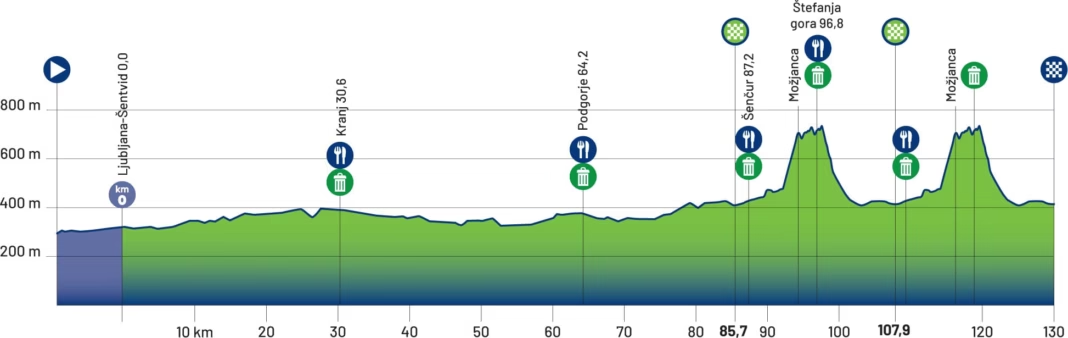
Vollering arrives in Slovenia not only as world champion but also as the defending European champion after winning the 2025 road race with a long solo attack. Saturday’s 2026 European Championships women’s road race covers 130km from Ljubljana to Šenčur and includes two ascents of the steep Možjanca climb, a 2.1km effort averaging 10.2% and reaching 15.8%.
The Netherlands also have options around Vollering, with Pieterse and Lorena Wiebes giving the team very different ways to approach the race. The full course is covered in our European Championships route guide, but the immediate visual is simpler: less than a week after winning in Montréal, Vollering is already out training in the jersey that will define the next year of her career.
The 28-year-old Swiss champion arrives after two seasons in which she has quickly established herself as one of the more versatile climbers and attackers in the Women’s WorldTour. Häberlin has won the Swiss road title in both of her full professional seasons and capped 2026 with her first international professional victory at the Tour de Gatineau.
Her move continues a rapid road progression that began from a mountain-bike background. Häberlin only started racing bikes in 2020, initially off-road, and was Swiss cross-country marathon champion within two months. By 2024, a fifth place from the breakaway on the final stage of the Tour de Suisse Women had pushed her towards a full-time road career.
Häberlin leaves SD Worx-Protime after rapid rise
Häberlin signed her first professional road contract with SD Worx-Protime ahead of 2025. At the time, the move represented a major change for a rider who had spent most of her short cycling career on the mountain bike. ProCyclingUK covered that first step when Häberlin joined SD Worx-Protime for the 2025 season.
She made her Grand Tour debut at the 2025 Giro d’Italia Women and has continued to move forward in 2026. The most notable stage-race result came on home roads at the Tour de Suisse Women, where she finished sixth overall after taking sixth on the mountainous final stage.
Häberlin also retained her Swiss road race title in June, adding a second consecutive national championship after her 2025 victory. She was second in the Swiss time trial two days earlier.
“Those doubts are long gone now, and I’m really happy to be a road cyclist,” Häberlin said of the uncertainty she initially felt about leaving mountain biking behind. “I see this next step as a great opportunity to keep learning and developing as a rider, and to gather more race days.”
Tour de Gatineau win adds another step before Canyon SRAM move
September provided another sign of that progression. Racing for Switzerland at the Tour de Gatineau, Häberlin made the decisive break and beat Georgia Baker and Ava Holmgren in the sprint from the front group to claim her first international professional road victory outside the national championships.
She followed that with 13th in the elite women’s road race at the World Championships in Montréal, keeping herself in the front group deep into a race won by Demi Vollering. The result came only nine days after Gatineau and reinforced the climbing and endurance qualities Canyon SRAM say they want to develop further.
Performance director Dan Fleeman described Häberlin as a strong climber with a substantial aerobic engine, particularly effective in long races where repeated climbing and fatigue gradually reduce the field. Canyon SRAM also see room for improvement in positioning and decision-making when the decisive moves begin.
Canyon SRAM see Häberlin as both support rider and future option
Canyon SRAM intend to use Häberlin across hard one-day races and stage races, initially in a role that can combine support work with opportunities of her own when the terrain suits.
Commercial director Jonas Möslein said her recent road results had already shown a high level despite the relatively late switch from mountain biking. He highlighted her endurance, climbing strength and willingness to attack, while also pointing to the scope for further development.
For Häberlin, the attraction was not only the sporting level. She said Canyon SRAM’s approach to individual rider development and its Generation team were important in convincing her that the move offered the right environment for the next phase of her career.
She will arrive alongside Liechti with both Swiss national road titles represented in the team at the start of 2027: Häberlin in the road race jersey and Liechti as the national time trial champion.
Giro dell’Emilia Donne takes place on Saturday 3 October 2026, with the women racing from Ferrara to the steep finish at the Santuario di San Luca above Bologna. The race starts at 10:15 local time, 09:15 in the UK, and is expected to finish shortly after 13:00 in Italy, around midday BST.
For UK viewers, this is an unusually compact morning watch. The women start half an hour before the men’s Giro dell’Emilia, but their shorter route means the decisive San Luca finale arrives before the men’s race reaches its own conclusion. The main thing to remember in 2026 is the change to the British streaming setup: TNT Sports remains the reference cycling broadcaster, while HBO Max has replaced Discovery+ as the streaming home of TNT Sports in the UK.
The race is officially Giro dell’Emilia Internazionale Donne Elite and carries UCI 1.Pro status. It is not a Women’s WorldTour event, but its position in the Italian autumn calendar and the San Luca finish regularly attract riders capable of winning at the highest level.
How to watch Giro dell’Emilia Donne 2026 in the UK
UK cycling coverage in 2026 is centred on TNT Sports and HBO Max. HBO Max launched in Britain earlier this year and took over the streaming role previously associated with Discovery+ for TNT Sports content. If you have watched Italian cycling through Discovery+ in previous seasons, HBO Max is now the platform to check.
Giro dell’Emilia Donne is part of the European autumn racing package rather than a standalone British free-to-air event. Check the TNT Sports television schedule and HBO Max cycling listings before Saturday morning for the final UK broadcast window. The men’s and women’s races take place on the same day, which can affect how the coverage is presented across the linear channels and streaming service.
Italian coverage is also scheduled around the two races, with Rai Sport carrying the Giro dell’Emilia programme. UK viewers should use the authorised British service rather than relying on the Italian stream, which can be geographically restricted.
The relatively early finish makes the women’s race easy to miss if you assume it will occupy the usual mid-afternoon European cycling slot. This is one to find in the listings before breakfast rather than switching on at 14:00 and discovering San Luca has already decided the result.
Photo Credit: Getty
UK start and finish times
The women leave Ferrara at 10:15 CEST on Saturday. Italy is one hour ahead of Britain while the UK remains on British Summer Time, giving a UK race start of 09:15 BST. The men’s race follows from the same Ferrara start area at 10:45 local time.
The expected women’s finish is approximately 13:05 to 13:23 CEST, or 12:05 to 12:23 BST. Race speed, weather and the way the bunch approaches Bologna will determine the exact time, so allow some margin if you are joining specifically for the finale.
Television pictures may begin later than the official race start. For viewers interested primarily in the decisive section, the final hour should cover the transition from the flatter approach into Bologna and the climbing around San Luca. If the full broadcast is available, the opening kilometres from Ferrara provide useful context because 2026 is the first edition to begin from the city.
What the 2026 route means for the race
The 2026 race moves from Ferrara towards Bologna before the familiar finish on the Colle di San Luca. The opening terrain is much flatter than the finale, so teams with a genuine San Luca contender have little reason to panic if an early move establishes a manageable advantage. The tactical pressure rises sharply once the race reaches the Bologna hills.
San Luca is the defining feature. The road climbs beside the famous portico towards the sanctuary, with the Curva delle Orfanelle among the best-known points on the ascent and gradients reaching around 20 per cent at their steepest. Positioning before the climb matters because losing places at the bottom forces riders to spend energy overtaking just as the gradient begins to bite.
The women’s race uses San Luca twice in 2026. That changes the finale from a single uphill effort into a more tactical contest. The first ascent can reduce the group and expose riders who are already close to their limit, while the second provides the finishing climb. A rider does not necessarily need to attack on the first passage to benefit from it. A hard pace can do enough damage to leave only a small group capable of contesting the final ascent.
The climb is short enough that pure climbers cannot simply settle into a long mountain rhythm, but steep enough to punish anyone who arrives poorly positioned or slightly below their best. The repeated changes in gradient reward riders who can produce hard accelerations while already under considerable load. That makes Giro dell’Emilia Donne particularly suitable for punchy climbers and Ardennes-style riders.
There is also little opportunity to recover once the final ascent begins. On a longer climb, a rider can sometimes absorb an acceleration and gradually return. San Luca is more abrupt. A gap of a few bike lengths on the steepest section can be enough to settle the race because the finish comes before a dropped rider has time to rebuild momentum.
The race’s previous winners reflect that demand. Elisa Longo Borghini has won the event four times, while Cecilie Uttrup Ludwig has also taken multiple victories. Kimberley Le Court won the 2025 edition. For the longer story of how the women’s race developed, see our history of Giro dell’Emilia Donne.
The official women’s start is 09:15 BST and the expected finish is around 12:05 to 12:23 BST. That makes the race a morning event for UK viewers even though it is taking place in Italy. If the live broadcast begins after the start, use the HBO Max or TNT Sports event listing for the exact on-air time rather than assuming coverage starts with the flag drop.
Anyone watching both races should be able to move directly from the women’s finish into the men’s Giro dell’Emilia coverage. The shared start city and San Luca finish make the two events feel like a single day of racing, but the women’s result should be settled well before the men’s finale.
If you need to watch on replay, go directly to the event page where possible. The result will circulate quickly once the riders reach San Luca, and the compact morning schedule means spoilers can appear on cycling sites and social media before many UK viewers have realised the race has finished.
The essential UK timings are therefore straightforward: Saturday 3 October, 09:15 BST official start and an expected finish shortly after 12:00 BST. Check TNT Sports and HBO Max for the confirmed live window on the morning of the race, with the final two ascents of San Luca the section to prioritise if you cannot watch everything.
The 2026 UEC Road European Championships take place in Slovenia from 2-7 October, with the elite women’s and men’s road races followed by the individual time trials later in the week.
For UK viewers, live coverage is available through TNT Sports and HBO Max. The European Championships sit inside TNT Sports’ cycling rights package, with the elite road races and time trials all scheduled for live coverage.
The women’s road race takes place on Saturday 3 October, the men’s race follows on Sunday 4 October, and both elite individual time trials are held on Wednesday 7 October. The elite mixed relay is also on the programme on Tuesday 6 October.
Great Britain are not sending riders to either elite road race in 2026. The British selection is focused on the time trials, with Lauren Dickson entered for the elite women’s event and Callum Thornley for the elite men’s race against the clock.
How to watch the 2026 European Road Championships in the UK
TV: TNT Sports Streaming: HBO Max Dates: 2-7 October 2026 Elite road races: 3-4 October Elite individual time trials: 7 October
TNT Sports is available through the major UK television platforms, including Sky, EE, BT and Virgin Media. Online streaming is now through HBO Max, with TNT Sports no longer carried on discovery+ in the UK.
The exact TNT Sports linear channel can change around other live sport, so the safest option for viewers wanting uninterrupted coverage is the HBO Max event stream. TNT’s online schedule already lists the elite women’s road race, men’s road race and both elite time trials.
2026 European Championships UK TV schedule
Event
Date
Race start (BST)
UK coverage
Women Elite road race
Saturday 3 October
12:30
TNT Sports / HBO Max
Men Elite road race
Sunday 4 October
11:30
TNT Sports / HBO Max
Elite mixed relay
Tuesday 6 October
14:00
TNT Sports / HBO Max
Women Elite individual time trial
Wednesday 7 October
13:30
TNT Sports / HBO Max
Men Elite individual time trial
Wednesday 7 October
15:15
TNT Sports / HBO Max
The UEC broadcast plan has the women’s road race feed beginning shortly before the race starts, although the pan-European linear channel is scheduled to join later in the afternoon. HBO Max is therefore the better option if you want the fullest available coverage from the start.
For the men’s road race, the international broadcast window begins before the start and runs through to the finish. The time-trial coverage on Wednesday is also scheduled continuously across the elite women’s and men’s sessions.
Women’s elite road race – Saturday 3 October
The elite women’s road race starts in Ljubljana at 13:30 local time, which is 12:30 BST, and finishes in Šenčur after 130km.
The opening 85.8km are relatively straightforward before the race reaches two laps of the 22.1km finishing circuit. Each lap includes the climb to Možjanca, 2.1km at around 10%, with gradients reaching almost 16%.
Demi Vollering arrives as the defending European champion and newly crowned world champion, with Elisa Longo Borghini, Kasia Niewiadoma-Phinney and Marlen Reusser among the strongest challengers. Our women’s European Championships road race preview covers the main contenders and how the final circuit could be raced.
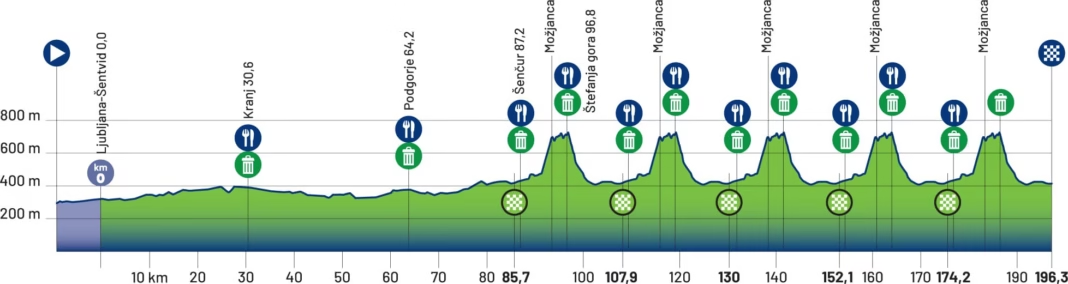
The men’s race begins at 12:30 local time, or 11:30 BST, and covers 196.3km from Ljubljana to Šenčur.
The men use the same finishing circuit as the women but complete five laps, making the repeated Možjanca climb the central feature of the race. More than 1,800 metres of climbing are packed into the closing section alone.
Tadej Pogačar will not defend his title after Slovenia confirmed its final team without him. Primož Roglič and Matej Mohorič lead the home squad, while Remco Evenepoel, Mads Pedersen, Juan Ayuso and Marc Hirschi are among the main names expected to start.
Women’s and men’s individual time trials – Wednesday 7 October
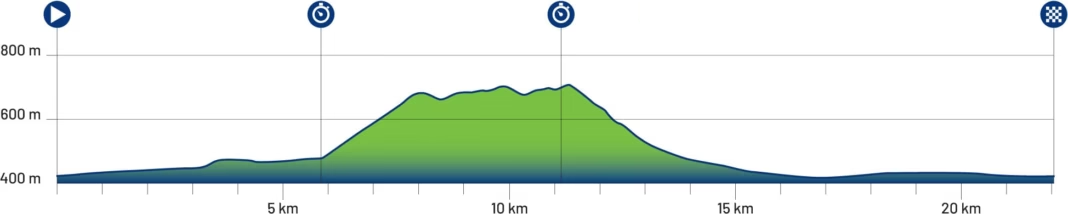
The elite time trials both take place on the 22.1km Šenčur circuit, using the same roads that form the finishing loop for the road races.
The women’s elite time trial starts at 14:30 local time, or 13:30 BST. The international broadcast feed is scheduled to begin at around 13:20 BST, with live coverage running into the men’s event later in the afternoon.
The men’s elite time trial is scheduled for 16:15 local time, or 15:15 BST, with the live feed beginning around 15:05 BST.
This is not a conventional flat championship time trial. The route includes 367 metres of climbing in only 22.1km and uses the same Možjanca ascent as the road-race circuit. The climb, technical descent and final flat run back to Šenčur make pacing and bike handling unusually important for a European Championship against the clock.
Great Britain’s elite representation is concentrated here. Lauren Dickson will ride the women’s event, while Callum Thornley starts the men’s TT after finishing 10th at the World Championships and taking second in the Vuelta a España time trial. Zoe Bäckstedt, silver medallist in the Worlds time trial, is not part of the European Championships squad.
Is the European Championships free to watch in the UK?
There is no confirmed free-to-air UK television coverage of the elite road races or individual time trials. The live UK rights sit with TNT Sports, with streaming through HBO Max.
The UEC does provide some races directly through its YouTube channel, particularly junior events, but the elite men’s and women’s road races and time trials are covered by the main broadcast rights package rather than the free UEC stream in the UK.
Who is racing for Great Britain?
British Cycling have again chosen a small, time-trial-focused squad for the European Championships. There will be no British riders in either elite road race.
Lauren Dickson is the sole British entrant in the elite women’s time trial and Callum Thornley will ride the elite men’s event. Ben Wiggins is also part of the squad for the men’s under-23 time trial.
Early entry lists had included riders such as Anna Henderson and Ethan Hayter, but neither is part of the final elite selection. That means British interest in Slovenia is concentrated almost entirely on Wednesday’s time trials.
The 2026 Tour of Guangxi will close the men’s WorldTour season with six stages across southern China from 13-18 October, starting in Chongzuo and ending with the decisive climb to the Nongla Scenic Area.
This year’s route is a significant change from 2025. The coastal opener in Fangchenggang has disappeared, the race starts inland in Chongzuo, two new stages take the peloton deeper into the mountainous western part of Guangxi, and the familiar Nongla summit finish has been moved to the final day.
That last change is the most important. In recent editions the overall classification was normally shaped at Nongla before a later sprint stage. In 2026 there is nowhere to recover afterwards: the red jersey will be decided on the climb itself.
The latest published stage distances total 1,043km, with three stages likely to favour sprinters or fast all-rounders, two much less predictable hilly days through the karst interior and one clear summit-finish showdown. For the wider background to the race, see our beginner’s guide to the 2026 Tour of Guangxi.
Tour of Guangxi 2026 route at a glance
Stage
Date
Route
Distance
Likely character
1
13 October
Chongzuo – Chongzuo
149.4km
Fast city opener
2
14 October
Chongzuo – Jingxi
179.7km
Hilly, sprint possible
3
15 October
Jingxi – Bama
212.3km
Longest stage, rolling finish
4
16 October
Bama – Tian’e
165.7km
New mountainous stage
5
17 October
Jinchengjiang – Yizhou
170.1km
New hilly transition stage
6
18 October
Yizhou – Nongla
165.8km
Queen stage, summit finish
Why the 2026 route is different
The Tour of Guangxi has often been built around a simple pattern: several opportunities for sprinters, one decisive uphill finish and a final city stage. The 2026 edition moves away from that structure.
Chongzuo hosts the start for the first time, shifting the race away from the coast and immediately placing it among the limestone landscapes that define western Guangxi. From there the route heads through Jingxi and Bama before two completely new stages via Tian’e and Yizhou.
The organiser has deliberately pushed the route further into the karst interior, where the roads are more undulating and the changes in elevation are more frequent. The exact climb-by-climb breakdown for the two new stages had not been published by the end of September, but they are clearly intended to make the middle of the race harder to control than the equivalent days in 2025.
The final stage then returns to a known quantity. Nongla has repeatedly decided the race because its short final climb is steep enough to create real gaps but not long enough for a pure mountain specialist to wait patiently. Riders need positioning, acceleration and the ability to sustain a hard effort all the way to the line.
Stage 1: Chongzuo to Chongzuo – 149.4km
The 2026 race begins with a new Chongzuo city stage. It is the first time the Tour of Guangxi has opened away from the coast, replacing the Fangchenggang circuit that started the 2024 and 2025 editions.
The stage is designed as the first opportunity for the fast riders. Chongzuo sits close to the Vietnamese border and is surrounded by karst hills, but the city-stage format should keep the main difficulty manageable enough for sprint teams to control.
That does not necessarily make it straightforward. Opening stages at Guangxi have often been raced at very high speed, with teams trying to establish the first leader’s jersey while breakaway riders chase mountain and intermediate-sprint points. The final kilometres will also carry the usual risk of a nervous bunch arriving together before the lead-outs are fully settled.
Stage 2: Chongzuo to Jingxi – 179.7km
The second stage follows a corridor already familiar from recent editions, heading west from Chongzuo towards Jingxi and the finish at the border city’s ancient-town area.
This is not a flat sprinter’s stage in the conventional sense. The route moves steadily into more broken terrain, with a longer climbing section late enough in the day to put pressure on the heaviest sprinters before the race drops back towards Jingxi.
That shape has not always been enough to prevent a bunch finish. Paul Magnier won here in 2025 after the peloton survived the late climbing, and the same basic tactical question applies in 2026: can the punchier teams make the ascent hard enough to remove the pure sprinters, or will the race regroup in time for another fast finish?
The roads around Jingxi are also exposed enough for positioning to matter before the climb. If the pace is already high when the peloton reaches the final hour, this can become more selective than the headline distance suggests.
Stage 3: Jingxi to Bama – 212.3km
At 212.3km, stage 3 is the longest day of the 2026 Tour of Guangxi and another route retained in broad form from the previous two editions.
The first half allows the race to settle, but the approach towards Bama becomes progressively more demanding. Previous versions of this stage have stacked several classified climbs into the final 80km rather than relying on one major ascent, producing a race that wears riders down without necessarily creating large general-classification gaps.
That makes it a difficult day to categorise. Strong sprinters have survived to contest the finish in Bama before, but the length of the stage and repeated late climbs also give breakaway riders and puncheurs a realistic chance if the sprint teams are unwilling to commit.
For the GC contenders, the main objective is likely to be avoiding trouble. The decisive climb comes later in the week, but a split on stage 3 could be expensive because there is enough difficult terrain for a small gap to become hard to close.
Stage 4: Bama to Tian’e – 165.7km
Stage 4 is one of the two major additions to the 2026 route and takes the race north from Bama through Fengshan towards Tian’e.
This is where the new Tour of Guangxi becomes harder to read. The organiser has described the redesigned western route as more mountainous, with sharper changes in elevation and more technical roads through the karst landscape. Bama to Tian’e is at the centre of that change.
There is no summit finish, so the stage does not automatically become a GC showdown. Instead, it should reward teams willing to use the terrain before the final kilometres. Repeated climbs can reduce the bunch, make the chase more expensive and give a strong breakaway a better chance than on stages 1 or 2.
Until the detailed road book confirms the exact KOM points, the important distinction is that this is no longer the relatively familiar Bama-to-Jinchengjiang stage used in recent editions. It sends the race onto new roads through Fengshan and Tian’e, making local knowledge and reconnaissance more valuable than usual.
Stage 5: Jinchengjiang to Yizhou – 170.1km
The second new stage starts in Jinchengjiang and runs through Huanjiang and Luocheng before reaching Yizhou.
Again, the route is intended to expose the peloton to more of Guangxi’s interior rather than simply transferring riders towards the known Nongla climb. The roads through this part of Hechi are constantly changing direction and elevation, which should make the stage more tiring than a straightforward transition day.
With the queen stage only 24 hours away, team priorities will split. GC squads will want to conserve their leaders and avoid crashes, sprint teams may see one of their final opportunities of the season, and breakaway riders will know that the favourites are unlikely to spend heavily chasing every move.
That can create an awkward race to control. If a strong group gets clear early, there is enough terrain between Jinchengjiang and Yizhou to make the chase costly. If the bunch stays together, the finish should favour riders who can still sprint after a long day of repeated smaller climbs.
Stage 6: Yizhou to Nongla – 165.8km
The Tour of Guangxi saves its most important stage for last. Yizhou to the Nongla Scenic Area measures 165.8km and finishes on the climb that has repeatedly decided the overall race.
The first part of the stage is far less intimidating than the finish. The route leaves Yizhou and runs through Xincheng and Shanglin before approaching Mashan, with most of the general-classification action compressed into the closing kilometres.
Nongla is officially around 3.1km at 6.3%, but the average hides the difficulty. The lower slopes contain ramps around 10%, which immediately stretch the group and make it difficult for domestiques to keep a steady tempo for long.
In 2025, Paul Double attacked on this climb, won the stage by nine seconds and moved into the race lead before securing the overall title the following day. In 2026 there is no following day. A similar move would decide the Tour of Guangxi on the spot.
The positioning battle before the climb will therefore be especially important. A three-kilometre ascent does not offer much time to recover from entering too far back, while the steep opening section encourages explosive attacks rather than a long, measured mountain effort.
It is a finish for climbers with acceleration, puncheurs who can sustain a hard three-to-eight-minute effort and GC riders who are comfortable racing aggressively. The margins are usually small, but the time bonuses and gaps on the road can turn a few seconds into the difference between first and fifth overall.
Where the 2026 Tour of Guangxi will be won
Nongla remains the obvious answer, but the redesigned middle of the race makes the route less one-dimensional than before.
Stages 2 and 3 can remove riders from contention through crashes, splits or poor positioning. Stages 4 and 5 are the bigger unknowns, with two new hilly routes capable of creating fatigue before the final climb. A rider who reaches Yizhou already under pressure may find that a three-kilometre summit finish is more than enough to expose it.
For the sprinters, the first three days offer the clearest opportunities, although stage 2 and especially stage 3 require more climbing than a conventional flat finish. Stage 5 may also return to a sprint if the new route proves controllable.
The overall contenders will spend most of the week trying not to waste energy before Nongla. With the queen stage now placed on 18 October, there is no need to defend the red jersey afterwards and no flat final day to reward a rider who has already taken time. The race can be won with one perfectly timed attack on the final climb.
The WorldTour season ends at Nongla
The Tour of Guangxi is the final men’s WorldTour race of 2026, beginning three days after Il Lombardia and finishing on 18 October. The race’s position in the calendar gives it an unusual mix of riders chasing one last result, sprinters looking for late-season wins and teams using the week to give younger riders WorldTour experience.
The race has been part of the WorldTour since its first edition in 2017, with a break during the pandemic years. Our history of the men’s Tour of Guangxi covers the previous winners and how the race has developed since its launch.


 Photo Credit: Getty