The Col du Galibier is one of the Tour de France’s great dividing lines. It separates valleys, regions and weather systems, but in the race it does something more important. It separates riders who are still in control from riders who are only just surviving.
At 2,642 metres, the Galibier is not simply another Alpine pass. It is the climb that helped define what the Tour’s high mountains could be. The race had already discovered the Pyrenees and the Tourmalet, but the Galibier gave the Alps a harsher, higher and more exposed identity. Since its first appearance in 1911, it has been treated as a climb that carries more than sporting difficulty. It carries memory.
That is why its return in the 2026 Tour de France matters. Stage 20 from Le Bourg d’Oisans to Alpe d’Huez uses the Col de la Croix de Fer, Col du Télégraphe, Col du Galibier, Col de Sarenne and Alpe d’Huez. It is the queen stage of the race, the last major mountain test before Paris, and the Galibier is the highest point of the whole Tour. It may not be the finish, but it could be the place where the final yellow jersey battle begins to break apart.
The Galibier’s Tour history is not built only on stage wins. It is built on weather, altitude, cracks, attacks, long descents and riders who found out too late that they had crossed into a different kind of race. For the 2026 route context, see our Tour de France 2026 full route guide, Tour de France 2026 queen stage guide and Tour de France 2026 climbs guide.
Where is the Col du Galibier?
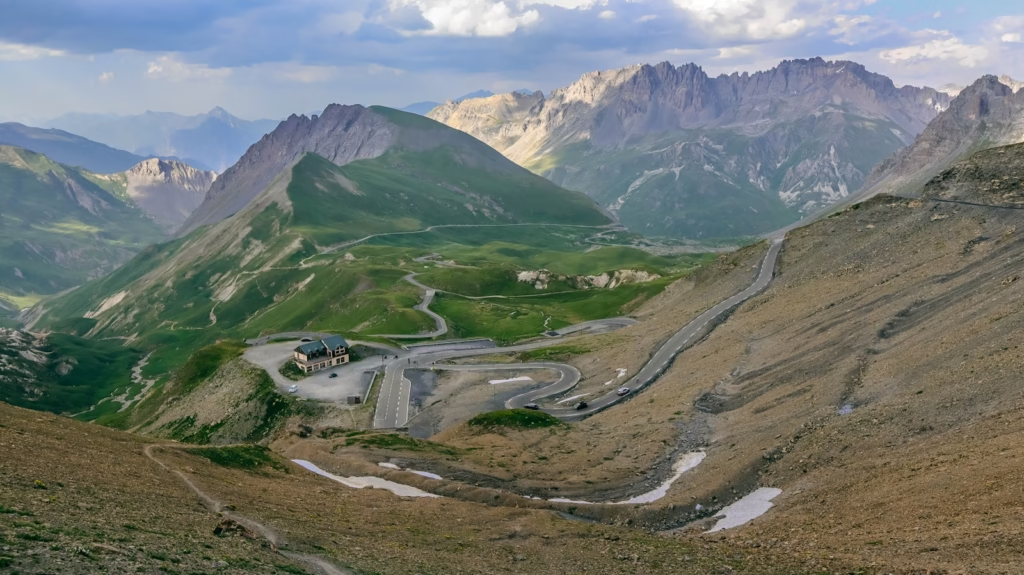
The Col du Galibier sits in the French Alps, between the Maurienne valley and the Briançon side of the mountains. It links the northern approach from Saint-Michel-de-Maurienne, via the Col du Télégraphe and Valloire, with the southern approach from the Col du Lautaret and Briançon.
That geography is central to its Tour identity. The Galibier is rarely just one climb in isolation. From the north, it is usually paired with the Télégraphe, creating a long two-part Alpine test. From the south, it often comes after the Lautaret, with a different rhythm and a less brutal average gradient, but still with altitude and exposure near the top.
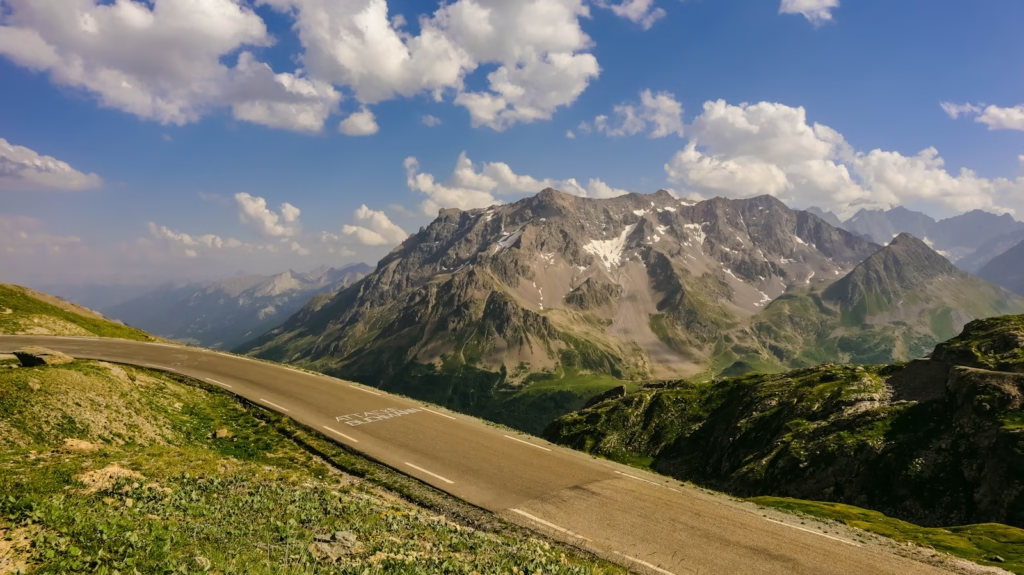
The summit is high, open and severe. The landscape changes as the road climbs. Trees disappear, the road becomes more exposed, and the final kilometres feel closer to a high mountain crossing than a normal road climb. This is part of the Galibier’s power. It looks and feels like a threshold.
In Tour terms, the Galibier is not only a climb. It is a place where the race moves into high Alpine seriousness. When it appears on the route, it usually means the day cannot be ordinary. The official Tour heritage page describes the Galibier as the most frequently ridden Alpine pass in the race’s history, which says plenty about its place in the sport’s geography: Tour de France heritage: Col du Galibier.
Why the Galibier matters so much
The Galibier matters because it sits at the intersection of history, altitude and race design. Some climbs are famous because they host summit finishes. Some are famous because they appear often. The Galibier is famous because it represents the Tour’s old mountain idea: long roads, huge passes, changing weather and riders exposed for hours.
It has also been used in many different ways. Sometimes it comes early in a huge Alpine stage. Sometimes it is the central climb before another finish. Sometimes it is the highest point of the race. In 2011, it even hosted the finish itself, giving the Tour its highest ever stage finish.
That versatility makes the Galibier different from a climb like Alpe d’Huez. Alpe d’Huez is a finish line, a stadium and a final judgement. The Galibier is often a launchpad, a breaking point or a road to somewhere else. Its damage may not always be visible at the summit. It may appear on the descent, in the valley afterwards, or on the final climb of the day.
That is exactly why it matters in 2026. The race will not finish on the Galibier. It will use the Galibier to weaken the race before Sarenne and Alpe d’Huez. For the full shape of that final mountain block, see our Tour de France 2026 Alps guide and why back-to-back Alpe d’Huez finishes could define the Tour de France 2026.
1911: the Tour first climbs the Galibier
The Galibier entered the Tour de France in 1911, only a year after the race had first crossed the high Pyrenean passes. Henri Desgrange wanted the Tour to go higher, harder and deeper into the mountains. The Galibier was the answer.
The first crossing came on a huge stage from Chamonix to Grenoble, with the riders sent over the Col du Télégraphe and then the Galibier. The road was not the smooth, familiar cycling landmark it is now. It was rough, remote and intimidating. The climb was not simply a sporting test. It was an expedition inside a bike race.
Émile Georget was the first rider over the Galibier in that 1911 Tour. The achievement mattered because it immediately gave the climb a status beyond a normal pass. Riders had not just climbed a mountain. They had crossed into a new version of the Tour.
Desgrange understood that. His reaction to the Galibier helped establish the climb’s mythology almost immediately. He saw it as a giant compared with what had come before. From that point, the Galibier became part of the Tour’s self-image: the race that could ask riders to do something nearly unreasonable, then come back and ask again.
For a wider view of how the race evolved from endurance contest to modern Grand Tour, see our brief history of the Men’s Tour de France.
Henri Desgrange and the Galibier
The Galibier is closely tied to Henri Desgrange, the first director of the Tour de France. Desgrange was not just organising a race. He was building a story of endurance, difficulty and human limits. The Galibier fitted that perfectly.
A memorial to Desgrange stands near the Galibier, on the Lautaret side. It is one of the most meaningful pieces of Tour geography. The race’s founder is remembered not in a city or beside a finish line, but high on the road that helped define his idea of the Tour.
That link also explains the Souvenir Henri Desgrange, the prize usually awarded to the first rider over the highest point of the Tour each year. When the Galibier is on the route and is the highest point, it often carries that prize. That gives the climb a ceremonial role as well as a sporting one.
The Tour is full of traditions, but this one feels especially appropriate. Desgrange wanted the race to be hard enough to matter. The Galibier still does that job.
For the modern jersey and prize context, see our Tour de France 2026 jerseys explained.
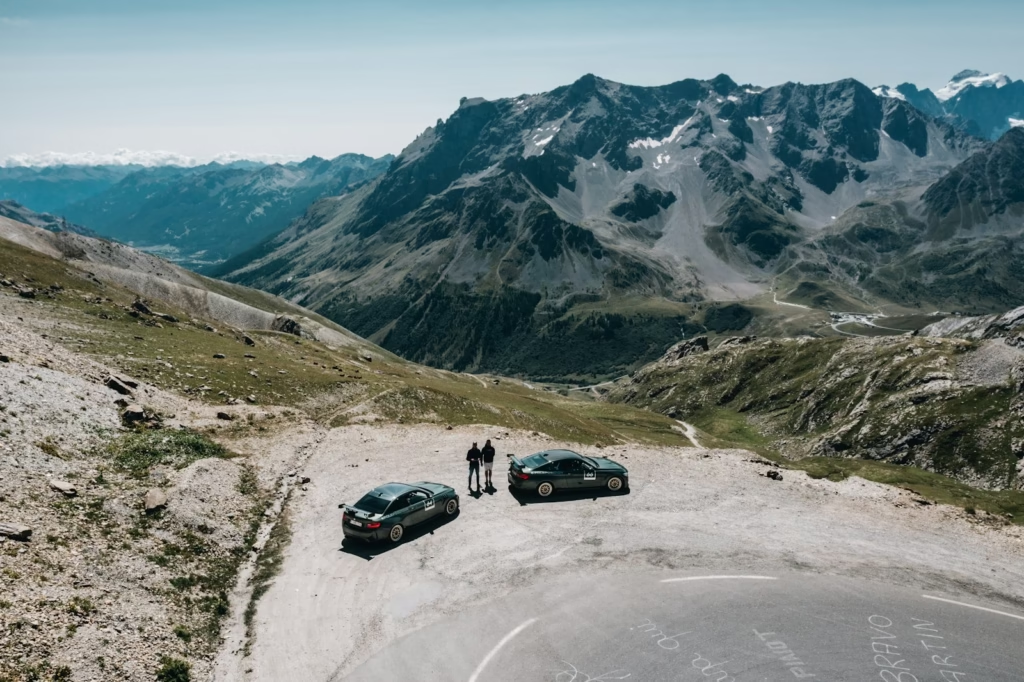
The Galibier and the birth of Alpine Tour racing
Before the Galibier, the Tour had already discovered that mountains could transform the race. The Pyrenees had changed the scale of the event, but the Alps gave the Tour another kind of drama. The climbs were longer, higher and more varied, and the weather could change the entire character of a stage.
The Galibier became one of the first true symbols of that Alpine identity. It was not simply hard because of gradient. It was hard because of its length, altitude and position. Riders had to deal with the Télégraphe, the upper Galibier, the summit, the descent and whatever the route demanded afterwards.
This gave the Tour a new tactical language. A rider could attack far from the finish. A leader could crack before the final climb. A descent could become as important as an ascent. Teams could be scattered across valleys. The Galibier helped create that kind of racing.
It is still one of the reasons the Tour uses it. Modern riders have better bikes, better clothing, better roads and better support. But the basic problem remains the same: the Galibier makes the race bigger than a single effort.
For how that Alpine pressure fits into the 2026 race, see our Tour de France 2026 mountain stages ranked by difficulty.
The Télégraphe-Galibier combination
The northern approach is the classic Galibier experience because the Col du Télégraphe comes first. On paper, the Télégraphe and Galibier are separate climbs. In practice, they often function as one long Alpine sequence.
The Télégraphe is not a warm-up. It is a serious climb in its own right, and it usually reduces the race before the Galibier begins. Riders then descend briefly into Valloire before the road rises again towards the Galibier. That short valley section can be deceptive. It gives a moment of recovery, but the hardest part is still ahead.
The Galibier from Valloire becomes more severe as it climbs. The road moves from village and pasture into a high, exposed landscape. The upper section, especially from Plan Lachat, is where the climb becomes truly difficult. The gradient bites harder, the air thins, and the road feels increasingly remote.
That is why the Télégraphe-Galibier combination has such a strong Tour identity. It is not just a climb. It is a long process of reducing the race. By the summit, the peloton is rarely still a peloton.
In 2026, Stage 20 uses that same central block. For a breakdown of the stage, see our Tour de France 2026 queen stage guide.
 Photo Credit: ASO-Charly Lopez
The southern approach from the Lautaret
The Galibier can also be climbed from the south, via the Col du Lautaret. This side has a different character. It is often less brutal in average gradient, but it still carries altitude, exposure and a difficult final section.
The Lautaret approach can be tactically awkward because the road before the final Galibier section may encourage teams to keep a steady tempo. It can feel more controlled than the northern side, until the last kilometres start to bite. At that point, riders who looked comfortable can suddenly lose contact.
This side has often been used when the Tour wants the Galibier as a high point before a descent towards Valloire, Serre Chevalier or another Alpine finish. It may not always produce the same attritional feel as the Télégraphe side, but it can still reshape a stage.
The Galibier’s two main approaches are part of why it has stayed relevant for so long. Route designers can use it in different directions, combine it with different passes and place it before different finishes. It is not locked into one pattern.
That flexibility is why the Galibier keeps returning.
The Galibier as the roof of the Tour
The Galibier often carries extra prestige because it can be the highest point of the Tour. Altitude matters in cycling, but in the Tour it also carries symbolism. The highest pass becomes a landmark inside the race, a place where the route reaches its physical ceiling.
When the Galibier is the highest point, the Souvenir Henri Desgrange often goes to the first rider across the summit. That gives breakaway riders, climbers and polka-dot contenders another reason to race hard. It is not always about the stage win. Sometimes the summit itself is a target.
This can change the race. A breakaway may fight for the Galibier even if it will be caught later. A mountains classification rider may burn energy before the final climb. A GC team may use the battle for the summit to increase pressure.
In 2026, the Galibier is again the highest point of the race. That makes it central to Stage 20 even though Alpe d’Huez hosts the finish. The Galibier will be a prize, a stress point and a tactical launchpad all at once. The official Tour de France Stage 20 page lists the Col du Galibier as the Souvenir Henri Desgrange point on the route.
For the polka-dot context, see our Tour de France 2026 climbers guide and best climbers at the Tour de France 2026.
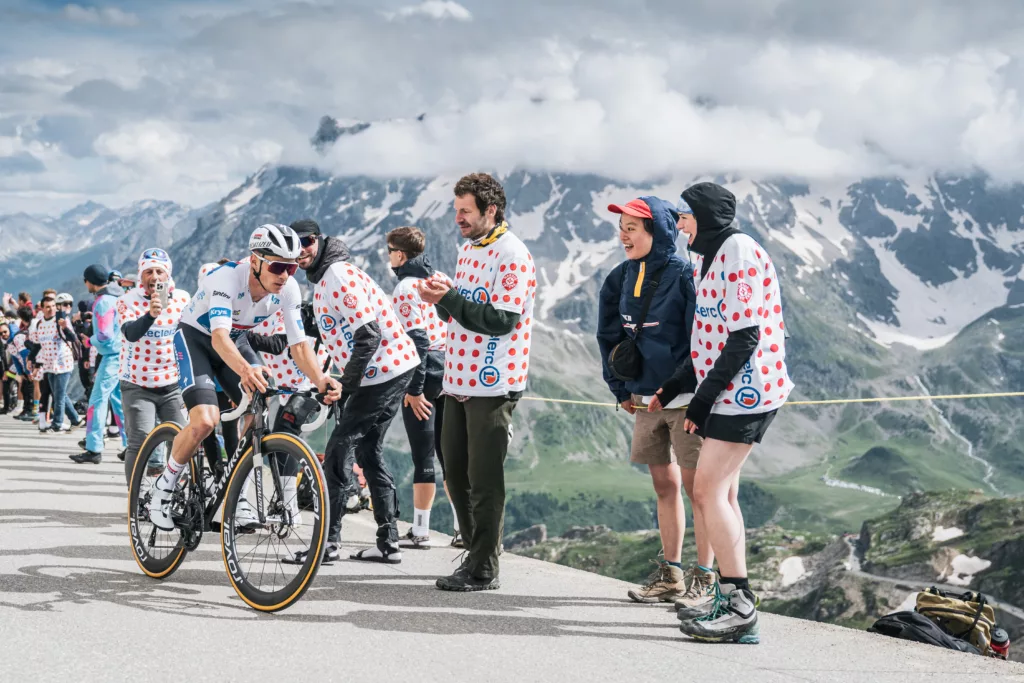 Photo Credit: A.S.O./Charly López
Weather, altitude and why the Galibier feels different
The Galibier is hard because of numbers, but numbers do not explain everything. The climb’s altitude and exposure make it unpredictable. Heat can be a problem lower down, but near the summit the weather can feel completely different. Cold, wind, rain and low cloud can change the stage quickly.
That is part of the Galibier’s Tour identity. It is a climb where the race can suddenly look older and harsher. Riders who are comfortable on lower climbs can struggle when the temperature drops and the road keeps rising. A team that looks organised in the valley can lose shape when jackets, feeding, descents and fatigue all become part of the same problem.
Altitude also changes the racing rhythm. A rider who is already close to their limit may lose time quickly near the top. The gap does not need to be huge at first. A few metres can become 20 seconds, then a minute, especially if the descent begins with the rider isolated or under pressure.
The Galibier is not always the steepest climb in the Tour, but it is one of the climbs where weakness can become visible fast. That is why it matters so much in the final week, when recovery is already stretched. For more on the cumulative effect of the race, see how Tour de France riders recover between stages and how hard is the Tour de France?.
1998: Pantani, Ullrich and a Tour turned upside down
One of the Galibier’s most famous modern moments came in 1998, on the road to Les Deux Alpes. Marco Pantani attacked in appalling weather and Jan Ullrich, the defending champion, cracked badly. The stage changed the entire Tour.
Pantani’s move is remembered not only because it won him the yellow jersey battle, but because of where and how it happened. The Galibier was not the final climb. It was the place where the race began to collapse behind him. The weather was awful, the stage was brutal, and the defending champion’s control disappeared.
That is the Galibier at its most dangerous. It does not need to be the finish. It can be the place where the race loses its previous shape. A rider attacks, a favourite hesitates, a team disappears, and suddenly the Tour is no longer following the script.
The 1998 stage also helped reinforce the Galibier’s reputation as a climb for long-range damage. It is not only about final-kilometre accelerations. It is about changing the whole direction of the race before the finish line is even close.
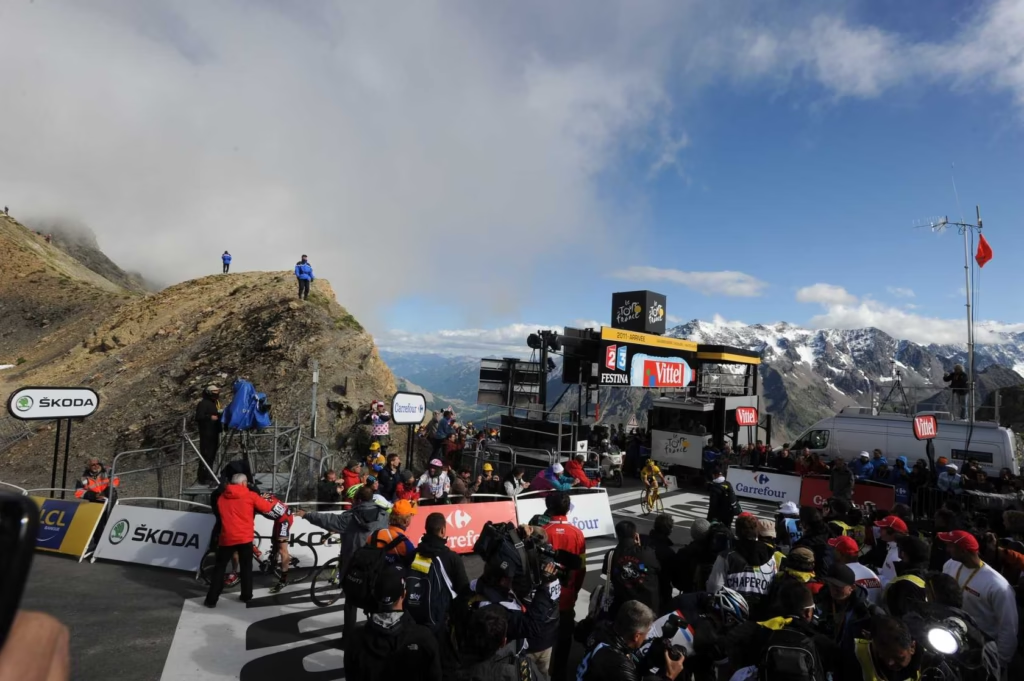
2011: Andy Schleck and the highest Tour finish
In 2011, the Tour did something unusual: it finished on the Galibier. Andy Schleck won Stage 18 at the summit after a long-range move, producing one of the defining mountain performances of that edition.
The stage finished at the highest altitude ever used for a Tour de France stage finish. That alone made it historic. But the way Schleck won gave it extra weight. He did not wait for a short acceleration near the line. He committed from distance, forced others to chase, and used the Galibier as the final proof of the move.
The 2011 finish showed a different version of the climb. Normally the Galibier is a passage, a high point before something else. That day, it was the destination. The road did not lead to a descent or another valley. It led to the result.
Schleck’s win remains one of the great modern examples of the Galibier as both theatre and sporting test. The climb gave the stage scale, but the attack gave it meaning.
For the modern 2026 comparison, see our Tour de France 2026 summit finishes guide.
2017: Roglič and the descent to Serre Chevalier
The 2017 Tour used the Galibier differently. Primož Roglič was first over the top before going on to win in Serre Chevalier. This was the Galibier as launchpad rather than finish.
That matters because it shows another way the climb can decide a stage. The summit does not have to be the end of the action. If a rider crests the Galibier with a gap and can descend well, the race behind becomes complicated. Chasers have to organise quickly after a high-altitude effort, often while tired and cold.
Roglič’s win also underlined the importance of technical skill after the summit. The Galibier is not just an uphill test. It is also a descent, a transition and a chance for a strong rider to turn a climbing move into a stage win.
This is especially relevant for modern racing. Riders are more evenly matched on climbs than ever. That means the summit is often only part of the move. The descent can complete it.
 Photo Credit: A.S.O./Aurélien Vialatte
2019: Quintana and the Valloire stage
In 2019, Nairo Quintana crossed the Galibier alone and won the stage in Valloire. It was a reminder that the climb still suits pure mountain attackers, especially when they are allowed freedom from the general classification favourites.
Quintana’s win came from a situation where the breakaway and GC race were connected but not identical. That is often how Galibier stages work. A stage winner can come from the front of the race, while the yellow jersey contenders fight a separate battle behind.
The Galibier’s position before Valloire made it decisive. A rider who could climb strongly over the top and manage the descent had a real chance. The climb created the separation, and the road after the summit allowed the strongest rider to finish the job.
It was not the biggest GC-defining Galibier moment, but it was a classic example of the climb as a stage-hunter’s opportunity. The Galibier can belong to the yellow jersey favourites, but it can also belong to a rider who chooses the right day from the break.
For more on that kind of rider, see our Tour de France 2026 breakaway specialists to watch and what is a breakaway in the Tour de France?.
2022: the Galibier in the Vingegaard-Pogačar rivalry
The 2022 Tour brought the Galibier back into the heart of the race’s modern rivalry. The climb featured in the brutal Alpine sequence that helped reshape the battle between Jonas Vingegaard and Tadej Pogačar.
Stage 11, finishing at the Col du Granon, used the Télégraphe and Galibier before the final climb. It was one of the key days of the Tour. The Galibier did not host the finish, but it helped create the fatigue and tactical pressure that made the Granon explosion possible.
The next day, the race again used the Galibier on the road to Alpe d’Huez. That showed how demanding the climb can be when placed inside back-to-back mountain stages. It is hard once. It is much harder when the whole race is already carrying the cost of the previous day.
That 2022 sequence is important for understanding 2026. The Galibier does not have to be the final climb to shape the yellow jersey battle. It can soften the race before another decisive ascent. In 2026, that role may be even clearer because the Galibier comes before Sarenne and Alpe d’Huez on the penultimate day.
For more on the Pogačar-Vingegaard context, see our features on Tadej Pogačar at the Tour de France 2026 and Jonas Vingegaard at the Tour de France 2026.
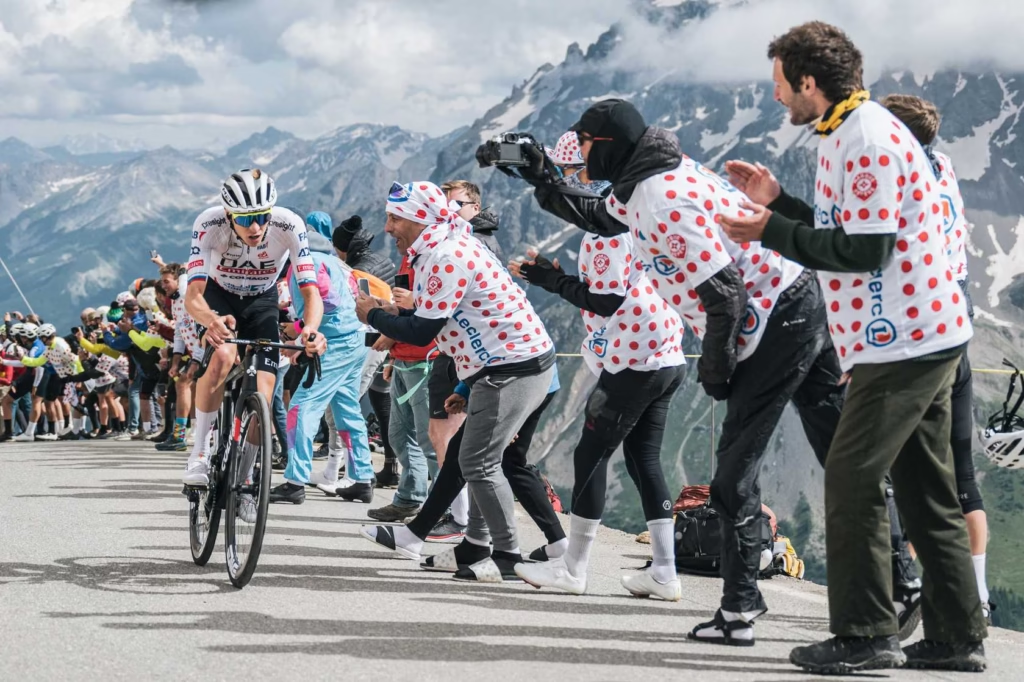
2024: Pogačar on the Galibier
In 2024, the Tour returned to the Galibier early in the race, and Tadej Pogačar used it to underline his authority. He led over the climb on the stage from Pinerolo to Valloire and won after the descent, taking control in a way that felt both modern and traditional.
The stage showed how the Galibier can still matter even when it appears early. It was not the final week. It was not a classic long Alpine ambush after 18 days of racing. But the climb still created separation because altitude, timing and descent skill all mattered.
Pogačar’s Galibier move also reinforced an important modern point. The best GC riders now attack where older race logic might have expected control. A stage that once looked like a selective mountain day can become a full GC test if the strongest rider decides to use it.
That is why the Galibier is dangerous in any position. In week one, it can expose preparation. In week two, it can punish fatigue. In week three, it can decide the Tour.
For the wider modern GC picture, see our Tour de France 2026 GC favourites ranked and Tour de France 2026 route: best days for GC attacks.
The Galibier compared with Alpe d’Huez
The Galibier and Alpe d’Huez are both Tour icons, but they work in very different ways.
Alpe d’Huez is a finish-line climb. Its mythology is built around the 21 hairpins, the crowds and the final ascent. It is direct, visible and theatrical. Riders attack there because the line is at the top and the whole world is watching.
The Galibier is more remote and less contained. It is often crossed rather than finished on. Its drama comes from scale, altitude and what it does to the race before the finish. It may not have the same stadium feel, but it can be more tactically complex.
That contrast is what makes Stage 20 in 2026 so interesting. The race will use both. The Galibier will test the riders high in the Alps, then Sarenne will add another hard barrier, and Alpe d’Huez will deliver the final verdict.
It is a route that combines the Galibier’s old Alpine severity with Alpe d’Huez’s finishing mythology. That is why it looks like the defining mountain stage of the 2026 Tour.
For the companion history, see our history of Alpe d’Huez at the Tour de France and Alpe d’Huez: why the Tour still fears the 21 bends.
Photo Credit: A.S.O./Aurélien VialatteThe Galibier compared with the Tourmalet
The Galibier and Tourmalet are often discussed together because they are two of the Tour’s defining mountain passes. The Tourmalet belongs to the Pyrenees. The Galibier belongs to the Alps. Both helped create the race’s mountain identity.
The Tourmalet came first and gave the Tour its first high mountain myth. The Galibier followed and pushed the Alpine version higher and harsher. If the Tourmalet is the original Pyrenean giant, the Galibier is the climb that made the Alps feel equally essential to the race.
They also differ in atmosphere. The Tourmalet often feels like a more enclosed, historic road through a cycling heartland. The Galibier feels more exposed and remote, especially near the summit. Both can be decisive, but they create different kinds of pressure.
In 2026, the route uses both mountain histories. The Pyrenees arrive early with the Tourmalet block, while the Galibier waits until the final mountain weekend. That gives the race a neat historical arc: first the old Pyrenean test, then the high Alpine reckoning.
For the Pyrenean part of that route, see our Tour de France 2026 Pyrenees guide.
Why the Galibier is not always a summit finish
The Galibier is rarely used as a summit finish because its greatest value is often as a pass. It connects other parts of the route and creates tactical possibilities before a different finish.
That does not make it less important. In many ways, it makes it more useful. A summit finish has a simple logic: climb to the top, stop the stage. A pass like the Galibier creates more uncertainty. Riders have to climb, descend, regroup, chase, eat, drink and prepare for what comes next.
That is where the Tour becomes more than a watts-per-kilo contest. A rider who suffers near the top may lose more time on the descent or valley road. A team with numbers can use the road after the summit. A breakaway rider can turn a small advantage into a stage-winning move.
The Galibier’s best use is often to create damage that the finish line later reveals. In 2026, that could be exactly its role. The race will still have Sarenne and Alpe d’Huez waiting after the Galibier, which makes the pass a trigger point rather than a finish-line judgement.
For more on summit finishes versus earlier mountain pressure, see our Tour de France 2026 summit finishes guide.
The Galibier and the polka-dot jersey
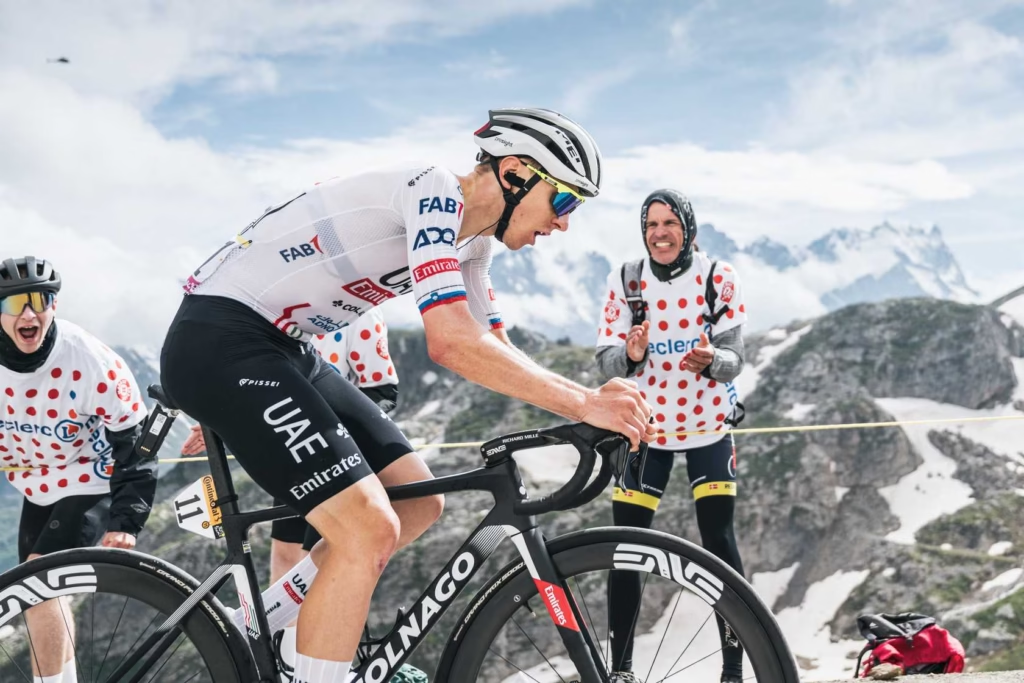
The Galibier has always mattered for the mountains classification. When it is the highest point of the race, the first rider over the summit gains prestige as well as points. That makes it a natural target for riders chasing the polka-dot jersey.
On a stage like the 2026 queen stage, the battle could be complicated. A breakaway may fight for the Galibier points, but the GC contenders may also be close enough to compete. If the yellow jersey group is racing hard by then, the polka-dot battle and the yellow jersey battle could merge.
This is one of the reasons high mountain passes are so important to the Tour. They create overlapping objectives. A breakaway rider wants points. A GC team wants pressure. A stage hunter wants a gap. A leader wants control. The same climb means different things to different riders.
The Galibier is perfect for that because it has status beyond the day’s route. Winning the summit matters, even if the stage finish is still far away.
For more on the climbers’ classification, see our Tour de France 2026 climbers guide and best climbers at the Tour de France 2026.
The Galibier and long-range attacks
The Galibier is one of the Tour’s best long-range attack climbs because it often comes far enough from the finish to make a move risky, but hard enough to make that risk worthwhile.
A final climb attack is usually easier to understand. A rider attacks, gains time, and the finish comes soon after. A Galibier attack can be more complex. There may be a descent, another climb, valley roads and teammates ahead or behind. The move needs support, calculation and courage.
That is why Galibier attacks can be so damaging. If a rider attacks there and the defending team cannot respond, the race can split into pieces long before the final climb. Chasers may hesitate because there is still too much road left. By the time they commit, the gap may already be serious.
In 2026, this could matter if a GC rider needs to take back time before Paris. Waiting for Alpe d’Huez may be safer, but the Galibier offers a bigger move. It is the climb where a rider can gamble on changing the whole race.
For likely 2026 attack points, see our Tour de France 2026 route: best days for GC attacks and where the Tour de France 2026 can be won before the Alps.
The Galibier and the descent
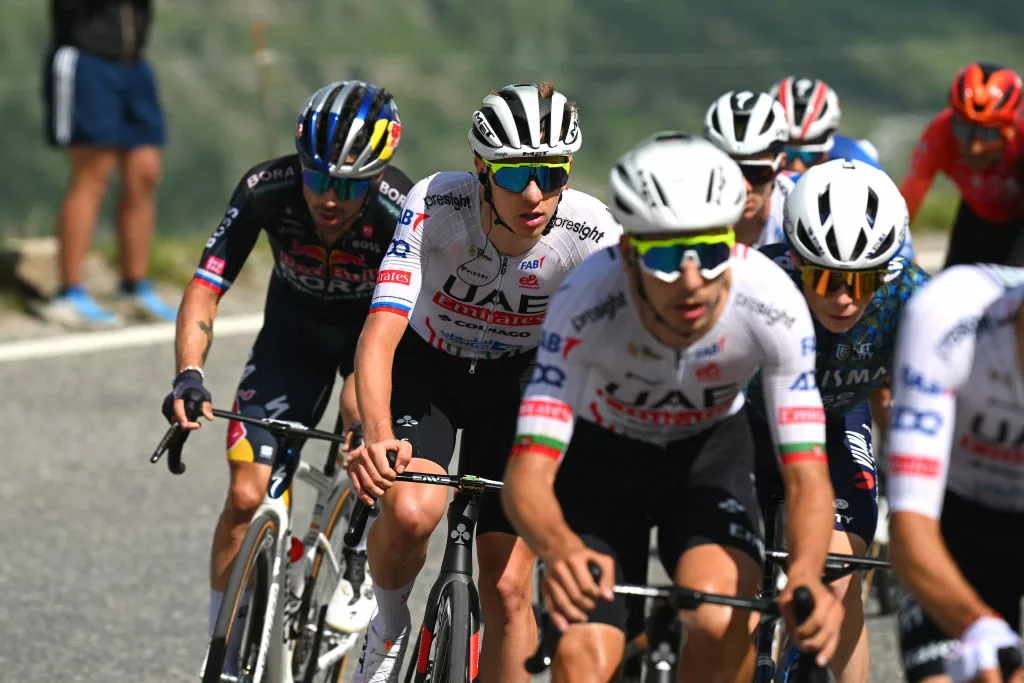
The Galibier’s descent is part of its difficulty. A rider who crests the summit under pressure still has to get down safely, efficiently and quickly. That is not a formality.
Descending after the Galibier can be cold, fast and technical. Riders may have to put on extra clothing, manage tired hands, recover from the climb and still hold position. If the road is wet or the weather changes, the descent becomes even more important.
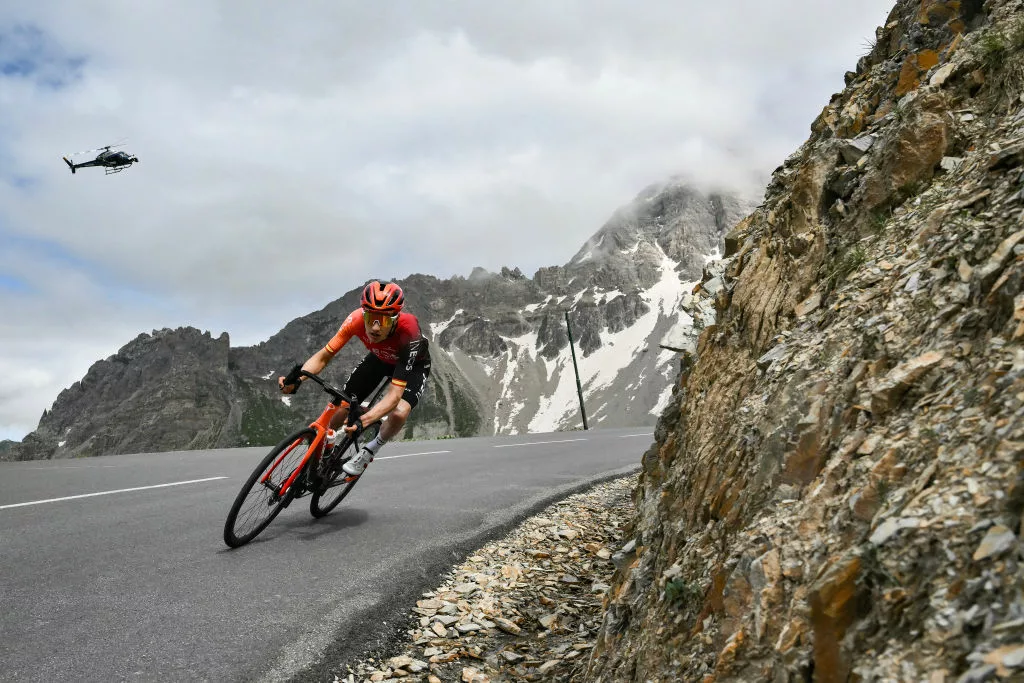
This is why riders such as Matej Mohorič, Tom Pidcock or Primož Roglič are so dangerous on stages with high passes. Climbing creates the gap, but descending can protect or extend it. A rider who is strong uphill but nervous downhill may lose the advantage almost immediately.
For GC riders, the descent can also be a defensive problem. If a leader is isolated over the top, teammates may not be there to help in the valley. A small gap at the summit can become a much bigger tactical issue afterwards.
In 2026, the Galibier descent will not be the end of the stage. That makes it even more important. Riders will still have Sarenne and Alpe d’Huez ahead.
For riders most likely to use those situations, see our Tour de France 2026 stage hunters to watch and Tour de France 2026 breakaway specialists to watch.
The 2026 return: Galibier before Sarenne and Alpe d’Huez
The Galibier returns in 2026 on Stage 20, the queen stage from Le Bourg d’Oisans to Alpe d’Huez. It comes after the Col de la Croix de Fer and Col du Télégraphe, then before the Col de Sarenne and final climb to Alpe d’Huez.
That placement is brutal. The Galibier is not being used as a scenic high point. It is the middle of a final-week mountain trap. By the time riders reach the summit, they will already have climbed heavily, but they will still be a long way from safety.
This is what makes the stage so hard to control. If a rider attacks on the Galibier, rivals have to decide whether to respond immediately or wait for Sarenne and Alpe d’Huez. If they wait and the gap grows, the Tour could be slipping away. If they chase too hard, they may pay later.
The Galibier will also carry the weight of history. In a race with back-to-back Alpe d’Huez finishes, it would be easy for the final climb to dominate the story. But Stage 20 may be decided earlier. The Galibier is the obvious place for the race to become truly dangerous.
For the full final weekend picture, see our why back-to-back Alpe d’Huez finishes could define the Tour de France 2026 feature and the official Stage 20 route page.
What kind of rider succeeds on the Galibier?
The Galibier rewards riders who combine climbing endurance, altitude tolerance, pacing and tactical judgement. It is not always the climb for the sharpest one-minute acceleration. It is a climb for riders who can sustain pressure and still make decisions when tired.
Pure climbers can thrive, especially from the north side when the road gets harder above Valloire. But the Galibier also rewards all-round Grand Tour riders because the summit is rarely the finish. A rider may need to descend well, handle valley roads, work with teammates and still climb again later.
This is why the Galibier is so important for GC riders. It tests more than climbing speed. It tests race management. The strongest rider may not attack there every time, but the weakest contender may be exposed there very quickly.
In 2026, the ideal Galibier rider is someone who can handle the Croix de Fer and Télégraphe without wasting energy, climb strongly at altitude, descend safely, then still have enough left for Sarenne and Alpe d’Huez. That is a narrow group.
For the likely contenders, see our Tour de France 2026 GC favourites ranked, Tadej Pogačar at the Tour de France 2026 and Jonas Vingegaard at the Tour de France 2026.
The Galibier for amateur riders
For amateur cyclists, the Galibier is one of the great bucket-list climbs of the Alps. But it should be treated with respect. The numbers are only part of the difficulty. Altitude, weather, exposure and the length of the approach all matter.
From Saint-Michel-de-Maurienne, the classic ride includes the Télégraphe before the Galibier. That makes it a long climbing day rather than a single effort. From Valloire, the climb is shorter but still hard, especially once the road reaches the upper slopes. From the Lautaret side, the approach is different but the altitude still makes the final section demanding.
The Galibier is also a climb where conditions can change. Riders should carry clothing, check whether the pass is open, and avoid underestimating the descent. Even in summer, the summit can feel cold compared with the valley.
That is part of the attraction. Riding the Galibier gives amateurs a direct connection with Tour history. It is not just a road the race has used. It is a road that helped define the race.
For a broader rider-travel angle around the 2026 route, see our cycling in Barcelona: climbs, roads and Tour de France atmosphere and L’Étape du Tour 2026 guide.
Why the Galibier keeps coming back
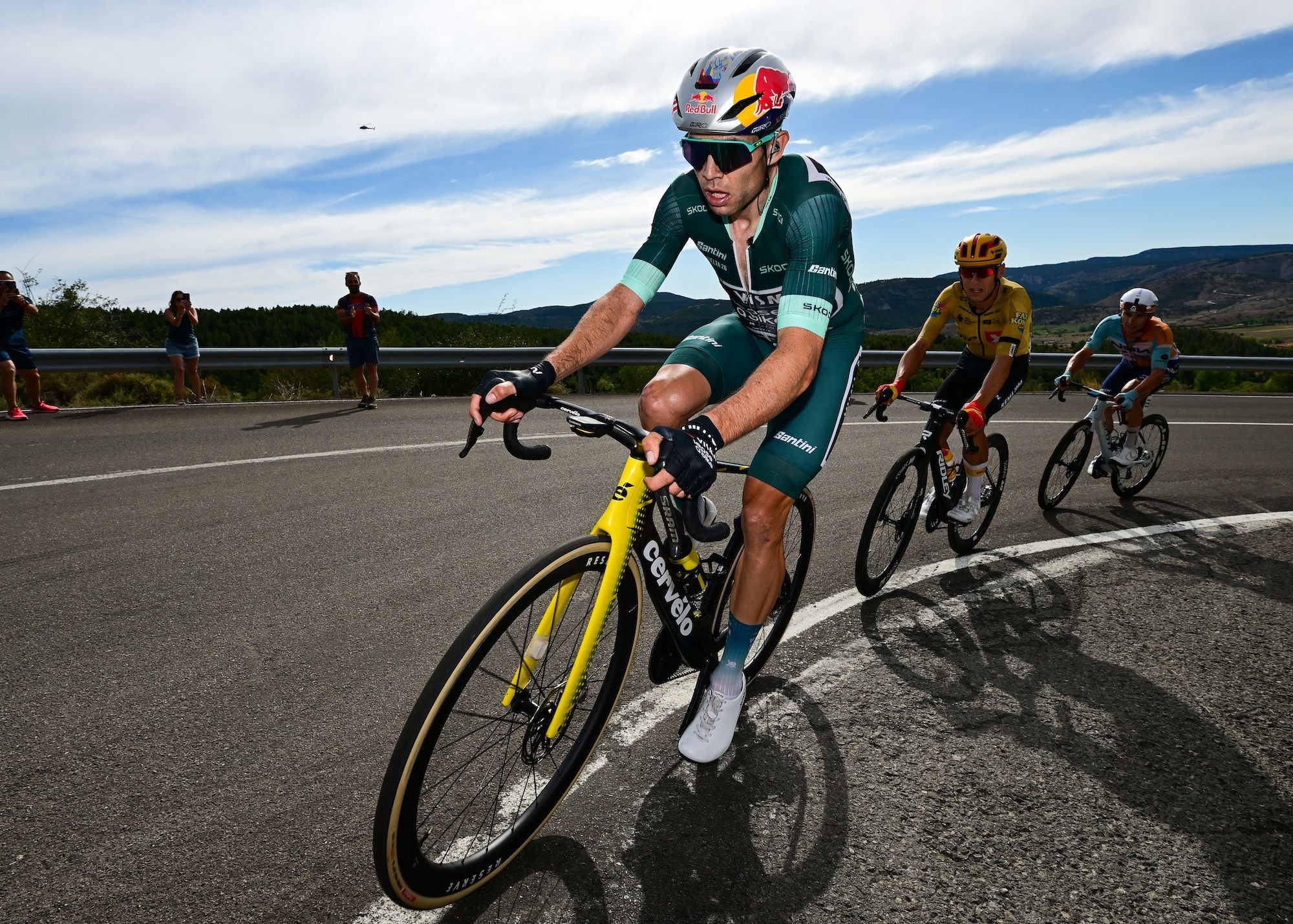
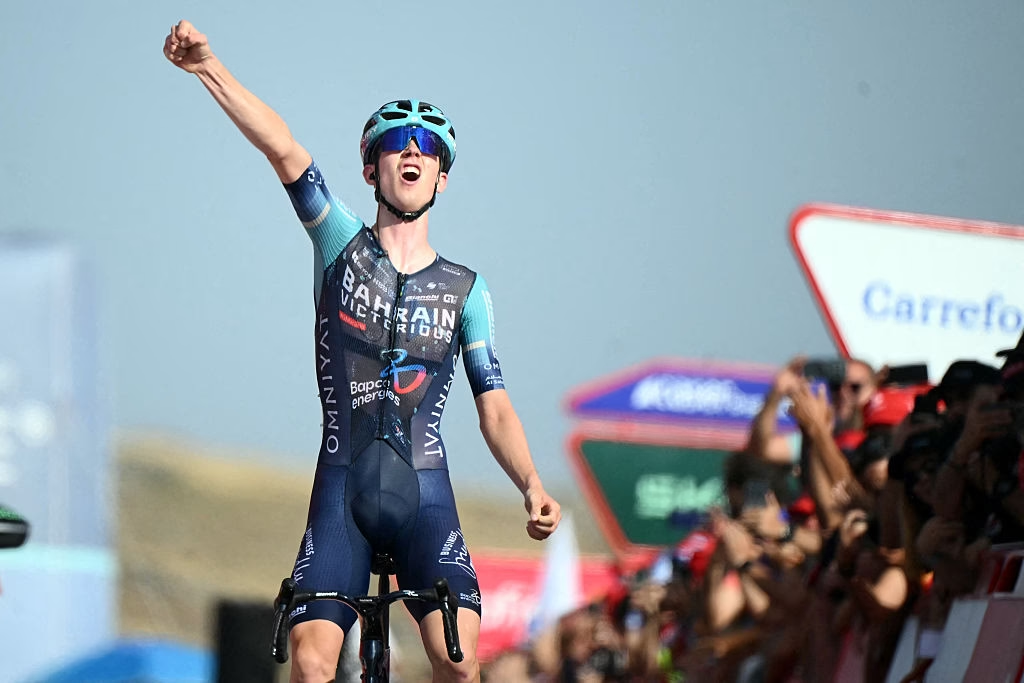
The Galibier keeps coming back because it gives the Tour something many climbs cannot. It has history, height, multiple approaches and tactical flexibility. It can crown a stage winner, break a GC contender, award the Souvenir Henri Desgrange, launch a long-range attack or simply make the race harder before another famous finish.
It also connects eras. The 1911 riders crossed a rough, intimidating high pass in a race that was still discovering what it wanted to become. Modern riders climb the Galibier with carbon bikes, radios, power meters and team cars. Yet the essential problem remains the same: the road is long, high and unforgiving.
The Tour needs climbs like this. New summit finishes can add freshness, and modern route design can create surprises, but the race still depends on certain old names carrying weight. The Galibier is one of them.
It is not just a climb that appears in the Tour. It is one of the reasons the Tour feels like the Tour.
Col du Galibier history explained simply
The Col du Galibier first appeared in the Tour de France in 1911 and quickly became one of the race’s defining Alpine climbs. It was high, remote and difficult, and Henri Desgrange treated it as proof that the Tour could go beyond normal sporting limits.
Since then, the Galibier has shaped the race in many ways. It has been a high pass, a summit finish, a place for the Souvenir Henri Desgrange, a launchpad for attacks and a climb where yellow jersey contenders have cracked. Pantani in 1998, Andy Schleck in 2011, Roglič in 2017, Quintana in 2019, the Pogačar-Vingegaard battles of 2022 and Pogačar’s 2024 move all sit inside that wider story.
In 2026, the Galibier returns on the queen stage before Sarenne and Alpe d’Huez. It is the highest point of the race and one of the last places where the general classification can be completely rewritten before Paris.
That is the Galibier’s role in Tour history. It does not always finish the story. More often, it reveals what the story is really going to be.
For more Tour de France 2026 coverage, visit our Tour de France hub, Tour de France 2026 mountain stages ranked by difficulty and how to watch Tour de France 2026 in the UK.