
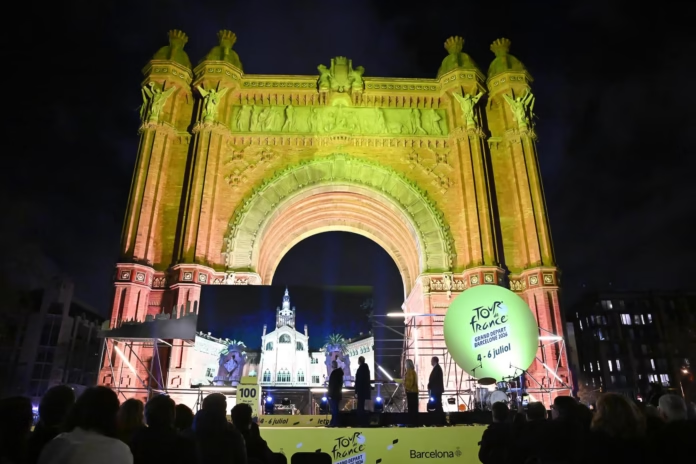
Barcelona is hosting the 2026 Tour de France Grand Départ because it offers the Tour almost everything a modern race start wants: a global city, a deep sporting identity, a strong tourism profile, a visible cycling culture and the kind of urban stage that can turn the first weekend into more than a ceremonial send-off.
The 2026 Tour begins on Saturday, 4th July with a 19.6km team time-trial in Barcelona, before the race continues through Catalonia and then towards France. It is the first time the Tour de France has started in Barcelona, and it gives the race a start that feels deliberately international, visually strong and tactically sharp.
This is not just a prestige appointment. Barcelona gives the Tour a city that can sell the race globally while also offering a route with sporting substance. A team time-trial through the city, a finish around Montjuïc, a wider Catalan opening and then an early move towards the mountains all make this Grand Départ feel more meaningful than a simple marketing exercise.
For the wider race context, see our Tour de France 2026 full route guide, Tour de France 2026 Grand Départ guide, Tour de France 2026 team time-trial explainer and Tour de France 2026 route analysis.
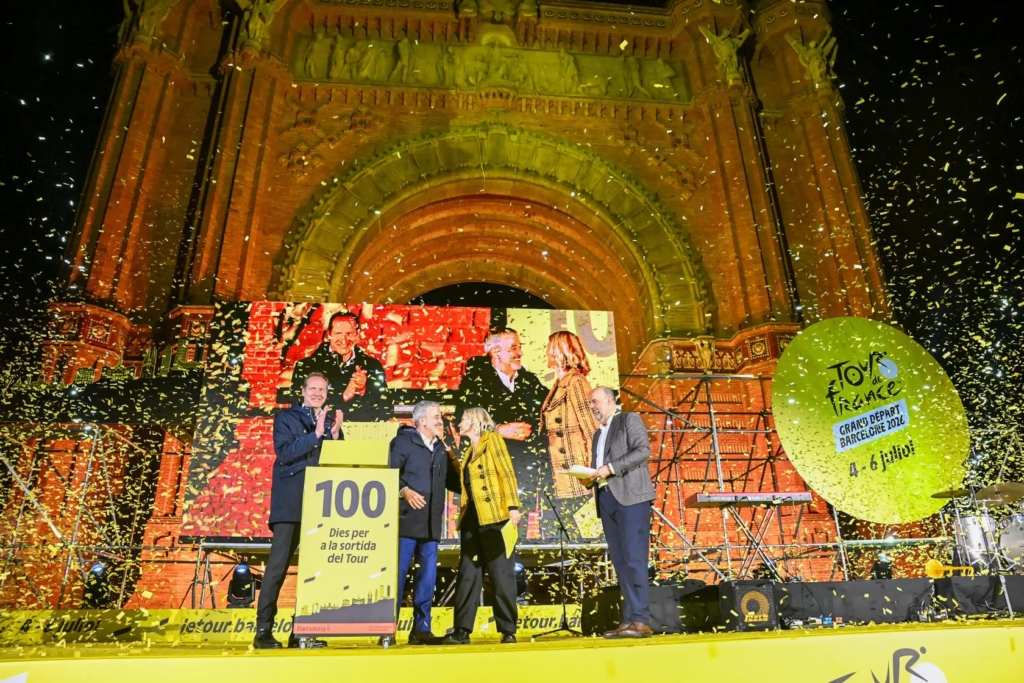 Photo Credit: A.S.O./Barcelona Ciry Council
Barcelona gives the Tour a global stage
The Tour de France has become increasingly comfortable starting outside France. Copenhagen, Bilbao, Florence and now Barcelona all show the same trend: the Grand Départ is no longer just the race’s first stage, it is an international showcase.
Barcelona fits that perfectly. It is instantly recognisable, easy to sell on television, and already associated with major sporting moments. The city has hosted the Olympic Games, football World Cup matches, major football finals, sailing events, Formula 1-related attention through the wider region, and countless international cultural events. The Tour is not arriving in a place that needs to prove it can handle a global sporting spotlight.
That matters. A Grand Départ is partly about logistics, partly about route design, but also about image. The Tour wants a start that looks big. Barcelona gives it coastline, boulevards, landmarks, packed streets and a city layout that can make a team time-trial feel both cinematic and technically demanding.
It also gives the race an opening weekend with a different feel from a typical French regional start. That can be valuable for the Tour, especially in a period when the race’s global audience matters as much as its roadside base.
For fans following the wider build-up, our beginner’s guide to Men’s Tour de France 2026 explains why the Barcelona start immediately makes the race feel different from a conventional opening sprint.
The city wanted the Tour
Barcelona’s 2026 Grand Départ is not an accidental pairing. The city has been linked with the Tour for years, and the official race framing has made clear that there was a long-running desire from Barcelona to bring the race back in a more substantial way after previous visits.
That political will matters because hosting the Grand Départ is a major undertaking. It brings road closures, security demands, transport disruption, tourism planning, broadcast infrastructure, team logistics and public expectation. A city has to want the race enough to absorb the inconvenience as well as the prestige.
Barcelona does. The Grand Départ gives the city a chance to present itself as a cycling city, not just a football, architecture or tourism destination. It also lets Barcelona connect the Tour with a broader civic message around mobility, public space and international visibility.
That is a large part of why the race is there. The Tour needs host cities with scale and enthusiasm. Barcelona has both.
The decision was confirmed well before the final route was unveiled, and the early announcement underlined how important the 2026 start was for both the city and the race. That background is covered in our original news piece on Barcelona hosting the 2026 Tour de France Grand Départ.
 Photo Credit: A.S.O./Dani Munoz
A city with a serious cycling identity
Barcelona is not only a pretty backdrop. It has a real cycling identity, even if that identity is different from the traditional northern European cycling heartlands.
The city has invested in urban cycling infrastructure, public bikes and bike lanes, and it has a growing everyday cycling culture. It also sits within Catalonia, a region with strong cycling connections, training roads, racing history and a landscape that naturally suits the sport.
That mix is useful for the Tour. The Grand Départ can present Barcelona as a modern urban cycling city while the surrounding Catalan stages connect the race to more traditional road racing terrain. The result is a start that works on several levels: city cycling, spectacle, tourism, competition and regional identity.
It also helps that cycling already belongs to the rhythms of the area. Catalonia has hosted major races, produced riders, and provided roads where professionals train and race. The Tour is not being dropped into an unfamiliar environment. It is amplifying something that already exists.
For the sporting shape of the opening weekend, see our Tour de France 2026 Grand Départ guide, while the full three-week structure is set out in our Tour de France 2026 full route guide.
Montjuïc gives the route history and drama
Montjuïc is central to why Barcelona works as a Tour start. It is not just a hill on the edge of the city. It is one of Barcelona’s most recognisable sporting spaces, tied to the 1992 Olympics and to the city’s wider sporting identity.
For cycling, that matters because the Tour needs more than flat ceremonial kilometres. The 2026 opener is a team time-trial, but the Montjuïc finale gives it a sharper edge. The climb towards the Olympic Stadium means the stage will not simply reward the biggest engines. Teams will need to manage the transition from fast city roads to an uphill finish.
That makes the route much more interesting. A flat opening team time-trial would have been clean and fast, but perhaps too predictable. A team time-trial finishing around Montjuïc immediately creates questions about pacing, team order, GC protection and who crosses the line first.
The result is a Grand Départ that is visually strong and tactically relevant. Barcelona is not just hosting the Tour. It is shaping the first yellow jersey.
For more on the format, see our Tour de France 2026 team time-trial explainer and how the stage 1 team time-trial could change the Tour de France 2026.
 Photo Credit: A.S.O./Dani Munoz
The Tour wants more than a symbolic start
Modern Grand Départs often have a ceremonial feel, but the best ones also affect the race. Barcelona does that.
The opening stage is not a neutral parade or a low-risk sprint. A 19.6km team time-trial means GC teams are under pressure immediately. The first day can create gaps, expose weaker squads, reward better organisation and potentially put a major contender into yellow before the race has even left the city.
That is important for the 2026 route. This Tour already has an aggressive structure: an early Pyrenean test to Les Angles, a major mountain day to Gavarnie-Gèdre, a stage 16 individual time-trial and a final Alpine block built around back-to-back Alpe d’Huez finishes. Starting with a team time-trial makes the opening weekend part of the GC story rather than a separate prelude.
Barcelona therefore gives the Tour both spectacle and consequence. The city gets the attention of the Grand Départ, while the race gets an opener that can genuinely influence the first week.
That balance is exactly what the modern Tour wants. It also explains why the Barcelona opener features so prominently in our Tour de France 2026 route analysis and Tour de France 2026 GC favourites ranked pieces.
Spain and the Tour have a growing Grand Départ relationship
Barcelona also fits a broader pattern of the Tour starting outside France more often, and Spain has become an increasingly important part of that pattern.
The 2023 Tour began in Bilbao, giving the Basque Country a hugely successful Grand Départ. Barcelona in 2026 continues that Spanish connection, but in a different register. Bilbao offered Basque passion, steep roads and a race opening shaped by punchy terrain. Barcelona offers a larger global city, a coastal setting, Montjuïc and a high-profile urban team time-trial.
The two starts are not the same, and that is part of the appeal. Spain can offer the Tour several different identities: Basque intensity, Catalan scale, mountain proximity, city spectacle and passionate roadside support. Barcelona lets the Tour return to Spain without repeating the same idea.
It also makes geographical sense. Catalonia gives the race a natural route towards the Pyrenees and France. The opening weekend can stay coherent rather than feeling like a detached overseas start that needs a long transfer before the race settles.
For the early mountain consequences of that route, see our Tour de France 2026 Pyrenees guide and where the Tour de France 2026 can be won before the Alps.
 Photo Credit: A.S.O./Barcelona Ciry Council
Barcelona brings tourism, business and broadcast value
A Tour de France Grand Départ is not only a sporting decision. It is also an economic and broadcast decision.
Barcelona has enormous tourism pull. It is easy for international visitors to understand, easy for broadcasters to frame, and commercially attractive for partners. The Tour can show the city’s landmarks, beaches, avenues and sporting spaces to a global audience. Barcelona, in return, receives one of cycling’s most powerful promotional platforms.
That exchange is central to modern Grand Départs. Cities pay, plan and disrupt themselves because the Tour brings attention that few events can match. The race gets a dramatic opening. The host city gets global visibility. In Barcelona’s case, that visibility supports a wider civic message around sport, mobility, tourism and city branding.
The team presentation around Sagrada Família, the race routes through the city and the Montjuïc finish all serve that purpose. They are not random scenic choices. They are a deliberate way of making Barcelona recognisable from the first images of the 2026 Tour.
For viewers watching from the UK, the broadcast side of the race is covered in our how to watch Tour de France 2026 in the UK guide.
The Grand Départ helps Barcelona promote cycling as part of city life
One of the strongest arguments for Barcelona hosting the Grand Départ is that it allows the city to present cycling as more than a race-day spectacle.
The Tour’s official local messaging has leaned into Barcelona as a cycling city, with urban cycling infrastructure, public space and sustainability all part of the story. That is important because the Tour is often used by host cities to say something about what they want to become, not just what they already are.
In Barcelona’s case, the Grand Départ fits into a broader urban cycling narrative. The city can show elite racing at the top level while also promoting cycling as a practical part of daily life. Those two things do not always sit naturally together, but the Tour gives Barcelona a chance to connect them.
That does not mean the event is without disruption. A Grand Départ in a major city brings closures, crowds and logistical stress. But the long-term value for Barcelona is the ability to present cycling as part of its civic identity, not only as a passing event.
 Photo Credit: A.S.O./Barcelona Ciry Council
A route that suits the Tour’s sporting direction
The 2026 route is built to reward complete teams and complete riders. Barcelona is the first expression of that idea.
A team time-trial immediately tests organisation. The early Pyrenees test climbing depth. The stage 16 time-trial tests individual pacing. The final Alps test recovery and endurance. That structure means the Tour starts as it means to continue, with a demand for all-round strength rather than one-dimensional racing.
Barcelona’s team time-trial therefore does more than provide a headline. It introduces the route’s main theme: the 2026 Tour will be won by a rider supported by a strong team, not just by a climber waiting for the final mountains.
That is why stage 1 matters so much for riders such as Tadej Pogačar, Jonas Vingegaard and Remco Evenepoel. It gives their teams an immediate responsibility. It also gives weaker squads an immediate problem.
For more on those main contenders, see our features on Tadej Pogačar at the Tour de France 2026, Jonas Vingegaard at the Tour de France 2026 and Remco Evenepoel at the Tour de France 2026.
Why Barcelona works better than a conventional opening sprint
A conventional opening sprint can be spectacular, especially when the yellow jersey is on offer, but it often tells us little about the overall race. Barcelona’s team time-trial should tell us a lot.
It will show which teams have arrived organised. It will reveal which GC leaders are protected by real depth. It will put immediate pressure on riders from weaker squads. It may give the first yellow jersey to a serious Tour contender rather than a sprinter or rouleur.
That changes the emotional tone of the opening weekend. There will still be spectacle, crowds and a sense of occasion, but the racing should feel sharper. The first yellow jersey may already carry real GC meaning.
That is a smart choice for a route that later leans into mountain difficulty. The Tour does not have to wait until the Pyrenees to create tension. Barcelona can create it on day one.
For the sprint side of the route, see our Tour de France 2026 sprint stages ranked and Tour de France 2026 sprinters guide.
 Photo Credit: A.S.O./Dani Munoz
What Barcelona means for the riders
For riders, Barcelona is both a privilege and a complication.
The prestige is obvious. Starting the Tour in a city of that size, on roads that will be packed and globally broadcast, gives the opening weekend a major-event feel. But the race itself will be stressful. A city team time-trial demands precision, communication and calm under pressure. The riders will have to manage speed, turns, positioning, road furniture, rhythm and the final rise towards Montjuïc.
For GC contenders, the risk is clear. Lose time in Barcelona, and the race changes immediately. Gain time, and the first week can be ridden with more confidence. For domestiques, it is a day where their work may define the entire opening phase of the Tour. For time-trial specialists, it is a rare chance to influence the race before the individual stage 16 test.
That is why the Barcelona Grand Départ is not just a city celebration. It is a sporting problem.
For more on the riders most likely to benefit, see our best time triallists at the Tour de France 2026, Tour de France 2026 domestiques who could decide the race and Tour de France 2026 dark horses for the general classification features.
What Barcelona means for the young riders
Barcelona could also be an important first test for the younger GC riders and debutants expected at the 2026 Tour.
A team time-trial is a difficult way to begin a first Tour de France. There is no easing into the race. A young rider has to trust the team, hold position, stay calm at high speed and then survive the final drag towards Montjuïc without giving away time. For riders like Paul Seixas, Oscar Onley or other emerging contenders, the opening day can shape confidence as much as classification.
That is one reason the Grand Départ works so well as a sporting test. It is not simply about the strongest rider. It is about the strongest team structure around each rider. Young contenders who have good support can leave Barcelona with their ambitions intact. Those who are isolated early may already be chasing before the mountains.
For more on that group, see our Tour de France 2026 young riders to watch guide.
What Barcelona means for fans
For fans, Barcelona offers one of the most accessible and varied Grand Départs in recent memory.
The city has excellent transport links, a large hotel base, familiar landmarks and a route that should offer several different viewing experiences. Fans can choose the fast early sections, the more technical city roads, the Montjuïc climb or the finish area. The team presentation adds another layer, giving visitors a chance to see the riders before racing begins.
The downside is the obvious one: crowding. A Grand Départ in a city like Barcelona will bring large numbers, road closures and serious movement restrictions. Anyone planning to attend will need to think carefully about where to watch, how to travel and how early to arrive.
But as a fan experience, it is hard to fault the logic. Barcelona gives the Tour scale, atmosphere and a route where the first day matters.
For UK viewers following from home, see our how to watch Tour de France 2026 in the UK guide. For broader race coverage, see the Tour de France hub.
Why it matters that the race starts outside France again
Some traditionalists still prefer the Tour to begin in France, but foreign Grand Départs have become part of the race’s modern identity. They allow the Tour to project itself beyond national borders while maintaining its French core once the race returns home.
Barcelona makes sense within that model. It is close enough to France for the route to remain geographically coherent, but distinct enough to give the opening weekend its own identity. The race can start in Catalonia, build through the Pyrenees and then settle into its wider French journey.
That makes Barcelona different from a distant overseas start that requires a major logistical reset. The race can move naturally from Spain into the rest of the route. The Grand Départ feels international without feeling disconnected.
For the full stage-by-stage route after Barcelona, see our Tour de France 2026 full route guide and Tour de France 2026 Pyrenees guide.
-
 Photo Credit: Getty
The legacy question
The strongest Grand Départs leave something behind.
For Barcelona, the question is whether the Tour can strengthen the city’s cycling identity beyond one weekend. That means not only packed roads and television images, but also lasting attention on cycling infrastructure, local clubs, community riding and the idea of bikes as part of the city’s future.
That is where the event’s long-term value sits. A Grand Départ can be a tourist showcase, but it can also be a catalyst. It gives a city a reason to talk about cycling in public, in planning, in schools, in transport debates and in the way people think about sport.
Barcelona already has much of the foundation. The Tour gives it a platform.
Why Barcelona was the right choice
Barcelona was the right choice for the 2026 Tour de France Grand Départ because it gives the race more than a start line. It gives it a story.
There is the sporting story of a rare opening team time-trial. There is the city story of Barcelona presenting itself as a cycling capital. There is the broadcast story of a race beginning among landmarks, coast roads and Montjuïc. There is the route story of a Grand Départ that leads naturally towards the Pyrenees and then into one of the hardest Tours in years.
That combination is why Barcelona works. It gives the Tour glamour, but also substance. It gives the city global attention, but also a reason to talk about cycling as part of its identity. It gives fans a spectacular opening weekend, but it gives the riders a real test.
The best Grand Départs do all of that. They do not just open the race. They tell you what kind of Tour is coming.
Barcelona does exactly that.
For the wider race hub, see our Tour de France section.

