Home Blog

UCI Road World Championships 2026 men’s road race preview: Evenepoel, Del Toro, Seixas, Van Aert and Pidcock lead Montréal battle

0

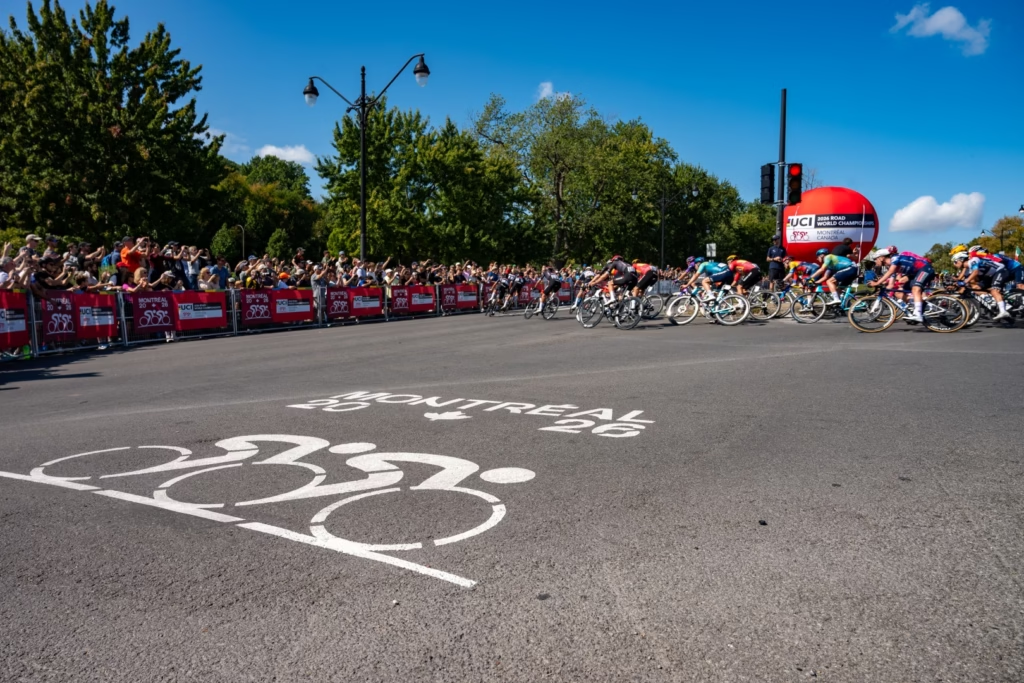
The elite men’s road race closes the 2026 UCI Road World Championships in Montréal on Sunday 27 September, with 273.7km, 3,803 metres of climbing and 12 laps around Mount Royal deciding the final rainbow jersey of the week.

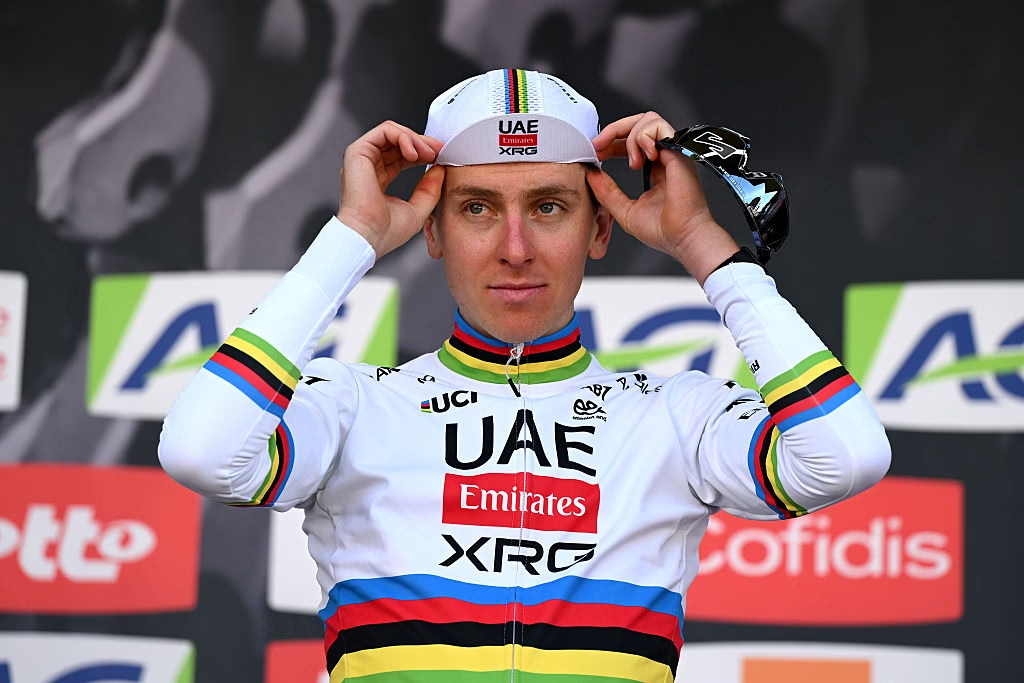
Tadej Pogačar should have arrived attempting to win a third consecutive world title. Instead, the injuries suffered when he crashed out of the Vuelta a España have ended his season, removing the rider around whom almost every major nation would otherwise have built its tactics.

That leaves a much more open championship. Remco Evenepoel has already won GP Québec. Isaac del Toro beat Paul Seixas on the actual World Championships circuit at GP Montréal. Tom Pidcock finished fourth in Québec and sixth in Montréal, while Wout van Aert heads to Canada after winning two Vuelta stages, the green jersey and the overall combativity award.

Mathieu van der Poel adds another former world champion to a field where the main contenders need very different versions of the same race. Belgium can attack with Evenepoel or wait for Van Aert. Mexico have a rider who has already won on Mount Royal but far less depth around him. France can use numbers before Seixas has to expose himself, while Great Britain have Pidcock, Oscar Onley and Adam Yates rather than one obvious card.

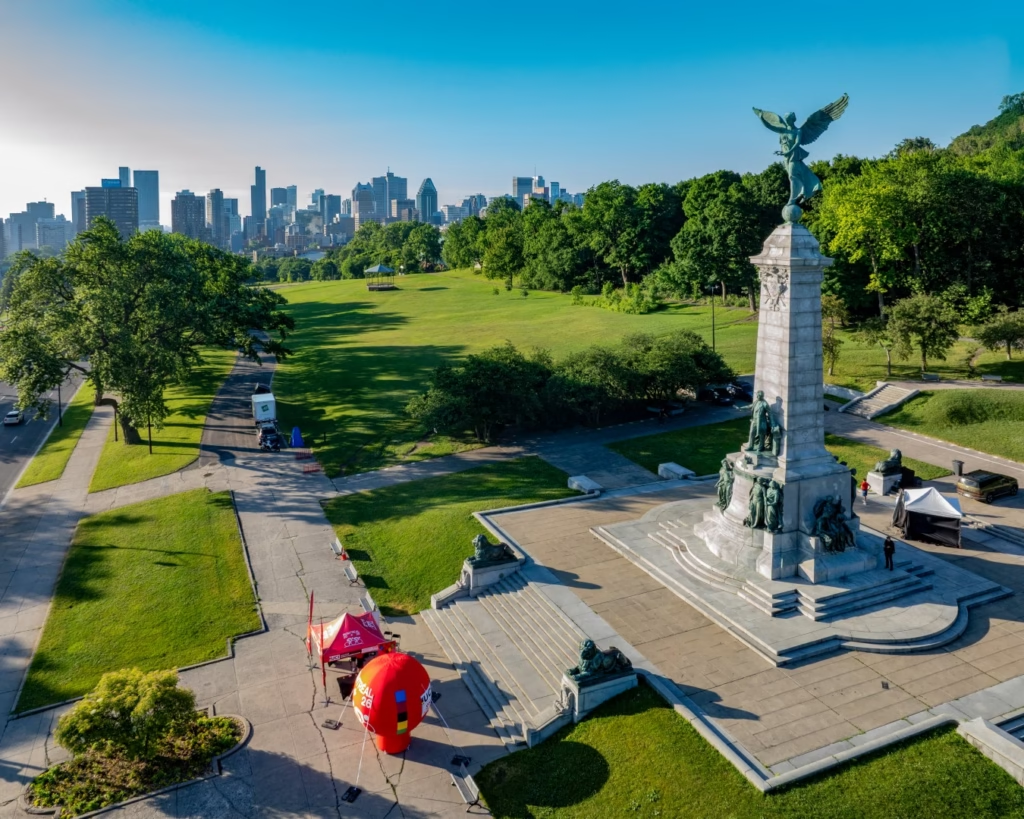
The 2026 UCI Road World Championships course guide explains how the 13.4km Mount Royal circuit works. For the men, the important part is the repetition. Camillien-Houde, Côte de la Polytechnique, Pagnuelo and the rising finish on Avenue du Parc return 12 times after more than 110km of racing outside Montréal.
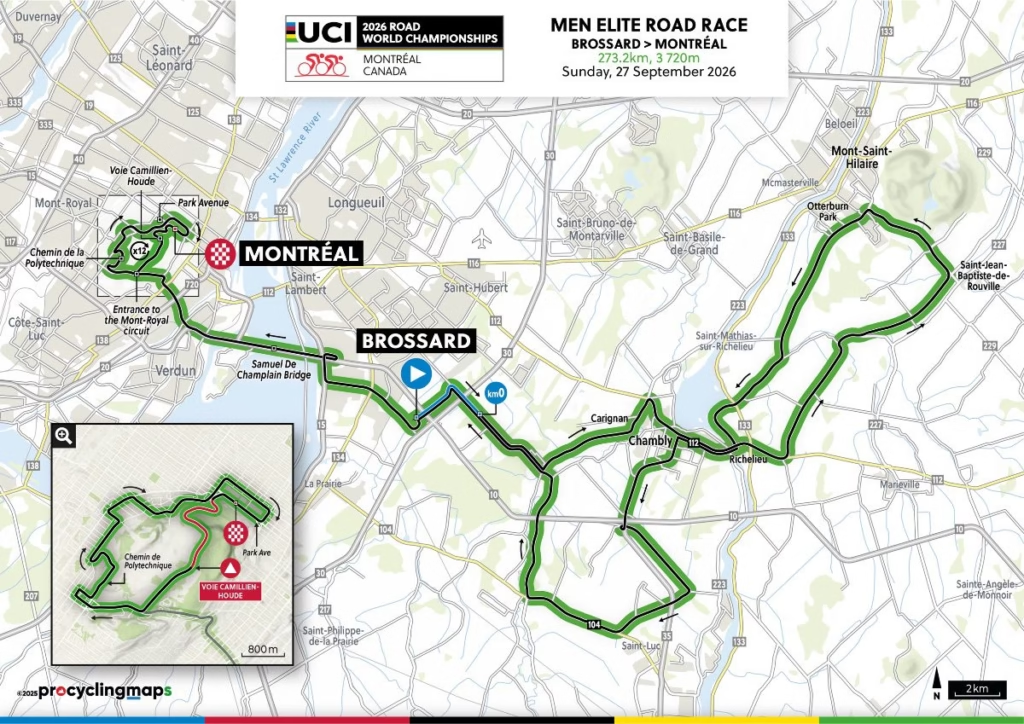
2026 World Championships Montreal Men's Road Race Route

UCI Road World Championships 2026 men’s road race details

Detail2026 elite men’s road race
DateSunday 27 September 2026
StartQuartier DIX30, Brossard
FinishAvenue du Parc, Montréal
Distance273.7km
Climbing3,803 metres
Start time09:00 EDT / 14:00 BST
Expected finishAround 20:40 BST
Finishing circuit13.4km
Mount Royal laps12
Defending championTadej Pogačar, not racing

The first 112.4km take the peloton through Montérégie before the race reaches Montréal. From there, 12 laps of the Mount Royal circuit account for more than 160km of the remaining distance and most of the climbing.

For television and streaming details, the World Championships TV schedule and live-stream guide covers the full week.

Previous winners

YearWinner
2025Tadej Pogačar
2024Tadej Pogačar
2023Mathieu van der Poel
2022Remco Evenepoel
2021Julian Alaphilippe

Pogačar’s absence guarantees a different winner in Montréal. Van der Poel and Evenepoel are the two recent champions on the current start list with the opportunity to take the rainbow jersey back.

Why Mount Royal gets harder every lap

Nothing on the Montréal circuit looks overwhelming when viewed once.

Camillien-Houde is the main sustained climb, with the hardest section around 1.8km at 8%. Côte de la Polytechnique is shorter but contains ramps above 11%, while Pagnuelo adds another half-kilometre rise before the course works back towards Avenue du Parc.

The GP Montréal 2026 route guide showed how quickly those climbs accumulate. Each 13.4km lap contains approximately 269 metres of elevation.

One passage of Camillien-Houde is manageable for almost everyone on this start list. Twelve are not.

During the early circuits, the climbing should steadily remove support riders and force weaker climbers to spend more energy holding position. By the final two or three laps, the same acceleration that caused little separation earlier can suddenly split a group immediately.

The final 600 metres on Avenue du Parc rise at around 4%, so there is no flat sprint waiting for anyone who survives. Riders still need enough power to accelerate after close to seven hours of racing.

GP Montréal gave the favourites a full-speed reconnaissance

Usually there is a degree of guesswork before a World Championships route is raced properly.

Not this year.

GP Montréal on 13 September used the same 13.4km Mount Royal circuit, with the WorldTour peloton completing it 16 times. The Worlds road race has four fewer circuit laps but adds the long approach from Brossard, making the championship almost 60km longer overall.

Isaac del Toro and Paul Seixas were the two riders who solved the circuit best.

Seixas attacked on the final Camillien-Houde ascent, Del Toro bridged across and the pair quickly established enough of a gap to decide the victory between them. Del Toro then beat the Frenchman on Avenue du Parc, with Brandon McNulty third, Quinn Simmons fourth and Evenepoel fifth.

Our GP Montréal race report showed how much of the finale was shaped before the final sprint. Ben Healy had already attacked from distance, McNulty and other UAE riders were repeatedly involved and several of the main favourites had been forced to spend energy before Seixas finally made the decisive move.

Worlds will not unfold the same way. Trade-team structures disappear, national teams have different numbers and the extra distance changes the value of every early effort.

The climbs themselves remain the same.
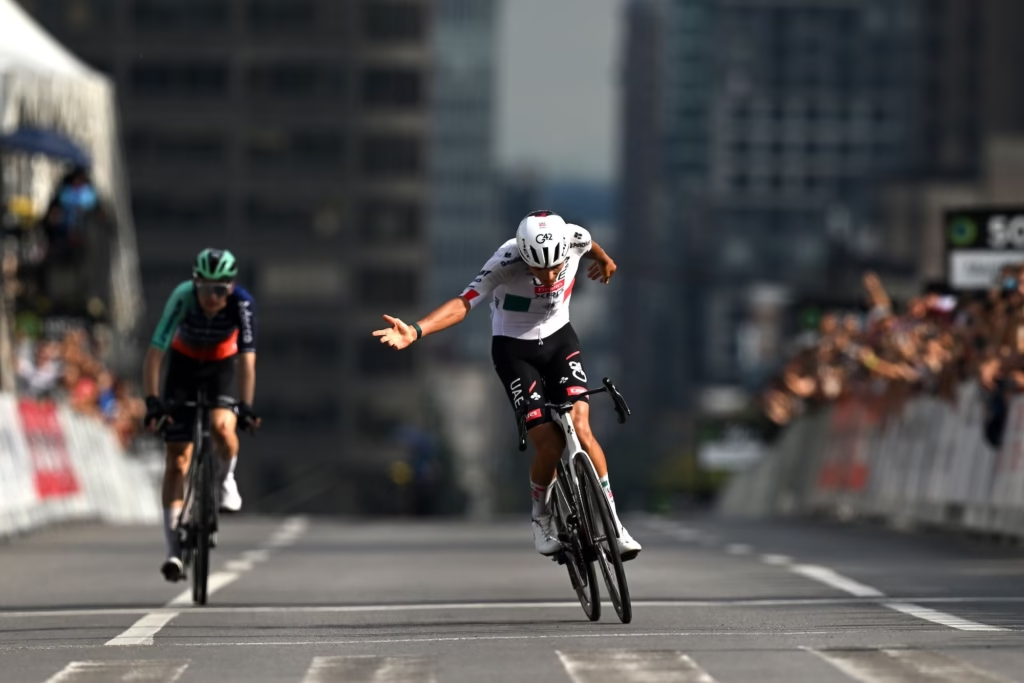
Isaac-del-Toro-announces-himself-as-rainbow-jersey-favourite-with-Grand-Prix-de-Montreal-victory

Isaac del Toro has already proved he can win here

Nobody on the start list has stronger direct evidence than Del Toro.

He has already won on the World Championships circuit.

The manner of the victory was as important as the result. Del Toro did not simply survive until a sprint. He recognised Seixas’s decisive attack, worked his way across and still had enough left to win convincingly on the uphill finish.

That combination is almost ideal for Montréal.

He climbs well enough to follow the strongest riders, accelerates sharply enough to create separation himself and has enough finishing speed that rivals cannot comfortably take him to Avenue du Parc.

The complication is everything that happened before he made the winning move.

At GP Montréal, UAE Team Emirates-XRG could use McNulty, Adam Yates and others to put pressure on rival teams while Del Toro conserved energy. Mexico cannot reproduce that strength in depth.

If Evenepoel attacks with 50km remaining, Del Toro has to decide how much responsibility he takes. If Britain put Onley or Yates ahead, the same question appears again. If Simmons, Healy or another strong outsider moves at the wrong moment, Mexico do not have a queue of WorldTour leaders available to close the gap.

Del Toro may be the best individual fit for the course. He could also be one of the riders forced to make the most decisions.
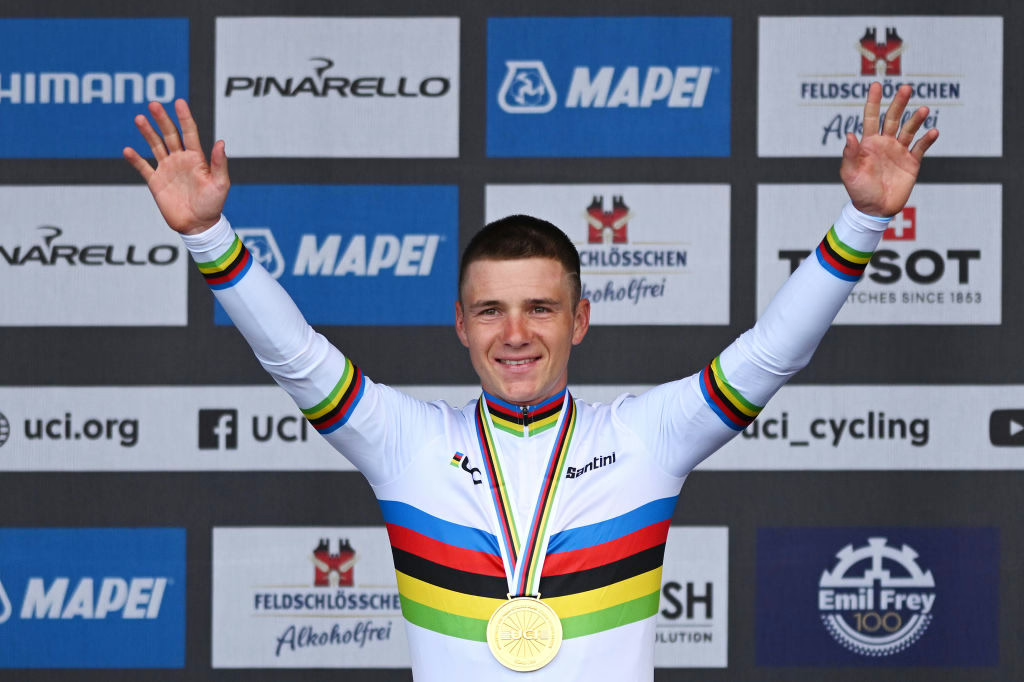
divWere-not-making-deals-with-other-teams-–-Remco-Evenepoel-ready-for-Tadej-Pogacar-duel-at-Worldsdiv

Remco Evenepoel does not need to wait for the final lap

Evenepoel’s two Canadian races offered different lessons.

At GP Québec he attacked from 28km out, helped establish the decisive move and eventually beat Giulio Ciccone for victory. Two days later in Montréal, he finished fifth after being forced to chase back towards the front once the race had already begun to split.

The Québec performance is probably the more useful guide to how Belgium should use him at Worlds.

Evenepoel does not need to wait until the final Camillien-Houde ascent. His ability to attack from 40 or 50km out can force every other major nation to make decisions well before they intended to.

Mexico may need Del Toro to chase.

France may have to use one of Seixas’s helpers.

Great Britain must decide whether Pidcock responds or whether Onley and Yates can handle it.

The Netherlands have to judge how much Van der Poel can afford to spend.

Belgium can make those attacks without committing Van Aert.

Even if Evenepoel is eventually caught, the cost of bringing him back can reshape the race behind.

Wout van Aert gives Belgium a completely different second route

Van Aert arrives from the Vuelta with one of the more interesting form lines in the race.

He won two stages, took the green jersey and collected the overall combativity award, while also spending substantial time working as part of Visma | Lease a Bike’s lead-out for Matthew Brennan.

The final Vuelta classification recap showed just how strong his three weeks had been beyond the stage wins.

The more relevant performance for Montréal came in Loja, where Van Aert won from a hard breakaway on a stage containing almost 3,300 metres of climbing.

That tells us more than another conventional sprint victory would have done.

The obvious question is recovery. Worlds comes only two weeks after the Vuelta ended, so Belgium need Van Aert to absorb the three-week workload rather than carry fatigue into Montréal.

If he does, the tactical value is enormous.

Evenepoel can attack without Belgium emptying its hand. If rivals bring him back, Van Aert may still be sitting in the group having spent far less energy.

Very few climbers on this start list want to reach Avenue du Parc with him.

Paul Seixas knows exactly where he can make the difference

Seixas was the rider who broke GP Montréal open.

His attack on the final Camillien-Houde climb was strong enough to separate the main favourites and briefly looked like the winning move before Del Toro bridged across.

Second place came with an obvious lesson.

Seixas can create the decisive selection on these roads.

He probably cannot afford to arrive at the finish with several of the fastest riders still attached.

Del Toro beat him comfortably in the two-rider sprint. Van Aert, Van der Poel and Pidcock are all riders France would rather remove before the final kilometre.

That gives France an incentive to make the race hard before the last lap rather than simply protecting Seixas until everybody else expects him to attack.

The extra distance could help him.

GP Montréal was 214.4km. Worlds is 273.7km. Seixas does not necessarily need a stronger final attack if another hour of racing has already reduced the number of riders capable of following it.
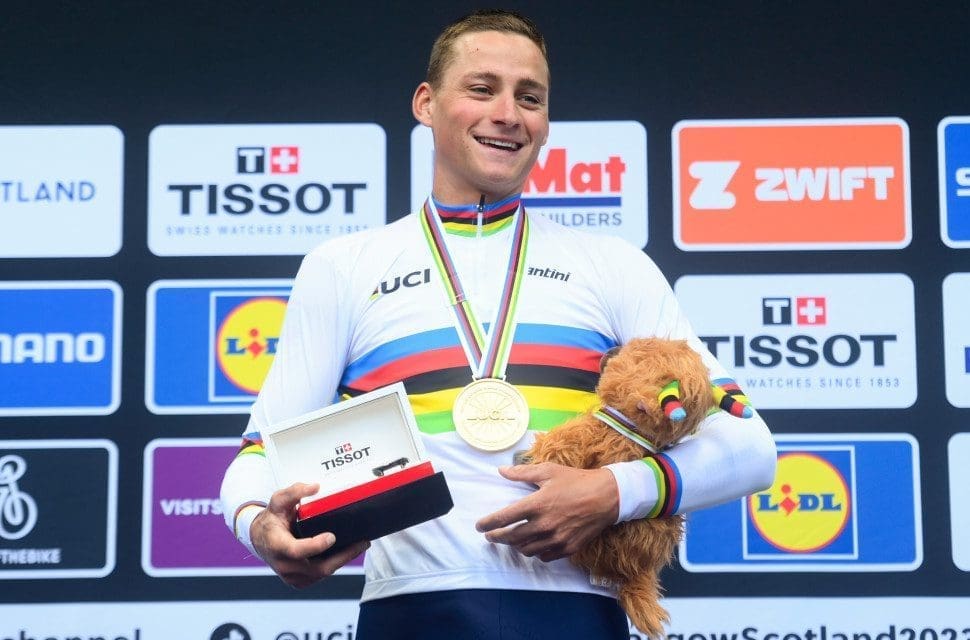
Mathieu-van-der-Poel-2023-World-Champion-Jersey

Mathieu van der Poel is the hardest major contender to place

Van der Poel arrives without the direct circuit comparison available to Del Toro, Seixas, Evenepoel and Pidcock.

The route can be read in two very different ways for him.

Twelve Mount Royal laps create enough sustained climbing to expose him if France, Mexico and Belgium continually push the pace towards a pure climbing contest.

The distance pulls the other way.

Few riders in the world have been more reliable after six hours of hard one-day racing. Van der Poel has repeatedly shown that extreme distance can turn into an advantage rather than a weakness.

His presence also affects how everyone else races.

If he survives into the final 10km, the climbing specialists know that waiting becomes dangerous. A rider who might otherwise save everything for Avenue du Parc may have to attack earlier simply to avoid facing Van der Poel in the finish.

That can create opportunities for riders who have nothing to do with the Dutchman’s own move.

His ideal race is probably hard but irregular rather than one continuous climbing test. If he gets small periods to recover between the strongest accelerations, he can remain in contention far deeper into the race than the profile alone suggests.

Tom Pidcock arrives with the right form and useful British depth

Pidcock’s Canadian results were almost exactly what Great Britain needed to see.

He finished fourth in Québec and sixth in Montréal, remaining competitive against most of the main World Championships contenders on both courses.

Britain also have more than one way to race around him.

Oscar Onley arrives from sixth overall and the white jersey at the Vuelta. Adam Yates knows Mount Royal exceptionally well and has the climbing strength to make a move that no major nation can simply ignore.

That means Pidcock should not have to follow every attack himself.

If Yates is ahead, Britain can wait.

If Onley joins a strong move, somebody else has to chase.

The Great Britain World Championships analysis looked at why that depth could be more valuable than simply declaring one protected leader from kilometre zero.

Pidcock’s strongest finale is likely to come from a heavily reduced group rather than a large sprint. He has enough acceleration to beat climbers without needing to take Van Aert or Van der Poel all the way to the line.

The task for Britain is reaching that situation with him still fresh.
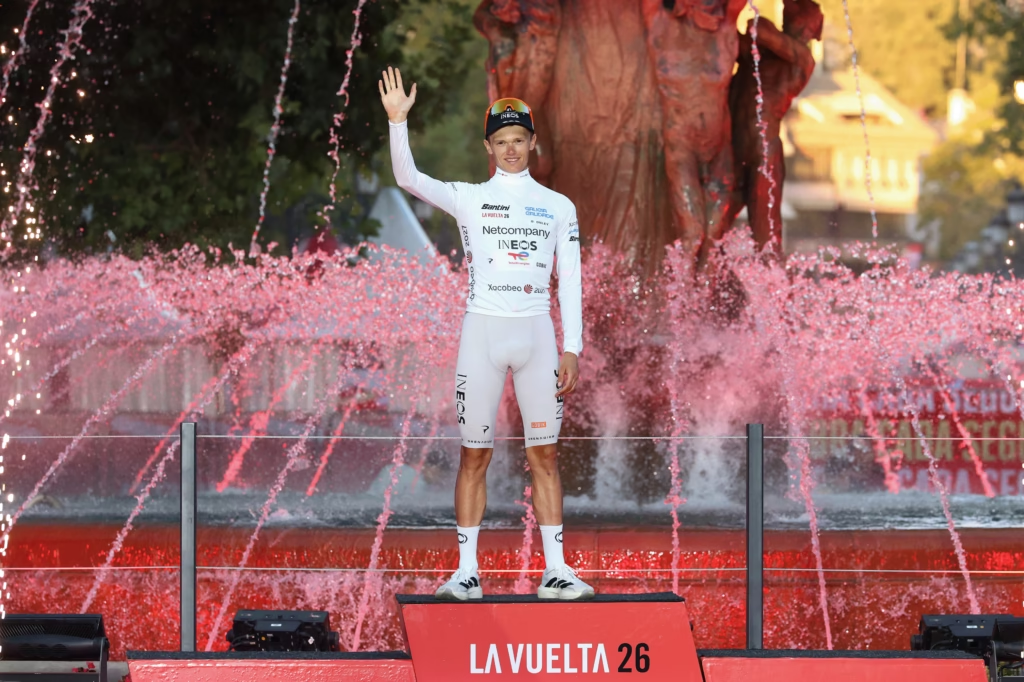
divI-think-I-took-last-year-for-granted-–-Oscar-Onley-fights-through-setbacks-with-vital-lessons-learnt-from-successful-rollercoaster-Vuelta-a-Espanadiv

Oscar Onley can be used as more than support

Onley’s Vuelta makes him one of the most interesting secondary options in the race.

He finished sixth overall and won the young rider classification after spending much of the final week close enough to the podium fight to demand attention from the strongest GC teams.

The physical condition is therefore obvious.

Recovery is less certain.

If Onley has absorbed those three weeks well, Britain should use him aggressively rather than simply asking him to ride for Pidcock from the start.

A move containing a recent Grand Tour top-six finisher cannot be ignored.

That is especially useful in a World Championships where Belgium, France, Mexico and the Netherlands all have clear reasons to save their main rider for later.

Every time somebody else has to chase Onley, the race becomes slightly better for Pidcock.

Brandon McNulty and Quinn Simmons give the USA several ways into the race

The United States were one of the strongest teams at GP Montréal.

McNulty finished third and Simmons fourth, with both riders involved while the race was still being decided rather than collecting places from a beaten chase group.

That is a useful starting point for Worlds.

The Americans do not need to organise everything around one leader.

McNulty can move late.

Simmons is at his best when the race becomes aggressive and nobody wants responsibility for chasing.

Matteo Jorgenson gives them another rider capable of surviving repeated climbing and attacking from further out.

That combination can cause problems for nations with one obvious protected contender.

If Simmons goes three laps from the finish, Belgium may be happy to let somebody else chase while preserving Evenepoel and Van Aert. France may not want to burn Seixas’s final helper. Mexico have far fewer riders available to solve the problem.

The USA may not have the single strongest rider on the start line, but they have enough good ones to keep changing the race.
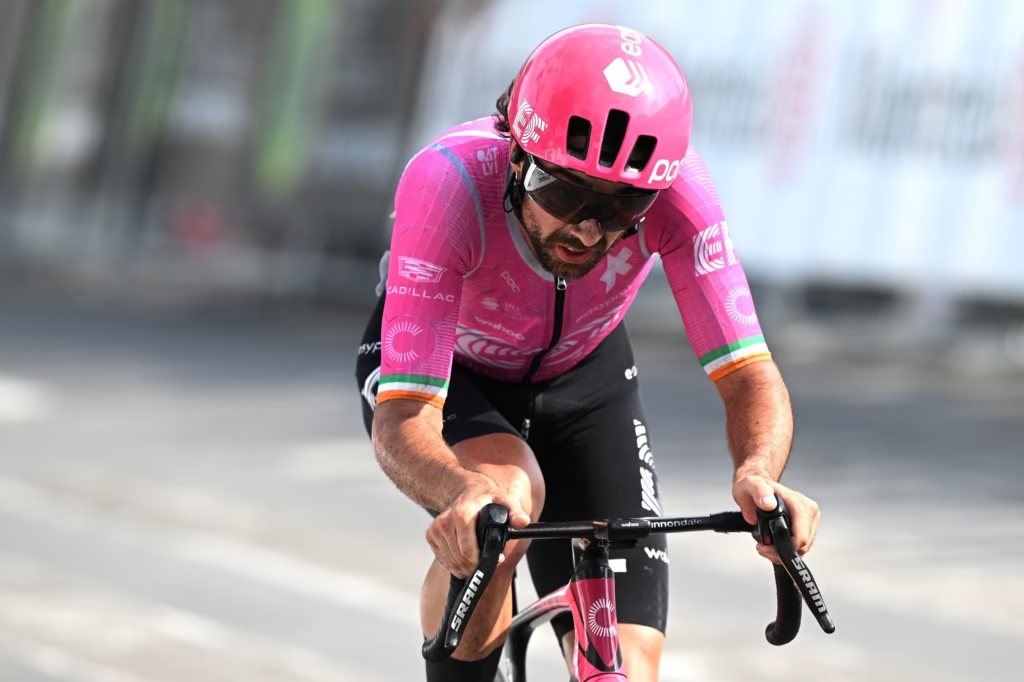
After-tough-season-Ben-Healy-finds-rhythm-and-form-in-time-for-World-Championships

Ben Healy needs the race to become uncomfortable

Healy showed exactly what he wants from Montréal during the WorldTour race.

He attacked from distance and spent a long period ahead while the favourites reorganised behind.

Ireland gain little by waiting until the final Camillien-Houde alongside Del Toro, Seixas and Evenepoel.

Healy needs uncertainty.

An attack two or three laps from the finish can create it. If Belgium have a rider in the move, they may refuse to chase. If Britain already have Onley or Yates there, the same applies. France may prefer to leave the work to somebody else while Seixas waits.

A gap can grow quickly when every country has a reason not to close it.

Healy is one of the best riders on the start list at exploiting precisely that situation.

Giulio Ciccone gives Italy a clear late-race threat

Ciccone’s second place behind Evenepoel at GP Québec confirmed that his form is where it needs to be.

Montréal offers more climbing than Québec and should suit him better from that perspective.

The finish is the problem.

Ciccone does not want to reach Avenue du Parc with Del Toro, Van Aert, Van der Poel or Pidcock still beside him.

Italy therefore have good reason to attack before the final kilometre rather than simply treating the championship as a race to deliver Ciccone to the last ascent.

The depth of their selection gives them room to do that.

World Championships often reward the nations willing to use strong riders before the race appears to have entered its decisive phase. Montréal looks particularly suited to that approach.

divIt-was-an-attack-in-my-style-Richard-Carapaz-gambles-on-long-distance-move-on-Vuelta-a-Espana-high-mountain-stagedivPhoto Credit: Getty

Richard Carapaz and Jhonatan Narváez give Ecuador contrasting cards

Ecuador may not have the numbers of Belgium, France or Britain, but they have two riders who want very different finales.

Carapaz is most dangerous when he can attack repeatedly after the race has already become selective.

Narváez offers more speed and can afford to wait longer.

That creates a simple division of responsibility.

Carapaz can make the aggressive move.

Narváez has no need to contribute behind.

If the move returns, Ecuador still have a rider better suited to the finish.

Once the race has been reduced to 20 or 30 riders, the size of the original national team matters less.

Mads Pedersen needs the race to stop short of its hardest version

Pedersen can never be dismissed from a championship of this length.

The 2019 world champion has built much of his career around surviving hard races that are supposed to be beyond the limits of a sprinter.

Mount Royal gives him a much more difficult problem.

If Seixas, Del Toro and Evenepoel continually increase the pressure during the final hour, the accumulated climbing may simply be too much.

Denmark therefore need a hard race without allowing it to become a pure climbing contest.

If Pedersen survives into the last 10km, the tactical equation changes immediately. Almost nobody in the remaining group will want to tow him towards the finish.

That alone can force attacks which alter the shape of the race.
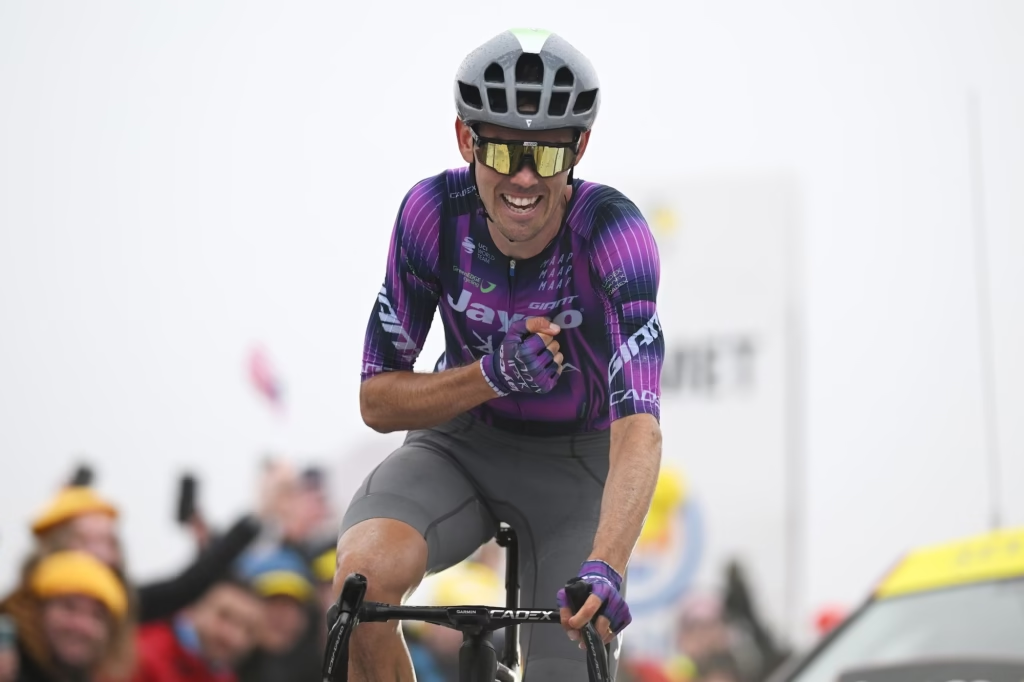
divJayco-AlUla-hedges-Tour-de-France-stage-hunting-bets-with-options-from-Ben-OConnor-to-Michael-Matthews-and-Pascal-Ackermanndiv

Michael Matthews still has a route to the finish

Matthews occupies a similar position.

Few riders know Montréal better, and his record across the Canadian races has repeatedly demonstrated how much climbing he can survive without losing his sprint.

The redesigned World Championships circuit has moved further towards the climbers, but Matthews remains dangerous if the strongest riders repeatedly cancel one another out rather than maintaining pressure.

Australia also have enough climbing strength that they do not need to protect him regardless of circumstances.

If the race becomes too hard, they can switch towards more aggressive options.

If groups continually come back together, Matthews becomes progressively more relevant.

The Vuelta riders carry the biggest recovery question

Van Aert and Onley are only part of a sizeable group arriving from Spain.

Enric Mas won the Vuelta, Primož Roglič finished second, Felix Gall third and Richard Carapaz fourth. The final classification shows how close several of the World Championships contenders were to maximum effort right through the final mountain stages.

Their form is not difficult to establish.

Their recovery is.

Two weeks can be enough to carry Grand Tour condition into a championship. It can also be too short to escape the fatigue of three weeks of racing.

Gall has the climbing profile for Mount Royal. Roglič has the explosiveness and finish. Mas has just produced the strongest Grand Tour of his career. Carapaz remains one of the most aggressive championship riders in the peloton.

The final week before Worlds will decide whether the Vuelta has sharpened them or emptied them.
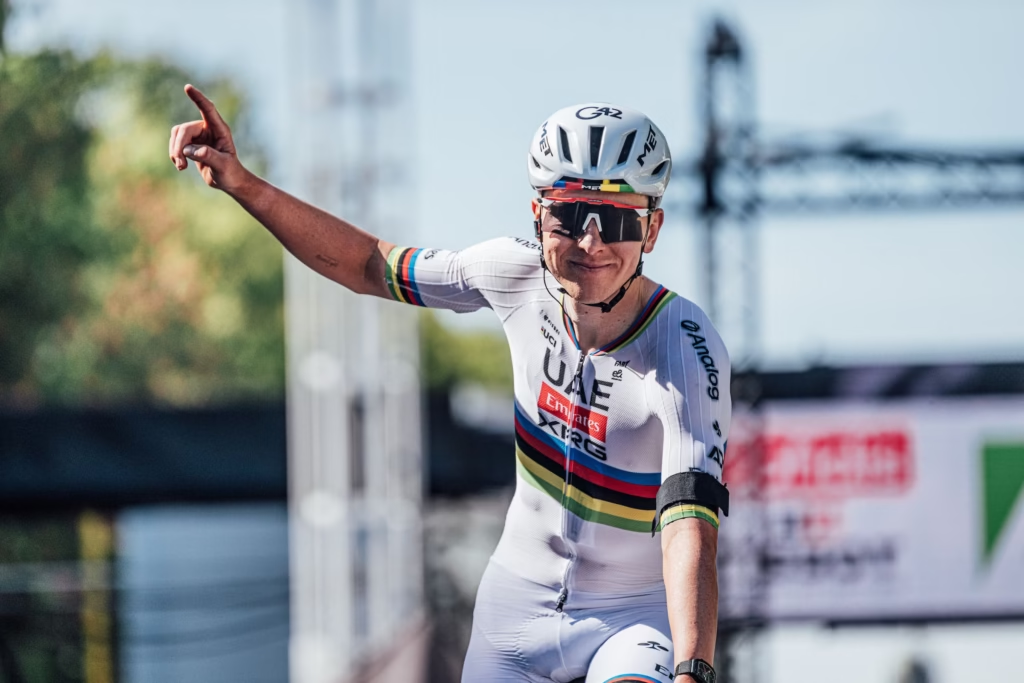
Tadej-Pogacar-named-as-one-of-100-most-influential-people-in-sport-for-2026-alongside-World-Cup-stars-Messi-and-Ronaldo-1

Pogačar’s absence changes how every major nation can race

The last two men’s World Championships had a clear centre.

Pogačar was the rider everybody had to stop.

Montréal does not have an equivalent.

Del Toro has already won on the circuit but does not have the strongest national team.

Evenepoel has a huge long-range threat but Belgium also have Van Aert.

Seixas appears capable of making the key climbing selection but has never raced an elite Worlds of this length as one of the principal favourites.

Pidcock is consistently close without being the obvious rider around whom everyone else must organise.

Van der Poel can win, but the course gives the climbers opportunities to remove him.

That uncertainty should encourage attacks earlier than would have been likely with Pogačar present.

There is no obvious point at which one nation can simply take control and say the race belongs to its leader.

How the 2026 World Championships could be won

There are several plausible versions of the finale.

Evenepoel, Healy, McNulty, Simmons or another strong attacker could get clear with two or three laps remaining and benefit from hesitation behind.

The race could reproduce the GP Montréal pattern, with the main favourites reaching the final Camillien-Houde together before one rider finally creates separation.

Or Van Aert and Van der Poel could survive long enough that the climbers are forced to attack earlier than they would ideally choose.

That last scenario may produce the most interesting racing.

A rider can make the decisive move without necessarily being the strongest rider in the race. He may simply attack because waiting for the sprint is even worse.

On a circuit with several short opportunities to accelerate and enough descending or flatter road for groups to hesitate afterwards, that distinction can decide a World Championship.
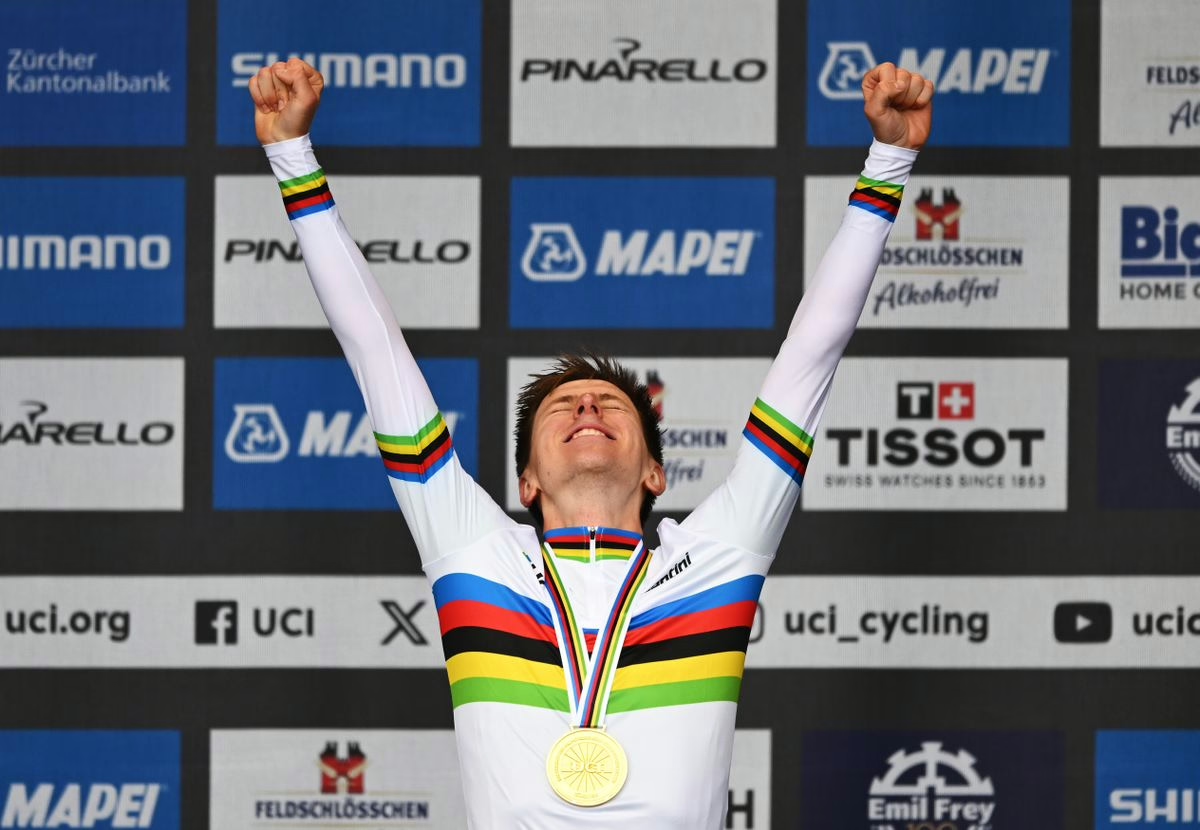
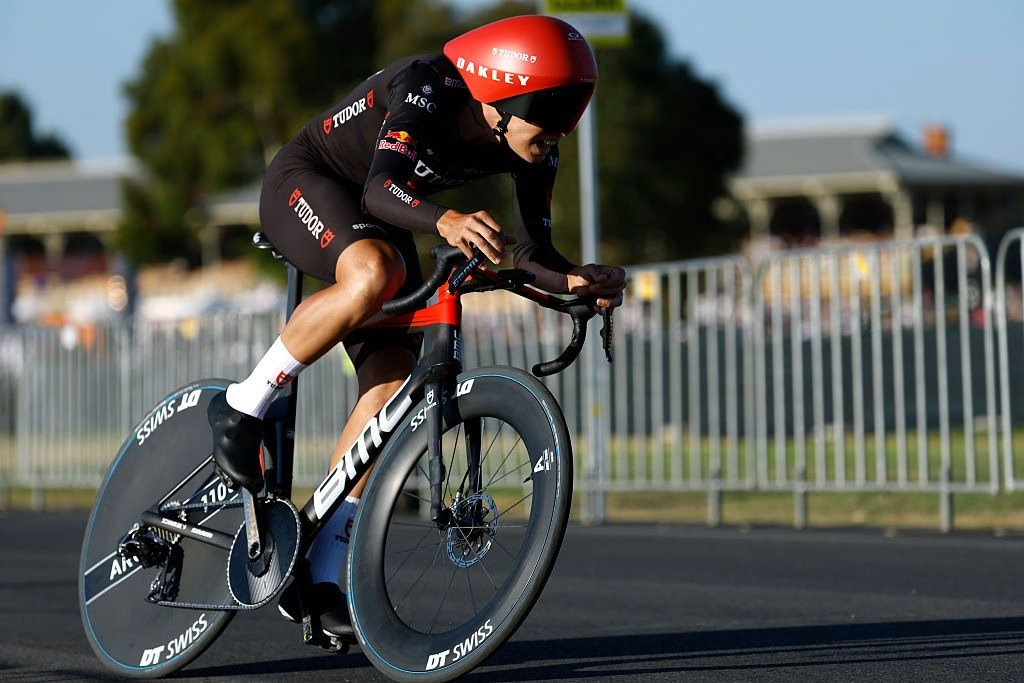
Other riders to watch

Thibau Nys and Maxim Van Gils give Belgium additional options before Evenepoel and Van Aert need to commit, while Jhonatan Narváez remains one of the quickest finishers among riders capable of surviving a hard Mount Royal race.

Mathias Vacek has the power and climbing ability to become dangerous if the final hour produces repeated small groups rather than one clean selection. Toms Skujiņš is another rider ideally suited to a championship where endurance, positioning and aggression can matter as much as pure climbing numbers.

Felix Gall’s Vuelta podium shows the level of his climbing form, while Primož Roglič offers Slovenia a completely different kind of threat in Pogačar’s absence.

Santiago Buitrago arrives from winning the mountains classification at the Vuelta and is another rider who becomes more dangerous if Colombia are prepared to attack rather than simply wait for the final lap.

For Canada, Michael Woods has the attraction of a home World Championships on terrain built around repeated climbing, while the home team will also benefit from knowing these roads better than almost anyone.

World Championships 2026 prediction

The safest prediction is that this will not be decided in the same straightforward way as the last two editions.

Del Toro has already won on Mount Royal and has the best direct evidence of any contender. The question is how much more work he has to do without UAE around him.

Evenepoel has the opposite advantage. Belgium can make other nations chase long before their main two riders need to settle the race themselves.

Pidcock has been consistently near the front in Canada without yet producing the defining result. Britain’s depth could give him a better tactical race at Worlds than he had at GP Montréal.

Top 3 prediction

1. Remco Evenepoel
2. Isaac del Toro
3. Tom Pidcock

The difference is unlikely to come down simply to who climbs Camillien-Houde fastest.

It is more likely to be decided by who reaches the final lap having spent the least energy solving everyone else’s attacks.

Marius Mayrhofer and Florian Stork extend with Tudor Pro Cycling through 2029

0

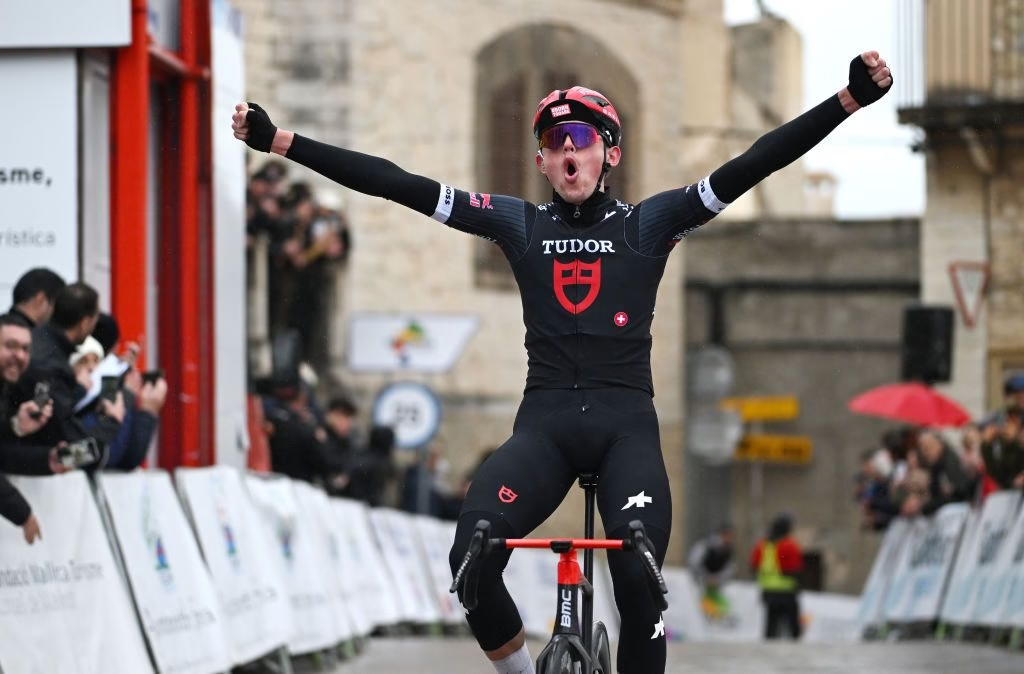
Tudor Pro Cycling have secured Marius Mayrhofer and Florian Stork on long-term contracts, with both German riders extending through the end of the 2029 season.

Mayrhofer and Stork joined Tudor in 2024 and have developed into important but very different parts of the team’s roster. Mayrhofer offers speed on selective Classics terrain and reduced finishes, while Stork has increasingly found opportunities as an attacking climber and stage racer.

Their new deals also come at contrasting points in their seasons. Stork has added another Giro d’Italia stage podium to his record in 2026 and still has racing ahead of him this year. Mayrhofer’s campaign is already over because of injury, but Tudor’s three-year commitment makes clear that the team still see him as part of their long-term plans.

Tudor back Mayrhofer through a difficult 2026

Mayrhofer arrived at Tudor with a WorldTour victory already on his palmarès after winning the Cadel Evans Great Ocean Road Race in 2023.

That breakthrough remains a good illustration of what makes him useful. The Geelong circuit had already removed many of the pure sprinters before Mayrhofer won from the reduced group, beating Hugo Page and Simon Clarke. Our history of the men’s Cadel Evans Great Ocean Road Race looks back at how that 2023 victory fitted into the event’s run of selective finales.

Mayrhofer added another victory at the Boucles de la Mayenne in 2025 and has continued to occupy the space between a pure sprinter and a Classics specialist. On the right terrain, he can survive enough climbing to retain the finishing speed that makes him dangerous.

His 2026 season has been much more difficult.

An injury suffered earlier in the year has prevented him from building a consistent campaign, and Tudor have now confirmed that the 25-year-old will not return to competition before the end of the season.

Rather than waiting to see how he recovers, the team have extended his contract through 2029.

“I’m happy to continue racing with Tudor Pro Cycling for the years ahead,” Mayrhofer said. “Since joining the Team in 2024, I have witnessed impressive growth here, and I am proud to have contributed to that progress.”

The German also pointed to the support he has received during a difficult year.

“Although this year brought personal challenges, I always felt the Team’s full support. I am determined to repay the trust placed in me with strong performances as soon as possible.”

Marius Mayrhofer 2023 Cadel Evans Great Ocean Road RacePhoto Credit: Getty

Mayrhofer still gives Tudor a valuable one-day option

Mayrhofer’s value to Tudor has never rested on being a high-volume winner.

His profile gives the team flexibility.

On flatter days, there are quicker specialists. On the hardest climbing races, Tudor have riders better suited to long ascents. Mayrhofer becomes particularly useful between those extremes, when repeated hills, positioning and fatigue begin removing the fastest sprinters.

That made him one of the more interesting secondary options in Tudor’s 2026 Classics squad and also part of the team’s wider Tour de Suisse plans before injury interrupted his year.

The challenge for 2027 is rebuilding enough consistency to put him back into those situations.

Tudor’s willingness to commit until 2029 suggests they believe his best results with the team are still ahead rather than behind.

Florian Stork has found another level at Tudor

Stork’s two-and-a-half seasons with Tudor have followed a different path.

He joined after a difficult period affected by injury and has gradually developed from a dependable climbing support rider into somebody capable of taking his own opportunities.

His first professional victory arrived at the Trofeo Serra Tramuntana in January 2025, when he won on the demanding Mallorcan terrain.

That was followed by a stage podium at the Giro d’Italia later in the year.

Stork returned to the Giro in 2026 and immediately produced another major result, finishing second on Stage 2 in Veliko Tarnovo. He survived the difficult finale before being beaten by Guillermo Thomas Silva in the reduced sprint, with Giulio Ciccone taking third.

Our Giro d’Italia 2026 Stage 2 report covered a day that briefly put Stork at the sharp end of the overall classification as well as on the stage podium.

The result meant he had finished on a Giro stage podium in consecutive seasons.

Challenge-Mallorca-Florian-Stork-pulls-off-late-attack-to-win-Trofeo-Serra-Tramuntana-1Photo Credit: Getty

Stork credits Tudor with giving him the reset he needed

For Stork, the extension is closely tied to the way his career has developed since leaving Team DSM and joining Tudor.

“Joining Tudor Pro Cycling in 2024 was exactly the fresh start I needed at this stage of my career and after a longer period of injury,” he said.

“From day one, I felt welcomed and supported, which helped me grow and develop to new levels, like completing my first Grand Tour and even fighting for stage podiums at the Giro d’Italia.”

Those Giro performances have helped redefine how Tudor can use him.

Stork remains valuable when the team need support on climbing days, but he has also shown that he can be released into breakaways and selective finales rather than spending every race working exclusively for a leader.

That was evident again this season. Tudor’s Giro d’Italia 2026 team arrived with broader ambitions, and Stork’s early second place showed the value of having riders outside the main leadership structure ready to take chances.

A contract built around mutual trust

Stork, now 29, described the extension as a reflection of the confidence that has developed between rider and team.

“The environment here encourages me to challenge myself and take the next step, both personally and professionally,” he said.

“This contract extension is a sign of mutual belief and trust, and I’m excited to keep building on our progress and the future.

“I look forward to the next races until the end of the season and working towards the bigger goals we have as a Team over the course of the next years.”

Unlike Mayrhofer, Stork’s 2026 season is not finished. He will continue racing before beginning preparations for the first year of his new deal.

Tudor secure two different pieces of their long-term roster

The significance of the announcement is not that Mayrhofer and Stork perform the same job.

They do not.

Mayrhofer gives Tudor speed and versatility for Classics-style racing. Stork gives them climbing depth, breakaway potential and another rider who has proved capable of turning freedom into Grand Tour results.

Both have also improved or found a clearer place within the team since arriving in 2024.

Tudor have continued to strengthen as a ProTeam during that period, building a roster capable of competing directly with WorldTour opposition rather than simply relying on wildcard visibility. The team’s 2026 programmes, including the Tour de Suisse and Giro d’Italia, have increasingly reflected that ambition.

Keeping Mayrhofer and Stork through 2029 provides continuity around that growth.

For Stork, the extension follows the strongest period of his professional career.

For Mayrhofer, it arrives at a much more difficult moment. That arguably makes the length of the deal even more significant, with Tudor choosing to back him through his recovery rather than waiting for results before deciding his future.

Both Germans will now remain part of the team’s plans for at least another three seasons.

Lotto Grand Prix de Wallonie Dames 2026: Karlijn Swinkels wins for second time on Citadelle de Namur

0

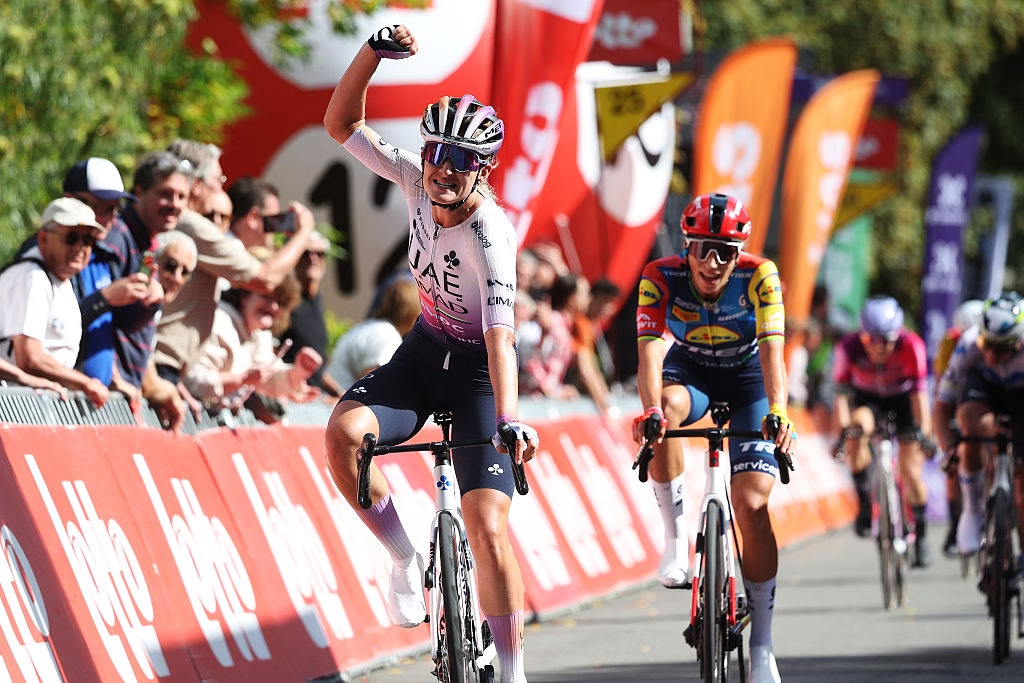
Karlijn Swinkels won the 2026 Lotto Grand Prix de Wallonie Dames, returning to the top step on the Citadelle de Namur two years after taking her first victory in the Belgian one-day race.

The UAE Team L’IMAD rider completed a superb three-year sequence at the event. She won the 2024 edition, finished second to Shari Bossuyt last September and has now reclaimed the title in 2026.

It is also Swinkels’ third road victory of the season following the Trofeo Binissalem-Andratx in January and her breakthrough Women’s WorldTour success at Trofeo Alfredo Binda in March.

New start in Seraing but the Citadel remains decisive

The fifth women’s Grand Prix de Wallonie covered 127.35km from Val Saint-Lambert in Seraing to the traditional finish on the Citadelle de Namur.

The change of start brought the race into the Liège region before a rolling route across Wallonia gradually became more selective towards Namur. There was no single major mountain to shape the race, but the repeated changes of gradient and the uphill finish again favoured riders capable of combining climbing strength with a fast finish.

That profile had attracted a strong field. Elisa Balsamo headed Lidl-Trek’s options alongside Loes Adegeest, Fleur Moors and Shirin van Anrooij, while defending champion Bossuyt returned with AG Insurance-Soudal. Liane Lippert, Célia Gery, Usoa Ostolaza and Swinkels’ UAE teammate Eleonora Gasparrini added further depth.

Swinkels nevertheless arrived with the clearest evidence that the finish suited her. Few riders have built a better record on the Citadel since the women’s race was introduced in 2022.

Swinkels returns to the top after last year’s second place

Swinkels’ first victory in Namur came in 2024, when she beat Elisa Longo Borghini and Anouska Koster after the race was reduced to a select group on the final climb.

She came within metres of repeating that result in 2025.

UAE had worked aggressively throughout the finale, with Dominika Włodarczyk attacking and Silvia Persico helping to make the selection on the Citadel. Swinkels entered the last corner well positioned and committed to the sprint, only for Bossuyt to come past in the closing metres.

Bossuyt’s victory left Swinkels second and Balsamo third in what became one of the closest finishes of the 2025 race.

Returning in 2026 therefore gave Swinkels the unusual record of having finished first and second in the two previous editions. This time she converted another strong ride on the Namur finish into victory.

A third victory in one of Swinkels’ strongest seasons

The result adds to a 2026 campaign in which Swinkels has taken a clear step forward as a one-day racer.

Her January victory at the Trofeo Binissalem-Andratx came on a steep uphill finish in Mallorca, a useful early indication of the form that would follow during the spring.

The bigger result arrived at Trofeo Alfredo Binda. Swinkels survived the selective final circuits with Anna van der Breggen and Mie Bjørndal Ottestad before beating both in Cittiglio to claim the first Women’s WorldTour victory of her career.

She then finished third at In Flanders Fields, sixth at both the Tour of Flanders and Amstel Gold Race and ninth at Dwars door Vlaanderen. That consistency carried into the second half of the season, including sixth overall at the Tour of Britain Women.

The common thread has been her ability to remain competitive when a one-day race becomes selective without losing the finishing speed required once the front group reaches the line.

Grand Prix de Wallonie has repeatedly rewarded exactly that combination.

Swinkels becomes the race’s first two-time winner

The women’s Grand Prix de Wallonie is still a young event, but Swinkels has now established the best record in its short history.

Julie De Wilde won the inaugural edition in 2022 before Marta Lach succeeded her in 2023. Swinkels became the third different winner in 2024 and Bossuyt continued that sequence last year.

Swinkels’ 2026 victory makes her the first rider to win the race twice.

Her three consecutive podium finishes are just as telling. The start location and parts of the route have changed during that period, but the race has retained its defining finish at the Citadelle de Namur. Swinkels has finished first, second and first there since 2024.

The result also gives UAE Team L’IMAD another late-season victory only three days after Dominika Włodarczyk won the Women’s Cycling GP Stuttgart & Region.

For Swinkels, Namur provides another result on the sort of rolling, selective terrain that has produced most of her best performances in 2026, ten days before the road race at the World Championships in Montréal.

Lotto Grand Prix de Wallonie Dames 2026 result

Pos.RiderTeamTime
1Karlijn SwinkelsUAE Team L’IMAD3:28:27
2Elisa BalsamoLidl-Treksame time
3Célia GeryFDJ United-SUEZsame time
4Liane LippertMovistar Teamsame time
5Usoa Ostolaza ZabalaLaboral Kutxa-Fundación Euskadisame time
6Victoire BerteauCofidis Women Teamsame time
7Millie CouzensFenix-Premier Techsame time
8Letizia BorghesiAG Insurance-Soudalsame time
9Eleonora Camilla GasparriniUAE Team L’IMADsame time
10Lauren DicksonFDJ United-SUEZsame time

Main photo credit: Getty

Elyne Roussel extends with St Michel-Preference Home-Auber93 for 2027

0

Elyne Roussel will remain with St Michel-Preference Home-Auber93 for the 2027 season, extending a relationship with the Aubervilliers team that began when she stepped directly from the junior ranks into the professional peloton in 2024.

The 20-year-old French rider has spent her entire senior career with Auber93 and will enter her fourth season with the team next year. There will be one important difference this winter: Roussel has completed her STAPS degree in Sports Management and intends to devote herself fully to cycling for the first time.

“I’m very happy to continue this journey with the team,” Roussel said. “The team has trusted me and supported my development since my junior years.

“Having now completed my STAPS degree in Sports Management, I’ll be able to fully dedicate myself to cycling, with the ambition of continuing to improve, playing a more active role in races while remaining committed to the team’s collective goals, and above all, continuing to learn.

“Thank you to the whole team for their trust. I can’t wait to write the next chapter together!”

Elyne Roussel Pointe du Raz Ladies Classic 2023

Roussel has developed within the Auber93 structure

Roussel’s connection with the team predates her first professional season.

She arrived with a strong final junior campaign behind her, finishing fifth in the 2023 European Championships road race and 11th at the World Championships. St Michel-Mavic-Auber93 subsequently signed Roussel for the 2024 season, giving her an immediate route into the senior professional peloton.

She was only 18 during that first season and made history at the Tour de France Femmes as the youngest rider to start the race. Rather than immediately chasing individual results, much of her first three years has been about absorbing the demands of a professional calendar while continuing her studies.

There have still been signs of progress. Roussel finished 12th at La Picto-Charentaise and 13th at La Périgord Ladies during her debut season, while her 2026 campaign has included 25th at Omloop van het Hageland, completing Paris-Roubaix Femmes and a 17th-place finish at the Egmont Cycling Race in August.

The extension gives her another year to turn that experience into a more prominent role.

Pointe du Raz remains an important part of her early story

Roussel had already achieved a notable result before turning professional.

At 17, she won the inaugural Pointe du Raz Ladies Classic in 2023 while racing for Team Breizh Ladies. The race was then a two-day French domestic event, with Roussel placing seventh in the opening time trial before winning the road stage and overall classification.

The event has since developed rapidly, first becoming a UCI race and then moving up to ProSeries level for 2026. Roussel therefore remains the first name on a palmarès that now sits on the international professional calendar.

Our history of the Pointe du Raz Ladies Classic traces that progression from Roussel’s inaugural victory through to the modern one-day race.

She returned in 2026 as part of the St Michel-Preference Home-Auber93 squad, an appropriate link between the rider she was as a junior and the professional she is still developing into.

Finishing her degree gives 2027 a different feel

The most interesting part of Roussel’s contract announcement is not simply that she is staying.

For the first three years of her professional career, she has been combining racing and training with university work. Completing her Sports Management degree removes that competing demand going into next season.

Roussel has been explicit about what she wants to do with the extra capacity. She wants to become “more active” in races rather than remaining exclusively in a support role, while still contributing to the team’s wider objectives.

That is a realistic next step for a rider who only turns 21 in December.

Auber93 have been patient with her development since recruiting her as a junior, and the decision to extend that relationship gives both sides an opportunity to see what changes once cycling becomes her full-time focus.

Roussel stays as Auber93 build around their women’s team

Her renewal also comes during an important transfer period for St Michel-Preference Home-Auber93.

The organisation confirmed in May that it will focus its professional future on the women’s team from 2027, ending its long-running men’s professional programme and concentrating its elite resources on the Women’s ProTeam.

That decision has brought a mixture of recruitment and continuity.

Heidi Franz has extended for 2027, while India Grangier will also remain for another season.

The team have also been active in the market. Cristina Tonetti has signed a two-year contract as Auber93 add more depth and finishing speed to the squad being assembled for the next phase of the project.

Roussel represents a different part of that strategy. She is not a new signing brought in to change the team’s level immediately, but a rider developed inside the structure who still has significant room to improve.

A fourth season with more responsibility

Roussel will enter 2027 with three professional seasons behind her but still at an age where many riders are only beginning their transition out of the under-23 ranks.

Her first years with Auber93 have already taken her from junior racing to the Tour de France Femmes, the cobbles of Paris-Roubaix and a much broader international calendar.

The next step is to become more influential within those races.

With her degree completed, a familiar team around her and another full season secured, 2027 gives Roussel the opportunity to find out how much further she can move when cycling no longer has to share her attention with university study.

Chrono Féminin de Gatineau 2026 contenders preview: Reusser leads final Worlds time trial rehearsal

0

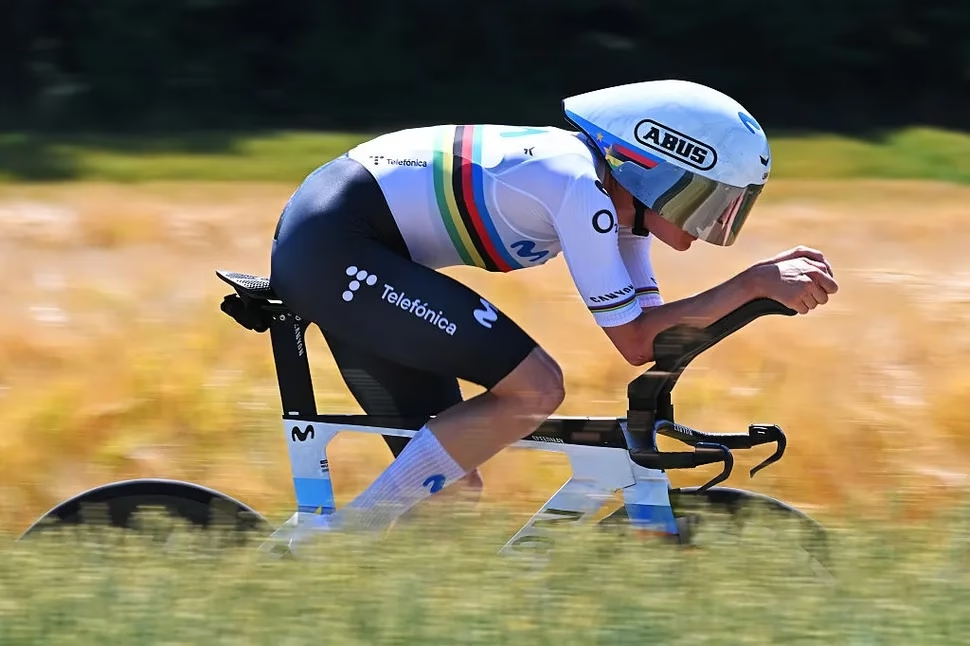
The Chrono Féminin de Gatineau has extra significance in 2026. Four days before the elite women’s individual time trial opens the UCI Road World Championships in Montréal, several riders heading to Worlds will get one final competitive run on their time trial bikes.

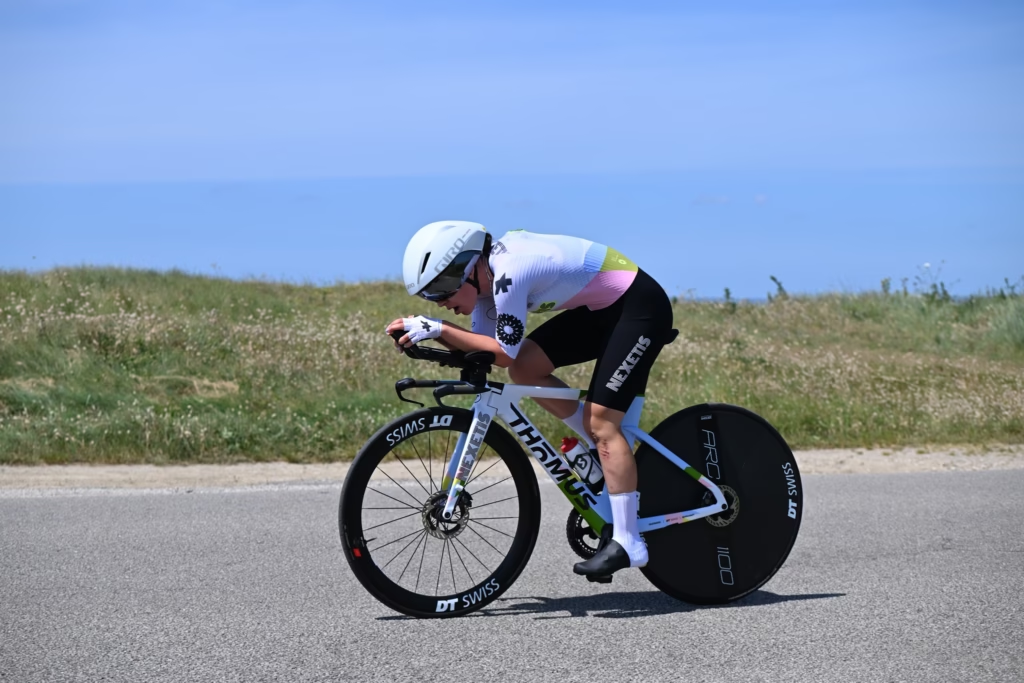
The 22.2km UCI 1.1 race takes place in Gatineau on Wednesday 16 September, with Marlen Reusser the outstanding name on the start list. The defending world champion will face Swiss teammate Jasmin Liechti, Australian champion Felicity Wilson-Haffenden, Canadian champion Nadia Gontova, Anniina Ahtosalo, Lauretta Hanson, Georgia Baker and several of the riders who will contest the under-23 World Championship on Monday.

Gatineau is much shorter than the 39.2km elite Worlds course and considerably more rolling, so the finishing order cannot simply be transferred across to Montréal. What it does provide is something much more useful than another training session. Riders have to go through their full race-day process, settle into their position at competition speed and find out exactly how their legs respond before the biggest time trial of the season.

For Marlen Reusser, anything other than victory would be a surprise. The gaps behind her could tell us rather more.

Chrono Féminin de Gatineau 2026 race details

DetailChrono Féminin de Gatineau 2026
DateWednesday 16 September
LocationGatineau, Québec, Canada
ClassificationUCI 1.1
FormatIndividual time trial
Distance22.2km
Elevation238 metres
First start10:45 EDT / 15:45 BST
Live coverageFloBikes from 10:35 EDT / 15:35 BST
2025 winnerLieke Nooijen

The route starts and finishes in downtown Gatineau, with enough elevation to break up the rhythm rather than producing a completely flat power test.

Lieke Nooijen averaged more than 46km/h when she won the 2025 Chrono Féminin de Gatineau, beating Emily Ehrlich by 41 seconds. Nooijen is not back to defend the title, and Reusser considerably raises the level required to win this year’s edition.

Marlen Reusser 2026 Tour de Suisse Women Stage 4 (Getty)Photo Credit: Getty

Marlen Reusser is the clear rider to beat

There is little ambiguity around the favourite.

Reusser is the reigning world time trial champion and has repeatedly demonstrated this season that she remains the benchmark over distances close to Gatineau’s.

She won the 23.7km time trial at the Tour de Suisse Women in June, beating Zoe Bäckstedt by 11 seconds and everyone else by more than 50 seconds. That performance moved her into yellow and laid the foundation for her eventual overall victory.

The full story of that ride is covered in our Tour de Suisse Women stage 4 report.

Reusser then delivered again at the Tour de France Femmes, winning the 21km Stage 4 time trial from Gevrey-Chambertin to Dijon and taking the yellow jersey.

That was another course where outright power was only part of the requirement. The Tour de France Femmes time trial guide highlighted the changes in rhythm around Marsannay and Corcelles-les-Monts, and Reusser managed them without sacrificing her advantage on the faster sections.

Gatineau falls into a similar duration to both of those efforts.

The bigger difference comes on Sunday. The elite World Championship time trial is 39.2km, requiring Reusser to sustain her position and power for much longer.

Wednesday is therefore more about sharpening than building.

Reusser has not raced since the Tour de France Femmes, giving her enough time to recover and complete a specific Worlds training block. Gatineau now gives her one opportunity to reproduce the opening, pacing and equipment routine under proper racing conditions before the rainbow jersey goes on the line.

She should win. The question is how emphatically.

Jasmin Liechti 2026 Bretagne Ladies Tour Stage 2 TT

Jasmin Liechti has become a serious time trial rider

Jasmin Liechti gives Switzerland another rider worth following closely.

The 23-year-old has made a substantial step forward in 2026 and time trialling has been central to it.

Her breakthrough came at the Bretagne Ladies Tour, where she dominated the 24.7km individual time trial in Plomodiern. Liechti averaged more than 48km/h, won by 27 seconds and took control of the general classification before sealing overall victory the following day.

That performance is covered in our Bretagne Ladies Tour stage 2 report.

Liechti subsequently became Swiss elite time trial champion and will join Reusser in the elite Worlds race on Sunday.

Her progression through the Swiss development system has been steady rather than sudden. She was already a World Championship U23 silver medallist against the clock in Zürich in 2024, but 2026 has shown that she can now translate that ability into senior racing.

Reusser remains several levels above almost everyone when she is at her best, so Liechti does not need to finish within a handful of seconds to leave Gatineau encouraged.

A strong second tier behind the world champion would be enough to make her one of the riders worth watching in Montréal.

12th La Vuelta Femenina 2026 - Stage 3Photo Credit: Getty

Felicity Wilson-Haffenden brings elite national champion form

Felicity Wilson-Haffenden is one of the most interesting riders on the start list because her main World Championship target comes a day later than Reusser’s.

The Australian races the women’s U23 time trial on Monday.

She arrives as the Australian elite time trial champion after beating Brodie Chapman by four seconds over 29.3km in Perth at the beginning of the season.

It was a significant result for a rider still only 20 at the time, and our Australian national time trial report looked at how composed Wilson-Haffenden was despite stepping up against the elite field.

She has backed it up since.

Wilson-Haffenden finished second to Bäckstedt in the longer time trial at the Baloise Ladies Tour and already knows what it is like to be close to a World Championship medal. She finished fourth in the U23 time trial in Kigali last September, only ten seconds outside the podium.

Gatineau gives her a rare opportunity to measure herself directly against Reusser immediately before trying to win a rainbow jersey of her own.

Matching the Swiss rider is an unrealistic requirement.

Being one of the closest riders would be much more relevant.

divNadia-Gontova-claims-career-first-elite-womens-time-trial-title-at-Canadian-Road-ChampionshipsdivPhoto Credit: Getty

Nadia Gontova has already gone close in Gatineau

Nadia Gontova brings the strongest combination of current Canadian time trial form and previous experience on these roads.

She finished second here in 2024, losing to Franziska Brauße by only four seconds. That result remains one of the closest editions in the race’s recent history and is covered in our 2024 Chrono Féminin de Gatineau report.

Two years later, Gontova arrives as Canadian elite time trial champion.

Her development has generally been built around climbing rather than becoming a pure specialist against the clock. The move to Liv AlUla Jayco for 2026 followed a breakthrough period in which she established herself as one of Canada’s strongest emerging stage racers, as outlined when Gontova’s WorldTour move was announced.

The Canadian title has added another dimension.

Gontova will represent Canada in Sunday’s elite time trial, so Wednesday is about more than trying to improve on her 2024 second place. It gives her a race-speed effort on home soil four days before the biggest home championship of her career.

If Reusser establishes the expected winning standard, Gontova’s place relative to Liechti, Wilson-Haffenden and Hanson should provide a useful indication of what a strong Montréal result might look like.

TDFF24S3 - Anniina Ahtosalo (2) (Medium)

Anniina Ahtosalo’s time trial ability should not be overlooked

Anniina Ahtosalo is still primarily associated with sprinting and fast one-day racing, but that can obscure how good she is against the clock.

The Finnish rider has won multiple national time trial titles and was European U23 champion in the discipline in 2024.

Her career profile reflects how closely those two sides of her racing have developed together. The same power that makes her dangerous in a sprint can translate well to shorter individual efforts.

That makes Gatineau particularly interesting.

At 22.2km, today’s race should suit Ahtosalo better than the 39.2km World Championship test. She can ride close to the limit for a relatively short period rather than having to sustain an aerodynamic effort approaching an hour.

Sunday will require much more controlled pacing.

Ahtosalo therefore has a realistic chance of finishing high today without that automatically making her one of the principal medal favourites for Montréal. Equally, a strong result against established specialists would confirm that she arrives at Worlds with genuine form rather than simply a national championship result on her palmarès.

Lauretta Hanson

Lauretta Hanson has a World Championships reason to go hard

Lauretta Hanson deserves more attention than her reputation as a road captain and Classics domestique sometimes allows.

She finished ninth in Reusser’s Tour de Suisse time trial, a significant result given the strength of that field, and Australia have selected her for the elite World Championship time trial.

The Lidl-Trek rider therefore has exactly the same practical reason as Reusser to take Gatineau seriously.

Sunday is only four days away.

Nobody wants to arrive at a World Championship having emptied themselves unnecessarily, but a 22km time trial is short enough to provide a high-quality final effort without creating the recovery problems associated with a long road race.

Hanson is unlikely to match Reusser’s outright speed. Finishing around the front of the chasing group would be a useful final marker before Montréal.

divA-big-head-knock-Georgia-Baker-recalls-long-battle-with-concussiondiv-1

Georgia Baker could benefit from the shorter distance

Georgia Baker provides another experienced Australian option today.

Baker’s track background gives her the sort of sustained power that can work particularly well in a shorter time trial. She also finished fourth at the Australian championships in January, behind Wilson-Haffenden, Chapman and Amber Pate.

She is not as established as a road time trial specialist as Reusser or Liechti, but Gatineau does not require an hour in the extensions.

That makes her more dangerous here than she would be over the full 39.2km Worlds distance.

If the course becomes a succession of hard accelerations and sustained power sections rather than a perfectly even pacing exercise, Baker has the engine to challenge for a strong placing.

Mackenzie Coupland 2026 Vuelta Extremadura Stage 3 Sprint (Getty)Photo Credit: Getty

Mackenzie Coupland and Ava Holmgren have U23 Worlds in sight

The race also contains several riders whose real championship arrives on Monday.

Mackenzie Coupland joins Wilson-Haffenden among Australia’s U23 options, while Canada’s Ava Holmgren is another rider using Gatineau as her final race-speed time trial before Montréal.

Holmgren has already won a Canadian U23 title against the clock and finished tenth in the U23 World Championship time trial last year. Her multi-discipline background gives her strong technical ability as well as the aerobic engine required for a course like this.

The difficulty for all of the U23 riders is separating today’s result from Monday’s target.

A rider can be several places behind Reusser and still produce exactly the performance she needs before Worlds. The more useful comparison is against the other young specialists.

Wilson-Haffenden, Coupland and Holmgren will all get that comparison today.

Tabea Huys can push towards the front group

Tabea Huys is another rider who should not be lost among the better-known WorldTour names.

The Austrian has already demonstrated strong national-level time trial ability and continues to develop quickly at only 20.

Gatineau is the sort of UCI 1.1 event where that progression can become easier to measure. There is one world-class benchmark in Reusser, several established professionals and a group of strong young time trial riders around her age.

A top-five or top-ten ride would represent another useful step.

Why the World Championships comparison has limits

The timing makes Gatineau important, but it is not a miniature version of Sunday’s race.

The elite World Championship time trial covers 39.2km with 220 metres of climbing. It uses long, fast sections through Montréal and includes a passage around the Circuit Gilles-Villeneuve before the riders return towards the finish beside Parc Jeanne-Mance.

The full Montréal World Championships course guide shows why sustained aerodynamic efficiency should matter so much.

Gatineau is much shorter.

A rider can afford to be more aggressive from the start and spend a greater proportion of the race above the intensity she could sustain for 39km. The repeated changes around the downtown circuit also interrupt the effort more frequently.

That means a rider could finish close to Reusser today and still lose considerably more time on Sunday.

The value is in seeing form, execution and equipment under pressure.

Reusser can check that everything works.

Liechti can establish another elite benchmark.

Gontova, Ahtosalo and Hanson can find out where they sit before Sunday’s championship.

Wilson-Haffenden, Coupland and Holmgren can do the same before the U23 title is decided on Monday.

Reusser is the benchmark, but the gaps are worth watching

The strength of Reusser’s 2026 time trial season makes her the obvious favourite.

She won in Aarburg. She won in Dijon. She arrives in Canada as defending world champion and with Sunday’s 39.2km Montréal test built around exactly the sort of sustained power that has defined her career.

Gatineau should be hers to lose.

The more interesting information may come immediately behind.

Liechti has a chance to show how close she has moved towards the elite specialists. Wilson-Haffenden can test herself against the world champion before chasing an U23 rainbow jersey. Gontova gets another opportunity on roads where she has already come within four seconds of victory, while Ahtosalo and Hanson both have good reasons to treat the race as more than a warm-up.

The first rider starts at 15:45 BST, with FloBikes coverage beginning ten minutes earlier.

Four days later, several of the same bikes will be on another start ramp in Montréal.

This time there will be a rainbow jersey waiting at the other end.

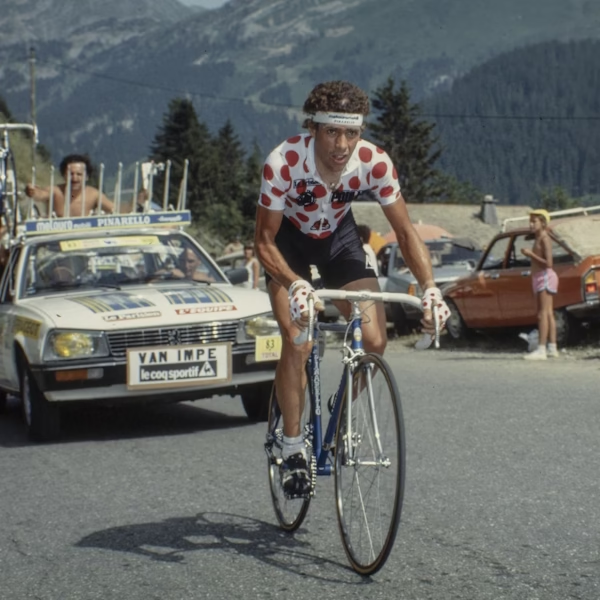
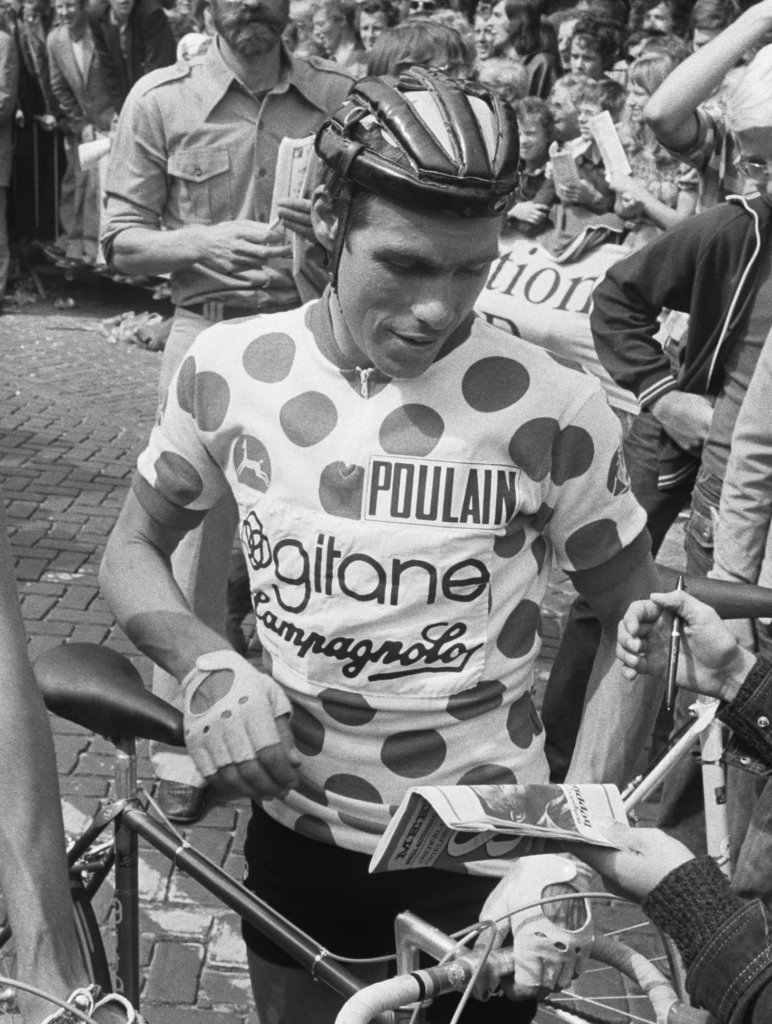
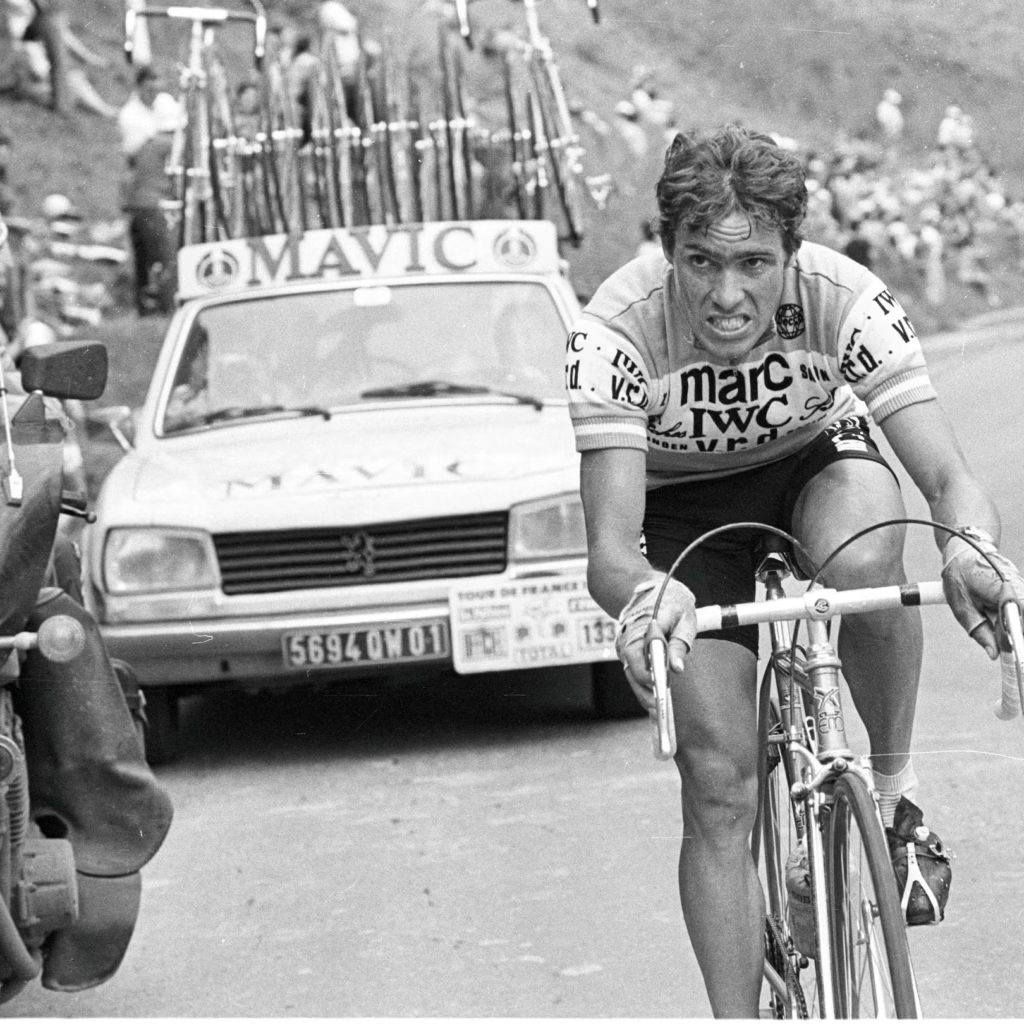
Lucien Van Impe: a pure climber in an era that still rewarded endurance first

0

Lucien Van Impe belongs to a particular line of Tour de France champions: small, light climbers whose authority came from the mountains rather than from dominating every type of terrain. He won the 1976 Tour, took the race’s mountains classification six times and collected nine Tour stage victories across a professional career that stretched from 1969 to 1987.

Those numbers make him easy to categorise as a specialist, but they can also flatten the story. Van Impe did not win the Tour simply because the 1976 route contained enough climbing. He had to beat Joop Zoetemelk across a four-week race of more than 4,000 kilometres, survive time trials that favoured heavier riders and choose the moment when his climbing superiority could create a gap large enough to defend.

He remains the last Belgian man to win the Tour de France. In a country whose cycling identity is so often built around the Classics, Van Impe’s place is different: the Belgian who became the outstanding pure Grand Tour climber of his generation and turned one decisive day in the Pyrenees into yellow in Paris.

Lucien van Impe

From Mere to the high mountains

Van Impe was born in Mere, East Flanders, on 20 October 1946. His build suited climbing from the beginning. At roughly 59kg during his racing career, he did not have the physical profile of a rider expected to dominate flat time trials or bully a peloton through crosswinds. His route to the top depended on extracting time where gradient reduced the value of raw power and rewarded repeated climbing acceleration.

He turned professional in 1969 and quickly established the pattern that would define his career. By 1971 he had won his first Tour mountains classification. He repeated it in 1972, when he also took his first Tour stage victory, and became a fixture in the upper reaches of the race whenever the route reached the Alps or Pyrenees.

The early 1970s were not an easy period in which to build a Tour palmarès. Eddy Merckx still dominated the sport, and the riders trying to win around him included Luis Ocaña, Bernard Thévenet, Raymond Poulidor and Zoetemelk. Van Impe’s climbing results therefore accumulated inside one of the deepest Grand Tour eras. He was not waiting for the field to weaken. He was learning how to turn one exceptional attribute into overall relevance.

A mountain specialist who kept returning to the Tour podium fight

By the middle of the decade, Van Impe was much more than a jersey hunter. He finished third in the 1971 Tour, fourth in 1972, fifth in 1975 and repeatedly showed that his climbing could carry him through the parts of the race that did not suit him. The mountains classification remained a natural target, but general classification became realistic because his bad days were increasingly controlled.

His rivalry with Zoetemelk is central to understanding this period. The Dutchman was the more rounded stage racer and would eventually win the 1980 Tour, but Van Impe could put him under severe pressure on the steepest climbs. ProCyclingUK’s Joop Zoetemelk rider history shows how often Zoetemelk’s career placed him close to the dominant rider of the moment. In 1976, that dominant opponent became Van Impe.

The pair had already traded mountain blows before the decisive Tour. Zoetemelk beat Van Impe on Alpe d’Huez in 1976 and again the following day, gradually tightening the overall race. Van Impe needed something larger than a few seconds at a summit finish. His response came in the Pyrenees.

Pla d'Adet and the day Van Impe won the 1976 Tour

Pla d’Adet and the day Van Impe won the 1976 Tour

The defining stage finished at Pla d’Adet above Saint-Lary-Soulan. Raymond Delisle began the day in yellow, while Van Impe and Zoetemelk were the two riders with the clearest route to overall victory. Van Impe attacked from distance, bridged towards the riders ahead and then separated himself on the final climb.

Zoetemelk chased largely alone. He was strong enough to pass other leading riders on the climb, but he could not close the decisive gap. Van Impe won the stage and put more than three minutes into his principal rival. The exact tactical folklore has become part of Tour history: directeur sportif Cyrille Guimard later claimed he had effectively ordered Van Impe to attack, while Van Impe disputed the more theatrical versions of that story. The result is less debatable. It was the move that broke open the race.

Van Impe then did something essential for a climber trying to win the Tour: he defended the advantage away from the mountains. He finished strongly enough in the final individual time trial to preserve his lead and reached Paris 4:14 ahead of Zoetemelk, with Poulidor third. He had won the Tour without winning the mountains classification, missing that competition by a point to Giancarlo Bellini.

The irony suited his career. The year in which Van Impe achieved his greatest climbing performance was also one of the rare Tours in which he did not take the polka-dot prize. Overall victory mattered more. His name sits permanently on ProCyclingUK’s list of Tour de France winners, and no Belgian man has joined him there since.

Why a second Tour never arrived

Winning in 1976 did not turn Van Impe into an all-terrain patron. His strengths remained sharply defined, and the Tour changed around him. He entered 1977 as a favourite but could not reproduce the same decisive advantage. Thévenet returned to win, while Van Impe’s campaign became another reminder that a climber needed the route, form and tactical opening to align.

He nevertheless remained a Tour force for years. Van Impe won the mountains classification again in 1977, 1981 and 1983, bringing his total to six. He finished second overall in 1981, behind Bernard Hinault, and returned to Pla d’Adet that year to win there again. The climb that had delivered his yellow jersey in 1976 remained one of the clearest expressions of his racing identity.

Longevity became part of the record. Van Impe started 15 Tours and finished all 15. In an era of longer stages, fewer protections for riders and much less specialised recovery, simply carrying Grand Tour competitiveness across that span was significant. His results were not confined to a brief peak around 1976.

Lucien Van Impe: a pure climber in an era that still rewarded endurance first

The Giro, Vuelta and a career beyond France

The Tour understandably dominates Van Impe’s reputation, but his climbing travelled. He won a stage of the Vuelta a España in 1979 and later became a major figure at the Giro d’Italia, winning the mountains classification in both 1982 and 1983. He also took a Giro stage in 1983.

Those Italian results came when he was already in his mid-30s. They matter because they show that Van Impe’s late career was not ceremonial. He could still shape Grand Tour mountain competitions long after the generation around his Tour victory had begun to disappear.

In 1983 he also won the Belgian national road title, an unusual but valuable addition for a rider so strongly associated with stage-race climbing. It did not transform him into a Classics rider, but it broadened a palmarès that is sometimes reduced too aggressively to one Tour and six mountains jerseys.

A climber from before the age of climbing specialists

Modern Grand Tour climbing is highly specialised: pacing is measured, nutrition is continuous, equipment is optimised for every gradient and teams arrive with detailed power models. Van Impe raced in a period when the basic physical requirement was less forgiving. A climber still had to absorb huge distances, repeated long transfers, rudimentary recovery and time trials that could be disproportionately damaging.

That context is why his 1976 win should not be treated as a route-assisted curiosity. Van Impe had to build a gap large enough in the mountains to cover his relative weaknesses elsewhere, and he had to do it against Zoetemelk, one of the most durable stage racers in Tour history. His attack at Pla d’Adet was spectacular because it was also mathematically necessary.

He also represents the closing stretch of Belgium’s extraordinary Tour-winning tradition. Before him came riders such as Eddy Merckx, whose dominance reshaped the race and whose rare moments of vulnerability remain part of Tour folklore, including the 1971 day at Orcières-Merlette. Van Impe was a very different champion. He did not control the sport. He waited for the mountains to give him leverage.

The last Belgian Tour winner

Van Impe retired after the 1987 season. By then his professional career had lasted nearly two decades and bridged the Merckx era, the rise of Hinault and the beginnings of another generation. His six Tour mountains titles stood as one of the defining climbing records of the race, while his 1976 yellow jersey remained unmatched by later Belgian riders.

The label of ‘last Belgian Tour winner’ can obscure as much as it explains. It frames Van Impe through what his country has not done since rather than through what he actually achieved. He was a 15-time Tour finisher, a multiple Grand Tour mountain champion, a stage winner in all three Grand Tours and a rider capable of finishing second at the Tour five years after his victory.

His career makes most sense when viewed through that consistency. Pla d’Adet was the decisive masterpiece, but it worked because Van Impe had spent years learning how to stay close enough to the best riders for one mountain attack to matter. In 1976, he finally created the gap that no one could take back.

Updated season form guide after Vuelta a España 2026

0

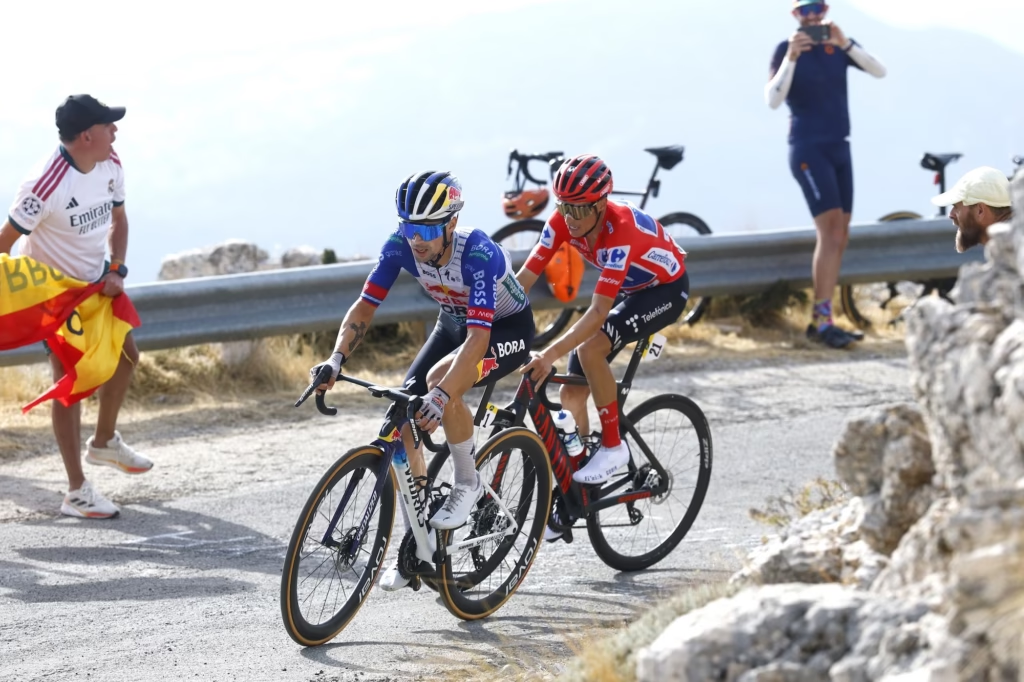
The 2026 Vuelta a España began with Tadej Pogačar as the dominant reference point and ended with Enric Mas finally converting years of Grand Tour consistency into an overall victory. Between those two facts, the race changed the late-season form picture for several of the peloton’s most important riders.

Mas won by 2:15 over Primož Roglič and 2:44 over Felix Gall, with Richard Carapaz fourth and Sepp Kuss fifth. Wout van Aert took the points jersey, Santiago Buitrago won the mountains competition and Oscar Onley secured white while finishing sixth overall. The final Vuelta classifications show a race that produced meaningful form signals well beyond the podium.

divI-never-expected-to-be-going-this-well-–-Primoz-Roglic-says-anything-could-happen-in-Vuelta-a-Espana-GC-battle-with-Enric-Mas-and-Felix-Galldiv

Mas leaves the Vuelta with his career redefined

Mas had finished second at the Vuelta three times before 2026, enough to establish him as one of the most reliable Grand Tour riders of his generation but also to leave an obvious gap in his palmarès. This time he took the opportunity when it appeared. Pogačar’s stage eight crash removed the race leader, but Mas still had to defend the jersey for almost two weeks against Roglič, Gall and a field that knew precisely where his vulnerabilities were supposed to be.

His stage nine victory on Alto de Aitana immediately changed the tone. Rather than merely inheriting red, Mas strengthened his position on the road. He then limited his losses in the stage 18 time trial and finished the job in the Sierra Nevada, where the final mountain stage left him with the 2:15 advantage he carried into Granada.

ProCyclingUK’s analysis of how Mas won the Vuelta traces that progression in detail. The important form conclusion is straightforward: Mas did not simply survive after Pogačar left. He repeatedly answered the specific tests that had prevented him winning Grand Tours before. At 31, that changes the way his future three-week campaigns should be judged.

Roglič is still elite, but the old guarantee has weakened

Second place would be an outstanding Vuelta for almost any rider. For a four-time winner, it inevitably reads differently. Roglič arrived with the experience, time-trial ability and finishing speed to exploit any weakness from Mas, yet he never found the sustained advantage needed to overturn the race.

The time trial was his clearest opportunity. He gained time, but not enough. The mountains then became a problem because Mas could defend rather than chase. By stage 20, Gall was strong enough to put pressure on Roglič’s second place while Mas extended his overall advantage. The separate analysis of why Roglič lost the 2026 Vuelta is less about a collapse than a narrowing margin for error.

Roglič remains capable of winning major stage races. Nothing in Spain suggests otherwise. The change is that his time trial and late-race acceleration no longer automatically solve a close Grand Tour. Against a rider defending well in the mountains, he needed a larger advantage from his strongest terrain than he could produce.

divMaybe-it-was-a-bit-boring-to-watch-–-Felix-Gall-refuses-to-crack-despite-onslaught-of-attacks-from-Richard-Carapaz-on-Vuelta-a-Espana-queen-stagediv

Gall has strengthened his Grand Tour standing again

Felix Gall’s third place continued a trajectory that has increasingly made him one of the most dependable pure climbers in stage racing. He finished only 29 seconds behind Roglič and was the stronger of the pair on the final mountain stage. That is significant because the podium was not secured through one exceptional day followed by damage limitation. Gall remained competitive deep into the third week.

His move to Lidl-Trek for 2027, already confirmed after the Vuelta, gives that form a wider consequence. A rider who can finish on a Grand Tour podium and still be applying pressure on stage 20 changes the options available to a team already building considerable stage-race depth. The remaining question is how much time Gall can avoid losing when a race contains a heavier time-trial programme.

Kuss found his best legs late

Sepp Kuss’s fifth place does not tell the whole story. He entered the final mountain stage outside the top 10 and used an aggressive long-range ride through the Sierra Nevada to jump six places. It was the sort of performance that recalled why Kuss can be so disruptive when he is allowed to race offensively rather than simply protect a position.

The result does not suddenly make him the obvious favourite for another Grand Tour, but it restores some of the threat that had faded during less consistent periods. Fifth overall after such a late move is evidence of deep endurance as well as climbing form. For Visma | Lease a Bike, it also means the Vuelta ended with more than Van Aert’s green jersey to take into the final part of the season.

divUnfinished-business-no-more-–-Wout-van-Aert-rectifies-one-of-the-biggest-disappointments-of-my-career-with-stunning-three-weeks-at-Vuelta-a-EspanadivPhoto Credit: Getty

Van Aert’s green jersey matters for Montréal

Van Aert won the points classification with 326 points, 53 clear of teammate Matthew Brennan. He won two stages, repeatedly scored across different terrain and remained effective deep into a mountainous Grand Tour. That is a different preparation from a rider arriving at the World Championships through a short block of one-day races, but the durability can be valuable on a long Montréal course.

ProCyclingUK has already looked specifically at Van Aert’s Vuelta form before the Montréal Worlds. The caution is recovery. A three-week race finishing only a week before the championships gives little time to freshen up, and the road race will punish accumulated fatigue. The positive is that Van Aert did not limp through Spain. He remained competitive and tactically active to the end.

Onley and Omrzel leave Spain with their ceilings raised

Oscar Onley’s sixth overall and white jersey are among the most important development results of the race. He finished 9:28 behind Mas and 1:10 ahead of Jakob Omrzel in the young rider classification. Onley also handled the Jerez time trial well enough to strengthen his white-jersey position, an encouraging sign for a rider whose climbing ability was already well established.

For Great Britain, that form feeds directly into the World Championships. Onley joins Tom Pidcock in a strong road squad, giving Britain a rider coming out of a Grand Tour with proven endurance and climbing form. The Great Britain Worlds guide explains why his presence gives the team tactical flexibility rather than merely another protected rider.

Omrzel’s seventh overall and stage victory at Calar Alto were arguably even more striking in development terms. He did not beat Onley for white, but he left Spain with proof that he can win on a major summit finish and remain inside a Grand Tour top 10. That moves him beyond prospect status.

Vuelta-a-Espana-stage-17-LIVE-Matthew-Brennan-seeking-fifth-stage-win-on-another-day-for-the-sprintersPhoto Credit: Getty

Buitrago and Brennan also changed their season

Santiago Buitrago’s mountains jersey rewarded consistency across the high mountains. He led the competition from stage nine and continued collecting points rather than relying on a single breakaway haul. His third place on the Calar Alto stage added another high-level result to a race in which he found a clear objective after the GC hierarchy settled.

Matthew Brennan’s five stage victories demand separate attention. Van Aert beat him to green, but a five-win debut Grand Tour puts Brennan’s sprinting progression on a different scale. The fact that Visma could leave Spain with the top two places in the points classification says plenty about how effectively the team converted opportunities after the GC battle moved elsewhere.

Pogačar’s crash remains the unavoidable break in the form line

No post-Vuelta form guide can treat Pogačar as if he simply lost the race. He was leading Mas by 3:50 when his stage eight crash ended his Vuelta and his season. Before that point, the race had been developing around the possibility of a Tour-Vuelta double. After it, every tactical relationship changed.

That does not diminish Mas’s subsequent performance, but it does mean the final standings answer a different question from the one posed at the start. Mas proved he could beat Roglič, Gall and the rest over the remaining two weeks. We did not get a complete three-week comparison between Mas and Pogačar.

The post-race Vuelta analysis and historical comparison place Mas’s win in the wider season. From a form perspective, the clearest conclusions are narrower: Mas has finally proved he can close a Grand Tour from the front, Gall is still improving, Roglič remains elite without being untouchable, and a cluster of riders led by Van Aert and Onley leave Spain with immediate relevance to the Montréal World Championships.

Cycling in Istria: coastal roads, hill towns and the Parenzana

0

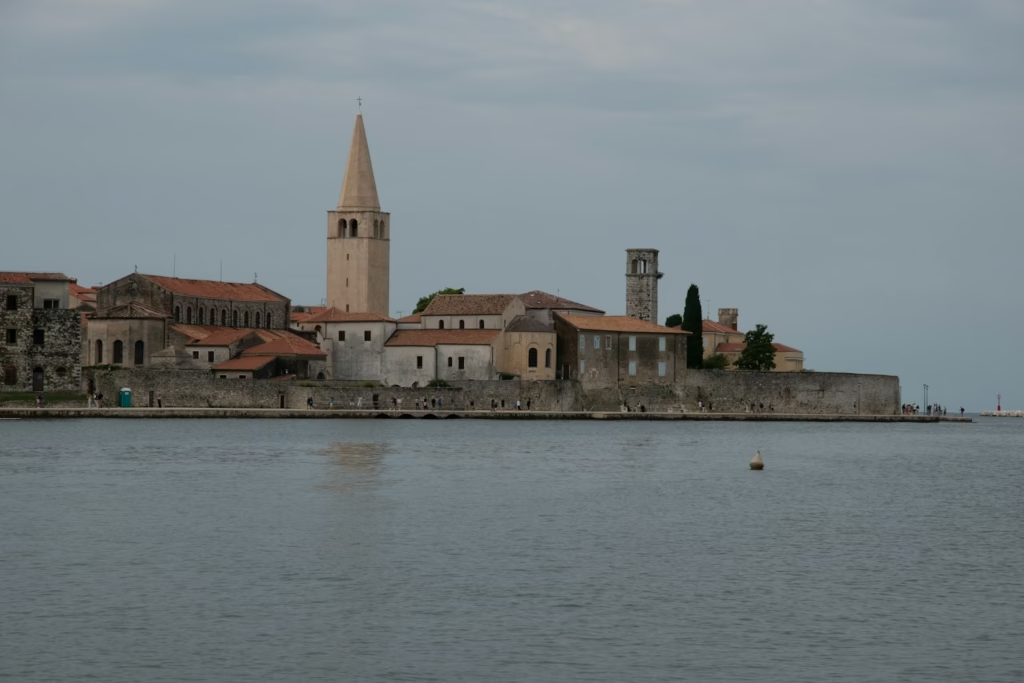
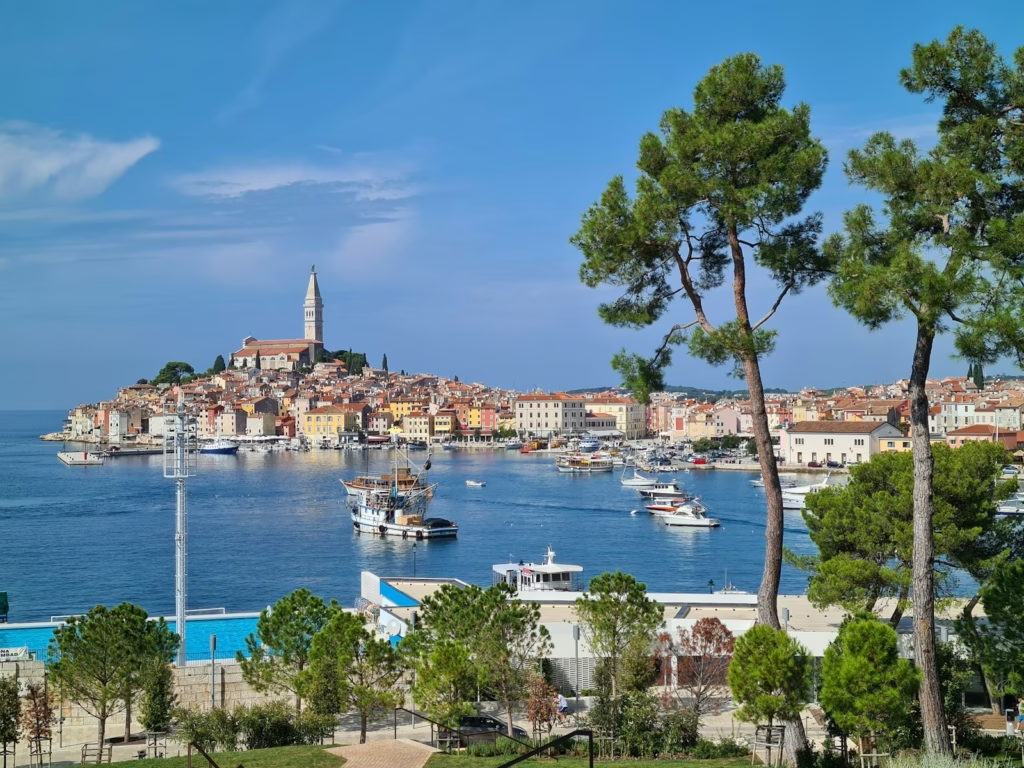
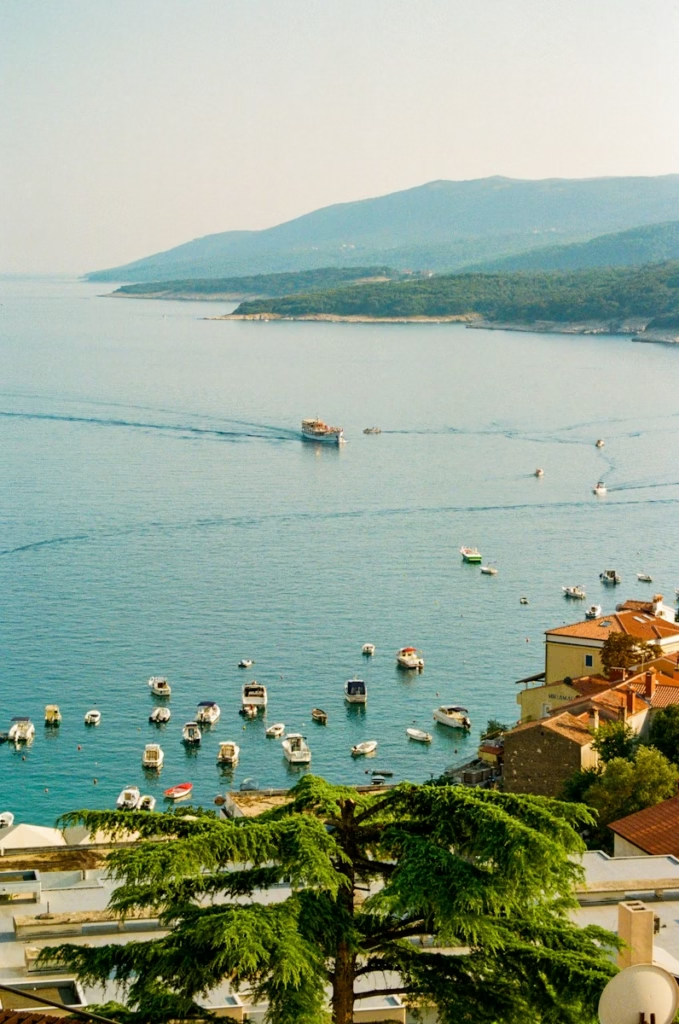
Istria is one of the easier parts of Croatia to turn into a dedicated cycling trip because the peninsula gives you several distinct types of riding without demanding a change of base every day. The western coast around Poreč and Rovinj is rolling rather than mountainous, the interior rises through vineyards and medieval hill towns, and the eastern side becomes sharper as the roads approach the Učka range.

It is also a region where road and gravel riding overlap naturally. The Parenzana, built on the trackbed of the old Trieste-Poreč narrow-gauge railway, is the best-known off-road line through northern Istria, while a dense network of minor asphalt roads makes it straightforward to build road loops around Motovun, Grožnjan, Buje, Pazin and the Mirna valley.

The main planning issue is traffic rather than gradient. Istria’s official cycling guidance specifically warns that coastal roads and some inland roads can become very busy in summer. A good cycling holiday therefore depends on choosing the right base, using quieter alternatives and riding early when the tourist season is at its busiest.

Istria Coastal town with historic buildings and a tall spire

Cycling in Istria at a glance

Best bases: Poreč for the widest choice of routes and cycling services; Rovinj for coast-and-interior loops; Buje or Motovun for quieter hill-country riding; Labin for a more climbing-focused eastern base.

Best time to ride: April to June and September to October. July and August are hotter, busier and less comfortable on exposed roads.

Terrain: rolling coast, repeated short-to-medium inland climbs, hill-town ramps and longer climbing towards eastern Istria. Expect constant elevation change rather than Alpine-length ascents on most western routes.

Bike choice: a normal road bike is ideal for asphalt loops. A gravel bike is the more versatile option if the Parenzana and forest tracks are central to the trip.

Gearing: compact or semi-compact road gearing with at least a 30 or 32-tooth largest sprocket is sensible. Stronger riders may not need it on the coast, but the steep approaches to hill towns make easier gearing worthwhile.

Main caution: summer traffic. Avoid assuming every major coastal road is pleasant simply because it is direct.

Why Poreč works as the simplest first base

Poreč is the practical starting point for a first Istrian cycling trip. It sits on the western coast, has a large accommodation base and is surrounded by roads that let you choose between easy coastal mileage and longer inland loops. The professional Istrian Spring race regularly uses Poreč and nearby towns, while the mass-participation Istria300 starts and finishes there, evidence of how well the road network supports serious riding.

The official Adriatic-Ionian cycling route gives a useful measure of the terrain. Its Plovanija-to-Vrsar stage is 69.4km with 765 metres of climbing, passing Umag, Novigrad and Poreč before continuing south. That is typical of western Istria: rarely flat for long, but manageable enough to accumulate distance without every ride becoming a mountain day.

From Poreč, a road rider can head inland towards Višnjan, Vižinada and the Mirna valley, then choose whether to add the climb towards Motovun. Another option is to ride south through Funtana and Vrsar before turning inland around the Lim Bay. These roads make it easy to build 60-100km days with enough climbing to be interesting without committing to a single major ascent.

Poreč also works well for mixed groups. A rider wanting a hard training day can head inland while a partner looking for a shorter recreational route has plenty of coastal options. That flexibility is harder to find in more purely mountainous destinations.

Istria white and blue boat on sea near green trees and buildings under blue sky during daytime

The Parenzana and the hill towns of northern Istria

The Parenzana is the route that gives Istria much of its cycling identity. The former railway linked Trieste and Poreč from 1902 to 1935. Its old trackbed now forms a cycling route through vineyards, woodland, tunnels and hill-country settlements, with the Croatian section passing places such as Buje, Grožnjan, Oprtalj and Motovun.

A gravel bike is the obvious choice if you want to ride substantial sections of it. The railway origins keep the gradients relatively controlled, but the surface and seasonal condition make wider tyres more comfortable than a conventional road setup. It is possible to use parts of the Parenzana as connectors within a mixed-surface loop rather than treating it as an end-to-end expedition.

Road riders should not ignore the same area. The asphalt approaches to Grožnjan and Motovun deliver exactly the kind of climbing Istria does well: relatively short ascents that become steep enough near the towns to force a proper effort. The Mirna valley provides lower ground between them, so a loop can repeatedly drop into the valley and climb back towards settlements on the ridges.

Motovun is the obvious visual target, but Buje is arguably a more practical base if cycling is the priority. It gives quick access to the Parenzana and the north-western road network without requiring every ride to finish with the same steep climb back into a hill town.

Rovinj, Lim Bay and the quieter roads south

Rovinj is the alternative base for riders who want a stronger holiday feel without giving up good road access. The immediate area is less severe than the northern hill country. Official tourism material describes 15 cycling trails around Rovinj, Bale and Kanfanar, with most rated easier and four moderately difficult. For a road cyclist, the value is the network behind those signed routes rather than the need to follow them exactly.

The Lim Bay is the obvious landmark north of town. The Adriatic-Ionian route’s Vrsar-to-Pula stage covers 86.1km with 1,095 metres of climbing and passes the Lim area before heading through Dvigrad and Kanfanar towards Rovinj. That gives a good template for a substantial road day: coast, inland rolling roads, a historic settlement and enough elevation to make the ride count.

The official route deliberately avoids the extremely steep climb directly out of Lim Bay, using an inland bypass instead. That is a useful reminder that route-planning apps can create technically rideable but unpleasant shortcuts. In Istria, the best road is often the quieter, slightly longer option rather than the most direct line between two coastal points.

Istria a body of water filled with lots of boats

Eastern Istria gives stronger riders more climbing

Riders wanting a harder trip should look east towards Labin and the roads beneath Učka. The landscape is more broken here, with the coast dropping sharply towards the Adriatic and inland roads repeatedly climbing back towards the plateau. Labin makes a useful base because you can create demanding loops without needing the long transfers that would be required from Poreč.

The Adriatic-Ionian route continues from Pula through Labin and on towards Brestova, showing how the eastern side can be incorporated into a longer point-to-point ride. For a conventional holiday, however, loops are easier logistically. A route can combine Labin, Rabac and inland villages, using the repeated climbs rather than chasing one headline summit.

If you want a true mountain day, the Učka area north-east of the peninsula extends the climbing possibilities beyond typical Istrian rollers. It is the place to go when 1,000 metres of ascent no longer feels like enough, but it is not necessary for a satisfying week. Western and central Istria can produce substantial elevation simply through repetition.

Traffic, surfaces and when to ride

Spring and early autumn are the obvious windows. Temperatures are better for long rides, accommodation is easier than at the height of the beach season and traffic is generally less intense. September has the additional advantage of warm sea temperatures if the trip is being shared with non-cycling days, while October can still offer excellent riding conditions around events such as Istria300.

July and August require more discipline. Istria’s official cycling safety material warns that traffic becomes very intense on coastal roads and some inland routes during summer, and it publishes safer alternatives to roads marked as hazardous. Start early, carry more fluid than you think you need and do not use a busy D-road simply because a mapping app considers it efficient.

Road surfaces on minor asphalt routes are generally suitable for a normal road bike, but conditions can vary after winter and on less-used inland lanes. For mixed riding, 35-45mm gravel tyres make the Parenzana and similar tracks far more comfortable. A road rider sticking to asphalt does not need specialist equipment beyond sensible gearing and puncture protection.

Food and water are easy to find around the main towns, but inland loops can create longer gaps between reliable stops. In hot weather, refill before leaving larger settlements. Hill towns make attractive café stops, but they also sit at the top of the climb, so it is worth carrying enough to reach them rather than assuming every village has an open shop.

How to build a three- or five-day Istria cycling trip

For three days, base yourself in Poreč. Use the first ride for a 60-80km coastal and inland loop towards Vrsar and the Lim area. Make day two the harder northern ride towards Vižinada, Motovun and Buje. On day three, either take a gravel bike onto the Parenzana or ride south towards Rovinj and Kanfanar.

With five days, split the trip. Three nights around Poreč or Rovinj give enough time for the western coast and hill towns, then move east to Labin for two more climbing-heavy days. That avoids spending the whole holiday driving across the peninsula while still showing how different eastern Istria feels.

Riders combining Croatia into a longer trip can pair Istria with the Dalmatian Coast around Split and Makarska. The contrast is useful: Istria is better for dense networks of rolling roads and mixed-surface exploration, while Dalmatia brings more exposed coastal riding and the much larger climbing backdrop of Biokovo.

Istria’s strength is choice rather than one famous road. You can ride 70km with moderate climbing from Poreč, spend a day on the Parenzana, chase steep ramps into medieval towns or move east for a much harder climbing loop. Plan around traffic and season rather than simply distance, and the peninsula works as a cycling destination for far longer than a single weekend.

Updated season form guide after GP Montréal 2026

0

The GP Montréal has always been useful as a late-season form check, but the 2026 edition carried far more weight than usual. With the UCI Road World Championships returning to Montréal only a week later, the same roads around Mount Royal gave the leading contenders a competitive rehearsal on terrain they will see again in national colours.

Isaac del Toro came out of it with the clearest result. The Mexican followed Paul Seixas when the Frenchman forced the decisive selection on the final ascent of Camillien-Houde, stayed with him through the run towards the finish and then used the sprint advantage that had made the tactical equation obvious once the pair reached the closing metres together. Del Toro won, Seixas was second, while Brandon McNulty completed the podium 27 seconds later.

The result matters beyond one WorldTour victory. ProCyclingUK’s GP Montréal race report showed how closely the decisive moves mapped onto the roads that will shape the Worlds. It also came two days after Remco Evenepoel’s emphatic GP Québec victory, leaving the Canadian double-header with several different form signals rather than one dominant favourite.

Del Toro has converted promise into repeatable winning form

Del Toro’s Montréal win was not built on surprise. His 2026 season has increasingly shown a rider capable of winning hard races through several different routes: climbing strength, tactical patience and enough speed to finish the job against reduced groups. Montréal brought those qualities together. He did not need to make the first decisive attack because Seixas did that work, but he recognised the move immediately and had the legs to close it.

That distinction matters for the Worlds. Trade-team racing allowed UAE Team Emirates-XRG to use McNulty and Adam Yates around Del Toro, while the Mexican team will have a different depth profile. He cannot assume the same level of control. What Montréal demonstrated, however, is that he does not need a race to be controlled perfectly. If the decisive group is reduced to a handful of riders, he can follow an acceleration rather than manufacture every split himself.

His sprint against Seixas also changes how rivals have to race him. Taking Del Toro to the line after a selective final lap is now a visibly dangerous option. Riders such as Evenepoel and Tom Pidcock may need to make the race harder or earlier if Del Toro is still present, while Seixas learned directly that climbing clear with the Mexican does not necessarily solve the problem.

divI-was-here-to-make-mistakes-–-Paul-Seixas-confident-he-can-improve-after-second-at-GP-de-Montreal-and-return-even-stronger-for-World-ChampionshipsdivPhoto Credit: Getty

Seixas may have produced the most revealing ride

Second place can undersell what Paul Seixas did. The 20-year-old attacked on the final Camillien-Houde climb and was strong enough to separate himself from a group containing riders with far greater experience in major one-day races. Del Toro was the only rider able to bridge, and Seixas continued trying to dislodge him rather than immediately accepting a two-up sprint.

That performance adds another layer to a season in which Seixas has moved from elite prospect to a rider who can influence the biggest races. The World Championships will be longer and tactically less predictable, and national-team dynamics will remove the familiar Decathlon CMA CGM structure. Even so, the physical message from Montréal was difficult to miss. On the central climb of the Worlds circuit, Seixas could make a selection rather than merely survive one.

France therefore has a rider who can be used aggressively even if it does not choose to build the entire race around him. That could be especially valuable if the favourites begin watching one another. A Seixas move cannot now be treated as a speculative attack from a young outsider.

Evenepoel remains dangerous despite the fifth place

Evenepoel’s fifth in Montréal, 35 seconds behind Del Toro, looks less impressive than his Québec victory but should not be read as a collapse in form. Québec showed his ability to sustain a long attacking effort. Montréal showed that the harder circuit can produce a different race, one in which repeated climbing and the timing of the final selection may matter as much as raw solo power.

For Belgium, that is useful information before the Worlds rather than a reason for alarm. Evenepoel still arrives as one of the riders most capable of turning a tactical pause into a race-winning gap. The key question is where he spends that effort. If Del Toro and Seixas are still alongside him late, waiting for the final kilometre is unlikely to be his best route.

The absence of Tadej Pogačar after his Vuelta crash has also altered the hierarchy. Evenepoel no longer has the defending champion absorbing much of the attention. The 2026 World Championships guide sets out a week in which Belgium can reasonably target both the time trial and road race, but Montréal made clear that the road title has several live contenders.

Tour de France 2026 - Étape 7 - Hagetmau / Bordeaux (175,1 km) - Tom PIDCOCK (PINARELLO-Q36.5 PRO CYCLING TEAM)

Pidcock and McNulty leave Montréal with useful evidence

McNulty’s third place reinforced UAE Team Emirates-XRG’s strength on the day, but his individual form deserves attention as well. He finished 27 seconds behind the leading pair and ahead of Quinn Simmons, Evenepoel and Pidcock. The American team can take confidence from having multiple riders capable of surviving deep into a hard race, even if the World Championships will not reproduce UAE’s numerical advantage.

Pidcock’s sixth place was similarly encouraging without being decisive. He finished 36 seconds down and used the race as a direct reconnaissance of the circuit he will tackle again for Great Britain. With Oscar Onley also selected, Britain has climbing depth as well as a leader with proven one-day finishing ability. ProCyclingUK’s Great Britain Worlds preview looks at how those options fit together.

Quinn Simmons, fourth at 30 seconds, is another rider whose Montréal result deserves more attention than a simple placing suggests. The American can race from distance and has the durability for a long championship day. A fourth place against this field strengthens the case for the United States to race proactively rather than waiting for the final circuit.

The Worlds form picture is open, but not vague

The Canadian races have narrowed the form picture without producing one overwhelming favourite. Evenepoel was the strongest rider in Québec. Del Toro won on the actual Montréal circuit. Seixas produced perhaps the sharpest uphill acceleration of the weekend, while McNulty, Simmons and Pidcock all finished close enough to confirm that they belong in the leading group of contenders.

That makes the final week before the road race unusually useful for interpretation. Riders do not need to prove their fitness again in another race. The evidence is already on the same climbs and roads. The main unknown is how national-team tactics reshape what happened under trade-team control.

The Montréal World Championships course guide explains the repeated climbing that will accumulate across the championship distance. GP Montréal suggests the final selection can happen on Camillien-Houde, but the longer Worlds distance creates more room for fatigue and earlier attacks. Del Toro and Seixas now carry the strongest direct evidence from the circuit. Evenepoel carries the clearest proof that he can win from distance. That is a much sharper form hierarchy than existed before the Canadian weekend.
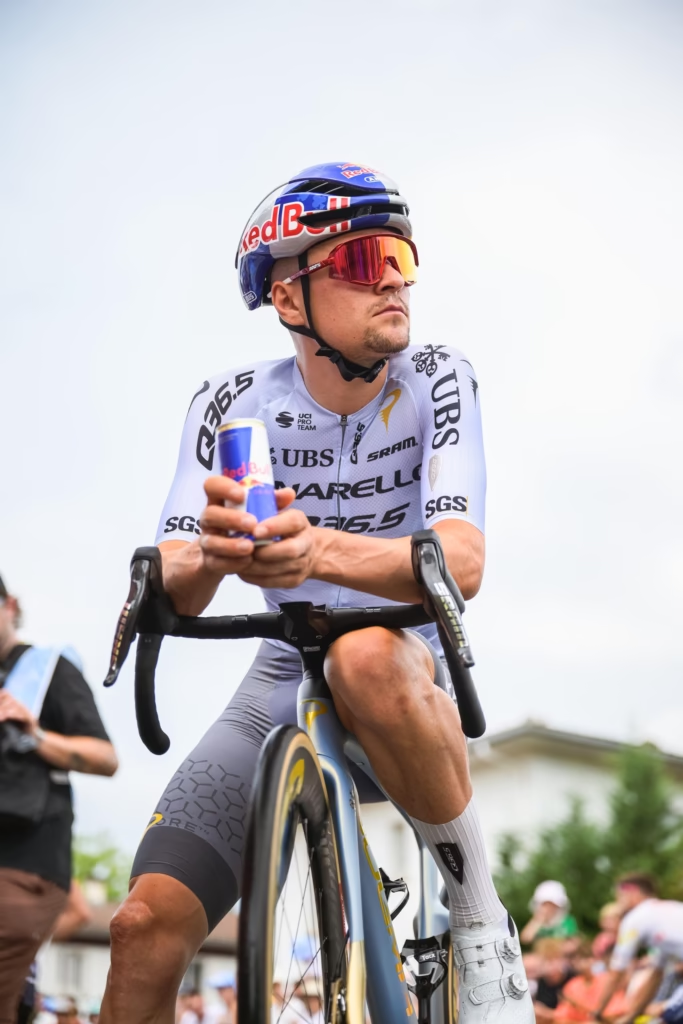
Beginner’s guide to the UCI Road World Championships 2026: Montréal races, schedule, routes and rainbow jerseys

The UCI Road World Championships take place in Montréal from 20-27 September 2026, with 13 world titles decided across eight days of racing.

For one week, the structure of professional cycling changes completely. Riders leave their normal trade teams behind and compete for their countries. Belgium, France, Great Britain, Italy, the Netherlands, Australia, Canada and dozens of other nations assemble temporary squads with one objective: winning a rainbow jersey.
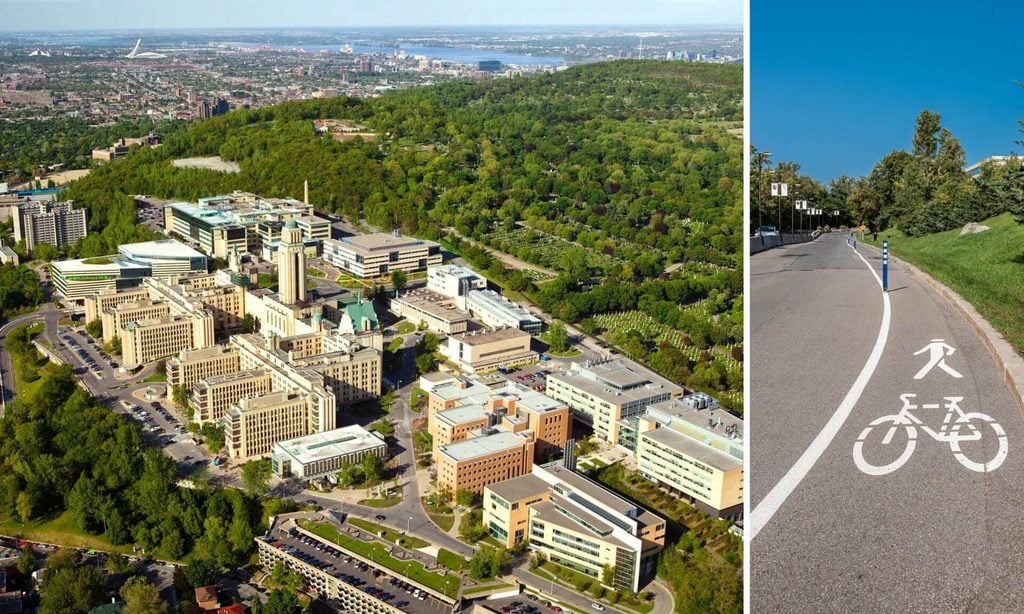
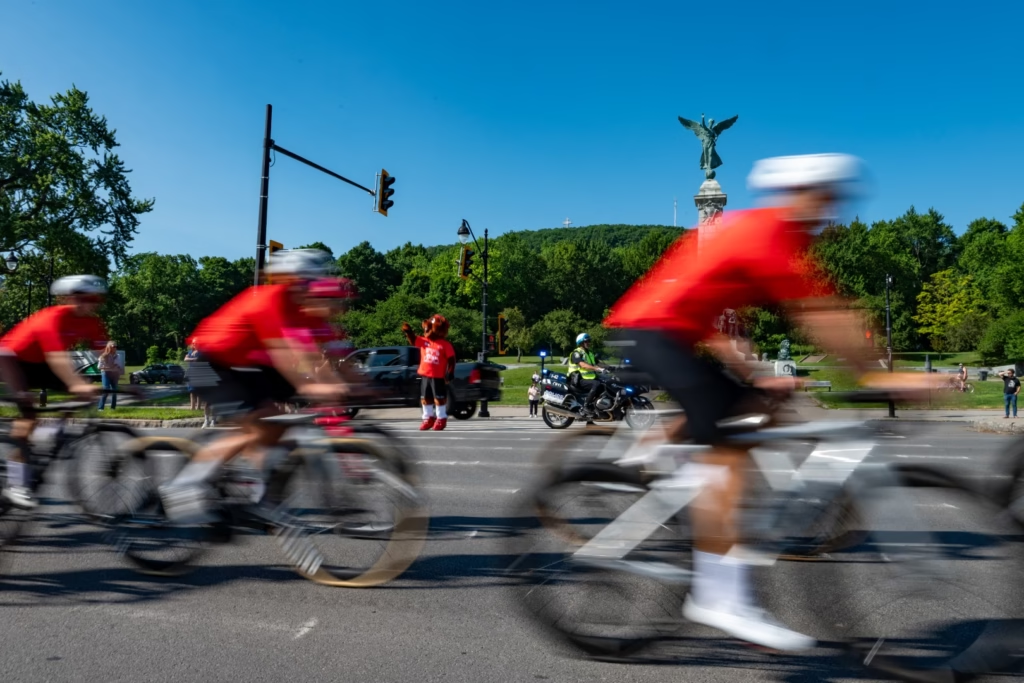
The championships cover individual time trials and road races for elite, under-23 and junior riders, together with the mixed relay team time trial. The elite women’s individual time trial provides the opening title on Sunday 20 September, while the elite men’s road race closes the championships on Sunday 27 September.

Montréal is not a new setting for major championship racing. The city hosted the Road World Championships in 1974, when Eddy Merckx completed his Giro d’Italia, Tour de France and World Championships treble on Mount Royal. Two years later, many of the same roads were used for the 1976 Olympic road race.

Exactly 50 years on from those Olympics, the rainbow jerseys return.

For a detailed look at every course, the 2026 UCI Road World Championships course guide covers the time trials, Mount Royal circuit and all of the key climbs.

2026 Montreal World Championships Road CyclingPhoto Credit: Montreal2026

UCI Road World Championships 2026 at a glance

DetailMontréal 2026
Dates20-27 September 2026
Host cityMontréal, Québec, Canada
Number of title events13
CategoriesElite, Under-23 and Junior
DisciplinesRoad race, individual time trial, mixed relay team time trial
First championshipElite women’s individual time trial
Elite women’s road raceSaturday 26 September
Elite men’s road raceSunday 27 September
Elite ITT distance39.2km for women and men
Elite women’s road race180.4km, 2,570m climbing
Elite men’s road race273.7km, 3,803m climbing
Main road race feature13.4km Mount Royal circuit
UK time differenceMontréal is five hours behind BST

There is no championship race on Wednesday 23 September, which is set aside for road race training and reconnaissance before the mass-start events begin the following day.

What are the UCI Road World Championships?

The Road World Championships are the annual UCI championships for road cycling.

Unlike the Tour de France, Giro d’Italia, Vuelta a España and the major Classics, riders do not compete for their professional teams. A Lidl-Trek rider becomes Belgian, French, Italian or British for the week. Someone who spends the season working for a teammate can suddenly find themselves racing against them.

That changes the tactics considerably.

Professional teams are constructed to race together for an entire season. National teams come together for only a handful of days. Riders use different teammates, different leadership structures and sometimes completely different roles.

A domestique at trade-team level might be the strongest rider their country possesses. A rider accustomed to being protected could instead spend Worlds working for somebody from a rival WorldTour team.

Team sizes are also uneven. Nations qualify places according to the UCI’s quota system, with the strongest countries able to field larger squads than smaller cycling nations. Defending champions can also receive a place outside their country’s standard quota.

That combination makes World Championship road races notoriously difficult to control.

2026 Montreal World Championships Road CyclingPhoto Credit: Montreal2026

What are the 13 races at the 2026 World Championships?

Montréal awards six individual time trial titles, six road race titles and one mixed relay championship.

DateEventDistanceClimbingDefending champion
20 SeptElite women’s individual time trial39.2km220mMarlen Reusser
20 SeptElite men’s individual time trial39.2km220mRemco Evenepoel
21 SeptWomen’s U23 individual time trial20.3km145mZoe Bäckstedt
21 SeptMen’s U23 individual time trial31.3km197mJakob Söderqvist
22 SeptMixed relay team time trial40.6km290mAustralia
22 SeptMen’s junior individual time trial20.3km145mMichiel Mouris
22 SeptWomen’s junior individual time trial10.7km91mMegan Arens
24 SeptWomen’s U23 road race134km2,690mCélia Gery
24 SeptMen’s junior road race134km2,690mHarry Hudson
25 SeptMen’s U23 road race174.2km3,497mLorenzo Mark Finn
25 SeptWomen’s junior road race80.4km1,614mPaula Ostiz
26 SeptElite women’s road race180.4km2,570mMagdeleine Vallières Mill
27 SeptElite men’s road race273.7km3,803mTadej Pogačar

The two elite time trials therefore open the championships, while the two elite road races occupy the final weekend.

For television coverage, streaming links and UK start times for every one of those events, the full World Championships viewing guide covers the entire week.

What is an individual time trial?

The individual time trial is the simplest World Championships discipline to understand.

Each rider starts separately and races against the clock. Drafting behind another competitor is not permitted, so there is no peloton and very little conventional team tactics once a rider is on the course.

The fastest time wins.

Equipment, aerodynamics, pacing, cornering and the ability to sustain a very high power output all become important.

Montréal gives the elite women and elite men exactly the same test: 39.2km with 220 metres of climbing.

That is a major contrast with the road races.

The time trial largely avoids the repeated Mount Royal climbing and instead runs through Montréal towards the St Lawrence River. One of the most distinctive sections takes the riders onto the Circuit Gilles-Villeneuve, home of Formula 1’s Canadian Grand Prix.

The relatively modest elevation should favour genuine time trial specialists.

Marlen Reusser enters as the defending women’s champion after finally taking the individual rainbow jersey in Kigali in 2025. Remco Evenepoel is attempting to win a fourth consecutive elite men’s time trial title.

2026 Montreal World Championships Road CyclingPhoto Credit: Montreal2026

Why does the women’s time trial start the World Championships?

The first rider of Montréal 2026 rolls down the start ramp in the elite women’s time trial at 09:00 local time on Sunday 20 September, or 14:00 BST.

The elite men follow later that afternoon.

Opening Worlds with the elite categories means the championships begin immediately with some of the biggest names of the week rather than building towards them through the junior competitions.

After Sunday, the programme moves through under-23 and junior time trialling before the road races take over during the second half of the week.

How does the mixed relay team time trial work?

The mixed relay is the only event at the Road World Championships where the result comes directly from a team racing against the clock.

Each country fields three men and three women.

The men’s trio starts first and completes its section of the course. The women’s riders then take over, with the combined performance determining the final result.

That means depth is more important than having one exceptional time trial specialist. A nation needs a strong men’s group and a strong women’s group to contend.

Australia are the defending champions after winning in both 2024 and 2025.

The Montréal mixed relay covers 40.6km with 290 metres of climbing and takes place on Tuesday 22 September.

What changed with the women’s under-23 World Championships?

The women’s under-23 category is still relatively new in its current form.

Under-23 world titles were introduced earlier, but for several seasons the classification was taken from riders competing within the elite women’s event. There was no separate race.

That changed in Kigali in 2025.

Women under-23 riders received dedicated road race and individual time trial events for the first time, bringing the women’s programme closer to the structure already used for the men.

Célia Gery became the first winner of the standalone women’s U23 road race.

Zoe Bäckstedt won the first separate U23 women’s time trial and returns to Montréal as defending champion.

What are the junior World Championships?

Junior racing sits below the under-23 category and regularly provides the first international glimpse of riders who will appear in the professional peloton a few years later.

Four junior titles are decided in Montréal.

Megan Arens and Michiel Mouris defend the individual time trial rainbow jerseys, while Paula Ostiz and Britain’s Harry Hudson arrive as the reigning road race champions.

Hudson’s 2025 victory was particularly significant for Great Britain. He spent the final 36km alone in Kigali to become the first British rider to win the men’s junior road race world title.

The junior road races also provide an early opportunity to see the Mount Royal circuit raced seriously before the elite championships at the weekend.

A-touch-of-sportsmanship-–-Why-Tadej-Pogacar-covered-his-rainbow-jersey-before-a-training-ridePhoto Credit: Getty

What is the rainbow jersey?

The rainbow jersey is the prize that makes the World Championships different from almost every other race.

It is white with five horizontal bands in blue, red, black, yellow and green.

A rider who becomes world champion wears it for the following year whenever competing in the discipline and category in which the title was won.

The distinction between disciplines matters.

If Evenepoel wins the individual time trial, for example, he wears the rainbow jersey in time trials. Winning the time trial does not allow him to wear it in ordinary road races.

The road race world champion wears the rainbow jersey throughout the following road season.

Former world champions retain another privilege once their year in the jersey ends. Rainbow bands can be added to the sleeves of their normal team kit for the remainder of their career.

That is why riders such as Mathieu van der Poel, Julian Alaphilippe and Lizzie Deignan remain immediately identifiable as former road world champions even years after holding the title.

How are the road races different from normal professional races?

There are no trade teams.

That single change affects almost everything.

At GP Montréal, UAE Team Emirates-XRG were able to use Adam Yates, Brandon McNulty and Isaac del Toro together. Yates attacked, McNulty covered moves and Del Toro could choose his moment rather than chase every dangerous rider himself.

At the World Championships, those riders represent different countries.

Belgium might have Remco Evenepoel attacking while Wout van Aert waits behind. Britain can send Oscar Onley or Adam Yates up the road while Tom Pidcock remains protected. France have their own interests around Paul Seixas. Mexico cannot rely on UAE teammates to support Del Toro.

There are temporary alliances, but they exist only while two countries want the same thing.

That uncertainty is a fundamental part of World Championships racing.

2026 Montreal World Championships Road CyclingPhoto Credit: Montreal2026

The road races are built around Mount Royal

The defining feature of Montréal 2026 is the 13.4km Mount Royal circuit.

Each lap contains approximately 269 metres of climbing.

The under-23 and junior road races are largely based around repeated laps of the circuit. The two elite events begin outside Montréal in Brossard before travelling through Montérégie and crossing towards the city.

Once they arrive at Mount Royal, the nature of the race changes.

The elite women complete eight circuits.

The elite men complete 12.

The individual climbs are not mountains by Grand Tour standards. The difficulty comes from riding them repeatedly until riders who were comfortable two hours earlier can no longer produce the same effort.

Camillien-Houde is the main sustained climb

Voie Camillien-Houde is the backbone of the circuit.

The hardest recognised section is around 1.8km at 8%, while the broader climb extends further at a lower average gradient.

One passage is manageable.

Eight or 12 are not.

Early in the race, Camillien-Houde will mostly remove weaker riders and force domestiques to work. By the final laps, it becomes somewhere the strongest contenders can attack and genuinely create separation.

The effect was already visible at the 2026 GP Montréal, which used the same redesigned Mount Royal circuit 16 times.

Montreal Chemin de Polytechnique

Côte de la Polytechnique brings the steepest gradients

Camillien-Houde is followed later in the circuit by the Côte de la Polytechnique.

It is much shorter but contains a section above 11%.

That makes positioning important.

A rider starting the climb too far back may have to produce almost the same effort as the attackers simply to move towards the front. Once the group becomes smaller, Polytechnique also offers one of the clearest places for an explosive attack.

Avenue Pagnuelo adds another short rise before the riders begin the run towards the finish.

None of these climbs decides the championship on its own.

Together, repeated lap after lap, they can gradually dismantle the peloton.

Avenue du Parc gives the finish another sting

Any riders still together return towards the line on Avenue du Parc.

The finishing road itself rises at approximately 4%, so this is not a conventional flat sprint.

That widens the range of potential winners.

A climber can try to escape on Mount Royal and stay away. A small group can attack and cooperate. A faster rider can attempt to survive everything and back their sprint.

The strongest candidate is someone capable of climbing repeatedly while retaining enough power to accelerate after several hours of racing.

GP Montréal has already demonstrated how that can work.

Paul Seixas attacked on the final Camillien-Houde ascent on 13 September. Isaac del Toro bridged across, the pair built a decisive advantage and Del Toro eventually beat Seixas on Avenue du Parc.

It was about as useful a competitive course reconnaissance as the Worlds contenders could have asked for.

Elite women’s road race: Saturday 26 September

The elite women race 180.4km with 2,570 metres of climbing.

The opening 72.7km takes the race from Brossard towards Montréal before eight laps around Mount Royal provide more than 2,150 metres of the total elevation.

That concentration of climbing is important.

This is not a race where one major early mountain creates a selection and everyone spends the next two hours trying to stay away. The difficulty increases as the race progresses.

Our elite women’s road race route guide breaks down the complete 180.4km course and explains why the final Mount Royal laps should be so selective.

Magdeleine Vallières Mill starts as defending champion after her breakthrough victory in Kigali.

She also has the rare experience of defending a rainbow jersey at a home World Championships.

2026 Montreal World Championships Road CyclingPhoto Credit: Montreal2026

Elite men’s road race: Sunday 27 September

The men’s championship closes Montréal 2026 with 273.7km and 3,803 metres of climbing.

The first 112.4km comes before the riders enter the finishing circuit.

They then complete Mount Royal 12 times.

That makes the race an endurance contest as much as a climbing one. The eventual champion is likely to have spent close to seven hours racing by the time Avenue du Parc arrives for the final time.

Tadej Pogačar is the defending world champion after winning in Zürich in 2024 and Kigali in 2025, but his 2026 season has been ended by the injuries suffered when he crashed out of the Vuelta a España.

There will therefore be a new men’s road world champion.

Recent racing has provided plenty of clues without producing one obvious answer.

Evenepoel won GP Québec. Del Toro beat Seixas in Montréal. Tom Pidcock finished inside the top six of both Canadian WorldTour races.

Van Aert arrives by a completely different route after three weeks at the Vuelta a España. He won two stages, the green jersey and the overall combativity award, and our Wout van Aert form watch looks at whether those three weeks have built the ideal base for Montréal or left too much fatigue to shed.

Great Britain’s chances in Montréal

Great Britain have several genuine options rather than one rider around whom everything has to be built.

Pidcock has already tested himself on the circuit. Onley arrives from finishing sixth and winning the white jersey at the Vuelta. Adam Yates gives the men’s team another dangerous climber who can attack before the final lap.

The women’s options include Bäckstedt, whose profile has expanded considerably beyond time trialling as she has developed into a stronger road racer.

The Great Britain World Championships team preview looks at how both elite teams can approach the championships.

There is a significant historical angle too.

Britain’s last elite road race world champion was Deignan in Richmond in 2015. Cavendish remains the most recent British men’s winner after Copenhagen in 2011.

The history of Great Britain at the Road World Championships traces those victories back through Nicole Cooke, Mandy Jones, Tom Simpson and Beryl Burton.

Why Montréal matters historically

The World Championships first visited Montréal in 1974.

That alone was significant because it was the first Road World Championships staged outside Europe.

Mount Royal provided the centrepiece.

Merckx arrived having already won the Giro and Tour that year and completed the treble by taking the rainbow jersey ahead of Raymond Poulidor. Geneviève Gambillon won the women’s title.

Two years later, the 1976 Olympics returned championship road racing to the same area. Sweden’s Bernt Johansson won the men’s road race, which was still restricted to amateur riders.

The modern circuit is not an exact copy of either historic route, but the principle is recognisable.

Repeated climbing around Mount Royal gradually removes riders until someone is strong enough to turn the selection into victory.

The history of the Grand Prix Cycliste de Montréal explains how top-level racing subsequently returned to those roads and eventually produced the modern WorldTour race.

In 2026, the story comes full circle.

How to watch the UCI Road World Championships 2026

The elite women’s time trial opens the championships at 14:00 BST on Sunday 20 September.

The elite men’s time trial follows at 17:45 BST.

Both elite road races begin at 14:00 BST on the final weekend, with the women racing on Saturday and the men on Sunday.

UK viewers can follow the championships through TNT Sports and HBO Max, while different free-to-air and streaming options are available internationally.

The World Championships TV and live-stream guide includes the full schedule together with direct viewing options for the UK, USA, Canada, Australia, Spain, Italy, France and Belgium.

ProCyclingUK’s Montréal 2026 coverage

This beginner’s guide is the starting point for ProCyclingUK’s World Championships coverage, with the detailed pages expanding each part of the week as the racing approaches.

The full Montréal course guide covers all 13 events and the differences between the time trial and road routes. The elite women’s route guide goes deeper into the eight-lap Mount Royal finale.

For the men’s course, the GP Montréal route guide provides a climb-by-climb look at the same 13.4km circuit that will be used at Worlds, while the GP Montréal race report shows how those roads behaved when raced at WorldTour intensity.

The Great Britain team preview covers Pidcock, Onley, Bäckstedt and the wider British options, while the Van Aert form analysis follows one of the most important riders arriving directly from the Vuelta.

The first rainbow jersey will be awarded on 20 September.

Seven days later, after 13 championship races, Mount Royal will decide the last one.