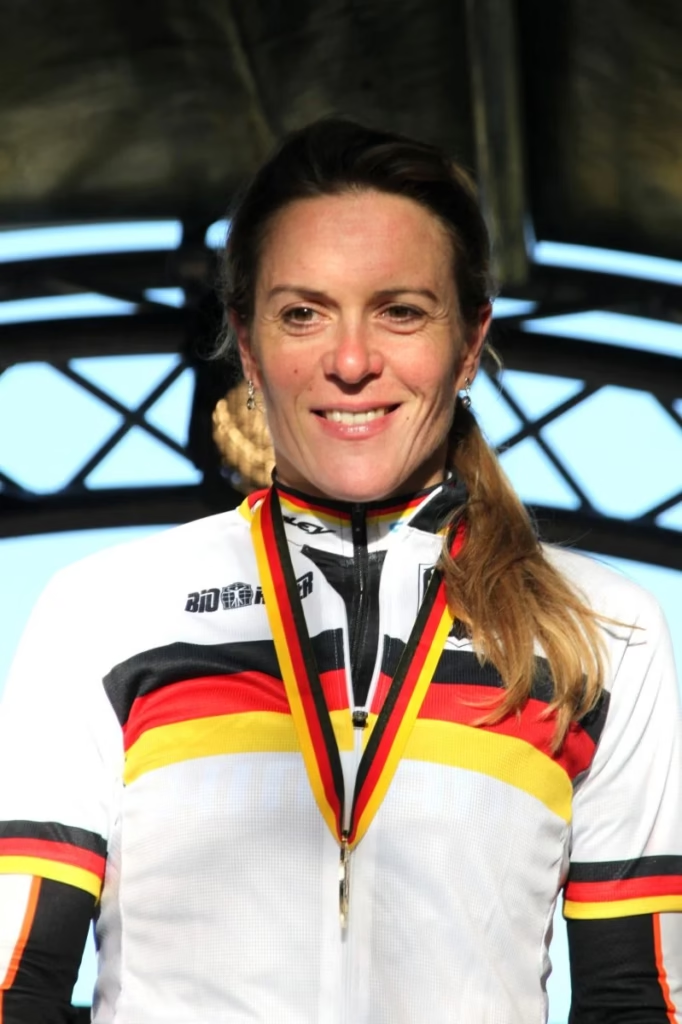
Hanka Kupfernagel was crossing cycling’s disciplinary boundaries decades before doing so became a celebrated part of the modern sport. She was the first women’s elite cyclo-cross world champion, eventually won that rainbow jersey four times, became road time trial world champion in Stuttgart and took Olympic silver in the road race. Around those headline results sat victories in La Flèche Wallonne, the Tour de l’Aude, Emakumeen Bira and Thüringen, along with national titles and competition on the track and mountain bike.
The important point is that these were not disconnected experiments. Kupfernagel was genuinely elite in more than one discipline. Between 2000 and 2010 she stood on the cyclo-cross World Championship podium in 10 of 11 editions, winning in 2000, 2001, 2005 and 2008. In the middle of that run she became the fastest woman in the world against the clock on the road.
That range places her among the most unusual riders in women’s cycling history. Modern cycling has become comfortable celebrating riders who switch between road, cyclo-cross, mountain biking and the track. Kupfernagel came from an era when those disciplines were becoming increasingly specialised and simply kept doing several of them anyway.
She was not proving a point about versatility. She was trying to win.
Gera, not Bad Langensalza, and a career built before reunification
Kupfernagel was born on 19 March 1974 in Gera, in what was then East Germany. She grew up inside the sporting culture of the German Democratic Republic before reunification changed both the country around her and the structures through which young athletes progressed.
Track cycling was important during her development, and she continued competing on the boards even after her road career began to gather momentum. She also raced mountain bikes and became a German champion in the discipline. That variety helps explain why her later success in cyclo-cross never looked like a road rider merely filling the winter. Technical ability, repeated high-intensity efforts and changing surfaces were already part of the athlete she had become.
Kupfernagel’s career therefore developed differently from that of a rider who discovers another discipline after establishing herself professionally.
The disciplines grew together.
Road racing eventually provided some of her biggest international results. Cyclo-cross provided her greatest period of sustained dominance. The track contributed to the engine and pacing ability that later became so important against the clock, while mountain biking reinforced a technical range that winter racing demanded every week.
That mixture was already unusual in the 1990s. It would become Kupfernagel’s defining characteristic.
She was already one of the best road riders in the world before cyclo-cross had a women’s Worlds
It would be easy to look at Kupfernagel’s four cyclo-cross rainbow jerseys and assume the road was secondary.
Her results from the second half of the 1990s say otherwise.
She became German road champion for the first time in 1995 and began collecting major stage-race victories almost immediately. Between 1995 and 2000 she won Gracia-Orlová five times. She took Emakumeen Bira in 1997, 1998 and 1999, won Thüringen in 1999 and finished second at the Tour de l’Aude that same season.
Those were not small results on the edge of a cyclo-cross career.
Emakumeen Bira was one of the major climbing stage races in the women’s calendar. The Tour de l’Aude was among the hardest multi-day races in the sport. Thüringen became one of the central races in German women’s cycling and would later be won repeatedly by riders such as Judith Arndt and Emma Johansson.
Kupfernagel could win them because she had considerably more than short explosive power. Her time trialling was already excellent, and she repeatedly used races against the clock to strengthen her GC position. She could also withstand enough climbing to remain competitive through a hard week.
The scale of that road ability became impossible to ignore at the 1998 World Championships in Valkenburg.
Kupfernagel won bronze in both the road race and individual time trial.
Two medals, two very different tests.
That was becoming a familiar pattern.
Winning La Flèche Wallonne showed she was more than a time triallist
One of Kupfernagel’s best road victories came on the Mur de Huy in 1999.
The women’s La Flèche Wallonne was only in its second edition. Fabiana Luperini had won the inaugural race a year earlier, immediately giving the new event credibility as a major contest for climbers and puncheurs.
Kupfernagel won the second.
She finished 13 seconds ahead of Edita Pučinskaitė, with Cindy Pieters third and Luperini fourth. Kupfernagel did not simply survive until a sprint on the Mur. She created clear separation from a group containing some of the strongest road riders of the period.
The result matters when assessing her road career because it sits outside the categories most readily associated with her.
This was not a time trial.
It was not a stage race where consistency could gradually compensate for a lack of explosiveness.
It was one of the hardest uphill one-day finishes in women’s racing, and Kupfernagel won outright.
Five years later she came back and finished second at Flèche behind Sonia Huguet, further evidence that the 1999 result was not simply the right day on the right course.
The Tour de l’Aude completed an extraordinary 2000 road season
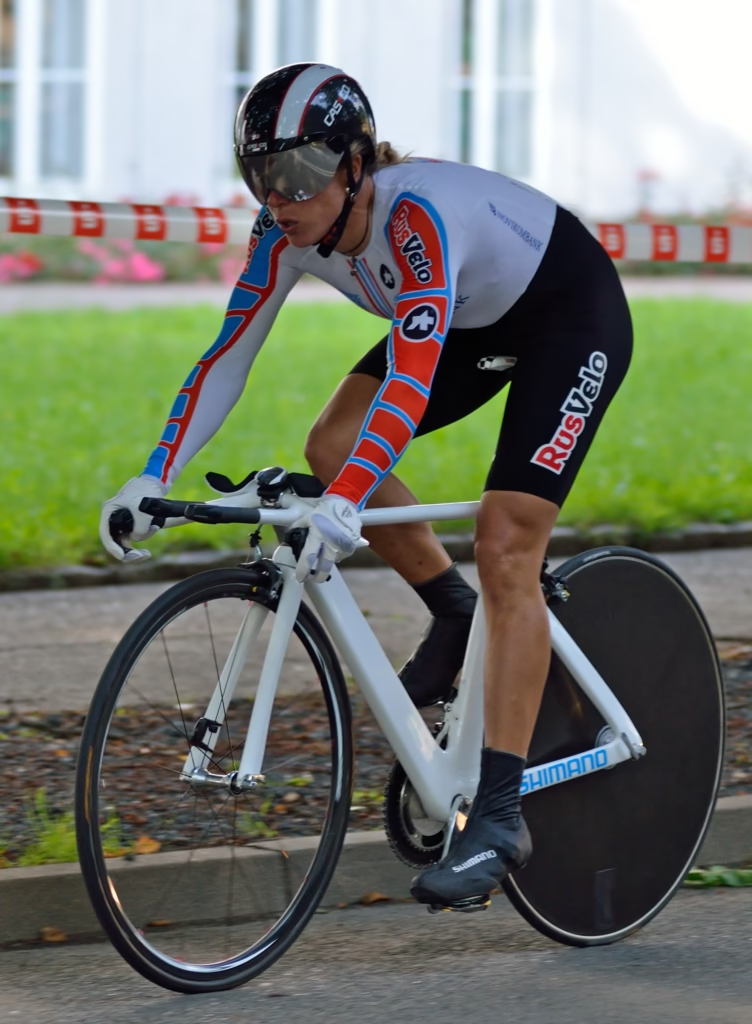
Kupfernagel had been second at the Tour de l’Aude in 1999 after winning the prologue, a road stage and the individual time trial.
She returned in 2000 and won the race.
The final classification placed her 1:26 ahead of her Radteam Kupfernagel team-mate Lada Kozlíková, with Zulfiya Zabirova third at 1:48. Kupfernagel again won the prologue and individual time trial during the race.
It was another demonstration of how valuable her range became across several days.
The Tour de l’Aude could not be reduced to one summit finish or one race against the clock. It required positioning, recovery and an ability to avoid losing the race when the terrain did not perfectly suit. Kupfernagel had all of those things.
Her stage-racing record by that point was already exceptional: three consecutive Emakumeen Bira victories, five Gracia-Orlová titles, Thüringen and now the Tour de l’Aude.
Then she went to Sydney.
Olympic silver came in a sprint against Leontien van Moorsel
The Sydney 2000 Olympic road race presented a completely different problem.
The 119.7km course was flat enough that repeated attempts to split the race failed to create a lasting selection. The medals eventually came down to a bunch sprint in wet conditions.
Leontien Zijlaard-van Moorsel won.
Kupfernagel finished second.
Diana Žiliūtė took bronze.
For Kupfernagel, silver was another result that refuses to fit into one tidy definition of the rider.
A woman who had won the Tour de l’Aude, Emakumeen Bira and Flèche Wallonne was now sprinting for Olympic gold from a large group.
The result places her on ProCyclingUK’s list of women’s Olympic road race medallists between two especially important generations. Jeannie Longo had won in 1996, while Nicole Cooke and Marianne Vos would later become Olympic champions as women’s road racing developed through the following decade.
Kupfernagel did not win in Sydney, but second place was one of the clearest demonstrations of how difficult she was to categorise.
The first women’s cyclo-cross rainbow jersey belonged to Kupfernagel
Cyclo-cross had held a men’s World Championship since 1950, but women did not receive an elite world title until 2000.
Kupfernagel won it.
The inaugural championship was held at Sint-Michielsgestel in the Netherlands, making her the first woman ever to wear the elite cyclo-cross rainbow jersey.
Then she defended it.
Kupfernagel won again at Tábor in 2001 before taking silver in 2002 and 2003 and bronze in 2004. She returned to the top step at St Wendel in 2005, collected another silver in 2006 and then won her fourth world title at Treviso in 2008. Silver medals followed in both 2009 and 2010.
The sequence is extraordinary when written out.
From the first women’s championship in 2000 through to 2010, Kupfernagel missed the podium only once, when she finished fifth in 2007.
Four golds.
Five silvers.
One bronze.
It meant that the formative first decade of elite women’s cyclo-cross Worlds was inseparable from one German rider.
Marianne Vos would eventually take the discipline into another level of statistical dominance, but Kupfernagel established the first benchmark.
She won cyclo-cross races through far more than physical strength
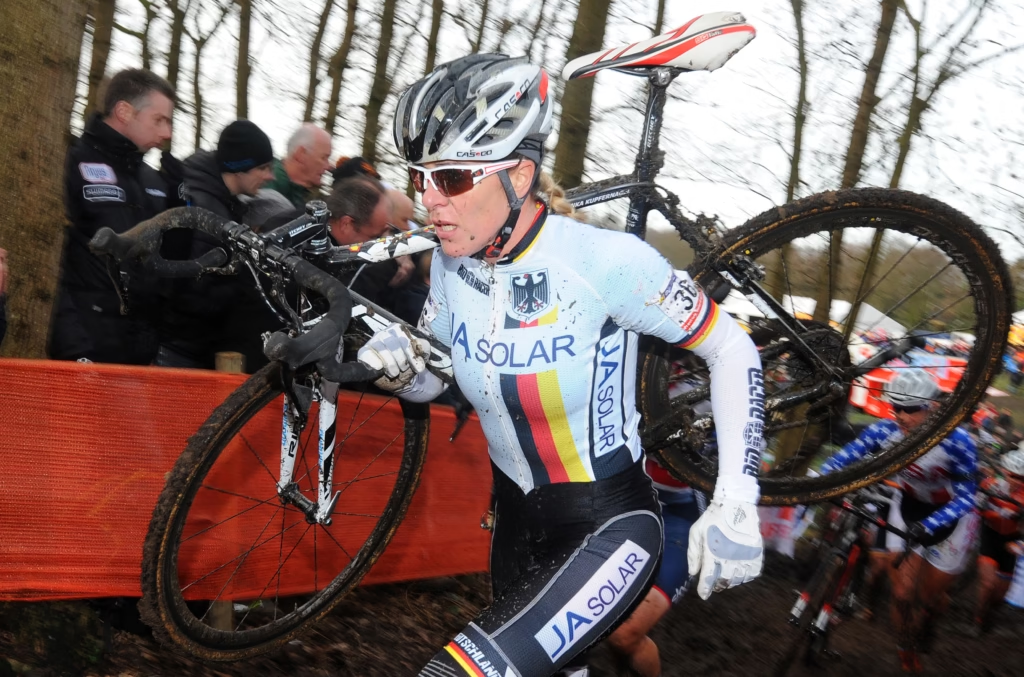
Cyclo-cross made particularly good use of Kupfernagel’s combination of abilities.
She could produce the repeated accelerations required out of corners, but endurance meant she could continue doing it when a race became heavy. Track and time-trial experience gave her an instinct for pacing. Mountain biking contributed technical confidence when the fastest line was not necessarily the cleanest one.
Then there was experience.
A muddy cyclo-cross race becomes more complicated as fatigue increases. Riders begin braking slightly too late, choosing poor lines or spending too much energy recovering from small errors. Kupfernagel was capable of making fewer of those mistakes while maintaining pressure.
That difference accumulated.
She did not have to produce one huge attack if every lap was already costing her rivals a little more.
Her record at the championships was reinforced by three European titles and a long run of German championships. Cyclocross24 records 11 elite German titles between 2001 and 2014, alongside victories across the European World Cup calendar.
For much of that period, a women’s cyclo-cross championship without Kupfernagel somewhere near the front was the unusual result.
Stuttgart 2007 gave her a second kind of rainbow jersey
Perhaps the most revealing victory of Kupfernagel’s entire career came away from the mud.
The 2007 Road World Championships were held in Stuttgart, giving Germany a home championship. Kupfernagel entered the individual time trial having already won the German title against the clock that season.
She left as world champion.
That victory inserted her name into a list dominated around that period by some of the great specialists of women’s cycling. Kristin Armstrong had won in 2006. Amber Neben succeeded Kupfernagel in 2008, while Emma Pooley, Judith Arndt and Ellen van Dijk would all wear the rainbow jersey over the following five seasons.
ProCyclingUK’s list of cycling world champions records Kupfernagel as the 2007 elite women’s time trial champion.
The timing makes the achievement particularly striking.
Kupfernagel had first become cyclo-cross world champion seven years earlier. She had already been a World Championship road race medallist, Olympic silver medallist, major stage-race winner and Classics winner.
Then, at 33, she added another discipline’s world title.
It was not versatility based on being reasonably good at many things. She had become the best in the world at two markedly different versions of cycling.
She also had the national titles to support the international results
The German championships provide another measure of Kupfernagel’s road consistency.
She won the elite road race five times, in 1995, 1997, 1998, 1999 and 2000. Against the clock, she took six national titles, including victories in 1995, 1996, 2000, 2002, 2007 and 2008.
The clustering of the road titles in the late 1990s coincided with an especially strong period for German women’s cycling.
Petra Rossner had become Olympic and track world champion before developing into one of the most prolific road sprinters of the era. Judith Arndt emerged as an elite stage racer, time triallist and Classics rider. Ina-Yoko Teutenberg developed into another outstanding sprinter, while Trixi Worrack followed as a younger all-rounder capable of remaining at the top of the sport for almost two decades.
Kupfernagel was different from all of them.
She was simultaneously one of Germany’s strongest road riders and the central figure in the early history of women’s elite cyclo-cross.
Germany did not have one outstanding female rider during that era. It had a group whose strengths overlapped just enough to make the national picture unusually deep.
Nürnberger was part of the career, but it did not define it
Kupfernagel is sometimes placed too neatly within the great German trade teams of the period.
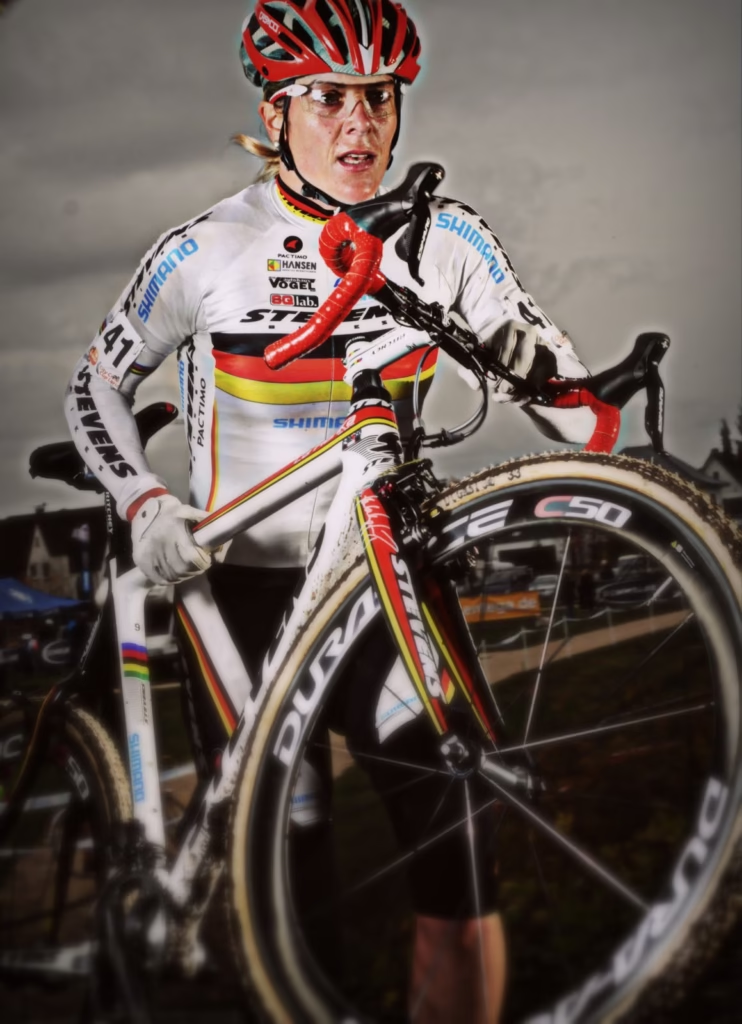
She did ride for Equipe Nürnberger Versicherung, but only during part of her road career, in 2002 and 2003. Much of her most dominant road period came earlier with The Greenery-Hawk Team and then the independently created Radteam Kupfernagel. In 2001 she raced for Farm Frites-Hartol before joining Nürnberger, with Vlaanderen teams following afterwards.
That distinction matters because Kupfernagel’s career was unusually self-contained.
In 2000 she raced for a team bearing her own name, Radteam Kupfernagel, managed by Torsten Wittig-Kupfernagel. The squad also included Dutch cyclo-cross champion Daphny van den Brand.
Nürnberger nevertheless places her within the wider development of German professional women’s cycling. The history of Equipe Nürnberger Versicherung shows how the squad brought together riders such as Rossner, Arndt, Worrack, Regina Schleicher and later Lisa Brennauer during a decade in which Germany repeatedly produced world-class women.
Kupfernagel’s brief period there adds another major name to that story, but her identity was never tied to one road team.
The constant was Kupfernagel herself.
Her road results survived long after her first dominant period
Another easy mistake is to treat the early 2000s as the end of Kupfernagel’s serious road career.
It was not.
The 2007 world time trial title is the obvious evidence, but there were other results deep into her thirties. She won the Sparkassen Giro in the same season and continued producing strong performances against the clock.
Even in 2012, aged 38, she finished second overall at the Tour de Free State and second at the Vårgårda World Cup road race. She also won the prologue at Thüringen that year.
That longevity paralleled what was happening in cyclo-cross.
Kupfernagel’s fourth world title came in 2008. She was still second at the Worlds in 2010, fourth in 2011 and continued collecting German titles.
The career did not progress cleanly from road rider to cyclo-cross specialist or from one peak into gradual retirement. Different disciplines moved to the foreground at different times.
That was precisely what made it unusual.
Modern multi-discipline stars make Kupfernagel’s career easier to understand
Cycling now has a much more familiar language for riders who refuse to specialise.
Marianne Vos became world champion on the road, track and in cyclo-cross. Pauline Ferrand-Prévot won world titles across road, cyclo-cross, mountain biking and gravel. Mathieu van der Poel and Tom Pidcock built major road careers alongside off-road world titles. Fem van Empel, Puck Pieterse and others have continued moving between disciplines at the highest level.
There is now an entire performance logic around doing it.
Different disciplines can refresh training, develop handling skills and offer competitive intensity without simply repeating the road calendar. Teams, coaches and sponsors understand the value.
Kupfernagel was doing much of that before the concept had been packaged so neatly.
She competed in track World Cups.
She won German mountain-bike titles.
She dominated cyclo-cross.
She became one of the strongest stage racers of the late 1990s and early 2000s.
She won an Ardennes Classic.
She took Olympic road silver.
She became world time trial champion.
That breadth belongs naturally within ProCyclingUK’s wider women’s rider history collection, because Kupfernagel demonstrates that the modern all-discipline rider has much older precedents.
Even retirement did not quite end the cyclo-cross story
Kupfernagel eventually brought her elite career to an end in 2016, more than two decades after her first major road results.
Even then, there was one more reminder of how deeply cyclo-cross remained attached to her.
After more than three years away from serious competition, Kupfernagel returned for the German cyclo-cross championships in January 2019.
She was 44.
She finished second.
It was not the beginning of a full professional comeback, but it hardly needed to be. The result fitted the rest of the career perfectly. A rider who had won the first women’s cyclo-cross world title almost two decades earlier could still return to a national championship and reach the podium.
By then the discipline had changed enormously. Women’s cyclo-cross had a full international calendar, established World Cups and generations of riders who had grown up knowing that there was a rainbow jersey available to them.
Kupfernagel had been there when there wasn’t.
Then she won the first one.
A career that makes more sense now than it did then
Kupfernagel’s results are impressive individually. Four cyclo-cross world titles would have been enough for a major career. So would an Olympic road medal and a time trial rainbow jersey. Winning the Tour de l’Aude, Emakumeen Bira, Thüringen and La Flèche Wallonne gives her a substantial road palmarès even before the other disciplines are considered.
Put together, they describe something rarer.
She was a genuine multi-discipline champion at a time when cycling increasingly encouraged riders to decide what sort of cyclist they were.
Kupfernagel never really did.
On some weekends she was the best cyclo-cross rider in the world. At other points she was winning stage races, attacking the Mur de Huy or racing for Olympic gold. Years later, when most of her contemporaries had settled firmly into their specialities, she became world champion against the clock.
That is why her career looks particularly modern when viewed from 2026.
Cycling eventually became enthusiastic about the idea of riders crossing disciplines and taking skills from one into another.
Hanka Kupfernagel had already spent a career showing exactly what that could look like.