
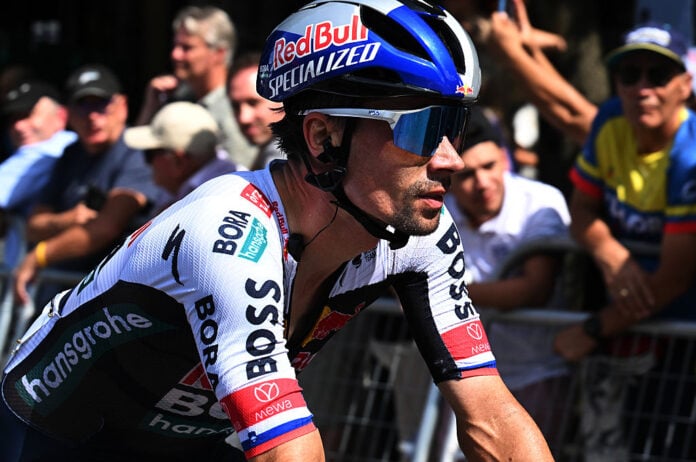
Primož Roglič at the 2026 Tour de France is a complicated idea before the race even starts. On pure ability, his name still belongs in any serious Grand Tour conversation. On team structure, age profile and recent direction, his place is far less straightforward. Red Bull-BORA-hansgrohe now have a wider leadership picture, with Remco Evenepoel and Florian Lipowitz increasingly central to their Tour de France plans, while Roglič’s own 2026 programme has not been built around July in the same way as in his peak years.
That does not make him irrelevant. It makes him more interesting. Roglič is no longer the obvious Tour captain who automatically arrives with a team built entirely around him. He is a multiple Grand Tour winner, an Olympic time-trial champion, a rider with three Tour de France stage wins and one of the sharpest finishing instincts of his generation. He is also 36, with a recent history of crashes, a quieter 2026 by his own standards and a team that may need to decide whether his best use is leadership, shared leadership, protection, or a Vuelta-focused programme instead.
The 2026 route only sharpens that question. The Tour starts with a team time-trial in Barcelona, moves quickly into the Pyrenees, uses the Massif Central and Vosges and Jura to keep the race uncomfortable, then ends with a major Alpine block including Orcières-Merlette and back-to-back Alpe d’Huez finishes. There is also a stage 16 individual time-trial, which should suit Roglič on paper, but the whole race asks for repeat climbing depth, recovery and resilience across three hard weeks.
So the question is not simply whether Roglič can still ride a strong Tour. The question is whether the 2026 Tour gives him the right environment to lead, or whether it exposes the reasons Red Bull-BORA-hansgrohe may be moving towards a different hierarchy.
For route context, see our Tour de France 2026 full route guide, Tour de France 2026 route analysis, Tour de France 2026 GC favourites ranked and Tour de France 2026 dark horses for the general classification.
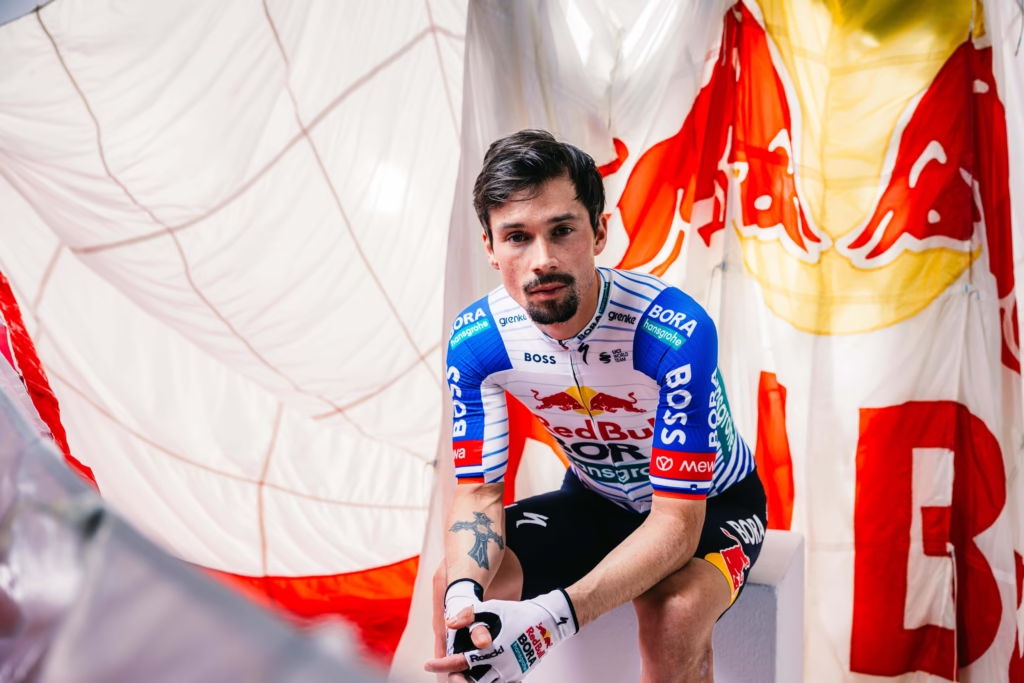
Roglič is no longer the automatic Tour leader
A few years ago, Roglič entering the Tour de France meant leadership by default. That is no longer the case.
The shift is not only about his age. It is about team structure. Red Bull-BORA-hansgrohe have been building a broader Grand Tour core, with Evenepoel’s Tour case changing the leadership equation and Lipowitz emerging as a serious stage-race option in his own right. That makes Roglič’s role more conditional than it once was.
If he starts the 2026 Tour, he is unlikely to do so in the old Jumbo-Visma-style framework where everything bends around him. He would either be part of a shared leadership plan or a protected secondary option. That can work, but only if everyone is clear before the race begins. A team time-trial on stage 1, an early Pyrenean summit finish and a brutal final week leave little room for blurred leadership.
For Red Bull-BORA-hansgrohe, the decision is strategic. Roglič still brings tactical intelligence, finishing punch, time-trial quality and huge experience. But the team also needs a leader who can absorb the whole route, recover repeatedly and still be climbing at the highest level on stages 18, 19 and 20. If they believe Evenepoel or Lipowitz gives them a clearer long-term Tour route, Roglič’s place becomes less about status and more about function.
That is the big change. Roglič’s palmarès still demands respect. His 2026 Tour role, if he rides, has to be earned within a team that now has other directions available.
For more on the main GC structure around the race, see our Tour de France 2026 domestiques who could decide the race, best time-triallists at the Tour de France 2026 and Tour de France 2026 route: best days for GC attacks.
Age changes the question, not the respect
Roglič will be 36 during the 2026 Tour de France and will turn 37 later in the year. That is old for a Grand Tour contender, especially in the current era, where Tadej Pogačar, Jonas Vingegaard, Remco Evenepoel, Florian Lipowitz and others have shifted the pace and repeatability required at the top of three-week racing.
But age alone is not the whole point. Roglič has never been a conventional rider. He arrived at the top level late after his ski-jumping career, developed rapidly, then built one of the most efficient Grand Tour records of his generation. His career has always had a slightly different clock.
The issue in 2026 is not whether a 36-year-old can still be strong. Roglič can still be strong. The issue is whether he can sustain the exact level needed to beat or even seriously pressure the current Tour favourites across the full route. The 2026 Tour does not offer a single climb-and-time-trial formula. It requires sharpness from stage 1, control through the Pyrenees, resilience through the Massif Central, patience through the Vosges and Jura, a strong stage 16 time-trial and then a final Alpine block that could punish any fading legs brutally.
That is where age becomes more than a number. Recovery becomes harder. Crashes take longer to overcome. Repeated accelerations hurt more. A rider may still produce a world-class day, but the Tour asks for three weeks of them.
Roglič’s age should not be used lazily against him, but it does change what a realistic Tour target looks like. Winning yellow would require not only form, but a race that opens in exactly the right way for him. A podium or top-five challenge may be more realistic if he starts as protected support or a secondary GC card.
For the broader hierarchy, see our Tadej Pogačar at the Tour de France 2026, Jonas Vingegaard at the Tour de France 2026 and Tour de France 2026 young riders to watch.
 Photo Credit: Getty
The Barcelona team time-trial is a good start for him
Stage 1 in Barcelona is a 19.7km team time-trial, and that should suit Roglič if Red Bull-BORA-hansgrohe arrive with a strong, disciplined unit.
On paper, this is one of the more favourable openings for him. Roglič has always been excellent against the clock, and even though this is a team test rather than an individual one, the demands still match his strengths: pacing, position, power, technical control and the ability to handle a high-pressure first day.
The format also helps a team with multiple GC riders. If Red Bull-BORA-hansgrohe line up with Evenepoel, Lipowitz and Roglič, the team time-trial gives them a collective target before leadership begins to separate. A strong opening ride could put the whole team ahead of rivals. A poor one could immediately force awkward internal decisions.
For Roglič personally, stage 1 would be a useful way into the race. He does not need to attack. He does not need to expose himself. He can help drive a team performance and start the race in a controlled environment. At this stage of his career, that matters.
The risk is the finish on Montjuïc. The final rising section means the team time-trial is not just about raw flat power. Teams have to manage their pacing carefully and avoid losing cohesion late. Roglič would be valuable there because he understands how to measure an effort, but the team still needs enough depth around him.
For more on the opening weekend, see our Tour de France 2026 Grand Départ guide, how to visit the Tour de France 2026 Grand Départ in Barcelona, Tour de France 2026 team time-trial explained and how the stage 1 team time-trial could change the Tour de France 2026.
The early Pyrenees are a warning
The 2026 Tour does not give older GC riders much time to settle. After the Barcelona weekend, the race reaches the Pyrenees early, with the stage 3 mountain finish at Les Angles and stage 6 to Gavarnie-Gèdre both creating immediate climbing pressure.
That is not ideal for Roglič if he is arriving short of race sharpness. He has often been at his best when he can use control, positioning and calculated acceleration rather than being dragged into long, repeated high-mountain stress from the opening days. The 2026 route asks GC riders to be ready almost immediately.
Stage 3 to Les Angles will be the first real indicator. It is unlikely to decide the Tour, but it can show who has come in slightly undercooked. If Roglič loses time there, the narrative changes quickly. If he stays close, it proves he has enough early climbing condition to remain part of the GC structure.
Stage 6 to Gavarnie-Gèdre is more serious. The Pyrenean profile gives the climbers a clear chance before the first week is even complete. For Roglič, this is where the balance between experience and age becomes visible. He can read a race as well as almost anyone, but he cannot afford to be missing the final few per cent on a route this hard.
If he is riding as a co-leader, the Pyrenees will test whether that is credible. If he is riding in support of Evenepoel or Lipowitz, this may be where his value becomes tactical rather than personal.
For the full mountain context, see our Tour de France 2026 Pyrenees guide, Tour de France 2026 mountain stages ranked by difficulty and Tour de France 2026 summit finishes full guide.
 Photo Credit: Getty
The Massif Central could suit his experience
The Massif Central block looks more useful for Roglič than the early Pyrenees.
Stage 9 to Ussel and stage 10 to Le Lioran are awkward, rolling, repeated-effort stages rather than pure high-mountain showdowns. That kind of terrain has often suited Roglič’s instincts. He is excellent at reading positioning, following the right wheels, using short climbs, and making rivals pay for tactical mistakes.
Stage 9 may be more about breakaways than GC, but it is still a day where a leader can lose control. Stage 10 to Le Lioran, coming after the first rest day, is more dangerous. Rest-day legs can be unpredictable, and the Massif Central rarely lets the peloton find an easy rhythm.
If Roglič is still close on GC, Le Lioran could be a place to test rather than defend. He does not need a long-range attack. He can use the final climbs to see who is vulnerable, especially if the race becomes selective but not fully explosive. If he is riding as support, his value could be even clearer: he can help steady the team through a stage that often punishes inexperience.
This is the sort of terrain where Roglič’s age may matter less than his intelligence. A younger rider can have more raw climbing firepower, but the Massif Central is often about knowing when to spend and when to wait.
For the route detail, see our Tour de France 2026 Massif Central guide, Tour de France 2026 breakaway stages ranked and where the Tour de France 2026 can be won before the Alps.
The stage 16 time-trial helps the case for Roglič
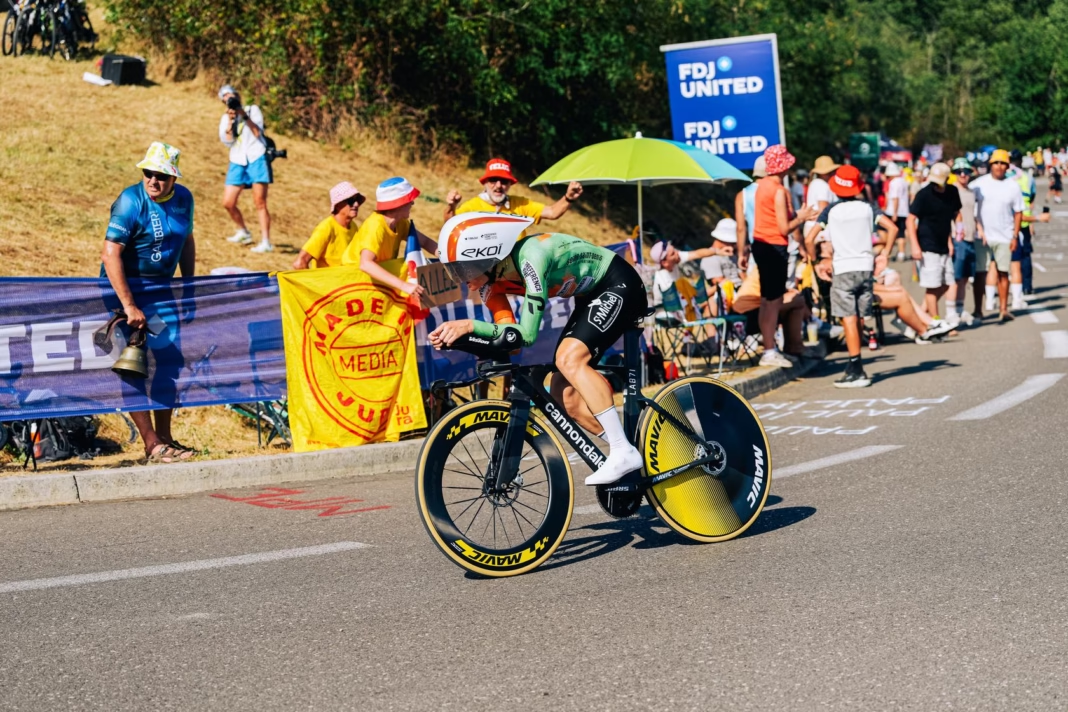
Stage 16 from Évian-les-Bains to Thonon-les-Bains is a 26.1km individual time-trial, and it is one of the clearest route positives for Roglič.
Even at this stage of his career, Roglič remains a rider whose GC credibility improves when a Grand Tour includes a meaningful time-trial. His Olympic gold in the discipline, his Grand Tour history and his pacing quality all point to a rider who can still use a stage like this better than many climbers.
The timing is important. Stage 16 comes after the Vosges and Jura block and before the final Alpine sequence. It is not a prologue-style test. It is a late-race time-trial, where recovery, condition and mental control matter as much as pure power.
That should suit Roglič if he is still in the race physically and mentally. A late time-trial gives him a way to gain time without needing to attack repeatedly in the mountains. It also makes him a more useful team option if Red Bull-BORA-hansgrohe have multiple riders inside the top 10. A strong Roglič on stage 16 can force rivals to calculate differently before Orcières-Merlette and Alpe d’Huez.
The concern is whether he reaches that stage still close enough. The time-trial can help him, but it cannot rescue a race that has already gone badly in the Pyrenees, Massif Central or Vosges. It is a weapon, not a guarantee.
For more on this part of the route, see our best time-triallists at the Tour de France 2026, Tour de France 2026 route analysis and Tour de France 2026 route: best days for GC attacks.
 Photo Credit: Getty
The final Alps are the hardest part of the argument
The biggest problem for Roglič is the final Alpine block.
Stage 18 finishes at Orcières-Merlette. Stage 19 goes to Alpe d’Huez. Stage 20 returns to Alpe d’Huez via Croix de Fer, Télégraphe, Galibier and Sarenne. This is where the 2026 Tour becomes brutally simple. Either a rider still has elite high-mountain strength, or the race exposes them.
For Roglič, this is the hardest part of the route fit. His best Grand Tour performances have often come from control, timing, short accelerations, time-trial strength and tactical efficiency. The final Alps may demand something harsher: repeated high-mountain climbing across consecutive days, after two and a half weeks of racing.
That does not mean he cannot survive it. Roglič has won Grand Tours and has climbed with the best often enough for that not to be questioned lightly. But winning the 2026 Tour would likely require him to be close to his best on the toughest days of the final week. At 36, with the team’s Tour leadership possibly pointing elsewhere, that is a lot to ask.
The back-to-back Alpe d’Huez stages are especially difficult. Stage 19 may already create damage. Stage 20 is the queen stage, with Galibier, Sarenne and Alpe d’Huez coming after the race has already been shredded. If Roglič is trying to defend a podium, it will be one of the toughest tests of his late-career resilience. If he is riding as a support rider, it may be a day where his role becomes about managing team tactics rather than saving his own result.
For the final week, see our Tour de France 2026 Alps guide, Tour de France 2026 queen stage guide, why back-to-back Alpe d’Huez finishes could define the Tour de France 2026 and Tour de France 2026 climbs guide.
Leadership with Evenepoel and Lipowitz is the central problem
The leadership issue may be more decisive than the route.
If Evenepoel starts the Tour as Red Bull-BORA-hansgrohe’s main leader, Roglič cannot simply ride his own race without consequences. The team would need to protect Evenepoel through the team time-trial, the early mountains, the stage 16 time-trial and the Alps. Adding Roglič as a second leader only works if he is strong enough to justify the resources.
Lipowitz adds another layer. He is younger, improving and increasingly credible in stage races. If the team sees him as part of its Tour future, then Roglič’s role becomes even harder to define. Does he lead? Does he co-lead? Does he mentor? Does he ride for stage wins? Does he stay away from the Tour and focus on the Vuelta?
This is where age and team planning meet. Roglič may still be too good to ignore, but the team cannot build around reputation alone. It has to decide who gives it the best chance to influence the 2026 Tour.
A three-pronged leadership plan can work in theory. In practice, the Tour often forces clarity. The first time a leader is isolated, the first time a domestique has to choose who to bring back, or the first time the team has to pace a climb, the hierarchy becomes visible.
For Red Bull-BORA-hansgrohe, the cleanest plan may be to send Roglič only if he has a defined role. Ambiguity would help nobody.
For more on that wider Red Bull-BORA-hansgrohe equation, see our Remco Evenepoel at the Tour de France 2026, Tour de France 2026 dark horses for the general classification and best time-triallists at the Tour de France 2026 features.
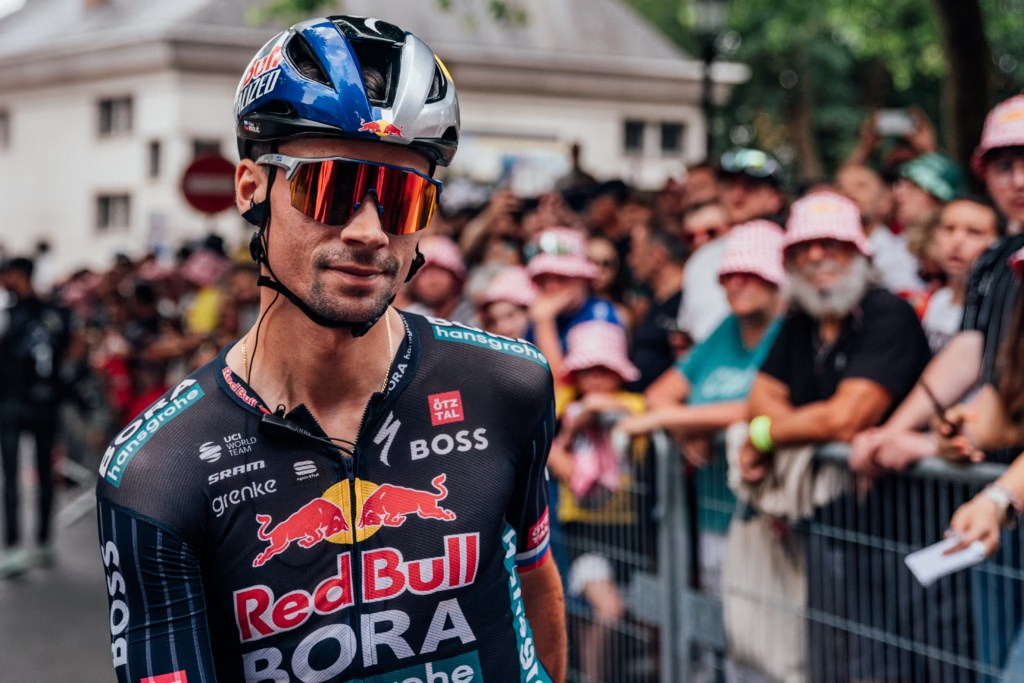 Photo Credit: Getty
What Roglič can still offer Red Bull-BORA-hansgrohe
Even if Roglič is not the sole leader, his value remains obvious.
He brings Grand Tour calm. He knows how to move through the stress of the first week, how to manage bad days, how to protect position, and how to read the moments when rivals are vulnerable. That experience is not easy to replace.
He also gives the team tactical flexibility. If Evenepoel is the main GC rider, Roglič can still act as a protected second card, forcing rivals to respect two options. If Lipowitz is riding strongly, Roglič can help stabilise the team around him. If the GC picture breaks apart, Roglič can still chase stages or use the stage 16 time-trial to move up.
The difficulty is ego and energy. A rider of Roglič’s stature is not a normal helper. Using him purely as a domestique would be unrealistic unless he fully accepts that role. Using him as a co-leader requires form. Using him as a stage hunter requires freedom. Each version has different consequences.
Still, if Red Bull-BORA-hansgrohe manage the role clearly, Roglič could be an asset even without being the main favourite. A Tour team with Evenepoel, Lipowitz and Roglič would have huge tactical depth, provided the hierarchy is settled before the race begins.
For more on support structures, see our Tour de France 2026 domestiques who could decide the race and Tour de France 2026 route: best days for GC attacks features.
The Vuelta question hangs over everything
The biggest reason to doubt Roglič at the Tour is not that he cannot ride it. It is that the Vuelta may make more sense.
Roglič’s relationship with the Vuelta a España is one of the defining parts of his career. If his 2026 goal is another tilt at that race, then the Tour becomes a risk. The 2026 Tour route is hard enough to drain any rider, especially one approaching 37. Riding it in a supporting or unclear role could cost energy that would be better used later in the season.
That is the strategic calculation. Does Red Bull-BORA-hansgrohe gain more from taking Roglič to the Tour as a secondary option, or from giving him a cleaner run at the Vuelta? If Evenepoel and Lipowitz are already central to July, the Vuelta route may offer Roglič a clearer leadership path.
This is not about writing him off. It is about using him properly. A late-career Grand Tour winner has to choose the right battles. The Tour is the biggest race, but it is not automatically the best race for every rider every year.
If Roglič rides the Tour, it should be because the team sees a real tactical and GC purpose. If he skips it, that may be the more logical decision rather than a sign of decline.
For more on how riders are shaping their 2026 targets, see our 2026 men’s racing calendar: how the stars are shaping their seasons and mapping the 2026 men’s season features.
 Photo Credit: Getty
Best-case scenario
The best-case scenario is that Roglič starts the Tour in strong form, helps Red Bull-BORA-hansgrohe in the Barcelona team time-trial, survives the early Pyrenees close to the favourites, then uses his experience through the Massif Central, Vosges and Jura to stay in the top-five conversation.
Stage 16’s time-trial could then move him up the GC, especially if some climbers lose time. From there, he would need to ride defensively in the Alps, pick the right wheels and avoid the kind of repeated accelerations that would expose him.
In that version of the race, Roglič could still finish top five, perhaps even fight for the podium if others crack. He would not need to dominate. He would need to be efficient, consistent and ruthless with any opening.
That is still possible. It is just no longer the most likely version.
For the kind of route pressure he would need to survive, see our Tour de France 2026 Massif Central guide, Tour de France 2026 Vosges and Jura guide and Tour de France 2026 Alps guide.
-
 Photo Credit: A.S.O./Gaëtan Flamme

Worst-case scenario
The worst-case scenario is that Roglič starts without full leadership clarity, loses time early in the Pyrenees, and becomes caught between roles.
If he is not close enough on GC, the team may prioritise Evenepoel or Lipowitz. If he is too important to be used as a normal helper, he could become tactically awkward. If the Alps expose his recovery, the final week could turn into survival rather than ambition.
There is also the crash question. Roglič’s career has repeatedly been shaped by falls, including his 2025 Giro d’Italia exit after a crash on stage 16. The 2026 Tour includes a nervous opening weekend, early mountains and several technical hilly stages. One bad moment can still change everything.
That is the central risk. Roglič’s floor is no longer as secure as it once was if the route and team hierarchy are not aligned.
For broader Grand Tour context, see our what Men’s Giro d’Italia 2026 means for the season analysis and Tour de France 2026 GC favourites ranked.
Verdict: route fit is good in places, but the leadership fit is uncertain
The 2026 Tour de France route gives Primož Roglič several things he can use. The Barcelona team time-trial suits his discipline. The stage 16 individual time-trial suits his skill set. The Massif Central and hilly transition stages suit his tactical intelligence. Even the early Pyrenees can be managed if he arrives sharp.
The problem is the whole package. This Tour is brutally hard across three weeks, and the final Alps are a major test for any rider, let alone one who will be 36 during the race. The route does not just ask whether Roglič can still be excellent. It asks whether he can still be excellent repeatedly, in July, against the strongest GC riders in the world, inside a team that may not be built around him.
That is why his Tour de France 2026 picture is uncertain. If he rides as a clearly defined co-leader or protected second option, he can still influence the race. If he rides with vague leadership status, the Tour may become messy for both him and Red Bull-BORA-hansgrohe. If he skips it for the Vuelta, that may be the most logical late-career choice.
Roglič still has the class. The route gives him some tools. But the leadership equation may matter more than the climbs.
For full race coverage, visit our Tour de France hub, Tour de France 2026 full route guide, Tour de France 2026 route analysis and how to watch Tour de France 2026 in the UK.

