
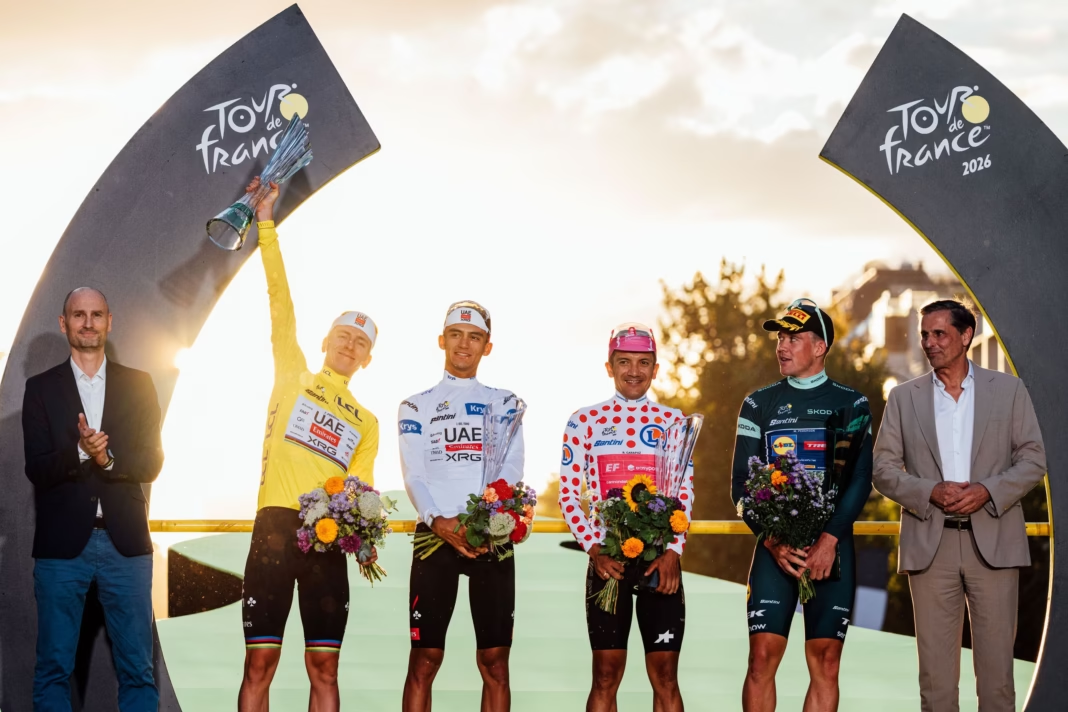
The Tour de France 2026 will be remembered first for Tadej Pogačar winning a fifth yellow jersey, but reducing the race to that one result misses how much historical ground shifted during three weeks in France.
Pogačar moved into the five-win club alongside Jacques Anquetil, Eddy Merckx, Bernard Hinault and Miguel Induráin. He did it at 27, younger than any of them when they reached five, and completed another five-stage Tour to move his career total to 26. Behind him, Remco Evenepoel finished second, Isaac del Toro became a Tour podium rider and Paul Seixas reached fourth while still representing the sport’s next generation rather than its established order.
There was also a significant absence from the final Tour de France 2026 classification. Jonas Vingegaard began the race as Pogačar’s defining rival but crashed out on Stage 15 with a fractured right collarbone, ending the latest chapter of a rivalry that had shaped the previous four Tours.
The final result therefore belongs in several different historical conversations. It strengthened Pogačar’s case among the greatest Tour riders ever, extended an era already dominated by two riders and produced a top 10 containing several names who could define what comes next.
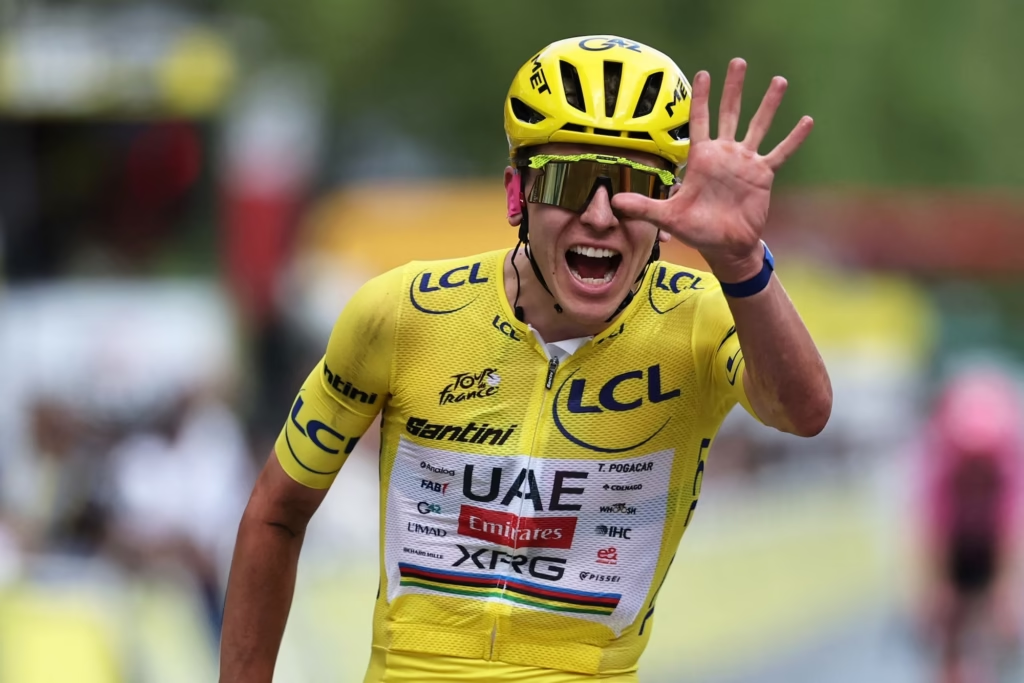
Five Tour victories changes the Pogačar conversation
Before 2026, Pogačar was already one of the great Tour riders. After 2026, the discussion changes.
His victories in 2020, 2021, 2024, 2025 and 2026 put him level with Anquetil, Merckx, Hinault and Induráin on five overall wins. Only those four riders had previously reached the official record, something explored in our wider look at the greatest Tour de France winners.
Anquetil became the first five-time winner in 1964. Merckx matched him in 1974, Hinault in 1985 and Induráin in 1995. More than three decades passed without anybody else joining them.
Pogačar has now done it. The question is no longer whether he belongs in that group, but where within it he belongs and whether five is actually where his total stops.
Pogačar reached five younger than anyone before him
Age is what makes the 2026 result particularly significant. Pogačar completed his fifth Tour victory at 27, reaching the traditional ceiling of Tour success while still at an age when a Grand Tour rider would normally expect several peak seasons ahead.
His Tour record is remarkably compressed. Seven starts have produced five victories and two second places, meaning he has never finished a Tour outside the top two.
That alone separates his trajectory from almost every great Tour career before him. Even riders with similarly extraordinary peaks usually experienced a poor Tour, missed season or transition period somewhere within the same stretch of their careers.
For Pogačar, the Tour has effectively contained only two outcomes since 2020: winning it or losing it to Vingegaard.
The full progression to five is covered in Tadej Pogačar: five Tour de France wins and the complete story of a record-equaling career.
The five-time champions all reached the record differently
The headline number places five riders together, but their Tour careers were not the same.
Anquetil used time trialling and control to define the first era of five victories. Merckx dominated classifications and stages to a degree that remains almost impossible to replicate, while Hinault combined aggression with enough versatility to win across virtually every type of terrain.
Induráin produced the only sequence of five consecutive victories, from 1991 through 1995, using overwhelming time trial strength and carefully controlled mountain racing to dominate an entire period.
Pogačar’s version looks different again. He wins mountain stages, uphill sprints, reduced finishes and time trials, but his greatest distinction may be how frequently he turns Tour-winning superiority into stage-winning aggression.
The 2026 race added another five victories to that record.
Twenty-six stage wins puts another historical target within reach
Pogačar ended the 2026 Tour with 26 career stage victories, moving him into a part of the all-time list where the next landmarks are no longer remote.
Bernard Hinault won 28 Tour stages. Eddy Merckx won 34. Mark Cavendish holds the outright record with 35.
Pogačar is now only two behind Hinault.
Merckx and Cavendish remain considerably farther away, but his rate of accumulation makes their totals realistic historical subjects rather than hypothetical ones. Five wins in 2026 followed six stages in 2024 and another dominant haul in 2025.
What makes the total unusual is that he is building it while simultaneously racing for yellow. Cavendish accumulated 35 victories through sprinting across 15 Tours. Pogačar is collecting wins while managing the general classification and often doing so on the hardest days of the race.
Whether he reaches 35 remains uncertain. It no longer sounds absurd.
Another dominant Tour was built through attacking
Pogačar did not reach five by protecting a comfortable advantage and letting the rest of the race happen around him.
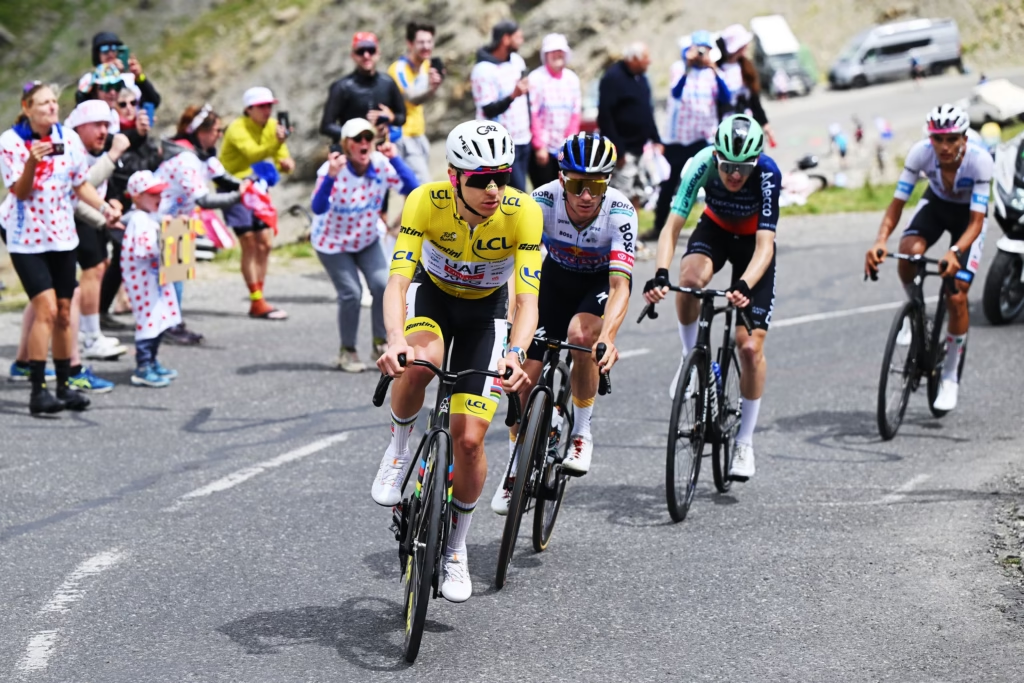
He won at Les Angles on Stage 3, attacked across the Tourmalet before winning at Gavarnie-Gèdre on Stage 6, took Le Lioran on Stage 10, won again at Le Markstein on Stage 14 and completed his stage-winning campaign on Alpe d’Huez on Stage 19.
The Tourmalet move was particularly important because it established the race’s hierarchy early. Pogačar attacked with around 43km remaining and eventually took 2:38 from Vingegaard, moving into yellow with a 2:42 lead.
That was not the conventional behaviour of a rider trying to minimise risk across three weeks. Modern Tour racing has changed partly because Pogačar repeatedly treats stages that could be controlled defensively as opportunities to attack.
His historical significance therefore extends beyond how many Tours he wins. He has helped reset expectations around how a dominant Tour leader can race.
Alpe d’Huez connected 2026 directly to Tour history
Stage 19 gave the race one of its clearest comparisons with the past.
Pogačar’s Alpe d’Huez ascent was timed at roughly 35:27 depending on the exact segment used, comfortably inside the long-standing Marco Pantani benchmark from 1995.
Direct comparisons across three decades require caution. Equipment, road surfaces, weather, stage design, race situations and timing points all differ, so an ascent time should never be treated as a perfect measure of riders from different eras.
The broader historical significance remains. The strongest riders of the current Tour are climbing its most famous mountains at speeds that sit directly alongside, and sometimes beyond, the benchmarks left by the dominant climbers of previous generations.
Pogačar doing that while riding towards his fifth yellow jersey inevitably deepens the debate over where he belongs in Tour history.
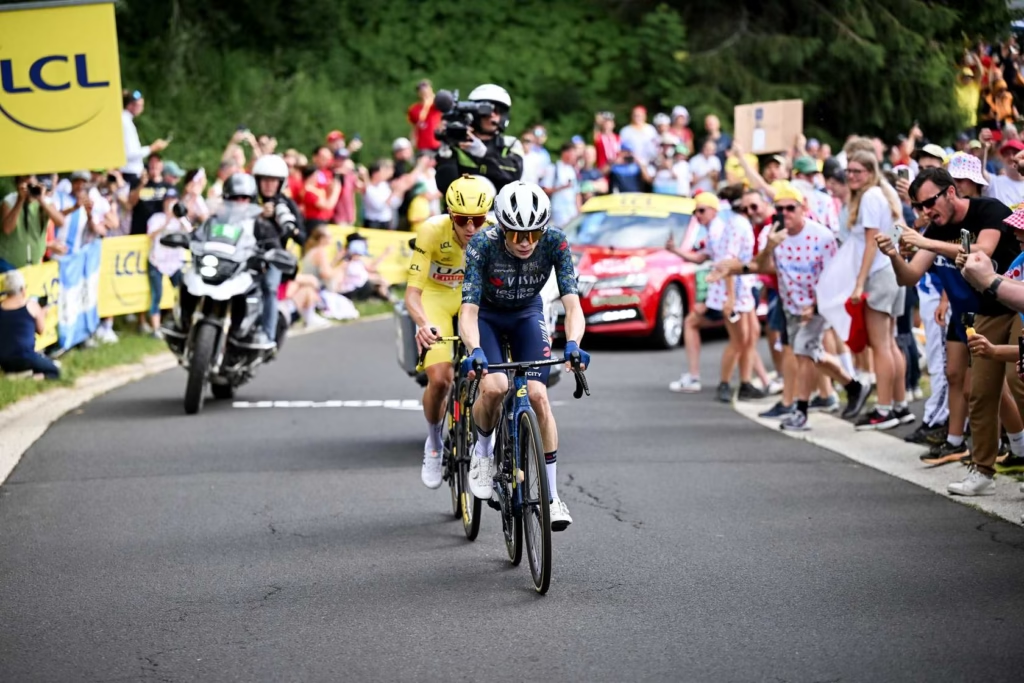 Photo Credit: A.S.O./Billy Ceusters
The Pogačar-Vingegaard era is still the defining rivalry
The 2026 Tour did not deliver the final-week Pogačar-Vingegaard duel many expected.
Vingegaard crashed in Bonneville with approximately 20km remaining on Stage 15 while sitting second overall at 4:30. He was unable to continue, and subsequent examinations confirmed a fractured right collarbone and multiple abrasions.
The full sequence is covered in why Jonas Vingegaard abandoned the Tour de France 2026.
His exit does not diminish what the rivalry has already become. Vingegaard defeated Pogačar in 2022 and 2023 before the Slovenian regained control in 2024 and 2025. For several seasons, the Tour effectively became a race defined around the two of them.
The 2026 edition added a strange chapter. Pogačar won again, but the rivalry was interrupted by injury rather than decisively settled on the road.
Evenepoel’s second place moved his Tour career forward
Remco Evenepoel finished second at 6:26, improving on his third place from 2024 and confirming that his Tour ambitions extend beyond collecting podiums behind Pogačar and Vingegaard.
His race included two stage victories, with the Stage 16 individual time trial providing the clearest demonstration of his strongest weapon. Evenepoel beat Pogačar by 28 seconds on the 26.1km course, a performance analysed in Remco Evenepoel wins the time trial, but the Tour de France podium is the real story.
One of the central questions around Evenepoel has always been whether his extraordinary time trial ability can coexist with the climbing required to win the Tour. The 2026 race did not completely answer that, because Pogačar remained clearly stronger across the whole race.
It did move the trajectory forwards. Third became second. Only one step remains.
Isaac del Toro made the podium a generational story
Isaac del Toro finishing third overall at 9:42 was one of the most important developments beyond Pogačar’s victory.
The Mexican had already established himself as one of the outstanding young stage racers in the sport, but a Tour podium moves expectation onto another level. He also won Stage 2 and finished the race in the white jersey, holding off Seixas by 2:14.
The striking part is that all of this happened while riding alongside Pogačar.
Historically, dominant Tour teams have often contained future winners. What makes UAE Team Emirates-XRG’s position particularly interesting is that del Toro has already developed into a podium rider while the established leader is still winning five stages and reaching the five-title record.
There was no leadership debate in 2026 because Pogačar was clearly stronger.
The race created the possibility of one in the future.
 Photo Credit: Getty
Paul Seixas accelerated the French timeline
Paul Seixas finishing fourth at 11:56 may become one of those results that looks even more important several years later.
France has waited since Bernard Hinault in 1985 for another home Tour winner. Numerous riders have created hope through podium finishes and strong mountain performances, but nobody has ended that drought.
Seixas is significant because of how quickly he has reached the front of the race. Fourth overall immediately moves him beyond being simply a development prospect and into the group of riders around whom future Tour campaigns will be discussed.
Lenny Martinez finishing fifth added another layer. With Jordan Jegat tenth, France placed three riders inside the final top 10.
The 41-year wait remains.
The structure underneath it suddenly looks deeper.
Three French riders in the top 10 changes the tone
The significance of Seixas, Martinez and Jegat is not simply that three French riders crossed an arbitrary top-10 threshold.
They represented different teams and different stages of development, suggesting something broader than another Tour built around one home GC hope.
French cycling has repeatedly produced strong Tour riders without finding the single rider capable of beating the best international contenders. Seixas offers the highest long-term ceiling, Martinez has already established elite climbing quality and Jegat added another credible GC presence.
It is far too early to declare a new French Tour-winning era.
It is much easier to see multiple routes towards one than it was a few seasons ago.
Tom Pidcock’s ninth place changed his own Tour history
Tom Pidcock finished ninth at 29:28, securing his first Tour de France top 10.
His Tour identity had previously been built primarily around stage hunting, most famously through his Alpe d’Huez victory in 2022. The 2026 race demonstrated that he can sustain a general classification campaign across three weeks rather than simply climbing with the favourites on selected days.
That followed third place at the 2025 Vuelta and strengthened the argument that his Grand Tour career has moved into a different phase.
The result and what it means for his future are explored in Tom Pidcock finishes ninth at the Tour de France 2026: what his first top 10 means.
The question around Pidcock is no longer whether he can ride for GC.
It is whether ninth is the beginning of the progression or somewhere close to the ceiling.
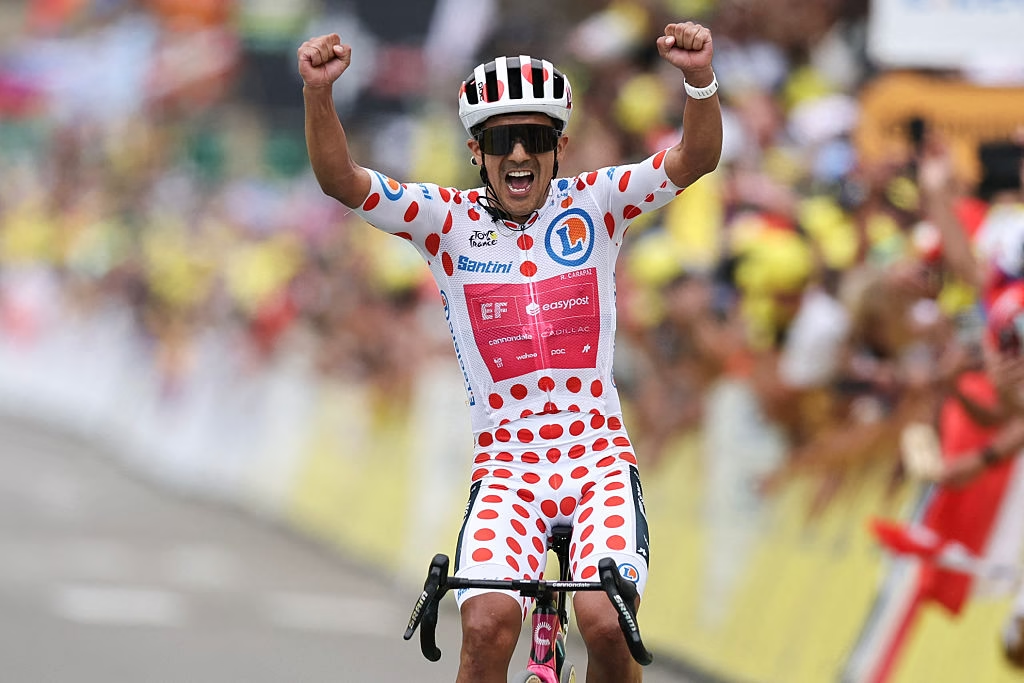
Carapaz produced a different kind of great Tour
Richard Carapaz finished eighth overall, but his race was considerably bigger than eighth place.
He won Stage 18 at Orcières-Merlette and Stage 20 on Alpe d’Huez, secured the mountains classification with 156 points and received the Super Combativity award. His final week turned an already solid GC campaign into one of the defining performances of the race.
That full run is covered in Richard Carapaz: two stage wins and the polka-dot jersey in a Tour de France to remember.
Historically, it also shows how a Tour rider’s role can evolve. Carapaz had already finished third overall in 2021 and won the Olympic road title. In 2026, rather than measuring success exclusively through GC, he combined stage hunting, the mountains classification and aggressive racing while still finishing eighth.
It was a different version of Tour success, and one of the strongest non-yellow campaigns of the edition.
The polka-dot jersey looked like a real competition again
The mountains classification has not always been won by the rider most visibly attacking in the mountains.
GC leaders can accumulate huge points by winning summit finishes, occasionally turning polka dots into a by-product of the yellow jersey battle rather than a separate objective.
Carapaz’s 2026 campaign went in the opposite direction. He repeatedly targeted mountain points, won mountain stages and mathematically secured the classification before Paris.
The decisive raid came on Stage 20, where his points across the Croix de Fer, Télégraphe and Galibier transformed the competition. The moment the jersey became mathematically safe is covered in Richard Carapaz mathematically secures Tour de France 2026 polka-dot jersey.
It felt like a traditional King of the Mountains campaign inside a modern Tour.
Pedersen’s green jersey belonged to the all-rounders’ tradition
Mads Pedersen winning the points classification also fits a broader historical pattern.
Green has often been associated with the fastest sprinter, but some of its most memorable winners have built campaigns through versatility. Sean Kelly and Peter Sagan could collect points on days when conventional sprinters were simply trying to survive.
Pedersen’s 2026 race belonged in that tradition.
He won Stage 4 in Foix, scored heavily in bunch sprints, targeted intermediate points and used difficult stages to strengthen his lead. By Stage 20, he was attacking through the mountains to remove the final mathematical chance of Jasper Philipsen overturning him in Paris.
The logic behind that campaign had been visible from the start in Mads Pedersen at the Tour de France 2026: stages, green jersey and hard days.
Pedersen did not win green by becoming the fastest pure sprinter.
He won because he could score on more types of stage than anyone trying to beat him.
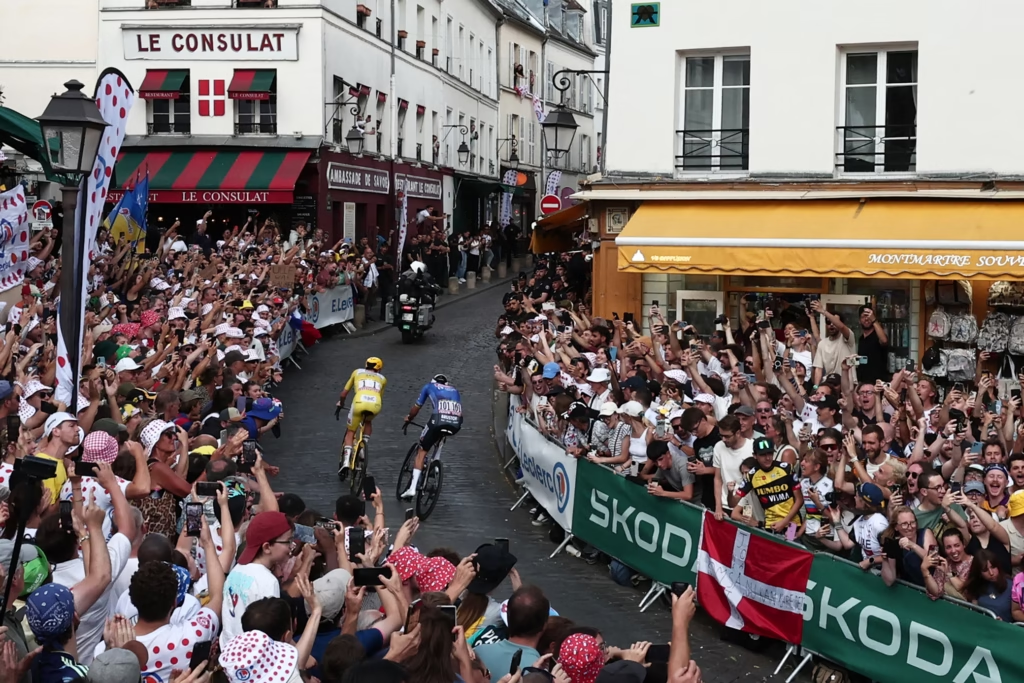 Photo Credit: Getty
Paris became historically unusual before the riders even raced it
The Tour’s final stage has traditionally followed one of the most recognisable formulas in professional sport.
Yellow is celebrated on the approach to Paris, the race reaches the Champs-Élysées and the sprinters contest the final victory.
The 2026 edition did not get the conventional approach at all.
Major wildfires elsewhere in France forced police and other security resources originally assigned to the Tour to be redeployed. The competitive stage was cut from 133km to 89km, with Yvelines and Hauts-de-Seine removed and all racing taking place inside Paris.
The full background is covered in France wildfires: how they changed the Tour de France 2026 final stage.
Crucially, the three ascents of Montmartre remained.
The organisational emergency therefore preserved the part of the route most capable of changing the sporting character of the day.
Van der Poel turned Stage 21 into a Classic
Mathieu van der Poel took advantage of that altered finale.
He attacked with Pogačar during the decisive part of the race, continued his move after the yellow jersey was caught and held off Philipsen and Pedersen on the Champs-Élysées.
It was not the conventional Paris sprint and it was certainly not a ceremonial final stage.
The Stage 21 race report completed a Tour in which Van der Poel had also won Stage 9 from the breakaway in Ussel.
His two victories captured the range that makes him so disruptive in modern stage racing. He is not a GC rider and does not need a conventional sprint to win. Give him a stage that begins behaving like a one-day Classic and the entire tactical shape changes.
Paris in 2026 gave him exactly that.
The route change belongs to a much older Tour tradition
The wildfire alteration was unusual, but the Tour changing around events outside the race is nothing new.
Its history has been shaped by wars, strikes, protests, extreme weather, landslides, pandemics and public safety concerns. The modern Tour may be one of the most sophisticated sporting operations in the world, but it still depends on the roads, public authorities and emergency services of the country around it.
In 2026, the emergency was not even on the route itself. Security resources were needed elsewhere, and the Tour became secondary.
That makes the revised Paris finale part of a much older historical theme: however large the race becomes, it cannot operate independently of the world through which it travels.
 Photo Credit: Getty
Seven Tours have produced only two winners
Tour history often divides naturally into eras.
Anquetil controlled the early 1960s. Merckx dominated around the turn of the 1970s. Hinault defined much of the late 1970s and early 1980s. Induráin owned the first half of the 1990s, while Team Sky and Ineos controlled much of the 2010s through Bradley Wiggins, Chris Froome, Geraint Thomas and Egan Bernal.
The period beginning in 2020 now has an unmistakable identity of its own.
Seven Tours from 2020 through 2026 have produced only two winners.
Pogačar has five.
Vingegaard has two.
Evenepoel, Roglič and every other challenger have yet to interrupt that sequence.
The wider shift towards the Pogačar-Vingegaard period is part of the modern story in our brief history of the men’s Tour de France.
The concentration of victories makes this one of the clearest Tour eras, even though dominance has been shared between two rivals rather than belonging exclusively to one rider or one team.
The next generation arrived before the old one went away
What makes the final 2026 classification especially interesting is that the race looked dominant at the top and unusually young underneath it.
Del Toro finished third.
Seixas was fourth.
Martinez fifth.
Mattias Skjelmose sixth.
Juan Ayuso seventh.
These were not young riders scattered around the lower half of the top 10 behind an established generation of veterans. They occupied most of the positions immediately behind Pogačar and Evenepoel.
Grand Tour generations rarely change cleanly. The established champion does not retire and hand yellow to the next rider. Younger contenders normally arrive while the dominant figure is still winning.
That is exactly what happened in 2026.
Pogačar showed no obvious decline.
The riders expected to define the Tours after him appeared anyway.
UAE now belongs in the discussion of dominant Tour teams
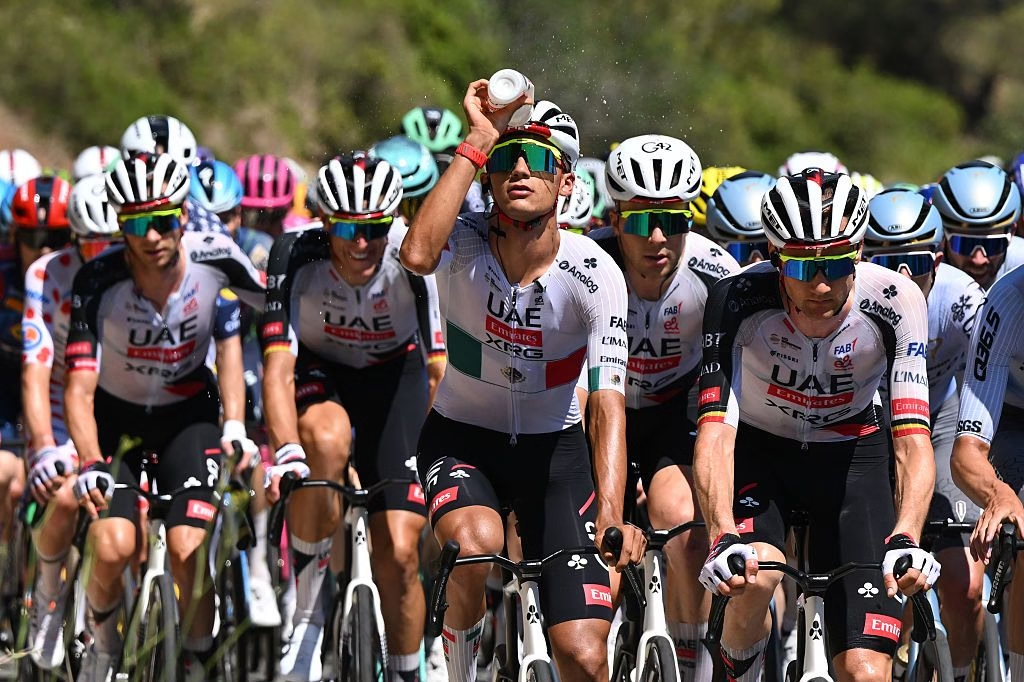
Pogačar winning while del Toro finished third also strengthened UAE Team Emirates-XRG’s place among the strongest Tour structures of different eras.
Dominant teams are nothing new. La Vie Claire put Hinault and Greg LeMond first and second in 1985 before their internal balance changed a year later. Banesto built around Induráin. Team Sky and Ineos turned collective strength into a central feature of Tour racing throughout the 2010s.
UAE’s version is different because Pogačar often races aggressively rather than relying exclusively on team control, but the depth behind him is increasingly comparable with the great Tour teams.
Winning yellow and placing another rider third overall is not simply evidence of a strong squad.
It demonstrates the scale of the problem facing anyone trying to isolate Pogačar.
They first have to get through the team around him.
Dominance no longer necessarily means controlled racing
One of the most striking contrasts with previous dominant periods is how the race looks while Pogačar is controlling it.
Induráin’s strongest Tours could often be understood through overwhelming time trials followed by mountain management. Team Sky’s best editions were built around a mountain train capable of restricting attacks before Froome or another leader made the decisive move.
Pogačar frequently creates the opposite effect.
He attacks while already leading.
He contests stages he does not need to win.
He follows moves a traditional yellow jersey might allow to disappear.
That creates an unusual combination. The overall result can be dominant while individual stages remain aggressive.
Pogačar eventually won by 6:26, but the Tour de France 2026 review contained long-range attacks, breakaway victories, repeated shifts lower down the GC, two Alpe d’Huez finishes and a final day where the yellow jersey himself attacked over Montmartre.
Dominance and unpredictability can exist in the same race.
The Pogačar era has made that increasingly normal.
Five victories does not automatically settle the greatest-ever debate
Pogačar is now level with the official record, but that does not automatically make him the greatest Tour rider.
Merckx’s record contains a level of total dominance extending far beyond five yellow jerseys. His 34 stage victories, secondary classifications and wider control of the race remain difficult to reproduce.
Hinault’s aggression and versatility provide another benchmark. Induráin remains the only rider to win five Tours consecutively, while Anquetil was the first to establish five victories as the standard by which Tour greatness could be measured.
Pogačar now has arguments unavailable to any of them. He reached five younger, his stage-winning rate is extraordinary and he has accumulated those victories during an era containing another multiple Tour winner in Vingegaard.
The verdict remains subjective.
The terms of the debate changed in 2026.
Pogačar no longer needs to chase the five-time champions.
He is one of them.


Six would create something the official Tour has never seen
There is one obvious number left.
Six.
No rider has officially won the Tour de France six times. Lance Armstrong crossed the line first seven times between 1999 and 2005, but those results were stripped and the editions remain without official winners.
Five is therefore still the recognised record.
If Pogačar wins another Tour, he does not simply move ahead of Merckx, Hinault, Induráin and Anquetil by one.
He creates a new category.
That possibility changes the historical meaning of every Tour he starts from now on. For each of the previous record holders, five represented the endpoint of their winning careers.
For Pogačar, 2026 may eventually be remembered as the moment five stopped being the target and became the platform for something unprecedented.
The 2026 Tour may look like both culmination and transition
Most Tours eventually acquire one dominant historical meaning.
The 1989 race is inseparable from Greg LeMond defeating Laurent Fignon by eight seconds. The 1998 Tour is tied to the Festina affair. The 2012 edition marked Britain’s first overall victory. The 2020 Tour is remembered through Pogačar overturning Roglič at La Planche des Belles Filles.
The meaning of 2026 may take longer to settle because several narratives overlap.
It was Pogačar’s fifth Tour and another five-stage campaign. It was Evenepoel’s first second place, del Toro’s first Tour podium and Seixas’ arrival near the top of the classification. Vingegaard’s challenge ended through injury, Carapaz took two mountain stages and polka dots, Pedersen won green through all-round racing and Van der Poel completed a wildfire-altered Paris finale with a Classics-style victory.
Most importantly, the race may eventually be remembered as the moment two Tour eras were visible simultaneously.
Pogačar reached the historical benchmark established by the greatest champions of the past.
Directly behind him, the riders who may define what comes next had already arrived.

