
Tour de France time cuts are the daily time limits riders must finish inside to stay in the race. If a rider finishes outside the time limit, they can be eliminated, unless the race jury applies an exception. The system exists to stop riders from losing huge amounts of time, riding the Tour at a much lower pace than the front of the race, and still continuing day after day.
The time cut is not a fixed number. It changes from stage to stage. A flat stage, a hilly stage, a mountain stage and a time-trial can all have different limits. The race organiser gives each stage a coefficient based on its difficulty, then the winner’s average speed determines the percentage of extra time allowed.
That means the time cut is only known properly after the stage winner has finished. Riders at the back know roughly what they need to do, but the exact cut-off depends on how fast the front of the race has gone.
For newer fans, time cuts explain why sprinters and domestiques can look so desperate on mountain stages. They are not trying to win. They are trying to survive. Our beginner’s guide to Men’s Tour de France 2026 explains the wider race structure, while this guide focuses on one of the Tour’s most important survival rules.
Tour de France time cuts at a glance
| Question | Answer |
|---|---|
| What is the time cut? | The latest time a rider can finish a stage and remain in the race |
| Is it the same every day? | No, it changes depending on stage difficulty and winner’s speed |
| Who sets it? | The race regulations, applied by the commissaires |
| What is it based on? | The stage winner’s time, the stage coefficient and average speed |
| Are mountain stages more generous? | Usually, yes |
| Can riders outside the cut be saved? | Sometimes, if the jury applies an exceptional decision |
| What is the gruppetto? | The group of riders at the back trying to finish inside the time limit |
| Why does it matter? | It can eliminate sprinters, injured riders or exhausted domestiques |
How the Tour de France time cut is calculated
The Tour de France time cut is calculated by taking the stage winner’s finishing time and adding a percentage on top. That percentage depends on two things: the stage coefficient and the winner’s average speed.
A stage coefficient is basically a difficulty category. Easier or faster stages have tighter limits. Harder mountain stages have more generous limits. The faster the winner rides, the percentage can also change.
A simple example:
| Stage winner’s time | Time-cut percentage | Time allowed behind winner | Latest permitted finishing time |
|---|---|---|---|
| 4 hours | 10 per cent | 24 minutes | 4 hours 24 minutes |
| 4 hours | 15 per cent | 36 minutes | 4 hours 36 minutes |
| 5 hours | 12 per cent | 36 minutes | 5 hours 36 minutes |
| 5 hours | 18 per cent | 54 minutes | 5 hours 54 minutes |
So if a mountain stage is won in 5 hours and the time cut is 18 per cent, riders would have 54 minutes after the winner to finish. If a rider finishes 55 minutes down, they are technically outside the limit.
The actual Tour regulations use detailed tables, but the principle is simple: harder stages and faster days usually change the amount of time the back of the race has to survive.
Why time cuts are not fixed
Time cuts are not fixed because Tour de France stages are not equal. A 170km flat stage finishing in a bunch sprint is very different from a high-mountain stage over the Tourmalet, Galibier or Alpe d’Huez.
A fixed cut-off would be unfair. If every stage had the same 30-minute limit, sprinters might be eliminated in huge numbers on the hardest mountain days. If every stage had a very generous cut-off, riders could lose too much time on flat stages without consequence.
The coefficient system allows the race to adjust. Flat days can be strict because most of the peloton should be able to finish relatively close to the winner. Mountain days need more flexibility because riders can be dropped early, climb at very different speeds and still be racing properly.
That is especially relevant on the 2026 route. The Tour includes 7 flat stages, 4 hilly stages and 8 mountain stages, with summit finishes at Gavarnie-Gèdre, Plateau de Solaison, Orcières-Merlette and Alpe d’Huez twice. Our Tour de France 2026 full route guide explains why that mix should create very different time-cut pressures across the three weeks.
What are stage coefficients?
Stage coefficients are the categories used to decide how strict the time cut should be. Each stage is assigned a coefficient before the race. The coefficient reflects the nature of the stage, such as whether it is flat, rolling, hilly, mountainous or a time-trial.
The details can change from one Tour to another, but the broad idea is consistent:
| Stage type | Typical time-cut feel |
|---|---|
| Flat stage | Tighter, because the stage should stay relatively fast and grouped |
| Hilly stage | More generous than a flat stage, but still demanding |
| Mountain stage | More generous, especially on hard summit-finish days |
| Very hard mountain stage | One of the most generous categories, but still dangerous for sprinters |
| Time-trial | Separate rules, because riders race individually or as teams |
This is why riders and teams study the race book carefully. They know which days are likely to be dangerous for the cut. A sprinter may not fear every mountain stage equally. The real danger depends on the coefficient, stage distance, weather, climbing profile and how aggressively the front of the race is ridden.
Why the winner’s speed matters
The winner’s speed matters because the time cut is linked to how fast the stage is raced. A hard mountain stage ridden conservatively can produce a different cut-off from a similar stage raced flat-out from the start.
This is important because riders at the back are indirectly affected by the tactics at the front. If the GC favourites attack early, or if a strong breakaway sets a very fast pace, the winner’s average speed can rise. That can change the cut-off and make the day more stressful for riders behind.
On a flat stage, if the peloton rides extremely fast all day because of crosswinds or a fierce sprint chase, the cut can also become a real issue for injured riders or those dropped early.
That is why the time cut is not just a rule. It is part of the race itself. The faster the front goes, the more pressure there can be on the back.
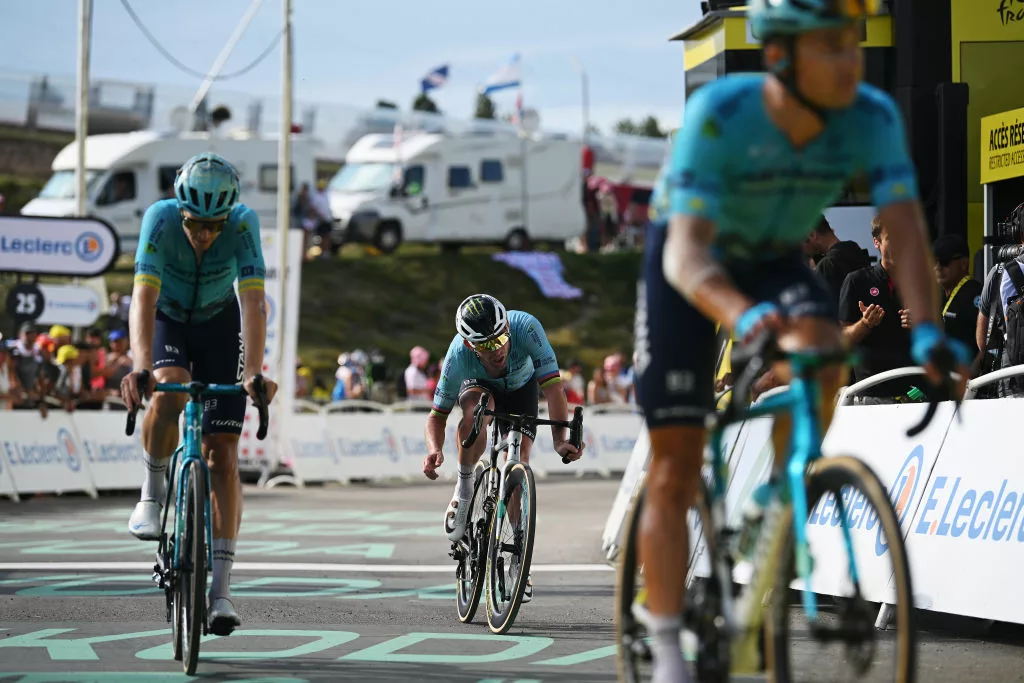
What happens if a rider misses the time cut?
If a rider finishes outside the time cut, they are normally eliminated from the Tour de France. They cannot start the next stage, and they are removed from the general classification and all other classifications.
That can be brutal. A rider may have survived crashes, illness, mountains and team work for two weeks, only to be eliminated for finishing a few seconds or minutes outside the limit.
There is, however, some room for judgement. The race jury can reinstate riders in exceptional circumstances. This is usually considered if a large group finishes outside the time limit, if extreme weather affects the stage, if crashes or incidents disrupt the race, or if eliminating all those riders would damage the race’s sporting balance.
But that is never something riders can rely on. The safe option is always to finish inside the cut.
Can the commissaires save riders outside the time cut?
Yes, the commissaires can sometimes allow riders to continue even if they finish outside the time limit. This is usually described as the jury using discretion.
The most common scenario is a large group of riders missing the cut together. If 30, 40 or 50 riders are outside the limit, eliminating them all could seriously affect the race. The jury may decide to keep them in, often with penalties in the points classification.
This can be controversial. Some fans argue that rules should be applied strictly. Others argue that the Tour has to remain practical and that eliminating an entire gruppetto on one extreme day would be excessive.
The important point is that discretion is not guaranteed. A single rider outside the cut is much more vulnerable than a large group. That is why riders at the back try to stay together. The gruppetto is partly about pacing, but it can also create safety in numbers.
What is the gruppetto?
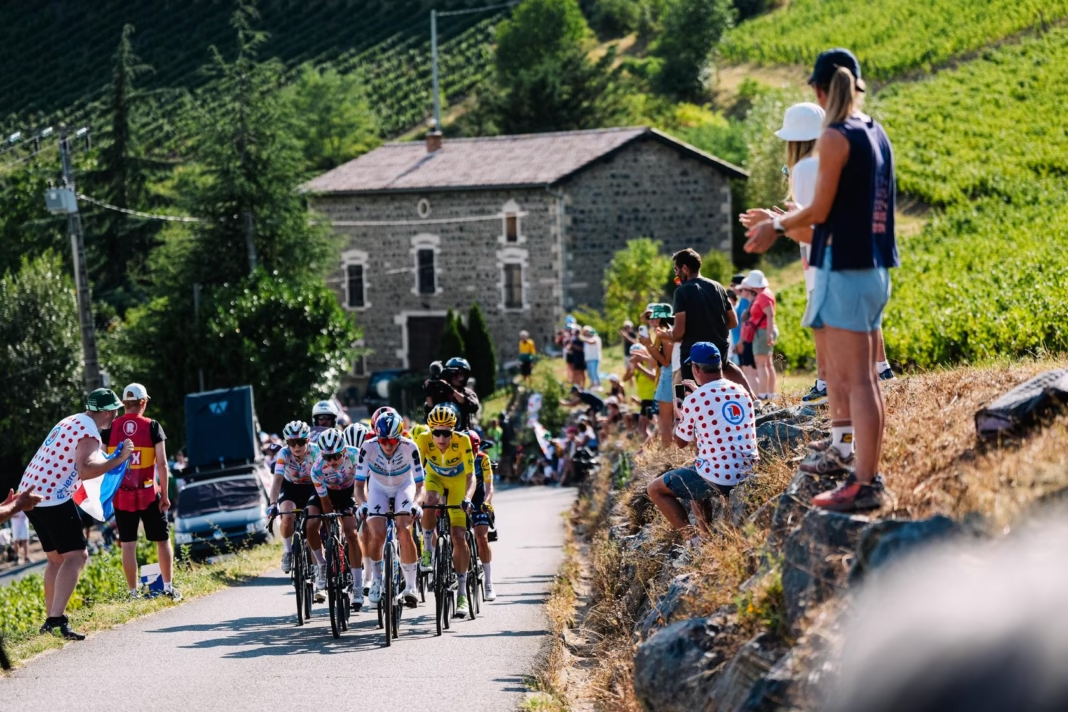
The gruppetto is the group of riders at the back of the race, usually formed on mountain stages, whose main goal is to finish inside the time cut. It often includes sprinters, lead-out riders, heavier rouleurs, injured riders and domestiques who have finished their work for the day.
The gruppetto is not just a random collection of dropped riders. It has its own rhythm and logic. Experienced riders help set a steady pace. They know how hard they can afford to ride, where they need to push, and how much time they are likely to have.
The aim is to avoid panic. If the gruppetto goes too hard too early, riders can crack. If it goes too slowly, everyone risks elimination. Good gruppetto riding is about calculation, experience and cooperation.
Sprinters rely on it heavily. A rider chasing the green jersey can have no chance of winning a mountain stage, but still needs to survive it to reach the next sprint opportunity. Our Tour de France 2026 green jersey guide explains why climbing survival is part of the points competition, even for the fastest riders.
Why sprinters fear mountain time cuts
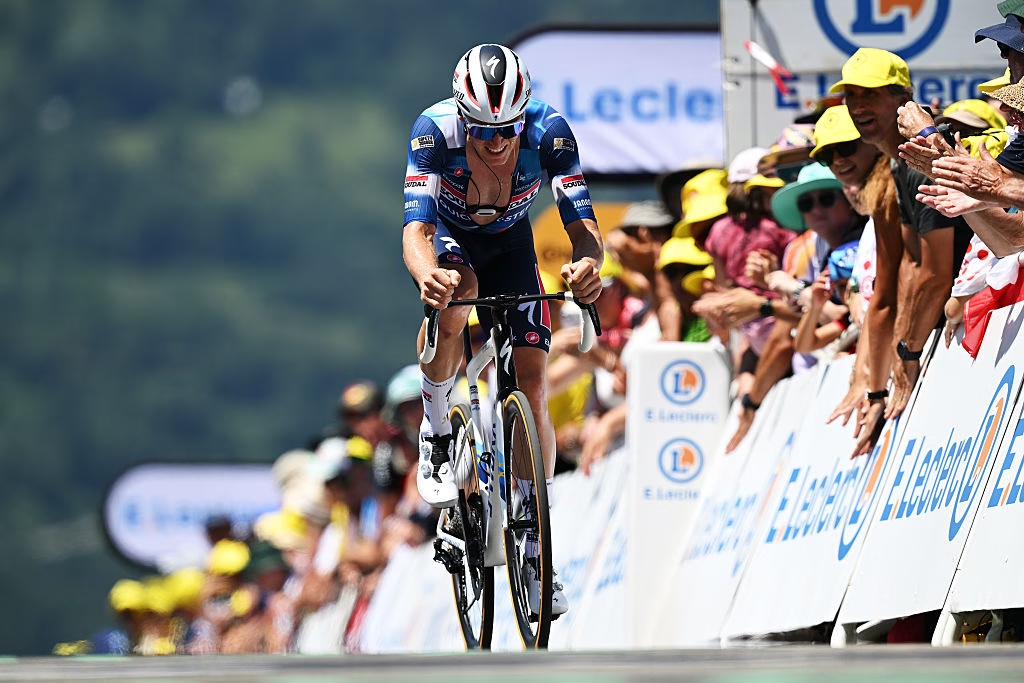
Sprinters fear mountain time cuts because they are usually heavier, more powerful riders built for speed on flatter roads, not repeated long climbs. On the hardest Tour stages, they may be dropped on the first major climb and spend hours chasing the cut.
That does not mean sprinters are weak. Surviving a Tour mountain stage as a sprinter is one of the hardest jobs in the race. They often ride at their limit all day, with no chance of stage victory and no television focus unless things become desperate.
The risk is higher if the stage is short and explosive. A short mountain stage can be raced very aggressively from the start, which raises the winner’s speed and gives dropped riders less time to settle. Long mountain stages can also be dangerous, especially if there is no easy section for the gruppetto to recover.
The 2026 Tour’s five summit finishes should create several nervous days for sprinters and lead-out riders. Our Tour de France 2026 summit finishes guide looks at the climbs where the back of the race may be under as much pressure as the front.
Why time cuts matter for domestiques
Time cuts are not only a problem for sprinters. They also matter for domestiques.
A domestique may spend the first half of a mountain stage working hard for a leader, riding on the front, chasing moves or positioning teammates before climbs. Once that work is done, they may be dropped and have to survive to the finish.
That is one reason domestique work is so hard. A rider can empty himself for the team, then still need enough energy left to make the time cut. If he fails, the team loses a helper for the rest of the race.
This is especially important in the final week. GC teams need climbing support deep into the Tour. Sprint teams need lead-out riders to survive the mountains so their sprinter can contest later stages. One missed cut can weaken a whole team structure.
Our explainer on what a domestique is at the Tour de France goes into more detail on why these support riders are so important across three weeks, while our look at the Tour de France 2026 domestiques who could decide the race shows how vital those support riders could be on this route.

Time cuts on flat stages
Flat stages usually have tighter time cuts, but they are normally less dangerous for most of the peloton because the bunch finishes together. The main risks are crashes, illness, mechanical problems and crosswinds.
If a rider is injured or dropped early, a flat stage can suddenly become dangerous. The peloton may be travelling at more than 45km/h, and once a rider loses contact, it can be almost impossible to return without teammates.
Crosswinds can also create time-cut problems. If the race splits into echelons and a rider is caught behind, the speed at the front may remain high all day. That can leave dropped riders under unexpected pressure, even on a stage that looked simple on paper.
For sprinters and sprint teams, the flat stages are where the reward comes after surviving the harder days. Our Tour de France 2026 route’s best days for sprinters identifies the stages where the fast men should have their clearest chances, while our Tour de France 2026 sprint stages ranked guide puts those opportunities in order.
Time cuts on hilly stages
Hilly stages can be deceptive. They are not always classified as full mountain days, but they can still be hard enough to drop sprinters and tired domestiques.
These are often the days where the time cut becomes tactically awkward. The stage may be too hard for pure sprinters, but not hard enough for the gruppetto to organise as clearly as it does in the high mountains. Attacks can come all day, the pace can keep changing, and riders at the back may struggle to judge how much time they have.
The 2026 Tour includes several hilly and medium-mountain-style stages where this could matter, especially through the Massif Central, Vosges and Jura. These are also the days where breakaways can succeed, which can affect the winner’s speed and therefore the time limit.
Our Tour de France 2026 breakaway stages ranked guide explains why these stages can be so difficult to control.
Time cuts on mountain stages
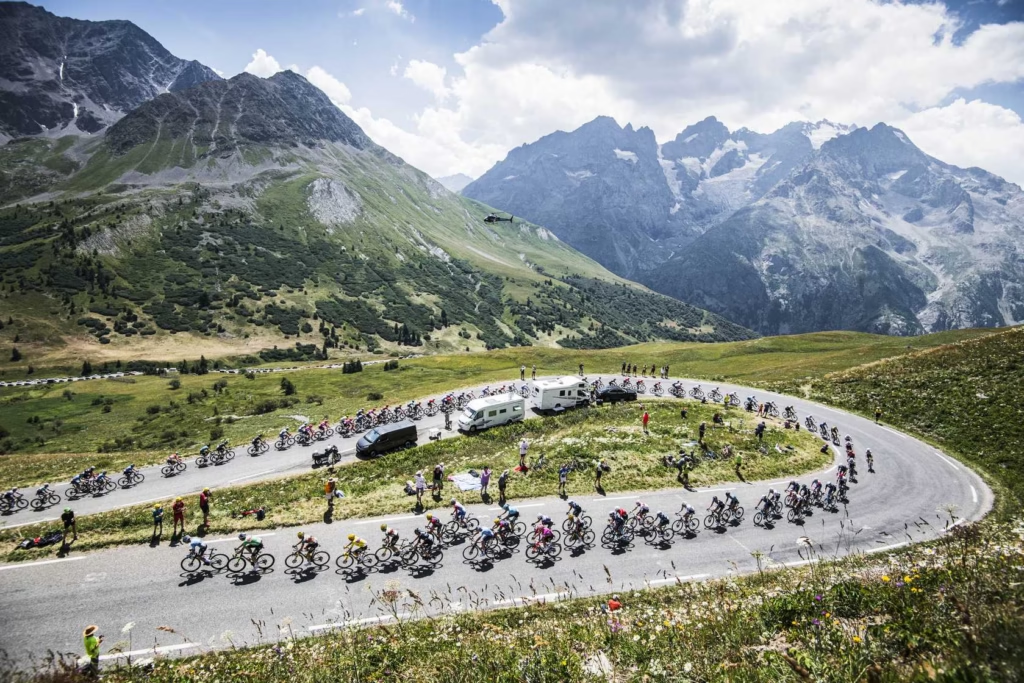
Mountain stages are where time cuts become most visible. The race can split early, the gaps can become large, and riders who are not climbing well may spend hours doing maths in their heads.
The gruppetto usually forms once the sprinters and heavier riders are dropped. Experienced riders then try to manage the gap. They know the race radio will provide updates on the cut-off, but they also need to judge the road. A long descent may help them regain time. A final climb may cost them more than expected. Bad weather can make everything harder.
Mountain time cuts are usually more generous than flat stage cuts, but that does not make them easy. The hardest days are often raced so aggressively that the cut still becomes a real threat.
The 2026 Tour’s mountain blocks in the Pyrenees and Alps should make this a recurring storyline. Our Tour de France 2026 mountain stages ranked by difficulty guide highlights the days where the cut could become especially stressful for non-climbers, while the Tour de France 2026 Pyrenees guide explains why the first mountain pressure arrives early.
Time cuts in time-trials
Time-trials have their own logic because riders are not racing in a bunch. Each rider or team starts separately, which means there is no peloton or gruppetto to help manage the day.
In an individual time-trial, riders still need to finish inside the limit, but the nature of the effort is different. The risk is usually lower for healthy riders, because the distance is shorter and the effort is controlled individually. But a rider who is ill, injured or badly fatigued can still be in danger.
Team time-trials are more complicated because the rules can affect how teams pace themselves and how many riders they keep together. The 2026 Tour opens with a team time-trial in Barcelona, which makes it important from stage 1. It is not only about the yellow jersey or GC gaps. It is also the first collective test of every team’s organisation.
Our Tour de France 2026 team time-trial explained guide breaks down how that opening stage works and why it matters.
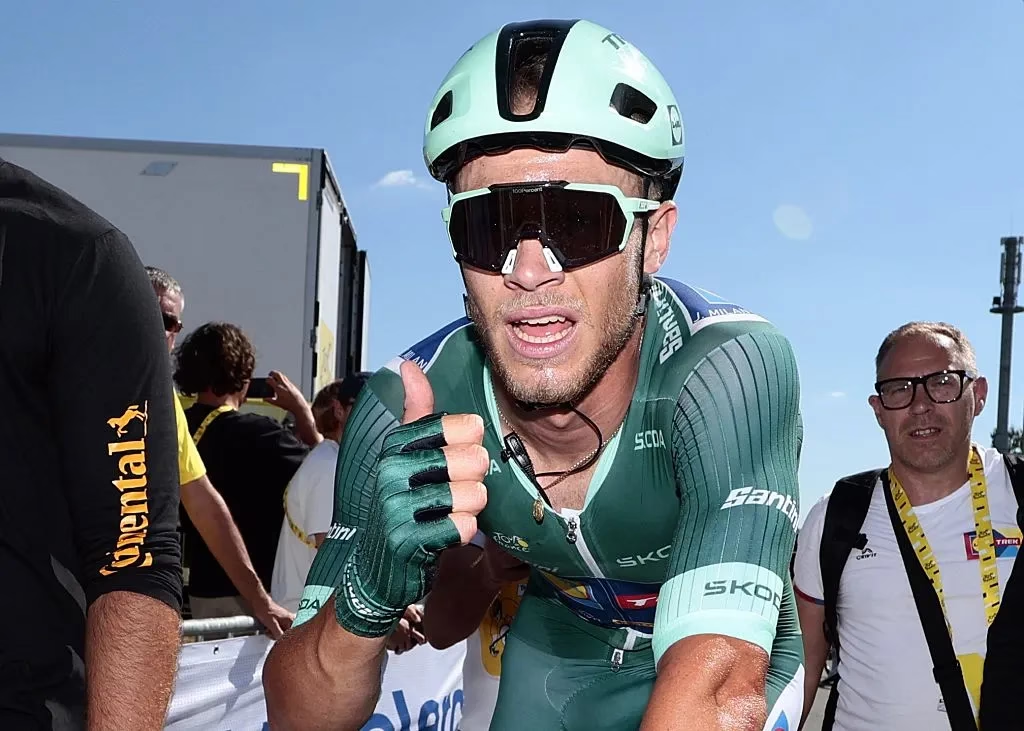 Photo Credit: Getty
Can the time cut affect the green jersey?
Yes, the time cut can have a major impact on the green jersey. Sprinters cannot win the points classification if they are eliminated in the mountains.
That is why green jersey contenders need more than sprint speed. They need climbing survival, team support, recovery and smart gruppetto riding. A rider can dominate flat sprints but lose the jersey battle if he cannot survive repeated mountain stages.
The time cut can also affect points if riders outside the limit are reinstated. In some cases, riders allowed to continue may lose points as a penalty. That can matter in a close green jersey fight.
This is why the green jersey is a three-week competition rather than just a sprint contest. The best points riders know how to score on flat days, survive hard days and avoid disaster.
Our Tour de France 2026 jerseys explained guide covers how the green jersey fits alongside the yellow, polka-dot and white jerseys.
Can the time cut affect the yellow jersey race?
The yellow jersey contenders are rarely in danger of missing the time cut, but the rule still affects the GC race indirectly.
First, time cuts can remove domestiques. If a GC leader loses key helpers in the mountains, his team becomes weaker in the final week. That can change the balance between UAE Team Emirates-XRG, Visma-Lease a Bike, Red Bull-BORA-hansgrohe, Soudal Quick-Step and other GC teams.
Second, time cuts influence how teams pace stages. If a team drives the pace extremely hard, it may not only attack rivals but also put pressure on the back of the race. This can weaken sprint teams, reduce the number of surviving support riders and change later stages.
Third, riders carrying injuries may be forced out by the time limit even if they are not direct GC contenders. That can affect team tactics and breakaway strength later in the race.
So while time cuts usually do not eliminate yellow jersey favourites, they still shape the race around them. Our Tour de France 2026 GC favourites ranked guide looks at the riders whose teams will need to manage those pressures across the full route.
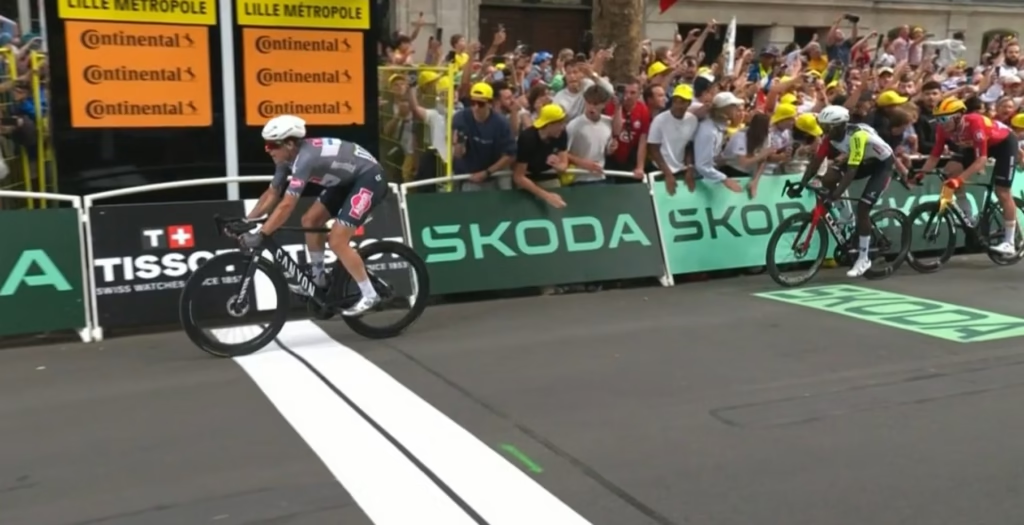
Why riders sometimes celebrate just making the cut
For a rider who has suffered all day, making the time cut can feel like a victory. This is especially true for sprinters in the Alps or Pyrenees.
Imagine being dropped early, climbing for hours, hearing that the front of the race is going faster than expected, and knowing your entire Tour could end if you lose a few more minutes. There is no stage win at stake. There may be no camera motorbike nearby. But the pressure is enormous.
When a gruppetto reaches the finish inside the limit, the relief can be obvious. Riders have protected their race. A sprinter has earned the right to contest the next flat stage. A domestique has survived to help his leader again. A team has avoided losing numbers.
That is why time cuts matter emotionally as well as tactically. They create a second race behind the race.
Famous time-cut dramas
Time-cut dramas are part of Tour de France history. They often happen when a mountain stage is raced faster than expected or when a sprinter is dropped early and has to fight all day.
Mark Cavendish has been involved in some of the most memorable modern examples, particularly on mountain stages where his green jersey hopes depended on surviving inside the limit. These days became stories not because he was fighting for the stage, but because survival itself became the drama.
That is common at the Tour. The front of the race may be about attacks, stage wins and yellow jersey gaps. Behind, another group may be calculating the cut-off, sharing work and desperately trying to stay alive in the race.
For viewers, those back-of-the-race stories can be just as revealing as the battle for the stage. They show the Tour’s depth. Not every meaningful fight happens at the front.
How fans can follow the time cut during a stage
The easiest way to understand the time cut while watching the Tour is to follow three things: the stage winner’s expected time, the stage type and the gap to the gruppetto.
Broadcasters will often mention the estimated time cut during mountain stages, especially if sprinters are in danger. Live trackers may show the gap between the front of the race and the gruppetto. Team radios and race officials will also be feeding information to riders.
A useful way to watch is:
| What to follow | Why it matters |
|---|---|
| Winner’s average speed | Helps determine the percentage used |
| Stage coefficient | Shows how strict or generous the limit is likely to be |
| Gap to the gruppetto | Tells you whether riders at the back are safe |
| Remaining climbs | Affects whether the gruppetto can recover or lose more time |
| Weather and crashes | Can influence jury decisions if many riders miss the cut |
Once you understand this, mountain stages become more interesting. The breakaway and GC fight may be at the front, but there may also be a survival race unfolding 30 or 40 minutes behind.
-
 Photo Credit: A.S.O./Billy Ceusters
Tour de France time cut FAQ
What is the time cut at the Tour de France?
The time cut is the maximum time a rider can lose to the stage winner and still remain in the race. It is calculated as a percentage of the winner’s finishing time.
Is the Tour de France time cut the same every day?
No. The time cut changes depending on the stage coefficient and the winner’s average speed. Flat, hilly, mountain and time-trial stages can all have different limits.
What happens if a rider misses the time cut?
A rider who misses the time cut is normally eliminated from the Tour de France and cannot start the next stage. The race jury can sometimes make exceptions.
Can riders be reinstated after missing the time cut?
Yes, but only at the discretion of the commissaires. This is more likely if a large group misses the cut or if exceptional circumstances affected the stage.
What is the gruppetto?
The gruppetto is the group of riders at the back of the race, usually on mountain stages, working together to finish inside the time cut.
Why do sprinters struggle with time cuts?
Sprinters are built for speed on flatter roads, not long mountain climbs. On hard mountain stages, they can be dropped early and have to ride together to survive the time limit.
Do GC riders worry about time cuts?
GC riders rarely worry about missing the time cut themselves, but they can lose domestiques if support riders finish outside the limit. That can weaken a team later in the race.
Are time cuts stricter on flat stages?
Flat stages usually have tighter time cuts because most riders are expected to finish closer to the winner. Mountain stages are generally more generous, but can still be dangerous if raced very fast.
Why time cuts are part of the Tour’s hidden drama
Time cuts are one of the Tour de France’s hidden dramas. They rarely decide the yellow jersey directly, but they shape the race every day. They decide which sprinters survive the mountains, which domestiques are still available in week three, which injured riders can continue, and how much pressure the back of the race can absorb.
They also show why the Tour is harder than the results sheet suggests. Finishing 40 minutes behind on a mountain stage may look anonymous, but for a sprinter or support rider it can be a successful day. The aim was not to win. It was to stay in the Tour.
That is why the time cut matters. It creates a race within the race, one measured not by glory but by survival. The riders at the front chase stage wins, jerseys and history. The riders at the back chase the right to start again tomorrow.
For more race explainers, route guides and jersey analysis, visit our Tour de France hub.

