Home Blog

Cycling in Umbria (Assisi / Spoleto / Norcia) – why it deserves a place on your riding list

0

Umbria is easy to overlook when planning an Italian cycling trip. Tuscany sits immediately to the west with a far bigger international profile, while the Dolomites and Bormio dominate the conversation for riders who want famous climbs. Around Assisi, Spoleto and Norcia, however, the roads and converted railway routes create a different kind of riding base: quieter, greener, less dependent on headline passes and flexible enough to combine road riding with gravel and traffic-free sections.

The strongest reason to ride here is the variety packed into a relatively compact part of central Italy. Assisi and the Umbrian valley provide gentler terrain, Spoleto gives access to the old railway towards Norcia and the Valnerina, and the hills around Norcia can turn a moderate-looking route into a serious climbing day. A week can include relaxed cycleway mileage, long road loops and mixed-surface riding without needing to move accommodation every night.
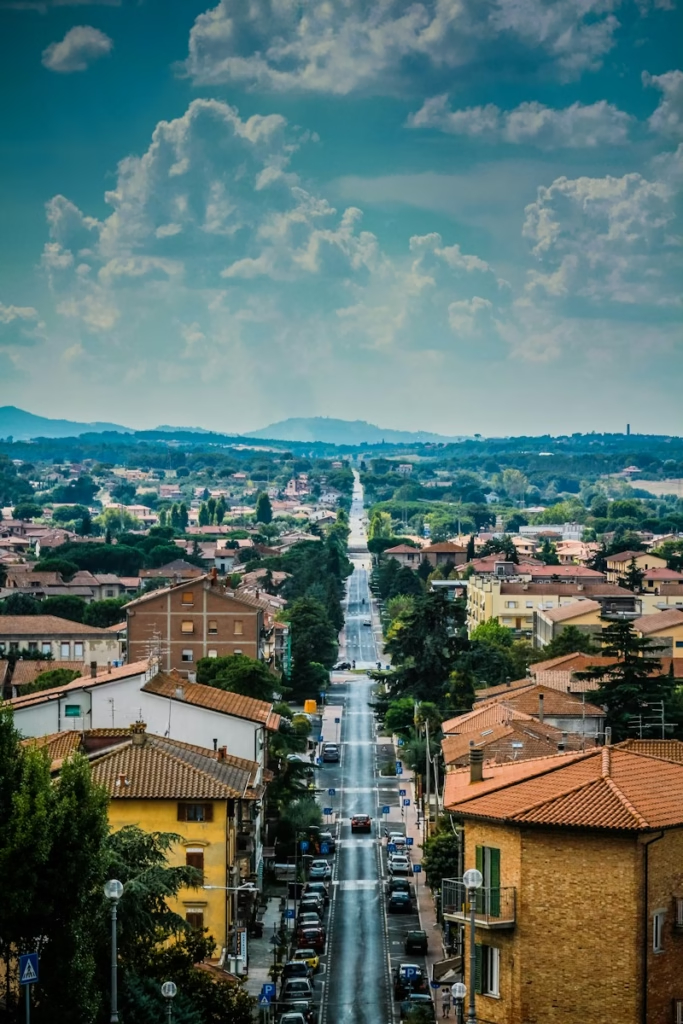
Umbria aerial photography of town

Umbria cycling at a glance

  • Best bases: Assisi for gentler valley riding, Spoleto for route variety, Norcia for harder climbing
  • Riding style: Rolling roads, Apennine climbs, converted railway paths and mixed-surface cycleways
  • Best bike: Endurance road bike for paved loops; gravel bike if the Spoleto-Norcia route is central to the trip
  • Tyres: 30-32mm for versatile road riding, wider for substantial gravel sections
  • Best period: April to June and September to October
  • Key route: Assisi-Spoleto-Valnerina corridor, with the former Spoleto-Norcia railway as the distinctive feature
  • Main challenge: Heat in midsummer and steep gradients once routes leave the valley floors
  • Ideal stay: Four to six riding days

Assisi gives the easiest introduction to the region

Assisi is the logical northern base for riders who want a gentle first day. The city itself sits on the slopes of Monte Subasio, so riding directly into the historic centre involves climbing, but the broad valley below is considerably flatter. That contrast makes it possible to choose between an easy spin and a much harder loop without travelling far.

The official Assisi-Spoleto cycle route covers 51.2km and gains relatively little height across its main valley sections. It passes Santa Maria degli Angeli, Cannara, Bevagna, Montefalco, Trevi and the Fonti del Clitunno before reaching Spoleto. The surface mixes asphalt and unpaved sections, which is important for road-bike planning. A pure race bike can handle much of the corridor, but a wider-tyred endurance or gravel setup makes the complete route more comfortable.

For stronger road riders, the official cycleway is better viewed as a spine rather than a complete day’s challenge. The hills around Montefalco and Trevi provide easy opportunities to add climbing, while Monte Subasio offers a much harder option above Assisi. The valley lets tired legs recover between efforts, something that becomes increasingly useful across a multi-day trip.

Assisi also works well for mixed groups. Riders who want distance can leave the marked route for hillier roads, while less experienced cyclists can remain on the easier corridor. That flexibility is one of Umbria’s biggest advantages over destinations built almost entirely around mountain passes.
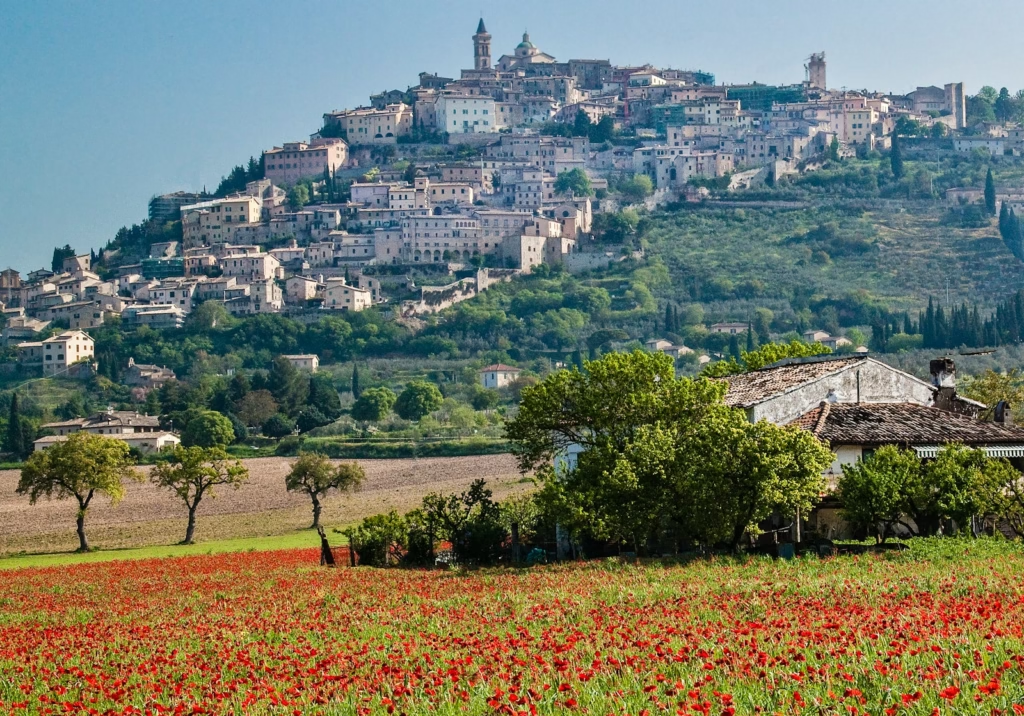
Umbria red flower field near green trees and white concrete building during daytime

Spoleto is the best all-round cycling base

If the trip is primarily about riding rather than sightseeing, Spoleto is arguably the strongest single base. The town sits at the southern end of the easier Assisi corridor and at the gateway to the Valnerina, while the former railway towards Norcia creates one of the most distinctive cycling routes in central Italy.

The old Spoleto-Norcia railway was engineered through difficult Apennine terrain, using tunnels, viaducts and gradual gradients to cross the mountains. Much of the disused alignment has been repurposed for cycling and walking. The result is very different from a normal road climb: riders gain height through a succession of shaded cuttings and tunnels rather than simply following a modern mountain road.

This is where bike choice matters most. The historic railway is not a conventional paved cycleway throughout. Gravel, rougher surfaces and tunnels make wider tyres and dependable lights sensible. A gravel bike is the obvious choice if the route is a major goal, although an endurance bike with sufficient clearance can work on suitable sections.

Spoleto also provides normal road options. The Valnerina roads follow the Nera river through steep-sided valleys, with side roads climbing quickly towards hill villages. A rider who brings a road bike can spend several days here without needing the railway at all, while a gravel bike opens another layer of the region.

The Valnerina turns a scenic trip into serious riding

South and east of Spoleto, the landscape becomes more enclosed and mountainous. The Valnerina follows the Nera through a corridor where villages sit between the river and steep slopes. Distances can look modest on a map, but side roads gain height rapidly and there are fewer long flat sections once a route turns away from the valley.

The broader Assisi-Spoleto-Cascata delle Marmore itinerary combines three cycle routes for roughly 106km. It links the Assisi-Bevagna-Spoleto corridor with the Spoleto-Norcia route and the Nera river cycleway. The official Italian tourism route describes much of it as low-traffic road or cycleway, making it a useful template even for riders who do not want to follow every kilometre exactly.

SpoletoNorcia Gravel demonstrates how much climbing the area can contain. Its 2026 routes range from 30km with around 700 metres of elevation to 140km with approximately 2,600 metres. Those figures are a useful warning against judging Umbrian rides by distance alone. A 75km mixed-surface day in the Valnerina can be a substantial ride.

Water and food planning becomes more important away from the main towns. Villages provide cafés and fountains, but opening hours are not always aligned with a British rider’s assumptions, particularly in quieter periods. Carrying enough food to finish the route without relying on one planned stop is sensible.
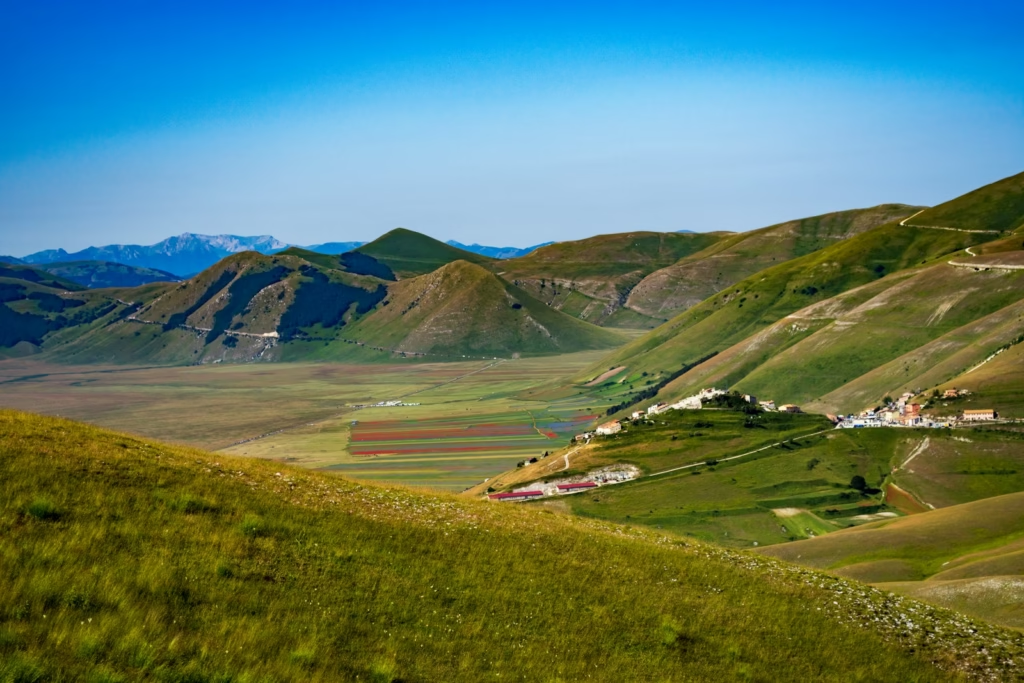
Umbria green grass field near mountain under blue sky during daytime

Norcia suits riders who want the hardest days

Norcia sits deeper in the Apennines and feels more like a mountain base than Assisi or Spoleto. The surrounding roads climb towards the Sibillini area and the high plateaux, with longer ascents and more exposure to changing weather. Riders who want the biggest climbing numbers should allocate at least one full day here.

The famous landscape around Castelluccio lies above Norcia, reached by sustained mountain roads that become especially busy when the flowering plain attracts visitors in late spring and early summer. The scenery is exceptional, but timing matters. An early start reduces traffic and gives more margin if conditions change at altitude.

Gearing should reflect the terrain rather than Italian cycling mythology. A compact chainset with at least a 30-tooth largest rear sprocket is a sensible minimum for most recreational riders, and a 32 or 34 can make consecutive climbing days considerably more enjoyable. There is no prize for turning a scenic holiday into repeated low-cadence survival.

Norcia was heavily affected by the 2016 central Italy earthquakes and reconstruction remains part of the area’s recent history. Riders should check current road and trail access rather than assuming every mapped route is permanently open. Mountain conditions, maintenance and reconstruction can all alter access.

Spring and early autumn are better than the hottest part of summer

April through June usually gives the best balance of green landscapes, comfortable temperatures and long daylight. Higher roads can still be cool in spring, particularly around Norcia, so the difference between the valley floor and the mountain sections should be taken seriously.

July and August can be very hot at lower elevations. Starting early helps, but riders planning long exposed road days may find the middle of the afternoon unpleasant. The old railway sections offer more shade than open roads, although tunnels and tree cover do not remove the need to carry enough water.

September and early October are excellent alternatives. Temperatures are generally more manageable, tourist traffic eases and the region remains warm enough for long road rides. Daylight becomes the main constraint later in autumn, while mountain weather around Norcia can change much faster than conditions in the valley.
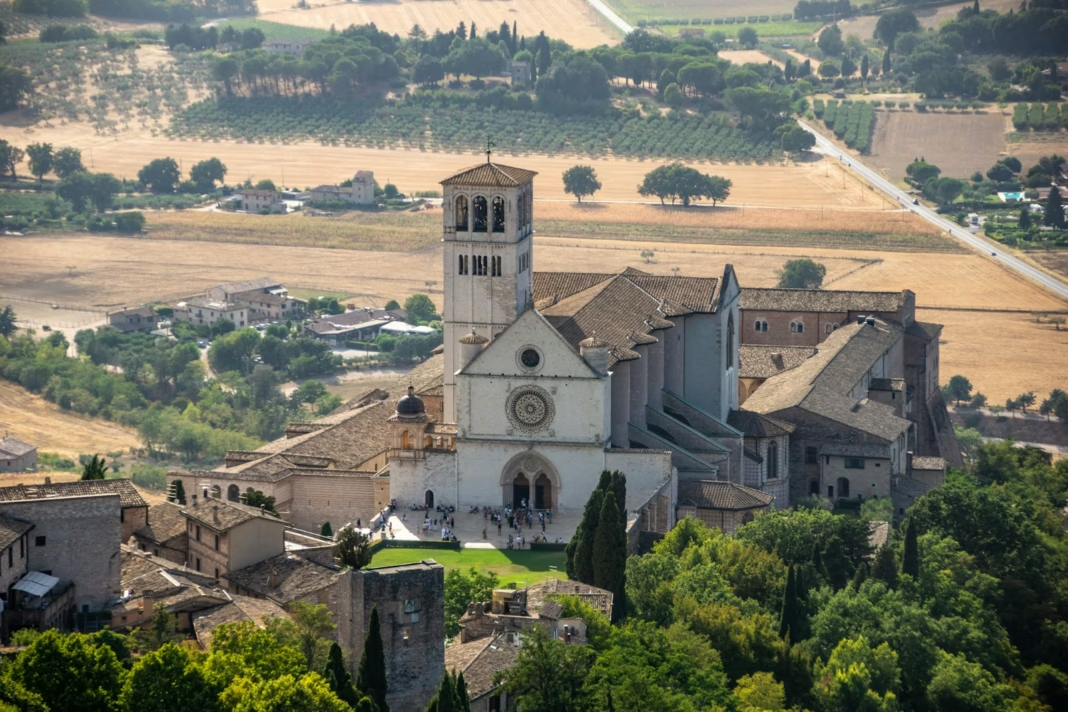
A five-day trip can combine all three areas without rushing

Use the first day around Assisi for a moderate valley ride, adding Montefalco or Trevi if the legs feel good. Day two can follow the corridor towards Spoleto, either as a point-to-point ride with luggage transferred or as part of a loop if the trip is based in one place.

Day three should focus on the Spoleto-Norcia railway and Valnerina, using a gravel or wider-tyred bike where appropriate. Day four can be the hardest road ride, moving towards Norcia and the higher Apennine roads. Keep day five flexible for a shorter recovery loop, another gravel section or a return towards Assisi.

That structure also works well as part of a broader Italian trip. Riders who want a more road-focused wine-and-hills experience can compare it with ProCyclingUK’s guide to cycling in Lucca and northern Tuscany, while Puglia provides a flatter southern alternative. More destination ideas are collected in the cycling travel hub.

Umbria works because it does not force one type of riding onto the whole holiday. Assisi provides access and gentler terrain, Spoleto connects roads with one of Italy’s most unusual railway conversions, and Norcia supplies the climbing. For riders who want Italy without building the trip around famous professional passes, that combination is unusually strong.

Blanka Vas joins Lidl-Trek through 2028 after early SD Worx-Protime exit

0

Blanka Vas will join Lidl-Trek from October on a contract running through the end of 2028, bringing her long spell with Team SD Worx-Protime to an earlier conclusion than previously expected.

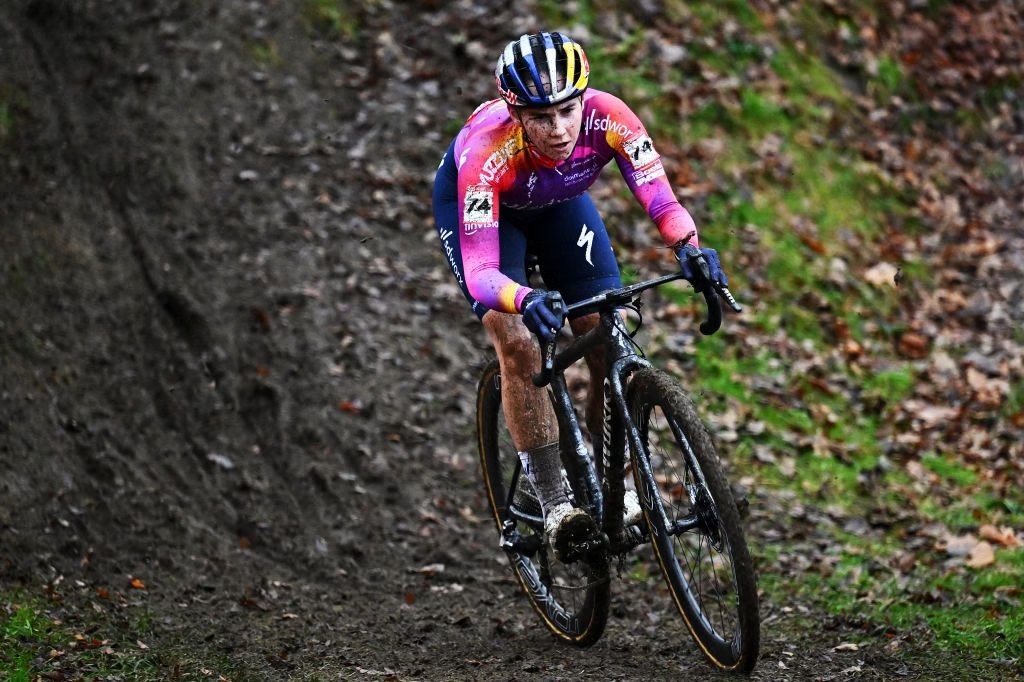
The 25-year-old Hungarian will make the switch in time for the 2026-27 cyclocross season before beginning her first full road campaign with Lidl-Trek in 2027. Vas had previously been contracted to SD Worx-Protime through the end of 2027, meaning the agreement allows her to leave a year before the scheduled end of that deal.

For Lidl-Trek, the signing adds another rider capable of operating across several different parts of the calendar. Vas has already won stages of the Tour de France Femmes and Giro d’Italia Women, competed for Olympic medals on both the road and mountain bike and established herself among the leading riders in cyclocross.

“I have very good feelings about it and can’t wait to get to know everyone in the team. I am super excited,” Vas said.

“I’m mostly looking forward to the new environment, the new challenges and everything I can learn. I’m excited to start this new chapter, get to know everyone and see what we can achieve together as a team.”

Blanka Vas

Vas looking for more leadership opportunities

The move gives Vas an opportunity to explore a greater leadership role after spending much of her WorldTour career within the unusually deep SD Worx-Protime structure.

She has frequently been able to race for her own results, particularly on punchier stages and selective one-day courses, but has also spent significant periods working alongside riders including Lorena Wiebes, Lotte Kopecky and Anna van der Breggen.

At Lidl-Trek, Vas is not expecting to become an automatic leader in every race. The attraction appears to be having more chances to test herself in that position while continuing to develop.

“I hope I can keep improving and become a stronger rider,” she said. “I’d also like to get some experience in a leadership role at some races and see how I can handle that. I think it would be a good opportunity for me to learn and grow.”

Her profile fits a Lidl-Trek women’s squad which has increasingly moved towards having several different cards rather than depending on one leader across an entire block of races.

Vas can sprint from reduced groups, survive difficult climbing better than most fast finishers and attack from distance. That gives Lidl-Trek options in the Ardennes, hilly stage races and harder one-day events without committing her to a single speciality.

Vas reunited with Niamh Fisher-Black

The transfer will reunite Vas with Niamh Fisher-Black, who left SD Worx-Protime for Lidl-Trek at the end of 2024.

“I don’t know too many people on the team yet, but I’ve been teammates with Niamh before and I really enjoyed racing with her,” Vas said.

“I’m really happy that we’ll be wearing the same colours again.”

Fisher-Black’s move to Lidl-Trek was also partly about creating more room for her own ambitions after several seasons inside SD Worx-Protime’s crowded leadership structure.

Vas now follows a similar route, although their strengths are very different. Fisher-Black has developed predominantly as a climber and general classification rider, while Vas gives Lidl-Trek another option for the shorter, sharper races where positioning and finishing speed become as important as pure climbing ability.

Tour de France and Giro stage winner

Vas joined SD Worx midway through the 2021 season and quickly became one of the most unusual riders on the women’s roster because of the range of disciplines she continued to combine.

Her first Giro d’Italia Women stage victory came in 2023, while one of her biggest road wins followed at the 2024 Tour de France Femmes.

Vas won Stage 5 of the 2024 Tour de France Femmes in Amnéville, beating Kasia Niewiadoma and Liane Lippert from the reduced front group on the same afternoon that teammate Demi Vollering lost the yellow jersey following a late crash.

She had arrived at that Tour only days after finishing fourth in the Paris Olympic road race, where she was part of the decisive front group before Kristen Faulkner attacked clear to win gold.

Vas has also been a regular Hungarian champion and has collected major results in cyclocross and mountain biking, including another fourth place at the Tokyo Olympic mountain bike race.

It is that ability to move between disciplines that Lidl-Trek intend to preserve.

divBlanka-Vas-holds-off-Zoe-Backstedt-in-thrilling-womens-Maasmechelen-World-Cupdiv-1

Cyclocross switch will happen almost immediately

Vas will not have to wait until January to race for her new team.

Her Lidl-Trek contract begins in October, allowing her to compete in the team’s colours during the upcoming cyclocross season. The timing makes the move particularly striking after SD Worx-Protime had recently increased its own investment in Vas’s winter programme.

Former world champion Sanne Cant joined SD Worx-Protime as a cyclocross coach in 2025, with Vas and Marie Schreiber among the riders at the centre of that project.

Lidl-Trek team manager Frank Schleck made clear that cyclocross remains part of the plan rather than something the team expects Vas to reduce.

“We’re especially excited that she’ll pull on the Lidl-Trek jersey very soon for the upcoming CX season,” Schleck said.

“Blanka represents exactly the kind of ambitious, multi-discipline rider we want to build our future around.”

Lidl-Trek continue building towards 2027

Vas is the latest addition to a Lidl-Trek roster that is already being reshaped for next season.

The team recently confirmed that Julia Kopecky will also join Lidl-Trek through 2028, with the Czech champion another rider whose value comes from being useful across several different types of racing.

Vas arrives with considerably more WorldTour experience despite still being only 25.

“I’ve followed her closely over the last few years and have always believed in the level she can reach,” Schleck said.

“At Lidl-Trek, our ambition is not only to bring together the best talent, but to create an environment where riders can develop, challenge themselves and reach their full potential. We believe we can give Blanka exactly that.”

For Vas, the first test comes almost immediately. Rather than seeing out another winter with SD Worx-Protime before changing teams in January, she will begin racing in Lidl-Trek colours during the coming cyclocross season.

The road programme and the extent of her new leadership opportunities will follow in 2027.

What Women’s Cycling GP Stuttgart & Region 2026 means for the season

0

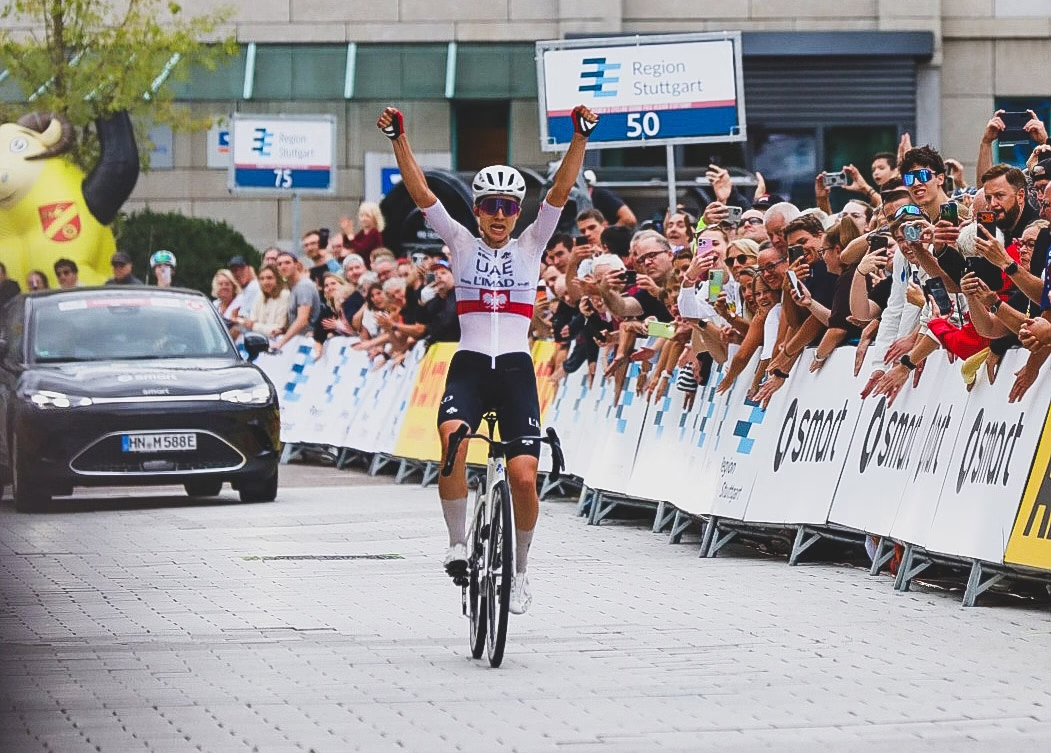
Dominika Włodarczyk’s victory at the 2026 Women’s Cycling Grand Prix Stuttgart & Region fits neatly with the direction of her season. The Polish champion did not wait for Elisa Balsamo in Tamm, attacked from the reduced race and stayed away, giving UAE Team L’IMAD a third consecutive win at the event without relying on two-time defending champion Eleonora Gasparrini.

That makes the result more useful than a simple late-season victory. Włodarczyk has moved from high-level support rider to a rider capable of deciding major races herself, UAE again showed why depth is such a powerful one-day weapon, and Balsamo’s second place confirmed the tactical cost of carrying the fastest finish in a selective group. With the World Championships close, Stuttgart supplied several clear form signals.

Włodarczyk’s 2026 season has changed her place in the hierarchy

Włodarczyk’s win should not be treated as a surprise produced by a weak field or a fortunate escape. Her year already included two Women’s WorldTour stage victories at Itzulia Women, both Polish national titles and seventh overall at the Tour de France Femmes. Stuttgart adds a ProSeries one-day victory to a season that has steadily broadened the types of races she can win.

The important change is tactical. Earlier in her career, rivals could afford to interpret a Włodarczyk attack partly through the riders behind her. If a teammate had a faster finish, the move could look like pressure rather than the final decision. That is no longer safe. Her back-to-back Itzulia stage wins showed that she can convert late aggression herself, and Stuttgart provided another example.

That development gives Poland another serious option for selective championships and gives UAE a rider whose value is no longer dependent on protecting somebody else. The Stuttgart race report showed how quickly the tactical burden shifted once she was clear.

divGrand-Prix-Stuttgart-Region-Eleonora-Gasparrini-does-it-again-with-canny-late-attackdiv-1Photo Credit: Getty

UAE’s third straight win says more than Gasparrini’s old course record

Eleonora Gasparrini won this race in 2024 and 2025, first from a small selection and then with a late attack. The switch to a new Tamm-based course could easily have ended UAE’s run because the previous victories had been so closely associated with Gasparrini’s finishing speed and timing.

Instead, the team found a third route to the same outcome. The 2026 Stuttgart route placed most of the climbing before the final three local circuits, which encouraged stronger all-rounders to attack before the race became easier to organise. Włodarczyk used exactly that transition.

UAE’s strength was that they did not need one predetermined scenario. Gasparrini remained dangerous if a reduced group reached the finish, while Włodarczyk, Silvia Persico and Karlijn Swinkels gave the team alternatives if the race became more aggressive. When Włodarczyk escaped, UAE could stop contributing behind and leave Lidl-Trek and the other sprint teams with the chase.

That is the kind of depth that repeatedly wins modern one-day races. It reduces the need for a single leader to respond to every move and forces rivals to make decisions before they know which UAE rider will ultimately be protected.

Balsamo’s second place confirms the problem of being the obvious sprinter

Elisa Balsamo did much of what Lidl-Trek needed. She survived a route containing roughly 1,700 metres of climbing, remained in contention through the repeated attacks and then won the sprint from the group behind Włodarczyk. The problem was that everybody else understood what would happen if the race came back together.

That changes the economics of a chase. Lidl-Trek had a clear reason to close the gap, but teams without a rider capable of beating Balsamo had far less incentive to spend their remaining domestiques helping. Włodarczyk did not need a huge advantage; she needed enough separation to create hesitation behind.

The result therefore should not be read as evidence that Balsamo lacked form. It points in the opposite direction. Her finishing speed was strong enough to make rival teams reluctant to cooperate, and second place was the consequence of being tactically feared. The pre-race contenders analysis identified that tension before the start.

Sandrine Tas 2026 Bretagne Ladies Tour Stage 1Photo Credit: Bretagne Ladies Tour

Sandrine Tas continues to turn opportunities into serious results

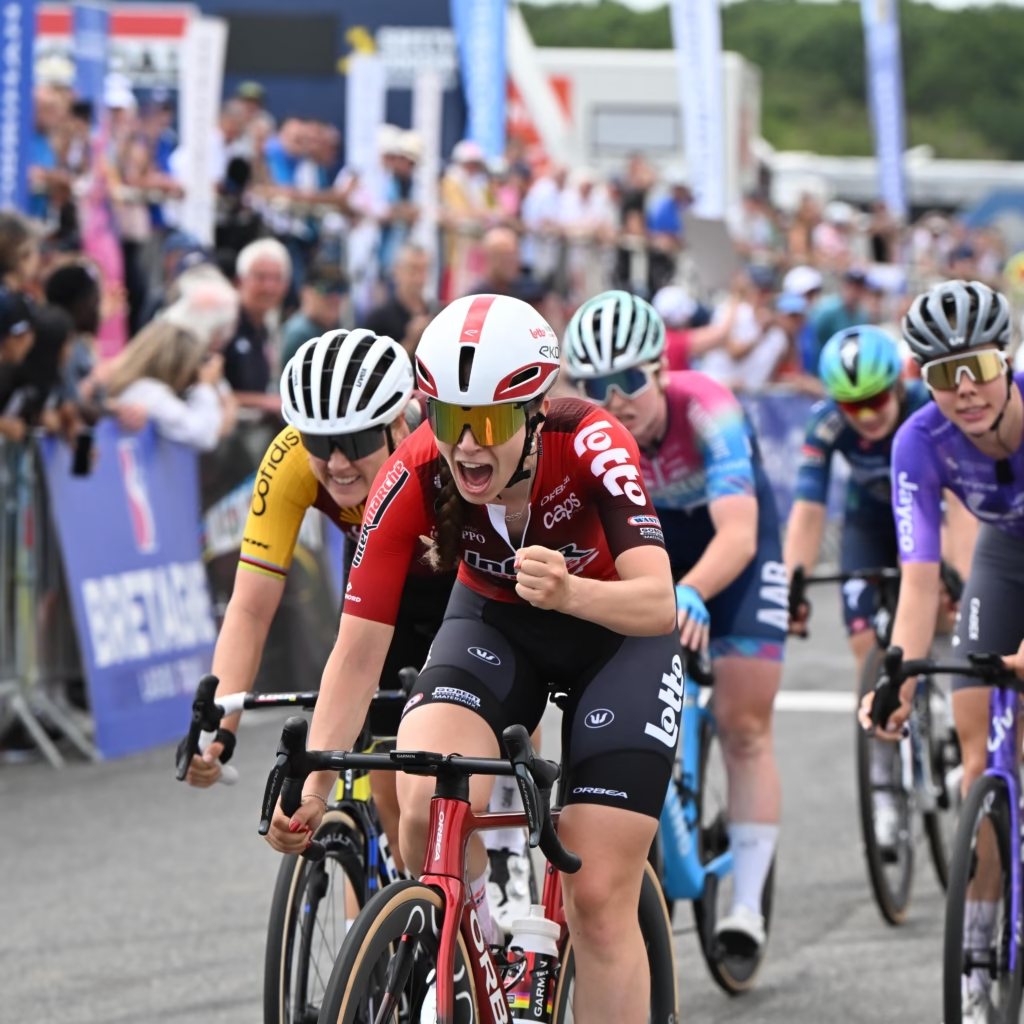
Sandrine Tas taking third for Lotto Intermarché Ladies was another significant result. The Belgian was not the most heavily marked rider in the field, but she stayed with the decisive race and still had enough speed to make the podium after a demanding 134.7km.

For riders outside the very largest teams, late-season ProSeries races can be particularly valuable because the fields are strong enough for the result to carry weight without being completely dictated by one dominant WorldTour structure. Tas used Stuttgart to place herself directly behind two established international winners.

That sort of performance matters when teams are assessing 2027 roles and when national selectors are looking for riders who can survive hard one-day racing. It is not the same as winning, but repeated presence near the front is how status changes over a season.

The new Tamm course has given the event a stronger tactical identity

The first three editions of the race were point-to-point affairs into Stuttgart. For 2026, Tamm hosted both start and finish and the riders completed two larger loops followed by three 11.8km finishing circuits. The redesign altered the geography without making the race easier to control.

Most of the climbing came before kilometre 100, which meant teams reached the finishing circuits after already spending riders and absorbing repeated accelerations. A flatter final section does not automatically produce a sprint if the teams capable of organising one have already been weakened.

Włodarczyk’s win gives the new format immediate credibility. It continued the pattern described in ProCyclingUK’s history of the Women’s Cycling Grand Prix Stuttgart & Region: all four editions have rewarded riders willing to race actively rather than wait for a large peloton to reach the line.

For Montréal, the form signal is stronger than the course comparison

Stuttgart is not a miniature version of the World Championships. Montréal will be longer and substantially harder, so none of the podium riders can simply transfer this result into a forecast for the rainbow jersey.

The form signal still matters. Włodarczyk is climbing well, racing aggressively and finishing moves after a long season. Balsamo is surviving enough climbing to remain dangerous deep into selective one-day races. Those are useful pieces of information for national teams deciding how early they need to attack and which riders can be protected into the final laps.

Stuttgart’s biggest lesson is about Włodarczyk rather than one championship. She has reached the point where allowing her a gap can decide a race. UAE already knew that from Itzulia. The rest of the peloton has now had another reminder on a very different course.

What GP Montreal 2026 means for the season

0

Isaac del Toro winning the 2026 Grand Prix Cycliste de Montréal would have carried weight on any version of the race. Doing it on the same Mount Royal circuit that will decide the men’s road world title in two weeks makes the result considerably more useful. Del Toro beat 19-year-old Paul Seixas in a two-rider finish, Brandon McNulty gave UAE Team Emirates-XRG third place and Remco Evenepoel finished fifth after winning GP Québec two days earlier.

Montréal did not decide the World Championships in advance, but it did reveal several things national teams now have to account for. Del Toro can win on the circuit, Seixas can make the decisive selection at elite level, UAE’s depth translated directly into control and Evenepoel proved that even excellent form does not guarantee tactical command on a course with repeated opportunities to attack.

Del Toro has gone from dangerous outsider to obvious Worlds threat

Before the Canadian races, Del Toro was already one of the most difficult riders to classify. His 2026 season included stage-race victories at the UAE Tour, Tirreno-Adriatico and Tour Auvergne-Rhône-Alpes, demonstrating climbing depth and the ability to finish hard mountain stages. Montréal added a different piece of evidence.

The Mexican did not win because one long climb allowed him to ride everybody off his wheel. He survived a race with constant reshuffling, had teammates placed in dangerous moves, responded when Seixas attacked on the final Camillien-Houde ascent and then had the finishing power to beat the Frenchman on Avenue du Parc. That combination is much closer to what a World Championship requires.

ProCyclingUK’s GP Montréal race report showed how UAE repeatedly placed riders ahead of Del Toro before he made the decisive bridge. He was not asked to spend the final 50km responding to every acceleration. That matters because Mexico will not have the same numerical strength at the Worlds.

The result therefore raises Del Toro’s individual status while also identifying the central problem he will face in national colours. He has proved he can win on the roads. Recreating the protected route into the finale will be harder without McNulty, Adam Yates and the rest of UAE shaping the race around him.

divI-was-here-to-make-mistakes-–-Paul-Seixas-confident-he-can-improve-after-second-at-GP-de-Montreal-and-return-even-stronger-for-World-ChampionshipsdivPhoto Credit: Getty

Seixas produced the kind of ride France can build around

Paul Seixas did not win, but second place may have changed France’s World Championship calculations almost as much as Del Toro’s victory changed Mexico’s. At 19, Seixas attacked on the final Camillien-Houde climb, reached Ben Healy and forced Del Toro to respond. He was not simply following stronger riders until the sprint.

That distinction matters. A young rider can collect a major placing by surviving in a reduced group and using speed at the finish. Seixas instead helped create the decisive selection on a circuit with more than 4,300 metres of climbing. The physical demand will be greater in the World Championship because of the longer distance, but the tactical evidence is already strong.

France now has to decide how much freedom to give him. Protecting a teenager as a sole leader would be premature in such a long race, but using him merely as support would ignore what Montréal demonstrated. The sensible advantage is flexibility. Seixas can attack early enough to force stronger nations to chase without the move being treated as a disposable secondary option.

UAE showed the template every strong national team will want to copy

Del Toro’s victory was the headline, but UAE’s use of numbers may be the most important tactical lesson from the race. Adam Yates was present when Ben Healy and Maxim Van Gils went clear. McNulty bridged later and remained strong enough to finish third. Del Toro could therefore wait until the decisive phase rather than chase every move himself.

That is particularly relevant to Belgium, France and other nations with several plausible winners at the World Championships. The temptation in a championship is to identify one leader and spend the rest of the team protecting them. Montréal suggested the opposite approach can be more powerful on this circuit. Putting credible riders ahead forces rivals to work and reduces the number of accelerations the nominal leader must answer.

The GP Montréal team-by-team guide identified UAE’s depth as one of their biggest strengths before the start. First and third was the cleanest possible confirmation. National teams with several high-level options will have noticed.

divI-dont-need-to-start-panicking-–-Remco-Evenepoel-already-refocused-on-World-Championships-after-missing-freshness-and-punch-in-GP-de-MontrealdivPhoto Credit: Getty

Evenepoel remains a favourite, but Montréal exposed the danger of isolation

Remco Evenepoel arrived after winning GP Québec in impressive fashion, where he attacked with Giulio Ciccone and then beat the Italian in the finish. Fifth in Montréal does not reverse the form signal from Québec. It does show that the harder circuit creates more ways for the race to escape his control.

Evenepoel missed the first version of the decisive selection and had to spend energy working back into contention. By the time Seixas and Del Toro moved on the final lap, the Belgian was no longer in the position to dictate the race. On a course where attacks can come from several different points, even one moment of hesitation can force a costly chase.

That makes Belgium’s team structure important. Evenepoel may enter the Worlds as the obvious reference after his GP Québec victory, but the presence of Wout van Aert and other strong riders gives Belgium the chance to avoid making every tactical decision depend on him. Montréal was evidence for sharing the burden, not evidence against Evenepoel’s condition.

The World Championship circuit is selective without being predictable

The redesigned GP Montréal route used 16 laps of the 13.4km Mount Royal circuit and accumulated roughly 4,304 metres of climbing. Camillien-Houde is the main reference point, but the repeated smaller climbs and constant loss of team numbers create much of the difficulty.

The race did not wait obediently for the final climb. Early moves were caught, new groups formed, Healy attacked alone and the final selection was still changing inside the last lap. That is likely to be one of the defining characteristics of the Worlds. The circuit is hard enough to weaken teams but not so singular that everybody has to attack at the same obvious point.

That favours riders who can read a race as well as climb. Del Toro and Seixas reached the final kilometre because they recognised the decisive moment. McNulty reached the podium because he had spent earlier parts of the race creating tactical pressure. A strong watts-per-kilogram figure is necessary here, but it is not a complete plan.

Pogačar’s absence has turned the Worlds into a genuinely open tactical race

Tadej Pogačar’s season-ending Vuelta crash removed the rider who would otherwise have shaped almost every team’s strategy. Without him, there is no single opponent everybody can assume will make the race at one predetermined moment. Montréal looked like a preview of the consequences.

Del Toro, Seixas, Evenepoel, McNulty, Quinn Simmons, Healy and others all occupied threatening positions at different stages. No rider was strong enough to close every move personally. That encourages national teams to use numbers and take calculated risks rather than wait behind one overwhelming favourite.

The GP Montréal start list was strong enough for the result to mean something, but a World Championship is longer and governed by national rather than trade-team loyalties. The hierarchy can still change over the next two weeks.

What changed on Sunday is the burden of proof. Del Toro no longer has to argue from potential on this circuit, because he has won on it. Seixas has shown he can make the decisive attack. Evenepoel remains in form but has seen how easily the race can become fragmented. Montréal did not settle the rainbow jersey. It made the list of credible ways to win it considerably longer.

What Vuelta a España 2026 means for the season

Enric Mas winning the 2026 Vuelta a España changes the shape of his career and gives Spanish cycling a home Grand Tour winner for the first time since Alberto Contador in 2014. After three previous second places at the Vuelta, Mas finally converted years of consistency into the result that had remained missing from his palmarès, finishing ahead of Primož Roglič and Felix Gall after three weeks in which the race changed dramatically when Tadej Pogačar crashed out on stage 8.

The final classification matters beyond the red jersey. Movistar have a Grand Tour victory around which to build, Roglič leaves another three-week race with a podium but without the record fifth Vuelta he was chasing, Gall has strengthened his status among the best pure climbers, and the points, mountains and young-rider classifications all produced riders whose 2026 seasons now look different from how they began.

Vuelta-a-Espana-stage-19-LIVE-Enric-Mas-defends-red-jersey-on-first-day-of-climactic-mountain-double-header

Mas has finally changed the first sentence of his career

For years, the simplest description of Mas was built around what he had nearly won. Three runner-up finishes at the Vuelta made him one of the most consistent Grand Tour riders of his generation, but also made every new challenge feel like another attempt to escape the same label.

Winning in 2026 removes that qualification. The story of how Mas won the Vuelta is not a tale of one explosive mountain attack. He took the jersey after Pogačar’s withdrawal and then spent the rest of the race defending it intelligently, absorbing Roglič’s gains in the Jerez time trial and protecting himself through the decisive mountain stages.

Stage 20 at Collado del Alguacil was the final proof. With more than 5,000 metres of climbing in the stage, Mas did not crack under the last major pressure and actually finished the day with a 2:15 advantage over Roglič. That was the performance that turned a lead created by circumstance into a Grand Tour victory earned across the full race.

The distinction matters. Pogačar’s crash changed the Vuelta, but Mas still had to beat everybody who remained. A three-week race does not award the final jersey for being in the right place on stage 8. It rewards the rider who can defend the position through the following thirteen stages.

Movistar have the result their entire project needed

Mas’s victory is equally significant for Movistar. The team has spent years carrying enormous Spanish expectations while competing against squads with greater budgets and deeper Grand Tour rosters. A home Vuelta victory gives that strategy a tangible return.

The team’s work after Mas took red was rarely spectacular, but it was effective. They controlled dangerous moves when necessary, protected him through crosswind and mountain stages and avoided the tactical panic that can consume a team defending a Grand Tour lead for the first time in years.

That matters for 2027 planning. Movistar no longer need to discuss Mas purely in terms of whether he can finally win a Grand Tour. They can build a programme around a rider who has done it. The psychological difference is difficult to measure, but the sporting difference is obvious.

divSecond-place-is-a-victory-for-me-after-pre-race-training-crash-and-injuries-Primoz-Roglic-celebrates-hard-fought-runner-up-spot-in-Vuelta-a-EspanadivPhoto Credit: Getty

Roglič remains extraordinarily consistent, but the margin for error is smaller

Primož Roglič finished second after entering the race with the possibility of becoming the first five-time Vuelta winner. He took time from Mas in the stage 18 individual time trial, but the 33 seconds gained were not enough to overturn the larger deficit created in the mountains.

Second place should not be dismissed. Roglič remains capable of reaching a Grand Tour podium deep into his career and was the closest rider to Mas when the race reached Granada. The issue is that the old formula of limiting losses in the mountains and taking decisive time against the clock no longer gives him the same margin it once did.

Mas rode the Jerez time trial well enough to contain the damage and then had enough climbing form to protect himself on stage 20. Roglič therefore needed a larger advantage from the discipline that has so often separated him from his rivals. The race showed that he can still contend for Grand Tours, but also that he needs the course and the mountain balance to work more precisely in his favour.

Gall’s podium confirms he belongs in the front rank of Grand Tour climbers

Felix Gall finishing third is another important outcome. The Austrian has produced major mountain performances before, but a Vuelta podium strengthens the case that he should now be judged as a genuine Grand Tour leader rather than a climber capable of occasional high general-classification finishes.

His limitation remains the same. Against riders such as Mas and Roglič, time trials can make the route to overall victory extremely narrow. Gall was one of the strongest climbers in the race and gained time on Roglič in the final mountain stage, yet still finished behind him overall.

For Decathlon CMA CGM, the result fits a season in which the team has continued to build greater depth around stage racing. Gall does not need to become an elite time triallist, but every improvement against the clock increases the number of Grand Tour routes on which he can realistically challenge for victory.

divTadej-Pogacars-brutally-unexpected-exit-from-the-Vueltaa-Espana-is-a-massive-reminder-of-cyclings-intrinsic-unpredictability-AnalysisdivPhoto Credit: Getty

Pogačar’s withdrawal changed the race without invalidating it

No analysis of the 2026 Vuelta can avoid Pogačar’s stage 8 crash and subsequent withdrawal. He began the race as the central favourite and his departure removed the rider most likely to control the general classification through raw superiority.

What followed was a different race, not an illegitimate one. Grand Tours have always been shaped by crashes, illness, weather and tactical mistakes. The riders who remain still have to complete the course and beat one another. Mas’s responsibility was not to prove he would have beaten Pogačar in an imaginary uninterrupted race; it was to win the race that actually existed after stage 8.

The wider consequence is that Pogačar’s season ended early and the World Championships picture changed with it. His absence from Montréal opens the men’s road race substantially, while Mas’s Vuelta victory ensures the season is not remembered only through the rider who left it injured.

Van Aert, Buitrago and Onley leave with classifications that matter

The final Vuelta classifications also gave Wout van Aert the points jersey and supercombativity award, Santiago Buitrago the mountains classification and Oscar Onley the white jersey.

Van Aert’s green jersey reinforces his value across the whole structure of a Grand Tour. He did not need to be the fastest pure sprinter every day because he could collect points on terrain that removed heavier specialists. That versatility remains one of Visma | Lease a Bike’s most useful weapons.

Buitrago’s mountains jersey rewards a race built around repeated climbing ambition, while Onley’s young-rider victory adds another substantial stage-race result to the British rider’s development. Neither classification carries the prestige of red, but both can shape leadership opportunities and race programmes next season.

Spain’s 12-year wait changes the emotional weight of the result

Spain had not produced a Vuelta winner since Contador in 2014. That drought had become increasingly awkward for a country with such a deep road-racing culture and such a central role in the WorldTour calendar.

Mas ending it matters because he has carried much of that pressure himself. He was repeatedly the highest-placed Spanish Grand Tour rider, repeatedly close to winning the Vuelta and repeatedly measured against champions from an earlier generation. Granada finally gave him the result that makes those comparisons less important.

The final stage itself, won by Tobias Halland Johannessen, was largely ceremonial for the general classification. The significance had been built over the previous three weeks. Mas leaves the 2026 Vuelta as a Grand Tour winner, Movistar leave with their biggest stage-race result in years and Spanish cycling no longer has to count backwards to 2014 when discussing its most recent home champion.

What La Choralis Fourmies Féminine 2026 means for the season

0

Lorena Wiebes winning La Choralis Fourmies Féminine again is not surprising. The more revealing part of the 2026 result is how little the order behind her changed. Lara Gillespie was second, Gladys Verhulst-Wild third, Nienke Veenhoven fourth and Kathrin Schweinberger fifth, reproducing the first five places from 2025 exactly despite a revised route and another year of development for the riders trying to close the gap.

That makes Fourmies useful as a late-season reference point. Wiebes remains the strongest benchmark in this type of race, Gillespie is becoming a remarkably consistent challenger, and the extra rolling terrain still did not fundamentally alter the advantage held by riders who can survive repeated accelerations and then sprint. With the World Championships approaching, those conclusions matter beyond one French ProSeries race.

Wiebes has made survival part of her sprinting advantage

The obvious way to beat Wiebes has always been to prevent her reaching a sprint. The difficulty in 2026 is that the range of races in which she can survive has continued to expand. Fourmies added another loop between Avesnes-sur-Helpe and Sains-du-Nord, extending the rolling middle section before the return to the local circuits, but the extra fatigue was not enough to separate her from the fastest riders.

That fits a season in which Wiebes has repeatedly shown that harder racing does not necessarily solve the problem. She has won when races stayed controlled and when they became selective, leaving rival teams with fewer obvious tactical routes. The Fourmies contenders preview framed the central problem before the start: opponents needed disorder, repeated attacks or crosswind pressure rather than simply hoping the additional climbing would remove her.

They did not create enough separation. Once Wiebes reached Fourmies in position to sprint, the result returned to the most familiar outcome in women’s cycling. That is important because it shows how complete the SD Worx-Protime rider has become. The sprint remains the final weapon, but surviving the road that leads to it is increasingly part of the same package.

divLara-Gillespie-strikes-for-gold-in-elite-womens-time-trial-debut-at-Irish-National-Time-Trial-Championshipdiv

Gillespie is no longer producing isolated breakthrough results

Lara Gillespie finishing second to Wiebes for a second consecutive year is a stronger result than another runner-up line might suggest. The Irish rider has spent 2026 moving from promising fast finisher towards a rider who can repeatedly contest important one-day races, and Fourmies reinforces that progression.

There is still a clear gap between challenging Wiebes and beating her. Gillespie did not find the speed required in the final metres, just as she could not in 2025. What has changed is the level of certainty around her own place in these finales. She can now enter sprint-heavy ProSeries races with a realistic expectation of making the podium rather than needing a perfect day to get there.

That matters for UAE Team L’IMAD because Gillespie provides a different tactical option from the team’s climbers and attacking all-rounders. The 2026 Fourmies start list contained considerable sprint depth, yet she again emerged as Wiebes’ closest rival. Repetition at that level is usually the point at which a rider’s status changes.

The identical top five exposes how stable this type of hierarchy can be

The most striking statistic from Fourmies is not Wiebes’ second victory. It is that Wiebes, Gillespie, Verhulst-Wild, Veenhoven and Schweinberger finished first through fifth in exactly the same order as they did twelve months earlier.

One-day racing is normally too volatile for that kind of repetition. Positioning, crashes, wind, team support and the timing of attacks can reorder a result even when the same riders arrive in similar form. Fourmies instead produced an unusually clean comparison between two editions and suggests that its particular demands continue to reward a very specific combination of durability and finishing speed.

The revised 2026 route was supposed to increase the opportunity for attackers. It did add fatigue, but not enough to rewrite the final hierarchy. That is useful information for organisers as well as teams. If Fourmies wants to remain a sprint Classic, the balance is working. If it wants a wider range of possible winners, a bigger structural change would probably be required.

Verhulst-Wild and Veenhoven remain valuable late-season references

Gladys Verhulst-Wild’s third place continued a strong season in which she has been able to convert sprint opportunities while also contributing in races that are too hard for pure specialists. Fourmies suits that profile and her second consecutive podium confirms that the 2025 result was not simply a product of one well-timed sprint.

Nienke Veenhoven’s fourth place carries a similar message. She remains one of the quickest riders outside the small group of established elite sprinters and continues to collect high finishes in races where positioning and resilience matter as much as outright top speed. The next step is converting more of those placings into victories when Wiebes, Kool or another first-line sprinter is present.

Schweinberger in fifth completes the picture. These are riders whose value extends beyond headline wins because they are consistently present when races reach their decisive phase. For teams building towards the final European one-day races, that reliability is important.

Fourmies strengthens rather than changes Wiebes’ World Championships case

The World Championships in Montréal will be much harder than Fourmies, so this result should not be treated as a direct prediction. The women’s road race will involve substantially more climbing and a much longer test, placing greater emphasis on endurance and repeated climbing over several hours.

Even so, Wiebes’ performance matters because every race in which she survives extra difficulty forces national teams to take her more seriously. The tactical calculation changes if rivals cannot assume that hard racing will remove the fastest finisher. They may need to attack earlier and commit stronger climbers before the final laps rather than waiting for a late selection.

Fourmies does not prove Wiebes can win the rainbow jersey. It does reinforce the uncomfortable part of the problem for her opponents: the line between a course that suits Wiebes and one that is hard enough to eliminate her keeps moving.

The race itself has now established a clear identity

La Choralis Fourmies Féminine is only seven editions old, but it no longer feels like a race searching for a role. The event has developed from a 1.2 race into a Women’s ProSeries fixture and now closes the Coupe de France Femmes Professionnelles with a recognisable sporting profile.

Its history, covered in ProCyclingUK’s history of La Choralis Fourmies Féminine, already contains bunch sprints, late attacks and a steady rise in field quality. The 2026 edition did not produce a tactical surprise, but that is useful in itself. It confirmed which riders and teams currently control this kind of late-season race.

For Wiebes, the season moves on with another win and another example of her expanding survivability. For Gillespie and the riders immediately behind, the gap is now clear enough to measure. Fourmies did not transform the hierarchy. It showed just how firmly that hierarchy has settled.

Vuelta a España 2026 final classification recap: Enric Mas wins red as Van Aert, Buitrago and Onley take jerseys

Enric Mas has won the 2026 Vuelta a España, ending a 12-year wait for a Spanish winner of the country’s Grand Tour and finally turning three previous runner-up finishes into his first Grand Tour victory.

The Movistar leader finished the race in 73:52:55, beating Primož Roglič by 2:15 and Felix Gall by 2:44. Richard Carapaz was fourth at 6:54, while Sepp Kuss used an aggressive final mountain stage to climb from 11th to fifth overall.

Wout van Aert won the green points jersey, Santiago Buitrago secured the mountains classification and Oscar Onley became the first British rider to win the Vuelta’s young rider competition. Decathlon CMA CGM finished as the leading team.

The final stage in Granada did not change the general classification. GC times were taken with 9.8km remaining before the riders raced the final lap around the Alhambra, where Tobias Halland Johannessen took the stage victory ahead of Alessandro Romele.

For a race which began with Tadej Pogačar appearing to take control almost immediately, the final podium would have been difficult to predict three weeks earlier.

Vuelta-a-Espana-stage-19-LIVE-Enric-Mas-defends-red-jersey-on-first-day-of-climactic-mountain-double-header

Mas takes the victory he had spent years chasing

Mas had finished second at the Vuelta in 2018, 2021 and 2022. In 2026, at 31, he finally reached the top step and became the first Spanish overall winner since Alberto Contador in 2014.

The circumstances in which he first took control were extraordinary. Pogačar had won three stages and built a 3:50 lead before crashing out of the Vuelta on Stage 8, suffering injuries which brought his season to an early end.

That put Mas into red, but the following two weeks made the distinction between inheriting the jersey and winning the race increasingly important.

On Alto de Aitana the following day, Mas attacked, won the stage and began creating his own advantage over Roglič, Gall and the rest of the contenders. He continued taking time through the second week, leaving the final week centred on one question: whether his advantage was large enough to withstand Roglič in the long Jerez time trial.

The situation before the final block was covered in our Vuelta state-of-the-race analysis. Roglič had the time trial, Gall had the mountains and Mas had to protect himself against both.

He did.

Jerez removed Roglič’s best route back into red

Stage 18 looked capable of changing the race.

Roglič started the 32.1km time trial 2:10 behind Mas and, on paper, this was the stage where he held the clearest advantage over the Spaniard. Mas did not have to beat him. He simply had to make sure the damage remained manageable.

The result was much better than that.

Roglič gained only 33 seconds, leaving Mas still 1:37 ahead. Our Stage 18 race report covers how Mas limited the losses and actually improved relative to Roglič over the final part of the course.

That performance changed the terms of the final weekend. Roglič could no longer rely on the time trial to bring him close enough for one small mountain gain to finish the job. He now had to take substantial time from a rider who had already been climbing better than him.

Peñas Blancas produced no change between the two.

On Collado del Alguacil, the last serious opportunity, the gap went in the opposite direction.

Mas gained another 38 seconds on Roglič and reached Granada with his 2:15 winning margin already established.

Vuelta-a-Espana-stage-21-LIVE-Enric-Mas-poised-to-win-the-red-jersey-as-Granada-hosts-race-finalePhoto Credit: Getty

Final Vuelta a España 2026 general classification

PositionRiderTeamFinal time/gap
1Enric MasMovistar73:52:55
2Primož RogličRed Bull-Bora-hansgrohe+2:15
3Felix GallDecathlon CMA CGM+2:44
4Richard CarapazEF Education-EasyPost+6:54
5Sepp KussTeam Visma | Lease a Bike+8:45
6Oscar OnleyNetcompany INEOS+9:28
7Jakob OmrzelBahrain Victorious+10:38
8Clément BerthetGroupama-FDJ United+11:41
9Cristián RodríguezXDS Astana+11:59
10Harold TejadaXDS Astana+12:51

Roglič holds second by 29 seconds from Gall

Roglič still leaves the Vuelta with another Grand Tour podium after a preparation badly affected by his August training crash.

Second place was far from secure on the final mountain stage.

Gall began Stage 20 1:24 behind Roglič but produced the stronger ride on Collado del Alguacil, taking back 55 seconds. The Austrian ultimately finished only 29 seconds short of second place.

That final gap underlines how important Jerez had been for both riders. Roglič gained enough there to move comfortably ahead of Gall, even if he took nowhere near enough time from Mas to threaten red.

Gall’s third place completes another strong Grand Tour for Decathlon CMA CGM and came with a healthy 4:10 advantage over Carapaz in fourth.

Kuss transforms his Vuelta on the final mountain stage

Sepp Kuss produced the largest late movement in the top 10.

He started Stage 20 in 11th place and finished it fifth.

Visma | Lease a Bike used Kuss’s distance from the podium battle to race aggressively, putting him into a position where the teams defending the higher GC places could not immediately justify committing everything to the chase. By the time the race reached Collado del Alguacil, Kuss had turned that freedom into a substantial gain.

He finished the Vuelta 8:45 behind Mas and 43 seconds ahead of Onley.

Fifth overall also completed an unusually broad Visma performance. Kuss supplied the GC result, Matthew Brennan won five stages and Van Aert took two victories of his own along with the green jersey.

‘I-just-missed-10-metres-Oscar-Onley-drops-out-of-Vuelta-a-Espana-top-five-after-faltering-on-final-mountain-stagePhoto Credit: Getty

Oscar Onley wins white after finishing sixth overall

Onley leaves Spain with sixth overall and the young rider classification.

His final position does not quite reflect how ambitious the first half of his Vuelta became. His ride on Aitana, where he was the only rider able to stay with Mas and finished second on the stage, briefly turned his race into a genuine podium challenge.

The second week was more difficult. Onley lost ground at Calar Alto and La Pandera, although he reached the second rest day still fifth overall and with the white jersey increasingly becoming a meaningful target in its own right. His position entering the final week remained strong despite Jakob Omrzel sitting close enough to keep the classification open.

Onley eventually finished 1:10 ahead of Omrzel, with Léo Bisiaux third in the young rider competition at 15:35.

At 23, Onley has now combined a top-six Grand Tour finish with a major classification victory and becomes the first British winner of the Vuelta’s white jersey.

Final young rider classification

PositionRiderTeamGap
1Oscar OnleyNetcompany INEOS74:02:23
2Jakob OmrzelBahrain Victorious+1:10
3Léo BisiauxDecathlon CMA CGM+15:35
Wout-van-Aert-2026-Vuelta-Espana-Stage-15-Photo Credit: Getty

Wout van Aert wins green ahead of Matthew Brennan

Van Aert won the points classification with 326 points, 53 ahead of teammate Brennan.

It was a particularly unusual green jersey contest because Visma possessed both of the leading riders.

Brennan won five stages during his first Grand Tour, an extraordinary return from a 21-year-old who began the race with far more modest expectations. By the end of the opening week, his Vuelta was already becoming much bigger than a promising Grand Tour debut.

Van Aert won twice but scored across a much broader range of stages. His victory from the breakaway in Loja on Stage 13 illustrated why the competition increasingly favoured him. He could collect points on days when most of the conventional fast men were no longer relevant.

Alessandro Romele’s second place on Stage 21 lifted him to third in the final standings with 216 points.

Final points classification

PositionRiderTeamPoints
1Wout van AertTeam Visma | Lease a Bike326
2Matthew BrennanTeam Visma | Lease a Bike273
3Alessandro RomeleXDS Astana216
4Bryan CoquardCofidis141
5Jordi MeeusRed Bull-Bora-hansgrohe116
divHis-best-is-yet-to-come-–-NSN-Cycling-add-much-needed-climbing-quality-with-signing-of-Santiago-Buitragodiv

Santiago Buitrago takes the mountains jersey

Buitrago finished with 78 points to win the mountains classification ahead of Van Aert on 62.

The Colombian built his advantage through repeated breakaway involvement rather than relying on one mountain stage. By the end of the opening week he had already begun targeting the competition deliberately, collecting enough points on the road to Aitana to take control.

The way the classification developed was one of the clearer examples of how the Vuelta’s different competitions separated from the GC battle. The Vuelta jersey guide explains how the climbing points are distributed across the race, and Buitrago used those opportunities consistently enough that he did not need to win a mountain stage to secure the jersey.

Van Aert’s second place is another measure of how varied his race was. Andreas Leknessund finished third on 36 points, ahead of Mikel Landa and final-stage winner Johannessen.

Final mountains classification

PositionRiderTeamPoints
1Santiago BuitragoBahrain Victorious78
2Wout van AertTeam Visma | Lease a Bike62
3Andreas LeknessundUno-X Mobility36
4Mikel LandaSoudal Quick-Step30
5Tobias Halland JohannessenUno-X Mobility28

Buitrago becomes the fifth Colombian winner of the Vuelta mountains classification.

Decathlon CMA CGM win the team classification

Decathlon CMA CGM completed the Vuelta with another classification victory alongside Gall’s third place overall.

The team won the competition in a combined time of 222:25:14, with XDS Astana second at 38 minutes and Bahrain Victorious third at 54:46.

XDS Astana’s position was helped considerably by Rodríguez and Tejada finishing ninth and tenth overall, while Bahrain combined Omrzel’s seventh place with Buitrago’s successful pursuit of the mountains jersey.

Final team classification

PositionTeamFinal time/gap
1Decathlon CMA CGM222:25:14
2XDS Astana+38:00
3Bahrain Victorious+54:46
4Groupama-FDJ United+1:01:28
5Netcompany INEOS+1:25:12

Vuelta a España 2026 classification winners

  • General classification: Enric Mas, Movistar
  • Points classification: Wout van Aert, Team Visma | Lease a Bike
  • Mountains classification: Santiago Buitrago, Bahrain Victorious
  • Young rider classification: Oscar Onley, Netcompany INEOS
  • Team classification: Decathlon CMA CGM

Mas’s victory provides the main image of the 2026 Vuelta, but the route from Monaco to Granada produced several very different winners. Pogačar dominated the opening week before his crash reset the race. Mas then proved strongest across the remaining GC tests, Roglič’s time-trial route back into contention never fully materialised, Gall came within half a minute of second place and Kuss transformed his final position with one aggressive afternoon.

The 2026 Vuelta route had been designed around that contrast between mountains and time trialling. In the end, Mas was the rider who handled both sides of it best.

Vuelta a España 2026 final result

Data powered by FirstCycling.com

Isaac del Toro wins GP Montréal 2026 ahead of Paul Seixas in World Championships dress rehearsal

0

Isaac del Toro won the 2026 Grand Prix Cycliste de Montréal after beating Paul Seixas in a two-rider finish on Avenue du Parc, two weeks before the same Mount Royal roads help decide the men’s World Championship.

Del Toro and Seixas emerged together from a chaotic final lap after Ben Healy’s late solo attack had stretched an already heavily reduced race. Once clear, the pair quickly built enough of an advantage to ensure victory would be decided between them, before Del Toro accelerated away from Seixas on the uphill drag to the line.

Brandon McNulty completed an excellent day for UAE Team Emirates-XRG by taking third, 27 seconds behind his teammate, with Quinn Simmons fourth and Friday’s GP Québec winner Remco Evenepoel fifth.

It was an important victory in its own right for Del Toro, but the timing and location make it difficult to separate from what comes next. The redesigned GP Montréal route uses the 13.4km Mount Royal circuit that will form the decisive part of the elite men’s World Championship road race on 27 September. Del Toro has now beaten many of the riders expected to challenge for the rainbow jersey on the roads where it will be won.

Early break given little chance to settle

The first significant move contained nine riders after a fast opening to the 214.4km race.

Michal Kwiatkowski and Ådne Holter were joined by Casper Pedersen, Anders Foldager, Pelayo Sánchez, Robbe Dhondt, Robin Carpenter, Kieran Haug and Canadian champion Jérôme Gauthier. Their advantage briefly reached around three minutes, but the peloton never allowed the race to settle into the usual pattern of a long-lived early break.

UAE Team Emirates-XRG, Red Bull-Bora-hansgrohe, Pinarello-Q36.5 and Decathlon CMA CGM all contributed as the gap began to fall. The repeated climbing on Camillien-Houde gradually removed riders from the back while also shortening the break’s lifespan at the front.

All nine escapees had been caught with 107km remaining.

That early catch was significant. Rather than waiting until the final two or three laps, the favourites’ teams were left with more than half of the race still to contest and plenty of opportunities to send riders forward.

As the GP Montréal team-by-team guide suggested before the race, depth became increasingly valuable as the attacks accumulated.

Ayuso and Leonard begin the serious racing

Lidl-Trek helped drive the next phase before Juan Ayuso and Michael Leonard established the first meaningful move after the original break had disappeared.

Maximilian Schachmann later joined them, while Wilco Kelderman tried to bridge as the gap began falling towards ten seconds. Their move eventually came back, but there was little pause before another dangerous selection formed.

Healy was central to it.

The EF Education-EasyPost rider attacked around the catch and went clear with Leonard, Kelderman, Schachmann, Ayuso, Adam Yates and Maxim Van Gils. With UAE and Red Bull both represented, there was initially little incentive for those teams to close the move themselves.

By then the main group was already becoming much smaller. Repeated passages over Mount Royal had reduced the race to fewer than 40 riders with more than 40km still remaining.

A crash in the bunch then brought down Derek Gee-West, Thymen Arensman, Bart Lemmen, Alex Baudin and Clément Braz Afonso, further disrupting the chase.

Ahead, Healy was beginning to turn a strong break into his own attack.

Healy goes alone as UAE load the chase

Healy increased the pace on Camillien-Houde and initially left Ayuso behind, with Van Gils and Yates the only riders capable of staying with him.

The trio carried an advantage of around 30 seconds towards the final 25km, but the race behind had not been decided. Simmons attacked from the chasing group with McNulty following before UAE committed more heavily to bringing Del Toro into the decisive phase.

McNulty went again and this time Del Toro came with him. Seixas, Giulio Ciccone, Afonso Eulálio and Tom Pidcock were also part of the move, creating a powerful chase that eventually reconnected with Yates.

Healy had already gone further up the road alone.

The Irishman began the final lap with only a small advantage, but his attack forced everyone behind to continue racing rather than watch one another. That mattered for Evenepoel in particular. The Belgian had missed the initial decisive selection and was forced to chase his way back into contention alongside Baudin.

By the time the final ascent of Camillien-Houde arrived, the race had effectively condensed into Healy against a small group containing several of the strongest riders on the GP Montréal start list.

Seixas attacks, Del Toro responds

Seixas made the decisive acceleration.

The 19-year-old attacked hard enough on the final Camillien-Houde ascent to leave the remaining favourites behind and close onto Healy. Del Toro recognised the danger immediately and worked his way across.

Once the two were together, the shape of the race changed almost instantly.

Rather than allowing the chase to reorganise, Del Toro and Seixas committed to the move. Their advantage went beyond 25 seconds inside the final 10km and continued growing on the descent towards the finish.

By four kilometres to go, they had roughly 45 seconds.

Seixas tried to dislodge Del Toro before the sprint but could not create meaningful separation. The Frenchman nevertheless continued working because second place from a two-man finish was preferable to allowing McNulty, Evenepoel, Pidcock and the rest to return.

That cooperation carried them safely onto Avenue du Parc.

Seixas led inside the final 500 metres, leaving Del Toro tucked behind as the road began to rise. The Mexican moved out with roughly 300 metres remaining and accelerated hard enough to open an immediate gap.

Seixas could not come back.

Del Toro crossed the line in 5:13:16 to take his first GP Montréal victory, with Seixas credited with the same time. McNulty won the battle behind to secure third and put a second UAE rider on the podium.

UAE’s numbers proved decisive

Del Toro delivered the winning move, but UAE’s control of the closing stages was about considerably more than their leader.

Yates had already made the dangerous move with Healy and Van Gils, forcing rival teams to consider whether they could afford to leave a UAE rider ahead. When that combination began to change, McNulty became one of the strongest riders bridging across from behind.

Del Toro was therefore rarely forced into chasing every attack himself.

That was exactly the scenario UAE wanted. Rather than asking their leader to cover an unpredictable race alone, they continually placed riders into positions which transferred responsibility elsewhere.

“We tried to have numbers in the final,” Del Toro said afterwards. “At the end, we got pretty much a good situation for us; they just put me in the place to try to fight for the victory.”

The outcome was first and third, but the more important detail was how many different ways UAE threatened the race before Del Toro eventually finished it.

Seixas produces another major performance

Second place also provided another indication of how rapidly Seixas is progressing.

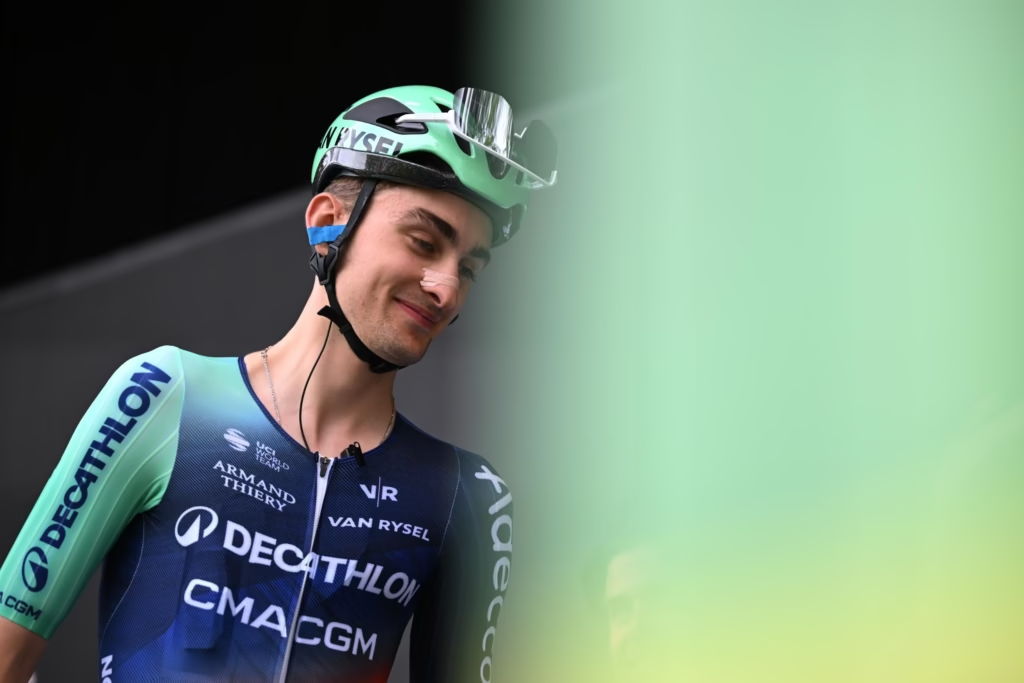
The Decathlon CMA CGM rider did not simply follow Del Toro to the finish. He made the acceleration that created the winning situation, caught Healy and then continued driving once Del Toro joined him.

The final sprint exposed the difference between the two riders on the day, but Seixas had already done enough to remove Evenepoel, Pidcock, Ciccone and the other established one-day contenders from the fight for victory.

His result also continues a season in which the Frenchman has increasingly moved from being judged as an exceptional young rider to simply being judged against the best riders in the WorldTour.

That comparison has repeatedly included Del Toro. The pair fought over the white jersey deep into the 2026 Tour de France, where Del Toro eventually finished third overall and Seixas fifth. Two months later, they were again the final two riders contesting one of the biggest races of the season.

Del Toro sends clear message before Montréal Worlds

The wider significance of Sunday’s result comes from the course.

The 2026 World Championships in Montréal return elite championship racing to Mount Royal more than half a century after Eddy Merckx won the rainbow jersey there in 1974.

The men’s World Championship will not replicate GP Montréal exactly. It begins with a longer approach before the riders complete 12 laps of the same 13.4km finishing circuit rather than the 16 laps raced on Sunday.

The important climbs, descents and technical characteristics are nevertheless the same.

Del Toro now knows he can win on them.

Evenepoel showed enough to recover from being caught behind the decisive move and still finish fifth. Pidcock and Ciccone remained involved deep into the finale. Healy demonstrated how difficult a long-range attack can be to control. Seixas showed that he can make the decisive acceleration on Camillien-Houde.

But none could beat Del Toro.

The Mexican arrived in Canada already established as one of the outstanding riders of the 2026 season after winning the UAE Tour, Tirreno-Adriatico, Tour Auvergne-Rhône-Alpes and Deutschland Tour before finishing on the Tour de France podium.

Montréal adds something different. It is a major WorldTour one-day victory, achieved against a championship-level field and on the circuit where the rainbow jersey will shortly be decided.

Two weeks out from the men’s road race, Del Toro has provided considerably more than evidence of good form. He has shown everyone else exactly what winning on Mount Royal looks like.

2026 GP Montreal result

Data powered by FirstCycling.com

Main photo credit: Getty

Faun Tour Femmes 2026: Juliette Berthet wins overall after two stage victories as Lauren Dickson takes finale

0

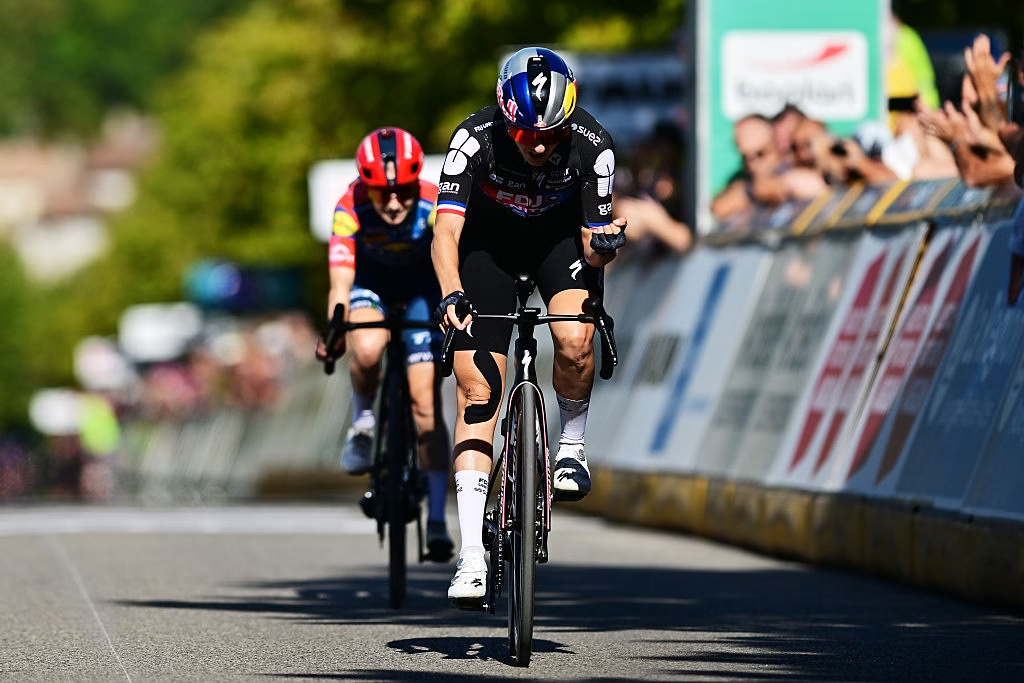
Juliette Berthet won the 2026 Faun Tour Femmes after a four-day battle with Niamh Fisher-Black in which the pair were still level on time going into the final stage around Peyrus.

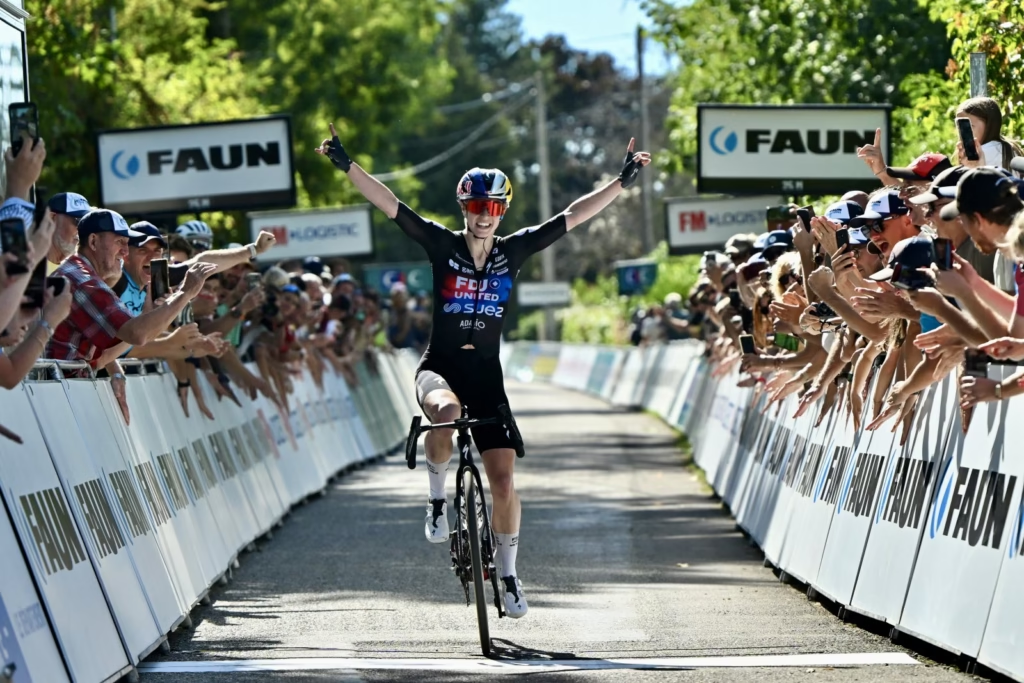
Berthet won stages two and three for FDJ United-SUEZ, beating Fisher-Black on both occasions, before protecting the race lead on the hardest day of the week. Teammate Lauren Dickson then completed an outstanding race for FDJ by winning stage four.

Solène Muller had opened the race with the first professional victory of her career in Boffres, meaning French riders won all four stages. The Faun Tour Femmes is the new identity of the former Tour Cycliste Féminin International de l’Ardèche, reduced to four days for 2026 but still built around the hilly roads of the Drôme and Ardèche.

The full Faun Tour Femmes start list had brought together several strong climbers, with Berthet, Fisher-Black, Usoa Ostolaza and Nienke Vinke among the most obvious GC options. The race also marked Sarah Gigante’s return after 403 days without racing.

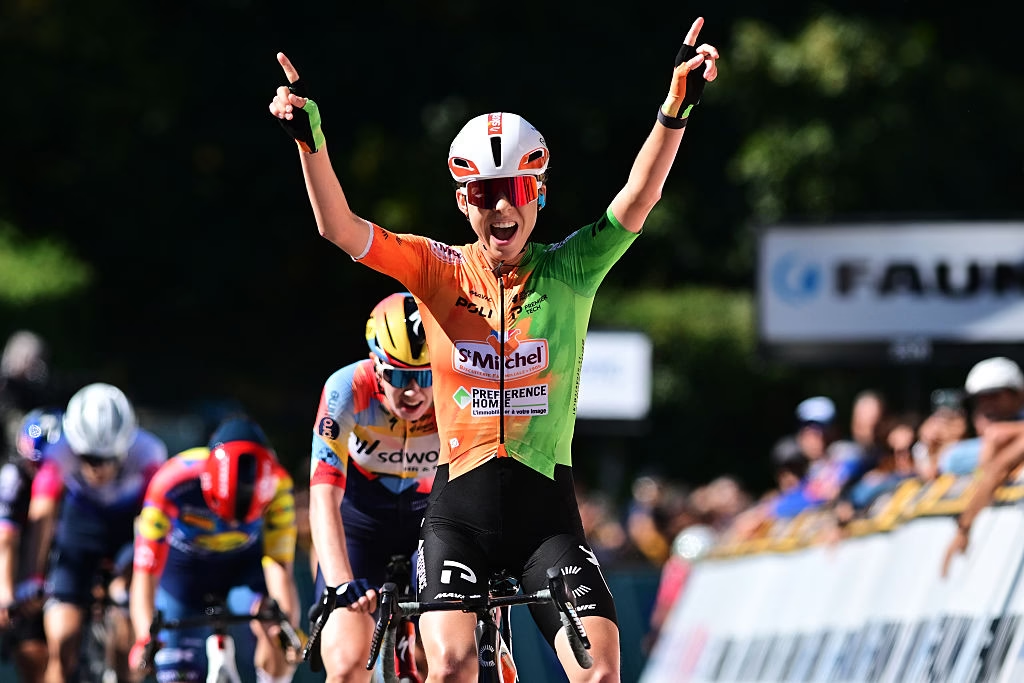
BOFFRES, FRANCE - SEPTEMBER 10: Solene Muller of France and Team St Michel - Preference Home - Auber93 celebrates at finish line as stage winner during the 24th Tour Cycliste Feminin International de l'Ardeche 2026,  Stage 1 a 115.7km stage from Guilherand-Granges to Boffres on September 10, 2026 in Boffres, France. (Photo by Billy Ceusters/Getty Images)Photo Credit: Getty

Stage 1: Solène Muller surprises the favourites in Boffres

The race opened with 115.7km from Guilherand-Granges to Boffres and immediately produced an unexpected winner.

More than 20 riders made the early break, with enough of the larger teams represented to complicate the chase. FDJ United-SUEZ eventually committed riders behind despite having Léa Curinier in the move, reducing an advantage of more than three minutes as the race approached its uphill finish.

The break still had enough time to contest the stage.

Muller attacked during the final 1.5km and helped create the small group that would fight for victory. She opened her sprint with around 175 metres remaining and held off Nienke Vinke, with Anna Henderson third.

Clémence Latimier was fourth and Fisher-Black fifth, while Berthet finished seventh on the same time. Dickson was seven seconds behind in 11th.

For Muller, it was the first professional victory of her career and St Michel-Preference Home-Auber93’s first win of the season.

The apparently minor difference between Fisher-Black in fifth and Berthet in seventh became relevant the following afternoon. When the pair finished stage two level on overall time, their placings in Boffres determined who wore the leader’s jersey.

Pos.RiderTeamTime
1Solène MullerSt Michel-Preference Home-Auber 933:08:27
2Nienke VinkeTeam SD Worx-Protimes.t.
3Anna HendersonLidl-Treks.t.
4Clémence LatimierMa Petite Entreprises.t.
5Niamh Fisher-BlackLidl-Treks.t.
Photo Credit: Getty

Stage 2: Berthet comes back to Fisher-Black and wins in Dieulefit

Stage two took place over 106.1km around Dieulefit, with three ascents of the Col du Pertuis and almost 1,500 metres of climbing.

Maite Urteaga Sorazu and Elisa Valtulini formed the early break before Valtulini was dropped on the second climb. Lidl-Trek increased the pace behind, with Henderson doing much of the work to reduce the advantage, and Urteaga was caught with around 29km remaining.

Ema Comte was the next rider to try her luck and carried an advantage towards the final ascent, but Fisher-Black and Berthet reached her as the GC race began in earnest.

Fisher-Black then accelerated hard enough to distance Berthet.

It looked briefly as though the New Zealander had found the separation she needed, but Berthet limited the gap and gradually worked her way back before the summit. The pair reached the final kilometres together, with Dickson leading the next group behind.

Berthet was comfortably quicker in the two-rider sprint and took her first victory for almost two years. Fisher-Black finished second, with Dickson third at 21 seconds.

The result left Fisher-Black and Berthet tied on overall time. Fisher-Black took yellow because she had finished fifth rather than seventh on stage one, while Dickson and Urška Žigart sat 28 seconds behind.

For Fisher-Black, the final climb had confirmed the strength that has made her an established Grand Tour contender. The problem was that Berthet had been able to survive her best acceleration and then beat her convincingly at the finish.

Pos.RiderTeamTime
1Juliette BerthetFDJ United-SUEZ2:56:48
2Niamh Fisher-BlackLidl-Treks.t.
3Lauren DicksonFDJ United-SUEZ+0:21
4Sidney SwierengaLiv AlUla Jayco+0:21
5Urška ŽigartAG Insurance-Soudal Team+0:21

Stage 3: Berthet wins again and takes yellow

Saturday’s 120km stage started and finished in Tournon-sur-Rhône and included two passages of the Côte de Colombier-le-Vieux before the Côte de Lemps late in the race.

Žigart’s GC challenge ended early when she crashed and abandoned, removing one of the three riders who had started the day within half a minute of Fisher-Black.

Noémie Abgrall and Émilie Morier spent much of the stage ahead before the race came back together around the final climbing.

Fisher-Black again tried to use the hills to separate Berthet, but this time FDJ had two riders involved in the decisive selection. Berthet and Dickson both stayed in the contest and the three strongest GC riders eventually emerged together.

That gave FDJ a tactical advantage, but they could not shake Fisher-Black before the finish.

The three arrived in Tournon-sur-Rhône together and Berthet again had the fastest sprint. Fisher-Black finished second for a second consecutive day, with Dickson third on the same time.

Berthet therefore moved into the yellow jersey despite remaining tied with Fisher-Black on time. Her two stage victories put her ahead on countback, while Dickson remained third at 28 seconds.

The race had now developed into a particularly awkward situation for Lidl-Trek. Fisher-Black needed only the smallest time gap to take the overall lead, but FDJ had Berthet on the same time and Dickson close enough behind to remain a genuine second threat.

Pos.RiderTeamTime
1Juliette BerthetFDJ United-SUEZ3:12:39
2Niamh Fisher-BlackLidl-Treks.t.
3Lauren DicksonFDJ United-SUEZs.t.
4Usoa OstolazaLaboral Kutxa-Fundación Euskadi+0:30
5Nienke VinkeTeam SD Worx-Protime+0:30
Lauren Dickson 2026 Faun Tour FemmesPhoto Credit: Getty

Stage 4: Dickson wins while Berthet secures the overall

The final 134.7km stage around Peyrus was the hardest of the four days.

The route included two ascents of the Col de Tourniol, 11.7km at around 6%, followed by the Col des Limouches. After three stages decided by relatively small differences, it gave Fisher-Black the terrain she needed to try to turn her climbing strength into the race lead.

She started level on time with Berthet.

FDJ’s advantage was Dickson. At only 28 seconds, the British rider was close enough to the overall lead that Fisher-Black could not simply allow her to escape while concentrating solely on Berthet.

The team’s two-rider position shaped the final stage. Fisher-Black needed to create a meaningful gap on Berthet while also remaining alert whenever Dickson moved clear.

Dickson ultimately converted that freedom into the stage victory, completing three consecutive wins for FDJ United-SUEZ after Berthet’s successes in Dieulefit and Tournon-sur-Rhône.

Berthet did what she needed to do against Fisher-Black and retained the yellow jersey, completing the overall victory after four days in which the pair had rarely been separated on the road.

Pos.RiderTeamTime
1Lauren DicksonFDJ United-SUEZ4:01:25
2Juliette BerthetFDJ United-SUEZ+0:09
3Niamh Fisher-BlackLidl-Trek+0:12
4Usoa OstolazaLaboral Kutxa-Fundación Euskadi+0:55
5Nienke VinkeTeam SD Worx-Protime+0:56

Faun Tour Femmes 2026 final general classification

Pos.RiderTeamTime
1Juliette BerthetFDJ United-SUEZ13:19:27
2Niamh Fisher-BlackLidl-Trek+0:03
3Lauren DicksonFDJ United-SUEZ+0:19
4Nienke VinkeTeam SD Worx-Protime+2:14
5Usoa OstolazaLaboral Kutxa-Fundación Euskadi+2:20
6Lore De SchepperAG Insurance-Soudal Team+2:42
7Julie BegoFrance+2:54
8Clémence LatimierMa Petite Entreprise+2:55
9Célia Le MouelMa Petite Entreprise+3:16
10Gaia RealiniLidl-Trek+3:34

Berthet won the race by surviving Fisher-Black’s best climbing attacks

The defining contest of the Faun Tour was established on stage two and barely changed thereafter.

Fisher-Black repeatedly looked capable of being the strongest rider uphill. In Dieulefit she actually dropped Berthet before the French rider recovered, and she was again one of the main instigators when stage three became selective.

What she could not do was turn those moments into lasting time gaps.

Berthet was consistently close enough to recover and had a clear advantage whenever the race ended with a sprint. Two consecutive stage victories were the result, and those placings eventually put her into yellow while the pair remained level on time.

That was a significant improvement on the rider described in our pre-season look at Berthet’s 2026 programme. Her climbing was good enough to stay attached to one of the strongest stage racers in the field, while her finishing speed repeatedly supplied the result once the hardest work was over.

Dickson gives FDJ the tactical advantage on the final weekend

Dickson’s contribution went beyond winning the final stage.

Her third place on stage two moved her to within 28 seconds of the lead, and she stayed there after joining Berthet and Fisher-Black at the front on stage three.

That forced Lidl-Trek to race against two GC threats on Sunday rather than one.

Fisher-Black could concentrate on dropping Berthet, but any hesitation over Dickson risked allowing another FDJ rider to move into overall contention. For FDJ, one rider could attack while the other remained attached to Fisher-Black.

Dickson eventually took the stage while Berthet kept the overall title.

Three victories from the final three stages was therefore not simply a reflection of individual strength. FDJ reached the weekend with the two best-placed riders behind Fisher-Black and used that numerical advantage to make the final day much more difficult for Lidl-Trek to control.

Four stages and four French victories

The first Faun Tour Femmes under its new name produced an unusual clean sweep for French riders.

Muller opened the race with a breakthrough win from the stage-one break. Berthet then took consecutive stages and the overall lead before Dickson, racing for the French FDJ United-SUEZ team, completed the team’s domination of the final weekend.

Berthet’s overall victory was the clearest result of the four days, but Fisher-Black provided the central opposition throughout. The two entered the final stage level on time after repeatedly finishing together despite Fisher-Black’s attempts to make the difference uphill.

Berthet ultimately won because she could answer those attacks and then use a faster finish when the road flattened out. With Dickson alongside her on the final two stages, FDJ also had the tactical depth required to turn a close individual contest into control of the race.

Vuelta a España 2026 stage 21: Tobias Halland Johannessen wins Granada finale as Enric Mas seals overall victory

Tobias Halland Johannessen won stage 21 of the 2026 Vuelta a España in Granada, beating Alessandro Romele in a tight sprint after an aggressive final circuit around the Alhambra, while Enric Mas completed the first Grand Tour victory of his career.

Johannessen emerged from a late move with Romele, Ramses Debruyne and Axel Laurance before holding off the XDS Astana rider at the line. Debruyne finished third, with Matthew Brennan recovering from being briefly distanced on the final climb to take fourth ahead of Bastien Tronchon.

The victory was Johannessen’s first in a Grand Tour and came 24 hours after he finished second to Mikel Landa on Collado del Alguacil. Mas arrived a few minutes later alongside his Movistar teammates, completing the Vuelta 2:15 ahead of Primož Roglič and 2:44 ahead of Felix Gall.

A ceremonial start before the racing begins in Granada

The final stage followed a different pattern from the traditional procession into Madrid. The 2026 Vuelta route ended in Granada for the first time, with the race entering a demanding finishing circuit rather than finishing with a conventional flat sprint.

The opening kilometres remained largely ceremonial. Mas and Movistar posed for photographs in specially prepared red kit, while several riders reaching the end of their professional careers were given time at the front of the peloton.

Steven Kruijswijk was among those receiving a guard of honour before the start. Jesús Herrada, Pello Bilbao, Magnus Cort and David de la Cruz were also making their final Vuelta appearances.

Movistar controlled the pace as the race approached Granada. There was little interest in forming a conventional breakaway because the decisive racing was always expected to begin once the peloton reached the city circuits.

The Alhambra circuit turns the finale into a selective race

The riders crossed the finish line for the first time with just over 40 kilometres remaining before immediately beginning the climb towards the Alhambra.

That ascent changed the character of the stage. The climb lasted around two kilometres and was repeated several times, making the Granada finale much harder than a normal final-day sprint.

Van Aert had reconnoitred the circuit during a Sierra Nevada training camp and described it before the stage as considerably harder than the Montmartre circuit used at the Tour de France.

The first ascent remained controlled by Movistar. The pace began to increase on the next passage when Visma | Lease a Bike briefly moved forward before Groupama-FDJ United took responsibility.

Jordi Meeus was among the sprinters beginning to lose contact as the repeated climbing gradually reduced the group.

Tronchon starts the decisive racing with 28 kilometres remaining

The first serious attack came from Tronchon with around 28 kilometres to go.

The Groupama-FDJ United rider accelerated on the climb and immediately created a selection containing several riders capable of winning from a small group. Brennan, Thibau Nys, Valentin Paret-Peintre, Laurance, Romele, Finn Fisher-Black and Milan Vader were among those to move clear, with Léo Bisiaux joining shortly afterwards.

Johannessen also made his way into the front of the race as the stage split into several groups.

Van Aert initially missed the strongest selection and remained in the chase. Movistar had no reason to help bring the groups back together because their only priority was getting Mas safely through the point at which the general classification times would be taken.

The race for the stage and the race for red were therefore effectively separated before the final lap.

Bilbao attacks as Van Aert and Coquard are dropped

Bahrain Victorious took responsibility approaching the final climb.

Pau Miquel set the pace for Bilbao before the experienced Basque rider attacked with around nine kilometres remaining. The acceleration immediately put several riders in difficulty, with Van Aert and Bryan Coquard among those unable to stay with the front group.

Bilbao opened a useful gap and initially appeared capable of carrying the move over the climb, but Laurance responded from behind.

The Netcompany INEOS rider caught Bilbao and then went past him before the summit. Romele was leading the pursuit behind, while Brennan and Tronchon were briefly among those struggling with the pace.

Laurance could not maintain the advantage on the descent.

A group of around a dozen riders came back together before the final five kilometres, with Brennan and Tronchon regaining contact.

Brennan’s return immediately changed the tactics. After winning five stages during his first Vuelta, nobody wanted to tow him directly to another sprint.

Johannessen and Romele get clear inside the final two kilometres

The attacks continued as the front group approached the finish.

Brennan, Nys, Bilbao, Pau Martí, Johannessen, Laurance, Tronchon, Paret-Peintre, Marco Brenner, Romele, Debruyne and Jarno Widar were among the riders still involved inside the final three kilometres.

The decisive move came with around two kilometres remaining.

Johannessen, Romele, Debruyne and Laurance opened a small gap while the riders behind hesitated over who should take responsibility for the chase. Several looked towards Brennan, but Visma had little incentive to spend everything closing a move only to deliver their young sprinter into another tactical battle.

That hesitation was enough.

Laurance was unable to stay with the leading three as they entered the final kilometre, leaving Johannessen, Romele and Debruyne to contest the stage.

Johannessen beats Romele for his first Grand Tour victory

Romele was the obvious sprint threat among the three leaders.

The Italian had been one of the breakthrough riders of the Vuelta, repeatedly featuring in sprint and reduced-group finishes without managing to take a stage.

Johannessen approached the finale with a very different record. The Norwegian is better known for his climbing and had already finished second on stage 7 at Valdelinares before another second place behind Landa on the penultimate day.

He did not wait for Romele to control the sprint.

Johannessen launched first and held the XDS Astana rider on his wheel all the way to the line. Romele drew close but never managed to come alongside, giving Johannessen his first Grand Tour stage victory.

Debruyne took third, while Brennan led the next group home in fourth. Tronchon finished fifth after beginning the sequence of attacks that had broken open the race almost 30 kilometres earlier.

Mas crosses the line with Movistar to win the Vuelta

The main peloton arrived after the stage-winning group with the overall classification already settled.

Mas deliberately dropped back to cross the line alongside Jorge Arcas, Orluis Aular, Carlos Canal, Pablo Castrillo, Raúl García Pierna and Iván Romeo.

His final advantage remained 2:15 over Roglič, with Gall completing the podium at 2:44. Richard Carapaz finished fourth, while Sepp Kuss’s long-range ride on stage 20 had moved him into fifth ahead of Oscar Onley.

For Mas, the victory ended a career defined for years by high Grand Tour finishes without an overall win. He had previously been a regular presence on the Vuelta podium but arrived in Granada as the first Spanish winner of the race since Alberto Contador in 2014.

The race had changed dramatically when Tadej Pogačar abandoned after crashing while wearing red, but Mas still had to convert the opportunity across the remaining two weeks.

His advantage was built in the mountains and then protected through the final sequence of decisive stages. Roglič took only 33 seconds from him in the stage 18 time trial in Jerez, before Mas held firm on Peñas Blancas and then increased his advantage over the Slovenian on Collado del Alguacil.

Van Aert, Buitrago and Onley complete the classification winners

Van Aert completed the race as winner of the points classification after combining two stage victories with repeated lead-out work for Brennan.

Santiago Buitrago won the mountains classification after spending much of the race attacking on the hardest climbs, while Onley secured the white jersey as the best young rider despite dropping from fifth to sixth overall on the final mountain stage.

Decathlon CMA CGM won the teams classification.

Johannessen took the final stage after spending three weeks showing he could contribute well beyond the high mountains. Mas, meanwhile, reached Granada with the Vuelta already effectively decided and was finally able to cross a Grand Tour finish line as the overall winner.

Vuelta a España 2026 stage 21 result

Data powered by FirstCycling.com

Vuelta a España 2026 final GC result

Data powered by FirstCycling.com

Main photo credit: Getty