Home Blog

World Championships 2026 withdrawals & Which major riders will miss Montréal?

The 2026 UCI Road World Championships arrive in Montréal without several riders who would ordinarily have featured prominently in the battle for the rainbow jerseys. Some never reached the point of selection, others have been forced out by crashes or illness in the final weeks, and a handful have chosen to end their seasons rather than travel to Canada.

Tadej Pogačar is by far the most consequential absence. The two-time defending men’s road race champion had been expected to shape the entire championship before his Vuelta a España crash ended his season. The women’s races have lost significant names too, including Pauline Ferrand-Prévot, Anna van der Breggen, Marianne Vos, Mischa Bredewold, Justine Ghekiere, Urška Žigart and Chloé Dygert.

The absences do not leave either elite race short of contenders. The men’s World Championships road race preview still contains Remco Evenepoel, Wout van Aert, Isaac del Toro, Paul Seixas and Tom Pidcock, while the women’s road race preview is headed by Demi Vollering alongside Katarzyna Niewiadoma-Phinney, Elisa Longo Borghini, Lotte Kopecky, Marlen Reusser and Magdeleine Vallières Mill.

What has changed is the tactical picture around them.
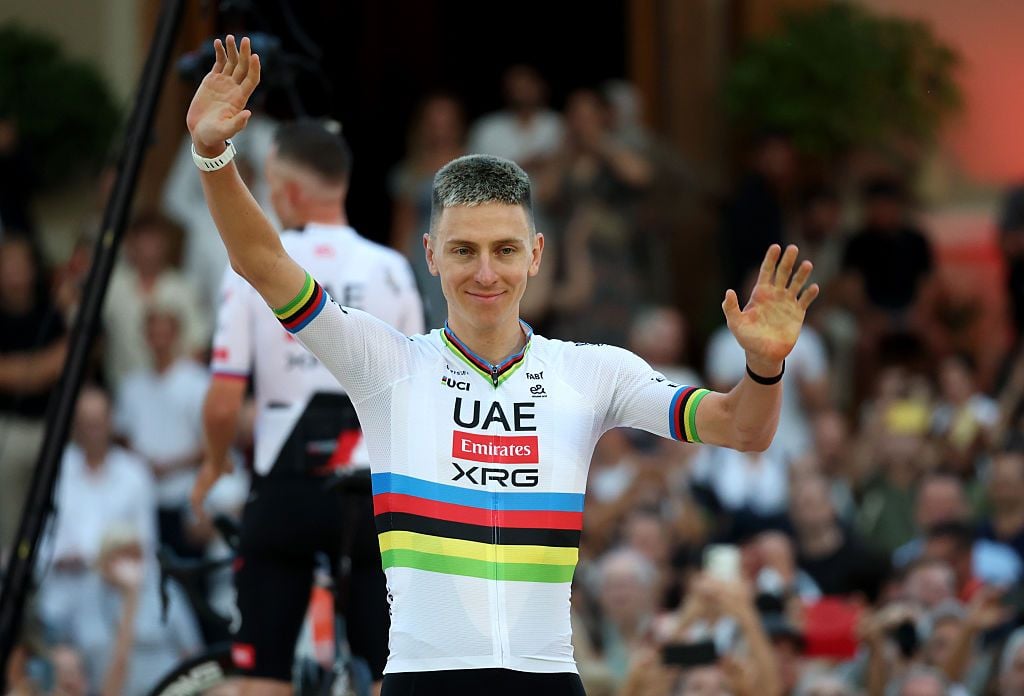
Vuelta-a-Espana-stage-1-LIVE-Tadej-Pogacar-and-Wout-van-Aert-take-part-in-Monaco-time-trial-Gran-PartidaPhoto Credit: Getty

Tadej Pogačar will not defend the rainbow jersey

The biggest missing name is also the rider who would otherwise have defined the men’s race.

Pogačar won the World Championships in Zürich in 2024 and Kigali in 2025 and was due to arrive in Montréal chasing a third consecutive rainbow jersey. The Mount Royal circuit looked particularly suitable to him, combining repeated climbing with a long race where endurance becomes increasingly important.

His season instead ended during Stage 8 of the Vuelta a España.

Pogačar crashed heavily while wearing the red jersey and was diagnosed with a concussion, displaced fracture of his left collarbone and a stable C7 cervical fracture. The collarbone required surgery, and any possibility of returning for the World Championships was subsequently abandoned.

The full sequence is covered in ProCyclingUK’s report on Pogačar’s season-ending Vuelta crash.

His absence changes far more than Slovenia’s leadership.

With Pogačar present, several countries would have expected him to attack and built their race around responding. Without him, there is no single rider everyone can assume will take responsibility for breaking the race open.

Slovenia now turn towards Primož Roglič, supported by riders including Matej Mohorič and Jan Tratnik, while the absence of Pogačar gives Belgium, France, Great Britain and Mexico considerably more freedom to dictate the race themselves.
divIts-no-use-hanging-your-head-–-Jonas-Vingegaard-gives-his-first-reaction-since-exiting-the-Tour-de-FrancedivPhoto Credit: Getty

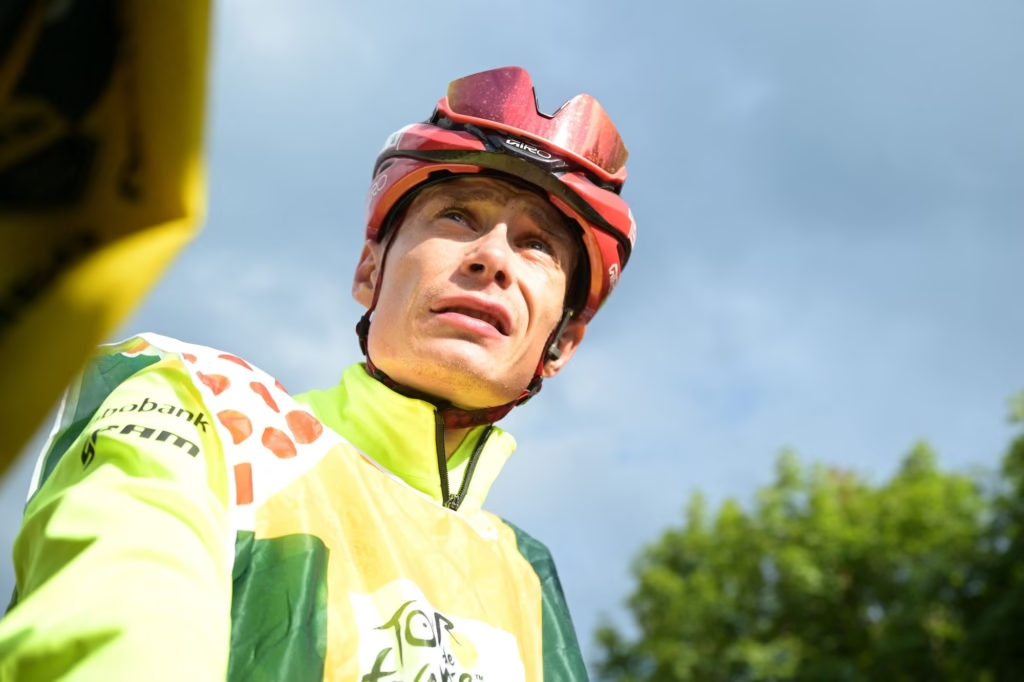
Jonas Vingegaard’s season ended after the Tour de France

Jonas Vingegaard will also be missing from Montréal after his 2026 season was ended by the collarbone fracture he suffered at the Tour de France.

The Dane crashed during Stage 15 while sitting second overall and was unable to continue. His recovery subsequently took long enough for Team Visma | Lease a Bike to rule out any racing during the remainder of the season.

World Championships appearances have never been central to Vingegaard’s career in the same way as the Grand Tours, but Montréal was a route where his climbing ability would have been relevant.

The men face 273.7km and 3,803 metres of climbing, with most of that elevation concentrated into 12 laps around Mount Royal. ProCyclingUK’s World Championships course guide shows why riders capable of repeatedly producing several-minute climbing efforts are expected to dominate the final part of the race.

Vingegaard will instead focus completely on preparing for 2027.
divIt-was-not-my-choice-–-Despite-back-pain-resurfacing-Mattias-Skjelmose-fulfills-team-duty-in-leadership-role-at-Tour-of-Guangxidiv-1Photo Credit: Getty

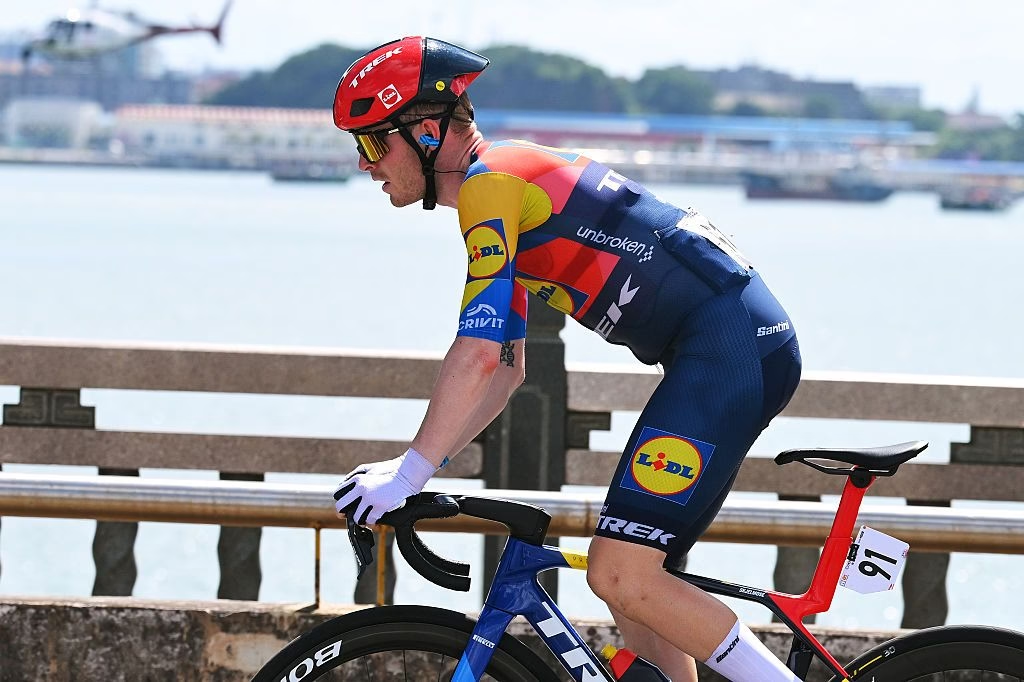
Mattias Skjelmose withdrew after the Vuelta

Mattias Skjelmose was supposed to be one of Denmark’s principal options in Montréal but pulled out after reaching the end of the Vuelta a España exhausted.

Skjelmose began the final week in Spain inside the top 10 overall before dropping to 13th by Granada. Rather than attempt to recover and travel directly to Canada, he told Danish national coach Michael Mørkøv that his body was no longer capable of producing the level required for Worlds.

That is a meaningful loss for Denmark.

Skjelmose’s combination of climbing ability and one-day racing strength made Montréal a natural target, particularly on a circuit requiring repeated short efforts rather than one sustained mountain ascent.

Anton Charmig takes his place after finishing third at GP Québec, while Mads Pedersen remains one of Denmark’s main cards.

Skjelmose’s withdrawal is also a reminder of the difficult scheduling around Montréal. Riders coming directly from the Vuelta have only a short recovery window before a 273km championship, and the effect of three weeks in Spain will not be the same for everybody.
2026 Lloyds Tour of Britain Men Tim WellensPhoto Credit: SWPix.com

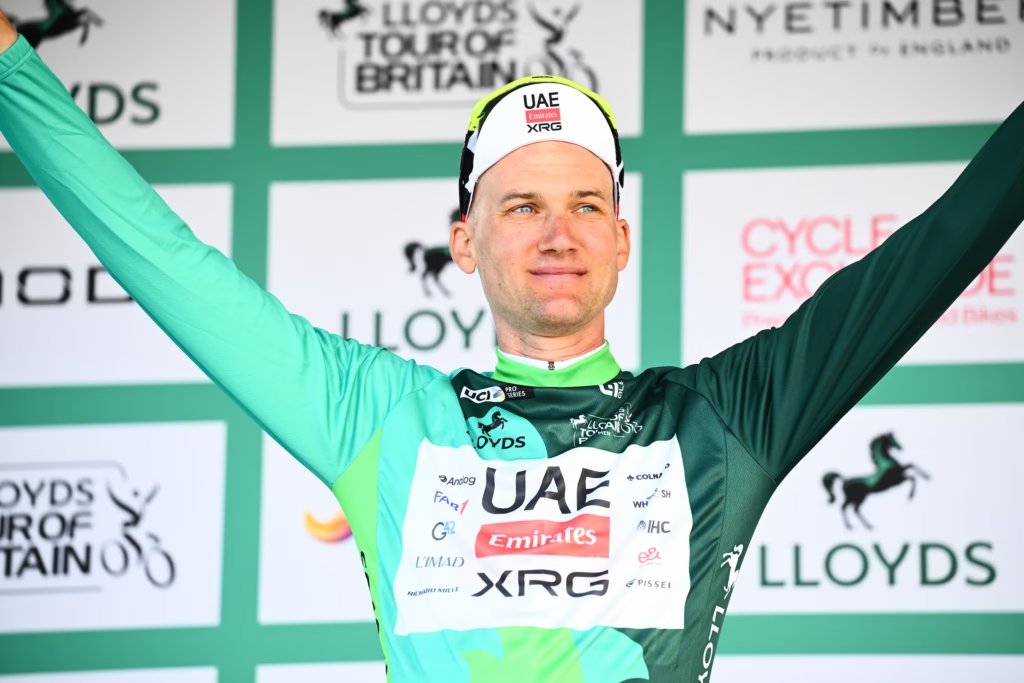
Tim Wellens chose not to ride for Belgium

Tim Wellens is a different type of absentee.

He is not missing the World Championships because of a new injury and was in good enough form to win the Tour of Britain earlier in September. Instead, Wellens had already decided after a difficult end to the Tour de France that he would not make himself available for Montréal.

Illness and poor form during the final week of the Tour disrupted his planned build-up. At that point he did not believe he would be ready for Worlds and committed to a different late-season programme with UAE Team Emirates-XRG.

His subsequent return to form made the decision more noticeable. Wellens won the Tour of Britain and was contacted by Evenepoel about reconsidering, but chose to stick with the plan he had already made.

That removes an extremely useful rider from Belgium’s team.

Wellens would not necessarily have been the outright leader with Evenepoel and Van Aert available, but the Mount Royal circuit is exactly the type of terrain where his ability to attack, climb and work deep into a hard one-day race could have been valuable.

Belgium still arrive with one of the strongest teams in Montréal. They simply do so without one of the riders who could have made their numerical advantage even greater.

‘This-year-has-been-a-tough-one-mentally-Jay-Vine-on-a-cautious-comeback-following-Giro-dItalia-abandon-1Photo Credit: Getty

Jay Vine misses the time trial after Vuelta illness

Jay Vine is one of the most significant absentees from the elite men’s individual time trial.

The Australian won silver behind Evenepoel at the 2025 World Championships in Kigali and had Montréal’s 39.2km test as a major late-season objective.

Illness at the Vuelta changed that plan.

Vine abandoned during Stage 12 on the road to Calar Alto and did not recover sufficiently to be included in Australia’s World Championships team.

His absence matters particularly because Montréal presents a very different time trial from Kigali. The Canadian course contains only 220 metres of climbing and should reward sustained aerodynamic power across almost 40 kilometres.

The full field is analysed in ProCyclingUK’s men’s World Championships time trial preview, where Filippo Ganna and Stefan Küng emerge as Evenepoel’s clearest challengers.

Without Vine, Australia are represented in the elite men’s time trial by Conor Leahy.
divThe-ribs-didnt-make-it-–-Derek-Gee-West-withdraws-from-time-trial-at-his-home-World-ChampionshipsdivPhoto Credit: Getty

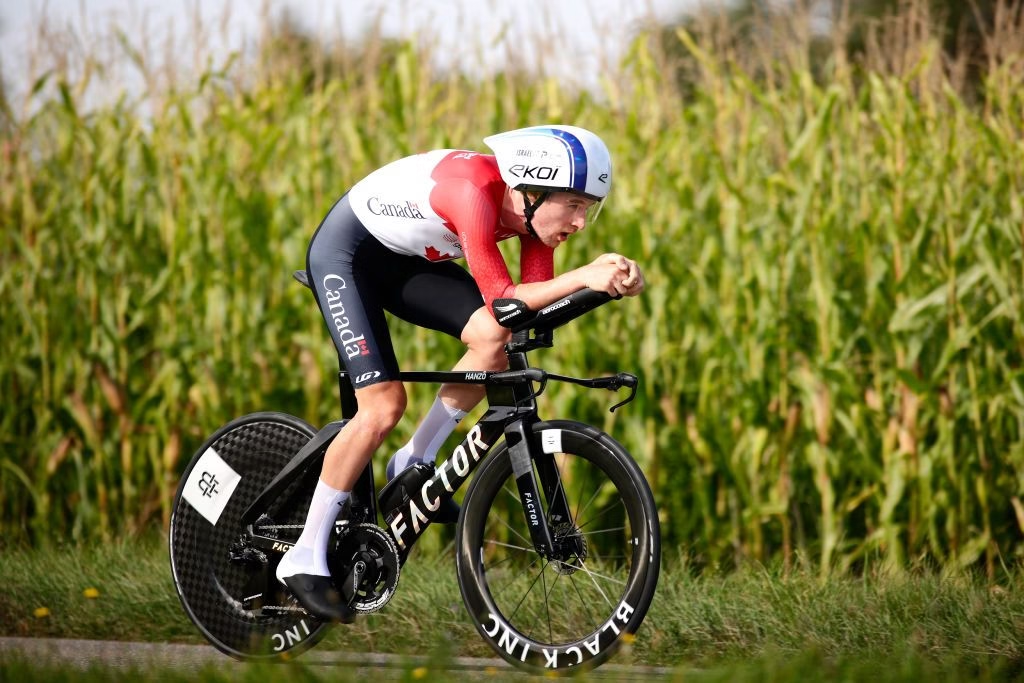
Derek Gee-West misses the time trial but still hopes to ride the road race

Derek Gee-West has not withdrawn from the World Championships completely, but his home championship has already been significantly reduced.

The Canadian crashed at GP Montréal and later confirmed that he had suffered rib fractures. He will therefore miss both the individual time trial and mixed relay.

Gee-West is still attempting to recover in time for the elite men’s road race on 27 September.

That makes him slightly different from the other riders on this list. His participation in the headline road event has not yet been ruled out, but Canada have already lost him from two races where he had originally been selected.

It is particularly frustrating timing after Gee-West spent the Canadian WorldTour races preparing on many of the same roads that will be used at Worlds.
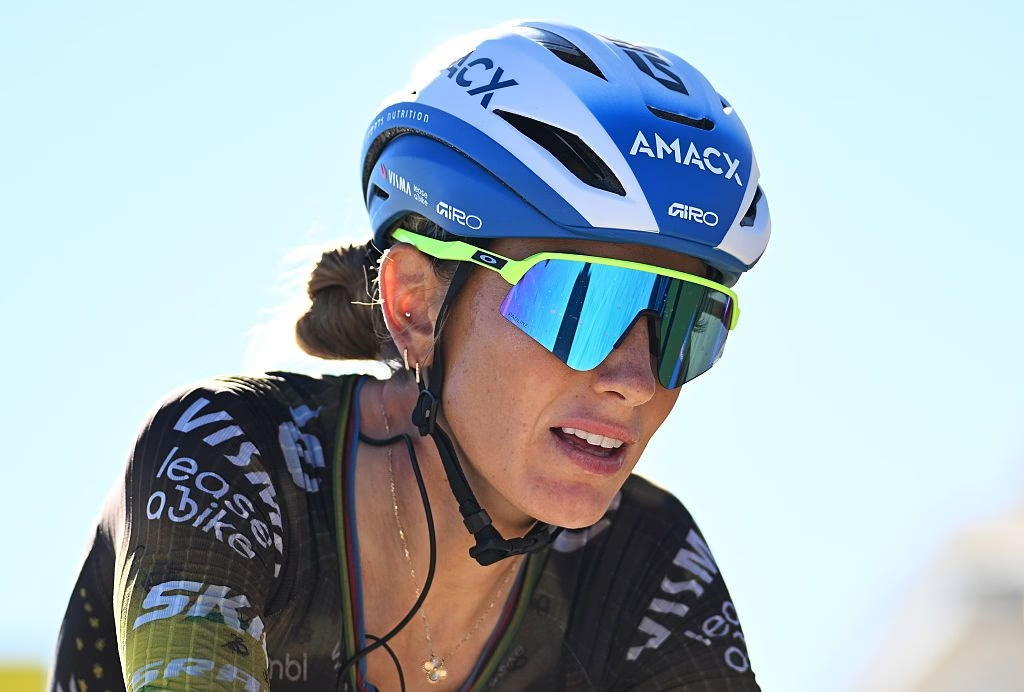
Defending-champion-Pauline-Ferrand-Prevot-will-not-start-stage-8-of-the-Tour-de-France-suffering-with-illnessPhoto Credit: Getty

Pauline Ferrand-Prévot has ended her season

Pauline Ferrand-Prévot will not contest the women’s road race despite a Montréal course which would normally put her firmly into the conversation.

The 2025 Tour de France Femmes winner has not raced since abandoning this year’s Tour before Stage 8. Her title defence had already unravelled during the mountain stages before illness brought her race to an end.

Visma | Lease a Bike subsequently confirmed that Ferrand-Prévot would take the rest of the year to rest and recover, ending her 2026 season.

It closes a difficult campaign without another attempt at the rainbow jersey she first won on the road in 2014.

Ferrand-Prévot’s absence is particularly noticeable because Montréal looks well suited to her strengths. The women complete eight Mount Royal circuits, creating a race where climbing ability, repeated accelerations and one-day endurance all matter.

France will instead build around a younger group headed by national champion Célia Gery, with Juliette Berthet, Cédrine Kerbaol, Evita Muzic, Maëva Squiban, Marie Le Net and Léa Curinier also selected.

Ferrand-Prévot’s difficult Tour and the questions it created for the rest of her year were covered in ProCyclingUK’s 2026 Tour de France Femmes review.
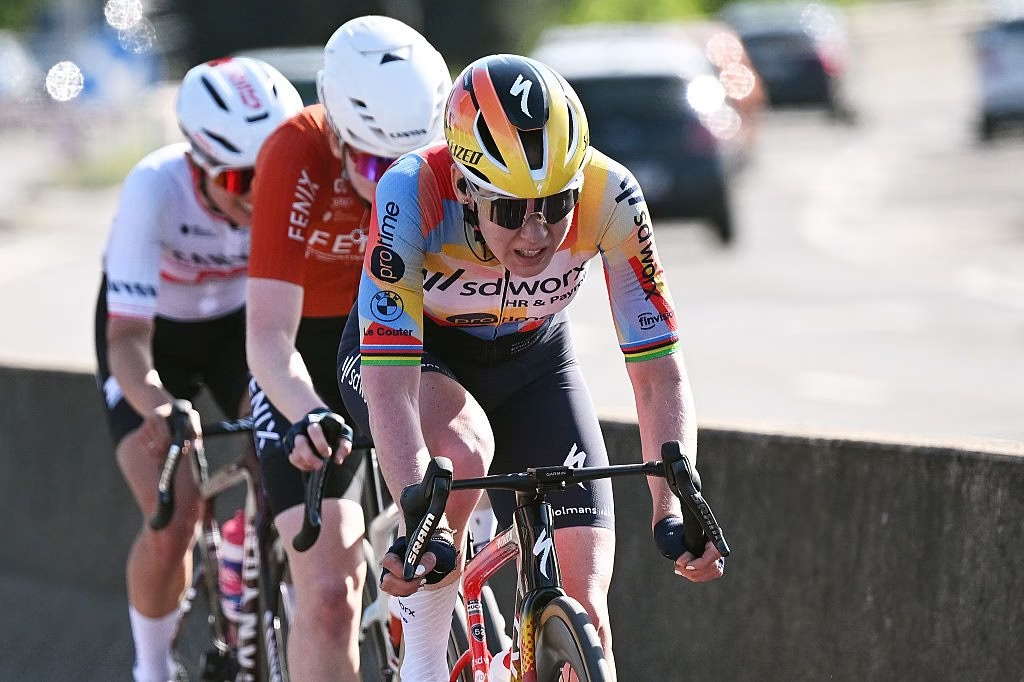
divI-really-didnt-feel-well-–-Anna-van-der-Breggen-cuts-through-with-fourth-at-Liege-Bastogne-Liege-despite-illnessdiv-1Photo Credit: Getty

Anna van der Breggen misses another chance at the rainbow jersey

Anna van der Breggen is one of two former Dutch world champions missing from a team built firmly around Vollering.

Van der Breggen has been struggling with illness and was not considered ready for Montréal.

The absence is substantial given her World Championships record.

She won the elite road race in 2018 and 2020 and finished second behind Reusser in the 2025 individual time trial in Kigali. A rider with that combination of championship experience, climbing ability and strength against the clock would ordinarily have been useful in both Montréal events.

Instead, the Netherlands have simplified their hierarchy.

Vollering is the clear road race leader, while Lieke Nooijen joins her in the individual time trial.
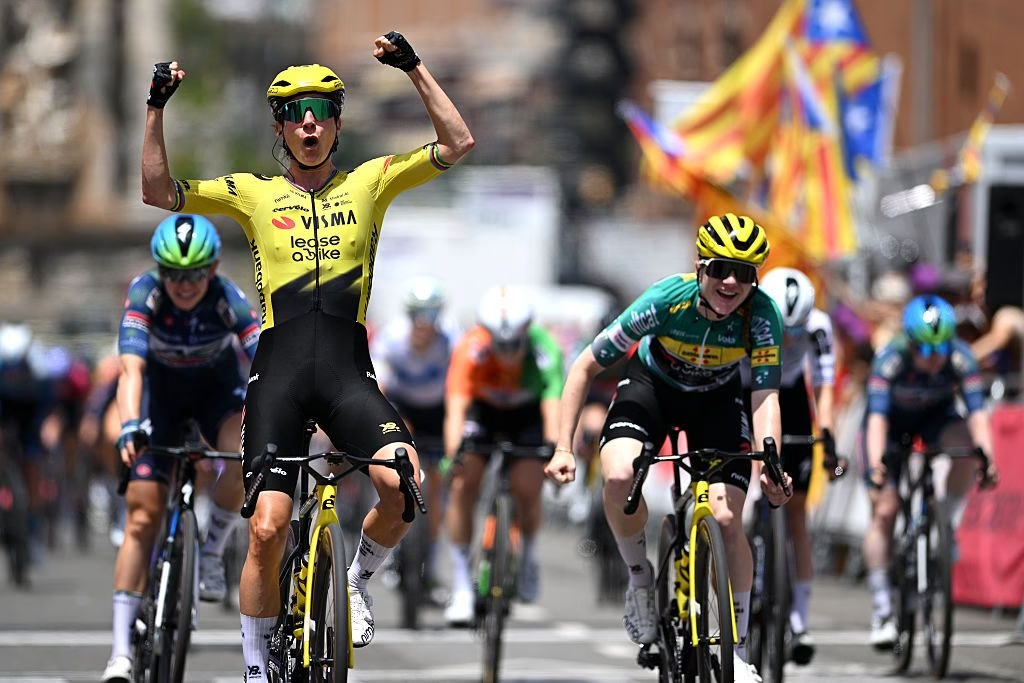
Volta-a-Catalunya-Feminas-Paula-Blasi-seals-GC-victory-as-Marianne-Vos-blasts-to-sprint-win-in-BarcelonaPhoto Credit: Getty

Marianne Vos has not been selected

Marianne Vos will also be missing from the Dutch team.

Unlike Bredewold, her absence is not the result of a last-minute injury. The three-time road world champion has had a disrupted 2026 and was not selected for Montréal, with the Dutch coaching staff pointing to a compromised preparation during a difficult year following the death of her father.

Vos is instead expected to focus on the Gravel World Championships in Australia in October.

At 39, she remains capable of influencing major races, but her results this year have not matched the level required to displace riders better suited to a demanding Mount Royal course.

Her absence, alongside Van der Breggen’s, also removes an enormous amount of championship experience from the Dutch team.

Vollering nevertheless has considerable support available through Puck Pieterse, Riejanne Markus, Lieke Nooijen, Karlijn Swinkels and Femke de Vries.
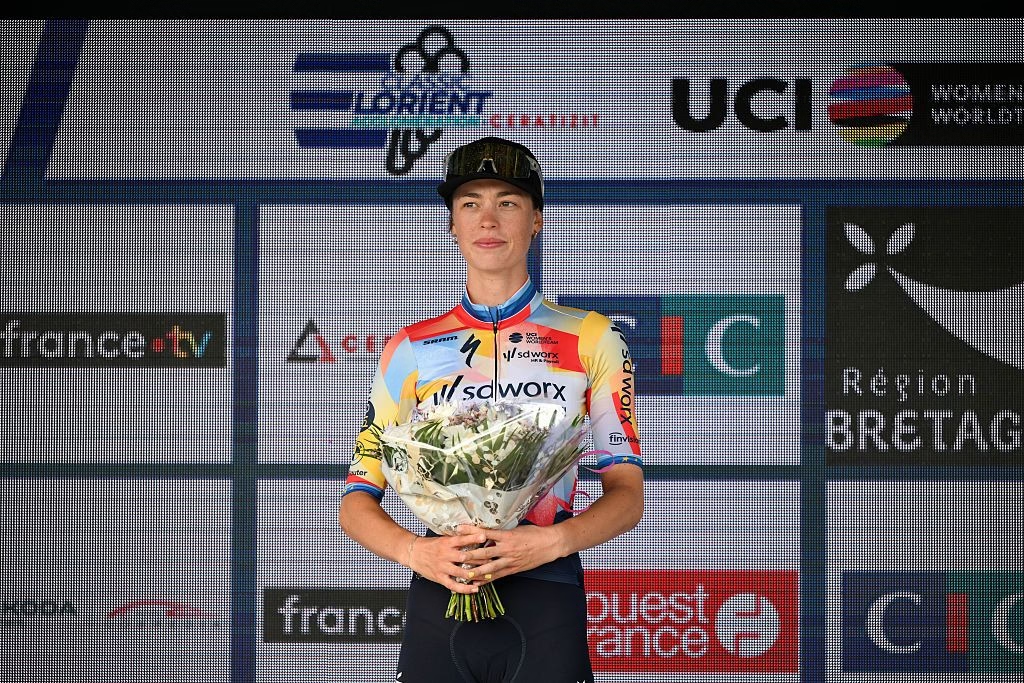
divMy-good-shape-will-come-in-handy-with-sitting-on-the-couch-Injury-forces-Mischa-Bredewold-out-of-Road-World-ChampionshipsdivPhoto Credit: Getty

Mischa Bredewold broke her pelvis days after selection

Mischa Bredewold was initially part of that Dutch team before crashing during the Faun Tour Femmes.

What first appeared to be an accident requiring treatment for cuts turned out to be considerably more serious. Medical examinations found an ischiopubic fracture of her pelvis, while an elbow wound also required surgery.

Her season is over.

The timing was particularly unfortunate because Bredewold had been in strong late-season form and offered the Netherlands another powerful one-day option behind Vollering.

Amber Kraak has been called into the team as her replacement.

ProCyclingUK covered the injury in detail when Bredewold was ruled out of the World Championships.

Justine Ghekiere 2026 Tour de France Femmes Press ConferencePhoto Credit: AG Insurance-Soudal

Justine Ghekiere’s season ended with a fractured kneecap

The same Faun Tour Femmes also removed Justine Ghekiere from Belgium’s Worlds plans.

Ghekiere crashed during the opening stage and initially completed the race before withdrawing the following morning. Subsequent examinations in Belgium identified a small, non-displaced fracture of her patella.

That ended her season immediately.

Ghekiere had already been selected as part of the Belgian road race squad and would have been particularly useful once the Montréal circuit started reducing the field.

Her climbing ability gave Belgium a rider capable of staying close to Kopecky through the hardest laps rather than requiring the two-time world champion to manage every move herself.

Sandrine Tas has been called up in her place.

The implications for Belgium are covered more fully in ProCyclingUK’s report on Ghekiere’s World Championships withdrawal.
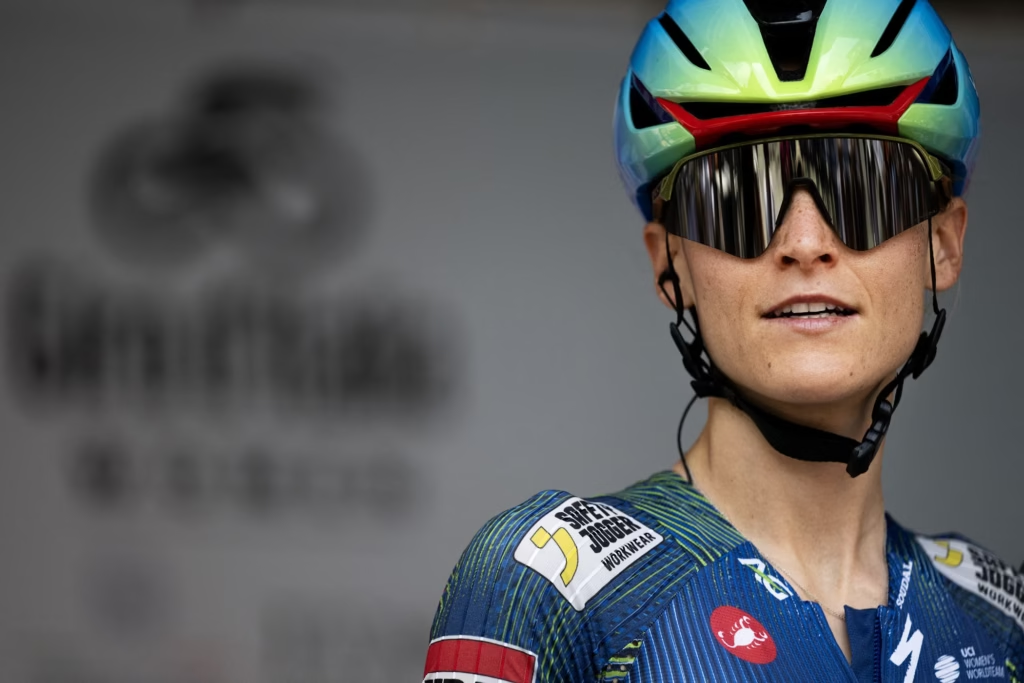
Urska-Zigart-refractures-her-jaw-in-crash-at-Faun-Tour-FemmesPhoto Credit: Getty

Urška Žigart fractured her jaw for a second time

Urška Žigart had been selected to lead Slovenia’s women in Montréal before another crash at the Faun Tour Femmes ended those plans.

The 29-year-old was sitting third overall when she crashed during Stage 3. Medical examinations subsequently revealed another fracture of her jaw.

It is the same injury she suffered at the Tour de Suisse earlier in the summer.

The repeated fracture makes another quick comeback unrealistic, and her 2026 season is now expected to be over.

Žigart had produced several of the strongest stage-race results of her career this season, including sixth overall at La Vuelta Femenina and eighth at the Giro d’Italia Women. On a climbing-heavy Montréal course, she would have been Slovenia’s obvious women’s road race leader.

Her withdrawal leaves Nika Bobnar as Slovenia’s only elite woman at the championships.
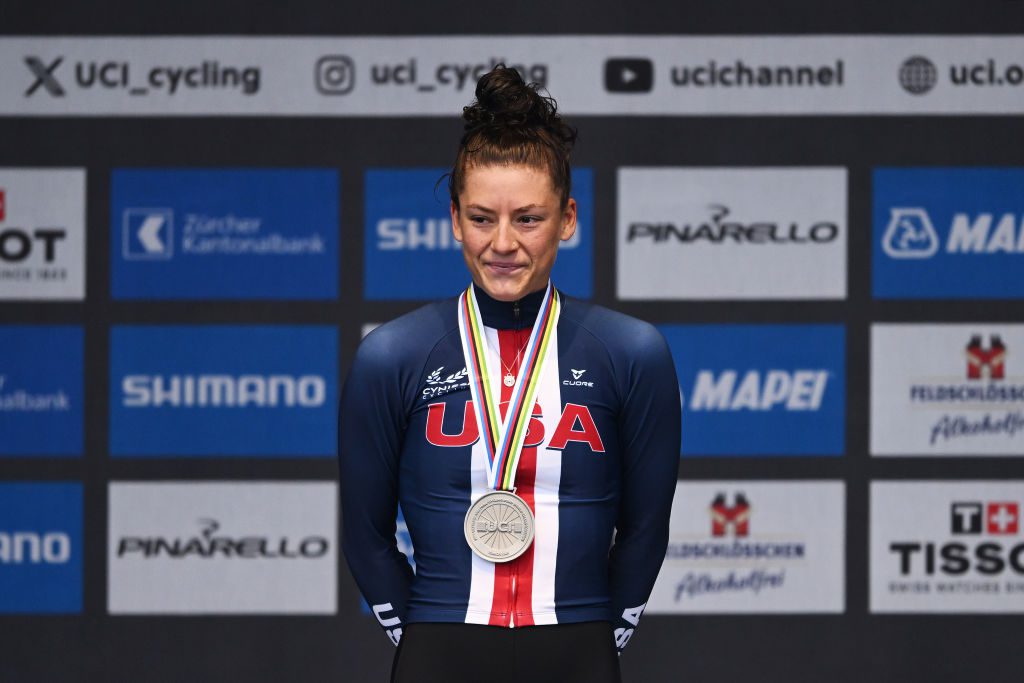
Chloe-Dygert-and-Magnus-Sheffield-lead-23-rider-US-roster-at-Kigali-Road-Worlds-1Photo Credit: Getty

Chloé Dygert is still recovering after a difficult 2026

Chloé Dygert is another major name absent from both the women’s road race and individual time trial.

The American is a two-time world time trial champion and finished second in the elite road race in Zürich in 2024, which alone would normally make her one of the first riders to consider when the World Championships arrive.

Her 2026 season has instead been dominated by physical problems.

Dygert has barely raced since crashing out of Paris-Roubaix Femmes and has undergone further treatment and surgery during a prolonged rehabilitation period. Her comeback did not progress far enough for Montréal and she was not included in the United States selection.

That is particularly significant for Sunday’s individual time trial.

A 39.2km course with limited climbing would normally be favourable to Dygert’s power and pursuit background. Instead, the American challenge against the clock comes from Kristen Faulkner and Taylor Knibb.

The rest of the medal contenders are covered in ProCyclingUK’s women’s World Championships time trial preview.

The missing riders change the races in different ways

Pogačar’s absence changes the entire men’s road race because he was the defending champion and the rider most countries would have expected to force the decisive move.

Skjelmose and Wellens remove tactical options from Denmark and Belgium. Vingegaard takes another elite climber out of a course built around accumulated elevation. Vine and Dygert reduce the depth of the individual time trials.

The effect in the women’s race is more spread out.

Ferrand-Prévot would have been another major climbing contender. Van der Breggen and Vos take experience away from the Netherlands, while Bredewold and Ghekiere remove important support from two of the strongest national teams. Žigart’s withdrawal effectively dismantles Slovenia’s original women’s plan.

None of those absences make Montréal weak.

They do make it different.

The 2026 World Championships course already creates enough tactical possibilities through repeated Mount Royal laps. Removing several riders who would ordinarily command attention leaves even more room for attacks from those who have made it to Canada.
Fem van Empel joins FDJ United-Suez with immediate effect

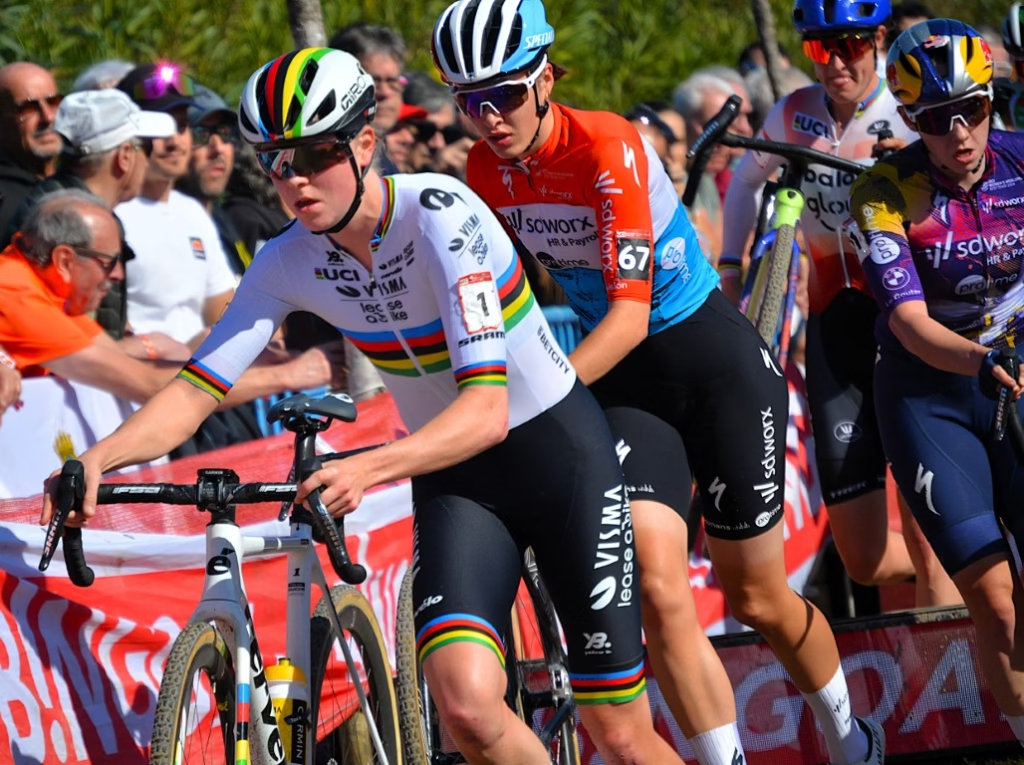
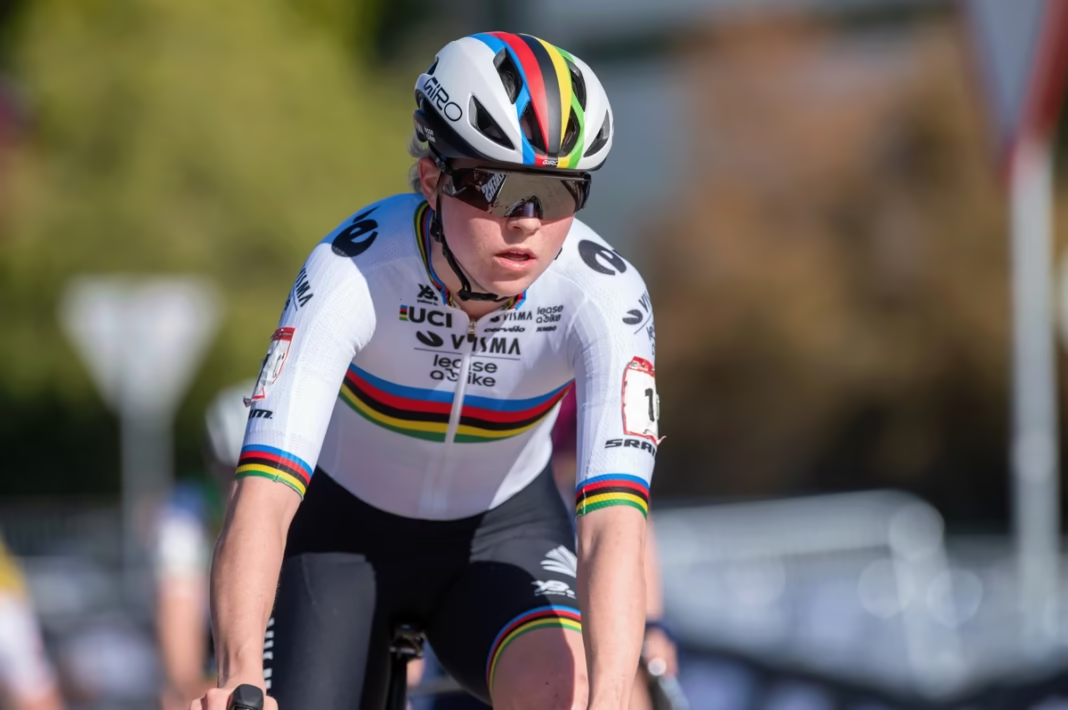
Fem van Empel has joined FDJ United-Suez with immediate effect, bringing one of cyclocross’s biggest names back into professional cycling after stepping away from Team Visma | Lease a Bike at the end of 2025.

The 24-year-old Dutch rider is a three-time elite cyclocross world champion and reached 50 career victories in the discipline before putting her professional career on hold last December. FDJ United-Suez have not announced a first race or detailed competition programme, with both the team and Van Empel placing the emphasis on enjoying cycling again rather than setting immediate performance targets.

“I’m ready for a new adventure and very excited about starting from scratch,” Van Empel said. “Above all, I want to have a lot of fun.”

Her arrival also strengthens the multidisciplinary direction FDJ United-Suez have increasingly pursued. Van Empel joins a structure which has already signed junior cyclocross and mountain bike world champion Anja Grossmann for 2027 and incorporated former mountain bike world champion Kate Courtney into its wider programme.

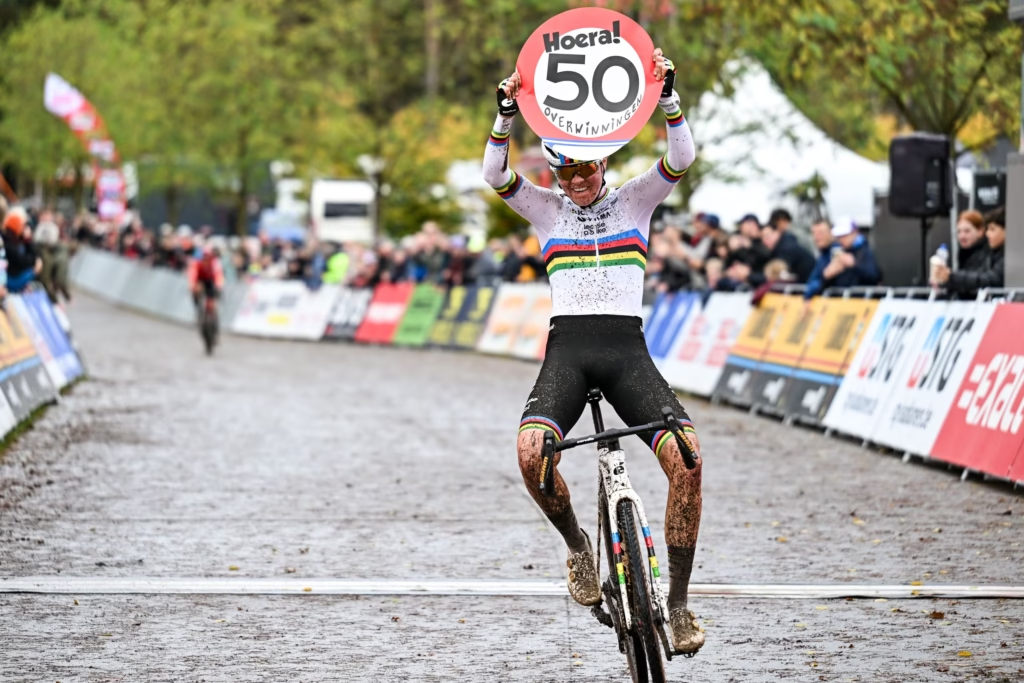
Fem-van-Empel-celebrates-50th-cyclocross-victory-at-muddy-Exact-Cross-race-with-handmade-sign-hidden-in-her-kit-1Photo Credit: Getty

Van Empel returns after stepping away from professional cycling

Van Empel’s move is unusual because it is not a conventional end-of-season transfer.

She left Team Visma | Lease a Bike and paused her professional career at the end of 2025, bringing an early conclusion to a contract that had originally been expected to continue beyond that season.

The decision followed a difficult year in which Van Empel had already taken time away from racing and subsequently reduced her road programme. She returned to cyclocross during the autumn and won again, including reaching the milestone of 50 professional cyclocross victories at Exact Cross Heerde, before stepping away once more.

Her ProCyclingUK rider profile charts a career that had developed at remarkable speed before that pause. Van Empel won three consecutive elite cyclocross world titles from 2023 to 2025, establishing herself as the dominant rider of her generation in the discipline while still in her early twenties.

The FDJ United-Suez announcement now marks the start of a different phase rather than simply a continuation of where she left off.

FDJ United-Suez put enjoyment ahead of immediate results

General manager Stephen Delcourt was clear that the team does not intend to make Van Empel’s arrival immediately about results.

“Fem’s arrival means a lot to us,” Delcourt said. “We all know what a tremendous champion she is and everything she has already accomplished. But today, our priority is first and foremost to support her so that she can rediscover the joy of riding, her smile, and the freedom to fully express herself.”

That tone matters given the circumstances of Van Empel’s return.

There is no announced target race, no immediate promise of a road campaign and no indication yet of what her cyclocross programme will look like. FDJ United-Suez are instead presenting the move as an opportunity to rebuild around the rider rather than attempting to force her immediately back into the schedule she previously followed.

“More than anything, we can’t wait to see Fem smiling on her bike again, enjoying competition, and fully blossoming as an athlete and as a woman,” Delcourt said. “The rest will follow naturally.”

25BeniWC - Fem van Empel

A major addition to FDJ United-Suez’s multidisciplinary project

Van Empel’s signing also says something about how FDJ United-Suez see their future.

The team have already become one of the strongest road structures in the women’s peloton, with Demi Vollering at the centre of their Grand Tour programme. Vollering extended her contract with FDJ United-Suez through 2028 earlier this season after continuing the team’s rise at the top of women’s stage racing.

Van Empel brings a completely different profile.

Cyclocross has been the foundation of her career, but she has also raced successfully on the road and has the acceleration, bike handling and repeated high-intensity power that can transfer naturally to selective one-day races.

FDJ United-Suez are not asking her to abandon that background.

Delcourt specifically linked the move with Anja Grossmann’s arrival from 2027 and Kate Courtney, describing a project designed to accommodate riders who compete across different disciplines rather than forcing everybody towards the same programme.

“With Fem, as with Anja Grossmann and Kate Courtney, we are also reinforcing our ambition to build a truly multidisciplinary project, capable of welcoming great champions with their own backgrounds, personalities and ambitions,” he said.

That gives Van Empel an environment where cyclocross does not have to compete with the road programme for priority.

What Van Empel could offer on the road

The unanswered question is how much road racing Van Empel eventually wants to do.

Her earlier seasons showed considerable potential without road cycling ever becoming the sole focus. She has the characteristics to be effective in races combining short climbs, technical sectors and reduced sprints, particularly when bike handling becomes as important as conventional road positioning.

The wider FDJ United-Suez roster also means she would not need to return as an immediate road leader.

The FDJ United-Suez 2026 team guide reflects how much depth the French team have developed around Vollering and their broader group of Classics and stage-race riders. That gives Van Empel room to rebuild a programme around the races she wants to ride rather than being required to fill a major competitive gap.

For now, however, projecting specific Classics or Grand Tours onto her return would go beyond what either rider or team have announced.

Van Empel’s own message is much simpler.

She wants a fresh start, and FDJ United-Suez appear willing to let the competitive programme develop from there.

A different sort of transfer for FDJ United-Suez

Most September transfer announcements are built around what a new rider is expected to win the following season. This one is deliberately different.

Van Empel already has a palmarès few riders achieve across an entire career, despite only turning 24 earlier this month. The question is not whether she has the ability to win major races. It is how she wants the next stage of her career to look after choosing to step away from the professional peloton.

FDJ United-Suez have given her a route back without attaching an immediate result to it.

For a rider whose previous career developed extraordinarily quickly, starting again on different terms may prove to be the most important part of the move.

Usoa Ostolaza joins Uno-X Mobility on three-year deal through 2029

0

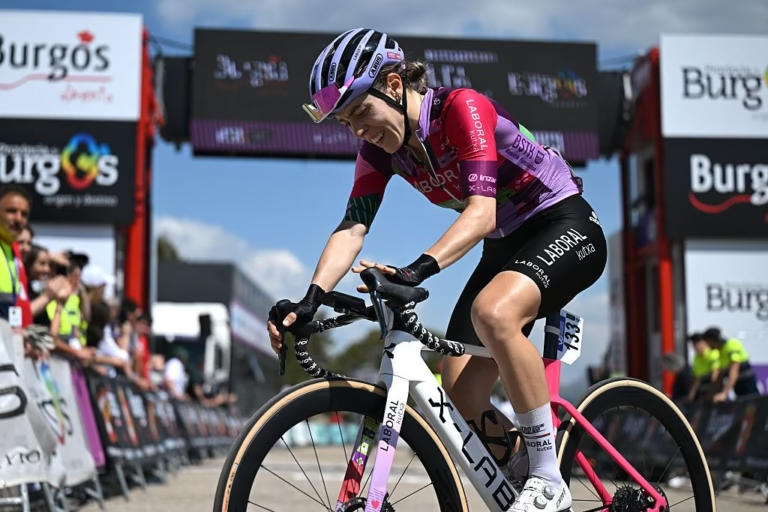
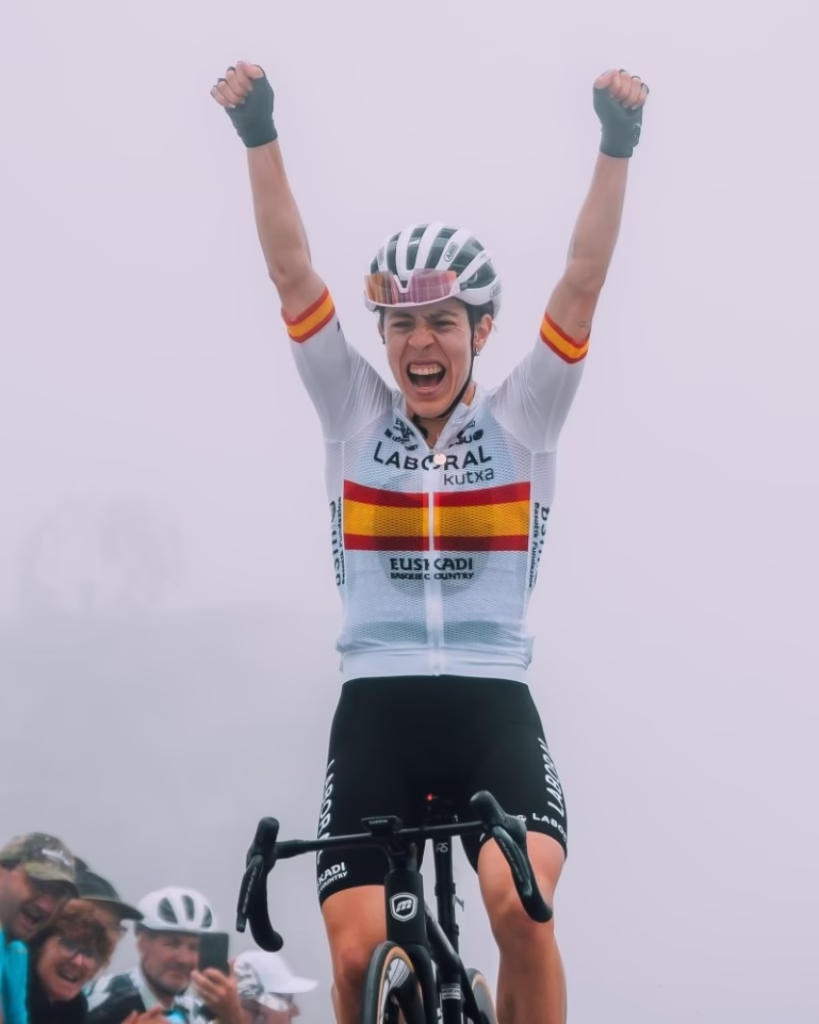
Usoa Ostolaza will leave Laboral Kutxa-Fundación Euskadi at the end of the 2026 season and join Uno-X Mobility on a three-year contract running through 2029.

The 28-year-old Basque rider gives Uno-X a proven general classification option after a season in which she finished fourth overall at La Vuelta Femenina, third at the Vuelta a Burgos Feminas and seventh at Itzulia Women. She also won the Gran Premio Ciudad de Eibar and took fourth on stage 3 of the Tour de France Femmes.

Those results have moved Ostolaza beyond being one of the strongest riders outside the Women’s WorldTour. She has increasingly been able to stay with established GC contenders on the hardest climbing days, and Uno-X see her as part of their attempt to become more competitive in the Grand Tours.

“I feel Uno-X Mobility is the perfect place for me to keep dreaming and growing as an athlete,” Ostolaza said. “It is a team with heart, professionalism and ambition.”

Usoa Ostolaza 2025 Tour des Pyrenees Stage 2

Ostolaza adds a genuine GC option to Uno-X

Ostolaza’s development during 2026 has changed the type of rider Uno-X are signing.

She finished fourth at La Vuelta Femenina, behind overall winner Paula Blasi, Anna van der Breggen and Marion Bunel. That was her clearest indication yet that she could put together a complete general classification performance over a WorldTour stage race rather than simply target individual mountain stages.

The result was followed by third overall at the Vuelta a Burgos Feminas. Ostolaza finished third on the final climb to Lagunas de Neila, behind Yara Kastelijn and Évita Muzic, with the same three riders filling the final general classification podium.

Seventh at Itzulia Women added another strong result on home roads. Across those three WorldTour stage races, Ostolaza showed enough consistency to make Grand Tour leadership a realistic part of her next contract rather than an aspiration based on isolated performances.

Uno-X Head of Sports Anna Badegruber sees exactly that role developing.

“Usoa will strengthen the climbing group within our team,” she said. “We have already seen what she can do in the general classification at Grand Tours, but she has also proven herself in hard one-day races.”

A late arrival who has progressed quickly

Ostolaza’s route into professional cycling has been unusual.

She previously competed in triathlon and did not begin racing seriously on the road until 2020. Laboral Kutxa-Fundación Euskadi brought her into the team the following season, beginning a progression which has taken her from domestic racing to the front group of Women’s WorldTour stage races in relatively little time.

Her first major breakthrough came in 2024. Ostolaza won the Spanish road race title and the Tour Féminin International des Pyrénées, then returned to win the Pyrenean stage race again in 2025.

This season moved the level up again.

Her fourth place at La Vuelta was followed by the Burgos podium and a strong Itzulia Women, while victory at the Gran Premio Ciudad de Eibar demonstrated that her climbing can also be converted into one-day results. Ostolaza attacked on the final ascent of Ixua and finished alone in Eibar.

That combination is attractive to Uno-X. She can target GC when the climbing is demanding enough, but she also has enough acceleration to make reduced-group finishes and hard one-day races worthwhile.

“The biggest change has been working on the mental side and getting to know myself better, both as a person and as a cyclist,” Ostolaza said. “When you feel at peace and motivated, you have the perfect combination to work hard on the bike and arrive at the races in good shape.”

eLAGUNAS DE NEILA, SPAIN - MAY 24: (L-R) Evita Muzic of France and Team FDJ United - SUEZ on second place, race winner Yara Kastelijn of Netherlands and Team Fenix-Premier Tech - Purple Leader Jersey and Usoa Ostolaza of Spain and Team Laboral Kutxa - Fundacion Euskadi on third place pose on the podium ceremony after the 11th Vuelta a Burgos Feminas 2026, Stage 4 a 120km stage from Gumiel de Mercado to Lagunas de Neila 1868m / #UCIWWT / on May 24, 2026 in Lagunas de Neila, Spain. (Photo by Szymon Gruchalski/Getty Images)Photo Credit: Getty

Uno-X offer a different route than the move previously expected

Ostolaza had been widely expected to move to another Women’s WorldTour team after her performances during the first half of the season. ProCyclingUK reported in July that she was close to joining FDJ-Suez, but the confirmed destination is instead Uno-X Mobility.

The Norwegian team offers a different opportunity.

Rather than joining a squad already built around one of the established Grand Tour favourites, Ostolaza can become a more central part of Uno-X’s stage-racing plans. The team already have a strong climbing group, but her 2026 results give them a rider who has demonstrated that she can compete inside the top five of a Grand Tour.

That represents another step for a squad which has gradually strengthened since entering the Women’s WorldTour. ProCyclingUK’s Uno-X Mobility 2026 team guide identified stage-race consistency as one of the areas where the team needed to convert solid depth into higher-level results.

Ostolaza directly addresses that.

Time trial improvement will be a priority

There is also a clear development target within the move.

Ostolaza has established herself as one of the stronger climbers in the women’s peloton, but improving against the clock would make a substantial difference to her GC prospects.

“I am excited to learn from a different approach to racing, new equipment and new routines,” she said. “One area I especially want to work on is the time trial, improving my position and learning more about aerodynamics.”

That matters because the gap between finishing around the top five of a Grand Tour and challenging for the podium can be determined away from the mountains.

Her climbing level already allows her to stay close to many of the strongest GC riders. Losing less time in individual time trials would leave fewer seconds to recover once the road goes uphill.

Uno-X believe the three-year contract gives them enough time to work on those details rather than expecting an immediate transformation.

Grand Tours become the main target

Ostolaza was already Laboral Kutxa’s clear leader for the 2026 Tour de France Femmes, but her race was disrupted by crashes after she had taken fourth on stage 3.

Her earlier results still make the direction clear.

“The Grand Tours will be a major focus, and I want to fight for the best possible result in the general classification,” she said. “I also believe I can perform well in certain classics that finish with a small group.”

That broader range should make Ostolaza one of Uno-X Mobility’s most important additions for 2027.

She is leaving Laboral Kutxa after six seasons with the team that brought her into professional cycling, but she does so having developed from a late convert to the sport into a rider capable of contesting WorldTour general classifications.

The next step is turning regular top-10 finishes into podiums and, eventually, a challenge for a major stage-race victory. Uno-X have given her three seasons to find out how far that progression can go.

Road World Championships winners and records: every elite road race and time trial champion

The UCI Road World Championships have produced some of cycling’s most recognisable champions, from Alfredo Binda, Eddy Merckx and Jeannie Longo to Marianne Vos, Peter Sagan and Tadej Pogačar. Winning brings the rainbow jersey until the next World Championships, followed by the right to wear rainbow bands for the rest of a rider’s career.

The professional men’s road race was first contested in 1927, while the women’s championship followed in 1958. Individual time trial world titles were introduced for elite men and women in 1994, creating a second individual rainbow jersey and a separate line of champions.

This page brings those records together rather than retelling the history of individual editions. It includes every elite men’s and women’s road race champion, every elite individual time trial winner, multiple champions, age records and every British winner.

The records are complete through the 2025 World Championships in Kigali. For more on how the championships work, national teams and the different rainbow jerseys, see ProCyclingUK’s beginner’s guide to the UCI Road World Championships.

Vuelta-a-Espana-stage-1-LIVE-Tadej-Pogacar-and-Wout-van-Aert-take-part-in-Monaco-time-trial-Gran-PartidaPhoto Credit: Getty

Current elite Road World Champions

EventDefending championNationYear won
Elite men’s road raceTadej PogačarSlovenia2025
Elite women’s road raceMagdeleine VallièresCanada2025
Elite men’s individual time trialRemco EvenepoelBelgium2025
Elite women’s individual time trialMarlen ReusserSwitzerland2025

Pogačar won successive road race titles in Zürich and Kigali, while Vallières became the first Canadian to win an elite road race rainbow jersey in 2025.

Evenepoel enters Montréal 2026 having won three consecutive elite men’s time trial titles. Reusser is defending the women’s time trial championship for the first time after winning in Kigali.

The current race against the clock is covered in ProCyclingUK’s women’s World Championships time trial preview.

Gianni Bugno Rainbow Jersey World Champion

Every elite men’s Road World Championships winner

The professional men’s road race was introduced in 1927 at the Nürburgring, with Alfredo Binda becoming the first champion.

No championships were held between 1939 and 1945 because of the Second World War.

YearWorld championNation
2025Tadej PogačarSlovenia
2024Tadej PogačarSlovenia
2023Mathieu van der PoelNetherlands
2022Remco EvenepoelBelgium
2021Julian AlaphilippeFrance
2020Julian AlaphilippeFrance
2019Mads PedersenDenmark
2018Alejandro ValverdeSpain
2017Peter SaganSlovakia
2016Peter SaganSlovakia
2015Peter SaganSlovakia
2014Michał KwiatkowskiPoland
2013Rui CostaPortugal
2012Philippe GilbertBelgium
2011Mark CavendishGreat Britain
2010Thor HushovdNorway
2009Cadel EvansAustralia
2008Alessandro BallanItaly
2007Paolo BettiniItaly
2006Paolo BettiniItaly
2005Tom BoonenBelgium
2004Óscar FreireSpain
2003Igor AstarloaSpain
2002Mario CipolliniItaly
2001Óscar FreireSpain
2000Romāns VainšteinsLatvia
1999Óscar FreireSpain
1998Oscar CamenzindSwitzerland
1997Laurent BrochardFrance
1996Johan MuseeuwBelgium
1995Abraham OlanoSpain
1994Luc LeblancFrance
1993Lance ArmstrongUnited States
1992Gianni BugnoItaly
1991Gianni BugnoItaly
1990Rudy DhaenensBelgium
1989Greg LeMondUnited States
1988Maurizio FondriestItaly
1987Stephen RocheIreland
1986Moreno ArgentinItaly
1985Joop ZoetemelkNetherlands
1984Claude CriquielionBelgium
1983Greg LeMondUnited States
1982Giuseppe SaronniItaly
1981Freddy MaertensBelgium
1980Bernard HinaultFrance
1979Jan RaasNetherlands
1978Gerrie KnetemannNetherlands
1977Francesco MoserItaly
1976Freddy MaertensBelgium
1975Hennie KuiperNetherlands
1974Eddy MerckxBelgium
1973Felice GimondiItaly
1972Marino BassoItaly
1971Eddy MerckxBelgium
1970Jean-Pierre MonseréBelgium
1969Harm OttenbrosNetherlands
1968Vittorio AdorniItaly
1967Eddy MerckxBelgium
1966Rudi AltigWest Germany
1965Tom SimpsonGreat Britain
1964Jan JanssenNetherlands
1963Benoni BeheytBelgium
1962Jean StablinskiFrance
1961Rik Van LooyBelgium
1960Rik Van LooyBelgium
1959André DarrigadeFrance
1958Ercole BaldiniItaly
1957Rik Van SteenbergenBelgium
1956Rik Van SteenbergenBelgium
1955Stan OckersBelgium
1954Louison BobetFrance
1953Fausto CoppiItaly
1952Heinz MüllerWest Germany
1951Ferdinand KüblerSwitzerland
1950Briek SchotteBelgium
1949Rik Van SteenbergenBelgium
1948Briek SchotteBelgium
1947Theo MiddelkampNetherlands
1946Hans KnechtSwitzerland
1938Marcel KintBelgium
1937Eloi MeulenbergBelgium
1936Antonin MagneFrance
1935Jean AertsBelgium
1934Karel KaersBelgium
1933Georges SpeicherFrance
1932Alfredo BindaItaly
1931Learco GuerraItaly
1930Alfredo BindaItaly
1929Georges RonsseBelgium
1928Georges RonsseBelgium
1927Alfredo BindaItaly
Peter-Sagan-Paris-Roubaix-showers

Who has won the men’s Road World Championships most often?

Five riders share the record of three elite men’s road race titles.

Peter Sagan is unique among them because he won all three consecutively, remaining world champion from Richmond in 2015 through Doha in 2016 and Bergen in 2017.

RiderNationWinsWinning years
Alfredo BindaItaly31927, 1930, 1932
Rik Van SteenbergenBelgium31949, 1956, 1957
Eddy MerckxBelgium31967, 1971, 1974
Óscar FreireSpain31999, 2001, 2004
Peter SaganSlovakia32015, 2016, 2017
Georges RonsseBelgium21928, 1929
Briek SchotteBelgium21948, 1950
Rik Van LooyBelgium21960, 1961
Freddy MaertensBelgium21976, 1981
Greg LeMondUnited States21983, 1989
Gianni BugnoItaly21991, 1992
Paolo BettiniItaly22006, 2007
Julian AlaphilippeFrance22020, 2021
Tadej PogačarSlovenia22024, 2025

Belgium is comfortably the most successful nation in the men’s road race with 27 victories through 2025. Italy follows with 19, while France has 10.

Pogačar enters the 2026 edition with the opportunity to join the five three-time champions if he wins for a third successive year.

Youngest and oldest men’s road race world champions

Karel Kaers remains the youngest winner of the professional or elite men’s road race. He was 20 years and 76 days old when he became champion in 1934.

Jean-Pierre Monseré was 21 when he won in 1970, while Remco Evenepoel was 22 when he took the title in Wollongong in 2022.

At the opposite end of the scale, Joop Zoetemelk remains the oldest champion. The Dutchman was 38 years and 272 days old when he won in 1985.

Alejandro Valverde came close to breaking that record in Innsbruck in 2018, winning at 38 years and 158 days.

Van Vleuten continues unbeaten run after another solo victory at Clasica Navarra

Every elite women’s Road World Championships winner

The women’s road race was introduced in 1958, when Luxembourg’s Elsy Jacobs became the first champion.

There was no women’s road race at the World Championships in the Olympic years of 1984, 1988 and 1992, when the Olympic road race took its place as the principal international championship.

YearWorld championNation
2025Magdeleine VallièresCanada
2024Lotte KopeckyBelgium
2023Lotte KopeckyBelgium
2022Annemiek van VleutenNetherlands
2021Elisa BalsamoItaly
2020Anna van der BreggenNetherlands
2019Annemiek van VleutenNetherlands
2018Anna van der BreggenNetherlands
2017Chantal BlaakNetherlands
2016Amalie DideriksenDenmark
2015Lizzie DeignanGreat Britain
2014Pauline Ferrand-PrévotFrance
2013Marianne VosNetherlands
2012Marianne VosNetherlands
2011Giorgia BronziniItaly
2010Giorgia BronziniItaly
2009Tatiana GuderzoItaly
2008Nicole CookeGreat Britain
2007Marta BastianelliItaly
2006Marianne VosNetherlands
2005Regina SchleicherGermany
2004Judith ArndtGermany
2003Susanne LjungskogSweden
2002Susanne LjungskogSweden
2001Rasa PolikevičiūtėLithuania
2000Zinaida StahurskaiaBelarus
1999Edita PučinskaitėLithuania
1998Diana ŽiliūtėLithuania
1997Alessandra CappellottoItaly
1996Barbara HeebSwitzerland
1995Jeannie LongoFrance
1994Monica ValvikNorway
1993Leontien van MoorselNetherlands
1992No race
1991Leontien van MoorselNetherlands
1990Catherine MarsalFrance
1989Jeannie LongoFrance
1988No race
1987Jeannie LongoFrance
1986Jeannie LongoFrance
1985Jeannie LongoFrance
1984No race
1983Marianne BerglundSweden
1982Mandy JonesGreat Britain
1981Ute EnzenauerWest Germany
1980Beth HeidenUnited States
1979Petra de BruinNetherlands
1978Beate HabetzWest Germany
1977Josiane BostFrance
1976Keetie van Oosten-HageNetherlands
1975Tineke FopmaNetherlands
1974Geneviève GambillonFrance
1973Nicole VandenbroeckBelgium
1972Geneviève GambillonFrance
1971Anna KonkinaSoviet Union
1970Anna KonkinaSoviet Union
1969Audrey McElmuryUnited States
1968Keetie van Oosten-HageNetherlands
1967Beryl BurtonGreat Britain
1966Yvonne ReyndersBelgium
1965Elisabeth EichholzEast Germany
1964Emma SonkaSoviet Union
1963Yvonne ReyndersBelgium
1962Marie-Rose GaillardBelgium
1961Yvonne ReyndersBelgium
1960Beryl BurtonGreat Britain
1959Yvonne ReyndersBelgium
1958Elsy JacobsLuxembourg
Catherine Marsal - Jeannie Longo - Maria Canins 1989 World Championships

Who has won the women’s Road World Championships most often?

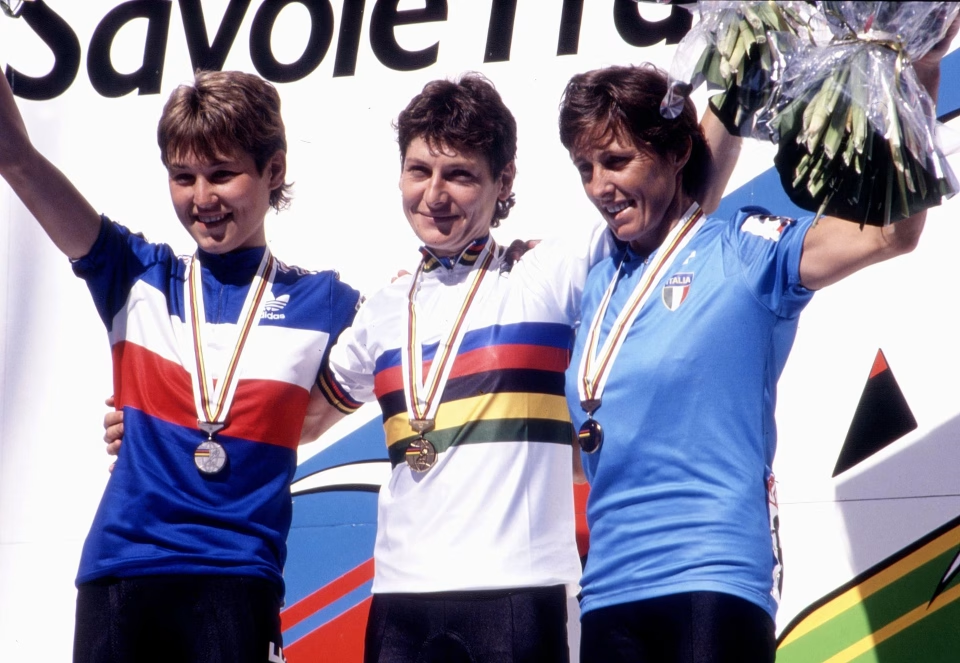
Jeannie Longo holds the outright women’s record with five road race world titles.

She won in 1985, 1986 and 1987 before retaining her position as champion through the Olympic year of 1988, when no World Championship road race was held. She won the next edition in 1989 and then added a fifth title in 1995.

RiderNationWinsWinning years
Jeannie LongoFrance51985, 1986, 1987, 1989, 1995
Yvonne ReyndersBelgium41959, 1961, 1963, 1966
Marianne VosNetherlands32006, 2012, 2013
Beryl BurtonGreat Britain21960, 1967
Keetie van Oosten-HageNetherlands21968, 1976
Anna KonkinaSoviet Union21970, 1971
Geneviève GambillonFrance21972, 1974
Leontien van MoorselNetherlands21991, 1993
Susanne LjungskogSweden22002, 2003
Giorgia BronziniItaly22010, 2011
Anna van der BreggenNetherlands22018, 2020
Annemiek van VleutenNetherlands22019, 2022
Lotte KopeckyBelgium22023, 2024

The Netherlands is the most successful nation in the women’s road race with 14 victories through 2025. France has 10 and Belgium eight.

Youngest and oldest women’s road race world champions

The women’s championship has produced particularly striking age records.

Ute Enzenauer was only 16 years and 229 days old when she won for West Germany in 1981. Petra de Bruin had won at 17 in 1979, while Beate Habetz was also 17 when she took the title a year earlier.

Marianne Vos was 19 when she won the first of her three elite road race rainbow jerseys in Salzburg in 2006.

Annemiek van Vleuten holds the record at the other end of the scale. She was 39 years and 351 days old when she won in Wollongong in 2022, less than two weeks before her 40th birthday.

Van Vleuten had also become world champion three years earlier, making her the two oldest winners of the women’s road race.

Beryl_Burton_1967d World Champion

Every British elite road race world champion

Great Britain has won seven elite road race titles through six riders.

Five of those victories have come in the women’s event, while Tom Simpson and Mark Cavendish are Britain’s two elite men’s road race champions.

YearRiderEvent
1960Beryl BurtonElite women’s road race
1965Tom SimpsonElite men’s road race
1967Beryl BurtonElite women’s road race
1982Mandy JonesElite women’s road race
2008Nicole CookeElite women’s road race
2011Mark CavendishElite men’s road race
2015Lizzie DeignanElite women’s road race

Burton remains the only British rider to have won the elite road race more than once.

Simpson became Britain’s first professional men’s champion in 1965 before Cavendish ended a 46-year wait in Copenhagen in 2011. Cooke combined Olympic and World Championship road race victories during her outstanding 2008 season, while Deignan remains Britain’s most recent elite road race world champion after winning in Richmond in 2015.

ProCyclingUK’s history of Great Britain at the UCI Road World Championships looks at each of those victories in greater detail.

divRoad-European-Championships-Remco-Evenepoel-dominates-elite-mens-time-trial-well-ahead-of-Filippo-Gannadiv-1

Every elite men’s World Championships time trial winner

The individual time trial became an elite World Championship event in 1994.

Britain’s Chris Boardman won the inaugural men’s title in Sicily, beginning a roll of honour that has since included Miguel Indurain, Jan Ullrich, Fabian Cancellara, Tony Martin, Filippo Ganna and Remco Evenepoel.

YearWorld championNation
2025Remco EvenepoelBelgium
2024Remco EvenepoelBelgium
2023Remco EvenepoelBelgium
2022Tobias FossNorway
2021Filippo GannaItaly
2020Filippo GannaItaly
2019Rohan DennisAustralia
2018Rohan DennisAustralia
2017Tom DumoulinNetherlands
2016Tony MartinGermany
2015Vasil KiryienkaBelarus
2014Bradley WigginsGreat Britain
2013Tony MartinGermany
2012Tony MartinGermany
2011Tony MartinGermany
2010Fabian CancellaraSwitzerland
2009Fabian CancellaraSwitzerland
2008Bert GrabschGermany
2007Fabian CancellaraSwitzerland
2006Fabian CancellaraSwitzerland
2005Michael RogersAustralia
2004Michael RogersAustralia
2003Michael RogersAustralia
2002Santiago BoteroColombia
2001Jan UllrichGermany
2000Serhiy HoncharUkraine
1999Jan UllrichGermany
1998Abraham OlanoSpain
1997Laurent JalabertFrance
1996Alex ZülleSwitzerland
1995Miguel IndurainSpain
1994Chris BoardmanGreat Britain
Most elite men’s time trial world titles Fabian Cancellara

Most elite men’s time trial world titles

Fabian Cancellara and Tony Martin share the men’s record with four victories.

Cancellara won in 2006, 2007, 2009 and 2010. Martin then succeeded him as the dominant rider of the early 2010s, winning three consecutive editions between 2011 and 2013 before adding a fourth title in 2016.

RiderNationWinsWinning years
Fabian CancellaraSwitzerland42006, 2007, 2009, 2010
Tony MartinGermany42011, 2012, 2013, 2016
Michael RogersAustralia32003, 2004, 2005
Remco EvenepoelBelgium32023, 2024, 2025
Jan UllrichGermany21999, 2001
Rohan DennisAustralia22018, 2019
Filippo GannaItaly22020, 2021

Evenepoel can equal Cancellara and Martin with a fourth title in Montréal in 2026. Victory would also make him the first man to win four consecutive elite World Championship time trials.

The 2026 elite time trials use the same 39.2km Montréal course, which is covered in ProCyclingUK’s World Championships course guide.

Ellen-van-Dijk-World-Champion-TT-Wollongong-2022

Every elite women’s World Championships time trial winner

The elite women’s individual time trial was also introduced in 1994, with American Karen Kurreck becoming the inaugural champion.

Jeannie Longo quickly established the event’s first major record. She won three consecutive titles from 1995 to 1997 before returning to win again in Lisbon in 2001.

YearWorld championNation
2025Marlen ReusserSwitzerland
2024Grace BrownAustralia
2023Chloé DygertUnited States
2022Ellen van DijkNetherlands
2021Ellen van DijkNetherlands
2020Anna van der BreggenNetherlands
2019Chloé DygertUnited States
2018Annemiek van VleutenNetherlands
2017Annemiek van VleutenNetherlands
2016Amber NebenUnited States
2015Linda VillumsenNew Zealand
2014Lisa BrennauerGermany
2013Ellen van DijkNetherlands
2012Judith ArndtGermany
2011Judith ArndtGermany
2010Emma PooleyGreat Britain
2009Kristin ArmstrongUnited States
2008Amber NebenUnited States
2007Hanka KupfernagelGermany
2006Kristin ArmstrongUnited States
2005Karin ThürigSwitzerland
2004Karin ThürigSwitzerland
2003Joane SomarribaSpain
2002Zulfiya ZabirovaRussia
2001Jeannie LongoFrance
2000Mari HoldenUnited States
1999Leontien van MoorselNetherlands
1998Leontien van MoorselNetherlands
1997Jeannie LongoFrance
1996Jeannie LongoFrance
1995Jeannie LongoFrance
1994Karen KurreckUnited States
Most elite women’s time trial world titles Jeannie LongoPhoto Credit: AFP/Dennis Charlet

Most elite women’s time trial world titles

Longo’s four victories remain the record.

Ellen van Dijk is next with three, while six riders have won the women’s time trial championship twice.

RiderNationWinsWinning years
Jeannie LongoFrance41995, 1996, 1997, 2001
Ellen van DijkNetherlands32013, 2021, 2022
Leontien van MoorselNetherlands21998, 1999
Karin ThürigSwitzerland22004, 2005
Kristin ArmstrongUnited States22006, 2009
Amber NebenUnited States22008, 2016
Judith ArndtGermany22011, 2012
Annemiek van VleutenNetherlands22017, 2018
Chloé DygertUnited States22019, 2023

Longo also holds another remarkable time trial record. She was 42 years old when she won her fourth title in 2001, making her comfortably the oldest winner of the elite women’s individual time trial.

British World Championship time trial winners

British World Championship time trial winners

Britain has won three elite individual time trial rainbow jerseys.

YearRiderEvent
1994Chris BoardmanElite men’s individual time trial
2010Emma PooleyElite women’s individual time trial
2014Bradley WigginsElite men’s individual time trial

Boardman won the very first men’s elite time trial world title in 1994.

Pooley became Britain’s first and, through 2025, only women’s elite time trial world champion when she won in Geelong in 2010. Wiggins added Britain’s third title in Ponferrada four years later, beating Tony Martin.

Together with the seven road race victories, that gives Great Britain 10 elite individual Road World Championship titles across the road race and individual time trial through the end of 2025.

Which riders have won both the road race and time trial world titles?

Winning both individual elite World Championship titles during a career is rare because the two events often reward very different riders.

Only two men have done it.

Abraham Olano became road race world champion in 1995 and won the individual time trial title in 1998. Remco Evenepoel followed by winning the road race in 2022 before beginning his run of time trial titles in 2023.

The women’s list is longer.

Jeannie Longo won five road race titles and four time trials. Leontien van Moorsel won the road race in 1991 and 1993 before becoming time trial champion in 1998 and 1999. Judith Arndt won the road race in 2004 and the time trial in 2011 and 2012.

Anna van der Breggen won road race titles in 2018 and 2020 and the time trial in 2020. Annemiek van Vleuten won the time trial in 2017 and 2018 before adding road race titles in 2019 and 2022.

Two women have won both individual elite titles at the same World Championships. Longo completed the double in 1995, while Van der Breggen won both races at Imola in 2020.

No elite man has yet completed the road race and individual time trial double at the same World Championships.

What does winning the rainbow jersey mean?

The winner of a World Championship receives the rainbow jersey for that specific discipline until the next edition.

A road race world champion wears it in road races but not individual time trials. The time trial world champion wears the rainbow jersey when competing against the clock.

When a rider’s reign ends, rainbow bands can remain on the cuffs and collar of their trade-team jersey for the rest of their career.

That is part of what makes the World Championships different from almost every other race in cycling. The title is decided on a single day, but becoming world champion remains visible long after the jersey itself has passed to the next winner.

Full start list for the men’s World Championships time trial 2026

0

The elite men’s individual time trial takes place on Sunday 20 September at the 2026 UCI Road World Championships in Montréal, with Remco Evenepoel attempting to become the first man to win four consecutive world titles against the clock.

The latest field contains 61 riders representing 40 countries. Evenepoel is joined by Filippo Ganna, Stefan Küng, Tobias Foss, Mathias Vacek, Brandon McNulty, Ethan Hayter and Callum Thornley among the strongest time trial specialists on the start list, while Belgium have three places through Evenepoel, Alec Segaert and Rune Herregodts.

The men race over 39.2km with 220 metres of climbing, using exactly the same course as the elite women earlier in the day. ProCyclingUK’s 2026 UCI Road World Championships course guide covers the route in detail, including the fast section around Circuit Gilles-Villeneuve and the return towards Parc Jeanne-Mance. A full race preview of the men’s time trial can be found here.

Men’s World Championships time trial 2026 race details

Date: Sunday 20 September 2026
Start: Avenue du Parc, Montréal
Finish: Parc Jeanne-Mance, Montréal
Distance: 39.2km
Elevation gain: 220 metres
Race start: 12:45 local / 17:45 BST
Defending champion: Remco Evenepoel

The course is considerably flatter than the one Evenepoel dominated in Kigali last year. Rather than repeatedly climbing around Mount Royal, the riders head towards the St Lawrence River and Circuit Gilles-Villeneuve before returning towards the finish.

That should increase the importance of sustained aerodynamic power and gives riders such as Ganna and Küng a more suitable test than they faced at the 2025 World Championships.

UK viewers can find the complete schedule and broadcast information in ProCyclingUK’s guide to watching the 2026 UCI Road World Championships.

divFilippo-Ganna-wins-sixth-mens-national-time-trial-championshipsdivPhoto Credit: Getty

Full men’s World Championships time trial 2026 start list

NationRider
AustraliaConor Leahy
BelgiumRemco Evenepoel
BelgiumAlec Segaert
BelgiumRune Herregodts
BelizeDerek Horton
BermudaNicholas Narraway
BermudaKaden Hopkins
BrazilVinicius Rangel
CanadaDerek Gee-West
CanadaMichael Leonard
Cayman IslandsChristopher Bodden
ChinaChenglu Liu
ChinaHaoming Cao
ColombiaBrandon Smith Rivera
ColombiaWalter Vargas
Czech RepublicMathias Vacek
DenmarkMikkel Bjerg
DenmarkKasper Asgreen
EstoniaMadis Mihkels
FrancePaul Seixas
FranceBruno Armirail
GermanyJasha Sütterlin
GermanyMax Walscheid
Great BritainCallum Thornley
Great BritainEthan Hayter
Guinea-BissauDjassi Da Costa
Guinea-BissauCalisto da Silva
HondurasFredd Matute
HungaryBarnabás Peák
HungaryErik Fetter
IrelandRyan Mullen
ItalyFilippo Ganna
ItalyMattia Cattaneo
JapanYuki Ishibashi
JordanMajed Abu Hammad
KazakhstanAnton Kuzmin
KazakhstanDaniil Marukhin
LuxembourgArthur Kluckers
MauritiusAlexandre Mayer
MexicoEdgar David Cadena
MexicoIsaac del Toro
MongoliaMaral-Erdene Batmunkh
NetherlandsDaan Hoole
NorwayTobias Foss
NorwayAndreas Leknessund
PolandMichał Kwiatkowski
PortugalIvo Oliveira
PortugalNelson Oliveira
RwandaSamuel Niyonkuru
RwandaRenus Byiza Uhiriwe
SerbiaOgnjen Ilić
SloveniaAnže Ravbar
South AfricaByron Munton
SpainPablo Castrillo
SpainIván Romeo
SwedenJakob Söderqvist
SwitzerlandStefan Bissegger
SwitzerlandStefan Küng
UkraineVitaliy Hryniv
United StatesÁrtem Schmidt
United StatesBrandon McNulty
divRemco-Evenepoel-starts-last-heavy-block-before-full-throttle-Tour-de-France-opening-week-with-Belgian-time-trial-titledivPhoto Credit: Getty

Belgium bring three riders around defending champion Evenepoel

Belgium have the largest representation among the leading nations, with Evenepoel joined by Segaert and Herregodts.

Evenepoel has won this event in each of the last three seasons, taking his first elite time trial rainbow jersey in Stirling in 2023 before defending it in Zürich and Kigali. Victory in Montréal would make him the first elite man to win four consecutive World Championships individual time trials.

Segaert gives Belgium another established specialist, while Herregodts adds a third rider capable of producing a strong result over a fast course.

Evenepoel has already shown his form in Canada by winning GP Québec before finishing fifth at GP Montréal. The road races used very different terrain, but his performances removed much of the uncertainty surrounding his condition ahead of Worlds.

Ganna leads Italy’s challenge

Filippo Ganna and Mattia Cattaneo represent Italy.

Ganna is the most obvious threat to Evenepoel on a course containing only 220 metres of climbing. He has already produced an outstanding long time trial this season, winning the 42km Giro d’Italia test from Viareggio to Massa by almost two minutes.

That distance is particularly relevant to Montréal. Sunday’s 39.2km course should require a similarly prolonged effort, while the relatively flat profile allows Ganna to spend much of the race using the sustained power that has made him a two-time world champion in the discipline.

Cattaneo gives Italy a second experienced starter and has built much of his career around strong performances against the clock and in week-long stage races.

divThere-were-a-few-things-going-on-Ethan-Hayter-won-five-time-trials-in-2025-but-a-nutrition-problem-disrupted-his-road-racingdivPhoto Credit: Getty

Great Britain select Thornley and Hayter

Great Britain will be represented by Callum Thornley and Ethan Hayter.

Thornley arrives directly from the Vuelta a España, where he finished second to Küng in the 32.1km Stage 18 time trial at Jerez de la Frontera. Only three seconds separated them, giving Thornley one of the strongest immediate form references among the Montréal field.

Hayter is the reigning British time trial champion and won the national title over 38.4km in June. That distance is almost identical to Sunday’s World Championships course and should leave few questions about his ability to manage the length of the effort.

Their wider place in the national squad is covered in ProCyclingUK’s Great Britain at the 2026 World Championships preview.

Joshua Tarling is not part of the British time trial selection.

Küng and Bissegger give Switzerland two experienced specialists

Switzerland bring Stefan Küng and Stefan Bissegger.

Küng arrives after winning the Vuelta time trial in Jerez, making him one of the few riders on the start list to have produced a major victory against the clock immediately before the World Championships.

He has also repeatedly gone close at this event, including taking silver behind Foss in Wollongong in 2022.

Bissegger gives Switzerland another rider whose best characteristics fit the course. He is particularly effective when a time trial allows long periods in an aerodynamic position without substantial climbing interrupting the rhythm.

Wollongong - Australia - cycling - Tobias Foss (NOR) pictured during 89th World Championships Men - ITT (WC) time trial ITT - Wollongong > Wollongong (34.2km) - Photo: Luca Bettini/SCA/Cor Vos © 2022Photo Credit: Cor Vos

Foss returns as a former world champion

Tobias Foss and Andreas Leknessund form the Norwegian pair.

Foss won the rainbow jersey in Wollongong in 2022, producing one of the biggest World Championships time trial surprises of recent years ahead of Küng and Evenepoel.

He has remained competitive against the clock since then and arrives in Montréal as Norwegian champion.

The course is very different from the one where he won four years ago, but the length makes pacing particularly important. Foss has already shown that he can produce his best effort in a one-day championship rather than simply relying on stage-race results.

Vacek, McNulty and Hoole strengthen the group behind the main contenders

Mathias Vacek is the Czech Republic’s sole entrant and has useful evidence over an even longer distance. He won the 48.1km Czech national championship in June, showing that almost 40km of racing should not create an endurance problem.

Brandon McNulty represents the United States alongside Ártem Schmidt. McNulty arrives in strong broader form after finishing third at GP Montréal on the Mount Royal circuit one week before Worlds.

The Netherlands have one rider in Daan Hoole. The relatively low climbing total should suit him considerably better than many championship courses, giving the Dutchman a clear opportunity to use his absolute power.

Jakob Söderqvist steps into the elite championship for Sweden after winning the under-23 world time trial title in Kigali last year. Paul Seixas rides for France alongside Bruno Armirail, while Isaac del Toro and Edgar David Cadena make up Mexico’s two-rider entry.

For a wider look at how the championships fit together, ProCyclingUK’s beginner’s guide to the 2026 UCI Road World Championships covers all 13 title events across the eight days in Montréal.

When will the men’s World Championships time trial start order be confirmed?

The current entry list establishes the expected field, but the final individual departure times have not yet been published.

Once the running order is confirmed, each rider will have a specific start time and start number. The later starters will have the advantage of receiving intermediate information from riders already on the course, with Evenepoel expected to be among the final names to leave the start ramp as defending champion.

The first rider is scheduled to begin at 12:45 local time, or 17:45 BST, on Sunday 20 September.

Full start list for the women’s World Championships time trial 2026

0

The elite women’s individual time trial opens the 2026 UCI Road World Championships in Montréal on Sunday 20 September, with defending champion Marlen Reusser heading a 53-rider field for the first rainbow jersey of the week.

Reusser is joined by Zoe Bäckstedt, Demi Vollering, Lieke Nooijen, Antonia Niedermaier, Elisa Longo Borghini, Kristen Faulkner, Taylor Knibb and Lotte Kopecky among a deep group of established time trial specialists. Great Britain have two starters through Bäckstedt and Anna Morris, while the Netherlands, Italy, Germany, United States and several other nations have also filled both of their available places.

The women face 39.2km with 220 metres of climbing, using exactly the same course as the elite men later in the day. ProCyclingUK’s 2026 UCI Road World Championships course guide covers the route in detail, including the fast section around Circuit Gilles-Villeneuve and the rise back towards the finish beside Parc Jeanne-Mance. A race preview can also be found here.

Women’s World Championships time trial 2026 race details

Date: Sunday 20 September 2026
Start: Avenue du Parc, Montréal
Finish: Parc Jeanne-Mance, Montréal
Distance: 39.2km
Elevation gain: 220 metres
Race start: 09:00 local / 14:00 BST
Expected finish: approximately 11:20 local / 16:20 BST
Defending champion: Marlen Reusser

Rather than using the repeated Mount Royal climbs which dominate the road races later in the championships, the time trial heads through Montréal towards the St Lawrence River and Île Notre-Dame.

The relatively low climbing total and long distance make this a sustained test of pacing and aerodynamic efficiency. The Formula 1 circuit should produce some of the fastest kilometres of the race before the riders return towards central Montréal.

UK viewers can find the full broadcast schedule in ProCyclingUK’s guide to watching the 2026 UCI Road World Championships.

divWe-dont-expect-that-Marlen-will-explode-–-FDJ-United-SUEZ-focus-on-keeping-up-the-pressure-after-Demi-Vollering-moves-into-second-overall-at-Tour-de-France-Femmesdiv

Full women’s World Championships time trial 2026 start list

NationRider
AustraliaLauretta Hanson
AustriaChristina Schweinberger
BelgiumLotte Claes
BelgiumLotte Kopecky
BulgariaGergana Stoyanova
CanadaNadia Gontova
CanadaOlivia Baril
Cayman IslandsAlyssa Burgess
ChinaXin Tang
ChinaShimeng Zhu
ColombiaDiana Peñuela
EstoniaAnn-Christine Allik
EstoniaJanika Lõiv
FinlandAnniina Ahtosalo
FranceCédrine Kerbaol
FranceJuliette Berthet
GermanyFranziska Koch
GermanyAntonia Niedermaier
Great BritainZoe Bäckstedt
Great BritainAnna Morris
IndonesiaMagh Firotika Marendra
IranSajedeh Siyahian
ItalyVittoria Guazzini
ItalyElisa Longo Borghini
JapanKarin Abe
KazakhstanFaina Potapova
KenyaMonica Jelimo Kiplagat
KenyaKendra Tabu
MauritiusLucie de Marigny-Lagesse
MexicoRomina Hinojosa
MexicoSara Roel
NamibiaVera Looser
NetherlandsLieke Nooijen
NetherlandsDemi Vollering
Neutral athleteKristina Novikova
New ZealandHenrietta Christie
New ZealandBronwyn MacGregor
NorwayKatrine Aalerud
PolandDominika Włodarczyk
RwandaDiane Ingabire
RwandaXaveline Nirere
Saudi ArabiaMashael Alhazmi
SloveniaNika Bobnar
SpainMireia Benito
SpainPaula Blasi
SwitzerlandMarlen Reusser
SwitzerlandJasmin Liechti
Trinidad and TobagoTeniel Campbell
UkraineValeriya Kononenko
United StatesKristen Faulkner
United StatesTaylor Knibb
ZimbabweSkye Davidson
ZimbabweRongina Ngandu

Marlen Reusser returns as defending champion

Reusser starts the week with the rainbow jersey after winning the 2025 title in Kigali ahead of Anna van der Breggen and Demi Vollering.

Her final competitive preparation came at the Chrono Féminin de Gatineau on Wednesday, where she again demonstrated why she enters Montréal as the rider everybody else has to measure themselves against. ProCyclingUK’s Chrono Féminin de Gatineau contenders preview looked at how the Canadian race fitted into her final preparation.

The Montréal course is substantially longer than Gatineau and places less emphasis on repeated changes in gradient. At 39.2km, maintaining speed and position deep into the race will be just as important as producing the highest opening power.

Reusser is joined in the Swiss team by Jasmin Liechti, who has made a substantial step forward against the clock during 2026.

Zoe Backstedt 2026 Tour de Suisse Women Stage 4 (Getty)

Great Britain select Bäckstedt and Morris

Great Britain have Zoe Bäckstedt and Anna Morris in the elite women’s time trial.

Bäckstedt enters her first elite World Championships as one of the strongest challengers to Reusser after another season of progress against the clock. She retained the British title and finished second to Reusser in the Tour de Suisse Women time trial before another strong performance at the Tour de France Femmes.

Morris also brings considerable track pursuit experience and finished second to Bäckstedt at the British championships.

The 39.2km distance presents a different test from many of the shorter stage-race time trials Bäckstedt has ridden this season, but its fast character should suit her ability to hold high power for prolonged periods.

Vollering and Nooijen give the Netherlands two contenders

Demi Vollering returns after taking bronze in Kigali and has another chance to add a World Championships time trial medal to a season already dominated by her stage-racing success.

Lieke Nooijen offers a different type of threat.

Nooijen finished only four seconds behind Reusser in the Tour de France Femmes time trial from Gevrey-Chambertin to Dijon, one of the strongest performances of her season. ProCyclingUK’s Tour de France Femmes Stage 4 time trial guide looked at the riders expected to shape that race against the clock.

Montréal is almost twice as long, so Nooijen now has to carry that speed through a much longer championship effort.

divVittoria-Guazzini-outpowers-Elisa-Longo-Borghini-to-secure-elite-womens-Italian-time-trial-titlediv

Italy, Germany and the United States bring two-rider teams

Italy have Elisa Longo Borghini and Vittoria Guazzini, giving them two very experienced options for the opening championship.

Germany send Antonia Niedermaier and Franziska Koch. Niedermaier has already established a strong World Championships record against the clock, while Koch beat her to the German national title earlier this season.

The United States pair Kristen Faulkner with Taylor Knibb. Both are particularly well suited to a race based around sustained power, although Knibb’s background in triathlon gives her a different route into the discipline from most of the field.

Belgium also have two starters through Lotte Kopecky and national time trial champion Lotte Claes.

Mie Bjørndal Ottestad will not start

Norway had initially selected Mie Bjørndal Ottestad alongside Katrine Aalerud, but Ottestad has since withdrawn from the World Championships.

Her recovery from the concussion suffered earlier in the summer has taken longer than expected, leaving Aalerud as Norway’s sole starter in the elite women’s individual time trial.

Ottestad had appeared on several preliminary start lists, so older versions of the field may still show two Norwegian riders.

When will the individual start times be confirmed?

The current entry list establishes the field, but the final running order is still to be published.

Once confirmed, each rider will receive an individual departure time, allowing the main contenders to be grouped into a complete start-order table. The later starters will be particularly important because they will have access to intermediate times from riders already on the course.

The first rider is scheduled to leave Avenue du Parc at 14:00 BST on Sunday, with the competition expected to finish at approximately 16:20 BST.

The wider championship programme, including all 13 title events across the eight days in Montréal, is available in ProCyclingUK’s beginner’s guide to the 2026 UCI Road World Championships.

Sergio Higuita joins Caja Rural-Seguros RGA on two-year deal through 2028

0

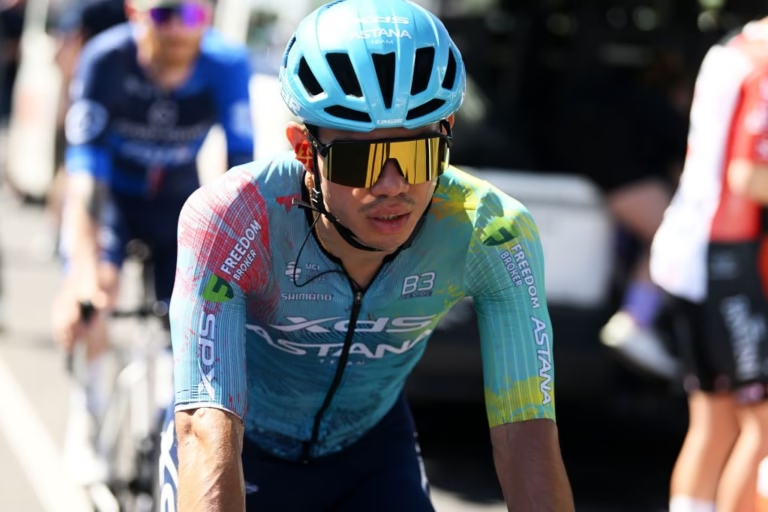
Sergio Higuita will leave XDS Astana Team at the end of the 2026 season and join Caja Rural-Seguros RGA on a two-year contract, keeping the Colombian with the Spanish ProTeam through 2028.

The 29-year-old gives Caja Rural a proven stage-race and one-day option after eight seasons at WorldTour level with EF Education-EasyPost, Bora-hansgrohe and XDS Astana Team. He has won the Volta a Catalunya, stages of the Vuelta a España, Tour de Romandie and Itzulia Basque Country, while his 2026 campaign has included ninth overall at the Tour de Suisse.

Moving to ProTeam level should also change the opportunities available to Higuita. Rather than operating as one of several climbing options within a WorldTour roster, he joins a Caja Rural squad where he can take more responsibility in week-long stage races and hilly one-day events.

The transfer becomes one of the most notable additions to Caja Rural’s developing roster and follows the decision to retain fellow Colombian Fernando Gaviria for the 2027 season.

Sergio-Higuita-becomes-latest-Astana-reinforcement-for-2025-WorldTour-survival-battle

Higuita looking for leadership opportunities at Caja Rural

Higuita explained that Caja Rural’s willingness to race aggressively against WorldTour teams was part of the attraction.

“I’m joining a team with a lot of history that has continued growing year after year,” he said. “The team is becoming stronger, has had a great year and races against the best WorldTour teams without fear.”

That approach fits a rider whose strongest performances have usually come when he has been allowed to race proactively rather than simply follow a general classification hierarchy.

Higuita won the 2022 Volta a Catalunya after a close battle with Richard Carapaz, while his 2019 Vuelta stage victory at Becerril de la Sierra came after spending much of the day on the attack. His acceleration also gives him options beyond traditional mountain finishes, particularly when a selective race reaches the line with a reduced group.

He sees stage races and one-day events as the areas where he can again become a regular leader.

“My best results have come in one-week races and one-day Classics,” Higuita said. “I want to target those races again. When I’m going well, I like being an aggressive rider who attacks from far out and isn’t afraid.”

That should give Caja Rural another way of approaching the bigger races on its calendar. The team already has riders capable of chasing breakaways and sprints, but Higuita brings a level of climbing and stage-race experience that has largely been developed at WorldTour level.

Tour de Suisse result showed Higuita can still compete for GC

Higuita’s 2026 season has not produced a victory, but ninth overall at the Tour de Suisse showed he remains capable of putting together a competitive general classification performance against WorldTour opposition.

The shortened five-stage race provided little room to recover from a bad day, combining repeated hilly racing, an individual time trial and the final mountain stage around Villars-sur-Ollon. Higuita stayed close enough across the week to secure a top-10 overall finish.

ProCyclingUK’s Tour de Suisse 2026 team-by-team guide identified Higuita as one of XDS Astana’s climbing options, while the result eventually became his strongest stage-race GC finish of the season.

His racing profile remains particularly useful for a ProTeam. Higuita can contest general classifications when the time-trial mileage is limited, target individual climbing stages and still carry enough finishing speed to compete from small groups.

That versatility gives Caja Rural more than another rider for mountain domestique duties.

Sergio Higuita looking for leadership opportunities at Caja Rural

A different role after two seasons with XDS Astana

Higuita joined XDS Astana after leaving Red Bull-BORA-hansgrohe and has spent the past two seasons working within a roster containing several other climbing and stage-race options.

His role has consequently varied depending on the race.

At this month’s GP Montréal, for example, Higuita lined up alongside Alberto Bettiol and Harold Martín López as one of the team’s options for a race containing more than 4,000 metres of climbing. ProCyclingUK’s GP Montréal team-by-team guide highlighted his ability to survive deeper into a hard race if the repeated climbs removed some of the faster riders.

Caja Rural can offer something more consistent.

At 29, Higuita is still young enough to target results himself but has accumulated four Tour de France appearances and four starts at the Vuelta a España. That experience is likely to make him one of the reference points within a squad where many riders are still building experience at the highest level.

Higuita believes that is another area where he can contribute.

“I already have a lot of experience in European cycling, so I think I can bring confidence and calm,” he said. “When there’s a chance to win or be close, I’ve often known how to keep a cool head.”

He also spoke about helping younger teammates deal with pressure while bringing the more relaxed atmosphere he associates with Colombian cycling.

Caja Rural continue strengthening their roster

The signing continues an active period for Caja Rural-Seguros RGA as the team looks to increase its ability to compete when invited to WorldTour races.

Gaviria joined for 2026 and has already agreed to remain for another season, while Higuita now brings another internationally recognised Colombian rider into the squad.

The two offer very different strengths. Gaviria remains focused primarily on sprint opportunities, whereas Higuita gives the team a leader for mountainous stage races, selective Classics and breakaways where climbing strength is required.

Their presence also gives Caja Rural substantially more experience around younger riders.

The team’s progression can be followed throughout the winter in ProCyclingUK’s Men’s Cycling Transfers Hub, which tracks confirmed signings, contract extensions and retirements ahead of the 2027 season.

Higuita wants to attack again

There is a sense from Higuita’s comments that the move is about more than simply extending his career for another two years.

He wants races where he can take responsibility and make decisions for himself.

That has often been when Higuita has been at his most effective. His best results have come from a combination of climbing ability, acceleration and a willingness to race before the final kilometres rather than waiting for a conventional mountain finish.

Caja Rural should be able to give him that freedom more often.

“I’m really motivated,” Higuita said. “It’s a project where I want to give everything I can.”

After two seasons at XDS Astana, the move gives Higuita a different place within the peloton. He is dropping from WorldTour to ProTeam level, but doing so with the expectation of becoming one of his new team’s principal leaders rather than simply taking another supporting role.

Nina Buijsman extends with Human Powered Health through 2028

0

Nina Buijsman will remain with Human Powered Health through the end of the 2028 season after signing a two-year contract extension with the American team.

The 28-year-old returned to Human Powered Health for 2026 following two seasons with FDJ-Suez, having previously raced for the team in 2022 and 2023. Her second spell has quickly developed into a more prominent role, with Buijsman combining leadership opportunities with increasingly consistent performances in the Women’s WorldTour.

Her season began with sixth overall at the Tour Down Under and continued with solid general classification performances at the Giro d’Italia Women, Tour de Suisse Women and Tour de France Femmes. Buijsman eventually finished 16th overall at the Tour, one place behind Juliette Berthet and only 10 seconds behind the French rider.

“I’m really happy to stay with the team. It felt good to come back after two years, and I really feel at home here,” Buijsman said. “The respect and trust within the team, as well as the motivation we have, are things I really like.”

The extension secures another established part of the Human Powered Health squad as the team continues shaping its roster for the next Women’s WorldTour cycle.

Nina Buijsman sprints to Burgos podium

A return that immediately produced results

Buijsman’s first race after returning to Human Powered Health gave an early indication that the move suited her.

She finished sixth overall at the Tour Down Under after moving up three places on the final stage, a result she described as a fresh start after a difficult 2025 campaign. It also came after the team immediately trusted her with a leadership role despite her two years away.

“The Tour Down Under in Australia at the beginning of the year was very special for me,” she said. “From the start, the team gave me the trust to be the leader there, even though I had been away from the team for two years and had a difficult year last season.”

Buijsman carried that consistency deeper into the season rather than relying on one early result.

At the Giro d’Italia Women she repeatedly stayed involved when the race became selective, including joining Silvia Persico in a late move on stage 3 to Buja. Her performances later in the summer showed further progress on longer climbs.

The Tour de Suisse Women was particularly useful evidence. On the final mountain stage around Villars-sur-Ollon, Buijsman was active in the chase behind Franziska Koch before the general classification riders took control, completing a week in which she was regularly visible when the terrain became harder.

That continued into the Tour de France Femmes, where she finished 16th overall. The final Tour de France Femmes classification placed Buijsman immediately behind Berthet and ahead of Noemi Rüegg and Magdeleine Vallieres.

Longer efforts have become a focus

Buijsman believes one of the clearest changes during 2026 has been her ability to deal with sustained climbing efforts.

“I’ve developed a lot in longer efforts, which is important for climbing, so I’m really happy with that,” she said. “Step by step, I’m getting closer to the top in climbing stages, which makes racing more exciting for me.”

That development changes what Human Powered Health can ask from her.

Buijsman has always been capable of handling rolling terrain and selective finishes, but improving on longer climbs gives her greater scope in stage races where the general classification is decided by sustained mountain efforts rather than short, punchy finales.

She has accumulated 50 race days during 2026, giving the team plenty of opportunity to use her across different terrain and roles. That workload has also allowed Buijsman to become more comfortable carrying responsibility within the team rather than operating mainly in support of others.

“I’ve also developed mentally, especially when it comes to trusting the process and dealing with the responsibility of being one of the leaders,” she said.

“In my last season with the team in 2023, I wasn’t at the physical and psychological level I’m at now. With the right training and racing, I’ve been able to develop physically.”

Human Powered Health see more to come

General manager Ro De Jonckere believes Buijsman has returned as a noticeably different rider from the one who left at the end of 2023.

“Nina’s story with us has always felt a little unfinished, so having her back this season has been really special,” De Jonckere said.

“She has grown enormously over the past year, both as a rider and in the way she approaches racing, and we have started to see the Nina we always knew was there and, honestly, even more than we expected.”

The two-year deal also gives Human Powered Health continuity while the team makes changes elsewhere.

Yara Kastelijn will join Human Powered Health for 2027 on a contract through 2028, adding another rider suited to hilly stage races and selective one-day events.

Marta Lach is also joining from SD Worx-Protime on a two-year contract, while Quinty Ton has been recruited from Liv AlUla Jayco.

Buijsman offers something slightly different from those additions. Rather than arriving as a new signing who needs to settle into the structure, she already knows the team and has spent 2026 establishing herself within its leadership group.

De Jonckere believes that familiarity can now be used as a foundation rather than another transition.

“She has taken another step this season, and it has been great to see her confidence and understanding of her own abilities grow,” he said. “We know there is still a lot more to come.”

Buijsman wants a bigger role in race finales

The extension gives Buijsman two more seasons to turn her improved climbing and stage-racing consistency into more decisive results.

She has already moved closer to the front of major races during 2026, but the next target is to become more influential when those races are being decided rather than simply finishing close behind the leading group.

“My goal is to keep developing and to play a role in the finals of races,” Buijsman said. “I love the game of racing, and it’s really cool to be part of it.”

Her return to Human Powered Health has already produced a stronger season than the one which preceded it. With her place secured through 2028, the next question is how far that progression can take her when the team gives her responsibility in the races best suited to her improving climbing profile.

Men’s World Championships time trial 2026 preview: Evenepoel faces Ganna and Küng in Montréal

0

Remco Evenepoel can make World Championships history in Montréal on Sunday 20 September. Victory in the elite men’s individual time trial would give the Belgian a fourth consecutive rainbow jersey, taking him beyond Michael Rogers and Tony Martin as the first man to win the title four years in succession.

The course gives his rivals reason to believe the run can be stopped. Montréal provides 39.2km of racing with only 220 metres of elevation gain, taking the riders away from Mount Royal and onto much faster roads around the St Lawrence River and Circuit Gilles-Villeneuve. Sustained aerodynamic power will matter far more than climbing ability.

That brings Filippo Ganna firmly back into the picture. The Italian produced one of the strongest long-distance time trials of recent years at the Giro d’Italia in May, while Stefan Küng arrives in Canada having beaten Callum Thornley by three seconds in the final individual time trial of the Vuelta a España. Mathias Vacek, Tobias Foss, Brandon McNulty and Ethan Hayter add further depth behind the three most obvious contenders.

Evenepoel still sets the standard. He has won every elite Worlds time trial since 2023 and beat Tadej Pogačar by 28 seconds in the Tour de France’s only individual time trial this summer. Montréal gives Ganna and the larger specialists more suitable terrain, but it does not obviously expose a weakness in the defending champion.

2026 World Championships Montreal Men's TT Route

Men’s World Championships time trial 2026 race details

Date: Sunday 20 September 2026
Start: Avenue du Parc, Montréal
Finish: Parc Jeanne-Mance, Montréal
Distance: 39.2km
Elevation gain: 220 metres
Start time: 12:45 local time / 17:45 BST
Expected finish: approximately 15:15 local time / 20:15 BST

The elite men race over exactly the same course as the women earlier on Sunday. ProCyclingUK’s 2026 UCI Road World Championships course guide covers the complete route and how the time trial differs from the much hillier road races later in the week.

UK viewers can watch the race through TNT Sports and HBO Max, with live coverage scheduled to begin shortly before the 17:45 BST start. The complete schedule is available in the World Championships TV and live-stream guide.

Previous winners

2025 – Remco Evenepoel
2024 – Remco Evenepoel
2023 – Remco Evenepoel

Evenepoel’s first two titles came directly at Ganna’s expense. He beat the Italian by 12 seconds in Stirling in 2023 before the margin fell to six seconds in Zürich the following year.

Kigali was completely different. Evenepoel dominated a 40.6km course containing around 680 metres of climbing, finishing 1:14 ahead of Jay Vine and catching Tadej Pogačar despite the Slovenian starting two and a half minutes before him.

That third victory put Evenepoel alongside Rogers and Martin, who also won three consecutive titles. Nobody has extended the sequence to four.

Why the Montréal course changes the contest

There is very little climbing for a World Championships time trial of this length.

The riders leave Avenue du Parc before travelling through central Montréal and Old Montréal towards the St Lawrence River. From there, the route reaches Île Notre-Dame and one of its most distinctive features, the Circuit Gilles-Villeneuve.

The Formula 1 circuit should produce some of the highest speeds of the race. Wide roads and flowing corners give the specialists long periods where they can stay in the extensions and hold a consistent effort rather than repeatedly braking, accelerating and climbing.

It does not remain completely straightforward. There are technical interruptions around the urban sections and bridges, while the return from Parc Jean-Drapeau becomes more broken before the final rise towards Parc Jeanne-Mance.

The key is likely to be managing the middle of the race. Ganna, Küng and the other large specialists can gain substantial time while the speeds are highest, but committing too much there leaves almost 40 kilometres in the legs by the time the road begins to rise towards the finish.

The full Montréal World Championships course guide looks more closely at that transition and why the Circuit Gilles-Villeneuve should be such an important part of the time trial.

Remco Evenepoel is one win from doing something nobody else has managed

There is no need to construct a complicated case for Evenepoel.

He has entered the last three World Championship time trials and won all three.

His 2026 season has also contained another reminder of the level he can reach against the clock. Stage 16 of the Tour de France covered 26.1km from Évian-les-Bains to Thonon-les-Bains, beginning with a long climb before becoming considerably faster towards the finish.

Evenepoel beat Pogačar by 28 seconds.

The route was much hillier than Montréal, but the performance mattered because it came deep into a Grand Tour and against one of the strongest stage racers in the world. The full ride is covered in ProCyclingUK’s Tour de France Stage 16 report.

His Canadian form also looks good. Evenepoel won GP Québec after attacking with 28km remaining and followed that with fifth at GP Montréal two days later. Those results do not tell us precisely what he can produce on a time trial bike, but they remove much of the uncertainty around his condition after a relatively quiet period following the Tour.

The flatter Montréal route probably reduces the advantage he enjoyed in Kigali. It does not follow that the course works against him. Evenepoel has already beaten Ganna on faster World Championships courses and won Olympic gold on the relatively flat Paris course in 2024.

His aerodynamic efficiency allows him to compete with riders producing considerably more absolute power.

That is what Ganna still has to solve.

Filippo-Ganna-eyes-home-stage-to-Verbania-to-prove-he-is-more-than-just-a-time-trialist

Filippo Ganna has the course and distance he wanted

Ganna’s Giro d’Italia time trial is the most relevant performance from any of Evenepoel’s challengers this season.

Stage 10 covered 42km from Viareggio to Massa, almost three kilometres longer than Sunday’s World Championship. Ganna completed it in 45:53 at an average of 54.921km/h and beat teammate Thymen Arensman by 1:54.

It was not simply another time trial victory. The margin over a strong field showed what Ganna can do when a race gives him more than 40 kilometres of predominantly fast roads.

ProCyclingUK’s Giro d’Italia Stage 10 report covers the scale of that performance and how quickly Ganna separated himself from everybody else.

Montréal is not identical. There are more changes of direction and a rising finish, while a World Championship brings a completely different level of pressure. The fundamental demands are nevertheless much closer to Viareggio-Massa than to a mountainous championship route.

Ganna also knows how small the gap to Evenepoel can become.

He lost by 12 seconds in 2023 and six seconds in 2024. Those are margins that can disappear through a slightly better corner, a change in wind conditions or a few watts maintained for longer in the final quarter.

The Giro ride showed that Ganna has not lost the capacity to produce extraordinary performances over this distance.

Sunday is his chance to turn that into another rainbow jersey.

Tour-de-Pologne-Stefan-Kung-takes-a-first-win-of-the-year-while-Marco-Brenner-wins-the-general-classification-with-stunning-time-trial-performancePhoto Credit: Getty

Stefan Küng arrives with the best possible final preparation

Küng has already completed a high-level 32.1km time trial this month.

On Stage 18 of the Vuelta a España, the Swiss rider beat Callum Thornley by three seconds between El Puerto de Santa María and Jerez de la Frontera. João Almeida was nine seconds behind, with Primož Roglič at 19 seconds.

It was an ideal rehearsal for Montréal. The Jerez course rewarded sustained speed, the race lasted more than 35 minutes and Küng had to manage his effort deep into the third week of a Grand Tour.

The Vuelta Stage 18 race report shows how Thornley established the early benchmark before Küng gradually found the seconds needed to win.

Küng then left the Vuelta rather than continuing through the final weekend, giving himself additional recovery time before Montréal.

He has been close to a world title before. Küng took silver in Wollongong in 2022 and has spent much of his career among the most consistent championship time triallists without winning this particular race.

His task is considerably harder than simply repeating Jerez. Evenepoel and Ganna represent a different benchmark.

The evidence at least suggests he arrives ready to challenge them.

Callum Thornley has changed expectations quickly

Thornley’s second place in Jerez moved him into this conversation.

The 23-year-old finished only three seconds behind Küng over 32.1km and nine seconds ahead of Almeida. It was not a short prologue where a few good corners can transform the result. Thornley stayed close to one of the world’s best specialists for more than 35 minutes.

Montréal extends that effort by seven kilometres.

That makes pacing and endurance more important, but there is little about the course itself that should trouble him. Thornley has shown that he can ride quickly on flat roads and sustain an aerodynamic position for long periods.

The bigger question is recovery. He has completed an entire Vuelta immediately before travelling to Canada.
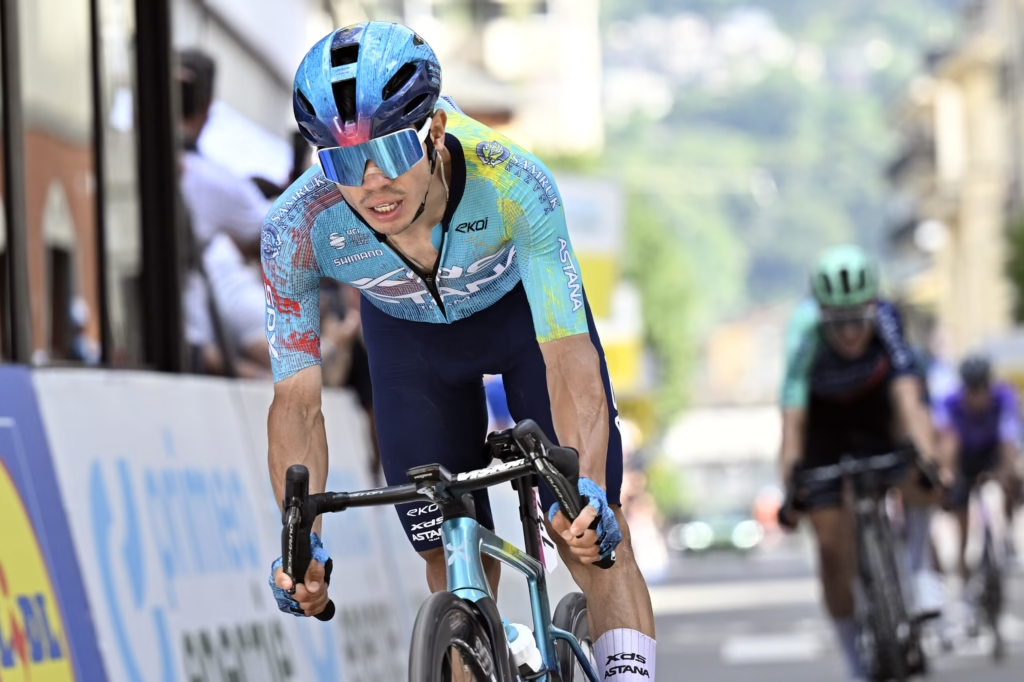
That can work both ways. Three weeks of racing can leave a rider carrying fatigue, but it can also produce the condition needed for one final prolonged effort.

Great Britain have another option in Ethan Hayter, making the British challenge more interesting than it appeared earlier in the season.

Ethan-Hayter-receives-fine-and-points-deduction-after-middle-finger-gesture-during-Tirreno-Adriatico-time-trial-1Photo Credit: Getty

Ethan Hayter already has a major result over almost exactly this distance

The distance of the British national championship is difficult to ignore.

Hayter raced for 38.4km around Lampeter in June, only 800 metres shorter than the Montréal course. He won the elite title convincingly and demonstrated that the duration itself is unlikely to be a problem.

His track background helps too. Hayter has spent years developing the ability to hold high power in an aerodynamic position, and the fastest sections of Montréal reward precisely that.

He also showed his speed at the start of the Vuelta, coming close to victory in the opening time trial.

Hayter has generally been less consistent than Evenepoel, Ganna or Küng in the biggest championship time trials. That is why the gap between being a medal contender and winning remains substantial.

The underlying ingredients are there, though.

A long, predominantly flat World Championship is considerably better for him than a race packed with sustained climbing.

Mathias Vacek should not have a problem with the distance

Vacek has already gone significantly further against the clock this year.

The Czech championship covered 48.1km, almost nine kilometres longer than Montréal, and Vacek won by more than a minute and a half. He also finished fourth in the Tour de Suisse time trial during June.

That combination is useful.

Some riders arriving in Montréal have demonstrated exceptional speed over 20 or 25 kilometres but still need to prove they can maintain it for close to an hour. Vacek has already shown the necessary endurance.

His challenge is outright speed against the strongest specialists.

A national championship victory does not automatically translate into the numbers required to beat Evenepoel or Ganna. Yet this course gives Vacek a realistic opportunity to turn another strong season against the clock into his best elite World Championships result.
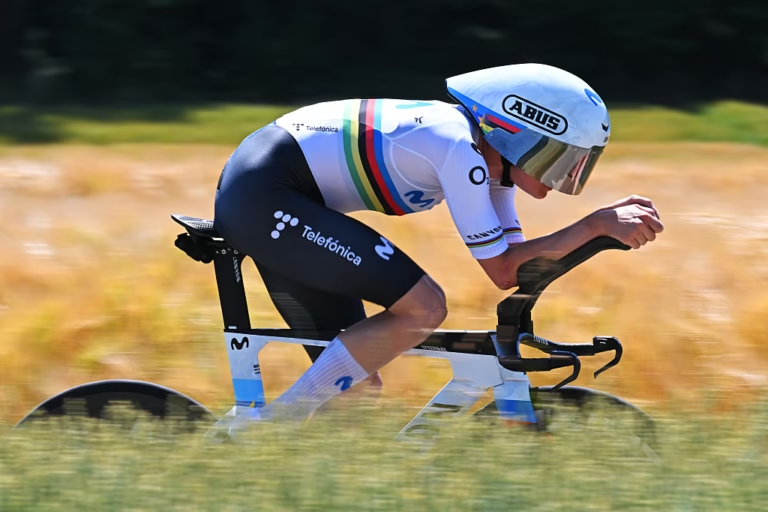
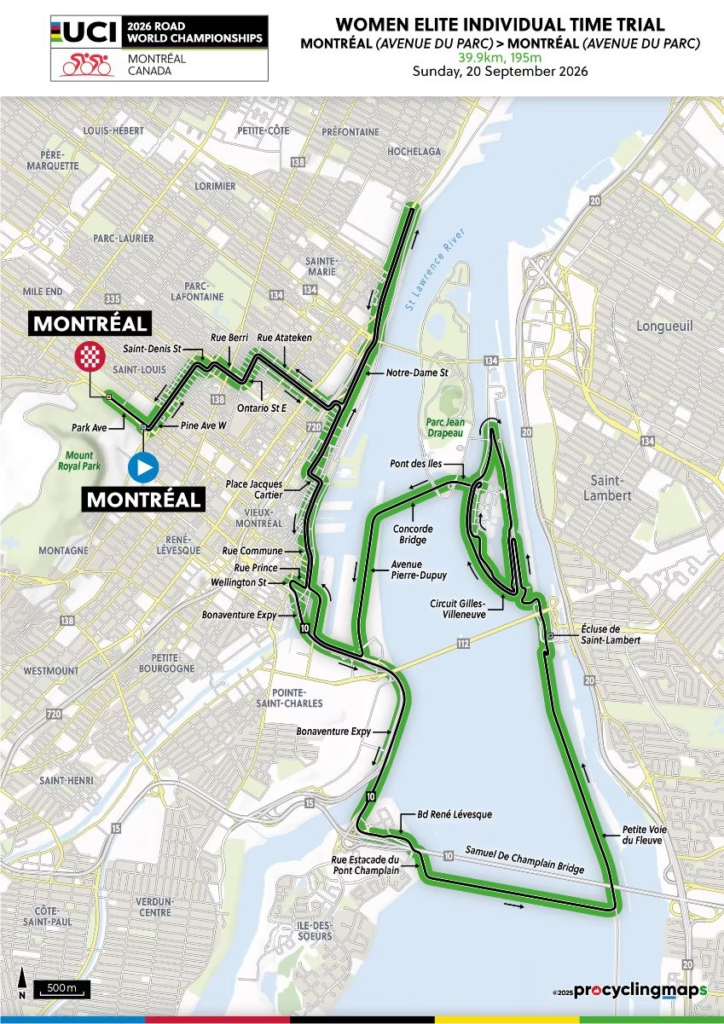
Tobias Foss has already shown why championship time trials can surprise

Foss remains the most obvious warning against treating the result as predetermined.

He won the World Championship in Wollongong in 2022 when Ganna, Evenepoel and several better-known specialists were expected to decide the medals.

The Norwegian produced his best performance on the day when it mattered.

His 2026 season has included another national time trial title, beating Andreas Leknessund in June. Montréal is much longer, but Foss has repeatedly shown that he can control a championship effort rather than starting too aggressively and fading.

His victory four years ago does not make him one of the two obvious riders to beat on Sunday.

It does mean nobody should dismiss him simply because his recent results are less striking than Ganna’s Giro ride or Küng’s Vuelta victory.

Brandon McNulty

Brandon McNulty brings strong Canadian form

McNulty has already shown that he is in good condition in Montréal.

He finished third at GP Montréal last Sunday behind Isaac del Toro and Paul Seixas, staying involved through a race containing more than 4,000 metres of climbing.

The time trial could hardly be more different, but McNulty has a long history of strong performances against the clock. He is capable of climbing well enough to handle the final rise without giving away the aerodynamic qualities needed for the much faster middle portion.

The GP Montréal route guide shows just how different last weekend’s road race was from Sunday’s individual test, despite both finishing in the same part of the city.

McNulty probably needs his best time trial of the season to reach the podium.

His condition gives him a chance of producing it.

Söderqvist, Hoole, Bissegger and Seixas add depth behind the main challengers

Jakob Söderqvist is one of the younger riders worth watching closely. The Swede won the under-23 world time trial title in Kigali last year and has continued producing strong performances against the clock in 2026. Montréal provides his first opportunity to establish where he sits against the very best elite specialists over a substantial distance.

Daan Hoole is another rider who should welcome the flatter profile. The Dutchman is selected specifically for a discipline that suits his large engine and ability to carry speed, rather than having to compromise between time trial and road-race characteristics.

Stefan Bissegger gives Switzerland another route into the upper places behind Küng. His best performances come on fast courses where aerodynamic efficiency matters more than climbing, making Montréal a much better fit than many championship routes.

Paul Seixas is the opposite type of contender. The Frenchman has developed rapidly against the clock and finished fourth in the Tour de France time trial, but that race included considerably more climbing. Montréal gives the pure specialists more kilometres on which to exploit their absolute power.

Seixas still arrives with excellent form after finishing second at GP Montréal and remains capable of a high result. The course simply asks a different question from many of the time trials where he has already excelled.

Why Ganna has his clearest chance to stop Evenepoel since Zürich

This race should reveal a lot very early.

Ganna needs the fastest sections to matter.

If he can use the run towards and around Circuit Gilles-Villeneuve to establish an advantage, Evenepoel is forced into the unusual position of chasing through the final part of a championship time trial.

If they are level when the course starts to rise back towards Parc Jeanne-Mance, the balance may move towards Evenepoel.

Küng needs something similar. His route to the rainbow jersey is probably built on carrying enormous speed across the flat middle section before limiting any losses over the final kilometres.

Evenepoel has more flexibility.

He does not have to destroy Ganna on the faster roads. Staying close is enough if he can then reproduce the controlled pacing that has defined his last three World Championship victories.

That is why Montréal feels more open than Kigali without making Evenepoel any less formidable.

The course has brought his rivals closer to their ideal conditions.

Now they have to use them.

Top 3 prediction

1. Remco Evenepoel

Evenepoel has won three consecutive World Championship time trials and continues to produce his best performances against the clock when the stakes are highest. Montréal gives Ganna better terrain than Kigali, but it does not remove Evenepoel’s aerodynamic advantage or his ability to sustain power over a long championship distance.

2. Filippo Ganna

Ganna’s 42km Giro victory is the strongest argument for an upset. He demolished the field over a distance almost identical to Montréal and has twice finished within 12 seconds of Evenepoel at the World Championships. The course gives him the opportunity to make those margins count.

3. Stefan Küng

Küng arrives directly from victory in the Vuelta’s 32.1km Jerez time trial and has had additional recovery after leaving the race the following morning. He has both the form and the course to challenge for another World Championship medal.

Women’s World Championships time trial 2026 preview: Reusser faces Bäckstedt and Vollering in Montréal

0

The 2026 UCI Road World Championships begin in Montréal on Sunday 20 September with the elite women’s individual time trial, and this is a very different test from the climbing-heavy race that decided the rainbow jersey in Kigali last year.

At 39.2 kilometres with only 220 metres of climbing, Montréal is built around sustained speed rather than repeated uphill accelerations. The distance is substantial, the fastest sections run through the Circuit Gilles-Villeneuve and there are long periods where the strongest specialists should be able to settle into an aerodynamic position and simply keep pushing.

That immediately places defending champion Marlen Reusser at the centre of the race. Zoe Bäckstedt and Demi Vollering are among the strongest challengers, while Lieke Nooijen, Antonia Niedermaier and Taylor Knibb form the next group capable of pushing towards the podium.

The wider 2026 UCI Road World Championships course guide covers every Montréal route and event, while the World Championships TV and streaming guide has the full UK schedule for the championship week.

2026 World Championships Montreal Women's TT Route

Women’s World Championships time trial 2026 race details

Date: Sunday 20 September 2026
Start: Avenue du Parc, Montréal
Finish: Parc Jeanne-Mance, Montréal
Distance: 39.2km
Elevation gain: 220 metres
Start time: 09:00 local time / 14:00 BST

The women’s elite time trial is the first race of the entire Montréal championship programme. Riders begin at 09:00 local time, with the elite men using the same 39.2km course later in the day.

For anyone unfamiliar with how the week fits together, the beginner’s guide to the 2026 UCI Road World Championships explains the programme, disciplines and rainbow jersey competitions.

Previous winners

2025 – Marlen Reusser
2024 – Grace Brown
2023 – Chloé Dygert

Reusser arrives in Montréal as defending champion after finally converting years of elite time trial performances into the individual rainbow jersey in Kigali.

Grace Brown won in Zürich in 2024 before retiring at the end of that season, while Chloé Dygert took her second elite title in Glasgow in 2023.

A long World Championships time trial with very little climbing

The most important feature of the Montréal course is not a climb or technical sector. It is the combination of 39.2km of racing and only 220 metres of elevation gain.

That creates a very different contest from Kigali, where the course repeatedly rewarded riders capable of carrying power over substantial climbing.

Montréal largely avoids Mount Royal. Instead, the race moves through central Montréal and Old Montréal towards the St Lawrence River before crossing onto the islands and reaching the Circuit Gilles-Villeneuve.

The Formula 1 circuit should contain some of the fastest kilometres of the entire World Championships. Its wide roads and sweeping corners offer long periods where riders can stay in the extensions, maintain momentum and produce uninterrupted power.

There are still technical sections, bridges and changes of direction capable of disrupting rhythm, but this is fundamentally a time trial for riders comfortable spending close to an hour at high speed.

The length matters as much as the profile. Most women’s time trials during the season are considerably shorter, so riders who can produce exceptional numbers for 20 or 25 kilometres still need to demonstrate that they can sustain them deep into a 39km championship effort.

Pacing will therefore be crucial. Losing a handful of seconds through caution early in the race may be recoverable. Going too hard through the opening 15 kilometres and paying for it across the final third probably will not be.

Tour-de-France-Femmes-stage-4-time-trial-start-times-–-Backstedt-Reusser-Vollering-among-second-half-starters-taking-on-21km-ITT

Marlen Reusser is the benchmark

Everything about the course points towards Marlen Reusser.

The defending world champion has spent much of her career establishing herself as one of the strongest pure time trial specialists in women’s cycling, and Montréal removes many of the features that can occasionally narrow her advantage.

There is no major climb where a lighter rider can take back large chunks of time. Instead, there are kilometres of fast road where Reusser can use her aerodynamic position, size and sustained power.

Her 2026 season has reinforced that position. She won the Tour de Suisse Women time trial in June, with the Aarburg test helping shape the overall race, and continued to show her strength against the clock later in the season.

The Tour de Suisse Women contenders preview highlighted the same underlying advantage: when a race gives Reusser enough uninterrupted time trial kilometres, everybody else often begins from a defensive position.

Her final preparation in Canada has also been encouraging. Reusser won the Chrono Féminin de Gatineau earlier this week, producing a substantial winning margin only days before the rainbow jersey race.

That makes Montréal less a question of whether Reusser has the form and more about whether anybody can remain close enough to challenge her.

Zoe Bäckstedt has become a genuine elite contender

Zoe Bäckstedt is no longer simply a young rider who may eventually challenge the established time trial specialists.

She is already doing it.

The British rider has continued the progression that made her such a dominant junior and under-23 rider, carrying her track pursuit power and aerodynamic efficiency into increasingly important elite road time trials.

Bäckstedt retained the British time trial title earlier this season and has repeatedly appeared near Reusser in major races against the clock.

Her Tour de Suisse performance was particularly significant. She finished second behind Reusser before continuing that form into the summer, demonstrating that her strongest results are no longer limited to national or age-group competition.

The main unknown in Montréal is distance.

Bäckstedt has the power required for the course, but 39.2km makes this a much longer effort than most of the time trials where she has already excelled.

If she reaches the final 10 kilometres still producing the same numbers as the opening half, she has the potential to finish very high.

Great Britain will also have Anna Morris competing against the clock, while Bäckstedt is central to the wider British Worlds squad covered in our Great Britain at the 2026 World Championships preview.

Demi Vollering 2026 Tour de France Stage 9 Attack (Getty)Photo Credit: Getty

Demi Vollering remains dangerous even on a flatter course

Demi Vollering is not the archetypal rider for this course, but her World Championship time trial record makes her impossible to discount.

She has become consistently competitive against the clock and enters Montréal after another season in which her time trialling played an important role in major stage races.

Vollering was second at the World Championships in Zürich in 2024 before finishing third in Kigali last season.

The Montréal course perhaps suits her slightly less than either of those routes. There is less climbing available for Vollering to exploit her power-to-weight advantage, while riders such as Reusser can spend longer operating in the environment that suits them best.

Yet Vollering has repeatedly closed the gap to the pure specialists.

Her 2026 season has also been one of the strongest of her career, including victories at both the Giro d’Italia Women and Tour de France Femmes.

The way she eventually secured the latter is covered in more detail in How Demi Vollering won the 2026 Tour de France Femmes.

A third consecutive World Championships time trial medal is firmly within reach.

Lieke Nooijen has shown she can challenge the very best

Lieke Nooijen may be the rider most capable of upsetting the established order.

Her breakthrough against the clock came through performances where she stopped simply being competitive and started getting extremely close to the riders normally expected to dominate.

The clearest example came during the Tour de France Femmes, where Nooijen finished only four seconds behind Reusser in the Dijon time trial.

That was an important result because of the quality behind them. Vollering, Bäckstedt and Kristen Faulkner were all beaten.

The difficulty is transferring a performance over roughly 20 kilometres into one lasting almost twice as long.

Nooijen has enough longer-distance evidence to suggest she can manage it, including her ride at the Dutch national championships. Montréal nevertheless places much more emphasis on pacing and late-race durability.

If she is still within touching distance at the halfway point, she could be one of the most interesting riders to follow through the second half.

Tour de France Femmes avec Zwift 2026 - Étape 8 - Sisteron / Nice (171,9 km) - Antonia NIEDERMAIER (CANYON//SRAM)

Antonia Niedermaier can push towards another major result

Antonia Niedermaier has quietly built one of the stronger championship time trial records among the younger generation.

The German finished fourth at the 2024 World Championships and sixth in Kigali last season, showing that she can repeatedly produce her best efforts at major championships.

She has also become an increasingly complete stage racer.

Niedermaier was one of the important riders in the 2026 Tour de France Femmes and finished the race as the best young rider, helping Canyon SRAM emerge as one of the strongest teams of the Tour.

Montréal’s flatter profile is not necessarily perfect for her, but the distance could compensate. Niedermaier is accustomed to sustained efforts and has already shown she can pace championship time trials extremely effectively.

Another top-six finish would fit the pattern of her recent Worlds performances, while a medal would represent the next step.

Taylor Knibb could thrive over nearly 40 kilometres

Taylor Knibb is one of the hardest riders in the field to measure against the traditional road specialists.

Her background comes from triathlon rather than the usual road development pathway, but that is also what makes a course like Montréal interesting for her.

Knibb is exceptionally accustomed to long, controlled aerodynamic efforts where pacing is central. A 39km time trial suits that profile more naturally than a short, explosive championship course would.

The technical sections and repeated changes of rhythm may favour the experienced road specialists, but once the course opens onto its faster stretches, Knibb has the physical characteristics to produce an extremely competitive ride.

She remains less predictable than Reusser, Bäckstedt or Vollering, but the podium would not require a completely implausible jump in performance.

12th La Vuelta Femenina 2026 - Stage 4Photo Credit: Getty

Lotte Kopecky has the power but faces a specialist course

Lotte Kopecky has more than enough raw power to produce a strong time trial.

Her track background, Classics record and ability to sustain high outputs mean there are few courses where she can be dismissed completely.

The issue is that Montréal rewards very specific time trial qualities for almost 40 kilometres.

Kopecky can be devastating over shorter and more varied efforts, but she faces riders who have spent much more of the season specialising in exactly this type of race.

That probably makes a medal more difficult than on a shorter championship course, although Kopecky remains more than capable of producing a top result if she gets the pacing right.

Kristen Faulkner suits the prolonged effort

Kristen Faulkner is another rider whose characteristics fit the basic demands of Montréal.

The American excels when races reward sustained power rather than repeated steep accelerations, and her time trial position has already produced major results at the highest level.

The long sections around the river and Circuit Gilles-Villeneuve should suit her especially well.

Faulkner probably needs another step compared with Reusser based on their 2026 performances, but this is a course where she should have fewer compromises than on a hilly championship route.

A place among the leading riders is realistic if she can maintain her speed through the final quarter.

divThis-year-I-cant-really-do-TTs-–-Elisa-Longo-Borghini-admits-weaknesses-as-she-loses-Tour-de-Suisse-lead-but-race-remains-opendiv

Elisa Longo Borghini adds another route to the podium

Elisa Longo Borghini comes into the World Championships as one of the most experienced riders in the field.

She is not normally the first name associated with a flat 40km time trial, but her ability to pace long individual efforts and maintain power after the point where others begin fading makes her difficult to ignore.

Longo Borghini’s Tour de France Femmes time trial was also stronger than the final result suggested after a late mechanical disrupted her ride.

Montréal will require a near-perfect performance for her to challenge Reusser, but few riders are better equipped to manage an effort of this length from start to finish.

The riders most likely to decide the medals

The depth behind Reusser makes the battle for the podium more open than the battle for outright favouritism.

Bäckstedt has perhaps the clearest combination of youth, raw power and recent time trial progression. Vollering brings the strongest recent championship record outside Reusser. Nooijen has already demonstrated that she can finish within seconds of the defending champion over a shorter course.

Niedermaier has repeatedly performed at Worlds, while Knibb, Kopecky, Faulkner and Longo Borghini each bring a different set of strengths to a course that heavily rewards sustained power.

The central question remains whether any of them can force Reusser away from her preferred race.

Montréal gives the Swiss rider almost everything she would ask for: a long distance, limited climbing and extended sections where maintaining speed matters more than acceleration.

That does not guarantee another rainbow jersey, but it establishes the benchmark everybody else has to reach.

Top 3 prediction

1. Marlen Reusser

Reusser has the strongest combination of championship pedigree, current form and course suitability. The limited climbing removes one of the obvious ways rivals can reduce her advantage, while the 39.2km distance rewards exactly the sort of sustained effort she has repeatedly shown she can control.

2. Zoe Bäckstedt

Bäckstedt looks increasingly capable of turning elite podiums into victories. The distance is the major question, but her raw power and performances against Reusser this season make her one of the clearest challengers.

3. Demi Vollering

The course is flatter than Vollering would ideally choose, but her championship record and continued improvement against the clock make another medal entirely plausible. She has finished on the Worlds time trial podium in each of the last two editions and arrives after an exceptional stage-racing season.