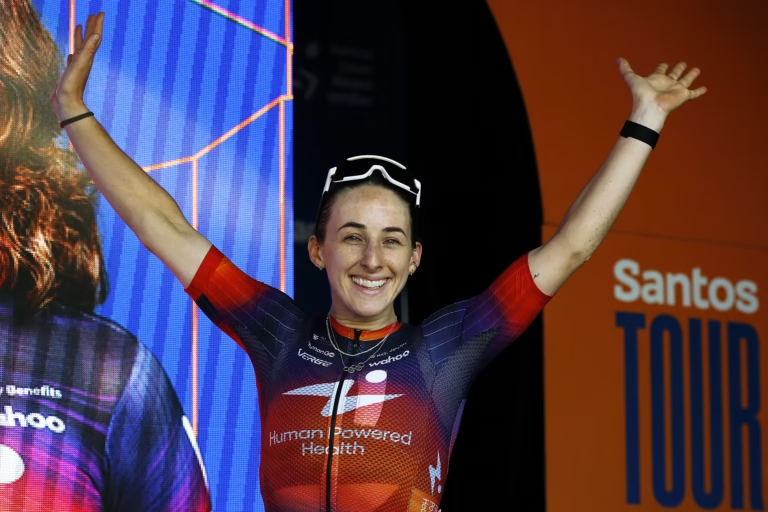
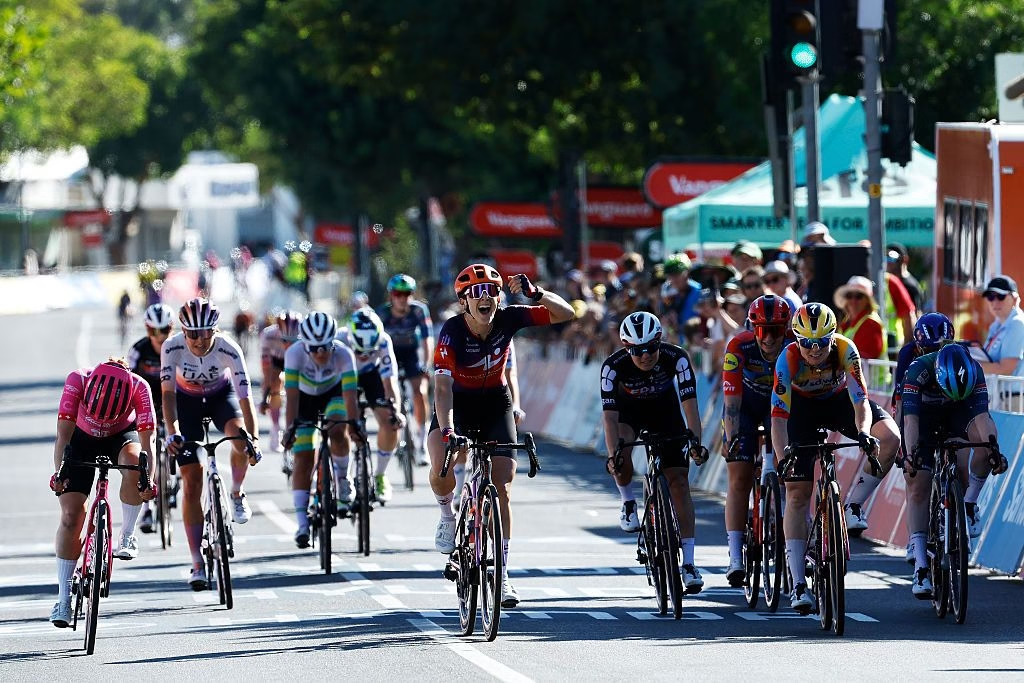
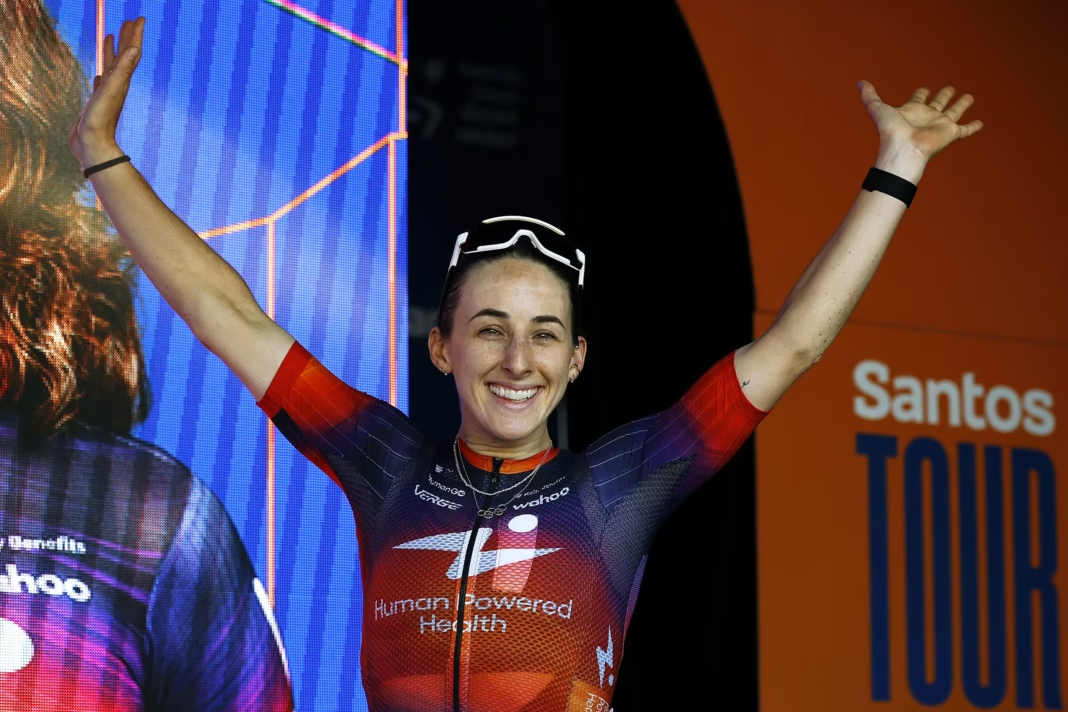
The 27-year-old Canadian has emerged as one of Human Powered Health’s principal sprint options during 2026, winning the Schwalbe Women’s One Day Classic in Australia, reclaiming the Canadian road title and taking her first Women’s WorldTour podiums.
Those results have come little more than a year after surgery for iliac artery endofibrosis left significant uncertainty over what level she would be able to reach on her return.
“I’m really happy to renew with the team,” Coles-Lyster said. “Seeing the steps we’ve taken and the progress we’ve made over the past two years has been phenomenal, and I’m excited to continue being a part of this wave as the team keeps growing.
“There is also something to be said about continuing to work with familiar faces and in a familiar environment that’s easy and comfortable.”
Australia provided the first sign that 2026 would be different
Coles-Lyster’s season began with the result she had spent years trying to achieve on the road.
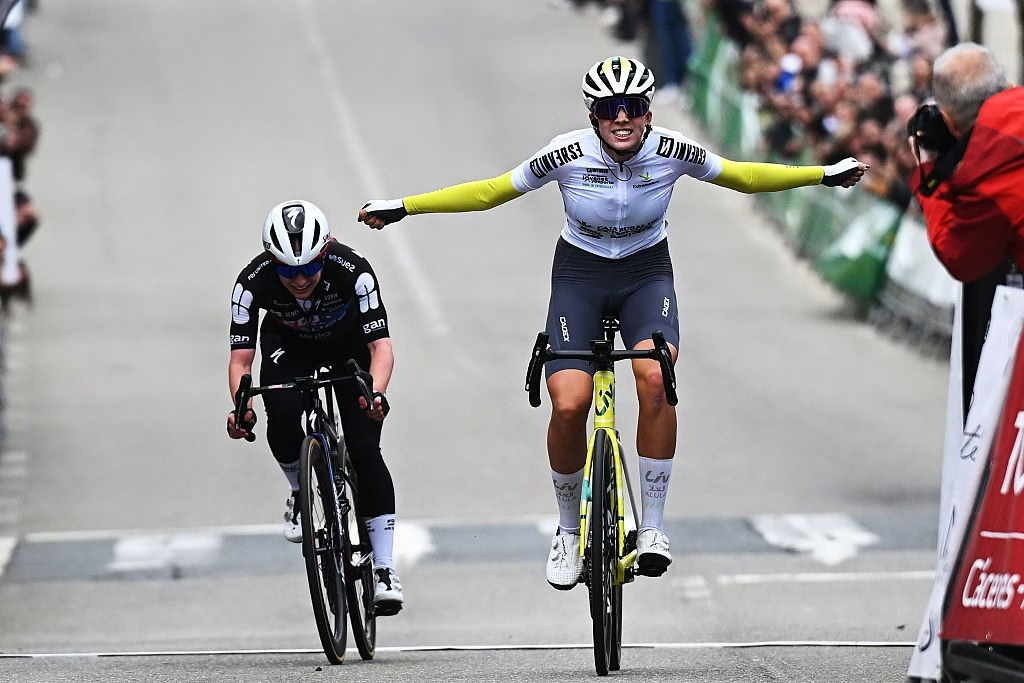
At the Schwalbe Women’s One Day Classic in Tanunda, she crashed with two laps remaining, returned to the front group and still had enough left to win the reduced sprint ahead of Noemi Rüegg and Marta Lach.
It was her first professional road victory and immediately changed the tone of a season that had begun with questions about how she would respond after surgery.
The race report from her Tanunda victory showed why the result meant more than simply having the fastest sprint. Coles-Lyster had to recover from the crash, regain position and then execute the finish after spending valuable energy just getting back into contention.
“There is a whole mixture of feelings,” she said of her comeback season. “This has been my comeback year from iliac artery endofibrosis, so to be so successful so soon has honestly been a bit of a relief.
“You go into a surgery like that with so many questions like ‘will I be able to come back to a good level?’ so to do it and come back better than before is a great feeling.”
Giro podium showed Coles-Lyster could challenge at WorldTour level
The Australian victory established that Coles-Lyster could win again. The next step was showing that she could consistently challenge the strongest sprinters in the WorldTour.
That came at the Giro d’Italia Women.
On Stage 6 into Brescello, Coles-Lyster launched early from a technical finale and briefly looked capable of holding off Elisa Balsamo. The Italian eventually came past in the final metres, but second place gave Coles-Lyster one of the biggest road results of her career.
The Giro Stage 6 report also highlighted one of the areas in which Coles-Lyster has become particularly effective. The final kilometre contained repeated corners and narrow roads, rewarding positioning and the ability to carry speed as much as outright sprint power.
Those qualities have always been part of her racing. Her track background means she is comfortable in tight spaces and accustomed to making decisions quickly at high speed.
What changed in 2026 was how regularly she was able to arrive in a position to use them.
She added another second place at the Argenta Classic in July, finishing behind Lara Gillespie in Deurne. The Argenta Classic result continued a run of results which increasingly looked like consistency rather than isolated form.
Canadian title completed the comeback
Coles-Lyster then won the Canadian road championship for the second time in her career.
Returning to the Maple Leaf jersey carried additional significance in a season built around proving that the surgery had not reduced her ceiling.
Human Powered Health general manager Ro De Jonckere described the comeback as one of the team’s major stories of 2026.
“Maggie’s comeback has been one of the great stories of our season,” he said. “To come back from double iliac artery surgery and perform at the level she has is a huge achievement, and a testament to her determination and character.”
The Canadian jersey has been visible throughout the second half of the season as Coles-Lyster continued producing results against high-level sprint fields.
At the Tour of Britain Women in August, she finished second to Lorena Wiebes in Blackpool, with Kimberly Le Court-Pienaar third. The Stage 2 sprint provided another WorldTour podium and another direct comparison with one of the fastest riders in the sport.
Coles-Lyster did not beat Wiebes, but repeatedly reaching those finales represents a clear change from where she stood before surgery.
A WorldTour victory is now the target
That progression has also altered Coles-Lyster’s expectations.
“At the same time it’s all just left me wanting more,” she said. “The year started on a high, and since the middle of the season I’ve been more consistent than I’ve ever been before, so my standards and expectations for myself have changed and I’m excited to build on this.”
The next goal is straightforward.
“A big goal is a World Tour win,” she said. “I’ve gotten closer this year with my first World Tour podiums, and there’s still Chongming Island to come, but I want that win.”
The Tour of Chongming Island should provide another opportunity before the season ends, particularly for a rider whose best results increasingly come from fast finishes where positioning and race reading matter as much as a perfectly organised lead-out.
That makes the next two seasons particularly interesting.
Coles-Lyster is no longer simply trying to establish herself as Human Powered Health’s sprint option. She is now trying to move from regular top-level contender to WorldTour winner.
Human Powered Health see another level still to come
Human Powered Health entered 2026 with a roster built around shared leadership rather than one dominant rider, and Coles-Lyster has become increasingly important within that structure.
The 2026 Human Powered Health team guide identified sprinting as one of the areas where the team needed to improve its conversion of good positions into major results.
Coles-Lyster’s season has helped close that gap.
De Jonckere believes there is still more available.
“Maggie is so much more than her results,” he said. “She is an incredibly smart racer, a fantastic team player and someone who naturally brings energy and motivation to the group.
“She understands racing, she reads situations well, and she is always willing to put herself on the line for her teammates. We have seen some really strong results from her this year, and we believe there is still another level to come.”
That wider contribution matters within Human Powered Health’s sprint structure. Coles-Lyster can race for herself, but she also has the track skills and positioning ability required to work within lead-outs when another teammate has the better opportunity.
The team now have her secured through 2028 rather than facing another contract decision just as she reaches the strongest period of her road career.
Coles-Lyster also pointed to the value of continuity.
Her first two seasons with Human Powered Health have included regular visits to the team’s performance facilities in Boston, where testing covers fitness, strength and body composition alongside the wider work of the coaching, medical and nutrition staff.
“I think my confidence in my racing over the two years I’ve been with the team has really developed a lot,” she said.
“Having the team backing me, learning so much from Magnus, all those pieces have really just come together to allow me to have such good performances and just really grow as a sprinter.”
The difference between the rider who joined Human Powered Health and the one extending through 2028 is now visible in the results.
Coles-Lyster arrived looking for a programme capable of helping her refine a career that had already included national titles, Olympic track racing and strong one-day performances.
Two years later, she has a first professional road win, another Canadian championship, WorldTour podiums and a realistic target of beating the sport’s leading sprinters at the highest level.
Human Powered Health will give her another two seasons to try.
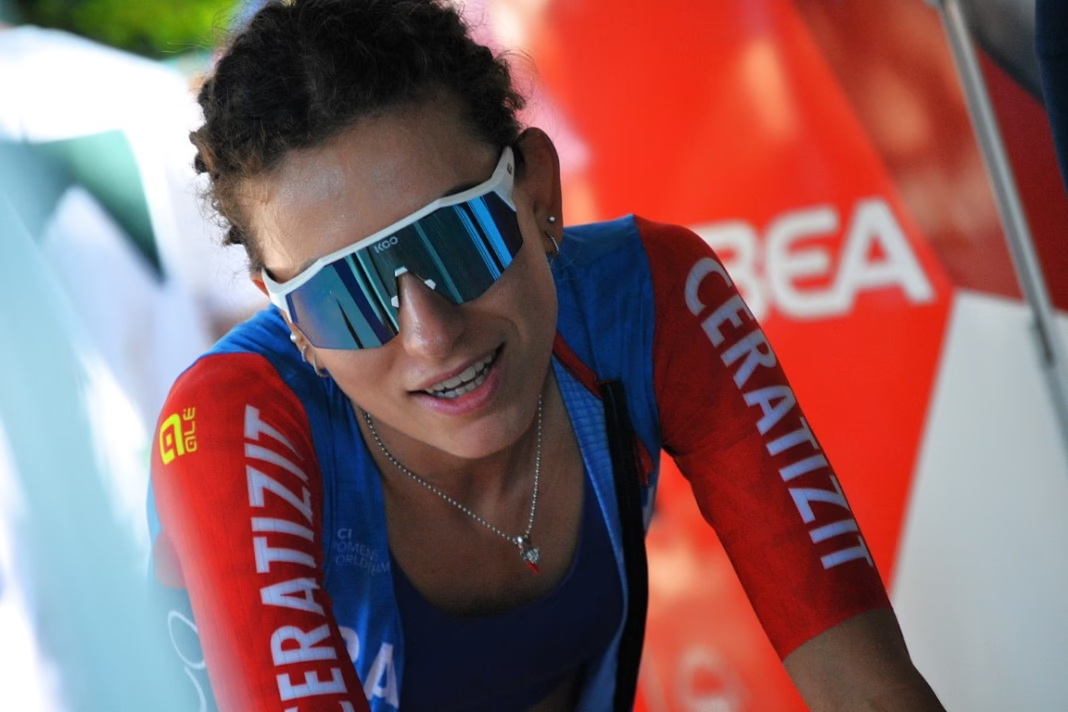
The 31-year-old Italian has spent her final two seasons with Laboral Kutxa-Fundación Euskadi, but has not raced since abandoning La Vuelta Femenina in May after struggling with health problems. Arzuffi had already decided at the beginning of 2026 that this would be her final season, meaning the difficult last few months did not prompt the retirement itself.
“After 14 years of living, racing and dreaming on a bike, I feel that the time has come for a new chapter,” Arzuffi wrote.
“It has been an incredible and intense journey, and I am proud of everything I achieved throughout these years, but even more so of everything I have learned, both on and off the bike.”
Her full rider profile traces a career which took her through several generations of women’s professional cycling, from a period when combining an international cyclocross programme with road racing was still relatively common to the much more specialised Women’s WorldTour era.
Arzuffi had already decided 2026 would be her final season
Arzuffi’s retirement had been approaching for several months.
She revealed during the summer that she had made the decision to stop at the beginning of the year, before illness disrupted what she had hoped would be a proper farewell season.
Her final race was ultimately La Vuelta Femenina. Arzuffi finished the opening stage but abandoned during Stage 2 after feeling unwell for several days.
She subsequently missed the Italian championships and did not return to competition.
That was particularly frustrating because the national championships had been one of the races she wanted to experience for the final time. Arzuffi was able to begin riding more regularly again during the summer, but a racing return never followed.
She turns 32 in November and had already concluded that this was the right point to move away from the demands of professional competition.
Cyclocross shaped the first half of her career
Arzuffi’s road career eventually took her to the biggest stage races in women’s cycling, but cyclocross was where she first established herself internationally.
She won four consecutive Italian under-23 cyclocross titles between 2013 and 2016 and collected European medals at both under-23 and elite level.
The biggest domestic result came in 2021, when she finally won the Italian elite cyclocross championship after several previous podium finishes.
For much of that period, Arzuffi was one of relatively few Italian women prepared to structure a substantial part of the year around the Belgian cyclocross calendar.
She moved into that environment rather than treating cyclocross as occasional winter preparation, racing against the strongest specialists and spending large parts of the winter based around the sport’s traditional heartland.
Those years became an important part of how she later viewed her career. They required independence, adaptability and an almost year-round racing schedule as one season flowed into another.
Photo Credit: Twila Muzzi
Road racing gradually became the priority
Arzuffi was never exclusively a cyclocross rider.
Her professional road career included BePink, Astana-BePink, Lensworld, Bizkaia-Durango, Valcar, Ceratizit-WNT and finally Laboral Kutxa-Fundación Euskadi.
She joined Ceratizit for 2023 as the balance of her programme began moving more decisively towards the road. ProCyclingUK covered that move when Ceratizit-WNT confirmed its 2023 roster, with Arzuffi intending to reduce her cyclocross programme to give herself more room to recover and prepare for the road season.
That change reflected the wider direction of women’s cycling.
As the road calendar expanded and racing became faster and more professional, combining a full cyclocross winter with an international road season became increasingly difficult.
Arzuffi had spent years doing exactly that.
Later in her career, she became open about the importance of rest and the cost of continually moving from one discipline into another without a substantial break.
The Giro remained one of the races that mattered most
Few races became more closely associated with Arzuffi’s road career than the Giro.
She started the Italian Grand Tour 11 times.
Ahead of the 2022 edition, she described it as the “race of my dreams” when discussing her ambitions with Valcar, a period covered in our feature on Arzuffi preparing for the Giro Donne.
Her strongest overall Giro finishes included 17th place in both 2016 and 2024, while she also collected a third place on a stage in 2018.
Those results reflected the role she increasingly occupied on the road.
Arzuffi was a durable climber rather than a prolific winner, capable of getting through hard stage races and supporting leaders deep into difficult terrain while taking her own opportunities when they appeared.
Her 2024 campaign became one of the best road seasons of her career and helped earn selection for the World Championships in Zürich.
Four Tours de France Femmes added another chapter
Arzuffi also started four editions of the Tour de France Femmes between 2022 and 2025.
She was part of the Valcar selection for the first modern edition in 2022, alongside Olivia Baril, Eleonora Gasparrini, Silvia Persico, Ilaria Sanguineti and Margaux Vigié.
Arzuffi continued returning to the Tour as her career moved through Ceratizit and then Laboral Kutxa.
By the end of 2025 she had accumulated 11 Giro starts and four Tours, a substantial Grand Tour record for a rider whose early international reputation had been built primarily through cyclocross.
Laboral Kutxa provided the final chapter
Arzuffi joined Laboral Kutxa-Fundación Euskadi for 2025 after two years with Ceratizit.
She remained for 2026 as the team continued strengthening its Women’s ProTeam programme.
The 2026 Laboral Kutxa roster again included Arzuffi as one of its most experienced riders, but the season never developed into the farewell campaign she had envisaged.
Arzuffi leaves with the experiences outweighing the results
Arzuffi’s retirement message made little attempt to reduce 14 years to a list of placings.
Instead, she focused on the people and experiences that surrounded them.
“I am truly grateful to all the people who supported me along the way: Fiamme Oro, all the teams I raced for, the people from my personal staff, my teammates, all the supporters, friends and, of course, my family,” she wrote.
“Twenty pictures are definitely not enough to sum up a 14-year career, but the memories, the emotions, the victories, the struggles, and all the people I met along the way will stay in my heart forever.”
The results still tell part of the story: an Italian elite cyclocross title, international championship medals, more than a decade racing the Giro, four Tours de France Femmes and a World Championships appearance on the road.
The broader career was defined by moving between two disciplines while women’s cycling changed rapidly around her.
Arzuffi began in an era where racing through the winter and then switching almost immediately to the road was still a viable career model. She leaves after seeing both cyclocross and women’s road racing become more specialised, demanding and professional.
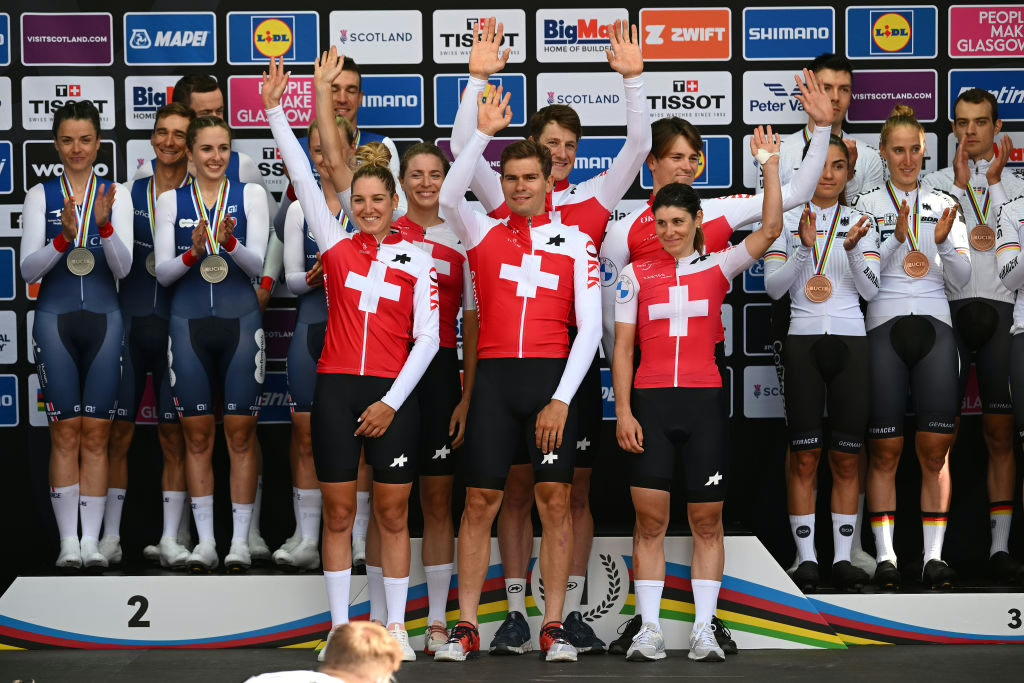
The mixed relay team time trial is one of the least familiar events at the UCI Road World Championships, but it has become one of the closest and most tactically interesting rainbow jersey races of Worlds week.
Six riders represent each nation: three men and three women. The men complete the opening half of the course before handing the race over to the women’s trio, with the final result decided by the combined time.
At Montréal 2026, the mixed relay takes place on Tuesday 22 September over 40.6km with 290 metres of climbing. Both halves use the same short Montréal time trial circuit, making it a very different challenge from the 39.2km individual time trials raced two days earlier.
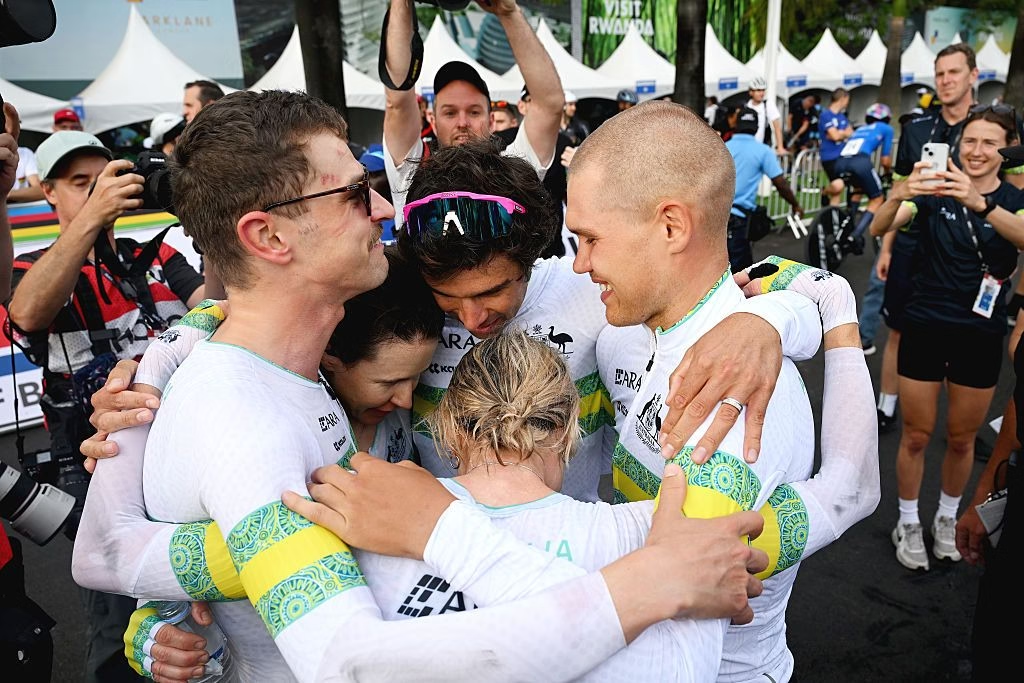
Australia arrive as two-time defending champions, but the team that won in Kigali last September cannot simply be repeated. Jay Vine is absent through illness, Brodie Chapman declined selection for personal reasons and Luke Plapp is not part of the Montréal squad. That removes three riders from the six who won the 2025 title.
France have already named a formidable and balanced relay team, Italy have committed Filippo Ganna and Vittoria Guazzini to a powerful six, while Switzerland retain much of the group that won consecutive titles in 2022 and 2023.
Each country selects three men and three women from its eligible elite and under-23 riders.
The men’s trio starts first.
They race together as a conventional team time trial, rotating through the wind and using one another’s slipstream rather than riding three separate efforts against the clock.
Once the men’s section is completed, the women’s trio is released onto the course.
There is no reset of the clock between the two groups. The women’s time is added directly onto whatever the men have already produced, so the entire nation effectively completes one continuous 40.6km relay.
The fastest combined time wins.
All six riders from the winning nation become world champions.
Why is the second rider so important?
A mixed relay does not require all three riders in each group to finish together.
The important rider is the second one.
The men’s relay time is taken when the second man reaches the changeover. The nation’s final time is then recorded when the second woman crosses the finish.
That means one rider from each trio can be dropped.
It also creates the most interesting tactical element of the race.
A team can use one rider extremely aggressively before allowing them to fall away, provided the remaining pair stay together.
That sounds straightforward, but the timing is difficult.
Drop the third rider too early and the final pair lose a valuable source of drafting and pacing. Keep somebody beyond the point where they can contribute properly and the two stronger riders may spend kilometres waiting rather than riding at their optimal speed.
The best teams usually remain as a trio for most of the course before deciding whether one rider should completely empty themselves near the end.
Why is team time trialling different from an individual TT?
Six brilliant individual time triallists do not automatically make the best mixed relay team.
A good team time trial depends on rhythm.
The rider on the front works hardest while the other two benefit from the draft. After completing a turn, the leader moves aside, drops to the back and recovers before eventually returning to the front.
Those changes need to be smooth.
A rider who accelerates several kilometres per hour every time they hit the front can make the team slower rather than faster. The riders behind repeatedly have to close small gaps, burning energy that could have been saved for later.
There is also a difference in how long each rider should lead.
The biggest engine in the group might take much longer turns than the third rider. Somebody technically excellent through corners can take greater responsibility on twisting sections. A lighter rider may be saved for a late rise rather than repeatedly exposed on fast open roads.
This is why track pursuit experience can be so valuable. Riders accustomed to high-speed team pursuiting already understand how to hold a wheel closely, change position without disrupting the group and distribute effort between teammates.
The Montréal mixed relay route
The mixed relay starts on Avenue du Parc and finishes alongside Parc Jeanne-Mance, using the shorter time trial circuit rather than the Mount Royal roads which dominate the road races later in the week.
The official total is 40.6km with 290 metres of climbing, with the men and women each completing essentially the same 20km circuit.
The route moves away from Avenue du Parc through Montréal before heading towards the river and the Pont de la Concorde area. It passes roads around Old Montréal, Avenue Pierre-Dupuy and Parc Jean-Drapeau before returning towards the city.
The profile is rolling rather than flat.
Each half contains around 145 metres of elevation, enough to interrupt the rhythm without turning the event into a climbing time trial.
The course rewards balance rather than one outstanding rider
The relatively short distance encourages aggressive pacing.
Around 20km is long enough for a poorly organised trio to unravel but short enough for a rider with a huge engine to take unusually long turns.
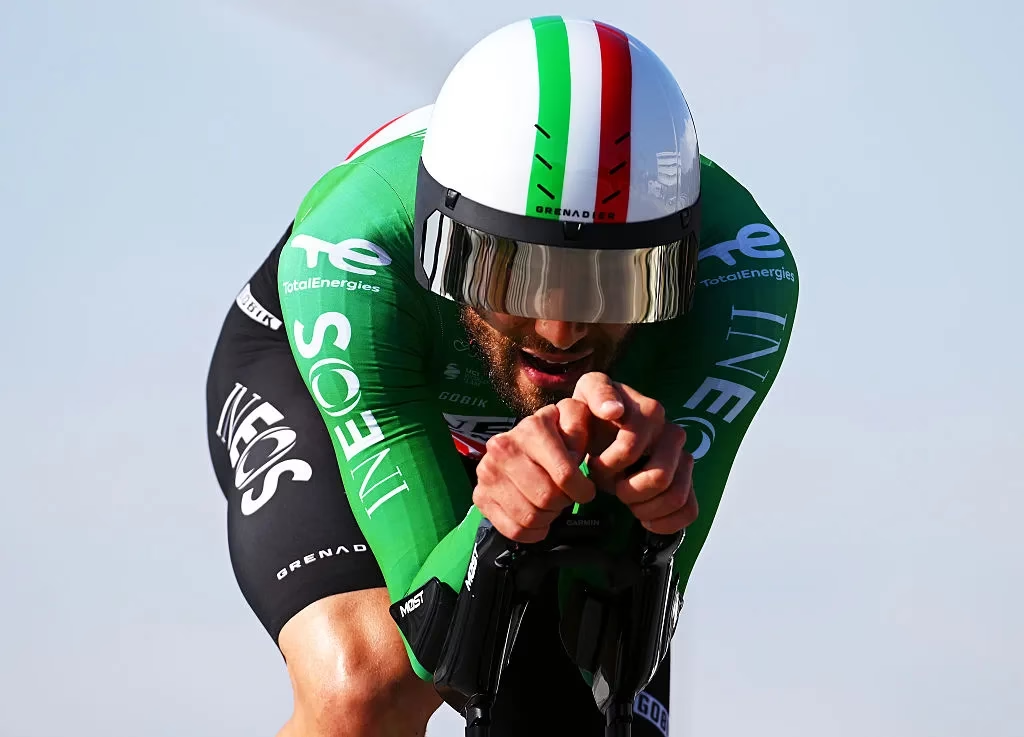
That could favour Italy with Ganna.
It should suit Switzerland with Reusser and Küng.
It also gives Australia reason to consider Conor Leahy, whose Olympic team pursuit background is almost tailor-made for this format.
But none of those riders can win the relay alone.
A national team gains little from having the fastest men’s trio if its women immediately lose the entire advantage. Likewise, three exceptional women can only recover so much if they begin their section half a minute behind.
The strongest relay is usually the nation with the smallest weakness across all six riders.
Previous mixed relay world champions
The mixed relay is still a relatively young World Championships event.
It was introduced in 2019 to replace the trade-team team time trial which had previously appeared on the Worlds programme.
Year
World champion
2019
Netherlands
2020
No event
2021
Germany
2022
Switzerland
2023
Switzerland
2024
Australia
2025
Australia
No nation has won three consecutive mixed relay world titles.
Australia can become the first in Montréal.
Australia are defending champions with a very different team
Australia have owned the event for the last two seasons.
Their first victory came in Zürich in 2024, when Michael Matthews, Jay Vine and Ben O’Connor combined with Grace Brown, Brodie Chapman and Ruby Roseman-Gannon.
The winning margin over Germany was only 0.85 seconds.
The difficulty for Australia in 2026 is replacing half of that winning team.
Vine, Plapp and Chapman are all missing from the Australian six
Jay Vine will not race in Montréal because of illness.
Luke Plapp has not been selected for this World Championships.
Brodie Chapman opted out of selection for personal reasons.
That removes the two men who raced alongside Matthews last year and one of the women who helped defend the title.
Australia still have experience available.
Matthews and Spratt were part of the 2025 winning team, while Wilson-Haffenden returns after riding the women’s leg in Kigali.
The final six has not yet been confirmed, but Australia have several possible replacements within their wider Worlds selection.
Conor Leahy is particularly interesting.
The Olympic team pursuit champion has been selected for the elite individual time trial and is exactly the type of rider who can adapt quickly to a three-man team effort.
Georgia Baker offers similar track pedigree on the women’s side, while Lauretta Hanson is another possible option. Australia’s strong under-23 selection means riders such as Mackenzie Coupland and Sophia Sammons can also enter the discussion.
That still leaves a good team.
It does not leave the same settled team which entered Kigali as defending champions.
Photo Credit: AusCycling/Chris Auld
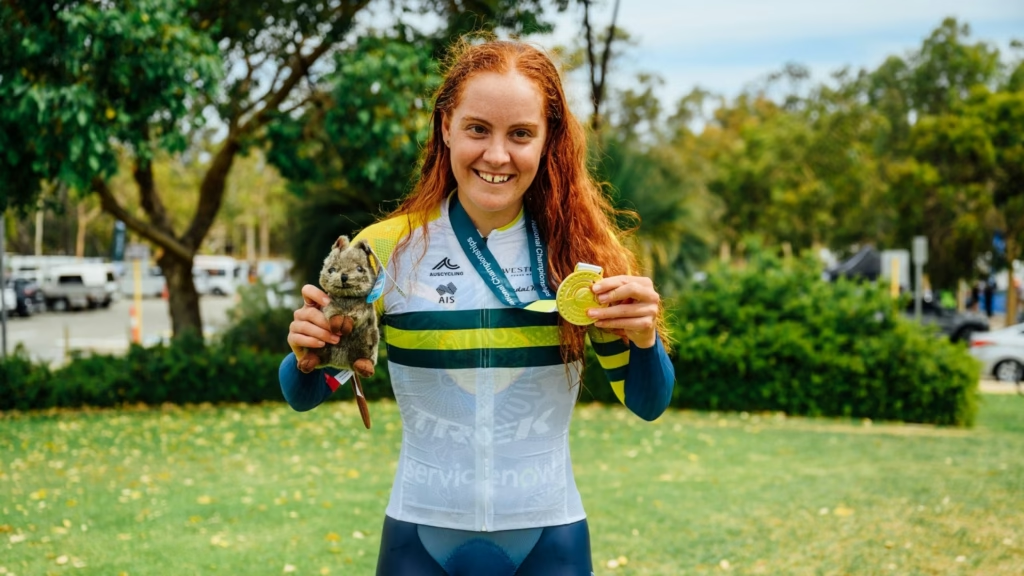
Felicity Wilson-Haffenden could become even more important for Australia
Wilson-Haffenden is one of the riders around whom Australia’s defence can be rebuilt.
She won the Australian elite individual time trial championship at the start of 2026 despite still being an under-23 rider and has backed that up with further strong performances against the clock.
She is already familiar with the relay after helping Australia win last year.
Her form can be assessed again immediately before Worlds at the Chrono Féminin de Gatineau, where she faces Reusser and several other Montréal-bound time trial riders.
Australia may be missing three members of last year’s team, but Wilson-Haffenden is a stronger rider now than she was in Kigali.
France have already committed to a balanced six
France finished second in Kigali and have left little ambiguity about their ambitions this year.
Their Montréal relay team has already been named.
Men
Women
Bruno Armirail
Juliette Berthet
Rémi Cavagna
Marion Borras
Jordan Labrosse
Cédrine Kerbaol
There is no obvious weak half of that team.
Armirail and Cavagna bring proven time trial power. Labrosse gives the trio another strong engine without creating the sort of mismatch that can make a team difficult to pace.
Borras has a strong track background, which is especially valuable in the relay format.
Kerbaol is an established time trial rider with the power to take long turns.
Berthet is the less obvious specialist but arrives in excellent road form after winning the Faun Tour Femmes and should cope comfortably with the modest climbing on the Montréal circuit.
France were only five seconds short last year.
Australia’s enforced changes make that result particularly relevant now.
Switzerland have the strongest mixed relay pedigree
Switzerland won in 2022 and successfully defended the title in 2023.
They were still only ten seconds behind Australia in Kigali last year despite Reusser losing time to a mechanical.
That history is why Switzerland remain central to the 2026 race regardless of the eventual combination selected.
The available pool includes Stefan Küng, Mauro Schmid and Jan Christen on the men’s side, with Reusser, Jasmin Liechti and Noemi Rüegg among the obvious women’s options.
Several of those riders already know exactly how to race together.
Reusser is the central figure.
She enters Worlds as defending individual time trial champion and has again been one of the strongest riders against the clock in 2026. She won the Tour de Suisse Women time trial in Aarburg before going on to take the overall victory.
The Tour de Suisse time trial report showed the size of the advantage she can create over a distance very similar to one half of the relay.
The challenge is using that power without breaking her own trio apart.
Switzerland have enough experience with Reusser to understand the problem better than most nations.
Italy have built a team around pure time trial strength
Italy’s confirmed line-up is arguably the most obviously powerful six in the race.
Men
Women
Filippo Ganna
Vittoria Guazzini
Matteo Sobrero
Elisa Longo Borghini
Mattia Cattaneo
Monica Trinca Colonel
The men’s trio immediately stands out.
Ganna remains one of the best pure time trial riders in the world. Sobrero and Cattaneo are strong enough against the clock that Italy should be able to maintain an extremely high speed without asking two weaker riders simply to hang onto Ganna.
The women’s trio is also well balanced.
Vittoria Guazzini brings world-class track pursuit experience alongside her road time trial ability.
Longo Borghini has years of experience in team events and remains a strong rider against the clock.
Trinca Colonel gives them another rider capable of handling the rolling sections rather than merely surviving them.
Italy finished fourth in Kigali, but their Montréal combination looks stronger on paper.
The question is whether the women’s trio can convert whatever advantage Ganna and the men are capable of creating.
Switzerland and Italy can both put Australia under pressure from the men’s start
This is where the structure of the race becomes interesting.
Australia’s 2025 victory was heavily influenced by an outstanding men’s leg.
Matthews, Plapp and Vine gave the women a significant cushion.
In Montréal, the replacement men’s trio may find itself racing against Ganna, Sobrero and Cattaneo for Italy, while Switzerland can call upon riders such as Küng and Schmid.
France have Armirail and Cavagna.
Australia no longer have any guarantee of reaching the handover with the fastest split.
That changes the task facing their women.
Spratt and Wilson-Haffenden were excellent in Kigali, but last year they were defending the advantage created by the men.
They may have to attack the course very differently if Australia begin the women’s leg behind.
Germany have enough history to remain a medal threat
Germany came within a second of beating Australia in Zürich.
That result alone is enough to keep them in the wider discussion.
The 2026 selection offers several riders well suited to a team time trial, particularly if Germany again prioritise balance rather than simply selecting the most famous individual names available.
Antonia Niedermaier and Franziska Koch give them strong potential on the women’s side, while Germany have enough experienced rouleurs among the men’s selection to build a competitive trio.
They do not have the obvious single engine of Italy with Ganna or Switzerland with Reusser.
The mixed relay does not require one.
Germany’s 2024 silver medal is proof of that.
The Netherlands have the talent to be dangerous
The Netherlands won the first mixed relay World Championship in Yorkshire in 2019.
They have not won it since.
That is slightly surprising for a nation with such depth in both men’s and women’s time trialling, but the event has repeatedly rewarded countries which treat the relay as a specialist discipline rather than simply assembling six strong names.
The current Dutch squads again contain the required ingredients.
Daan Hoole provides clear men’s time trial strength.
Lieke Nooijen and Demi Vollering are part of the women’s time trial selection, while Riejanne Markus gives the Netherlands another rider with extensive experience against the clock.
Their ceiling is high.
How much they prioritise the relay between the individual time trials and road races may determine how close they get to it.
Photo Credit: Getty
Great Britain have intriguing options
Britain also have the pieces required to produce a strong relay.
The question is whether they fit them together.
Zoe Bäckstedt is one of the strongest young time trial riders in the world and has both road and track experience.
Ethan Hayter offers exactly the type of pursuit background which translates naturally into a three-rider time trial.
Britain’s wider men’s and women’s selections contain several more riders comfortable against the clock.
That gives the selectors possibilities.
It does not yet make Britain as established a mixed relay nation as Australia, Switzerland or France.
The final six and how seriously they target the discipline will determine whether Britain belong among the medal favourites or the next group behind.
Why having the fastest men does not guarantee anything
The split after the men’s leg attracts plenty of attention because it is the first time we can compare all the leading nations.
It is not the result.
A nation can lead comfortably and still lose.
The women’s trio has another complete lap to ride and can erase a sizeable deficit if the balance between the two halves is poor.
The opposite is also true. A country with an exceptional women’s group cannot afford to start half a minute down simply because its men were unable to stay together.
The mixed relay rewards complete national programmes.
That is why Australia, France and Switzerland have been so successful recently.
All three have been able to build strong trios on both sides of the handover.
The handover can change the race immediately
There is also a psychological element that does not exist in an individual time trial.
The women know where their nation stands when they start.
They can be released with a lead.
They can begin almost level with another country.
Or they can know immediately that they need to chase time.
That does not mean a trio should abandon its pacing plan, but it inevitably affects how the final leg feels.
A five-second deficit is manageable.
Twenty-five seconds may encourage a riskier strategy, longer turns and an earlier decision to sacrifice the third rider.
When margins at previous World Championships have been measured in fractions of a second, those decisions become significant.
Australia retain the rainbow jerseys and enough of the previous winning structure to remain one of the main nations to watch.
The difference is that their 2026 team needs rebuilding.
France have arguably the most settled challenge. They were only five seconds away in Kigali and arrive with a confirmed six built specifically around the relay.
Switzerland have won the race twice and were close again last year despite Reusser’s mechanical. A clean run puts them straight back into the title contest.
Italy may have the highest theoretical ceiling. Ganna, Sobrero and Cattaneo can produce an exceptional men’s split, while Guazzini gives the women’s trio the technical background required to make the most of it.
Germany and the Netherlands belong in the next group, with Great Britain another nation capable of moving into medal contention if the final selection clicks.
This is also a race where small errors can completely change that hierarchy.
A poor corner.
One overenthusiastic turn.
A rider dropped two kilometres too early.
A mistimed changeover.
None costs much individually. Five seconds was the difference between gold and silver last year.
Australia are chasing something no nation has done before
The defending champions have the opportunity to win a third consecutive mixed relay title.
Switzerland reached two.
Australia have already matched them.
Doing it again in Montréal would be more impressive because this is not a continuation of the same six-rider group.
Half of last year’s winning team is missing.
The replacements have to rebuild the balance which made Australia so effective in Zürich and Kigali, and France, Switzerland and Italy all have reasons to believe the opportunity is there.
That makes the mixed relay one of the more open events of the opening half of Worlds week.
The first nation starts at 13:30 BST on Tuesday 22 September, with the rainbow jersey expected to be settled by around 16:15 BST.
The format may still be unfamiliar to plenty of viewers.
The racing should not need much explanation once six riders, two laps and a handful of seconds separate the best nations in the world.
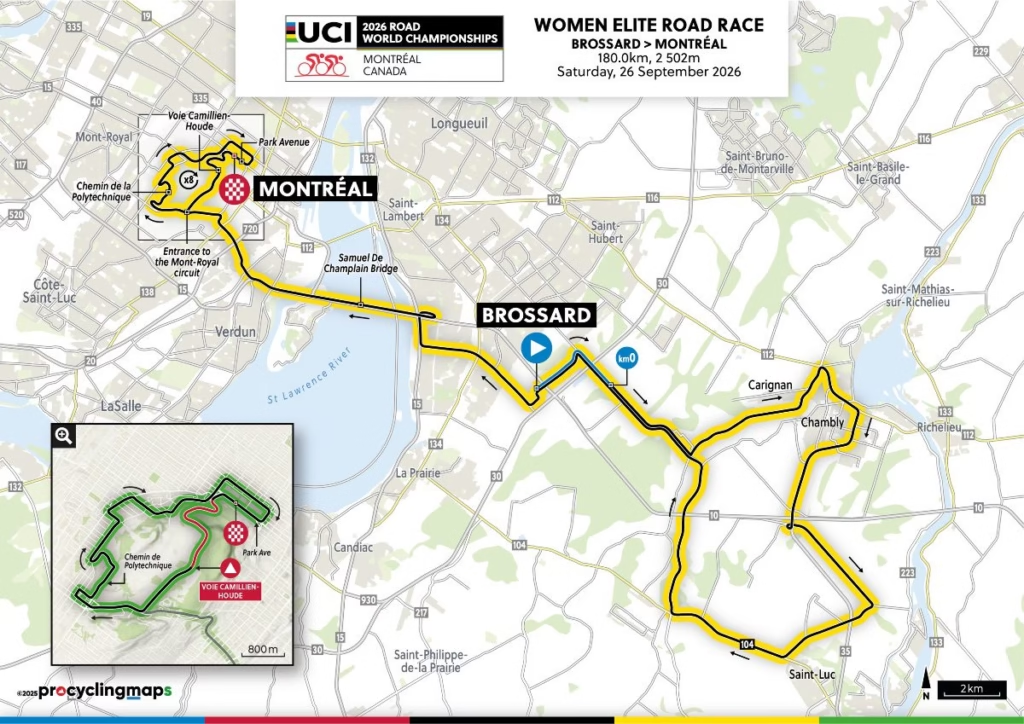
The elite women’s road race at the 2026 UCI Road World Championships takes place in Montréal on Saturday 26 September, with 180.4km and eight laps of Mount Royal standing between a deep field of contenders and the rainbow jersey.
Demi Vollering arrives with the strongest season of anyone on the start list. She has won the Giro d’Italia Women and Tour de France Femmes alongside Omloop Het Nieuwsblad, the Tour of Flanders, La Flèche Wallonne and Liège-Bastogne-Liège. A first elite road world title would complete a season already well beyond anything she has previously achieved.
There is no shortage of opposition. Katarzyna Niewiadoma-Phinney pushed Vollering deep into the final weekend of the Tour. Elisa Longo Borghini finished third there and remains one of the best championship racers of her generation. Paula Blasi has won La Vuelta Femenina and Amstel Gold Race, while Kim Le Court-Pienaar reaches Montréal having added greater climbing range to the sprint that has always made her dangerous.
Lotte Kopecky is attempting to win a third world title in four years, Marlen Reusser gives Switzerland a powerful long-range option and Magdeleine Vallières Mill returns as defending champion at a home World Championships.
The course is difficult enough to reward the climbers without completely ruling out the stronger Classics riders. That balance is what should make the final two laps so difficult to control.
UCI Road World Championships 2026 women’s road race details
Detail
2026 elite women’s road race
Date
Saturday 26 September 2026
Start
Quartier DIX30, Brossard
Finish
Avenue du Parc, Montréal
Distance
180.4km
Climbing
2,570 metres
Start time
09:00 EDT / 14:00 BST
Expected finish
Around 19:10 BST
Finishing circuit
13.4km
Mount Royal laps
8
Defending champion
Magdeleine Vallières Mill
The opening 72.7km takes the race through Montérégie before the riders reach Montréal. More than 2,150 metres of the total climbing then comes during the eight Mount Royal circuits.
Kopecky is the only rider on this year’s start list to have won the elite road title more than once. Vallières Mill has the opportunity to defend the rainbow jersey on home roads.
Eight Mount Royal laps should steadily break the race apart
There is no single enormous climb around which every tactic has to revolve.
Instead, Montréal keeps repeating the same difficulties until the riders start reaching them with very different legs.
Camillien-Houde provides the main sustained effort. The hardest section is around 1.8km at 8%, enough for the best climbers to create separation once fatigue begins accumulating.
Côte de la Polytechnique comes later and is much shorter, but the ramps above 11% offer a sharper attacking point. Pagnuelo adds another rise before the riders return towards Avenue du Parc.
One lap is manageable for almost everybody likely to play a meaningful role.
Eight are different.
The first few circuits should gradually reduce the support available to the leaders. By the final two laps, positioning before Camillien-Houde becomes increasingly important because every gap requires more energy to close than it did an hour earlier.
That accumulation is why this race should suit riders who combine climbing with one-day endurance rather than pure mountain specialists.
Avenue du Parc means the climbers cannot afford to wait too long
The final road rises towards the finish.
It is not a brutal climb, but the gradient of around 4% gives riders such as Kopecky, Le Court-Pienaar and Noemi Rüegg a much stronger finish than most of the obvious climbers.
That matters long before the sprint itself.
Niewiadoma-Phinney does not want to reach Avenue du Parc with Kopecky.
Longo Borghini would prefer not to take Le Court-Pienaar there.
Vollering has a powerful uphill acceleration, but even she has little reason to leave Kopecky in contention if the opportunity appears to remove her earlier.
The faster finishers therefore influence the final lap simply by surviving.
Their presence gives the climbers a reason to keep attacking.
Demi Vollering arrives after an extraordinary 2026 season
Vollering has spent much of the year winning almost every type of race required to become world champion in Montréal.
She took Omloop Het Nieuwsblad and the Tour of Flanders before dominating the Ardennes, winning both La Flèche Wallonne and Liège-Bastogne-Liège.
She then turned towards the stage races and won the Giro d’Italia Women before completing the Giro-Tour double at the Tour de France Femmes.
Her Tour victory was particularly relevant.
Vollering did not simply dominate one mountain stage and protect a large advantage. She repeatedly had to repair difficult tactical situations before finally taking control during the last weekend.
Niewiadoma-Phinney took yellow from her on Mont Ventoux. Vollering responded by attacking into Nice the following day and began the final stage with only an eight-second advantage. Her attack on the Col d’Èze then turned the closest final-day GC battle in the modern Tour into a victory by 1:18.
That ability to produce another major effort after days of pressure is exactly what makes her difficult to beat in Montréal.
The Netherlands have Vollering but cannot simply control everything
The Dutch team was originally built around Vollering with Mischa Bredewold as one of its most important support riders.
Bredewold’s pelvic fracture at the Faun Tour Femmes has changed that plan, with Amber Kraak replacing her.
The Netherlands still have Riejanne Markus, Lieke Nooijen, Puck Pieterse, Karlijn Swinkels, Femke de Vries and Kraak around Vollering.
It is a strong team, but there are reasons to avoid simply riding on the front for 100km.
Pieterse gives them another rider capable of being influential very late. She won the mountains classification at the Tour de France Femmes and has the punch required for the shorter Mount Royal climbs.
Swinkels and de Vries have both shown strong late-season form.
If the Netherlands simply ask those riders to close every attack, Vollering may reach the final circuits surrounded by rivals whose teammates have spent far less energy.
The better option is allowing their secondary riders to follow dangerous moves rather than treating every break as something that must immediately be eliminated.
Photo Credit: Getty
Katarzyna Niewiadoma-Phinney has already shown she can hurt Vollering
Niewiadoma-Phinney produced one of the rides of the season on Mont Ventoux.
She attacked while Vollering and Marlen Reusser hesitated behind, won the stage and moved into the yellow jersey. It was only Vollering’s response over the final two days that denied her a second Tour victory.
Montréal should suit Niewiadoma-Phinney particularly well.
There are repeated climbs rather than one long mountain, plenty of points where an attack can force hesitation and a final hour where tactical judgement matters almost as much as raw climbing strength.
Her problem is the finish.
Niewiadoma-Phinney is unlikely to want Kopecky, Le Court-Pienaar or Rüegg alongside her on Avenue du Parc.
Poland therefore need to attack.
Fortunately, they have Dominika Włodarczyk.
Włodarczyk finished seventh overall at the Tour de France Femmes and has continued carrying strong form through the late season. She gives Poland a rider strong enough to attack before Niewiadoma-Phinney needs to commit.
That division of labour could be one of the most useful tactical combinations in the race.
Elisa Longo Borghini knows how to survive a World Championship
Longo Borghini has been collecting major World Championship results for more than a decade.
Her first elite road race bronze medal came in 2012. She added another in 2020 and a third in 2024.
What remains missing is the rainbow jersey.
Montréal provides another course which fits the way she races. Long distance helps rather than hurts her, repeated climbing gives her opportunities to attack and she has never needed a conventional finishing scenario to produce a result.
She also reaches Worlds after another strong Tour de France Femmes.
Longo Borghini finished third overall behind Vollering and Niewiadoma-Phinney, moving onto the podium during the final weekend after consistently staying around the front of the GC group.
The final Tour de France Femmes classification also showed the strength Italy will have to account for when judging several of their biggest rivals. Paula Blasi finished fifth, Dominika Włodarczyk seventh and Kim Le Court-Pienaar ninth.
Longo Borghini’s route to victory probably involves attacking rather than waiting.
If she reaches the final kilometre with several quicker riders, her opportunities narrow considerably.
Photo Credit: Getty
Paula Blasi has become one of the defining riders of 2026
Blasi no longer belongs in the outsider category.
Her season has removed any doubt about that.
She won Amstel Gold Race and then La Vuelta Femenina, where she overturned Anna van der Breggen’s advantage on the Angliru to take the biggest stage-race victory of her career.
She followed that with further wins before finishing fifth at the Tour de France Femmes.
Her September form has remained strong too.
At the Pointe du Raz Ladies Classic, Blasi joined Célia Gery in the decisive late move and came within metres of holding off the chase before Nina Berton bridged across in the closing moments.
That performance matters for Montréal.
Blasi does not need to wait for the final climb and hope she can simply outclimb Vollering. She has already shown repeatedly this year that she can race aggressively from further out.
García gives them somebody capable of making the race harder before Blasi has to move.
Kim Le Court-Pienaar has become far more than a fast finisher
Le Court-Pienaar’s progression during 2026 is one of the reasons the women’s race is so difficult to reduce to the usual climbing hierarchy.
She remains fast.
The difference is how much climbing she can now survive before using that speed.
She won Stage 6 of the Tour de France Femmes and finished ninth overall, then produced an even more significant performance at the Tour of Britain Women.
The Great Orme gave the race its main climbing test. Le Court-Pienaar attacked near the finish, opened a decisive gap and eventually won the general classification.
Mauritius cannot surround her with riders capable of controlling the final circuits.
Le Court-Pienaar therefore has to let the major nations solve as many tactical problems as possible.
If she spends the last 50km chasing every dangerous attack herself, her sprint becomes irrelevant.
If she reaches the final lap close to the favourites without having wasted energy, everyone else has a problem.
Photo Credit: Getty
Lotte Kopecky is still the rider nobody wants to carry to the finish
Kopecky has won two of the last three World Championships.
That alone keeps her central to the race.
Glasgow in 2023 and Zürich in 2024 required different performances, but both demonstrated how difficult Kopecky is to race against once she survives the hardest part of the course.
Her 2026 season has included victory at Milano-Sanremo Women, showing that the fundamental combination of endurance, climbing strength and finishing speed remains intact.
The uncertainty is her recent condition.
Kopecky went to the Tour of Britain Women looking for a late-season racing block but withdrew through illness before the stages most relevant to Montréal.
If Kopecky reaches the final Camillien-Houde in the front group, the climbers cannot afford to wait.
Nobody wants to discover how fast a two-time world champion still is after 180km.
Marlen Reusser gives Switzerland a completely different weapon
Reusser has the first major title of Worlds week to think about before the road race.
She defends the elite individual time trial rainbow jersey on Sunday 20 September.
Six days later, Switzerland can use the same power in a very different way.
Reusser is unlikely to want repeated late accelerations on Camillien-Houde against Vollering, Niewiadoma-Phinney and Blasi.
She does not need to wait for them.
Her value is the ability to attack on the roads between the climbs and make rival nations decide who is going to chase.
A committed Reusser move cannot simply be given a minute.
That allows Noemi Rüegg to wait behind.
It is a very useful combination.
Photo Credit: Getty
Noemi Rüegg could benefit if Switzerland force others to chase
Rüegg has produced another season full of strong one-day and stage-race performances.
Her finishing speed separates her from most of the climbing contenders.
She was second at Milano-Sanremo Women and has repeatedly shown that she can survive difficult terrain before sprinting from a reduced group.
That makes the Swiss strategy straightforward.
Reusser can make the race uncomfortable from distance.
Rüegg does not need to help bring her back.
If another country closes the move, Switzerland still have their quicker finisher sitting in the favourites’ group.
If nobody does, Reusser is more than strong enough to make a long-range attack stick.
Magdeleine Vallières Mill defends the rainbow jersey on home roads
Vallières Mill arrives in Montréal in a completely different position from the one she occupied before Kigali.
Last year she was a dangerous rider capable of exploiting the right situation.
Now everybody knows exactly what happens if she is allowed to exploit it.
Her victory in Rwanda made her Canada’s first elite road world champion, and she now gets to defend the jersey in front of a home crowd.
Her 2026 results have shown that the title was not an isolated performance. She has remained competitive across the hardest Classics and finished 18th at the Tour de France Femmes.
Canada also have enough depth that Vallières Mill does not need to personally respond to everything.
Sarah Van Dam gives them recent form and a strong engine for an aggressive race. Alison Jackson provides experience and is capable of entering earlier moves. Nadia Gontova offers climbing strength after winning the Canadian time trial title.
The rainbow jersey will inevitably attract attention, but Canada should be able to share some of that workload.
Niamh Fisher-Black is arriving in strong climbing form
Fisher-Black finished second at the 2025 World Championships and is again building towards Montréal with useful form.
She came within two seconds of winning the recent Faun Tour Femmes, eventually finishing second overall behind Juliette Berthet.
The final stage was particularly encouraging.
Fisher-Black repeatedly attacked on the major climbs and looked capable of putting Berthet under serious pressure, but the Frenchwoman had enough team strength around her to manage the situation.
The same issue exists at Worlds.
New Zealand have fewer riders than the major European nations.
Fisher-Black therefore cannot spend three laps reacting to every move made by the Netherlands, Italy, Spain and France.
Her best chance is making one of her own efforts count.
She already showed in Kigali that she can race a World Championship without the support numbers enjoyed by the largest countries.
France can attack without committing to one leader
The absence of Pauline Ferrand-Prévot removes the most obvious French headline name.
It does not leave France short of options.
Juliette Berthet comes into Worlds immediately after winning the Faun Tour Femmes, taking two stages before surviving Fisher-Black’s attacks on the final day.
Célia Gery has continued her rapid progression and was third behind Nina Berton and Blasi at Pointe du Raz.
Cédrine Kerbaol, Évita Muzic and Maëva Squiban add further climbing strength.
France therefore have little reason to wait.
They can place riders into moves without worrying that doing so compromises one clear protected leader.
That can be particularly awkward for the Netherlands.
Every French attack forces somebody else to decide whether the rider ahead is dangerous enough to chase.
Great Britain need to keep the race tactical for Zoe Bäckstedt
Zoe Bäckstedt leads a British group containing several riders capable of being useful on the Mount Royal circuit.
The key question is how hard the Netherlands and the pure climbers make the final hour.
Bäckstedt has developed into a far more complete road rider, winning both British national titles this year and adding selective road performances to the time trial ability that has always been obvious.
Eight relentlessly hard climbing laps would not be ideal.
A race which breaks, reforms and allows powerful riders back into contention is much more interesting.
Anna Henderson and Pfeiffer Georgi can help create that type of race, while Lauren Dickson arrives with good climbing form after winning the final stage of the Faun Tour Femmes.
Britain should use those riders rather than simply trying to protect Bäckstedt until the final circuit.
Dominika Włodarczyk gives Poland more than a support rider
Reducing Włodarczyk to Niewiadoma-Phinney’s domestique would waste one of Poland’s strongest weapons.
She finished seventh at the Tour de France Femmes and has continued racing aggressively through September.
That makes her exactly the sort of rider who can attack one or two laps before the obvious favourites want to commit.
The tactical benefit is substantial.
The Netherlands cannot ignore her.
Italy cannot automatically wait for Longo Borghini.
Spain have to decide how much responsibility they want to take.
Niewiadoma-Phinney can stay behind while everybody else makes those calculations.
World Championships are often won because one nation has a second rider too strong to be treated as harmless.
Poland have that rider.
Antonia Niedermaier can benefit from a very hard race
Niedermaier has spent 2026 establishing herself among the best stage-race climbers in the world.
She finished second overall at the Giro d’Italia Women and fourth at the Tour de France Femmes, where she also won the white jersey.
The Tour de France Femmes final results underline how consistently she stayed close to the very best GC riders through the decisive mountain stages.
A World Championship is tactically very different.
Niedermaier does not have the same finish as Kopecky, Le Court-Pienaar or Rüegg, so Germany need the race to become extremely selective.
That gives her a clear objective.
The harder the final three laps become, the more interesting Niedermaier gets.
Other riders to watch
Puck Pieterse is far too strong to think of solely as a Dutch helper. Her Tour de France Femmes mountains jersey and podiums at both La Flèche Wallonne and Liège-Bastogne-Liège make her a genuine option if the race develops away from Vollering.
Mavi García can attack before Blasi has to show herself, while Silvia Persico gives Italy another rider capable of surviving a difficult race and finishing quickly enough to exploit a small group.
Kristen Faulkner remains one of the most dangerous long-range riders available to the United States. Montréal offers enough road between climbs for a committed solo move to become difficult to organise against.
Liane Lippert showed excellent climbing form at the Tour of Britain Women and remains particularly well suited to races built around repeated short climbs rather than long mountain passes.
Cédrine Kerbaol has the same opportunity within a French team that should be looking to attack rather than chase.
Nina Berton arrives after winning Pointe du Raz by bridging across to Blasi and Gery in the closing kilometres, another indication that her late-season form is moving in the right direction.
Photo Credit: Getty
The Netherlands have the strongest leader and the biggest burden
Vollering being the strongest rider in the race does not automatically make the Netherlands the easiest team to race for.
Everyone knows who carries the greatest responsibility.
If an Italian attacks, the Netherlands are expected to respond.
If France place somebody ahead, the Netherlands are watched.
If Włodarczyk moves, Poland sit back and wait for orange jerseys to appear at the front.
That is how a strong team can gradually spend itself.
The Dutch need to avoid that trap.
Pieterse, Swinkels and de Vries are strong enough to be used as tactical riders rather than simply workers. Kraak knows Vollering well from their trade-team environment and can be particularly valuable in keeping the race organised around her without asking Vollering herself to solve every problem.
The Netherlands do not need a controlled peloton.
They need the race to reach its final phase with Vollering having spent less energy than her rivals.
There is an important difference.
The final lap could be shaped by who is still capable of sprinting
By the last Camillien-Houde ascent, everyone left at the front will be tired.
Their tactical needs will still be different.
Kopecky wants to remain attached.
Le Court-Pienaar wants to remain attached.
Rüegg may be perfectly happy to remain attached.
Niewiadoma-Phinney wants them gone.
Longo Borghini probably wants them gone.
Fisher-Black needs separation.
Niedermaier certainly does.
Vollering can play either way, but she would still rather arrive at Avenue du Parc without the strongest finishers.
That should prevent the final climb from becoming a waiting game.
If nobody attacks, the race moves towards riders who are dangerous in the sprint.
She has won the biggest stage races, the Ardennes Classics and Flanders during the same season. The Montréal course falls almost directly between those specialities.
Niewiadoma-Phinney has already shown that she can exploit a tactical hesitation from Vollering and has Włodarczyk available to make Poland difficult to control.
Longo Borghini has the endurance and World Championships record to survive whatever the race becomes.
Blasi has spent 2026 winning races through both climbing and aggression.
Le Court-Pienaar brings a finish that none of the pure climbers want to face.
Kopecky has already solved this championship twice.
Reusser can attack from areas where the climbers would prefer not to work. Rüegg can wait behind her. Fisher-Black arrives with excellent climbing form and Vallières Mill will have the rainbow jersey and a home crowd behind her.
It is a deep race.
Vollering is still the rider everyone has to find a way to beat.
Top 3 prediction
1. Demi Vollering 2. Katarzyna Niewiadoma-Phinney 3. Kim Le Court-Pienaar
Vollering’s season has shown that she no longer needs one particular type of race to win. She can attack from distance, finish from small groups and sustain the repeated climbing that Mount Royal will demand.
Niewiadoma-Phinney has perhaps the best combination of form, course suitability and tactical freedom among the riders trying to stop her.
Le Court-Pienaar is the rider who could benefit most if the strongest climbers fail to make the final lap selective enough. If she survives Polytechnique for the last time, nobody will be keen to take her to Avenue du Parc.
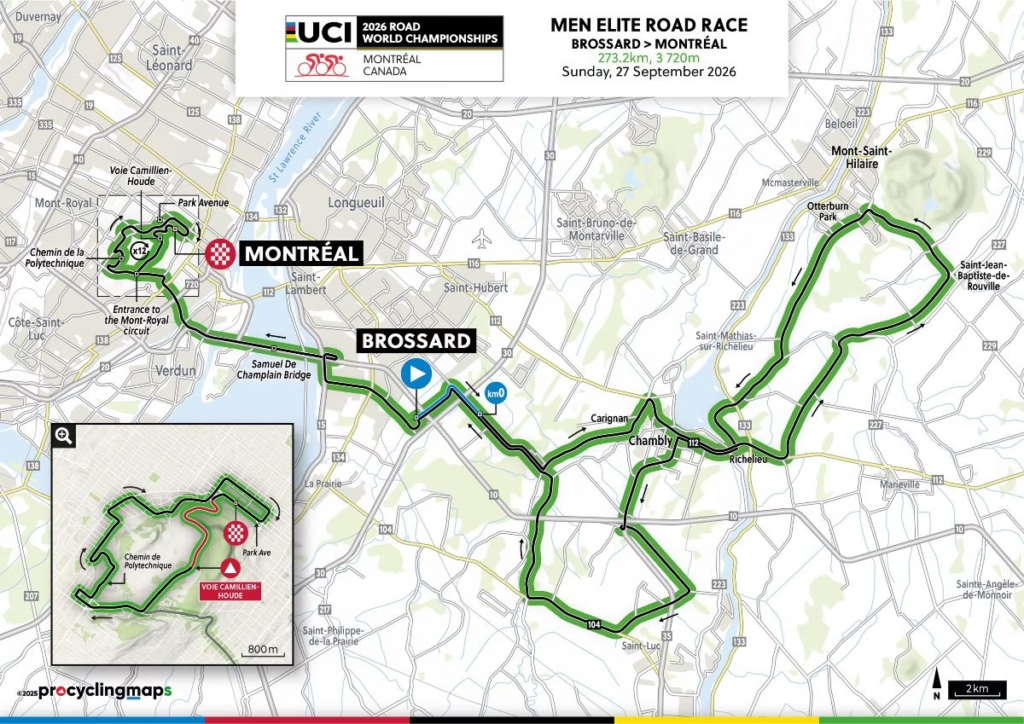
The elite men’s road race closes the 2026 UCI Road World Championships in Montréal on Sunday 27 September, with 273.7km, 3,803 metres of climbing and 12 laps around Mount Royal deciding the final rainbow jersey of the week.
Tadej Pogačar should have arrived attempting to win a third consecutive world title. Instead, the injuries suffered when he crashed out of the Vuelta a España have ended his season, removing the rider around whom almost every major nation would otherwise have built its tactics.
That leaves a much more open championship. Remco Evenepoel has already won GP Québec. Isaac del Toro beat Paul Seixas on the actual World Championships circuit at GP Montréal. Tom Pidcock finished fourth in Québec and sixth in Montréal, while Wout van Aert heads to Canada after winning two Vuelta stages, the green jersey and the overall combativity award.
Mathieu van der Poel adds another former world champion to a field where the main contenders need very different versions of the same race. Belgium can attack with Evenepoel or wait for Van Aert. Mexico have a rider who has already won on Mount Royal but far less depth around him. France can use numbers before Seixas has to expose himself, while Great Britain have Pidcock, Oscar Onley and Adam Yates rather than one obvious card.
The 2026 UCI Road World Championships course guide explains how the 13.4km Mount Royal circuit works. For the men, the important part is the repetition. Camillien-Houde, Côte de la Polytechnique, Pagnuelo and the rising finish on Avenue du Parc return 12 times after more than 110km of racing outside Montréal.
UCI Road World Championships 2026 men’s road race details
Detail
2026 elite men’s road race
Date
Sunday 27 September 2026
Start
Quartier DIX30, Brossard
Finish
Avenue du Parc, Montréal
Distance
273.7km
Climbing
3,803 metres
Start time
09:00 EDT / 14:00 BST
Expected finish
Around 20:40 BST
Finishing circuit
13.4km
Mount Royal laps
12
Defending champion
Tadej Pogačar, not racing
The first 112.4km take the peloton through Montérégie before the race reaches Montréal. From there, 12 laps of the Mount Royal circuit account for more than 160km of the remaining distance and most of the climbing.
Pogačar’s absence guarantees a different winner in Montréal. Van der Poel and Evenepoel are the two recent champions on the current start list with the opportunity to take the rainbow jersey back.
Why Mount Royal gets harder every lap
Nothing on the Montréal circuit looks overwhelming when viewed once.
Camillien-Houde is the main sustained climb, with the hardest section around 1.8km at 8%. Côte de la Polytechnique is shorter but contains ramps above 11%, while Pagnuelo adds another half-kilometre rise before the course works back towards Avenue du Parc.
The GP Montréal 2026 route guide showed how quickly those climbs accumulate. Each 13.4km lap contains approximately 269 metres of elevation.
One passage of Camillien-Houde is manageable for almost everyone on this start list. Twelve are not.
During the early circuits, the climbing should steadily remove support riders and force weaker climbers to spend more energy holding position. By the final two or three laps, the same acceleration that caused little separation earlier can suddenly split a group immediately.
The final 600 metres on Avenue du Parc rise at around 4%, so there is no flat sprint waiting for anyone who survives. Riders still need enough power to accelerate after close to seven hours of racing.
GP Montréal gave the favourites a full-speed reconnaissance
Usually there is a degree of guesswork before a World Championships route is raced properly.
Not this year.
GP Montréal on 13 September used the same 13.4km Mount Royal circuit, with the WorldTour peloton completing it 16 times. The Worlds road race has four fewer circuit laps but adds the long approach from Brossard, making the championship almost 60km longer overall.
Isaac del Toro and Paul Seixas were the two riders who solved the circuit best.
Seixas attacked on the final Camillien-Houde ascent, Del Toro bridged across and the pair quickly established enough of a gap to decide the victory between them. Del Toro then beat the Frenchman on Avenue du Parc, with Brandon McNulty third, Quinn Simmons fourth and Evenepoel fifth.
Our GP Montréal race report showed how much of the finale was shaped before the final sprint. Ben Healy had already attacked from distance, McNulty and other UAE riders were repeatedly involved and several of the main favourites had been forced to spend energy before Seixas finally made the decisive move.
Worlds will not unfold the same way. Trade-team structures disappear, national teams have different numbers and the extra distance changes the value of every early effort.
The climbs themselves remain the same.
Isaac del Toro has already proved he can win here
Nobody on the start list has stronger direct evidence than Del Toro.
He has already won on the World Championships circuit.
The manner of the victory was as important as the result. Del Toro did not simply survive until a sprint. He recognised Seixas’s decisive attack, worked his way across and still had enough left to win convincingly on the uphill finish.
That combination is almost ideal for Montréal.
He climbs well enough to follow the strongest riders, accelerates sharply enough to create separation himself and has enough finishing speed that rivals cannot comfortably take him to Avenue du Parc.
The complication is everything that happened before he made the winning move.
At GP Montréal, UAE Team Emirates-XRG could use McNulty, Adam Yates and others to put pressure on rival teams while Del Toro conserved energy. Mexico cannot reproduce that strength in depth.
If Evenepoel attacks with 50km remaining, Del Toro has to decide how much responsibility he takes. If Britain put Onley or Yates ahead, the same question appears again. If Simmons, Healy or another strong outsider moves at the wrong moment, Mexico do not have a queue of WorldTour leaders available to close the gap.
Del Toro may be the best individual fit for the course. He could also be one of the riders forced to make the most decisions.
Remco Evenepoel does not need to wait for the final lap
Evenepoel’s two Canadian races offered different lessons.
At GP Québec he attacked from 28km out, helped establish the decisive move and eventually beat Giulio Ciccone for victory. Two days later in Montréal, he finished fifth after being forced to chase back towards the front once the race had already begun to split.
The Québec performance is probably the more useful guide to how Belgium should use him at Worlds.
Evenepoel does not need to wait until the final Camillien-Houde ascent. His ability to attack from 40 or 50km out can force every other major nation to make decisions well before they intended to.
Mexico may need Del Toro to chase.
France may have to use one of Seixas’s helpers.
Great Britain must decide whether Pidcock responds or whether Onley and Yates can handle it.
The Netherlands have to judge how much Van der Poel can afford to spend.
Belgium can make those attacks without committing Van Aert.
Even if Evenepoel is eventually caught, the cost of bringing him back can reshape the race behind.
Wout van Aert gives Belgium a completely different second route
Van Aert arrives from the Vuelta with one of the more interesting form lines in the race.
He won two stages, took the green jersey and collected the overall combativity award, while also spending substantial time working as part of Visma | Lease a Bike’s lead-out for Matthew Brennan.
The more relevant performance for Montréal came in Loja, where Van Aert won from a hard breakaway on a stage containing almost 3,300 metres of climbing.
That tells us more than another conventional sprint victory would have done.
The obvious question is recovery. Worlds comes only two weeks after the Vuelta ended, so Belgium need Van Aert to absorb the three-week workload rather than carry fatigue into Montréal.
If he does, the tactical value is enormous.
Evenepoel can attack without Belgium emptying its hand. If rivals bring him back, Van Aert may still be sitting in the group having spent far less energy.
Very few climbers on this start list want to reach Avenue du Parc with him.
Paul Seixas knows exactly where he can make the difference
Seixas was the rider who broke GP Montréal open.
His attack on the final Camillien-Houde climb was strong enough to separate the main favourites and briefly looked like the winning move before Del Toro bridged across.
Second place came with an obvious lesson.
Seixas can create the decisive selection on these roads.
He probably cannot afford to arrive at the finish with several of the fastest riders still attached.
Del Toro beat him comfortably in the two-rider sprint. Van Aert, Van der Poel and Pidcock are all riders France would rather remove before the final kilometre.
That gives France an incentive to make the race hard before the last lap rather than simply protecting Seixas until everybody else expects him to attack.
The extra distance could help him.
GP Montréal was 214.4km. Worlds is 273.7km. Seixas does not necessarily need a stronger final attack if another hour of racing has already reduced the number of riders capable of following it.
Mathieu van der Poel is the hardest major contender to place
Van der Poel arrives without the direct circuit comparison available to Del Toro, Seixas, Evenepoel and Pidcock.
The route can be read in two very different ways for him.
Twelve Mount Royal laps create enough sustained climbing to expose him if France, Mexico and Belgium continually push the pace towards a pure climbing contest.
The distance pulls the other way.
Few riders in the world have been more reliable after six hours of hard one-day racing. Van der Poel has repeatedly shown that extreme distance can turn into an advantage rather than a weakness.
His presence also affects how everyone else races.
If he survives into the final 10km, the climbing specialists know that waiting becomes dangerous. A rider who might otherwise save everything for Avenue du Parc may have to attack earlier simply to avoid facing Van der Poel in the finish.
That can create opportunities for riders who have nothing to do with the Dutchman’s own move.
His ideal race is probably hard but irregular rather than one continuous climbing test. If he gets small periods to recover between the strongest accelerations, he can remain in contention far deeper into the race than the profile alone suggests.
Tom Pidcock arrives with the right form and useful British depth
Pidcock’s Canadian results were almost exactly what Great Britain needed to see.
He finished fourth in Québec and sixth in Montréal, remaining competitive against most of the main World Championships contenders on both courses.
Britain also have more than one way to race around him.
Oscar Onley arrives from sixth overall and the white jersey at the Vuelta. Adam Yates knows Mount Royal exceptionally well and has the climbing strength to make a move that no major nation can simply ignore.
That means Pidcock should not have to follow every attack himself.
If Yates is ahead, Britain can wait.
If Onley joins a strong move, somebody else has to chase.
Pidcock’s strongest finale is likely to come from a heavily reduced group rather than a large sprint. He has enough acceleration to beat climbers without needing to take Van Aert or Van der Poel all the way to the line.
The task for Britain is reaching that situation with him still fresh.
Oscar Onley can be used as more than support
Onley’s Vuelta makes him one of the most interesting secondary options in the race.
He finished sixth overall and won the young rider classification after spending much of the final week close enough to the podium fight to demand attention from the strongest GC teams.
The physical condition is therefore obvious.
Recovery is less certain.
If Onley has absorbed those three weeks well, Britain should use him aggressively rather than simply asking him to ride for Pidcock from the start.
A move containing a recent Grand Tour top-six finisher cannot be ignored.
That is especially useful in a World Championships where Belgium, France, Mexico and the Netherlands all have clear reasons to save their main rider for later.
Every time somebody else has to chase Onley, the race becomes slightly better for Pidcock.
Brandon McNulty and Quinn Simmons give the USA several ways into the race
The United States were one of the strongest teams at GP Montréal.
McNulty finished third and Simmons fourth, with both riders involved while the race was still being decided rather than collecting places from a beaten chase group.
That is a useful starting point for Worlds.
The Americans do not need to organise everything around one leader.
McNulty can move late.
Simmons is at his best when the race becomes aggressive and nobody wants responsibility for chasing.
Matteo Jorgenson gives them another rider capable of surviving repeated climbing and attacking from further out.
That combination can cause problems for nations with one obvious protected contender.
If Simmons goes three laps from the finish, Belgium may be happy to let somebody else chase while preserving Evenepoel and Van Aert. France may not want to burn Seixas’s final helper. Mexico have far fewer riders available to solve the problem.
The USA may not have the single strongest rider on the start line, but they have enough good ones to keep changing the race.
Ben Healy needs the race to become uncomfortable
Healy showed exactly what he wants from Montréal during the WorldTour race.
He attacked from distance and spent a long period ahead while the favourites reorganised behind.
Ireland gain little by waiting until the final Camillien-Houde alongside Del Toro, Seixas and Evenepoel.
Healy needs uncertainty.
An attack two or three laps from the finish can create it. If Belgium have a rider in the move, they may refuse to chase. If Britain already have Onley or Yates there, the same applies. France may prefer to leave the work to somebody else while Seixas waits.
A gap can grow quickly when every country has a reason not to close it.
Healy is one of the best riders on the start list at exploiting precisely that situation.
Giulio Ciccone gives Italy a clear late-race threat
Ciccone’s second place behind Evenepoel at GP Québec confirmed that his form is where it needs to be.
Montréal offers more climbing than Québec and should suit him better from that perspective.
The finish is the problem.
Ciccone does not want to reach Avenue du Parc with Del Toro, Van Aert, Van der Poel or Pidcock still beside him.
Italy therefore have good reason to attack before the final kilometre rather than simply treating the championship as a race to deliver Ciccone to the last ascent.
The depth of their selection gives them room to do that.
World Championships often reward the nations willing to use strong riders before the race appears to have entered its decisive phase. Montréal looks particularly suited to that approach.
Photo Credit: Getty
Richard Carapaz and Jhonatan Narváez give Ecuador contrasting cards
Ecuador may not have the numbers of Belgium, France or Britain, but they have two riders who want very different finales.
Carapaz is most dangerous when he can attack repeatedly after the race has already become selective.
Narváez offers more speed and can afford to wait longer.
That creates a simple division of responsibility.
Carapaz can make the aggressive move.
Narváez has no need to contribute behind.
If the move returns, Ecuador still have a rider better suited to the finish.
Once the race has been reduced to 20 or 30 riders, the size of the original national team matters less.
Mads Pedersen needs the race to stop short of its hardest version
Pedersen can never be dismissed from a championship of this length.
The 2019 world champion has built much of his career around surviving hard races that are supposed to be beyond the limits of a sprinter.
Mount Royal gives him a much more difficult problem.
If Seixas, Del Toro and Evenepoel continually increase the pressure during the final hour, the accumulated climbing may simply be too much.
Denmark therefore need a hard race without allowing it to become a pure climbing contest.
If Pedersen survives into the last 10km, the tactical equation changes immediately. Almost nobody in the remaining group will want to tow him towards the finish.
That alone can force attacks which alter the shape of the race.
Michael Matthews still has a route to the finish
Matthews occupies a similar position.
Few riders know Montréal better, and his record across the Canadian races has repeatedly demonstrated how much climbing he can survive without losing his sprint.
The redesigned World Championships circuit has moved further towards the climbers, but Matthews remains dangerous if the strongest riders repeatedly cancel one another out rather than maintaining pressure.
Australia also have enough climbing strength that they do not need to protect him regardless of circumstances.
If the race becomes too hard, they can switch towards more aggressive options.
If groups continually come back together, Matthews becomes progressively more relevant.
The Vuelta riders carry the biggest recovery question
Van Aert and Onley are only part of a sizeable group arriving from Spain.
Enric Mas won the Vuelta, Primož Roglič finished second, Felix Gall third and Richard Carapaz fourth. The final classification shows how close several of the World Championships contenders were to maximum effort right through the final mountain stages.
Their form is not difficult to establish.
Their recovery is.
Two weeks can be enough to carry Grand Tour condition into a championship. It can also be too short to escape the fatigue of three weeks of racing.
Gall has the climbing profile for Mount Royal. Roglič has the explosiveness and finish. Mas has just produced the strongest Grand Tour of his career. Carapaz remains one of the most aggressive championship riders in the peloton.
The final week before Worlds will decide whether the Vuelta has sharpened them or emptied them.
Pogačar’s absence changes how every major nation can race
The last two men’s World Championships had a clear centre.
Pogačar was the rider everybody had to stop.
Montréal does not have an equivalent.
Del Toro has already won on the circuit but does not have the strongest national team.
Evenepoel has a huge long-range threat but Belgium also have Van Aert.
Seixas appears capable of making the key climbing selection but has never raced an elite Worlds of this length as one of the principal favourites.
Pidcock is consistently close without being the obvious rider around whom everyone else must organise.
Van der Poel can win, but the course gives the climbers opportunities to remove him.
That uncertainty should encourage attacks earlier than would have been likely with Pogačar present.
There is no obvious point at which one nation can simply take control and say the race belongs to its leader.
How the 2026 World Championships could be won
There are several plausible versions of the finale.
Evenepoel, Healy, McNulty, Simmons or another strong attacker could get clear with two or three laps remaining and benefit from hesitation behind.
The race could reproduce the GP Montréal pattern, with the main favourites reaching the final Camillien-Houde together before one rider finally creates separation.
Or Van Aert and Van der Poel could survive long enough that the climbers are forced to attack earlier than they would ideally choose.
That last scenario may produce the most interesting racing.
A rider can make the decisive move without necessarily being the strongest rider in the race. He may simply attack because waiting for the sprint is even worse.
On a circuit with several short opportunities to accelerate and enough descending or flatter road for groups to hesitate afterwards, that distinction can decide a World Championship.
Thibau Nys and Maxim Van Gils give Belgium additional options before Evenepoel and Van Aert need to commit, while Jhonatan Narváez remains one of the quickest finishers among riders capable of surviving a hard Mount Royal race.
Mathias Vacek has the power and climbing ability to become dangerous if the final hour produces repeated small groups rather than one clean selection. Toms Skujiņš is another rider ideally suited to a championship where endurance, positioning and aggression can matter as much as pure climbing numbers.
Felix Gall’s Vuelta podium shows the level of his climbing form, while Primož Roglič offers Slovenia a completely different kind of threat in Pogačar’s absence.
Santiago Buitrago arrives from winning the mountains classification at the Vuelta and is another rider who becomes more dangerous if Colombia are prepared to attack rather than simply wait for the final lap.
For Canada, Michael Woods has the attraction of a home World Championships on terrain built around repeated climbing, while the home team will also benefit from knowing these roads better than almost anyone.
World Championships 2026 prediction
The safest prediction is that this will not be decided in the same straightforward way as the last two editions.
Del Toro has already won on Mount Royal and has the best direct evidence of any contender. The question is how much more work he has to do without UAE around him.
Evenepoel has the opposite advantage. Belgium can make other nations chase long before their main two riders need to settle the race themselves.
Pidcock has been consistently near the front in Canada without yet producing the defining result. Britain’s depth could give him a better tactical race at Worlds than he had at GP Montréal.
Top 3 prediction
1. Remco Evenepoel 2. Isaac del Toro 3. Tom Pidcock
The difference is unlikely to come down simply to who climbs Camillien-Houde fastest.
It is more likely to be decided by who reaches the final lap having spent the least energy solving everyone else’s attacks.
Mayrhofer and Stork joined Tudor in 2024 and have developed into important but very different parts of the team’s roster. Mayrhofer offers speed on selective Classics terrain and reduced finishes, while Stork has increasingly found opportunities as an attacking climber and stage racer.
Their new deals also come at contrasting points in their seasons. Stork has added another Giro d’Italia stage podium to his record in 2026 and still has racing ahead of him this year. Mayrhofer’s campaign is already over because of injury, but Tudor’s three-year commitment makes clear that the team still see him as part of their long-term plans.
Tudor back Mayrhofer through a difficult 2026
Mayrhofer arrived at Tudor with a WorldTour victory already on his palmarès after winning the Cadel Evans Great Ocean Road Race in 2023.
That breakthrough remains a good illustration of what makes him useful. The Geelong circuit had already removed many of the pure sprinters before Mayrhofer won from the reduced group, beating Hugo Page and Simon Clarke. Our history of the men’s Cadel Evans Great Ocean Road Race looks back at how that 2023 victory fitted into the event’s run of selective finales.
Mayrhofer added another victory at the Boucles de la Mayenne in 2025 and has continued to occupy the space between a pure sprinter and a Classics specialist. On the right terrain, he can survive enough climbing to retain the finishing speed that makes him dangerous.
His 2026 season has been much more difficult.
An injury suffered earlier in the year has prevented him from building a consistent campaign, and Tudor have now confirmed that the 25-year-old will not return to competition before the end of the season.
Rather than waiting to see how he recovers, the team have extended his contract through 2029.
“I’m happy to continue racing with Tudor Pro Cycling for the years ahead,” Mayrhofer said. “Since joining the Team in 2024, I have witnessed impressive growth here, and I am proud to have contributed to that progress.”
The German also pointed to the support he has received during a difficult year.
“Although this year brought personal challenges, I always felt the Team’s full support. I am determined to repay the trust placed in me with strong performances as soon as possible.”
Photo Credit: Getty
Mayrhofer still gives Tudor a valuable one-day option
Mayrhofer’s value to Tudor has never rested on being a high-volume winner.
His profile gives the team flexibility.
On flatter days, there are quicker specialists. On the hardest climbing races, Tudor have riders better suited to long ascents. Mayrhofer becomes particularly useful between those extremes, when repeated hills, positioning and fatigue begin removing the fastest sprinters.
That made him one of the more interesting secondary options in Tudor’s 2026 Classics squad and also part of the team’s wider Tour de Suisse plans before injury interrupted his year.
The challenge for 2027 is rebuilding enough consistency to put him back into those situations.
Tudor’s willingness to commit until 2029 suggests they believe his best results with the team are still ahead rather than behind.
Florian Stork has found another level at Tudor
Stork’s two-and-a-half seasons with Tudor have followed a different path.
He joined after a difficult period affected by injury and has gradually developed from a dependable climbing support rider into somebody capable of taking his own opportunities.
His first professional victory arrived at the Trofeo Serra Tramuntana in January 2025, when he won on the demanding Mallorcan terrain.
That was followed by a stage podium at the Giro d’Italia later in the year.
Stork returned to the Giro in 2026 and immediately produced another major result, finishing second on Stage 2 in Veliko Tarnovo. He survived the difficult finale before being beaten by Guillermo Thomas Silva in the reduced sprint, with Giulio Ciccone taking third.
Our Giro d’Italia 2026 Stage 2 report covered a day that briefly put Stork at the sharp end of the overall classification as well as on the stage podium.
The result meant he had finished on a Giro stage podium in consecutive seasons.
Photo Credit: Getty
Stork credits Tudor with giving him the reset he needed
For Stork, the extension is closely tied to the way his career has developed since leaving Team DSM and joining Tudor.
“Joining Tudor Pro Cycling in 2024 was exactly the fresh start I needed at this stage of my career and after a longer period of injury,” he said.
“From day one, I felt welcomed and supported, which helped me grow and develop to new levels, like completing my first Grand Tour and even fighting for stage podiums at the Giro d’Italia.”
Those Giro performances have helped redefine how Tudor can use him.
Stork remains valuable when the team need support on climbing days, but he has also shown that he can be released into breakaways and selective finales rather than spending every race working exclusively for a leader.
That was evident again this season. Tudor’s Giro d’Italia 2026 team arrived with broader ambitions, and Stork’s early second place showed the value of having riders outside the main leadership structure ready to take chances.
A contract built around mutual trust
Stork, now 29, described the extension as a reflection of the confidence that has developed between rider and team.
“The environment here encourages me to challenge myself and take the next step, both personally and professionally,” he said.
“This contract extension is a sign of mutual belief and trust, and I’m excited to keep building on our progress and the future.
“I look forward to the next races until the end of the season and working towards the bigger goals we have as a Team over the course of the next years.”
Unlike Mayrhofer, Stork’s 2026 season is not finished. He will continue racing before beginning preparations for the first year of his new deal.
Tudor secure two different pieces of their long-term roster
The significance of the announcement is not that Mayrhofer and Stork perform the same job.
They do not.
Mayrhofer gives Tudor speed and versatility for Classics-style racing. Stork gives them climbing depth, breakaway potential and another rider who has proved capable of turning freedom into Grand Tour results.
Both have also improved or found a clearer place within the team since arriving in 2024.
Tudor have continued to strengthen as a ProTeam during that period, building a roster capable of competing directly with WorldTour opposition rather than simply relying on wildcard visibility. The team’s 2026 programmes, including the Tour de Suisse and Giro d’Italia, have increasingly reflected that ambition.
Keeping Mayrhofer and Stork through 2029 provides continuity around that growth.
For Stork, the extension follows the strongest period of his professional career.
For Mayrhofer, it arrives at a much more difficult moment. That arguably makes the length of the deal even more significant, with Tudor choosing to back him through his recovery rather than waiting for results before deciding his future.
Both Germans will now remain part of the team’s plans for at least another three seasons.
Karlijn Swinkels won the 2026 Lotto Grand Prix de Wallonie Dames, returning to the top step on the Citadelle de Namur two years after taking her first victory in the Belgian one-day race.
The UAE Team L’IMAD rider completed a superb three-year sequence at the event. She won the 2024 edition, finished second to Shari Bossuyt last September and has now reclaimed the title in 2026.
It is also Swinkels’ third road victory of the season following the Trofeo Binissalem-Andratx in January and her breakthrough Women’s WorldTour success at Trofeo Alfredo Binda in March.
New start in Seraing but the Citadel remains decisive
The fifth women’s Grand Prix de Wallonie covered 127.35km from Val Saint-Lambert in Seraing to the traditional finish on the Citadelle de Namur.
The change of start brought the race into the Liège region before a rolling route across Wallonia gradually became more selective towards Namur. There was no single major mountain to shape the race, but the repeated changes of gradient and the uphill finish again favoured riders capable of combining climbing strength with a fast finish.
That profile had attracted a strong field. Elisa Balsamo headed Lidl-Trek’s options alongside Loes Adegeest, Fleur Moors and Shirin van Anrooij, while defending champion Bossuyt returned with AG Insurance-Soudal. Liane Lippert, Célia Gery, Usoa Ostolaza and Swinkels’ UAE teammate Eleonora Gasparrini added further depth.
Swinkels nevertheless arrived with the clearest evidence that the finish suited her. Few riders have built a better record on the Citadel since the women’s race was introduced in 2022.
Swinkels returns to the top after last year’s second place
Swinkels’ first victory in Namur came in 2024, when she beat Elisa Longo Borghini and Anouska Koster after the race was reduced to a select group on the final climb.
She came within metres of repeating that result in 2025.
UAE had worked aggressively throughout the finale, with Dominika Włodarczyk attacking and Silvia Persico helping to make the selection on the Citadel. Swinkels entered the last corner well positioned and committed to the sprint, only for Bossuyt to come past in the closing metres.
Returning in 2026 therefore gave Swinkels the unusual record of having finished first and second in the two previous editions. This time she converted another strong ride on the Namur finish into victory.
A third victory in one of Swinkels’ strongest seasons
The result adds to a 2026 campaign in which Swinkels has taken a clear step forward as a one-day racer.
Her January victory at the Trofeo Binissalem-Andratx came on a steep uphill finish in Mallorca, a useful early indication of the form that would follow during the spring.
The bigger result arrived at Trofeo Alfredo Binda. Swinkels survived the selective final circuits with Anna van der Breggen and Mie Bjørndal Ottestad before beating both in Cittiglio to claim the first Women’s WorldTour victory of her career.
She then finished third at In Flanders Fields, sixth at both the Tour of Flanders and Amstel Gold Race and ninth at Dwars door Vlaanderen. That consistency carried into the second half of the season, including sixth overall at the Tour of Britain Women.
The common thread has been her ability to remain competitive when a one-day race becomes selective without losing the finishing speed required once the front group reaches the line.
Grand Prix de Wallonie has repeatedly rewarded exactly that combination.
Swinkels becomes the race’s first two-time winner
The women’s Grand Prix de Wallonie is still a young event, but Swinkels has now established the best record in its short history.
Julie De Wilde won the inaugural edition in 2022 before Marta Lach succeeded her in 2023. Swinkels became the third different winner in 2024 and Bossuyt continued that sequence last year.
Swinkels’ 2026 victory makes her the first rider to win the race twice.
Her three consecutive podium finishes are just as telling. The start location and parts of the route have changed during that period, but the race has retained its defining finish at the Citadelle de Namur. Swinkels has finished first, second and first there since 2024.
The result also gives UAE Team L’IMAD another late-season victory only three days after Dominika Włodarczyk won the Women’s Cycling GP Stuttgart & Region.
For Swinkels, Namur provides another result on the sort of rolling, selective terrain that has produced most of her best performances in 2026, ten days before the road race at the World Championships in Montréal.
The 20-year-old French rider has spent her entire senior career with Auber93 and will enter her fourth season with the team next year. There will be one important difference this winter: Roussel has completed her STAPS degree in Sports Management and intends to devote herself fully to cycling for the first time.
“I’m very happy to continue this journey with the team,” Roussel said. “The team has trusted me and supported my development since my junior years.
“Having now completed my STAPS degree in Sports Management, I’ll be able to fully dedicate myself to cycling, with the ambition of continuing to improve, playing a more active role in races while remaining committed to the team’s collective goals, and above all, continuing to learn.
“Thank you to the whole team for their trust. I can’t wait to write the next chapter together!”
Roussel has developed within the Auber93 structure
Roussel’s connection with the team predates her first professional season.
She arrived with a strong final junior campaign behind her, finishing fifth in the 2023 European Championships road race and 11th at the World Championships. St Michel-Mavic-Auber93 subsequently signed Roussel for the 2024 season, giving her an immediate route into the senior professional peloton.
She was only 18 during that first season and made history at the Tour de France Femmes as the youngest rider to start the race. Rather than immediately chasing individual results, much of her first three years has been about absorbing the demands of a professional calendar while continuing her studies.
There have still been signs of progress. Roussel finished 12th at La Picto-Charentaise and 13th at La Périgord Ladies during her debut season, while her 2026 campaign has included 25th at Omloop van het Hageland, completing Paris-Roubaix Femmes and a 17th-place finish at the Egmont Cycling Race in August.
The extension gives her another year to turn that experience into a more prominent role.
Pointe du Raz remains an important part of her early story
Roussel had already achieved a notable result before turning professional.
At 17, she won the inaugural Pointe du Raz Ladies Classic in 2023 while racing for Team Breizh Ladies. The race was then a two-day French domestic event, with Roussel placing seventh in the opening time trial before winning the road stage and overall classification.
The event has since developed rapidly, first becoming a UCI race and then moving up to ProSeries level for 2026. Roussel therefore remains the first name on a palmarès that now sits on the international professional calendar.
She returned in 2026 as part of the St Michel-Preference Home-Auber93 squad, an appropriate link between the rider she was as a junior and the professional she is still developing into.
Finishing her degree gives 2027 a different feel
The most interesting part of Roussel’s contract announcement is not simply that she is staying.
For the first three years of her professional career, she has been combining racing and training with university work. Completing her Sports Management degree removes that competing demand going into next season.
Roussel has been explicit about what she wants to do with the extra capacity. She wants to become “more active” in races rather than remaining exclusively in a support role, while still contributing to the team’s wider objectives.
That is a realistic next step for a rider who only turns 21 in December.
Auber93 have been patient with her development since recruiting her as a junior, and the decision to extend that relationship gives both sides an opportunity to see what changes once cycling becomes her full-time focus.
The team have also been active in the market. Cristina Tonetti has signed a two-year contract as Auber93 add more depth and finishing speed to the squad being assembled for the next phase of the project.
Roussel represents a different part of that strategy. She is not a new signing brought in to change the team’s level immediately, but a rider developed inside the structure who still has significant room to improve.
A fourth season with more responsibility
Roussel will enter 2027 with three professional seasons behind her but still at an age where many riders are only beginning their transition out of the under-23 ranks.
Her first years with Auber93 have already taken her from junior racing to the Tour de France Femmes, the cobbles of Paris-Roubaix and a much broader international calendar.
The next step is to become more influential within those races.
With her degree completed, a familiar team around her and another full season secured, 2027 gives Roussel the opportunity to find out how much further she can move when cycling no longer has to share her attention with university study.
The Chrono Féminin de Gatineau has extra significance in 2026. Four days before the elite women’s individual time trial opens the UCI Road World Championships in Montréal, several riders heading to Worlds will get one final competitive run on their time trial bikes.
The 22.2km UCI 1.1 race takes place in Gatineau on Wednesday 16 September, with Marlen Reusser the outstanding name on the start list. The defending world champion will face Swiss teammate Jasmin Liechti, Australian champion Felicity Wilson-Haffenden, Canadian champion Nadia Gontova, Anniina Ahtosalo, Lauretta Hanson, Georgia Baker and several of the riders who will contest the under-23 World Championship on Monday.
Gatineau is much shorter than the 39.2km elite Worlds course and considerably more rolling, so the finishing order cannot simply be transferred across to Montréal. What it does provide is something much more useful than another training session. Riders have to go through their full race-day process, settle into their position at competition speed and find out exactly how their legs respond before the biggest time trial of the season.
For Marlen Reusser, anything other than victory would be a surprise. The gaps behind her could tell us rather more.
Chrono Féminin de Gatineau 2026 race details
Detail
Chrono Féminin de Gatineau 2026
Date
Wednesday 16 September
Location
Gatineau, Québec, Canada
Classification
UCI 1.1
Format
Individual time trial
Distance
22.2km
Elevation
238 metres
First start
10:45 EDT / 15:45 BST
Live coverage
FloBikes from 10:35 EDT / 15:35 BST
2025 winner
Lieke Nooijen
The route starts and finishes in downtown Gatineau, with enough elevation to break up the rhythm rather than producing a completely flat power test.
Lieke Nooijen averaged more than 46km/h when she won the 2025 Chrono Féminin de Gatineau, beating Emily Ehrlich by 41 seconds. Nooijen is not back to defend the title, and Reusser considerably raises the level required to win this year’s edition.
Photo Credit: Getty
Marlen Reusser is the clear rider to beat
There is little ambiguity around the favourite.
Reusser is the reigning world time trial champion and has repeatedly demonstrated this season that she remains the benchmark over distances close to Gatineau’s.
She won the 23.7km time trial at the Tour de Suisse Women in June, beating Zoe Bäckstedt by 11 seconds and everyone else by more than 50 seconds. That performance moved her into yellow and laid the foundation for her eventual overall victory.
Reusser then delivered again at the Tour de France Femmes, winning the 21km Stage 4 time trial from Gevrey-Chambertin to Dijon and taking the yellow jersey.
That was another course where outright power was only part of the requirement. The Tour de France Femmes time trial guide highlighted the changes in rhythm around Marsannay and Corcelles-les-Monts, and Reusser managed them without sacrificing her advantage on the faster sections.
Gatineau falls into a similar duration to both of those efforts.
The bigger difference comes on Sunday. The elite World Championship time trial is 39.2km, requiring Reusser to sustain her position and power for much longer.
Wednesday is therefore more about sharpening than building.
Reusser has not raced since the Tour de France Femmes, giving her enough time to recover and complete a specific Worlds training block. Gatineau now gives her one opportunity to reproduce the opening, pacing and equipment routine under proper racing conditions before the rainbow jersey goes on the line.
She should win. The question is how emphatically.
Jasmin Liechti has become a serious time trial rider
Jasmin Liechti gives Switzerland another rider worth following closely.
The 23-year-old has made a substantial step forward in 2026 and time trialling has been central to it.
Her breakthrough came at the Bretagne Ladies Tour, where she dominated the 24.7km individual time trial in Plomodiern. Liechti averaged more than 48km/h, won by 27 seconds and took control of the general classification before sealing overall victory the following day.
Liechti subsequently became Swiss elite time trial champion and will join Reusser in the elite Worlds race on Sunday.
Her progression through the Swiss development system has been steady rather than sudden. She was already a World Championship U23 silver medallist against the clock in Zürich in 2024, but 2026 has shown that she can now translate that ability into senior racing.
Reusser remains several levels above almost everyone when she is at her best, so Liechti does not need to finish within a handful of seconds to leave Gatineau encouraged.
A strong second tier behind the world champion would be enough to make her one of the riders worth watching in Montréal.
Photo Credit: Getty
Felicity Wilson-Haffenden brings elite national champion form
Felicity Wilson-Haffenden is one of the most interesting riders on the start list because her main World Championship target comes a day later than Reusser’s.
The Australian races the women’s U23 time trial on Monday.
She arrives as the Australian elite time trial champion after beating Brodie Chapman by four seconds over 29.3km in Perth at the beginning of the season.
It was a significant result for a rider still only 20 at the time, and our Australian national time trial report looked at how composed Wilson-Haffenden was despite stepping up against the elite field.
She has backed it up since.
Wilson-Haffenden finished second to Bäckstedt in the longer time trial at the Baloise Ladies Tour and already knows what it is like to be close to a World Championship medal. She finished fourth in the U23 time trial in Kigali last September, only ten seconds outside the podium.
Gatineau gives her a rare opportunity to measure herself directly against Reusser immediately before trying to win a rainbow jersey of her own.
Matching the Swiss rider is an unrealistic requirement.
Being one of the closest riders would be much more relevant.
Photo Credit: Getty
Nadia Gontova has already gone close in Gatineau
Nadia Gontova brings the strongest combination of current Canadian time trial form and previous experience on these roads.
She finished second here in 2024, losing to Franziska Brauße by only four seconds. That result remains one of the closest editions in the race’s recent history and is covered in our 2024 Chrono Féminin de Gatineau report.
Two years later, Gontova arrives as Canadian elite time trial champion.
Her development has generally been built around climbing rather than becoming a pure specialist against the clock. The move to Liv AlUla Jayco for 2026 followed a breakthrough period in which she established herself as one of Canada’s strongest emerging stage racers, as outlined when Gontova’s WorldTour move was announced.
The Canadian title has added another dimension.
Gontova will represent Canada in Sunday’s elite time trial, so Wednesday is about more than trying to improve on her 2024 second place. It gives her a race-speed effort on home soil four days before the biggest home championship of her career.
If Reusser establishes the expected winning standard, Gontova’s place relative to Liechti, Wilson-Haffenden and Hanson should provide a useful indication of what a strong Montréal result might look like.
Anniina Ahtosalo’s time trial ability should not be overlooked
Anniina Ahtosalo is still primarily associated with sprinting and fast one-day racing, but that can obscure how good she is against the clock.
The Finnish rider has won multiple national time trial titles and was European U23 champion in the discipline in 2024.
Her career profile reflects how closely those two sides of her racing have developed together. The same power that makes her dangerous in a sprint can translate well to shorter individual efforts.
That makes Gatineau particularly interesting.
At 22.2km, today’s race should suit Ahtosalo better than the 39.2km World Championship test. She can ride close to the limit for a relatively short period rather than having to sustain an aerodynamic effort approaching an hour.
Sunday will require much more controlled pacing.
Ahtosalo therefore has a realistic chance of finishing high today without that automatically making her one of the principal medal favourites for Montréal. Equally, a strong result against established specialists would confirm that she arrives at Worlds with genuine form rather than simply a national championship result on her palmarès.
Lauretta Hanson has a World Championships reason to go hard
Lauretta Hanson deserves more attention than her reputation as a road captain and Classics domestique sometimes allows.
She finished ninth in Reusser’s Tour de Suisse time trial, a significant result given the strength of that field, and Australia have selected her for the elite World Championship time trial.
The Lidl-Trek rider therefore has exactly the same practical reason as Reusser to take Gatineau seriously.
Sunday is only four days away.
Nobody wants to arrive at a World Championship having emptied themselves unnecessarily, but a 22km time trial is short enough to provide a high-quality final effort without creating the recovery problems associated with a long road race.
Hanson is unlikely to match Reusser’s outright speed. Finishing around the front of the chasing group would be a useful final marker before Montréal.
Georgia Baker could benefit from the shorter distance
Georgia Baker provides another experienced Australian option today.
Baker’s track background gives her the sort of sustained power that can work particularly well in a shorter time trial. She also finished fourth at the Australian championships in January, behind Wilson-Haffenden, Chapman and Amber Pate.
She is not as established as a road time trial specialist as Reusser or Liechti, but Gatineau does not require an hour in the extensions.
That makes her more dangerous here than she would be over the full 39.2km Worlds distance.
If the course becomes a succession of hard accelerations and sustained power sections rather than a perfectly even pacing exercise, Baker has the engine to challenge for a strong placing.
Photo Credit: Getty
Mackenzie Coupland and Ava Holmgren have U23 Worlds in sight
The race also contains several riders whose real championship arrives on Monday.
Mackenzie Coupland joins Wilson-Haffenden among Australia’s U23 options, while Canada’s Ava Holmgren is another rider using Gatineau as her final race-speed time trial before Montréal.
Holmgren has already won a Canadian U23 title against the clock and finished tenth in the U23 World Championship time trial last year. Her multi-discipline background gives her strong technical ability as well as the aerobic engine required for a course like this.
The difficulty for all of the U23 riders is separating today’s result from Monday’s target.
A rider can be several places behind Reusser and still produce exactly the performance she needs before Worlds. The more useful comparison is against the other young specialists.
Wilson-Haffenden, Coupland and Holmgren will all get that comparison today.
Tabea Huys can push towards the front group
Tabea Huys is another rider who should not be lost among the better-known WorldTour names.
The Austrian has already demonstrated strong national-level time trial ability and continues to develop quickly at only 20.
Gatineau is the sort of UCI 1.1 event where that progression can become easier to measure. There is one world-class benchmark in Reusser, several established professionals and a group of strong young time trial riders around her age.
A top-five or top-ten ride would represent another useful step.
The timing makes Gatineau important, but it is not a miniature version of Sunday’s race.
The elite World Championship time trial covers 39.2km with 220 metres of climbing. It uses long, fast sections through Montréal and includes a passage around the Circuit Gilles-Villeneuve before the riders return towards the finish beside Parc Jeanne-Mance.
A rider can afford to be more aggressive from the start and spend a greater proportion of the race above the intensity she could sustain for 39km. The repeated changes around the downtown circuit also interrupt the effort more frequently.
That means a rider could finish close to Reusser today and still lose considerably more time on Sunday.
The value is in seeing form, execution and equipment under pressure.
Reusser can check that everything works.
Liechti can establish another elite benchmark.
Gontova, Ahtosalo and Hanson can find out where they sit before Sunday’s championship.
Wilson-Haffenden, Coupland and Holmgren can do the same before the U23 title is decided on Monday.
Reusser is the benchmark, but the gaps are worth watching
The strength of Reusser’s 2026 time trial season makes her the obvious favourite.
She won in Aarburg. She won in Dijon. She arrives in Canada as defending world champion and with Sunday’s 39.2km Montréal test built around exactly the sort of sustained power that has defined her career.
Gatineau should be hers to lose.
The more interesting information may come immediately behind.
Liechti has a chance to show how close she has moved towards the elite specialists. Wilson-Haffenden can test herself against the world champion before chasing an U23 rainbow jersey. Gontova gets another opportunity on roads where she has already come within four seconds of victory, while Ahtosalo and Hanson both have good reasons to treat the race as more than a warm-up.
The first rider starts at 15:45 BST, with FloBikes coverage beginning ten minutes earlier.
Four days later, several of the same bikes will be on another start ramp in Montréal.
This time there will be a rainbow jersey waiting at the other end.
Lucien Van Impe belongs to a particular line of Tour de France champions: small, light climbers whose authority came from the mountains rather than from dominating every type of terrain. He won the 1976 Tour, took the race’s mountains classification six times and collected nine Tour stage victories across a professional career that stretched from 1969 to 1987.
Those numbers make him easy to categorise as a specialist, but they can also flatten the story. Van Impe did not win the Tour simply because the 1976 route contained enough climbing. He had to beat Joop Zoetemelk across a four-week race of more than 4,000 kilometres, survive time trials that favoured heavier riders and choose the moment when his climbing superiority could create a gap large enough to defend.
He remains the last Belgian man to win the Tour de France. In a country whose cycling identity is so often built around the Classics, Van Impe’s place is different: the Belgian who became the outstanding pure Grand Tour climber of his generation and turned one decisive day in the Pyrenees into yellow in Paris.
From Mere to the high mountains
Van Impe was born in Mere, East Flanders, on 20 October 1946. His build suited climbing from the beginning. At roughly 59kg during his racing career, he did not have the physical profile of a rider expected to dominate flat time trials or bully a peloton through crosswinds. His route to the top depended on extracting time where gradient reduced the value of raw power and rewarded repeated climbing acceleration.
He turned professional in 1969 and quickly established the pattern that would define his career. By 1971 he had won his first Tour mountains classification. He repeated it in 1972, when he also took his first Tour stage victory, and became a fixture in the upper reaches of the race whenever the route reached the Alps or Pyrenees.
The early 1970s were not an easy period in which to build a Tour palmarès. Eddy Merckx still dominated the sport, and the riders trying to win around him included Luis Ocaña, Bernard Thévenet, Raymond Poulidor and Zoetemelk. Van Impe’s climbing results therefore accumulated inside one of the deepest Grand Tour eras. He was not waiting for the field to weaken. He was learning how to turn one exceptional attribute into overall relevance.
A mountain specialist who kept returning to the Tour podium fight
By the middle of the decade, Van Impe was much more than a jersey hunter. He finished third in the 1971 Tour, fourth in 1972, fifth in 1975 and repeatedly showed that his climbing could carry him through the parts of the race that did not suit him. The mountains classification remained a natural target, but general classification became realistic because his bad days were increasingly controlled.
His rivalry with Zoetemelk is central to understanding this period. The Dutchman was the more rounded stage racer and would eventually win the 1980 Tour, but Van Impe could put him under severe pressure on the steepest climbs. ProCyclingUK’s Joop Zoetemelk rider history shows how often Zoetemelk’s career placed him close to the dominant rider of the moment. In 1976, that dominant opponent became Van Impe.
The pair had already traded mountain blows before the decisive Tour. Zoetemelk beat Van Impe on Alpe d’Huez in 1976 and again the following day, gradually tightening the overall race. Van Impe needed something larger than a few seconds at a summit finish. His response came in the Pyrenees.
Pla d’Adet and the day Van Impe won the 1976 Tour
The defining stage finished at Pla d’Adet above Saint-Lary-Soulan. Raymond Delisle began the day in yellow, while Van Impe and Zoetemelk were the two riders with the clearest route to overall victory. Van Impe attacked from distance, bridged towards the riders ahead and then separated himself on the final climb.
Zoetemelk chased largely alone. He was strong enough to pass other leading riders on the climb, but he could not close the decisive gap. Van Impe won the stage and put more than three minutes into his principal rival. The exact tactical folklore has become part of Tour history: directeur sportif Cyrille Guimard later claimed he had effectively ordered Van Impe to attack, while Van Impe disputed the more theatrical versions of that story. The result is less debatable. It was the move that broke open the race.
Van Impe then did something essential for a climber trying to win the Tour: he defended the advantage away from the mountains. He finished strongly enough in the final individual time trial to preserve his lead and reached Paris 4:14 ahead of Zoetemelk, with Poulidor third. He had won the Tour without winning the mountains classification, missing that competition by a point to Giancarlo Bellini.
The irony suited his career. The year in which Van Impe achieved his greatest climbing performance was also one of the rare Tours in which he did not take the polka-dot prize. Overall victory mattered more. His name sits permanently on ProCyclingUK’s list of Tour de France winners, and no Belgian man has joined him there since.
Why a second Tour never arrived
Winning in 1976 did not turn Van Impe into an all-terrain patron. His strengths remained sharply defined, and the Tour changed around him. He entered 1977 as a favourite but could not reproduce the same decisive advantage. Thévenet returned to win, while Van Impe’s campaign became another reminder that a climber needed the route, form and tactical opening to align.
He nevertheless remained a Tour force for years. Van Impe won the mountains classification again in 1977, 1981 and 1983, bringing his total to six. He finished second overall in 1981, behind Bernard Hinault, and returned to Pla d’Adet that year to win there again. The climb that had delivered his yellow jersey in 1976 remained one of the clearest expressions of his racing identity.
Longevity became part of the record. Van Impe started 15 Tours and finished all 15. In an era of longer stages, fewer protections for riders and much less specialised recovery, simply carrying Grand Tour competitiveness across that span was significant. His results were not confined to a brief peak around 1976.
The Giro, Vuelta and a career beyond France
The Tour understandably dominates Van Impe’s reputation, but his climbing travelled. He won a stage of the Vuelta a España in 1979 and later became a major figure at the Giro d’Italia, winning the mountains classification in both 1982 and 1983. He also took a Giro stage in 1983.
Those Italian results came when he was already in his mid-30s. They matter because they show that Van Impe’s late career was not ceremonial. He could still shape Grand Tour mountain competitions long after the generation around his Tour victory had begun to disappear.
In 1983 he also won the Belgian national road title, an unusual but valuable addition for a rider so strongly associated with stage-race climbing. It did not transform him into a Classics rider, but it broadened a palmarès that is sometimes reduced too aggressively to one Tour and six mountains jerseys.
A climber from before the age of climbing specialists
Modern Grand Tour climbing is highly specialised: pacing is measured, nutrition is continuous, equipment is optimised for every gradient and teams arrive with detailed power models. Van Impe raced in a period when the basic physical requirement was less forgiving. A climber still had to absorb huge distances, repeated long transfers, rudimentary recovery and time trials that could be disproportionately damaging.
That context is why his 1976 win should not be treated as a route-assisted curiosity. Van Impe had to build a gap large enough in the mountains to cover his relative weaknesses elsewhere, and he had to do it against Zoetemelk, one of the most durable stage racers in Tour history. His attack at Pla d’Adet was spectacular because it was also mathematically necessary.
He also represents the closing stretch of Belgium’s extraordinary Tour-winning tradition. Before him came riders such as Eddy Merckx, whose dominance reshaped the race and whose rare moments of vulnerability remain part of Tour folklore, including the 1971 day at Orcières-Merlette. Van Impe was a very different champion. He did not control the sport. He waited for the mountains to give him leverage.
Van Impe retired after the 1987 season. By then his professional career had lasted nearly two decades and bridged the Merckx era, the rise of Hinault and the beginnings of another generation. His six Tour mountains titles stood as one of the defining climbing records of the race, while his 1976 yellow jersey remained unmatched by later Belgian riders.
The label of ‘last Belgian Tour winner’ can obscure as much as it explains. It frames Van Impe through what his country has not done since rather than through what he actually achieved. He was a 15-time Tour finisher, a multiple Grand Tour mountain champion, a stage winner in all three Grand Tours and a rider capable of finishing second at the Tour five years after his victory.
His career makes most sense when viewed through that consistency. Pla d’Adet was the decisive masterpiece, but it worked because Van Impe had spent years learning how to stay close enough to the best riders for one mountain attack to matter. In 1976, he finally created the gap that no one could take back.