

Matteo Jorgenson goes into the 2026 Tour de France as one of the most important riders in Team Visma | Lease a Bike’s entire selection. He is not the outright leader, because that role belongs to Jonas Vingegaard. He is not a pure domestique either, because his own level is now too high for that label to tell the full story. Jorgenson is the rider who gives Visma tactical range.
That matters because the 2026 Tour is not a simple mountain-to-mountain race. The route starts with a team time-trial in Barcelona, moves into the Pyrenees early, crosses the Massif Central, builds through the Vosges and Jura, then finishes with a brutal Alpine block and back-to-back Alpe d’Huez summit finishes. It asks for climbing depth, time-trial strength, tactical flexibility and the ability to survive hard days before the final climb even starts.
Jorgenson can help in all of those areas. He can protect Vingegaard on dangerous terrain, ride strongly in the team time-trial, survive deep into mountain stages, cover moves from UAE Team Emirates-XRG and Red Bull-Bora-Hansgrohe, and become a plan B if the race turns chaotic. That makes him one of the most valuable support riders at the Tour, even if his own final result may not show the scale of his influence.
For the wider race picture, see our Tour de France 2026 full route guide, Tour de France 2026 GC favourites ranked and Tour de France 2026 team-by-team guide.
 Photo Credit: Getty
Matteo Jorgenson’s likely role at the 2026 Tour de France
Jorgenson’s primary job is clear: help Vingegaard win the Tour. Everything else depends on how the race develops.
If Vingegaard is strong and Visma are in control, Matteo Jorgenson becomes one of the final mountain support riders. He can sit near the front on the hardest climbs, mark dangerous moves and make sure UAE or Red Bull-Bora-Hansgrohe do not isolate Vingegaard too early. In that version of the race, Jorgenson’s own GC result becomes secondary.
If the race becomes more complicated, his role expands. He can go up the road as a satellite rider. He can force other teams to chase. He can cover moves from Juan Ayuso, Isaac del Toro, Florian Lipowitz or Carlos Rodríguez. He can also stay high enough on GC to give Visma another tactical card.
That is what makes him different from a normal helper. A traditional mountain domestique sets pace until he is empty. Matteo Jorgenson can do that, but he can also attack, descend, time-trial and ride a full three-week race at a high level. He has already finished 8th overall at the Tour and 10th overall at the Vuelta a España, so rivals cannot simply ignore him if he moves.
For more on that kind of rider, see our feature on Tour de France 2026 domestiques who could decide the race and our guide to what a domestique is at the Tour de France.
Why Jorgenson matters so much to Vingegaard
Vingegaard’s Tour hopes will depend partly on whether Visma can keep him supported deep into the mountains. The Pogačar-era Tour is not won by one leader alone. UAE Team Emirates-XRG are expected to bring several riders who can climb at a very high level, and Red Bull-Bora-Hansgrohe should have more than one option around Remco Evenepoel.
That means Visma need more than one strong mountain helper. Sepp Kuss gives them a pure climbing reference. Jorgenson gives them the all-round version: climbing, positioning, tactical intelligence and the ability to ride aggressively before the final climb.
On stage 20, the queen stage to Alpe d’Huez, that could be crucial. The route includes the Croix de Fer, Télégraphe, Galibier, Sarenne and the final climb to Alpe d’Huez. A rider like Matteo Jorgenson may be needed long before the last ascent. He can help keep Vingegaard safe across the valleys, cover attacks on the penultimate climbs and still be useful when the race becomes selective.
If UAE try to send Del Toro or Ayuso forward, Jorgenson is the kind of rider Visma can use in response. If Evenepoel tries to use a hard tempo before the final climb, Jorgenson can help stabilise the race. If Vingegaard wants to attack from further out, Matteo Jorgenson can be part of the setup.
For more on the decisive climbing terrain, see our Tour de France 2026 queen stage guide, Tour de France 2026 Alps guide and Jonas Vingegaard at the Tour de France 2026.
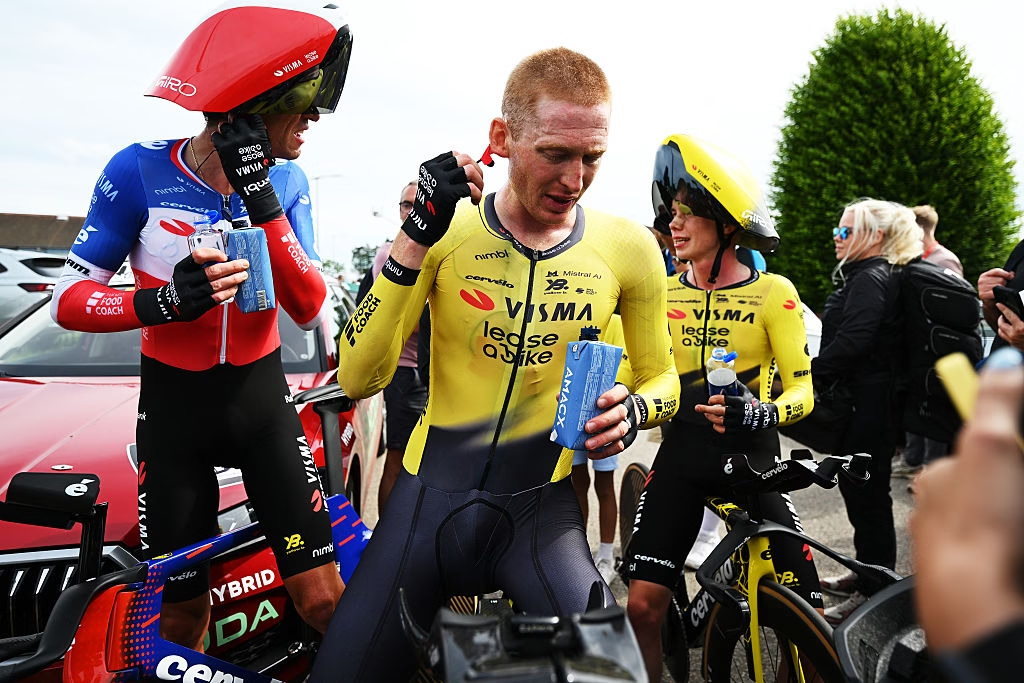 Photo Credit: Getty
Form guide: where is Matteo Jorgenson before the Tour?
Jorgenson’s 2026 Tour build-up has not been completely straightforward. A collarbone fracture from Amstel Gold Race interrupted his original plan and forced him into a revised approach before the Tour. That makes his pre-race form more nuanced than a simple list of results.
The important point is that he has built enough recent evidence to remain one of Visma’s most trusted riders. His 2024 season changed his standing in the peloton. He won Paris-Nice, then won Dwars door Vlaanderen, came close to overall victory at the Critérium du Dauphiné and finished 8th overall at the Tour de France. That was the year he moved from promising all-rounder to elite stage-race and tactical asset.
He then backed it up in 2025 by winning Paris-Nice again. That mattered because it showed the first win was not a one-off. He also finished 10th overall at the Vuelta a España while helping Vingegaard to overall victory, reinforcing the idea that he can combine personal quality with team service.
The collarbone injury means there is some uncertainty. Riders can return quickly from that kind of crash, but the Tour requires repeated peak efforts, positioning confidence and full commitment in the mountains. His return at Tour Auvergne-Rhône-Alpes was therefore important less because of the result alone and more because it gave him race rhythm before Barcelona.
The form question is not whether Jorgenson is good enough. He clearly is. The question is whether he is at the same level that made him such a strong Tour rider in 2024. If he is close, Visma have one of the best support riders in the race.
For more on the race that gave him that late pre-Tour rhythm, see our Tour Auvergne-Rhône-Alpes 2026 team-by-team guide and what Tour Auvergne-Rhône-Alpes 2026 means for the season.
Matteo Jorgenson’s strengths
Jorgenson’s biggest strength is completeness. He does not fit neatly into one category, which is exactly why Visma value him so highly.
He can climb well enough to stay with the main GC group deep into mountain stages. He can time-trial strongly enough to be useful in the Barcelona team time-trial and dangerous in shorter stage races. He can ride Classics-style terrain, which matters on the hilly and transitional days. He can descend, position and read races. He can also handle pressure without needing a team built entirely around him.
That mix makes him useful on almost every kind of Tour stage. On flat days, he can help protect Vingegaard. On hilly days, he can cover moves. On mountain days, he can work late. On a breakaway day, he is too dangerous to let go easily. In the team time-trial, he is part of the engine room.
His tactical value is especially important. Some riders are strong but predictable. Matteo Jorgenson is strong and flexible. If Visma want to ride defensively, he can support. If they want to attack, he can move early. If they need to react, he can cover. That gives the team options.
For more on similar riders in the Tour picture, see our best climbers at the Tour de France 2026, Tour de France 2026 dark horses for the general classification and best time-triallists at the Tour de France 2026.
The Barcelona team time-trial
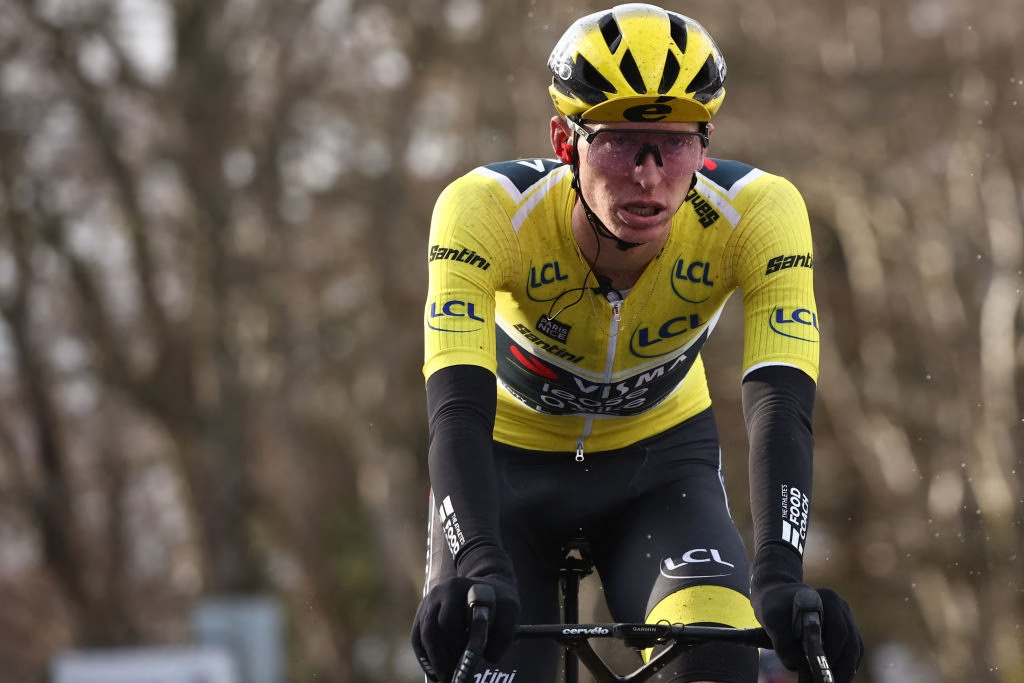
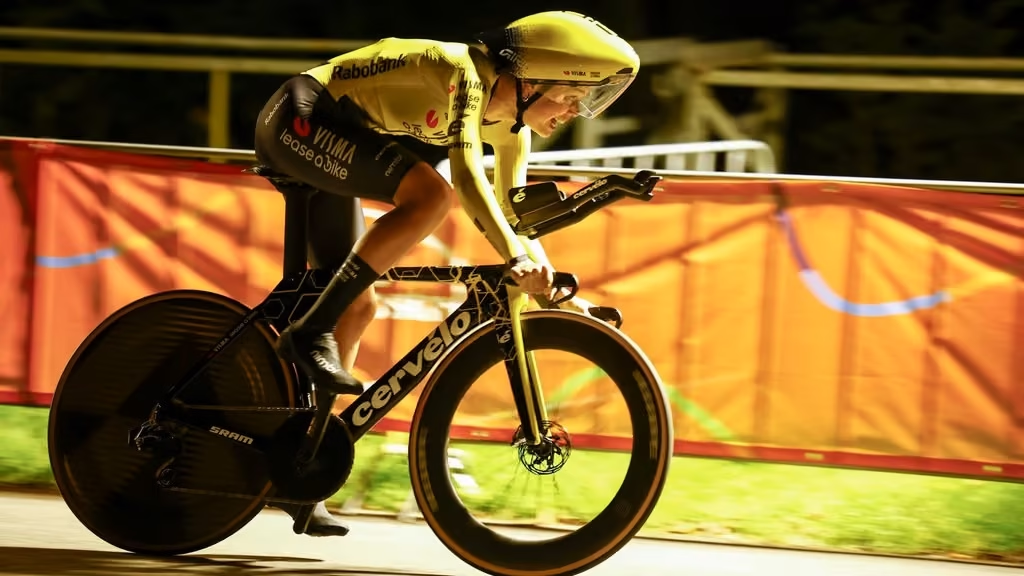
The opening stage in Barcelona is a 19.7km team time-trial, and Jorgenson should be one of Visma’s important riders there. It is not just about raw power. A Tour team time-trial requires organisation, pacing, cornering, communication and the ability to finish with the right riders still together.
Jorgenson is well suited to that. He has the time-trial strength to contribute, but also the race intelligence to keep the ride controlled. Visma cannot afford to lose meaningful time to UAE, Red Bull-Bora-Hansgrohe or INEOS on day one. If Vingegaard gives away time immediately, the whole race becomes more difficult.
The team time-trial also shapes Jorgenson’s own tactical value. If Visma start strongly, they can race the early Pyrenees with confidence. If they lose time, Matteo Jorgenson may be needed earlier than planned to control attacks or chase dangerous moves.
For a support rider, the TTT is not glamorous, but it could be one of his most important contributions of the race.
For more detail, see our Tour de France 2026 team time-trial explained and how the stage 1 team time-trial could change the Tour de France 2026.
The early Pyrenees
The Tour reaches the Pyrenees very early in 2026, and that increases Jorgenson’s importance. The first week is not a long procession towards the mountains. GC riders will be tested almost immediately.
The early climbing days are where Visma need to avoid panic. Vingegaard does not need to win the Tour in the Pyrenees, but he cannot afford to be isolated or lose unnecessary time. Jorgenson can help keep the race stable, especially if UAE try to use their depth early.
Stage 3 to Les Angles and stage 6 to Gavarnie-Gèdre should tell us a lot about Visma’s structure. If Jorgenson is still present late, it suggests he has recovered well from the disrupted spring and can carry a major mountain workload. If he is missing earlier than expected, Visma may have to lean more heavily on Kuss and other support riders.
The Pyrenees also offer tactical possibilities. If the race opens unexpectedly, Matteo Jorgenson is the kind of rider who can follow a dangerous move without forcing Visma to immediately commit Vingegaard. That is valuable in a Tour where multiple teams have secondary GC cards.
For more on this part of the route, see our Tour de France 2026 Pyrenees guide and Tour de France 2026 summit finishes guide.
The Massif Central and medium mountains
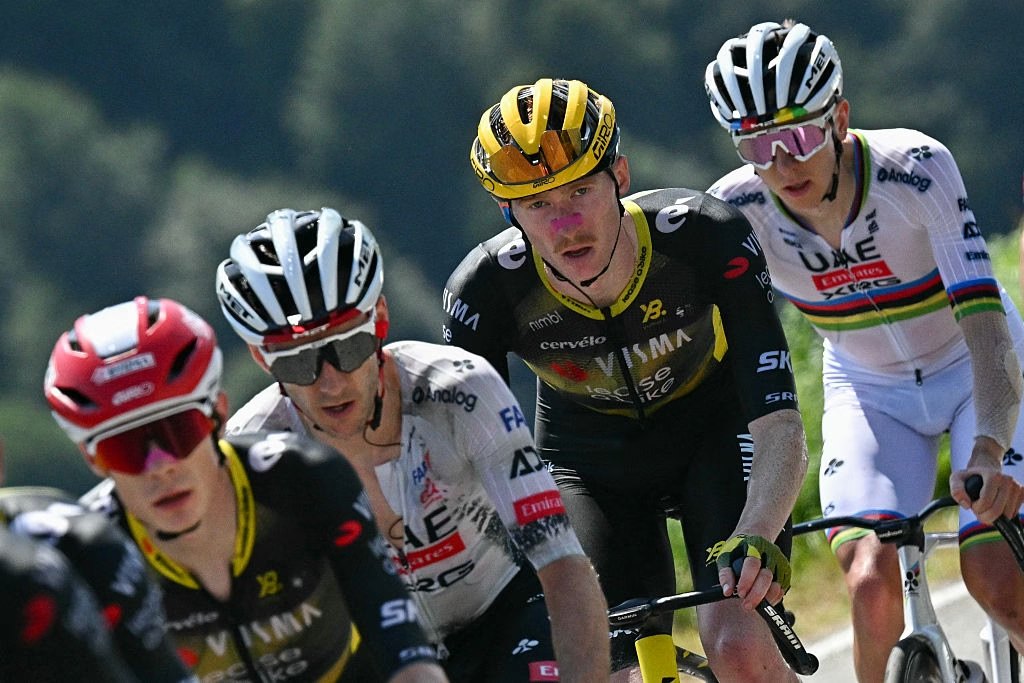
The Massif Central may be one of the most important sections for Jorgenson’s tactical value. Stage 10 to Le Lioran is not an Alpine monster, but it has the kind of terrain where positioning, timing and team depth can cause real damage.
This is exactly where Jorgenson can influence the race. He is not only a final-climb helper. He can ride rolling climbs, cover attacks before the decisive section and keep Vingegaard out of trouble when the road constantly changes rhythm.
These stages are also where Visma might use him proactively. If UAE or Red Bull-Bora-Hansgrohe look too comfortable, Jorgenson can be sent into a move to force a reaction. If Vingegaard wants teammates ahead of him, Jorgenson is one of the best candidates. If the race becomes chaotic, he can help reconnect, pace or protect.
The Massif Central rarely looks as decisive as the Alps on paper, but it can be where the Tour’s hierarchy starts to bend. Jorgenson’s all-round profile makes him especially valuable there.
For wider context, see our Tour de France 2026 Massif Central guide, where the Tour de France 2026 can be won before the Alps and Tour de France 2026 route: best days for GC attacks.
The Vosges and Jura
The Vosges and Jura block is another area where Jorgenson’s value could be higher than a standard mountain domestique. These climbs are often irregular, tactical and hard to control. They do not always produce clean one-on-one GC duels, but they can make teams suffer.
Stage 13 to Belfort, stage 14 to Le Markstein Fellering and stage 15 to Plateau de Solaison all create different problems. Some are suited to breakaways, some to GC pressure, some to a mixture of both. Jorgenson can fit into all three race types.
If Visma want to defend, he can sit around Vingegaard and keep the tempo stable. If they want to test UAE’s depth, he can help make the stage hard earlier. If rivals send dangerous riders away, he can cover without forcing Vingegaard to react personally.
This is where his Classics background matters. Jorgenson is comfortable in races that are not cleanly controlled. He can handle positioning, changing gradients, narrow roads and tactical uncertainty. The Tour is often won in the high mountains, but it can be lost on days like these.
For more on this section, see our Tour de France 2026 Vosges and Jura guide, Tour de France 2026 stage hunters to watch and Tour de France 2026 route: best days for breakaways.
 Photo Credit: Getty
The final Alpine block
The final Alpine block is where Jorgenson’s Tour will be judged. Visma need him to still be strong by stages 18, 19 and 20. If he is, Vingegaard’s chances improve significantly.
Stage 18 to Orcières-Merlette starts the final run of mountain pressure. Stage 19 finishes on Alpe d’Huez. Stage 20 returns to Alpe d’Huez after a much harder route, with Croix de Fer, Télégraphe, Galibier and Sarenne before the final climb. This is where the Tour could become a team-depth contest before it becomes a leader-versus-leader contest.
Jorgenson may not be the last Visma rider with Vingegaard on the steepest final kilometres. That job may be Kuss if he is at his best. But Jorgenson’s work before that point could be just as important. He can help control the early climbs, cover satellite attacks and keep Visma from being outnumbered.
If UAE use Del Toro or Ayuso aggressively, Jorgenson may be the rider tasked with following. If Red Bull-Bora-Hansgrohe use Lipowitz or Jai Hindley to test the race, he may be the rider who neutralises it. If Vingegaard attacks from distance, Jorgenson could be the teammate placed ahead to help after a descent or valley section.
That is why he is so valuable. He gives Visma tactical insurance in the hardest part of the Tour.
For more on the terrain that will define the final week, see our Tour de France 2026 Alps guide, Tour de France 2026 mountain stages ranked by difficulty and Tour de France 2026 climbs guide.
Can Matteo Jorgenson ride for GC himself?
Matteo Jorgenson can ride a strong GC. He has already proved that. But in the 2026 Tour, his GC freedom depends almost entirely on Vingegaard.
If Vingegaard is racing for yellow, Jorgenson’s own GC is likely to be shaped by service. He may lose time because he works before the final climb. He may sacrifice stage results. He may sit high overall for a while, then fall back after spending himself for the leader.
If Vingegaard has a problem, the situation changes quickly. Matteo Jorgenson is one of the few support riders in the race who could become a credible GC plan B. He can climb, time-trial and recover well enough to stay inside the top 10 if given protection. He is not an emergency placeholder. He is a real stage-race rider.
The more subtle option is that he stays high on GC without being the leader. That can be tactically useful. A Matteo Jorgenson sitting 8th or 10th overall forces rival teams to respect him. If he goes up the road, they cannot treat it like a harmless breakaway. That gives Visma leverage.
The most likely outcome is that he sacrifices personal GC for Vingegaard, but Visma will know that having him close on the standings is useful for as long as possible.
For the wider GC context, see our Tour de France 2026 GC favourites ranked and Tour de France 2026 dark horses for the general classification.
Can he win a stage?
A stage win is possible, but only if the race situation gives him freedom.
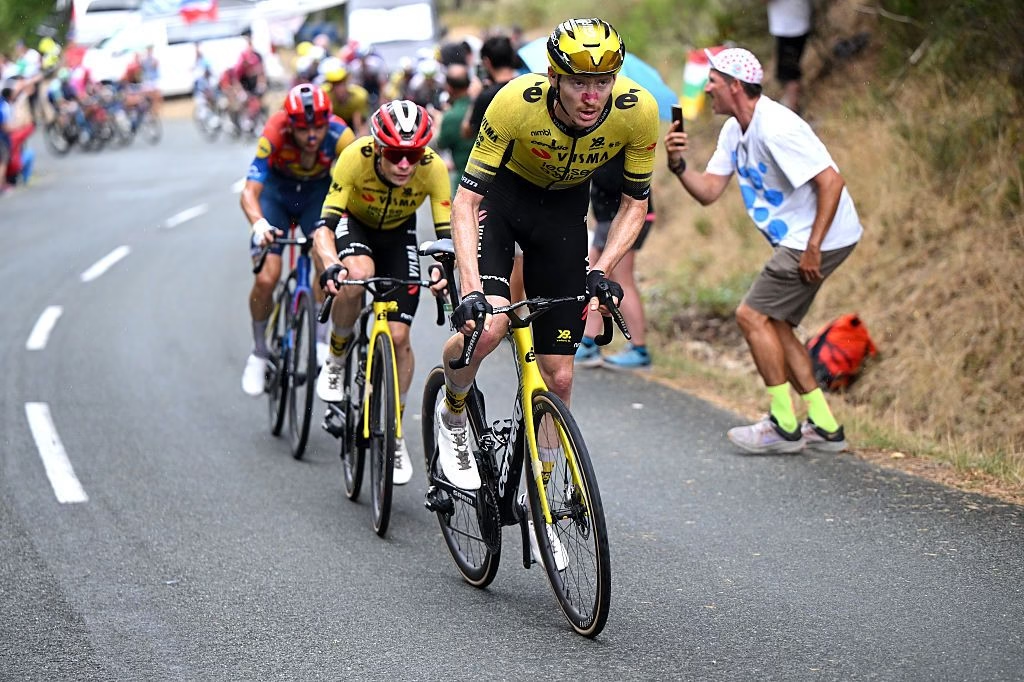
Jorgenson has the profile to win from several types of breakaway. He can win on hilly terrain, medium mountain stages and selective days where the strongest all-rounders survive. Stage 9 to Ussel, stage 13 to Belfort and stage 17 to Voiron all look like terrain where he would normally be dangerous.
The problem is that he may not be allowed to chase those chances. If Visma need him for Vingegaard, he cannot spend energy in breakaways. If he is high on GC, other teams will chase him. If he is being saved for the Alps, Visma may not want him burning matches in the second week.
The best stage-win scenario is tactical rather than planned. If Jorgenson is sent ahead as part of a Visma strategy and the move gains freedom, he could end up with a chance. If Vingegaard is secure and Visma have room to attack, he could be released late in the race. If his GC position slips and his support role changes, he becomes a much more obvious stage-hunting threat.
On pure ability, he can win a Tour stage. On likely role, he may have to prioritise Vingegaard.
For likely breakaway terrain, see our Tour de France 2026 route: best days for breakaways and Tour de France 2026 stage hunters to watch.
Matteo Jorgenson against UAE’s depth
The most important tactical comparison is not Jorgenson against Pogačar. It is Matteo Jorgenson against UAE’s support and secondary leaders.
UAE may use Del Toro and Ayuso to make the race complicated. They can attack, sit on GC, work for Pogačar or force other teams into difficult choices. That is exactly where Visma need Matteo Jorgenson. He gives them a rider capable of responding without immediately exposing Vingegaard.
If UAE send a dangerous rider ahead before the final climb, Visma do not want Vingegaard forced to close it personally. Jorgenson can be the bridge. If UAE ride a hard tempo with multiple climbers, Jorgenson can help keep Visma present. If the race becomes a numbers game, he prevents Vingegaard from being isolated too soon.
That is where his tactical value may matter more than his individual climbing rank. Jorgenson does not need to be stronger than Pogačar. He needs to be strong enough to reduce UAE’s options and keep Vingegaard in a race he can win.
For more on the key rivals, see our Tadej Pogačar at the Tour de France 2026, Juan Ayuso at the Tour de France 2026 and best climbers at the Tour de France 2026.
Matteo Jorgenson and Sepp Kuss
The Jorgenson-Kuss pairing is central to Visma’s mountain plan. They are different riders, and that difference is useful.
Kuss is the purer high-mountain climber. When the race reaches long, hard climbs and the group is down to the elite names, he can be the final helper. His value is clearest on stages such as Orcières-Merlette, Alpe d’Huez and the queen stage.
Jorgenson is broader. He can do mountain work, but he can also help on hilly days, transitional stages, descents, valleys and tactical phases before the final selection. He gives Visma more options before Kuss becomes the key climbing domestique.
Together, they create a support structure that can work across the whole route rather than only the final Alpine climbs. If both are strong, Visma can race with confidence. If one is below level, Vingegaard becomes more exposed against UAE’s depth.
The best version of Visma’s Tour probably has Jorgenson managing the race before the final climb and Kuss carrying Vingegaard deeper into the decisive altitude.
For more on the support-rider battle, see our Tour de France 2026 domestiques who could decide the race.
-
 Photo Credit: Cor Vos
What would count as success?
Jorgenson’s success should not be judged only by his final GC placing. His job is not necessarily to finish as high as possible. His job is to make Vingegaard’s Tour stronger.
A successful Tour for Jorgenson could look like a modest final GC result if he has spent the race supporting attacks, closing gaps and protecting Vingegaard. It could also look like a top-10 finish if Visma manage to keep him high without compromising their leader. It could include a stage win, but only if the race opens in a way that allows it.
The clearest success marker is whether Vingegaard reaches the final week with support. If Jorgenson is still there on stage 20, covering moves and helping Visma control the hardest day of the race, his Tour will have been valuable.
The other marker is tactical influence. If rival teams have to worry about Jorgenson, he has done part of his job. If UAE or Red Bull-Bora-Hansgrohe cannot use their secondary riders freely because Jorgenson is covering them, Visma’s race becomes easier.
Prediction: what will Matteo Jorgenson do at the Tour de France 2026?
Jorgenson’s most likely Tour is a high-value support race rather than a personal GC campaign. He should be one of Vingegaard’s key lieutenants, especially through the Massif Central, Vosges, Jura and early parts of the Alpine stages. He may sit high on GC for part of the race, but his final placing could be shaped by how much he has to work.
A top-10 finish is possible if Visma keep him protected and the race does not force early sacrifices. A stage win is possible if he gains tactical freedom. But the most realistic role is deeper and less obvious: the rider who keeps Visma in control when UAE and Red Bull-Bora-Hansgrohe try to stretch the race.
His value is not just form. It is flexibility. Jorgenson gives Visma a rider who can defend, attack, cover, pace and adapt. In a Tour route this varied, that may be almost as important as having one more pure climber.
Prediction: key mountain and tactical support for Vingegaard, possible top-10 outsider if allowed to keep his own GC alive, and one of the most important non-leaders in the 2026 Tour de France.
For more Tour coverage, visit our Tour de France hub, Tour de France 2026 full route guide and how to watch Tour de France 2026 in the UK.

