

Watching the Tour de France on the roadside is nothing like watching it on television. On TV, the race is constant: helicopter shots, time gaps, commentators, graphics, replays and slow-motion attacks. At the roadside, it is mostly waiting, noise, heat, confusion, anticipation, then a few seconds of speed that somehow make the whole day feel worthwhile.
That is the first thing to understand. The Tour is not a normal sports event where you sit down, watch two hours of continuous action and go home. It is a moving festival. The race comes to you, passes in layers, and then disappears. You may spend five hours waiting for five minutes of actual racing, but those five minutes feel completely different when the peloton is metres away.
The build-up is part of the point. Roads close. Villages change rhythm. People arrive with flags, folding chairs, cool boxes, camper vans, bikes, radios and phones. Children wait for the publicity caravan. Local cafés fill early. Police motorbikes begin to pass. Helicopters appear. The crowd starts looking down the road at every new noise. By the time the riders arrive, the race already feels present.
That is why roadside watching is one of the best ways to understand the Tour de France. It shows the race as a physical thing: fast, loud, tense, messy and much bigger than the television picture suggests. You see the faces, the speed, the team cars, the stress, the gaps, the suffering and the tiny details that cameras often smooth out.
For the 2026 race context, see our Tour de France 2026 full route guide, Tour de France 2026 in Catalonia: what fans need to know and how to visit the Tour de France 2026 Grand Départ in Barcelona.
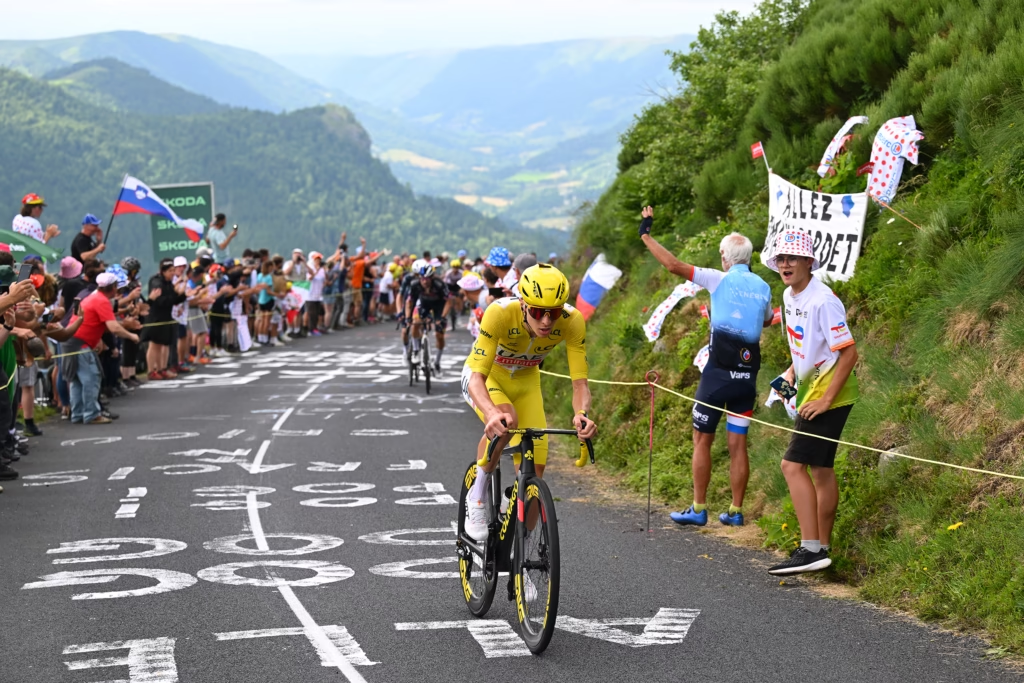 Photo Credit: Getty
The day starts long before the riders arrive
A roadside Tour de France day starts early. Even if the riders are not due for several hours, you often need to be in place long before the race comes through. Roads close, traffic is diverted, parking fills up and mountain access can become difficult very quickly.
On flat stages, you may be able to arrive later if you are watching from a town, village or easy roadside section. On major climbs, summit finishes or famous locations, the day starts much earlier. In places such as Alpe d’Huez, the Galibier, the Tourmalet or Mont Ventoux, fans can arrive the day before, or even several days before, to secure a place.
The waiting is not dead time. It is part of the experience. You watch the route slowly turn from public road into race corridor. Local traffic disappears. Barriers go up in towns. Gendarmes take position. Motorbikes begin to pass. Team staff, race officials and organisation vehicles roll through. The road that looked ordinary in the morning starts to feel like a stage.
That is one of the strange pleasures of watching the Tour in person. You see the race being assembled before your eyes. The peloton is the centrepiece, but the Tour itself is a whole moving system.
For the most important 2026 viewing areas, see best places to watch the Tour de France 2026 in Barcelona, Tour de France 2026 Pyrenees guide and Tour de France 2026 summit finishes guide.
The publicity caravan arrives first
Before the riders, the publicity caravan arrives. For first-time spectators, this can be a surprise. It is loud, colourful, commercial and slightly ridiculous, with branded vehicles, music, dancers, mascots and staff throwing small gifts into the crowd.
It can feel more like a carnival procession than a bike race. Children love it. Adults pretend not to, then still try to catch keyrings, caps, sweets or packets of whatever sponsor product is being handed out. The caravan is part of the Tour’s roadside culture, and in many villages it is almost as big a draw as the peloton.
It also changes the energy of the crowd. Until then, people are sitting, chatting, eating or hiding from the sun. Once the caravan appears, everyone stands up. Phones come out. Children move closer. People start shouting. The road feels active.
There is a safety point here too. The caravan is still traffic. Vehicles are moving, gifts are thrown, children can step forward without thinking, and the temptation to grab something from the road can be strong. The best rule is simple: stay off the road, keep children close and do not lean into the route.
The caravan usually means the riders are getting closer, but not immediately there. There may still be a long gap before the race itself arrives. That gap is when the anticipation begins to build properly.
For newer fans, the beginner’s guide to Men’s Tour de France 2026 explains how the race is structured before the roadside chaos begins.
 Photo Credit: Getty
The first signs of the race
After the caravan, the road goes through another phase. It becomes quieter, but more tense. Race vehicles appear more frequently. Police motorbikes pass. Neutral service cars come through. Official cars and TV motorbikes move into position. A helicopter may hover overhead.
If you are following the race on a phone, radio or roadside loudspeaker, you may know whether there is a breakaway, how big the gap is, and whether the peloton is chasing. If not, you have to read the race from what arrives.
A lone motorbike might mean the breakaway is close. More motorbikes, photographers and race cars usually mean the leaders are about to appear. The crowd begins to move forward, then remembers to step back. People look at each other, trying to work out if this is it.
Then the first riders arrive.
On television, a breakaway can look steady and controlled. At the roadside, it looks much faster and more violent. You hear the tyres, the chains, the breathing, sometimes a shouted instruction. The riders are there, then gone. If it is a small group, you may only get a few seconds. It is enough to see the strain on faces and the difference between riders pulling, sitting on or fighting to stay attached.
The peloton may follow soon after, or several minutes later. That gap changes the experience. If the break is far ahead, the crowd settles again and waits. If the bunch is close, the noise rises almost immediately.
For more on how to understand that race situation, see what is a breakaway in the Tour de France?, Tour de France 2026 route: best days for breakaways and Tour de France 2026 breakaway stages ranked.
The peloton is faster than you expect
Everyone knows professional cyclists are fast. Seeing the Tour peloton at roadside level still changes that understanding.
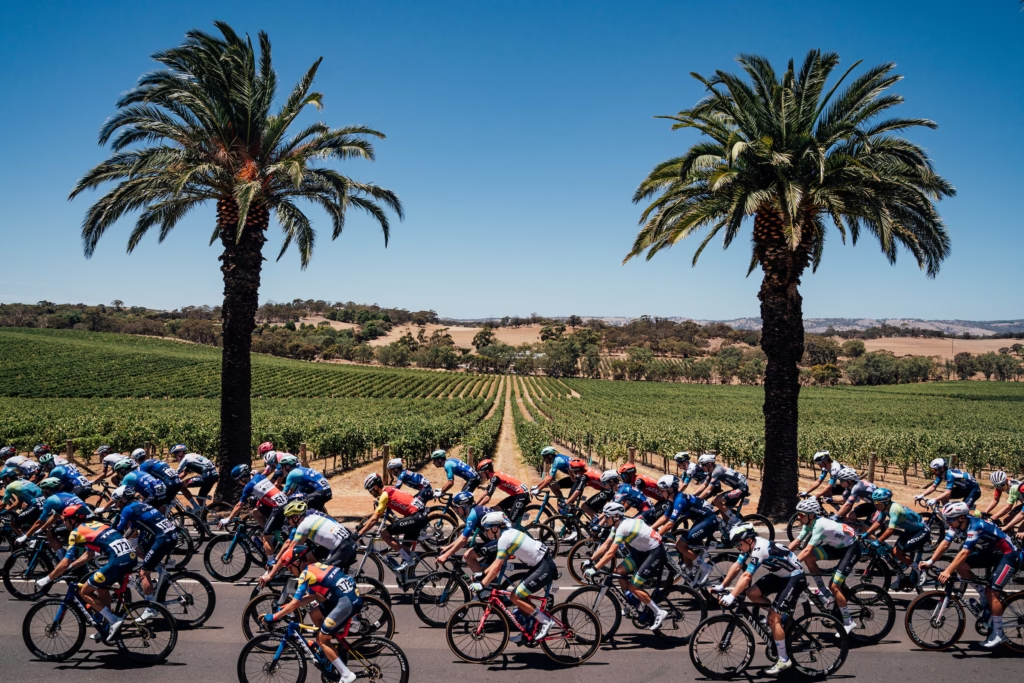
On a flat road, the bunch can pass like a moving wall. The noise builds quickly: motorbikes, wheels, chains, radios, team cars, shouting, the crowd, then air being pushed by more than 150 riders moving at speed. It is not silent or graceful in the way television sometimes makes it seem. It is physical.
The front of the peloton is organised. Teams are lined up, leaders are protected, domestiques are working, and riders are fighting for position. The middle can look dense and nervous. The back can look more strained, with riders moving up, dropping back, eating, talking or trying to stay out of trouble.
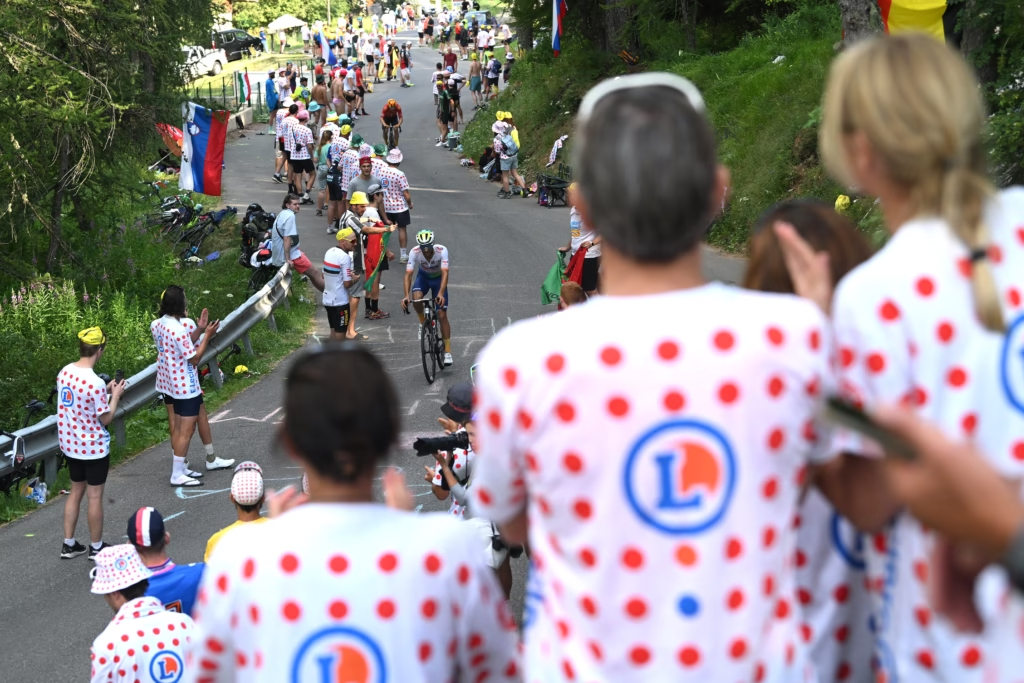
On climbs, it is different. The race slows down enough for you to see more. You can recognise faces, notice who is suffering, hear breathing, and see the difference between a rider climbing within themselves and one on the edge. On a steep climb, the peloton may no longer be a peloton at all. It can arrive in groups, pairs and lone riders.
That is why mountain stages are so popular for roadside fans. You see more of the riders, for longer, and the effort is easier to read. A sprint stage may be faster and louder, but a mountain stage is more revealing.
For more on what the riders are doing at those speeds, see how fast do Tour de France riders go?, how hard is the Tour de France? and Tour de France 2026 mountain stages ranked by difficulty.
You see the race differently from TV
Watching the Tour on the roadside gives you less information but more feeling.
You may not know the exact time gaps. You may not know who has been dropped until they pass. You may miss the decisive attack if it happens elsewhere. You may spend most of the day unsure what is happening in the overall race.
But you see things television cannot always show properly. You see how close the fans are. You see how narrow some roads feel when the peloton fills them. You see riders looking for bottles, speaking into radios, checking over shoulders or grimacing in silence. You see the difference between a leader sheltered in third wheel and a domestique emptying themselves on the front.
You also see the riders after the television focus has moved on. On mountain stages, the back of the race can be just as striking as the front. Sprinters, injured riders and exhausted domestiques may pass much later, surrounded by team cars, motorbikes and small groups of fans still clapping them through. That is where the Tour’s difficulty becomes obvious.
The roadside view is incomplete, but it is honest. You realise the Tour is not only the fight for yellow. It is also riders surviving, teams managing damage, sprinters fighting time cuts, and domestiques getting through another day.
For more on those hidden races, see how Tour de France time cuts work, why sprinters suffer in the Tour de France mountains and what is a domestique at the Tour de France?.
The best places to watch
The best place to watch the Tour depends on what kind of experience you want.
A town centre gives you atmosphere, cafés, big crowds, barriers, music and a more organised feel. Starts and finishes are especially good if you want the full event experience. You may see team buses, sign-on, podiums, sponsor areas and riders warming up or cooling down. The trade-off is that crowds are heavier and the best viewing spots can be harder to reach.
A roadside village is often more relaxed. You can get a sense of the Tour passing through everyday life. People decorate houses, local bars fill up, and the race briefly becomes the centre of the village. This can be one of the most enjoyable ways to watch, especially on rolling or transitional stages.
A climb gives you the most time with the riders. The steeper the road, the slower they pass. Famous climbs bring the biggest crowds and the strongest atmosphere, but also the hardest logistics. You may need to walk, cycle or arrive very early. Food, water, shade and toilets become more important than people expect.
A descent is usually not the best place to watch. Riders pass extremely fast, safety margins are smaller, and there is less time to understand the race. A corner on a descent may look tempting, but it can be dangerous and may be heavily controlled.
A time trial is different again. Riders pass one by one or, in a team time-trial, squad by squad. You see more repeated action, more pacing differences and more equipment detail. For the 2026 Tour, the Barcelona opening team time-trial should be one of the most accessible and unusual roadside experiences of the race.
For the 2026 route, see Tour de France 2026 team time-trial explained, A history of team time trials at the Tour de France and how the Stage 1 team time-trial could change the Tour de France 2026.
Watching from a climb
Watching from a climb is the classic Tour de France roadside experience.
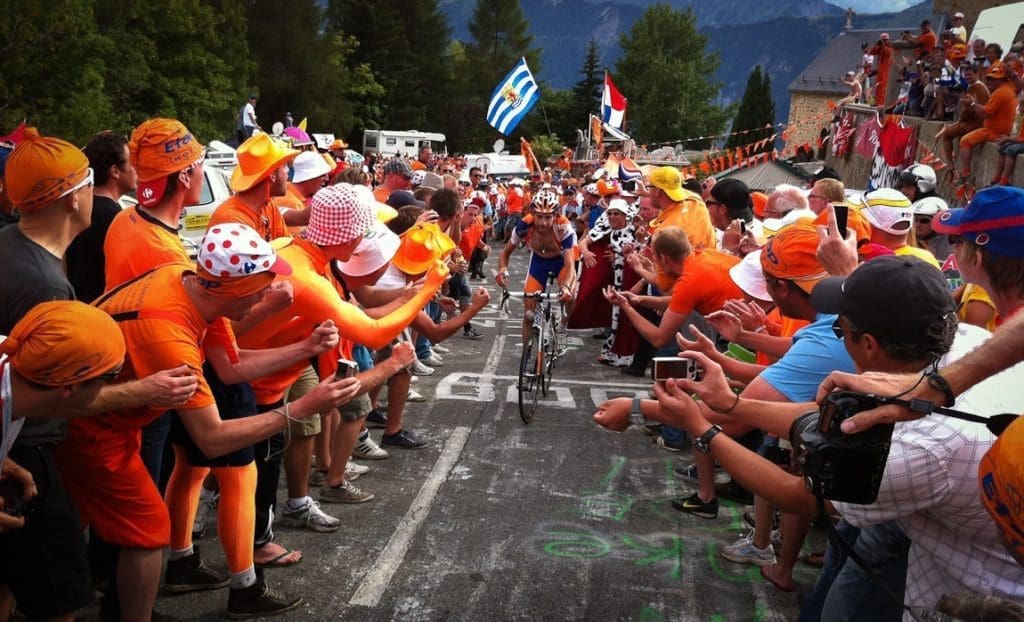
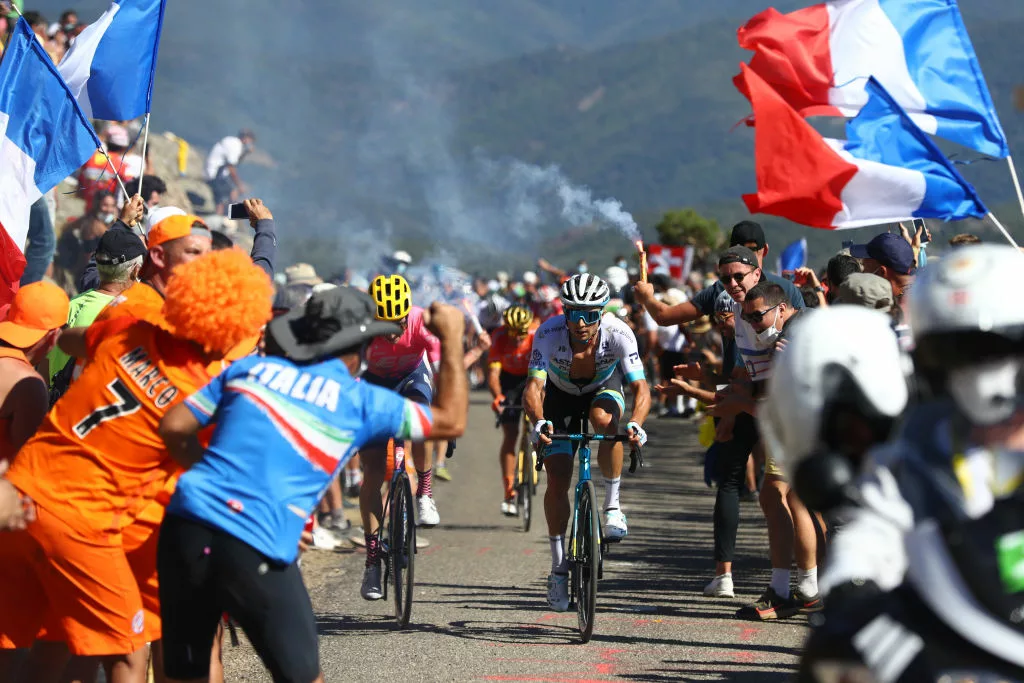
The atmosphere builds slowly. Fans walk or ride up the mountain. Camper vans line the road. Flags hang from barriers, balconies and roadside walls. People write names on the tarmac. Club jerseys from across Europe appear. Music plays from vans. Someone always has a cowbell.
The riders pass more slowly than on the flat, but still much faster than most amateur cyclists could manage. The front group may be small, controlled and tense. The favourites often look calmer than seems reasonable. Behind them, the race fragments. Groups pass with different moods: leaders, helpers, stage hunters, dropped climbers, sprinters, injured riders, the gruppetto.
A climb lets you see suffering clearly. You can see riders rocking slightly, looking down, asking for bottles, or trying not to show weakness. You can also see how important crowd behaviour is. A good mountain crowd creates noise and colour without blocking the riders. A bad one narrows the road, runs alongside riders or gets too close with flags and phones.
The best mountain spectators know when to step back. The riders should feel the noise, not the danger.
In 2026, the major mountain roadside experiences will include the Pyrenees, the Alps and especially the back-to-back Alpe d’Huez finishes. Those stages should draw huge crowds, but they will also demand careful planning.
For more on the mountain route, see Tour de France 2026 mountain stages ranked by difficulty, Tour de France 2026 Alps guide and why back-to-back Alpe d’Huez finishes could define the Tour de France 2026.
Watching a sprint stage
A sprint stage is a very different roadside experience. The riders pass at high speed, often in a dense and nervous peloton, and the race may be over in seconds.
If you are near the finish, the atmosphere is huge. Barriers, grandstands, commentary, big screens, sponsor zones and packed crowds all make it feel like a major event. You may be able to follow the final kilometres on screens before the riders arrive. The sound of the sprint is intense, but the actual view can be brief unless you have a good spot.
If you are along the route rather than at the finish, the experience is more about the speed of the peloton. On a flat exposed road, the bunch can pass so quickly that it is difficult to pick out individual riders. You may see team trains, sprint teams protecting position, and GC riders staying near the front to avoid trouble.
The best way to enjoy a sprint stage roadside is to choose your location carefully. A finish town gives the fullest event experience. A slight rise or corner can slow the peloton enough to see more, though safety and barriers matter. A long straight road shows the speed but gives less detail.
Sprint stages are also good for families if watched from a controlled town or village location, because access can be easier than on remote mountain roads. The caravan, crowds and event atmosphere often matter as much as the race itself.
For the 2026 sprint picture, see Tour de France 2026 route: best days for sprinters, Tour de France 2026 sprint stages ranked and Tour de France 2026 sprinters guide.
Watching a time trial
A time trial is one of the best ways to watch the Tour if you want more than one brief rush of riders.
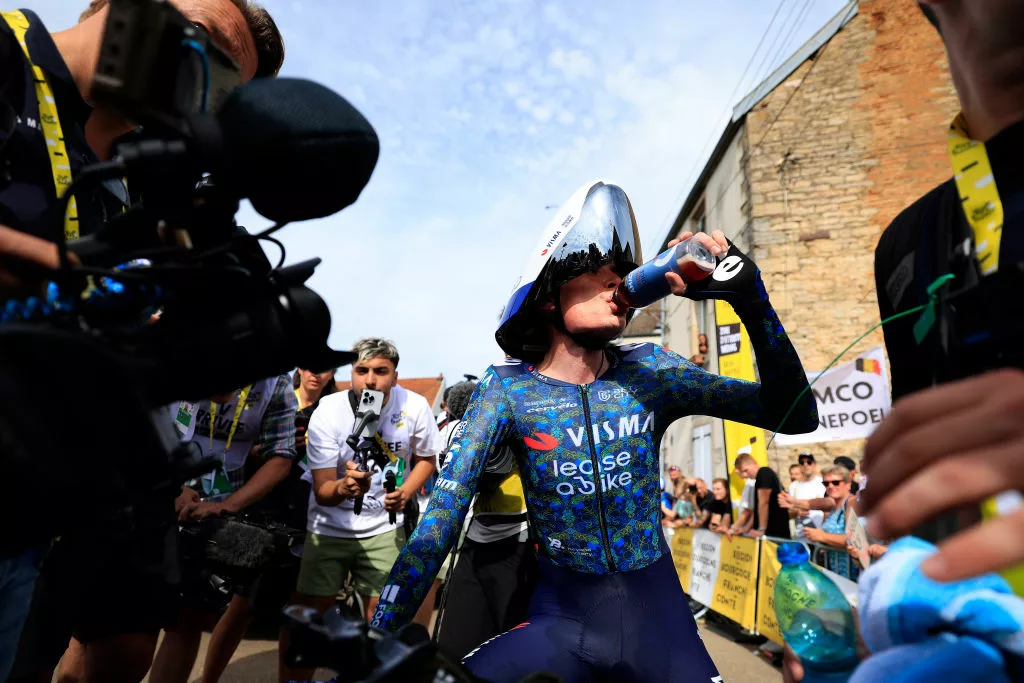
In an individual time trial, riders start at intervals, so the action is spread out. You can compare styles, positions, pacing and effort. Some riders look smooth and controlled. Others look like they are fighting the bike. The fastest riders often look calmer than expected until you notice how quickly they disappear.
A team time-trial is even more visually striking. Instead of one rider, a whole team moves together, rotating through turns and trying to keep the line smooth. At roadside level, you can hear the speed, the communication and the strain of riders trying not to lose the wheel.
The 2026 Tour opens with a team time-trial in Barcelona, which should make the Grand Départ feel very different from a standard road stage. Rather than one peloton passing once, fans should see each team separately. That makes it easier to compare squads and understand which GC leaders are starting strongly.
Time trials also work well in cities because the route is controlled, the viewing points are often easier to reach, and the action lasts longer for spectators. The trade-off is that popular corners, climbs and finish areas can fill quickly.
For the Barcelona opener, see Tour de France 2026 Grand Départ guide, best places to watch the Tour de France 2026 in Barcelona and cycling in Barcelona: climbs, roads and Tour de France atmosphere.
What you should bring
The basic kit for watching the Tour roadside is simple: water, food, sun cream, a hat, comfortable shoes, a battery pack, and more patience than you think you need.
Water matters most. Tour stages are often watched in July heat, sometimes on exposed roads with little shade. If you are on a mountain, in a rural area or waiting several hours, do not assume you can buy drinks nearby. Bring more than you expect to need.
Food is also useful, especially if you are watching from a remote spot. In towns, cafés and shops may be busy or closed off by barriers and crowds. On climbs, there may be nothing available once you are in position.
Comfortable shoes matter because you may have to walk further than planned. Road closures can turn a short journey into a long one. If you are watching in the mountains, you may need to climb on foot after leaving a car, shuttle or bike lower down.
A battery pack helps because phones are used for maps, race updates, photos and messages. Signal can be poor in mountain areas, so it is also worth downloading maps or saving key information before you go.
A small radio can still be useful if you want race information without relying on mobile data. Some fans also bring folding chairs, umbrellas, waterproofs, binoculars and small flags. The exact list depends on whether you are in a town, on a mountain or at a finish.
For fans travelling from the UK, the how to watch Tour de France 2026 in the UK guide covers the broadcast side if you are mixing roadside days with TV or streaming coverage.
Road closures shape everything
Road closures are one of the biggest surprises for first-time Tour spectators.
You cannot treat the Tour like a normal roadside stop. Roads may close hours before the race arrives. In mountain areas, they may close much earlier, especially to cars and camper vans. Once closed, movement becomes limited. You may be able to walk or cycle on parts of the route for a while, but that also stops as the race gets closer.
This means your plan needs to work backwards from the race time. Where will you park? Can you leave after the stage? Are you prepared to wait? Is there a shuttle? Can you walk back safely? Do you need lights if the return is late? Are you relying on a road that will still be closed?
The end of the stage can be just as complicated as the start. Once the broom wagon and final race vehicles have passed, roads do not instantly return to normal. Crowds move, vehicles leave, police reopen sections gradually, and mountain roads can become heavily congested.
If you are driving, assume delays. If you are cycling, check whether bikes are allowed and be realistic about descending or riding away among crowds. If you are using public transport, check the last service. If you are watching from a major climb, patience is part of the day.
For 2026 travel planning, see how to visit the Tour de France 2026 Grand Départ in Barcelona, Tour de France 2026 in Catalonia: what fans need to know and best places to watch the Tour de France 2026 in Barcelona.
The atmosphere is local and international at once
One of the best things about watching the Tour roadside is the mix of people.
There are local families who watch because the race is passing their village. There are cycling fans who have planned the trip for months. There are camper-van regulars who follow several stages. There are club riders in matching kit. There are fans from Denmark, Slovenia, Belgium, Britain, the Netherlands, Colombia, Australia, the Basque Country and everywhere else the modern Tour reaches.
The Tour feels French, but not only French. It is local and international at the same time. A small village may host fans from half a dozen countries for one afternoon. A mountain road may feel like a temporary cycling republic, with flags, languages and jerseys all mixed together.
That is part of the race’s charm. The Tour is not held inside a stadium. It borrows roads, towns, fields, cafés, campsites and mountain passes. The roadside crowd becomes part of the scenery.
The atmosphere also changes depending on the place. A Grand Départ city feels organised and polished. A mountain feels wilder. A rural village feels communal. Paris feels ceremonial. The roadside experience is not one thing. It changes every day.
For more on the places that shape the 2026 race, see cycling in Barcelona: climbs, roads and Tour de France atmosphere, Tour de France 2026 Massif Central guide and Tour de France 2026 Vosges and Jura guide.
 Photo Credit: Nico Vereecken/PN/Cor Vos
How close you are to the riders
The closeness is what shocks many first-time spectators.
On television, the Tour can feel controlled and distant. At the roadside, riders may pass within arm’s length. You can see sweat, hear breathing, notice gear changes and sense the speed in a way that no broadcast can fully capture.
That closeness is also why spectators have a responsibility. Do not step into the road. Do not lean over barriers. Do not run alongside riders. Do not wave flags, phones or signs into the route. Do not let children or pets move near the road. Do not try to touch riders, push them or take selfies as they pass.
The best roadside fans add noise without adding risk. They clap, shout, ring bells and create atmosphere from the side of the road. They give riders space. They understand that the race line belongs to the race.
This matters most on climbs, where the road can narrow as crowds press in. It also matters near corners, feed zones, descents and technical sections. A rider avoiding one fan can crash into another rider. A loose bag, flag or dog can change a race.
The Tour feels special because fans are close. It only works if that closeness is respected.
For the race roles you are watching at close range, see how Tour de France teams work and Tour de France 2026 domestiques who could decide the race.
Following the race while you wait
One challenge of roadside watching is knowing what is happening before the riders arrive.
A phone is the easiest option. Live trackers, race apps, social media, team updates and text commentary can all help. But mobile signal can be poor in mountains or crowded areas, so it is worth having another way to follow the race.
Some fans use radio coverage. Others rely on local loudspeakers, big screens in finish towns or updates from people nearby. Even without perfect information, the roadside often finds a way to share news. Someone will know the breakaway gap. Someone will say who has crashed. Someone will shout that the yellow jersey is in trouble.
There is also a certain pleasure in not knowing everything. You read the race from the road. If three riders arrive with several motorbikes and a race car, you know the break is serious. If the peloton is lined out behind one team, you know the chase is hard. If the grupetto arrives much later, you understand how hard the day has been.
The television version gives you control. The roadside version gives you discovery.
For help reading the race situation, see how do Tour de France teams work?, Tour de France 2026 contenders preview and Tour de France 2026 jerseys explained.
Watching with children
The Tour can be brilliant for children, but it needs planning.
The caravan is often the highlight. The colours, music, vehicles and freebies make it feel like a parade before the race. Town starts and finish areas can also work well because there are facilities, barriers, food options and more to look at.
The harder option is a long roadside wait in heat, rain or remote countryside. Children may get bored long before the riders arrive. Shade, snacks, water, hats, games and realistic expectations all help.
Safety is the main point. Children should not be allowed to stand in the road, chase caravan gifts or move forward when the riders approach. The race arrives quickly, and motorbikes or cars can pass before and after the peloton. Even after the riders have gone, the road may not be safe immediately.
A good family viewing spot is usually a village, town or controlled roadside section with space to stand back. A famous mountain hairpin may sound exciting, but it can be crowded, hot, loud and difficult to leave.
For a first Tour experience, a stage start, time trial route or medium-sized town can be better than a remote summit finish. The Barcelona Grand Départ should be one of the more practical 2026 options for families, especially around the city stages covered in our Tour de France 2026 Grand Départ guide.
Watching by bike
Arriving by bike can be one of the best ways to watch the Tour. It gives you more flexibility than a car, especially once roads begin to close to motor traffic.
On some stages, you can ride close to the route, lock the bike, watch the race, then leave more easily than drivers stuck in post-stage traffic. In mountain areas, riding up can also be part of the experience, especially if you want to feel the climb before watching professionals race it at another level.
But it still needs planning. Road closures apply to bikes too as the race gets closer. You may be stopped from riding further up a climb. Descending after the stage can be slow and crowded. You need food, water, lights if you may return late, and a realistic idea of how far you have to ride.
A bike also makes it easier to watch from less obvious places. You do not have to fight for car parking in a packed village or summit area. You can choose a quieter section, move on foot if needed, and avoid some of the worst traffic afterwards.
For cycling-trip angles around the 2026 route, see cycling in Barcelona: climbs, roads and Tour de France atmosphere, L’Étape du Tour 2026 complete guide and cycling in the Bavarian Alps: Garmisch-Partenkirchen climbs, roads and atmosphere.
The race after the race
When the riders have passed, the day is not quite over.
First come more team cars, race vehicles, commissaires, medical vehicles, neutral service and the broom wagon. The broom wagon is the symbolic end of the race convoy, though road reopening can still take time after it has passed.
Then the crowd begins to move. People fold chairs, collect bags, look for children, check photos and work out how to leave. On a mountain, this can take a long time. Roads may be packed with pedestrians, bikes, camper vans and cars all trying to move at once.
This is when patience matters again. The temptation is to leave immediately, but thousands of others may be doing the same. In a town, cafés and bars may fill. On a climb, descending roads may be crowded. If you are driving, you may sit in traffic for a long time before moving properly.
The best approach is to accept the slowness. Let the crowd thin. Watch the podium on a phone if you have signal. Have food left. Do not plan a tight connection afterwards unless you are watching from somewhere with easy public transport.
The Tour arrives quickly, but it does not always let you leave quickly.
For the race convoy and final-rider context, see what is the broom wagon in the Tour de France?.
Is watching the Tour roadside free?
Most roadside viewing at the Tour de France is free. That is one of the race’s great strengths. Unlike stadium sports, the Tour passes through public space, and fans can stand along much of the route without buying a ticket.
There are exceptions and controlled areas. Hospitality, grandstands, some finish zones and special access areas may require passes or payment. Security restrictions can also limit where spectators stand, especially near finishes, starts, technical areas or dangerous sections.
But the basic roadside experience remains open. You can stand on a climb, in a village, by a field, near a roundabout, along a time-trial course or on a town street and watch the race pass.
That accessibility is central to the Tour’s identity. It belongs partly to the places it passes through. The race does not just visit spectators. Spectators become part of the race environment.
That also means fans have to look after that privilege. Safe, respectful roadside behaviour is what keeps the Tour open and close.
For broader background on why the race works this way, see a brief history of the Men’s Tour de France and every Tour de France winner since 1903.

Is it worth watching the Tour de France in person?
Yes, but it helps to understand what you are getting.
If you want detailed race information, television is better. You will see attacks, graphics, replays, time gaps and the whole stage narrative. Roadside watching cannot match that.
If you want to feel the Tour, roadside is better. You feel the waiting, the heat, the crowd, the noise, the caravan, the speed, the stress and the sudden rush of the peloton. You understand that the Tour is not only a bike race but a moving event that takes over roads, towns and mountains.
The best way to experience the Tour may be to do both. Watch one stage on the roadside, then follow the next on television with a new understanding of what those roads feel like. Once you have stood on a climb or in a village and felt the peloton pass, the broadcast looks different.
The roadside gives you less of the race, but more of its reality.
For UK-based fans combining in-person travel with home coverage, see how to watch Tour de France 2026 in the UK and why you can’t watch Tour de France 2026 free on ITV and what to do instead.
Roadside Tour de France viewing tips
Choose your stage based on the experience you want. A sprint finish is fast and crowded, a climb is slower and more dramatic, a time trial gives repeated action, and a stage start gives the best chance to see riders before the race begins.
Arrive early, especially on mountain stages or famous viewing points. Bring more water than you think you need. Wear comfortable shoes. Expect road closures and delays. Keep children close. Stay out of the road. Do not run alongside riders. Do not wave objects into the route. Be patient after the race passes.
Use your phone for live updates, but do not rely on signal. Download maps before you go. Know how you are getting back. If you are cycling, plan for closed roads and crowded descents. If you are driving, assume traffic will be slow.
Most of all, accept that roadside watching is not efficient. It is slow, imperfect and sometimes uncomfortable. That is part of why it works. The Tour de France is enormous on television, but at the roadside it becomes immediate: wheels, faces, noise, colour and a road that is suddenly the centre of the cycling world.
For more Tour de France travel and viewing coverage, see Tour de France 2026 full route guide, best places to watch the Tour de France 2026 in Barcelona and Tour de France 2026 route analysis.

